

FORECAST UPDATES
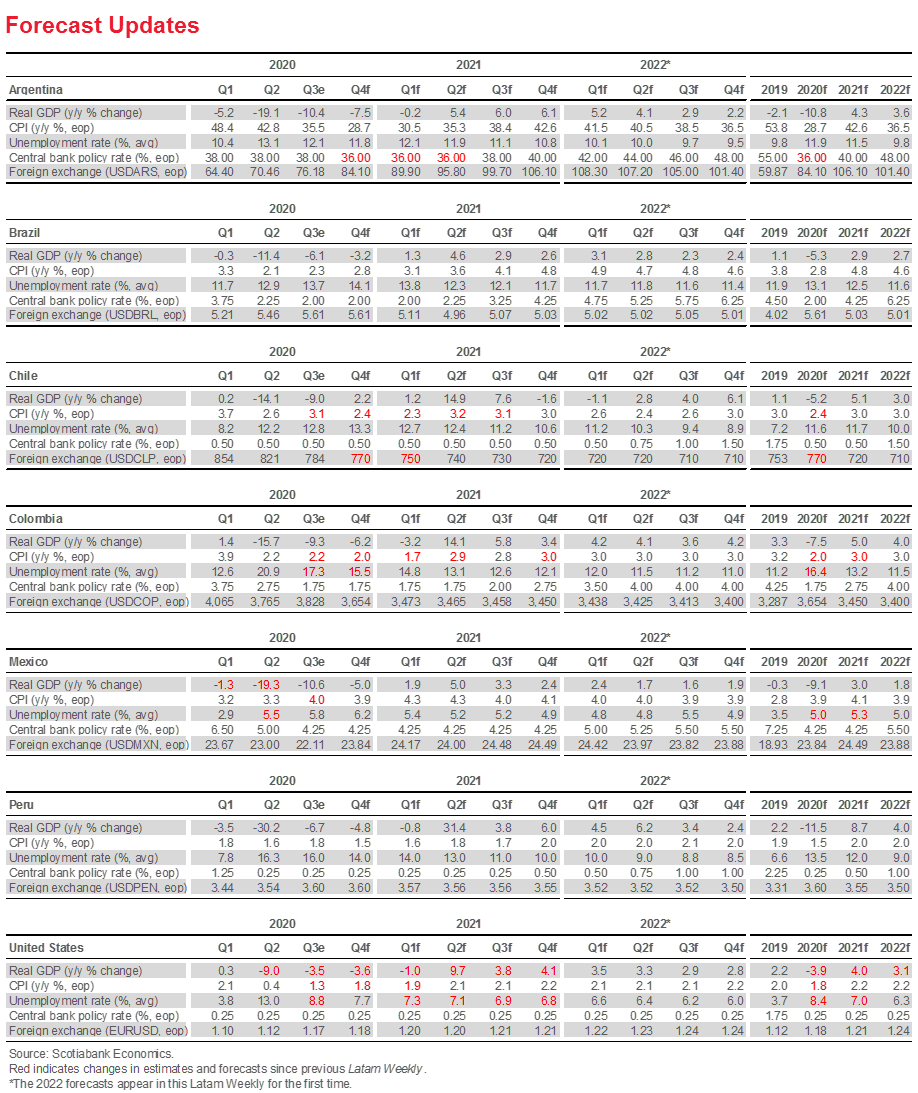
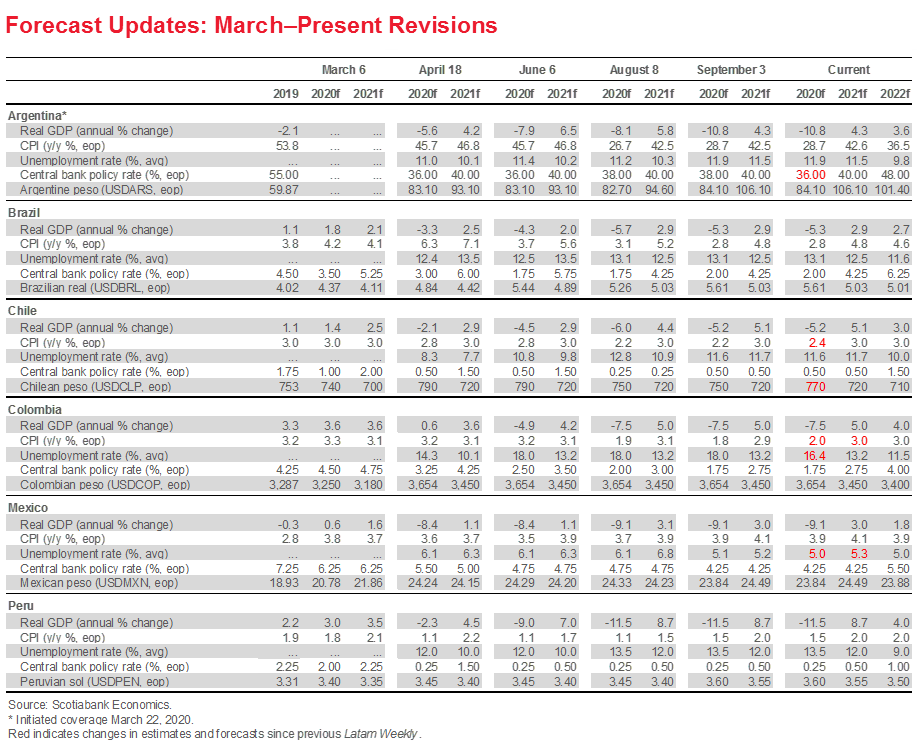
Detailed quarterly forecasts for 2022 appear in this edition of the Latam Weekly for the first time; revisions to our projections are otherwise limited to fine tuning. Argentina’s policy-rate path now reflects the BCRA’s 200 bps in cuts to the benchmark Leliq rate over the last two weeks, moves that we had expected in Q2/Q3. Following September inflation surprises, price forecasts were edged up for Chile and Colombia, and adjusted slightly in Mexico between 2020 and 2021.
ECONOMIC OVERVIEW
We take stock of policy developments in response to the pandemic and look at where efforts are likely to focus next.
MARKETS REPORT
Following recent accelerations in inflation in Colombia, Peru, Chile, and Brazil, while Mexican inflation continues to sit at the top of Banxico’s target range, we look at how markets are pricing inflation and how they contrast with analysts’ consensus, central bank projections, and Scotia’s forecasts.
COUNTRY UPDATES
Concise analysis of recent events and guides to the fortnight ahead in the Latam-6: Argentina, Brazil, Chile, Colombia, Mexico, and Peru.
MARKET EVENTS & INDICATORS
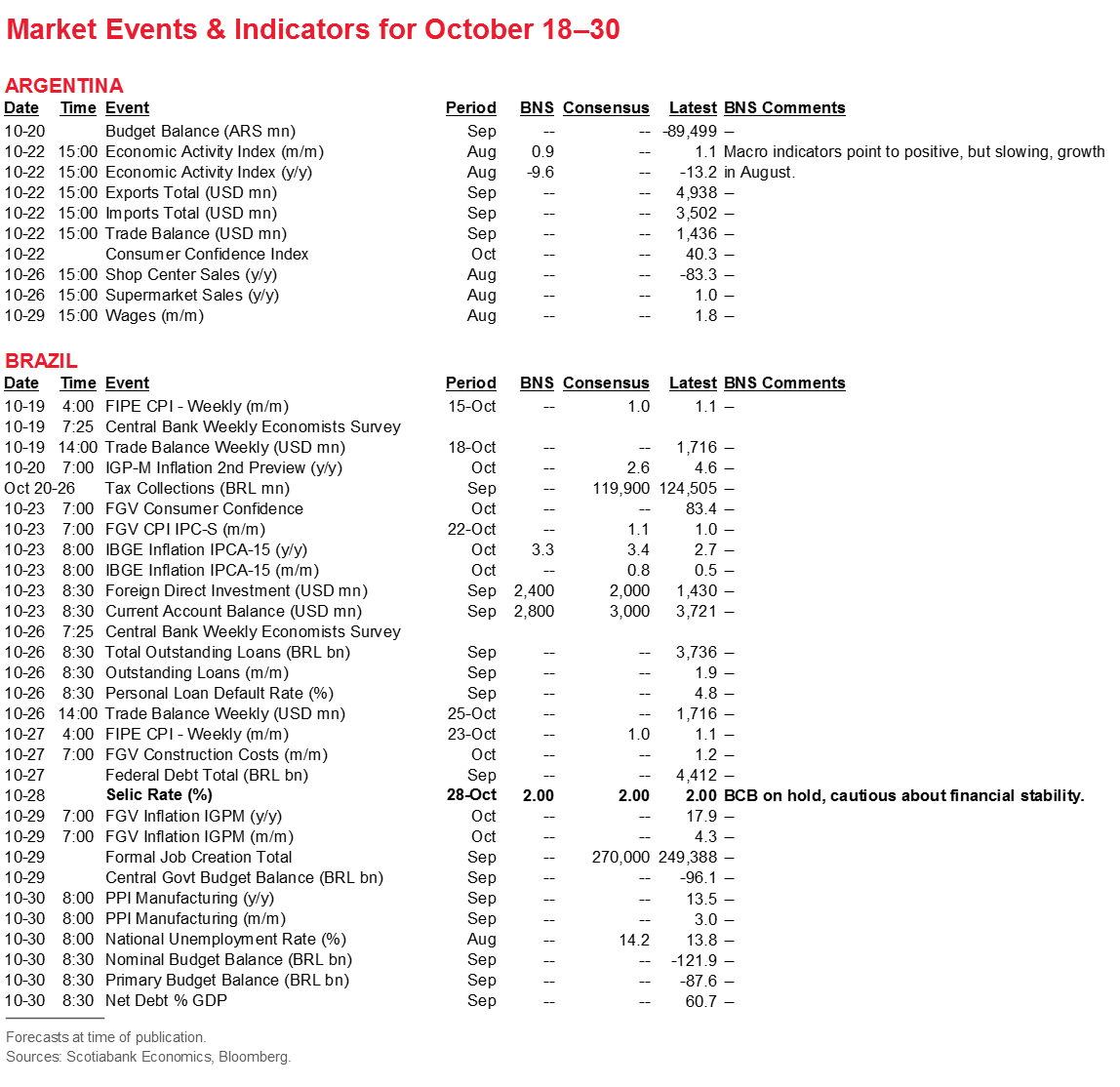
Risk calendar with selected highlights for the period October 18–30 across our six major Latam economies.
Economic Overview: More Fiscal Ahead
Brett House, VP & Deputy Chief Economist
416.863.7463
Scotiabank Economics
brett.house@scotiabank.com
Our first detailed forecasts for 2022 point to gradual normalization of monetary policy across the Latam-6 as growth reverts to underlying trends.
While the next week is quiet on the central bank front, we expect to see holds from Brazil’s BCB and Colombia’s BanRep in the final days of October.
With monetary authorities across the Latam-6, particularly in the five inflation-targeting regimes, expected to remain on hold into mid-2021, fiscal policy is likely to dominate responses to the second wave of COVID-19.
MARKETS AND FORECAST DEVELOPMENTS
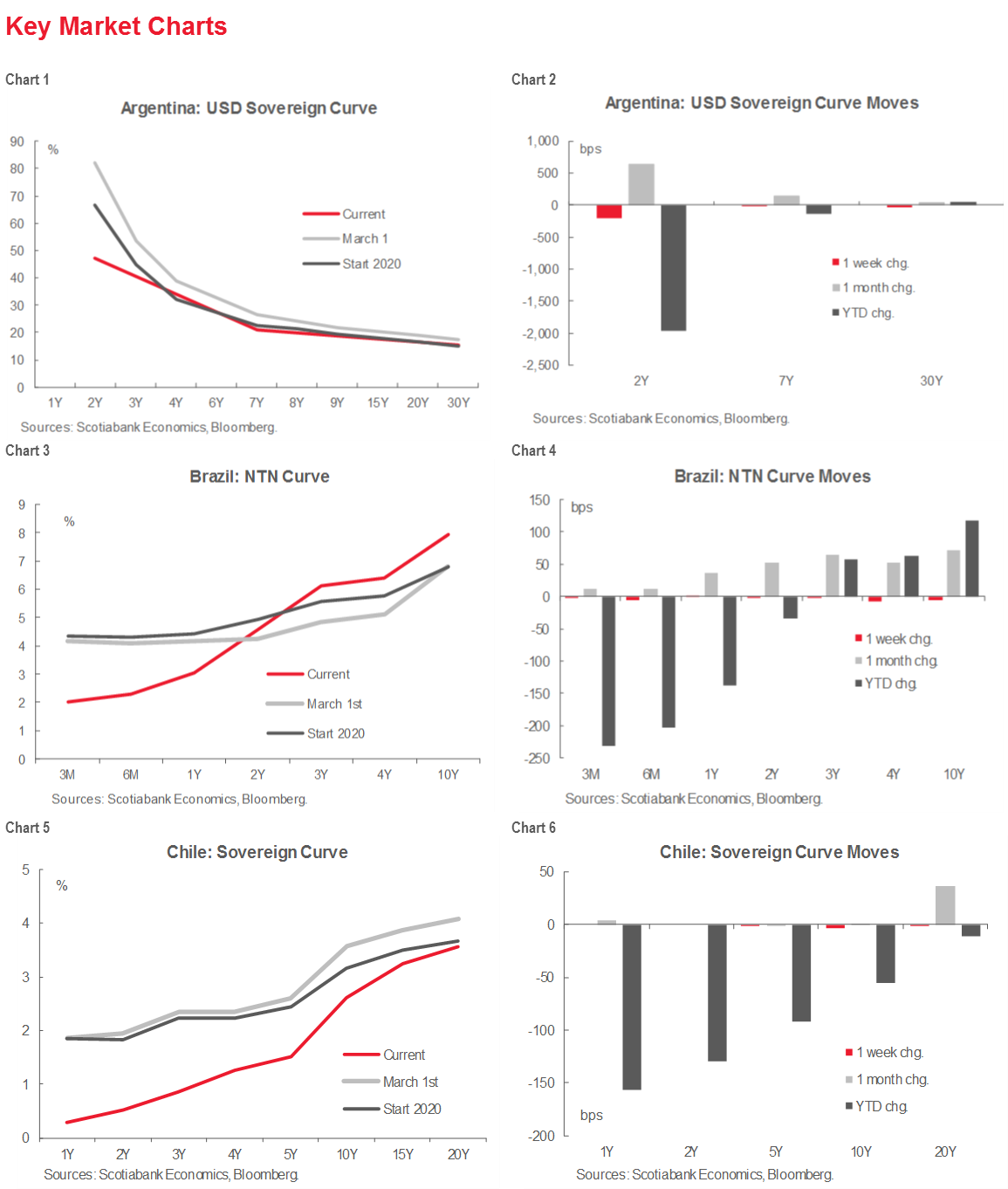
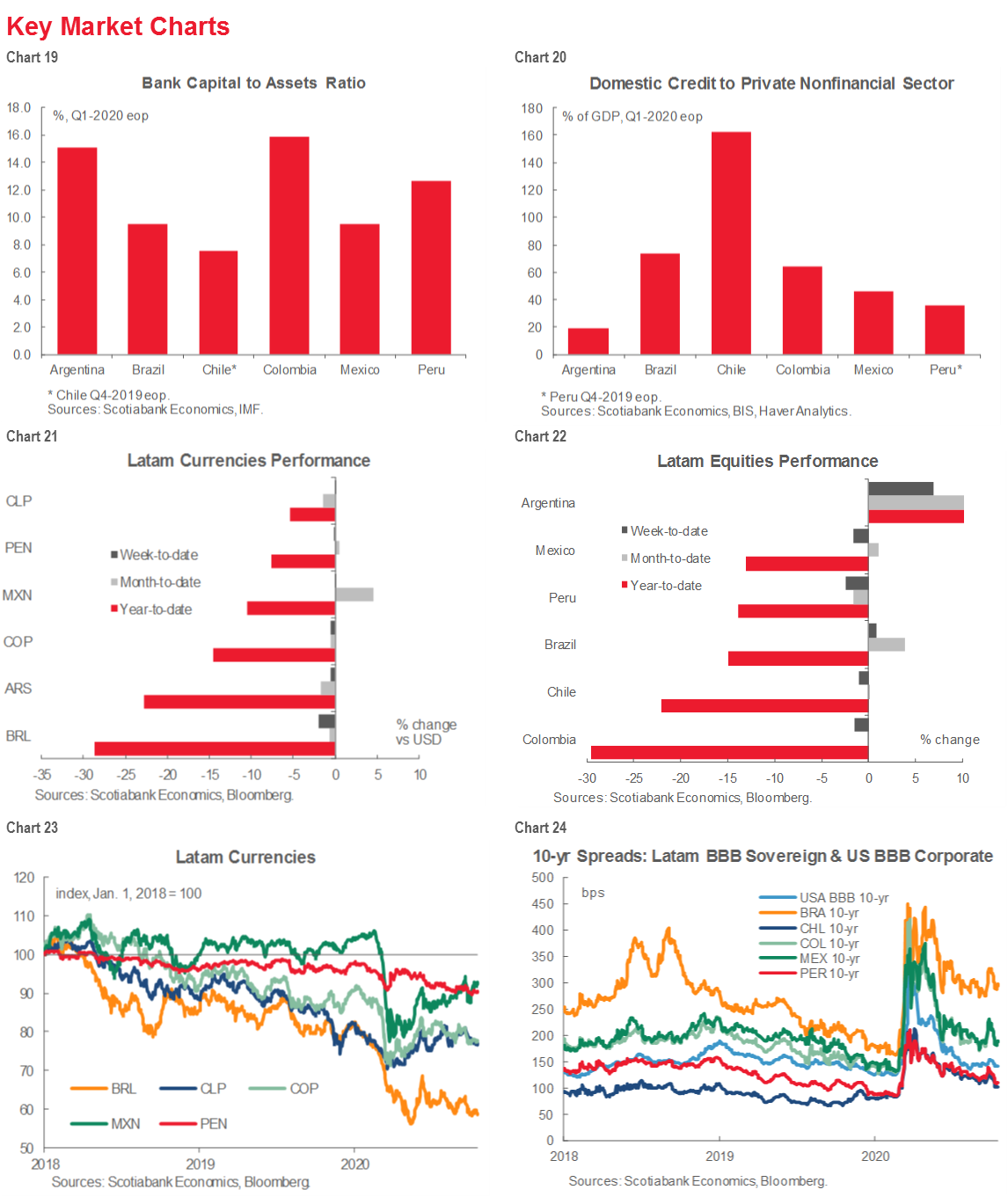
In FX markets over the last week, Brazil’s real continued to hold on to its status as the worst-performing emerging-markets currency in 2020. With a -2.0% drop on the week driven by fiscal, financial, and political concerns (table 1), the BRL was outpaced in EM-space by only the Policy zloty and Hungarian forint as they were hit by rising COVID-19 numbers in eastern Europe. Also amongst the worst-performing EM currencies, Argentina’s official peso rate slid -0.5% w/w as the authorities moved to allow faster depreciation in the official ARS even as the blue-chip swap rate spiked to a record USDARS 170. The BCRA’s recent cuts to benchmark Leliq rate sent a signal that more depreciation lies ahead.
In equities, Argentina’s Merval stood out with a 7.8% w/w gain, its largest one-week advance since the first week of June (table 2). The move capped four consecutive weeks of inflows into Argentine stocks, and was driven mainly by off-shore ADRs on banks and the energy sector, which recovered from sell-offs earlier this year. Talks with the IMF continued and incited some confidence that better conditions ahead.

This edition of the Latam Weekly provides our first detailed quarterly forecasts for 2022. Our projections anticipate gradual normalization of monetary policy across the Latam-6 as growth reverts to underlying trends. It’s notable that the post-pandemic trend looks set to be notably weaker in Mexico following what could be three years of weak investment.
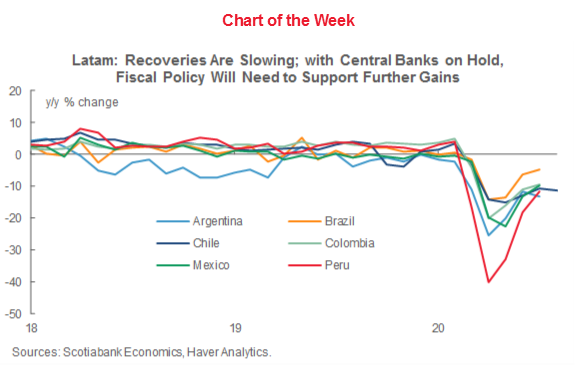
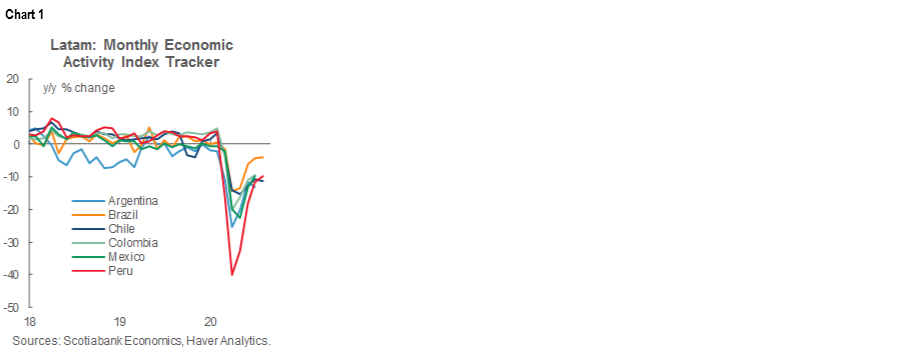
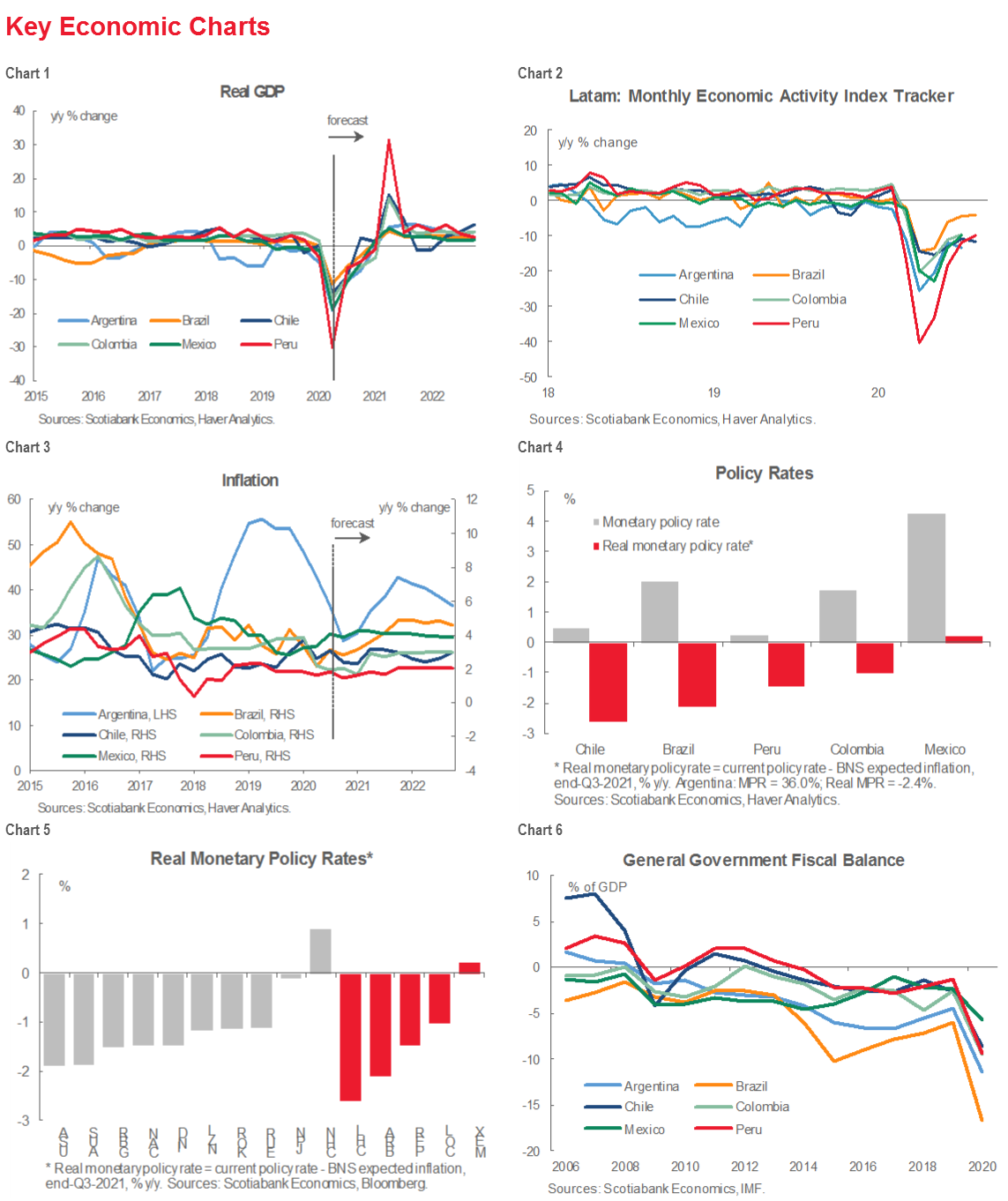
For the near-term horizon, revisions to our forecasts are limited to fine-turning as the pace of recovery starts to level off across the Latam-6 (chart 1). Argentina’s policy-rate path now reflects the BCRA’s -200 bps in cuts to the benchmark Leliq rate over the last two weeks, moves that we had expected in Q2/Q3. Following September inflation surprises, price forecasts were edged up for Chile and Colombia, and adjusted slightly in Mexico between 2020 and 2021.
COVID-19: ARGENTINA REMAINS THE STAND-OUT
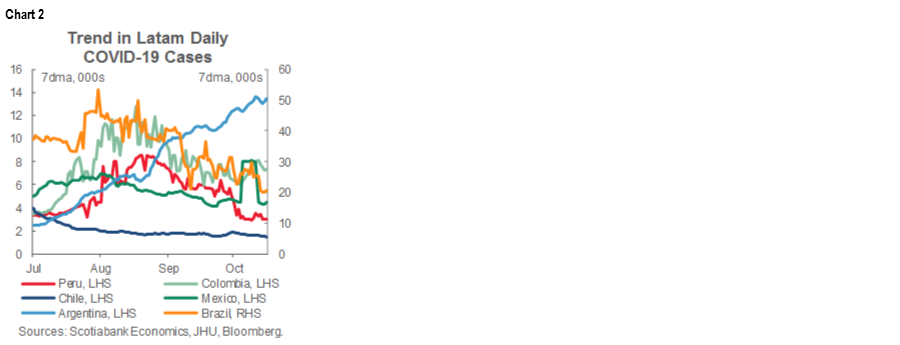
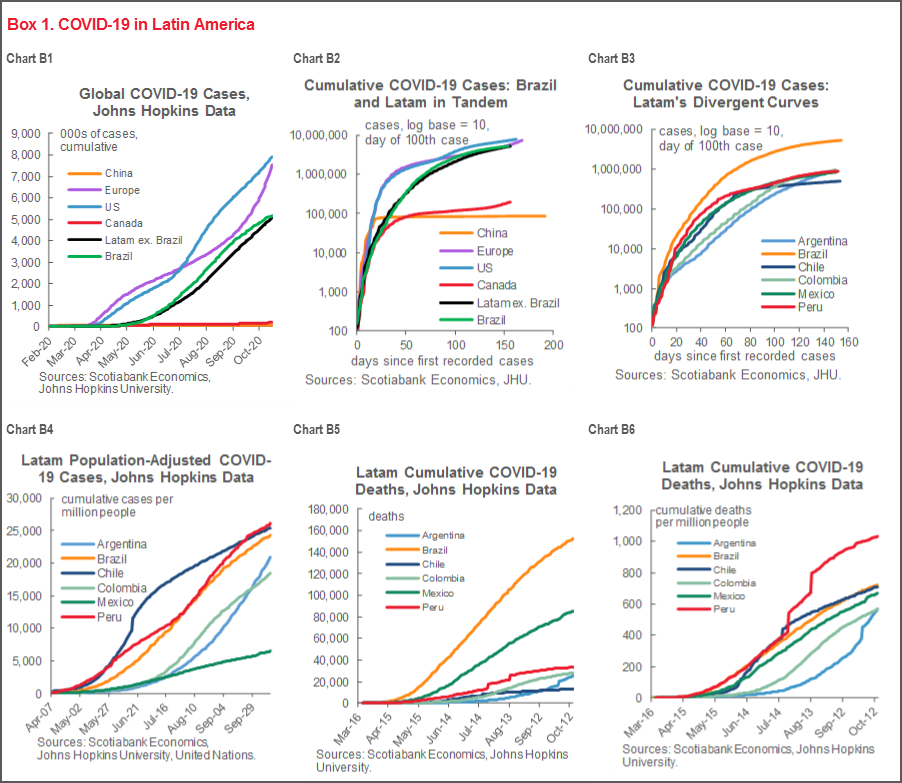
New COVID-19 case numbers remain on a downward trend in most of the Latam-6 with the exception of Argentina (chart 2). Peru has cut its weekly moving average by two-thirds from its peak, while Colombia has reduced its new numbers by half. Mexico shows an anomalous spike in early-October owing to a catch-up in data reporting. October marks the first time since the beginning of the pandemic that trends in Latam have looked better than those in Canada, the US, and Europe (box 1, charts B1 and B2). Within Latam, Argentina continues deteriorating against its regional peers (charts B3, B4, and B5), though Peru remains in another league from the rest in terms of per capita deaths related to COVID-19.
CENTRAL BANKS AND MACRO DATA
I. Central banks
The week ahead is free of scheduled central bank activity, but we will be watching for continued impromptu announcements from Argentina’s BCRA after two rate adjustments over the last two weeks. Despite the possibility of further changes in the BCRA’s repo rates, we don’t expect to see further cuts in the benchmark 28-day Leliq reference rate.
Looking to the last week of October, both Brazil’s BCB and Colombia’s BanRep are set for monetary policy decisions, where both we and consensus expect these central banks to remain on hold. Additionally, Chile’s BCCh releases the minutes from its October 15 meeting on Friday, October 30.
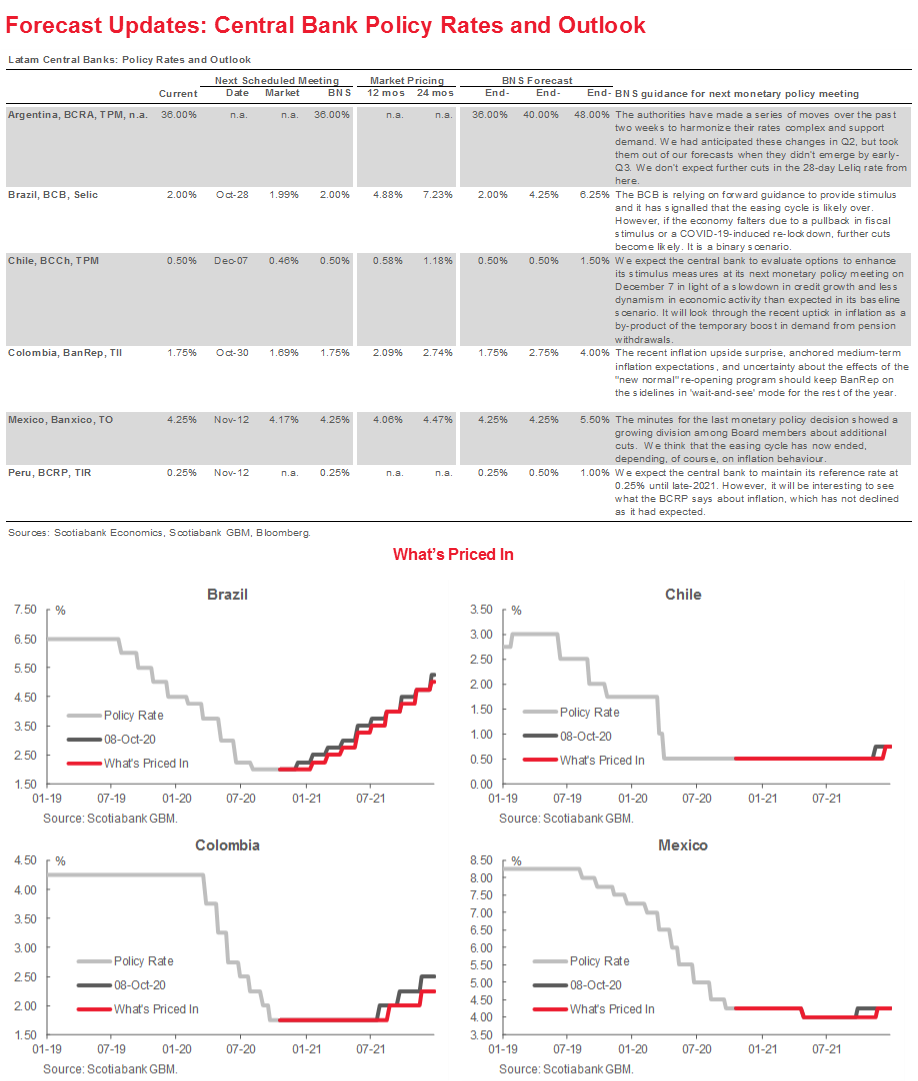
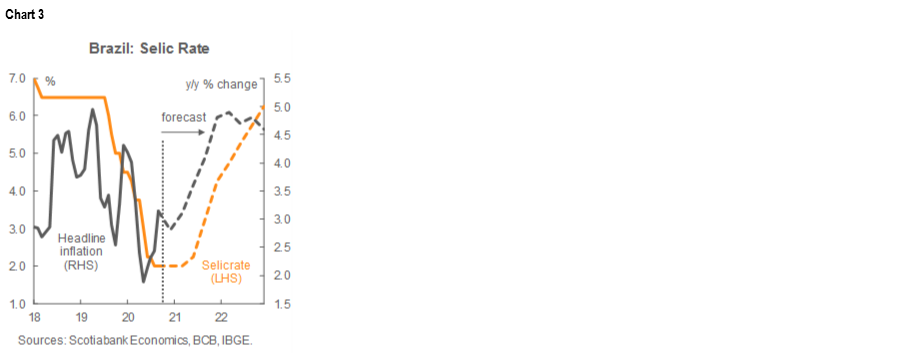
Brazil. The BCB’s Copom meets next on Wednesday, October 28, and it is expected by both our Brazil economist and consensus to keep the Selic on hold at a record low of 2.00% for a third meeting in a row (chart 3).
In its statement following its last meeting on September 16, the Copom noted that it expected headline inflation to rise in the near term along with economic activity, but it assessed that core price growth remained consistent with the achievement of the BCB’s inflation targets (chart 4). Although the Copom acknowledged that the economy remains weak and that it still requires “strong monetary stimulus”, it also cautioned that the room for any further easing was small—and possibly non-existent—owing to prudential and financial stability concerns.
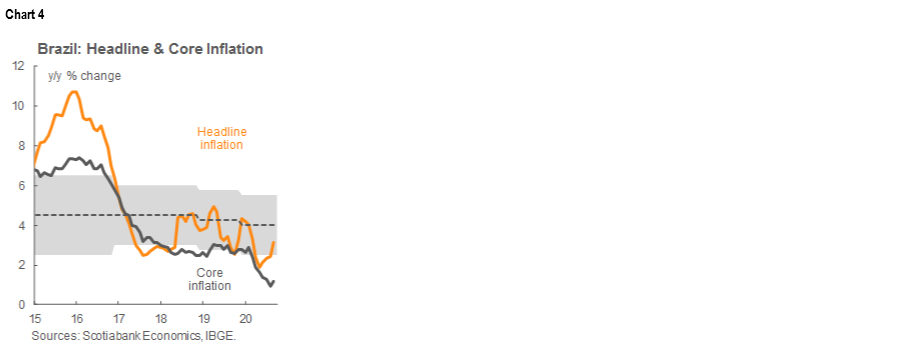
Instead, the Copom invoked an intensification of its forward guidance, moving from an advisory that it did not foresee a reduction in the extent of monetary stimulus to a stronger note that it did not intend such a pullback unless inflation returns to the target over the relevant policy horizon to end-2021. The minutes simply repeated and amplified the discussion of this increased reliance on forward guidance, and underscored the BCB’s caution toward any further cut in rates owing to financial stability issues.
While our Brazil economist doesn’t expect any further substantial moves on October 28, we will look to the statement to provide additional insight on the BCB’s reaction function and greater colour on its macroprudential concerns. Any fiscal developments in the meantime are also likely to be reflected in the Copom’s communications.
Colombia. The Board of the BanRep will conduct its next monetary policy meeting on Friday, October 30, and we expect the intervention rate to be held at its record low of 1.75% following what we sense was a final -25 bps cut in this easing cycle on September 25 (chart 5).
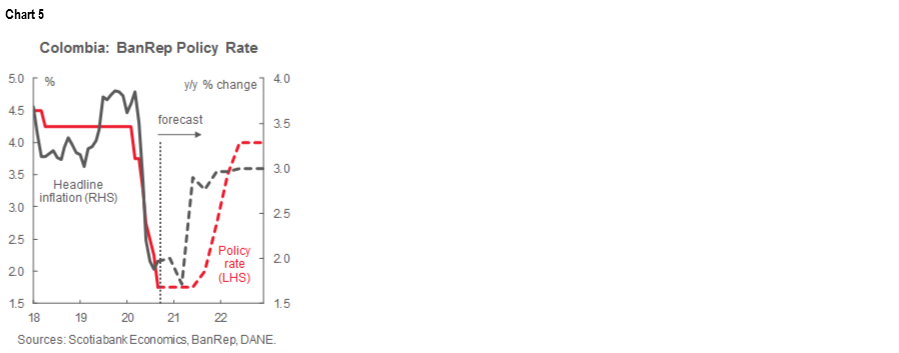
The decision to cut at the September meeting followed a split 4-3 vote where the minority preferred to hold the policy rate unchanged at 2.00%. The meeting’s statement maintained the Board’s gradualist, data-dependent stance, and did not articulate a fresh set of forward-looking guidelines for the Bank’s conduct of monetary policy.
The minutes from the September 25 meeting indicated that the Board’s three-member minority had voted to hold at 2.00% owing to concerns about further COVID-19 developments and implications for public debt under additional monetary policy easing. The minutes imply that the Board’s minority would not be minded to cut further on a more gradual pace, but would instead continue to oppose any additional rate cuts, other things being unchanged.
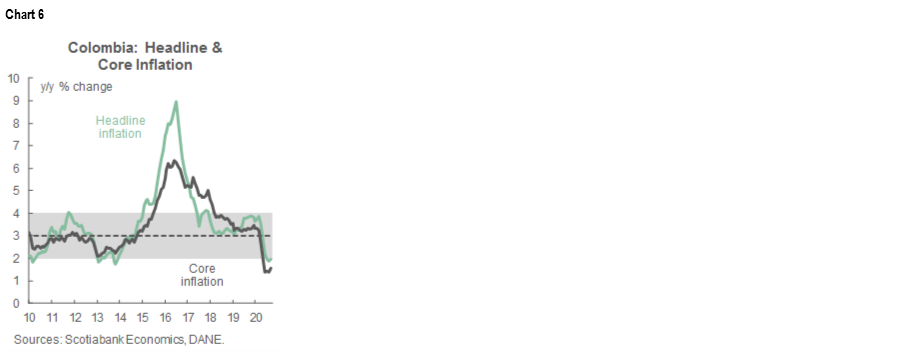
Since then, macro data has pointed toward a hold at the next meeting. September headline and core inflation came in stronger than anticipated following the roll-off of a set of public subsidies and regulations that had kept some prices in check, increased bio-security costs, and weaker disinflationary pressures than had been expected on other fronts—though inflation remains at the bottom of the BanRep’s target range (chart 6). August employment numbers also showed some improvement. Altogether, these developments augur against any further easing and, in the view of our team in Bogota, should keep the Board in data-dependent, wait-and-see mode for some time.
Chile. The BCCh will release on Friday, October 30, the minutes of the Board’s October 15 monetary policy meeting where it unanimously voted to keep its benchmark rate on hold at its 0.5% “technical minimum”, level at which it has been since late-March.
The Board’s communications following the October 15 decision skewed dovish. The Board’s statement implied that the central bank has begun to have less conviction in the breadth and pace of the recovery, with some particular concern about the slow-down in credit growth. Our team in Santiago expects the central bank to look at options to increase the stimulus it provides to the Chilean economy in the context of its next monetary policy meeting on December 7. The minutes may provide some early indication of how these discussions could evolve.
II. Macro data
The week ahead starts slowly with no major releases across the Latam-6 from Monday, October 19 to Wednesday, October 21. Data prints are clustered over the remaining two weeks ahead, but with no major risk events scheduled for Peru during the entire period. For additional details, see the Market Events & Indicators calendar at the back of this report.
Argentina. Thursday, October 22, sees a cluster of releases: the August monthly GDP proxy, September trade data, and October consumer confidence. All three are expected to mark a gradual waning in the pace of the recovery under the shadow of rising COVID-19 numbers. We expect monthly GDP growth to slow a touch from 1.1% m/m to 0.9% m/m, which would continue to raise the annual comparison from -13.2% y/y to -9.6% y/y.
Brazil. Inflation for the first half of October, due on Friday, October 23, is expected to accelerate from 2.7% y/y in late-September to 3.3% y/y. September FDI and the current account surplus are also both expected to firm up further in data released the same day.
Chile. The week ahead is quiet, with only September PPI on Friday, October 23. The following week sees a cluster of data drop on Friday, October 30, with September manufacturing production and retail activity both expected to show strong month-on-month gains. September’s unemployment rate is expected to remain stable owing to offsetting gains in new jobs and the number of people seeking employment.
Colombia. August’s monthly GDP proxy, out on Thursday, October 22, is expected to show some further modest gains despite the month’s regional lockdowns. September unemployment, due Friday, October 30, should also show continued improvements.
Mexico. Perhaps the most closely watched data release across Latam will be Mexico’s bi-weekly inflation for the first half of October, out on Thursday, October 22. Our team in CDMX is aligned with consensus and expects sequential inflation to rise from 0.0% 2w/2w to 0.5% 2w/2w, which would nudge annual headline inflation up from 3.9% y/y to 4.0% y/y. Sequential core inflation is also expected to rise from 0.1% 2w/2w to 0.2% 2w/2w.
August’s monthly GDP proxy index, set for release on Monday, October 26, is expected to show some slippage in annual terms, from -9.8% y/y in July to -10.5% y/y. We will be watching the service sector closely for signs of further re-opening and recovery. The print will be of only limited utility as preliminary Q3 GDP data arrive on Friday, October 30, where we expect an improvement from -19.3% y/y in Q2 to -10.6% y/y in Q3.
Peru. Notably, there are no data releases scheduled for the entire fortnight ahead.
IT’S MAINLY FISCAL, AGAIN
With inflation targeting central banks in the Pacific Alliance countries and Brazil now on hold into 2021, slowing recoveries (chart 1, again) and a possible COVID-19 second wave are likely to keep policy makers focused on additional fiscal measures to support the region’s economies. At the IMF-World Bank Annual Meetings this past week, the Fund’s head of Fiscal Affairs, Vitor Gaspar, indicated that most advanced economics and some emerging economies with solid market access should be able to stabilize their debt ratios by 2025 without the need for spending cuts because borrowing costs are so low, reiterating the findings of the IMF’s newly released Fiscal Monitor.
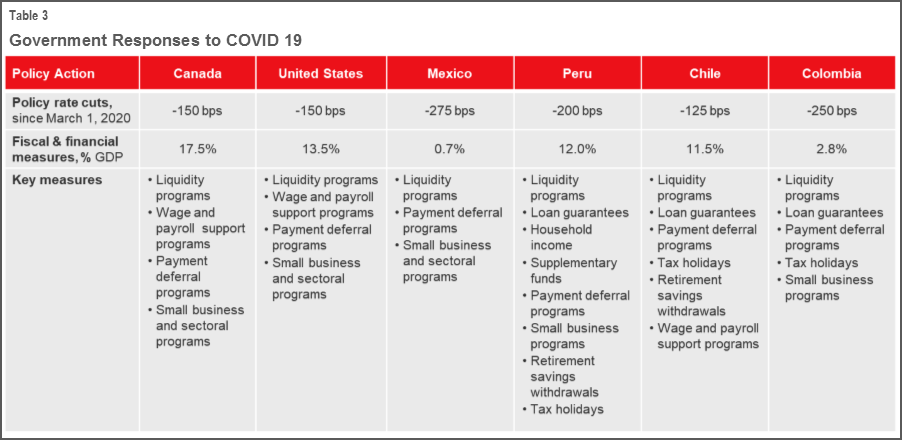
Although fiscal and financial measures already undertaken across the Pacific Alliance have been substantial (table 3), Mexico and Colombia still have space to do more, if necessary. In fact, the recent IMF Article IV mission statement for Mexico went so far as to suggest fiscal measures on the order of 2.5–3.5% of GDP. Our team in Bogota cautions that additional fiscal support would need to be accompanied by tax reform, which is expected in the year ahead. We anticipated in our September 20 Latam Weekly that additional debt issuance by Mexico and Colombia could be absorbed well by markets, while risks may be a bit greater for Peru and Chile. Still, with the Fed set to remain on hold through 2023, debt-financed fiscal stimulus should remain sustainable throughout the region.
USEFUL REFERENCES
IMF, Fiscal Monitor, October 2020: https://www.imf.org/en/Publications/FM/Issues/2020/09/30/october-2020-fiscal-monitor
Markets Report: Pricing Latam Inflation
Tania Escobedo Jacob, Associate Director
212.225.6256 (New York)
Latam Macro Strategy
tania.escobedojacob@scotiabank.com
With contributions from Brett House.
September CPI readings in Colombia, Peru, Chile and Brazil all came in above expectations, while in Mexico we saw some stabilization in prices, but annual inflation remained just above the upper limit of Banxico’s target range.
In general, re-opening strategies across the region are halting the decline in annual inflation prints that have been seen across most of the Pacific Alliance since the pandemic started.
There are also signs of resistance to deflation in basic food prices and in the prices of other goods linked to domestic demand, which have not declined as had been expected with the economic slump. This dynamic could point to more permanent changes resulting from higher logistics costs on the supply side and new consumer trends from the demand side.
Scotiabank Economics’ forecasts (see pp. 2 and 3) anticipate this possible inflection point for inflation; hence, our economics teams have not made any changes in their monetary policy forecasts for the region, where no further cuts are projected and hikes aren’t anticipated until mid-2021, with the first moves expected to come in Brazil.
We look at the latest inflation readings and contrast them with market-based inflation expectations, our forecasts, central bank projections, and analysts’ consensus to determine potential sources of value in the pricing of inflation-linked instruments.
INFLATION TAKES A TURN
The past two weeks marked a busy fortnight for inflation data in Latam, with some interesting takeaways. September CPI indices in Colombia, Peru, Chile and Brazil all came in above expectations, while in Mexico we saw some stabilization, but annual rates remained just above the upper limit of Banxico’s target range (chart 1). Core inflation has also accelerated in recent months in most of the Latam-5 inflating targetters (chart 2).
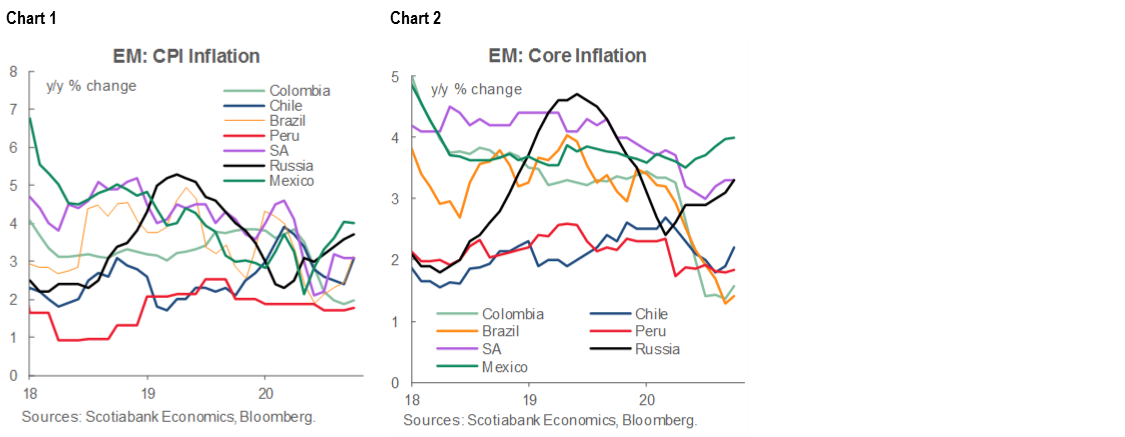
In general, the re-opening strategies of economies across the region appear to be halting the decline in annual inflation prints that we have seen across most of the Pacific Alliance (i.e., Chile, Colombia, Mexico, and Peru) since the pandemic started. Now that the worst of the economic contraction seems to be over, the risks of temporary deflation are fading. With higher inflation, real rates across the Latam-5 inflation-targeting regimes could go even further into negative territory (chart 3).
TEMPORARY BOOSTS FROM DEMAND MEASURES
Disposable incomes and hence, retail sales and consumption more broadly, have been particularly boosted by withdrawals from pension accounts in Chile and direct government transfers in Brazil. In both cases, however, the upside surprises in consumer demand in September might prove short-lived, as the moves did not come from a solid increase in wages or a structural recovery in economic activity.
In Chile, for example, we had disappointing economic activity indicators in August, mainly owing to the slow recovery of investment, which is one of the main determinants of employment. Also, for the next few months, our team in Santiago highlights the importance of monitoring when and how the INE moves back to collecting price data in a manner closer to its usual practices (i.e., scaling back the extent of imputations), a process that could bring volatility into upcoming inflation prints. For now, the upside surprises in realized inflation have been enough for our economists to raise their forecast for end-2020 from 2.2% y/y to 2.4% y/y. This aligns Scotiabank’s outlook with the latest forecasts published by the central bank (BCCh) in its September Monetary Policy Report.
LESS DEFLATION THAN ANTICIPATED
There are also signs of some resistance to deflation in basic food prices and the prices of other goods linked to domestic demand, which have not declined as expected with the economic slump. This dynamic could be pointing to more permanent changes resulting from higher logistics costs on the supply side and adjustments in the consumer trends from the demand side. The deprecation of the region’s currencies might also be adding pass-through support to tradable goods prices.
In Colombia, September’s inflation surprise resulted from the upside effect of the government removing some of the subsidies and aid it deployed through the worst of the pandemic, as well as higher biosecurity costs in transport services. Goods inflation increased by 16 bps while regulated prices increased by 60 bps. Core inflation also rose: ex-food inflation came in at 1.57% y/y (up 20 bps from the previous month), while ex-food and regulated-price inflation increased by 10 bps to 1.67% y/y.
For Peru, September was the third consecutive month in which inflation came in higher than expected, which underscored the persistence of basic food prices and other goods prices that are usually more sensitive to declines in economic activity. The absence of any major indications in the September print that inflation would move downward meant that, with only three months left in the year, both the BCRP’s 2020 forecast (0.8% y/y) and our own projection (1.1% y/y) seemed to be out of reach. Hence, following the release of the September inflation data on October 1, our economists in Lima increased their forecast for end-2020 inflation to 1.5% y/y from 1.1% y/y, and for end-2021 to 2.0% y/y from 1.5% y/y.
In Mexico, consumer price inflation for September stabilized at 4.01% y/y, slightly above the upper limit of Banxico’s target range (3%, +/- 1 ppt) after five months of increases. The recent fall in oil prices resulted in a negative contribution from the energy component to the September inflation basket; additionally, agricultural prices came off their peak. We note, however, that, as usual, these prices are prone to volatility. Core inflation in September stood at its highest rate since 2018, and although it is still driven by process food and merchandise goods prices, these components are showing some signs of stabilization. Meanwhile, Mexican services inflation remains low, but it has pared its downward trend, as the sector gradually re-opens. Our economists’ forecasts for inflation by end-2020 and end-2021 are 3.9% and 4.1%, respectively, higher than the 3.7% and 2.9% anticipated by the central bank.
Despite being potentially at an inflection point for inflation, we have not made any changes in our monetary-policy expectations in the region, as inflation prints remain comfortably within the central banks’ target ranges (with the exception of Mexico) and our projected policy-rate paths already reflect forecasts for some acceleration in inflation into 2021. Hence, our local economists are anticipating long holds by the inflation-targeting central banks in the Pacific Alliance, where no further changes are anticipated until at least the last quarter of 2021. In contrast, our Brazil economists thinks the BCB could begin lifting rates as soon as Q2-2021.
LINKERS AND BREAKEVENS
Since July, we have been pointing to divergences between market-based implied breakeven-inflation (BEI) projections and our own Latam forecasts (see the Latam Weekly Markets Report from Aug 8, 2020). In Chile and Colombia, recent inflation prints support our view that there is value left in the short end of the BEI curve. Meanwhile in Mexico, the carry is attractive in the shorter end of the curve and gives space for the breakevens to catch up with our forecast for higher inflation in the coming year. In Brazil, breakeven inflation is still short of our economist’s forecast, which implies opportunities, particularly in the 1Y sector. We look at each market in more detail below.
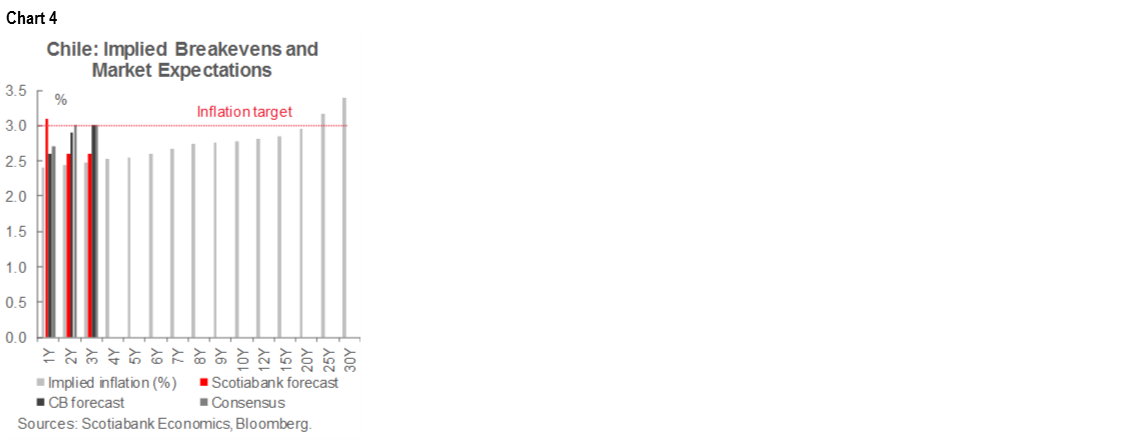
In Chile, our house forecasts for inflation in the coming year are slightly above analysts’ consensus (chart 4). Twelve months ahead, Scotiabank Economics forecasts headline inflation at 3.1% y/y, above the analysts’ consensus of 2.7% y/y and the central bank forecast of 2.7% y/y. For the same period, breakeven inflation is at 2.4% y/y. Eighteen months from now, our economics team anticipates stable inflation near 2.6% y/y, while the central bank has pencilled in a pickup to 2.9% y/y and the consensus of analysts converges to 3% y/y; breakeven inflation for 18 months out is 2.45% y/y, which looks a bit underpriced at this stage. There appears to be some value in long positions in the short end of the breakevens, especially the 1-3Y area, which we would expect to move closer to our house forecasts.
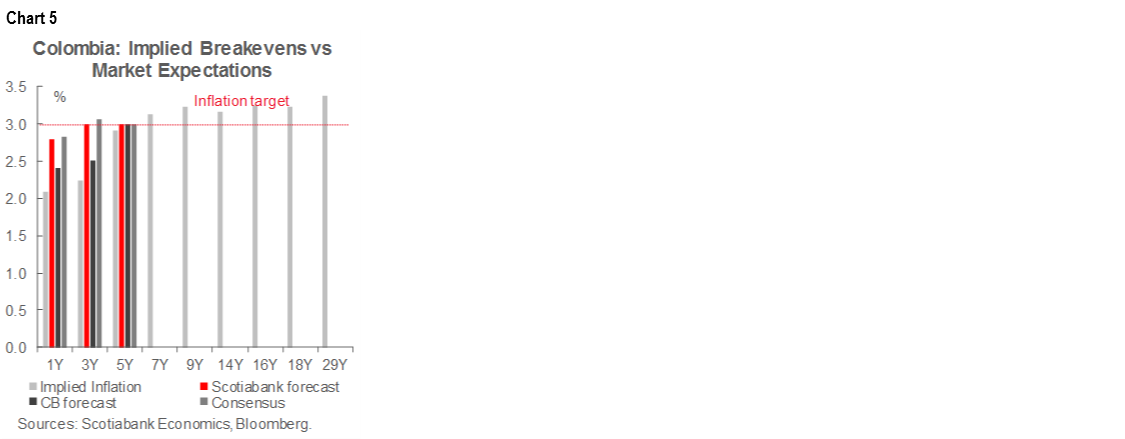
In Colombia, Scotiabank Economics anticipates that annual inflation will be around 2.8% in one year’s time, a bit above the central bank forecast of 2.4% y/y, but closer to the consensus call of 2.83% y/y (chart 5). Breakeven inflation has been adjusting to the upside, but we still see opportunity in the short end of the curve. Further down across the UVR curve, we think that the best value is in the ten- and twenty-year tenors.
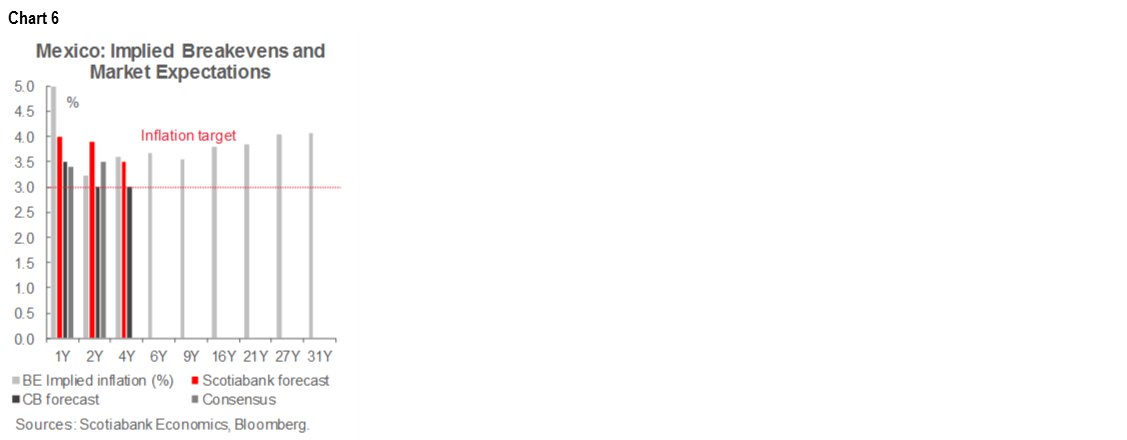
In Mexico, the 1Y breakeven inflation rate is 5.1% y/y, which looks too high on the basis of our macro modelling (chart 6). We see, however, carry trade opportunities in the very short end of the UDIs curve, as realized inflation should trend toward our forecast of 4.0% y/y one year out and 4.1% by end-2021. And even if inflation surprises to the downside, the pricing of a lower reference rate would leave the carry trade with enough room to exit the position without losses.
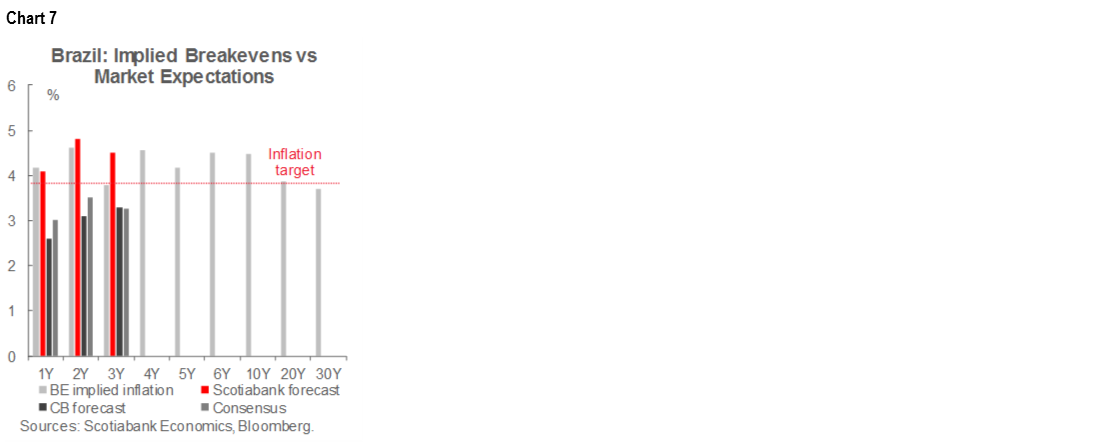
In Brazil, our economist anticipates inflation will be at 4.1% y/y a year from now, above the central bank forecast of 2.6% y/y and analysts’ consensus of 3.02% y/y, but in line with breakeven expectations of 4.1% y/y (chart 7). The rationale for Scotiabank Economics’ forecasts rests on what has been in the past a high degree of pass-through from moves in the BRL (20%–30%); a public finance outlook that is deteriorating, which has sparked inflation in similar episodes; extremely easy monetary conditions; and an expectation that prices will remain sticky despite the widening output gap. Given that our house inflation forecasts and breakeven expectations are aligned, we don’t see an obvious opportunity until we get out to the 3Y tenor.
COUNTRY UPDATES
Argentina—A Busy Time for the BCRA
Brett House, VP & Deputy Chief Economist
416.863.7463
brett.house@scotiabank.com
The BCRA announced on Thursday, October 15, further steps in its program to harmonize its interest rate complex, following an earlier set of similar adjustments a week ago. The central bank again raised its reverse repo rates, lifting both the 1-day and 7-day rates by 300 bps to 30% and 33%, respectively. It also cut the benchmark 28-day Leliq rate by another 100 bps to 36%. We had expected the authorities to take these moves in Q2, or perhaps by Q3, but we took them out of our forecasts after they failed to materialise then. We don’t expect the Leliq rate to be lowered any further from here.
These rate changes represent a mixed bag for the economy and markets. On the one hand, the move to harmonize rates should marginally increase the coherence and effectiveness of the BCRA’s monetary policies. The rate changes may also make good on the BCRA’s intention to provide some limited support to the ARS by increasing the real return on peso-denominated instruments. Any impact is, however, likely to be small as the 200 bps cut in the Leliq rate over the last week goes in the wrong direction and doesn’t address bigger investor concerns about the authorities’ macro framework.
Inflation is set to continue cutting into real returns on Argentine assets and the ongoing slide in the ARS further dents the attractiveness of peso-denominated instruments. We expect inflation to remain at or near 3% m/m through end-2021, but tradable sub-sectors, such as clothing, are already seeing inflation in the 4% m/m to 5% m/m range (first chart) owing to FX pass-through effects with the blue-chip swap rate continuing to sit at more than twice the official USDARS cross rate (the blue-chip rate hit USDARS 170 on Friday, October 16, the highest in more than 30 years). Headline annual inflation (second chart) is nevertheless set to fall below 30% y/y into end-2020 owing to base effects from 2019, but unless fundamental policy changes are undertaken it should head back above 40% y/y before end-2021. Economy Minister Guzman mused at the end of this past week about making changes to FX and capital controls, but he didn’t provide any specifics.
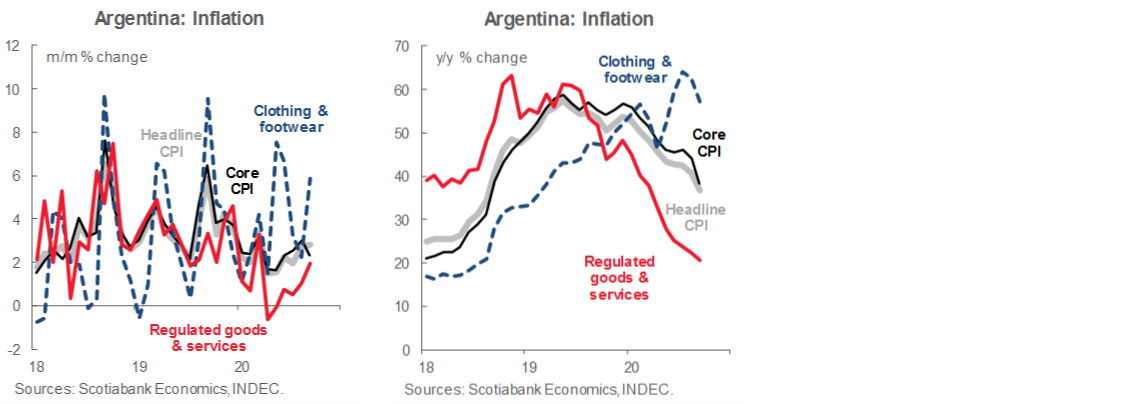
Turning to the risk calendar for the next two weeks, Thursday, October 22 is scheduled to see the arrival of data on economic activity in August, September trade numbers, and October consumer confidence—a series of prints that should provide some deeper insights on developments in Q3 and some early indication of what lies ahead in Q4. We estimate that Argentina’s recovery continued into August and trimmed the economy’s gap compared with last year from -13.2% y/y in July to -9.6% y/y. Sequential growth, however, would have slowed from 1.1% m/m in July to 0.9% m/m, consistent with the extension of contagion control measures through the month and into October. Argentina’s trade volumes are expected to have remained weak in September owing to a combination of softening demand for imports and decisions by agricultural producers to hold back exports in anticipation of further depreciation in the ARS. The impact on the trade balance was likely a wash. With growth in COVID-19 numbers having accelerated through September and into October—in contrast with most of the rest of Latam—consumer confidence likely followed its -2.43% m/m decline in September with a further ebb in October.
Brazil—BCB Committee to Remain Cautious Based on Fear of Inflation Persistence
Eduardo Suárez, VP, Latin America Economics
52.55.9179.5174 (Mexico)
esuarezm@scotiabank.com.mx
Since the 2014–16 oil-price shock passed, we have been surprised by the lack of response in IPCA inflation to what have been material depreciations in the Brazilian real, aka, “the curious case of the absent FX-inflation pass-through” (first chart). Even though we have seen some spikes in inflation (such as in 2018), these upswings have been quite moderate, and inflation has been mostly contained in a 2–3% range, well below the BCB’s target. The last IPCA print for September came in at 3.14% y/y, higher than consensus and our own call by 10 bps. However, it remained below the BCB’s inflation targets for the policy horizon (4.00% for 2020, 3.75% for 2021 and 3.50% for 2022). Furthermore, looking at its components, the absence of broad price pressures is even more notable: the only component whose year-on-year rate of inflation came in above 2.55% y/y was food & beverages (second chart). The spike in food prices has been described by the BCB itself as seasonal, meaning that inflation remains “missing in action”.
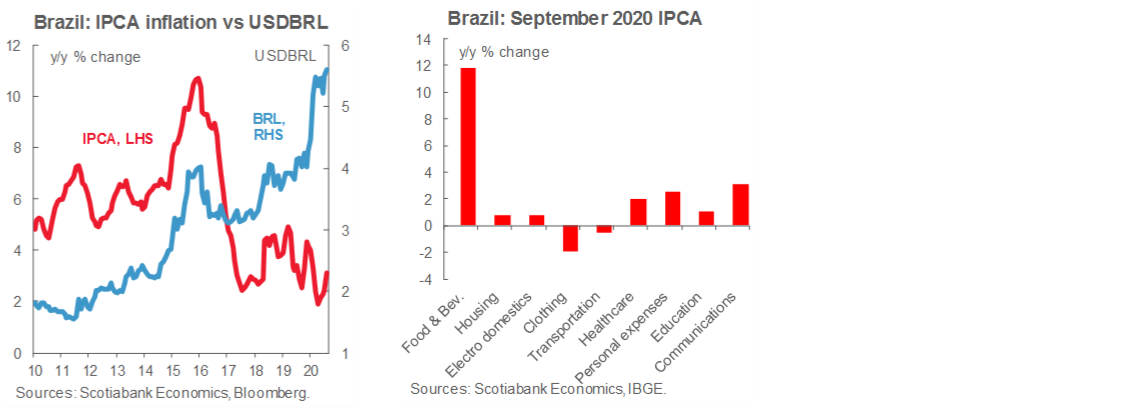
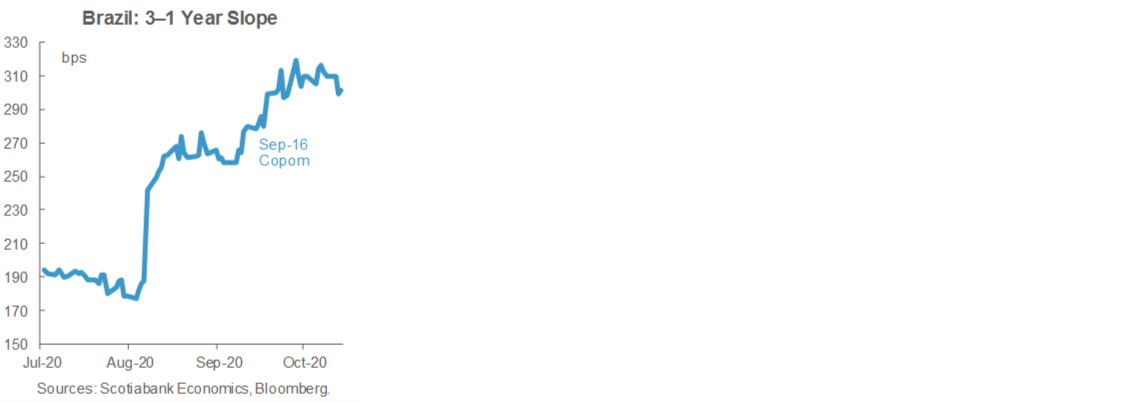
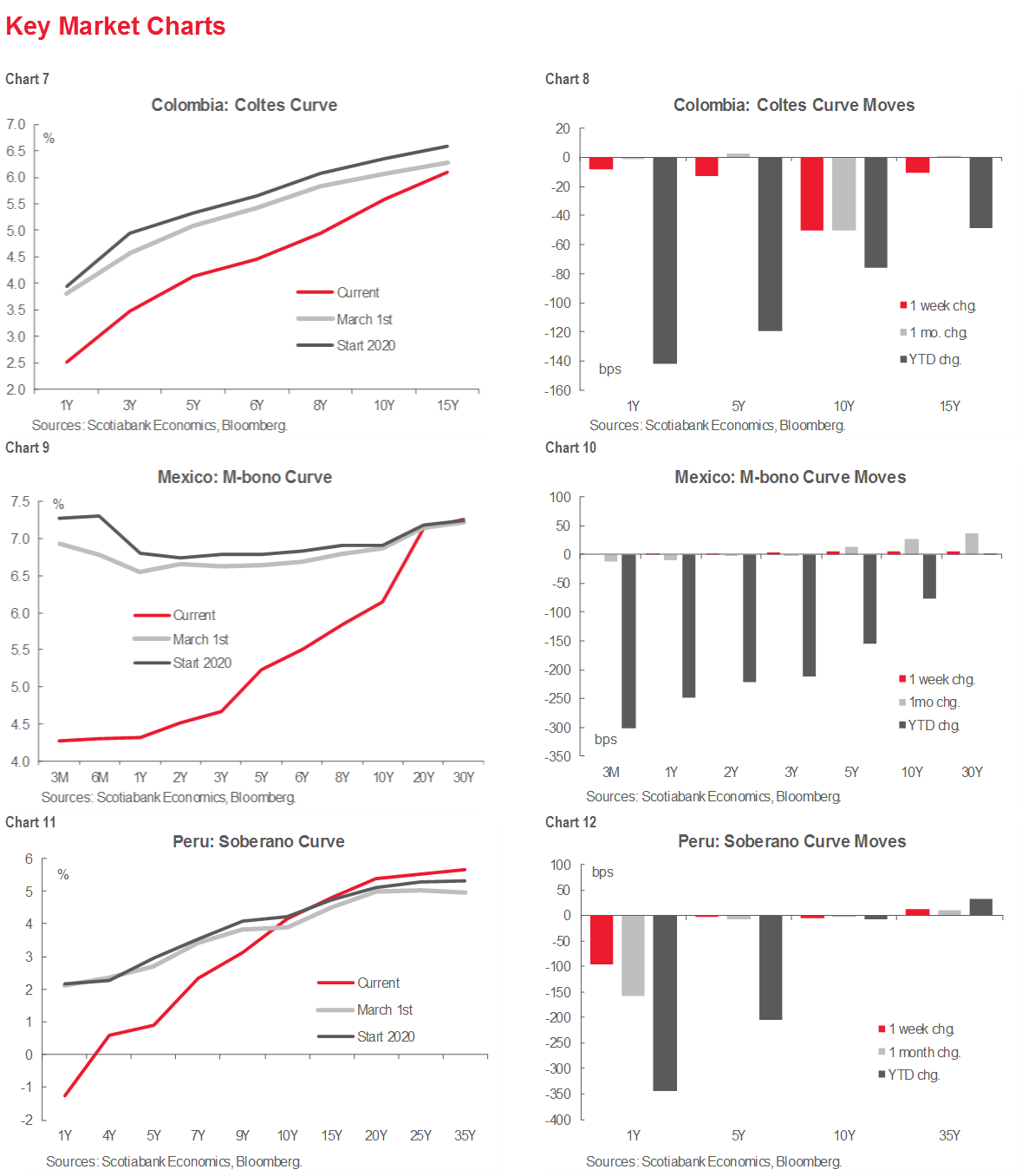
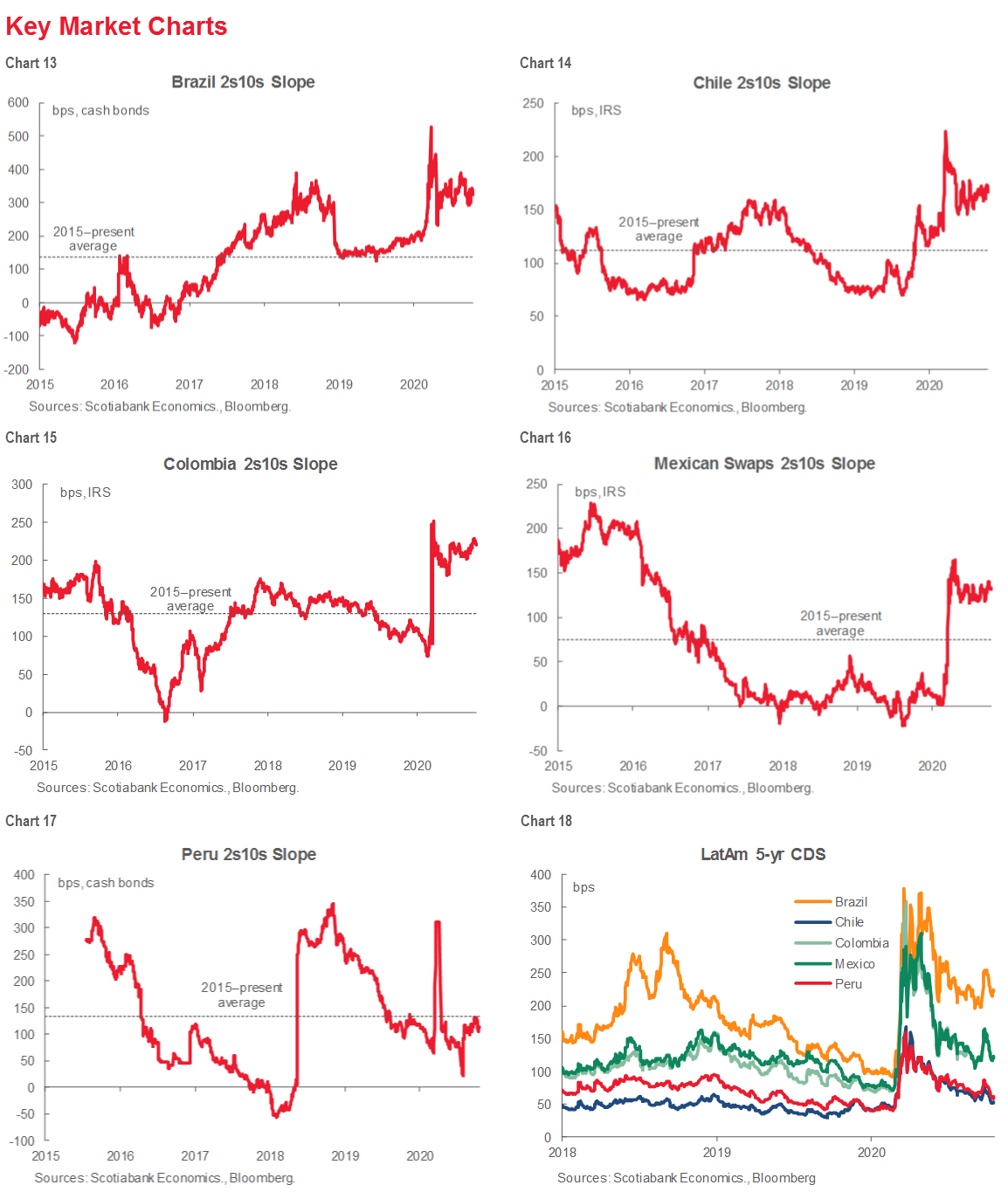
Despite a very benign inflation environment, and still-weak economic activity, the BCB has elected to be cautious, signaling that it is likely at the end to its easing cycle and is resorting instead to the introduction of forward guidance as an additional form of stimulus. The BCB’s signal is that the Selic will remain on hold for a prolonged period. However, local rates markets seem skeptical that it will be able to stick to this pledge, with the 3–1 year slope steepening about 30–40 bps since the announcement (third chart). We do not think the problem is the BCB’s credibility, but rather skepticism over how the government will deliver on its fiscal consolidation once the COVID-19 shock plays out. With growth still weak and highly dependent on a stimulus package that will gradually be unwound from now until its expiry at the end of 2020, and inflation still well contained, we think it is worth thinking about why the BCB has remained cautious. It appears that its main arguments are related to financial stability.
A couple of years ago (2018) the BCB published a study of FX-inflation pass-through dynamics in the era of the floating BRL during 2000–15). The study argued that pass-through is not linear, but tends to increase with the size of shocks, which is a frequent finding in the economics literature. The authors noted that “Under the so-called ‘normal’ regime, the long-run pass-through to consumer-price inflation is estimated at near zero, only 0.00057 percentage points given a 1% exchange-rate shock. Comparatively, the expected pass-through to inflation under a ‘crisis’ regime is 0.1035 percentage points for the same exchange rate shock.” It also finds that once the economy switches from one regime to the other (i.e., from normal to crisis or vice versa), the new extent of pass-through proves persistent for several quarters.
We assume that one of the reasons the BCB is being cautious now—despite economic weakness and soft inflation—is a fear that the nearly 30% YTD depreciation in the BRL could prompt a shift toward the “high pass-through” regime. Looking forward, the we expect IPC inflation for the first half of October, due on Friday, October 23, to accelerate from 2.7% y/y in late-September to 3.3% y/y. While this shouldn’t shift the BCB’s stance from a hold at 2.00% at its next Copom meeting on Wednesday, October 28, we do expect it to provide more colour on its inflation regime and financial stability concerns.
Chile—Central Bank Could Increase Monetary Stimulus in December
Jorge Selaive, Chief Economist, Chile
56.2.2939.1092 (Chile)
jorge.selaive@scotiabank.cl
Carlos Muñoz, Senior Economist
56.2.2619.6848 (Chile)
carlos.munoz@scotiabank.cl
In a quiet week in terms of economic releases, the central bank’s monetary policy meeting on Thursday, October 15, emerged as the key event. The BCCh Board kept the monetary policy rate at 0.5%, as we expected, and described a scenario of economic recovery driven by the re-opening of activity. It cautioned, however, that the rebound remains extremely fragile and heterogeneous, with concentrated improvements in some very specific sectors. Likewise, the central bank acknowledged a slowdown in the flow of credit, an issue that should have been mentioned in the previous meeting, as we pointed out at that time, and some supply-side restrictions. Regarding inflation, the Board acknowledged the surprise in September, but assertively pointed out that the spike in prices reflected the injection of resources from fiscal aid and the withdrawal of funds from the AFPs. In this context, we expect the central bank to evaluate options to increase monetary stimulus at its next monetary policy meeting on December 7 as it looks through the recent, temporary rise in demand and prices, and focuses instead on the slowdown in credit growth and less dynamism in activity than expected in its baseline scenario.
On the same day as the BCCh’s monetary policy decision, Thursday, October 15, Fitch downgraded Chile’s Long-Term (LT) Foreign-Currency Issuer Default Rating (IDR) to “A-” from “A” and revised its Outlook to “Stable” from “Negative”. Fitch also lowered Chile’s LT Local Currency IDR to “A-” from “A+” and revised its Outlook to “Stable” from “Negative”. The downgrade reflected the weakening of the public finances in the wake of secular pressures to increase social spending in the aftermath of widescale protests in October and November 2019, which have been compounded by the economic downturn precipitated by the COVID-19 pandemic. Fitch forecasted the government debt burden to continue to increase over the medium term, given Chile’s lower trend growth prospects and difficulties in consolidating its fiscal accounts amid a heavy political calendar and social pressures.
In other news, on Wednesday, October 14, the Constitutional Committee of the Chamber of Deputies resumed debate on the four bills related to the withdrawal of funds from the AFPs, which include a proposal to allow a second withdrawal of 10%. The Minister of Finance warned that if this proposal were approved, the cumulative effect of the two sets of withdrawal authorizations would reduce the future pension of each contributor by an average of 23% and, additionally, would imply a fiscal cost of USD 4 bn. Regarding the financial market implications, the President of the Central Bank said that a second authorization for withdrawals would imply sell-offs of a greater proportion of local assets. The second withdrawal bill is still being discussed in Congress, and we expect strong opposition to it from the Government and a portion of Congress.
In the fortnight ahead we will have more data with which to assess the resilience of the economic recovery. On October 30 we will receive employment and sectoral data for September. We expect the unemployment rate will remain flat from August’s print (12.9%), acknowledging a recovery in the workforce as more people are looking for jobs, but also an increase in employment, as the re-opening of the economy is allowing businesses to recall furloughed employees. Regarding sectoral activity data, we estimate retail sales increased 9% y/y in September, explained by the boost coming from the withdrawal of pension funds and the other measures implemented by the Government to support households’ incomes. For manufacturing, we project a decline of -2% y/y, a better print than in August, but still reflecting a shock to production due to the pandemic. Finally, for September monthly GDP, due to be released on November 2, we expect it to be down by -6% y/y, a further improvement from August’s -11.3% y/y level. Our September forecast would keep Chile on track for a decline in GDP of -5.2% in 2020, as noted in our forecast on p. 2.

Colombia—Potential Fiscal Adjustments After COVID-19 Pandemic
Sergio Olarte, Head Economist, Colombia
57.1.745.6300 (Colombia)
sergio.olarte@co.scotiabank.com
Jackeline Piraján, Economist
57.1.745.6300 (Colombia)
jackeline.pirajan@co.scotiabank.com
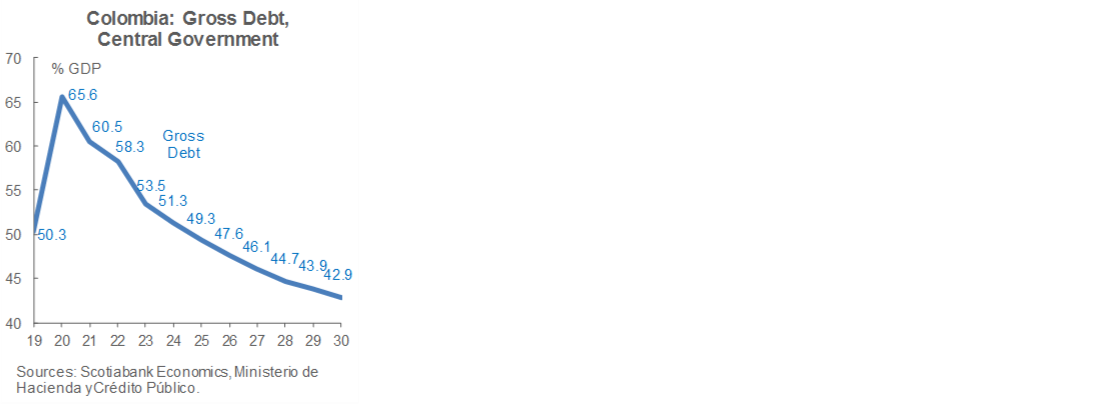
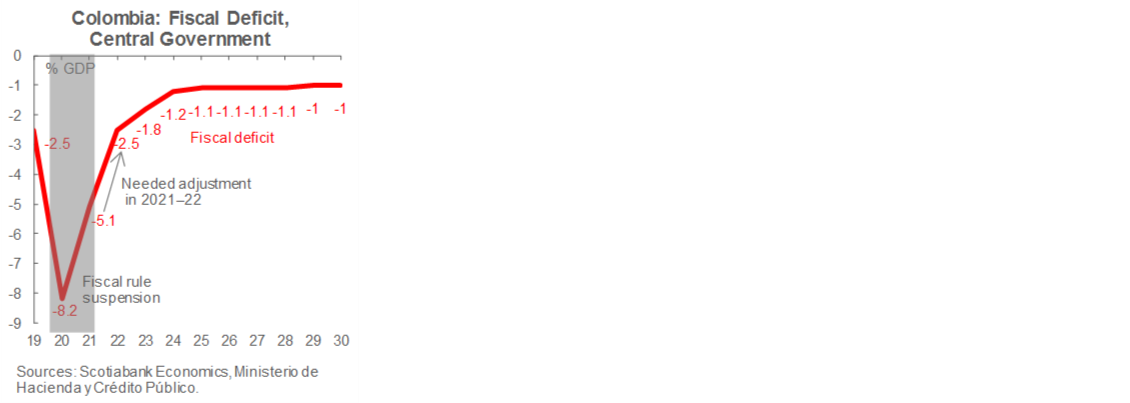
The nature of the COVID-19 shock has demanded unprecedented fiscal stimulus around the world. In fact, the IMF has projected that, in 2020, the debt/GDP ratio will rise to 120% in developed countries and 65% in developing countries. Both figures are high by historical comparison. In Colombia, for instance, given the temporary suspension of its fiscal rule, this ratio is expected to rise more than 15 ppts to 65%, which will raise concerns about the absorption of new issuances and medium-term sustainability.
At the beginning of the year, the government—in line with its fiscal rule—presented a fiscal deficit goal of 2.2% of GDP for 2020. However, the COVID-19 shock caused this target to be increased by 6 ppts to 8.2% of GDP. The plan was to tap international markets and multilaterals to fill the new public financing requirements. Colombia issued USD 3.8 bn in global markets earlier this year, with bid-to-cover ratios of 4.5 and 5.3 in January and June, respectively, amidst abundant global liquidity and low developed-market rates. The authorities have also drawn USD 1.4 bn from multilaterals. Domestically, the government issued a 30-year bond for COP 4.3 tn
(USD 1.3 bn), with a 1.9 bid-to-cover ratio, that was placed almost entirely offshore. In short, markets have reacted positively to the large increase in Colombia’s public debt.
Having said this, uncertainty regarding tax revenues and further countercyclical expenditures continues to be very high. So far, the 7.7% YTD (up to August) tax-revenue shortfall is broadly consistent with an 8.2% of GDP fiscal deficit at only 42% of budgetary execution. However, since the future of the economic recovery is still uncertain, so is tax revenue for the remainder of this year and 2021. Reflecting this uncertainty, in a strategic move, the government decided to issue another COP 5 tn (USD 1.3 bn) of COLTES this year. It is not clear if this issuance replaces some other funding sources in 2020 or is pre-financing for 2021 needs; its ultimate status will depend on the speed of the economic recovery.
The other important question is how Colombia’s higher debt stock will be brought back down. Theory says that as economic activity recovers, so to do tax revenues; however, in this case, economic losses have been very large, and the ensuing economic pickup is likely to be gradual. Therefore, the tax revenue generated by GDP growth may not be enough to pay down Colombia’s growing debt burden. If Colombia wants to keep its good credit ratings, it will need another tax reform next year. The only way to increase tax revenues without killing economic activity recovery is via fighting evasion and useless exemptions. In the VAT alone, the government is losing around 7 ppts of GDP in revenue every year due to these issues. The government is already working to convince Congress and the public of the need for improvements in the VAT framework and will try to recover at least 2 ppts of GDP in tax revenues next year by fixing some other significant tax framework issues. The idea is to ensure that higher VAT revenues from low-income populations will be returned to them via transfers under COVID-19 programs already in place.
All in all, although fiscal sustainability is a challenge, it does not seem to be a major consideration in the short run for investors. But fiscal worries are likely to come to the fore next year. Although we think tax reform will pass by the end of 2021, there are some concerns that it may be watered down or held up since it will be a pre-election year.
On the monetary policy front, BanRep’s regular Board meeting will be held on October 30. We think the Board will stay put at 1.75%. September headline and core inflation surprised on the upside on the back of vanishing subsidies on regulated prices and higher biosecurity costs, which together crimped some disinflationary forces. Additionally, employment—the other major variable in the BanRep’s monetary-policy reaction function— is recovering at a quickening pace which, in our opinion, is enough to keep the central bank in wait-and-see mode for a while.
Mexico—Weakening of the Rule of Law?
Mario Correa, Economic Research Director
52.55.5123.2683 (Mexico)
mcorrea@scotiacb.com.mx
In a highly controversial decision, the Supreme Court of Justice reformulated the question set by President Lopez Obrador for a referendum to investigate former presidents, and then ruled on Thursday, October 1, that the referendum was constitutional. After this decision, the Financial Times published an editorial that argued that Lopez Obrador was the new strongman in Latin America. One of the keys for an economic recovery is the reignition of a solid investment process, but for this to happen, stronger rule of law is required and perceptions about Mexico’s legal environment deteriorated after the Supreme Court decision.
Gross fixed investment (GFI) grew 4.4% m/m sa in July, which was a weak reading. In a year-on-year comparison, GFI contracted -21.2% in real terms. Weak capital goods imports and ongoing uncertainty imply that investment growth—which was already soft prior to the pandemic—should remain on only a slow upward path through the end of 2020. Non-residential construction investment was particularly weak in July at -25.8% y/y. Total investment represented 20.3% of GDP in 2018 and 19.3% in 2019, while for 2020 it is expected to fall to 16.3% of GDP. In a new attempt to boost capital spending, the government, with private-sector leaders, announced on Monday, October 5 an investment plan worth MXN 297 bn (1.3% of GDP) that includes some projects already in process and concentrates the largest projects in the realm of Pemex.
Domestic private consumption was still down -15.1% y/y in July, despite a 5.2% m/m sa gain. In annual terms, consumption of domestic goods, down -14.3% y/y, fared better than imported goods, still off by -22.7% y/y. We continue to expect weak domestic private consumption growth for the rest of the year in light of a highly uncertain economic environment and greater caution amongst consumers.
Data for the auto sector painted a mixed picture for the industry in September. Production growth was 2.7% m/m, up from -0.5% m/m in August—softening the annual contraction from -13.2% y/y to -5.5% y/y. Growth of domestic sales of new vehicles slowed from 5.8% m/m in August to just 0.9% m/m in September, easing the annual contraction from -28.7% y/y to -22.8% y/y. Exports of vehicles fell -4.1% m/m in September, which took annual growth down from -8.6% y/y to -13.1% y/y. The pullback in exports growth was tied directly to the late-summer slowing in the rebound in the US and Canada.
Headline inflation came in below the consensus expectation in September (0.23% versus 0.28% m/m) and below the 0.26% m/m recorded a year ago, while year-on-year inflation slightly cooled from 4.05% to 4.01% (versus 3.00% y/y a year ago). Core monthly inflation stayed at 0.32% m/m, in line with analysts’ consensus of 0.31% m/m and the 0.32% m/m recorded in August. Core annual inflation increased—for the fifth consecutive month—from 3.97% y/y to 3.99% y/y (versus 3.75% y/y a year earlier).
INEGI also published the sub-index of prices for items in the Minimum Consumption Basket, which is made up of 176 products and 299 generic services. The goods and services considered come from the basket used by the National Council for the Evaluation of Social Development Policy (Coneval) in the multi-dimensional measurement of poverty. Prices in the Minimum Consumption Basket registered increases of 0.33% m/m and 4.47% y/y in September, well above the general headline.
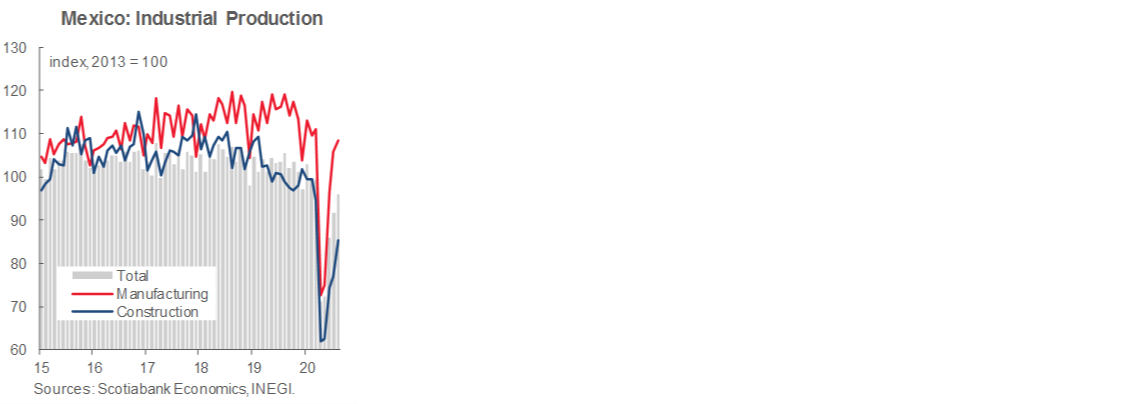
Industrial activity growth slowed from 7.1% m/m sa in July to 3.3% m/m sa in August, which was a bit better than the 2.4% m/m sa expected by consensus. This still managed to improve the annual comparison from -11.4% y/y in July to -9.0% y/y (versus consensus of -10.3% y/y). Manufacturing growth slowed sharply from 11.3% m/m in July to 0.8% m/m in August. In contrast, construction growth improved from 1.3% m/m to 11.2% m/m. As can be seen in the graph above, there has been an uneven recovery within the industrial sector, with manufacturing activity reviving more rapidly than construction. The slowing pace of the US industrial recovery, particularly in the auto sector, represents a significant challenge for Mexico’s manufacturing concerns. The August data also point to some generalized weakness in domestic demand that could persist for the rest of year owing to the degree of uncertainty in the prevailing economic outlook.
Formal job creation rose for the second consecutive month in September, according to National Institute for Social Security (IMSS) data. New jobs added rose from 92.4k in August to 113.8k in September, after five successive months of declines between March and July. In the first nine months of 2020, 719.3k positions were lost and in the last twelve months 865.3k jobs were eliminated, the worst numbers for these periods in at least 23 years.
The October 8 release of the minutes for the last Banxico monetary policy meeting on September 24 revealed an intense discussion about the proper central bank response under the current economic circumstances. Two of the five members of the Board are clearly advocating for more cuts in the reference interest rates, while the other three are expressing serious concerns, if not openly suggesting a pause, about continuing with the easing cycle. There was considerable discussion on whether the current rise in inflation would be temporary, and a lot of faith that the huge output gap will eventually curb inflation—without much consideration given to the positive impact on economic activity from additional cuts in the reference rate. In this light, we think the easing cycle is now over, although the possibility of another -25 bps cut should not be discounted entirely.
The IMF Article IV statement on Mexico was unusually rich in policy recommendations, from which the need for a significant change in fiscal strategy stands out. The IMF proposed, among other things, the provision of fiscal support on the order of 2.5% to 3.5% of GDP to limit damage to Mexico’s economic activity. They recommended that this should be accompanied by credible medium-term fiscal reform and a revision of current spending, mentioning that Pemex’s business strategy is crowding out resources for essential public expenditures. Our takeaway from the IMF recommendations is that current economic strategy is not conducive to growth and should be seriously corrected.
Finally, in an unprecedented event, the former Secretary of Defense, Salvador Cienfuegos, was arrested in the US on his arrival at the Los Angeles Airport on Friday, October 16, as requested by the US Drug Enforcement Administration (DEA). He has been charged with drug trafficking.
Over the next couple of weeks, we will receive a range of information by which we will be able to assess the pace and strength of the economic recovery in Q3. The most relevant piece of information will be the advance of GDP in Q3, to be released on Friday, October 30, but other key indicators will be the unemployment rate and trade balance figures for September, the Global Economic Indicator (IGAE) for August, financial activity and public finances numbers for September, and inflation for the first half of October, which will be a key inputs for the next monetary policy decision by Banxico on November 12.
Peru—With Elections on the Horizon, the Political Waters Have Calmed, but the Economy is Taking Its Time to Perk Up
Guillermo Arbe, Head of Economic Research
51.1.211.6052 (Peru)
guillermo.arbe@scotiabank.com.pe
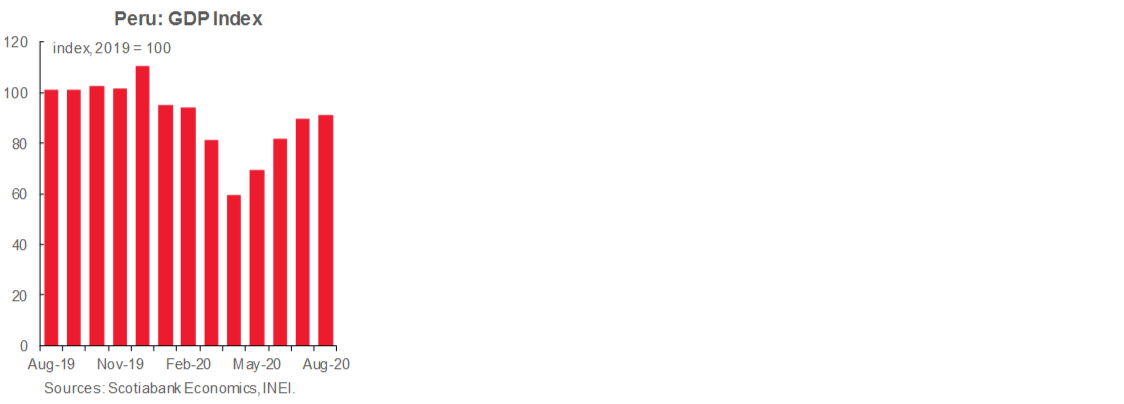
The country is now close to fully operational—albeit with capacity restrictions—and the remaining lockdowns are limited to education, tourism, and little else. GDP growth figures to August do not yet reflect the full extent of the unlocking. August GDP growth came in at a weakish -9.8% y/y, which was up only 2.4% in m/m terms.
GDP in August differed from previous pandemic months in that the sectors linked to domestic demand outperformed export sectors. This was largely because mining fell -10.2% y/y. At the same time, sectors linked to domestic demand performed in line with expectations, or better. Visibility has improved on the magnitude of the contraction, and most GDP forecasts are falling in a much narrower -11% to -13% range for 2020, broadly in line with our -11.5%.
Mining production in August felt the impact of a shortage of workers as a large number of miners were quarantined due to COVID-19. As a result, mining activity was at 83% of pre-COVID-19 levels in August, rather than the full capacity we had expected. It is our understanding that the shortage continued in September, but by October production was closer to normal. Mining investment fared even worse in August, down -43.7% y/y and -16.7% m/m.
Given the dip in mining output, the trade balance came in a tad softer than expected in August, registering a USD 321 mn surplus, about half of what we had expected. This is a relative non-issue as the trade balance is firmly positive, had been performing above expectations in previous months, and is likely to continue to do so thanks to the persistent improvement in terms of trade. The bright spot in exports was agro-industrial exports, which increased 4.9% y/y, led by blueberries.
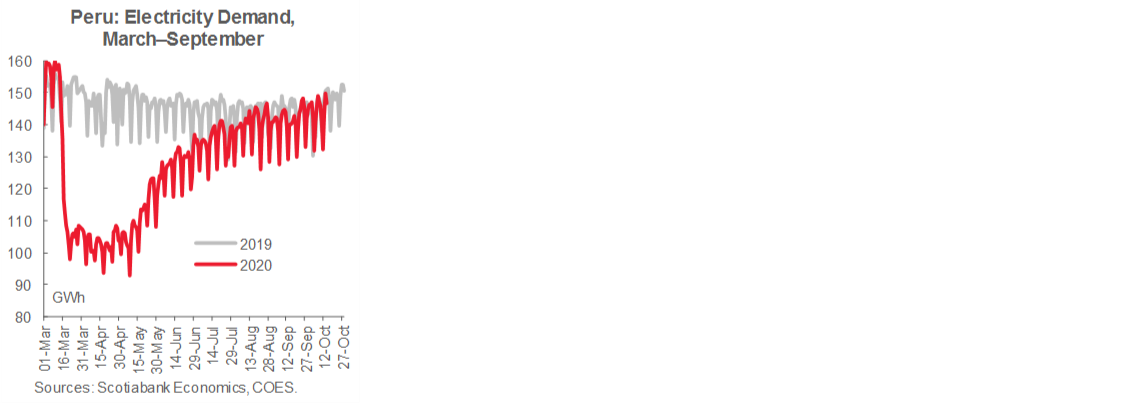
Data for more recent months is just beginning to appear. Electricity demand was down only -2% y/y in September and is trending at a positive 0.4% in the first half of October. If this trend continues, October could be the first month to see positive electricity demand growth since February, before the lockdown.
Tax revenue in September was down -19.9% y/y. Tax revenue had been improving significantly since June (when it was down -47%), but this improvement seems to have slowed at levels that are still low. Part of the reason that tax revenue has continued to lag is that tax relief measures were still extant in September. Tax revenue is trending below our expectations, but so is fiscal spending. Most fiscal deficit forecasts are also settling to around 9% of GDP for 2020, which is in line with our 8.6%.
With six months to go before the April 2021 elections, potential candidates are jockeying to place themselves on the starting line. George Forsyth, a moderate centrist with little political experience outside of his current tenure as Mayor of La Victoria, a district in Lima, is leading in the polls with about 20% vote intention (Datum, October). A group of potential candidates follow at a bit of a distance, with 4% to 5% of vote intention, including Keiko Fujimori (5%), Hernando de Soto (5%), Veronica Mendoza (4%) and Daniel Urresti (4%). Based on past elections, it is much too early in the race for this snapshot to have much more than anecdotal value. Candidates have until December 22 to register.
There are no major data releases scheduled in the calendar for the next two weeks.

| LOCAL MARKET COVERAGE | |
| CHILE | |
| Website: | Click here to be redirected |
| Subscribe: | carlos.munoz@scotiabank.cl |
| Coverage: | Spanish and English |
| COLOMBIA | |
| Website: | Forthcoming |
| Subscribe: | pirajaj@colptria.com |
| Coverage: | Spanish and English |
| MEXICO | |
| Website: | Click here to be redirected |
| Subscribe: | estudeco@scotiacb.com.mx |
| Coverage: | Spanish |
| PERU | |
| Website: | Click here to be redirected |
| Subscribe: | siee@scotiabank.com.pe |
| Coverage: | Spanish |
| COSTA RICA | |
| Website: | Click here to be redirected |
| Subscribe: | estudios.economicos@scotiabank.com |
| Coverage: | Spanish |
DISCLAIMER
This report has been prepared by Scotiabank Economics as a resource for the clients of Scotiabank. Opinions, estimates and projections contained herein are our own as of the date hereof and are subject to change without notice. The information and opinions contained herein have been compiled or arrived at from sources believed reliable but no representation or warranty, express or implied, is made as to their accuracy or completeness. Neither Scotiabank nor any of its officers, directors, partners, employees or affiliates accepts any liability whatsoever for any direct or consequential loss arising from any use of this report or its contents.
These reports are provided to you for informational purposes only. This report is not, and is not constructed as, an offer to sell or solicitation of any offer to buy any financial instrument, nor shall this report be construed as an opinion as to whether you should enter into any swap or trading strategy involving a swap or any other transaction. The information contained in this report is not intended to be, and does not constitute, a recommendation of a swap or trading strategy involving a swap within the meaning of U.S. Commodity Futures Trading Commission Regulation 23.434 and Appendix A thereto. This material is not intended to be individually tailored to your needs or characteristics and should not be viewed as a “call to action” or suggestion that you enter into a swap or trading strategy involving a swap or any other transaction. Scotiabank may engage in transactions in a manner inconsistent with the views discussed this report and may have positions, or be in the process of acquiring or disposing of positions, referred to in this report.
Scotiabank, its affiliates and any of their respective officers, directors and employees may from time to time take positions in currencies, act as managers, co-managers or underwriters of a public offering or act as principals or agents, deal in, own or act as market makers or advisors, brokers or commercial and/or investment bankers in relation to securities or related derivatives. As a result of these actions, Scotiabank may receive remuneration. All Scotiabank products and services are subject to the terms of applicable agreements and local regulations. Officers, directors and employees of Scotiabank and its affiliates may serve as directors of corporations.
Any securities discussed in this report may not be suitable for all investors. Scotiabank recommends that investors independently evaluate any issuer and security discussed in this report, and consult with any advisors they deem necessary prior to making any investment.
This report and all information, opinions and conclusions contained in it are protected by copyright. This information may not be reproduced without the prior express written consent of Scotiabank.
™ Trademark of The Bank of Nova Scotia. Used under license, where applicable.
Scotiabank, together with “Global Banking and Markets”, is a marketing name for the global corporate and investment banking and capital markets businesses of The Bank of Nova Scotia and certain of its affiliates in the countries where they operate, including, Scotiabanc Inc.; Citadel Hill Advisors L.L.C.; The Bank of Nova Scotia Trust Company of New York; Scotiabank Europe plc; Scotiabank (Ireland) Limited; Scotiabank Inverlat S.A., Institución de Banca Múltiple, Scotia Inverlat Casa de Bolsa S.A. de C.V., Scotia Inverlat Derivados S.A. de C.V. – all members of the Scotiabank group and authorized users of the Scotiabank mark. The Bank of Nova Scotia is incorporated in Canada with limited liability and is authorised and regulated by the Office of the Superintendent of Financial Institutions Canada. The Bank of Nova Scotia is authorised by the UK Prudential Regulation Authority and is subject to regulation by the UK Financial Conduct Authority and limited regulation by the UK Prudential Regulation Authority. Details about the extent of The Bank of Nova Scotia's regulation by the UK Prudential Regulation Authority are available from us on request. Scotiabank Europe plc is authorised by the UK Prudential Regulation Authority and regulated by the UK Financial Conduct Authority and the UK Prudential Regulation Authority.
Scotiabank Inverlat, S.A., Scotia Inverlat Casa de Bolsa, S.A. de C.V., and Scotia Derivados, S.A. de C.V., are each authorized and regulated by the Mexican financial authorities.
Not all products and services are offered in all jurisdictions. Services described are available in jurisdictions where permitted by law.