

HIGHLIGHTS
- Another tricky BCRP decision (where we expect a rate hold), the BCB’s meeting minutes (amid fiscal uncertainty), and Mexican, Brazilian, and Colombian CPI are next week’s Latam highlights in a generally quieter week where the global focus will be on U.S. CPI, and choppy equity and energy markets.
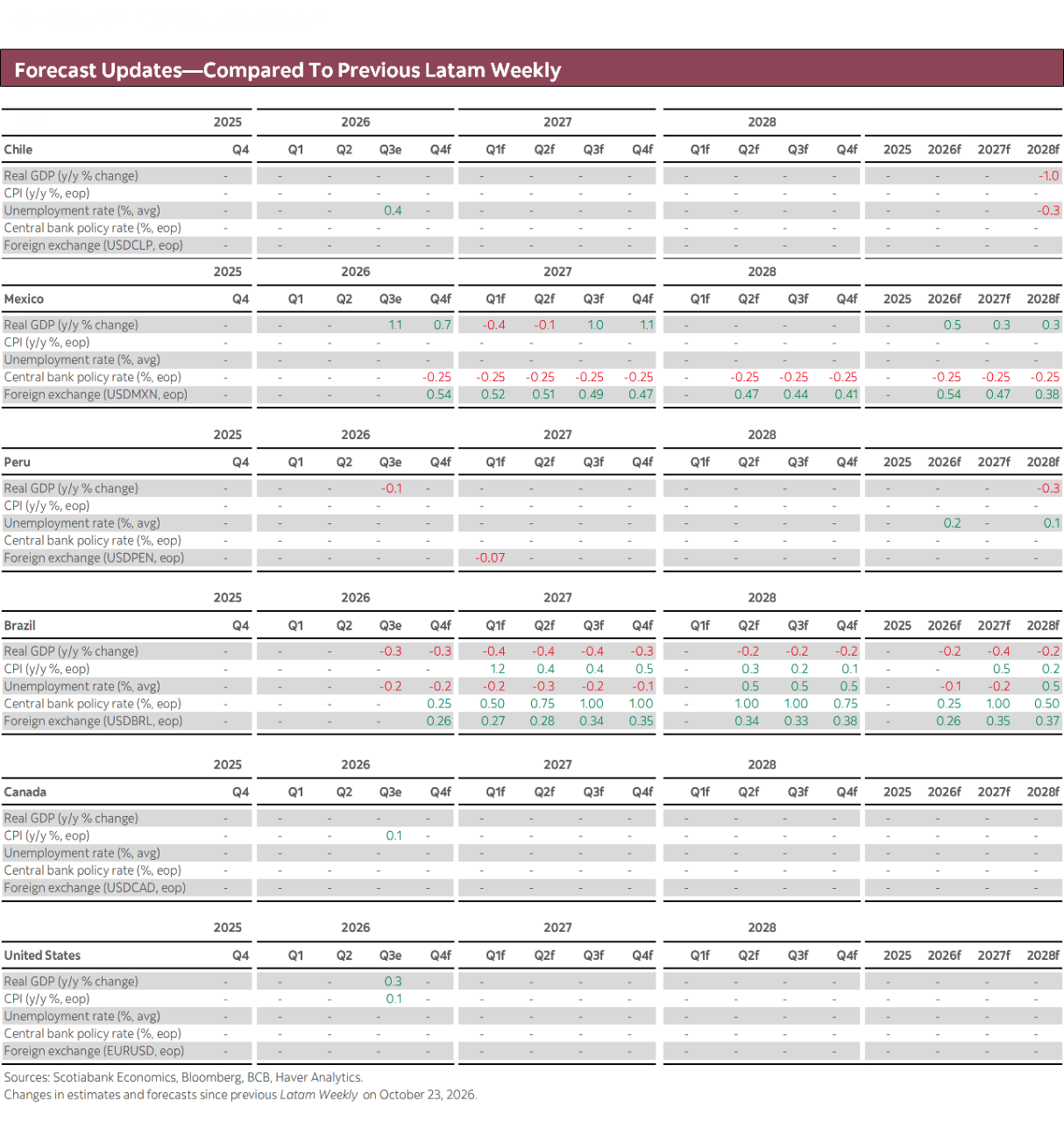
- Mexican CPI is expected to pick up in full-month October data, and recent economic figures continue a trend of outperforming expectations, challenging Banxico’s latest decision to loosen policy—even if signalling an extended period of rate stability.
- In today’s note, the team in Mexico covers the latest investment data, showing a solid recovery from last year’s contraction. This has come with a less encouraging mix of growth, however, as public investment has taken an outsized role in this rebound and private sector momentum still leaves a lot to be desired for sustained growth.
- The team in Chile discusses their expectation for a 25bps rate hike by the BCCh at next month's meeting, though this is not a guarantee as oil prices and CLP developments, alongside November's CPI print will influence this decision.
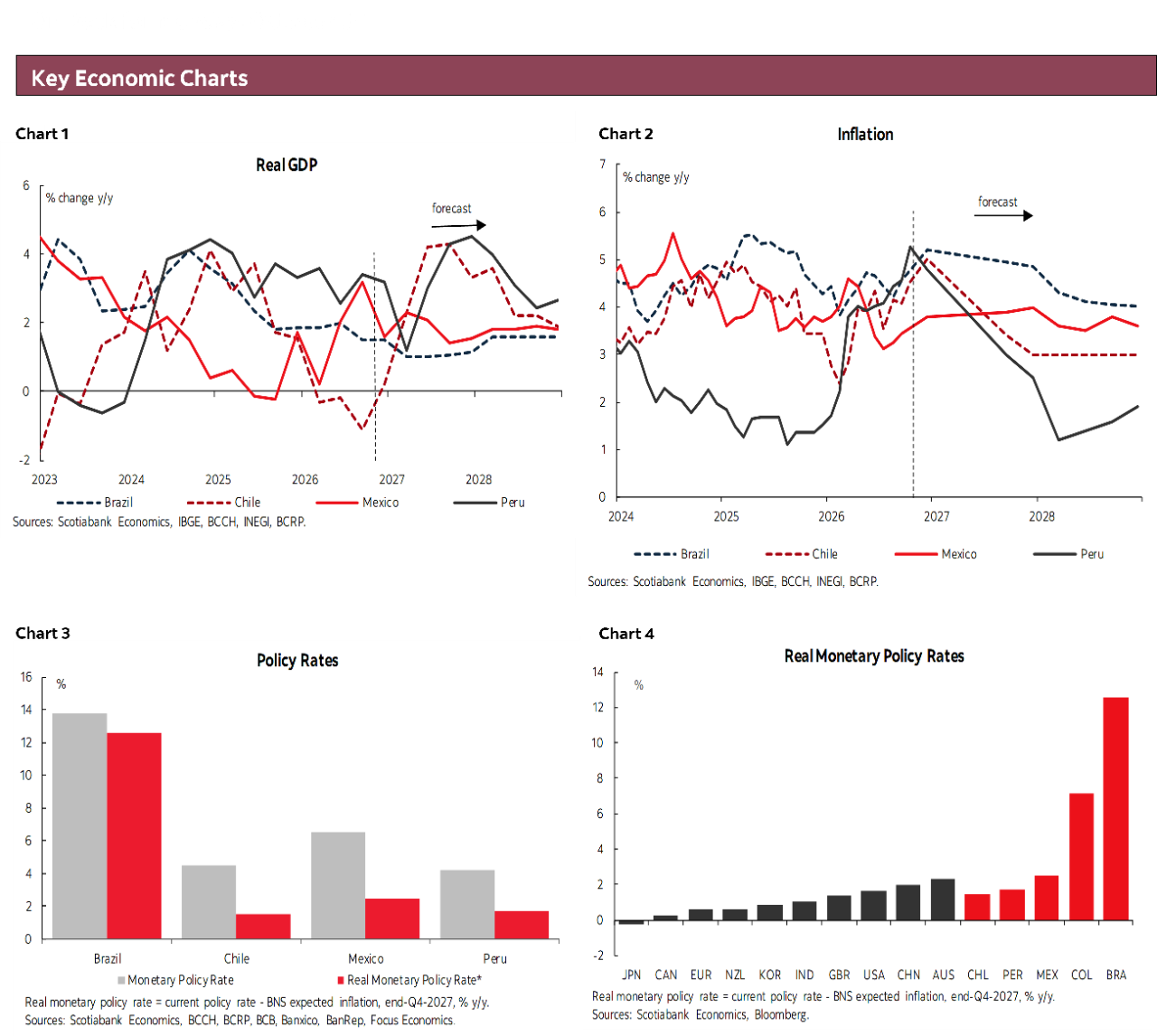
Chart of the Week
BCRP DECISION, BCB MINUTES, MEXICO AND BRAZIL CPI
Juan Manuel Herrera, Director
+52.55.2299.6675
juanmanuel.herrera@scotiabank.com
- Another tricky BCRP decision (where we expect a rate hold), the BCB’s meeting minutes (amid fiscal uncertainty), and Mexican, Brazilian, and Colombian CPI are next week’s Latam highlights in a generally quieter week where the global focus will be on U.S. CPI, and choppy equity and energy markets.
- Mexican CPI is expected to pick up in full-month October data, and recent economic figures continue a trend of outperforming expectations, challenging Banxico’s latest decision to loosen policy—even if signalling an extended period of rate stability.
- In today’s note, the team in Mexico covers the latest investment data, showing a solid recovery from last year’s contraction. This has come with a less encouraging mix of growth, however, as public investment has taken an outsized role in this rebound and private sector momentum still leaves a lot to be desired for sustained growth.
- The team in Chile discusses their expectation for a 25bps rate hike by the BCCh at next month's meeting, though this is not a guarantee as oil prices and CLP developments, alongside November's CPI print will influence this decision.
The coming week is a quieter one, with fewer but still highly relevant economic events in Latam and the G10 while the market continues to pay close attention to developments in the AI space and energy prices, after a week that saw sharp swings in equities and crude oil around the Democratic Party’s strong victory in Tuesday’s U.S. midterm elections. U.S. employment figures also came in well above forecasts, and another major central bank, the BoE, joined the ranks of rate hikers in a more hawkish than expected announcement.
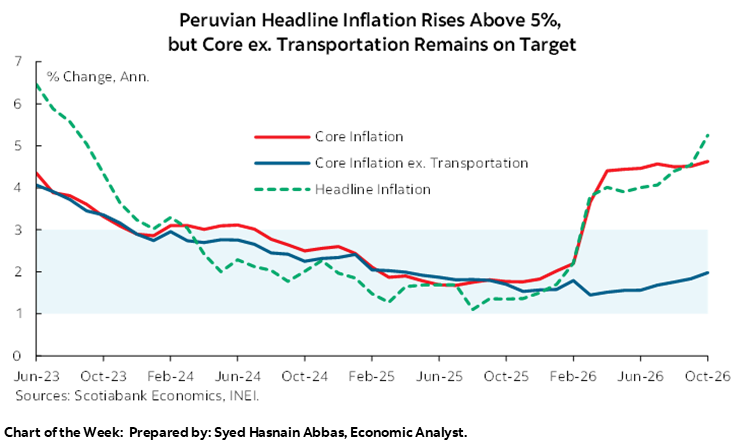
We had our own share of surprises this week in Latam. The week kicked off to a huge overshoot in Peruvian inflation for October (coming in at 5.3% vs our 4.9% y/y forecast), and Banxico delivered a 25bps rate cut yesterday—a move that wasn’t broadly expected by economists, but we concede had been somewhat teed up (see our recap here). Outside of our specific regional coverage, the impeachment/resignation of Paraguay’s president Peña amid the collapse of a major commercial bank with ties to his government also developed quickly in recent days.
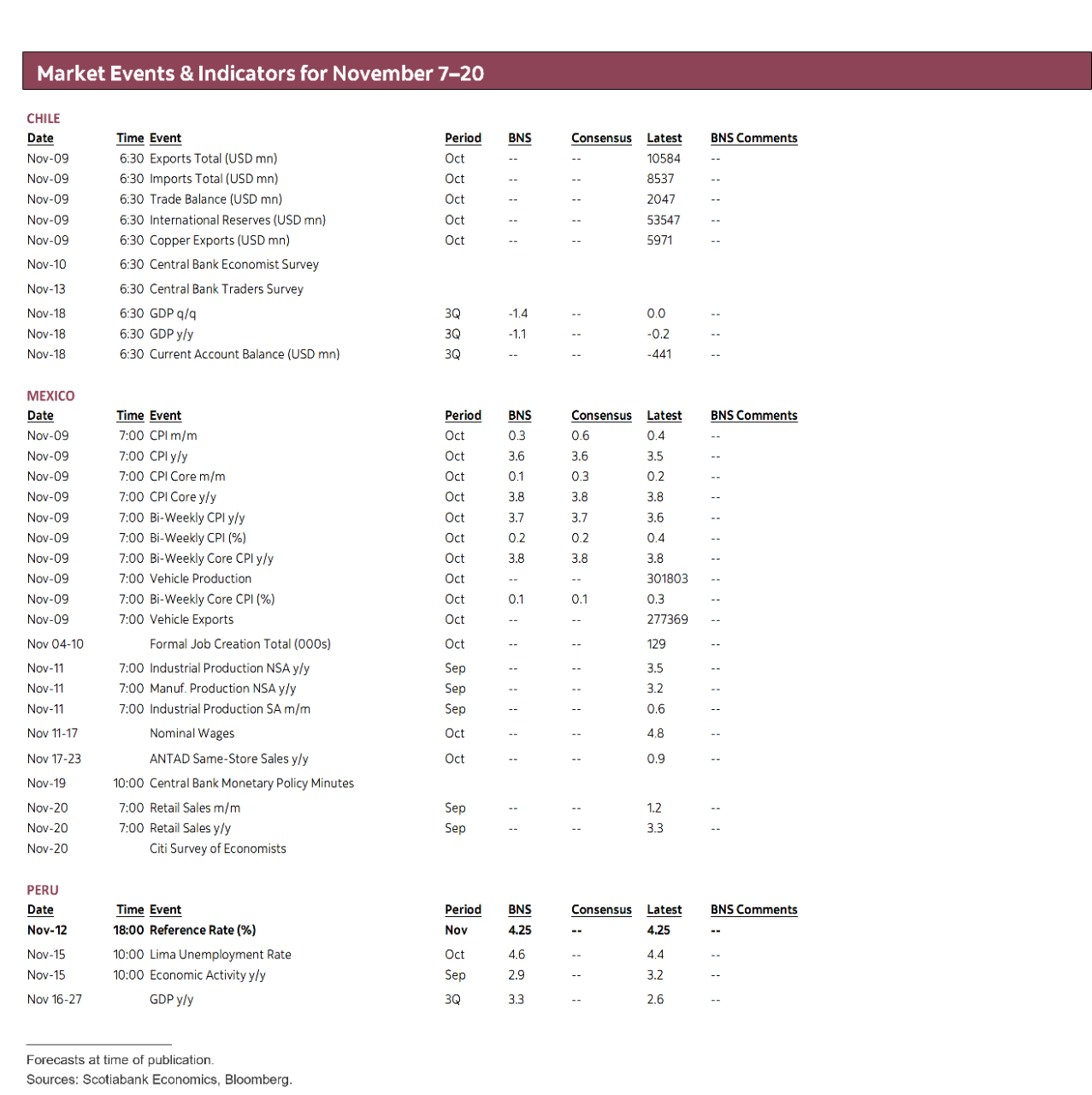
Monday brings full-month Mexican CPI figures for October that should continue to show elevated headline and core inflation—particularly in services—that, as we mention almost every week, remain significantly above a level that would augur for policy easing. The median economist polled by Bloomberg expects that headline inflation will rise to 3.65% from 3.45% with core prices ticking marginally higher to 3.78% from 3.75%—both forecasts are broadly in line with mid-month CPI results and similar to ours.
On Wednesday, we’ll watch industrial production data for August, paying close attention to the performance of electronic/technological equipment manufacturing that has been a solid source of support in recent months for Mexico’s economy—and it would seem its domestic value added is picking up, while the (mostly) assembly of these goods requires a high share of imported inputs.
That’s the other piece of the puzzle that is odds with Banxico’s latest rate cut. GDP growth has been much firmer than expected in the year-to-date. While we believe the second half of the year has been a bit less dynamic, the overall trend is of firmer growth than thought but we don’t see enough evidence that Mexico can sustain a near/above-2% pace of expansion.
In today’s note, the team in Mexico covers the latest investment data, showing a solid recovery from last year’s contraction This has come with a less encouraging mix of growth, however, as public investment has taken an outsized role in this rebound and private sector momentum still leaves a lot to be desired for sustained growth.
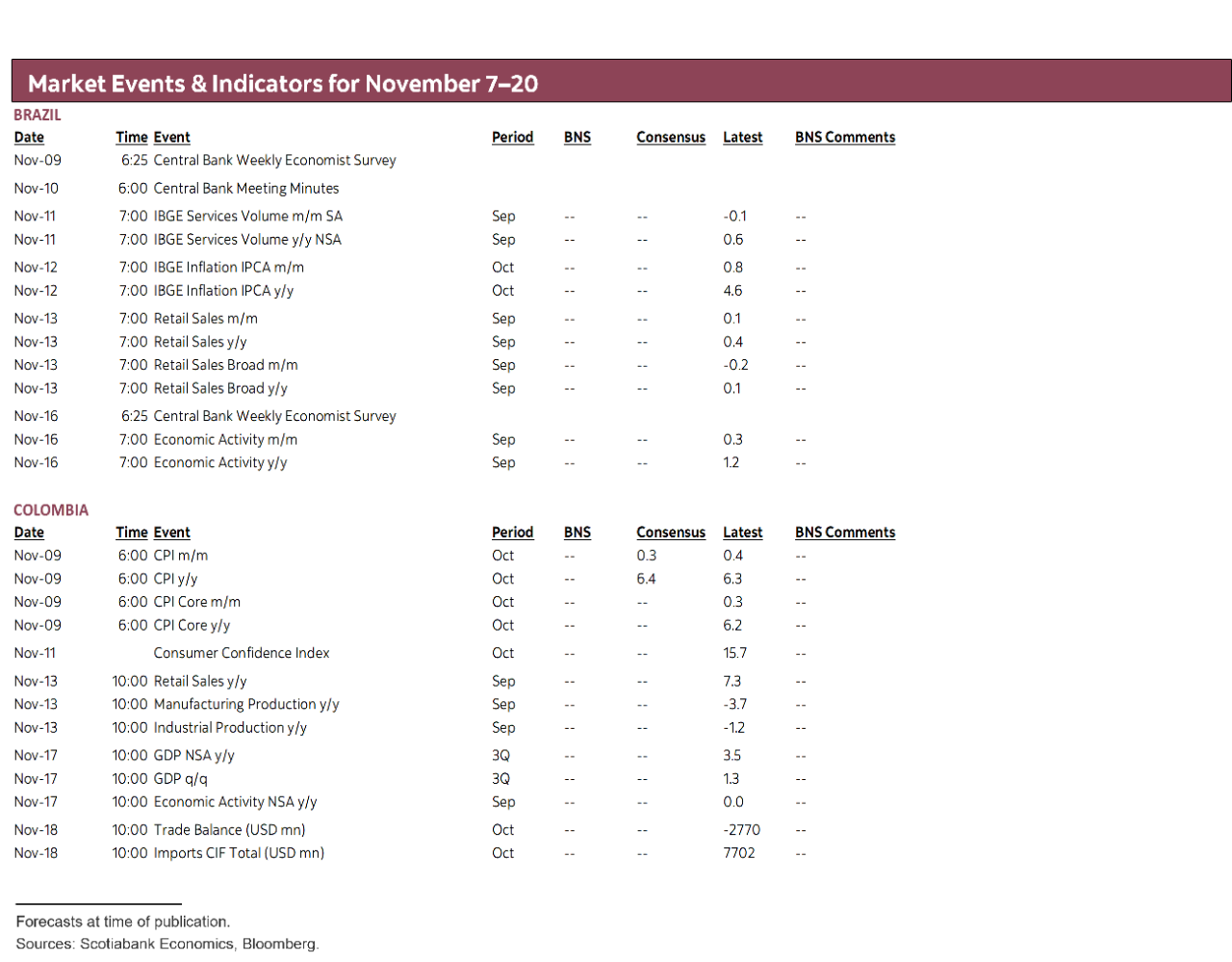
Brazil also publishes October CPI data, on Thursday, but the release should not be a relevant market mover given that we have IPCA-15 results at hand. Brazilian markets will focus on two things next week. First, the minutes to the BCB’s meeting earlier this week will be dissected for the bank’s thinking about when they may have a chance to cut rates again (or even what would trigger a hike).
With Lula’s victory in the second-round presidential election a couple of weeks ago comes a significant fiscal impulse. The recent 15% increase to Bolsa Familia payments, and campaign promises of debt relief and tax breaks for microenterprises/self-employed persons, and continued measures to curb gasoline prices, among others are expected to support growth and pressure inflation (outside of energy measures, of course).
Second, markets still don’t have much to go on regarding Lula’s fiscal plans to how he will stick to previous fiscal targets while rolling out these costly stimulus measures. Finance Minister Durigan said yesterday that the president is expected to decide on potential fiscal measures later this month, following trips to Turkey and the Philippines lasting until November 15th. It also remains to be seen who will take Durigan’s place in the next administration, with VP Alckmin and Planning Minister Moretti among the names being floated. A technocratic profile would help in cooling market fears, though Lula would have to follow their advice—and that remains to be seen.
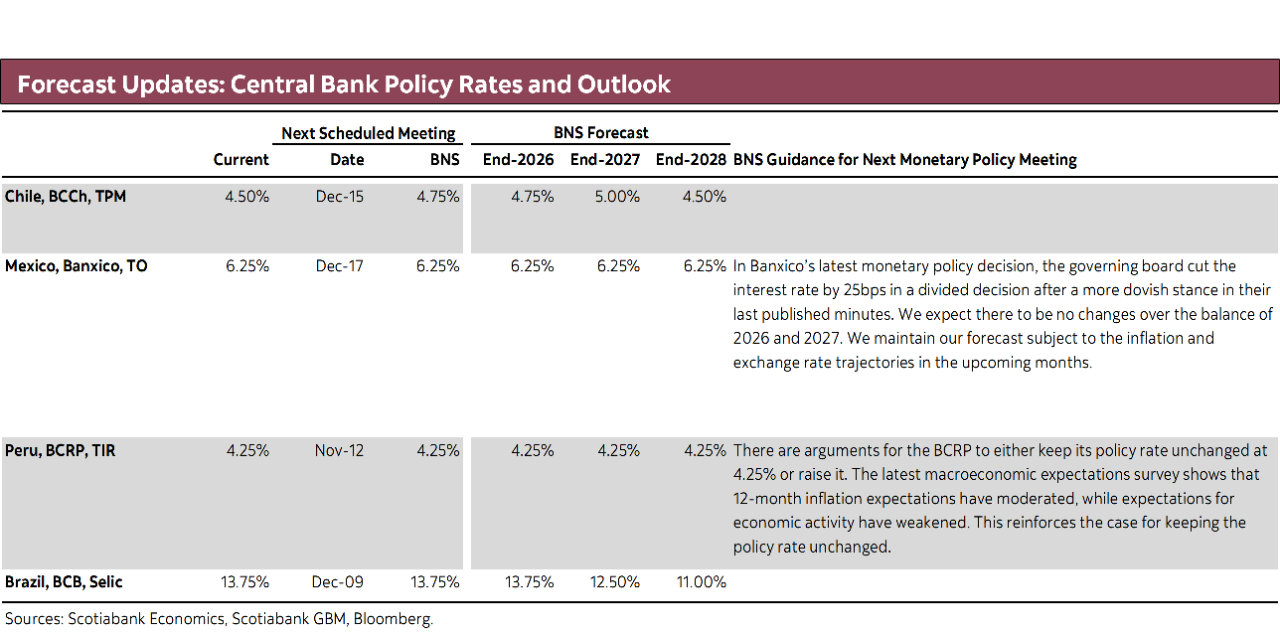
The BCRP again faces a tricky rate decision, to be announced on Thursday, where we expected another rate hold at 4.25%. As mentioned previously, October inflation came in significantly above forecasts, hitting a three-year-high in y/y terms and the 0.6% m/m increase was well higher than historical norms (you can read our team’s analysis here).
The usual suspects are to blame: El Niño and energy prices. Food and non-alcoholic beverages prices rose 1.8% due to higher agricultural prices impacted by adverse weather, and transportation prices increased 0.8% due to higher prices at the pump. High inflation remains relatively narrow, however. Prices excluding food, energy, and transportation picked up a touch from 1.8% to 2.0% y/y—where one can even place some of the blame on a low base of comparison last October.
A major input into the BCRP’s decision that has been worrying us is the trend in inflation expectations. The bank’s latest survey results published yesterday are friendly to our call for an unchanged rate. Median twelve-months-ahead inflation expectations eased a touch from 3.09% to 3.05%, showing that economists think that by late next year headline inflation will be just grazing the upper-bound of the BCRP’s target range.
While we’ve naturally seen an uptrend in inflation expectations that responds to observed data and energy/food prices risks, there has not been a material deviation from the target range and projections still reflect a view that second-round effects will not be significant. In any case, we have to warn that the BCRP can be unpredictable, so a rate hike cannot be ruled out—though it becomes more difficult to argue for a rate hikes campaign, rather than tweaks.
COUNTRY UPDATES
Chile—Probability of a Policy Rate Hike in December Increases Significantly
Anibal Alarcón, Senior Economist
+56.2.2619.5465 (Chile)
anibal.alarcon@scotiabank.cl
- In line with our expectations, the Board considered a hike in October
Since July, we have argued that despite weak domestic demand amid both domestic and external shocks, inflationary risks had increased, leading us to view a 25bp policy rate hike in December and another during Q1-27 as the baseline scenario, taking the policy rate to 5.0% during the first half of next year. At the October monetary policy meeting, the Central Bank aligned with our view by highlighting significant inflationary risks on top of other supply-side shocks, while the Minutes made it clear that the decision not to hike in October was explained almost entirely by communication considerations ahead of the publication of the December Monetary Policy Report and its corresponding policy rate corridor. Our monetary policy call, which remains at odds with market consensus, is unchanged, although we introduce some nuances in this note.
A 25bp policy rate hike at the upcoming December 15th meeting carries a high probability, although it is not fully guaranteed. The evolution of oil prices and the exchange rate over the coming weeks could affect that probability, as could November's inflation print. In our view, if inflation outcomes materialize in line with current UF forward pricing, they would be sufficient to convince the Board of the need to begin the policy tightening process. Higher inflation readings would require a higher nominal policy rate than that contemplated in the September MPR in order to maintain the real policy rate path embedded in the baseline scenario, as indicated by the Board. Additionally, at Scotiabank we estimate that the neutral policy rate currently lies between 4% and 5%, reflecting adjustments in external interest rates, wider fiscal deficits, and geopolitical conflicts, among other factors.
September GDP contains an important piece of information for the Board regarding its concerns about the recovery. In fact, September GDP showed that, in the absence of climate-related shocks, non-mining activity remained resilient, helping to partially alleviate concerns about the pace of the recovery that the Board has emphasized in its last two policy statements. October GDP will form part of the additional information available for both the December policy meeting and the MPR, but it is unlikely to be supportive (Scotia estimates a decline of between 1% and 2% y/y), as it was heavily affected by climate-related factors that also disrupted non-primary sectors. In that regard, we expect the Board to place greater weight on the September GDP reading as evidence of the economy’s relatively stronger underlying condition and its capacity to withstand an adjustment in the level of the policy rate.
Investment in Mexico: Recovery in 2026, but Challenges to Consolidate It in 2027
Rodolfo Mitchell, Director of Economic and Sectoral Analysis
+52.55.3977.4556 (Mexico)
mitchell.cervera@scotiabank.com.mx
Miguel Saldaña, Economist
+52.55.5123.1718 (Mexico)
msaldanab@scotiabank.com.mx
Martha Cordova, Economic Research Specialist
+52.55.5435.4824 (Mexico)
martha.cordovamendez@scotiabank.com.mx
Gross fixed investment has begun to show more favourable signs during 2026, following the marked deterioration seen through much of 2025. Although the recent recovery is a positive signal for growth prospects, its composition suggests maintaining a degree of caution. In particular, part of the rebound is associated with a recovery in public investment, especially in construction, while the environment for private investment remains characterized by uncertainty and relatively weak business confidence. Looking toward 2027, for investment to maintain its momentum, the private sector will need to deliver a broad-based rebound, particularly in a context in which fiscal constraints will limit the government’s ability to increase capital spending on a sustained basis.
The data available for 2026 show a significant change from the dynamics observed the previous year. In August, gross fixed investment grew 5.7% year over year, marking five consecutive months of gains after 19 straight months of contractions. The rebound continued to be led by construction, which rose 7.6% year over year, while investment in machinery and equipment advanced 3.5%. Likewise, public investment showed particularly solid growth of 11.1% year over year, while private investment increased 4.8%. Within machinery and equipment, the imported component remains stronger, growing 5.2%, compared with a gain of just 1.0% in the domestic component, suggesting that the recovery remains uneven across the different components of investment. However, on a monthly, seasonally adjusted basis, investment fell 1.8% from July, partially tempering the positive signal from the annual figures.
In this regard, the performance of public finances helps explain part of this change. Between January and September, public-sector physical investment increased 8.0% in real annual terms, following the sharp adjustment observed in 2025. Moreover, excluding Pemex, growth was 12.4% in real terms. This recovery is relevant for correctly interpreting the behaviour of gross fixed investment during 2026. This is particularly visible in construction, one of the components on which government spending has a more direct impact. Therefore, part of the recent high growth rates partly reflects a normalization effect after a particularly weak base. Nevertheless, some elements still point to caution. Business confidence remains below 50 points, and trade and financial uncertainty persist that may delay longer-term investment decisions.
For 2027, the Economic Package projects public physical investment of around 1.03 trillion pesos, equivalent to real growth of 3.5% relative to the corresponding estimate. In addition, priority investment projects account for around 560 billion pesos, including approximately 150 billion earmarked for rail projects.
Nevertheless, the investment budget will face significant constraints, given the projected 4.6% real increase in pensions and retirement benefits, while financial costs would rise 11.8%. Therefore, more sustainable growth will require private investment to take on a greater role in 2027. On the other hand, if uncertainty continues to delay business decisions, public investment could end up serving mainly as a temporary substitute for private-sector weakness, rather than becoming a catalyst.
All in all, the performance in 2026 offers a positive signal for Mexican investment, but it is still premature to interpret it as the start of a new expansionary cycle. After a prolonged period of contractions, gross fixed investment registered a change in trend, and the recovery of government physical investment contributed particularly to stronger momentum in construction. However, base effects from a depressed comparison and the still-limited strength of some private components warrant maintaining a degree of caution. Looking toward 2027, the composition of investment will likely matter more than its point-in-time growth rate. Therefore, to sustain momentum in 2027, it will be necessary to foster the conditions for the private sector to begin taking on a greater number of projects.
| LOCAL MARKET COVERAGE | ||
| CHILE | ||
| Website: | Click here to be redirected | |
| Subscribe: | anibal.alarcon@scotiabank.cl | |
| Coverage: | Spanish and English | |
| MEXICO | ||
| Website: | Click here to be redirected | |
| Subscribe: | estudeco@scotiacb.com.mx | |
| Coverage: | Spanish | |
| PERU | ||
| Website: | Click here to be redirected | |
| Subscribe: | siee@scotiabank.com.pe | |
| Coverage: | Spanish | |
DISCLAIMER
This report has been prepared by Scotiabank Economics as a resource for the clients of Scotiabank. Opinions, estimates and projections contained herein are our own as of the date hereof and are subject to change without notice. The information and opinions contained herein have been compiled or arrived at from sources believed reliable but no representation or warranty, express or implied, is made as to their accuracy or completeness. Neither Scotiabank nor any of its officers, directors, partners, employees or affiliates accepts any liability whatsoever for any direct or consequential loss arising from any use of this report or its contents.
These reports are provided to you for informational purposes only. This report is not, and is not constructed as, an offer to sell or solicitation of any offer to buy any financial instrument, nor shall this report be construed as an opinion as to whether you should enter into any swap or trading strategy involving a swap or any other transaction. The information contained in this report is not intended to be, and does not constitute, a recommendation of a swap or trading strategy involving a swap within the meaning of U.S. Commodity Futures Trading Commission Regulation 23.434 and Appendix A thereto. This material is not intended to be individually tailored to your needs or characteristics and should not be viewed as a “call to action” or suggestion that you enter into a swap or trading strategy involving a swap or any other transaction. Scotiabank may engage in transactions in a manner inconsistent with the views discussed this report and may have positions, or be in the process of acquiring or disposing of positions, referred to in this report.
Scotiabank, its affiliates and any of their respective officers, directors and employees may from time to time take positions in currencies, act as managers, co-managers or underwriters of a public offering or act as principals or agents, deal in, own or act as market makers or advisors, brokers or commercial and/or investment bankers in relation to securities or related derivatives. As a result of these actions, Scotiabank may receive remuneration. All Scotiabank products and services are subject to the terms of applicable agreements and local regulations. Officers, directors and employees of Scotiabank and its affiliates may serve as directors of corporations.
Any securities discussed in this report may not be suitable for all investors. Scotiabank recommends that investors independently evaluate any issuer and security discussed in this report, and consult with any advisors they deem necessary prior to making any investment.
This report and all information, opinions and conclusions contained in it are protected by copyright. This information may not be reproduced without the prior express written consent of Scotiabank.
™ Trademark of The Bank of Nova Scotia. Used under license, where applicable.
Scotiabank, together with “Global Banking and Markets”, is a marketing name for the global corporate and investment banking and capital markets businesses of The Bank of Nova Scotia and certain of its affiliates in the countries where they operate, including; Scotiabank Europe plc; Scotiabank (Ireland) Designated Activity Company; Scotiabank Inverlat S.A., Institución de Banca Múltiple, Grupo Financiero Scotiabank Inverlat, Scotia Inverlat Casa de Bolsa, S.A. de C.V., Grupo Financiero Scotiabank Inverlat, Scotia Inverlat Derivados S.A. de C.V. – all members of the Scotiabank group and authorized users of the Scotiabank mark. The Bank of Nova Scotia is incorporated in Canada with limited liability and is authorised and regulated by the Office of the Superintendent of Financial Institutions Canada. The Bank of Nova Scotia is authorized by the UK Prudential Regulation Authority and is subject to regulation by the UK Financial Conduct Authority and limited regulation by the UK Prudential Regulation Authority. Details about the extent of The Bank of Nova Scotia's regulation by the UK Prudential Regulation Authority are available from us on request. Scotiabank Europe plc is authorized by the UK Prudential Regulation Authority and regulated by the UK Financial Conduct Authority and the UK Prudential Regulation Authority.
Scotiabank Inverlat, S.A., Scotia Inverlat Casa de Bolsa, S.A. de C.V, Grupo Financiero Scotiabank Inverlat, and Scotia Inverlat Derivados, S.A. de C.V., are each authorized and regulated by the Mexican financial authorities.
Not all products and services are offered in all jurisdictions. Services described are available in jurisdictions where permitted by law.