

HIGHLIGHTS
- Peruvian and Brazilian economic activity figures and U.S. CPI are the standout data releases next week in an otherwise relatively quiet regional and global data calendar.
- August economic activity figures will likely continue to show sluggish growth in Brazil in the low-1s, while Peru’s economy is estimated to have expanded by 3.3% y/y, in line with our full year forecast of 3.2%.
- In today’s Weekly, the team in Mexico go over the main results of the latest Latinobarometer report, which tracks indicators regarding democracy, institutional, economic, and social and political issues for the countries in the region.
Chart of the Week
SOLID GROWTH IN PERU DESPITE HEADWINDS AGAINST A SLUGGISH BRAZILIAN ECONOMY
Juan Manuel Herrera, Director
+52.55.2299.6675
juanmanuel.herrera@scotiabank.com
- Peruvian and Brazilian economic activity figures and U.S. CPI are the standout data releases next week in an otherwise relatively quiet regional and global data calendar.
- August economic activity figures will likely continue to show sluggish growth in Brazil in the low-1s, while Peru’s economy is estimated to have expanded by 3.3% y/y, in line with our full year forecast of 3.2%.
- In today’s Weekly, the team in Mexico go over the main results of the latest Latinobarometer report, which tracks indicators regarding democracy, institutional, economic, and social and political issues for the countries in the region.
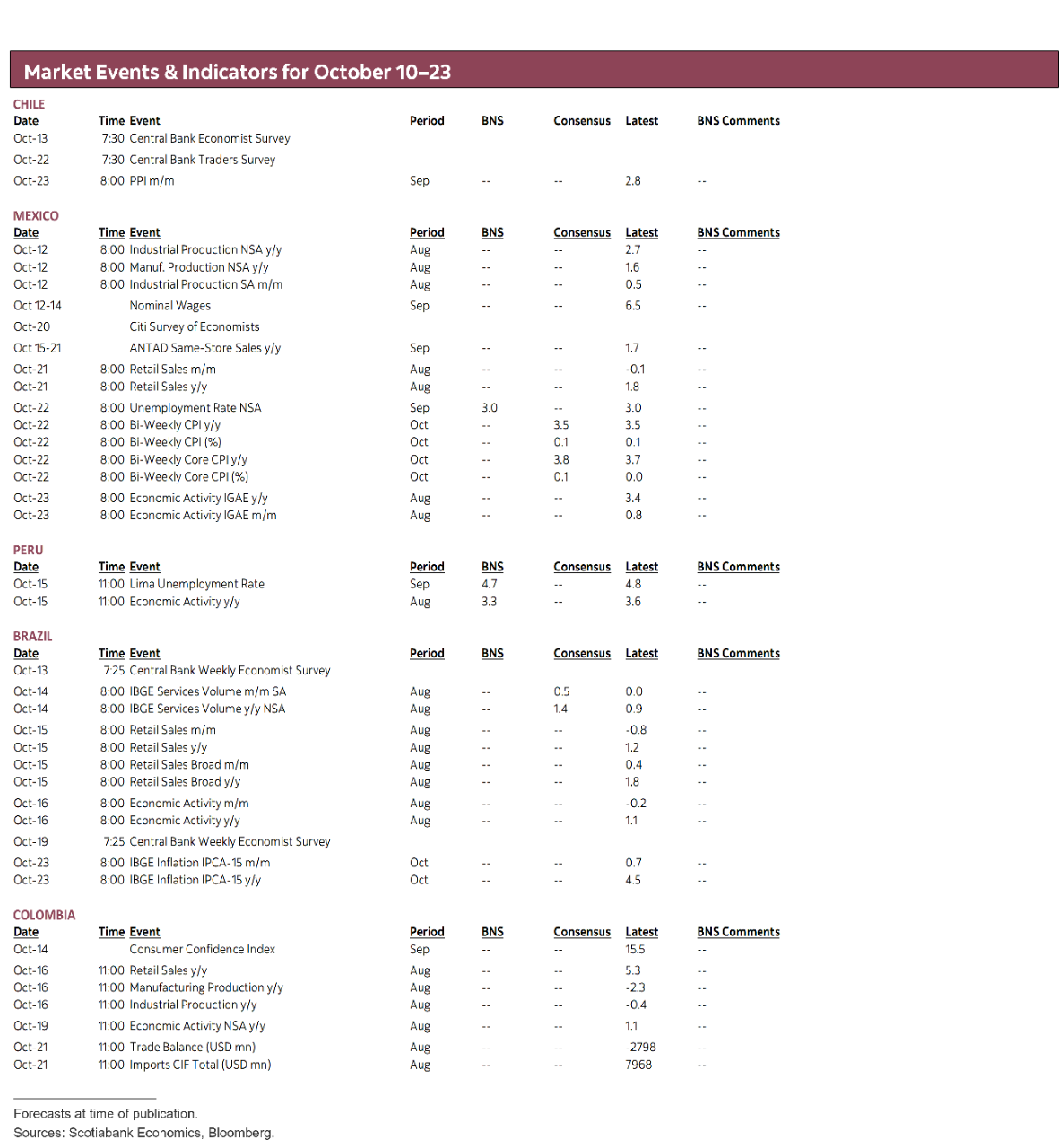
Peruvian and Brazilian economic activity figures and U.S. CPI are the standout data releases next week in an otherwise relatively quiet regional and global data calendar, while the global Q3 earnings season gathers speed. There are no major central bank decisions on tap, but a parade of speeches by policymakers awaits, complemented by the release of the IMF’s World Economic Outlook on Monday. Anxiety over rising global borrowing rates will likely continue to test market sentiment, alongside the usual headlines on Middle East or energy sector developments.
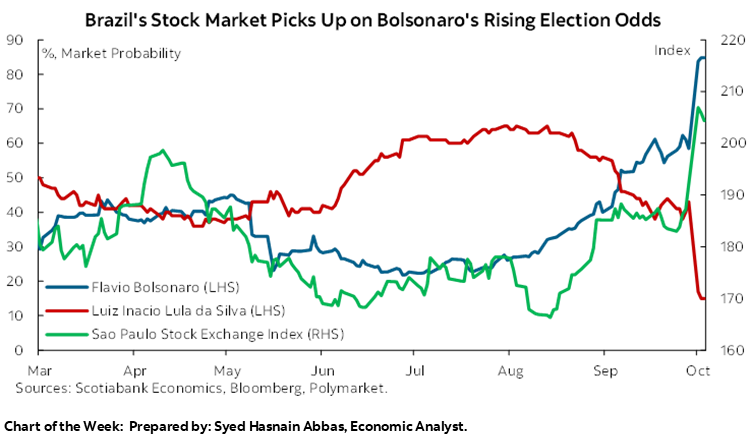
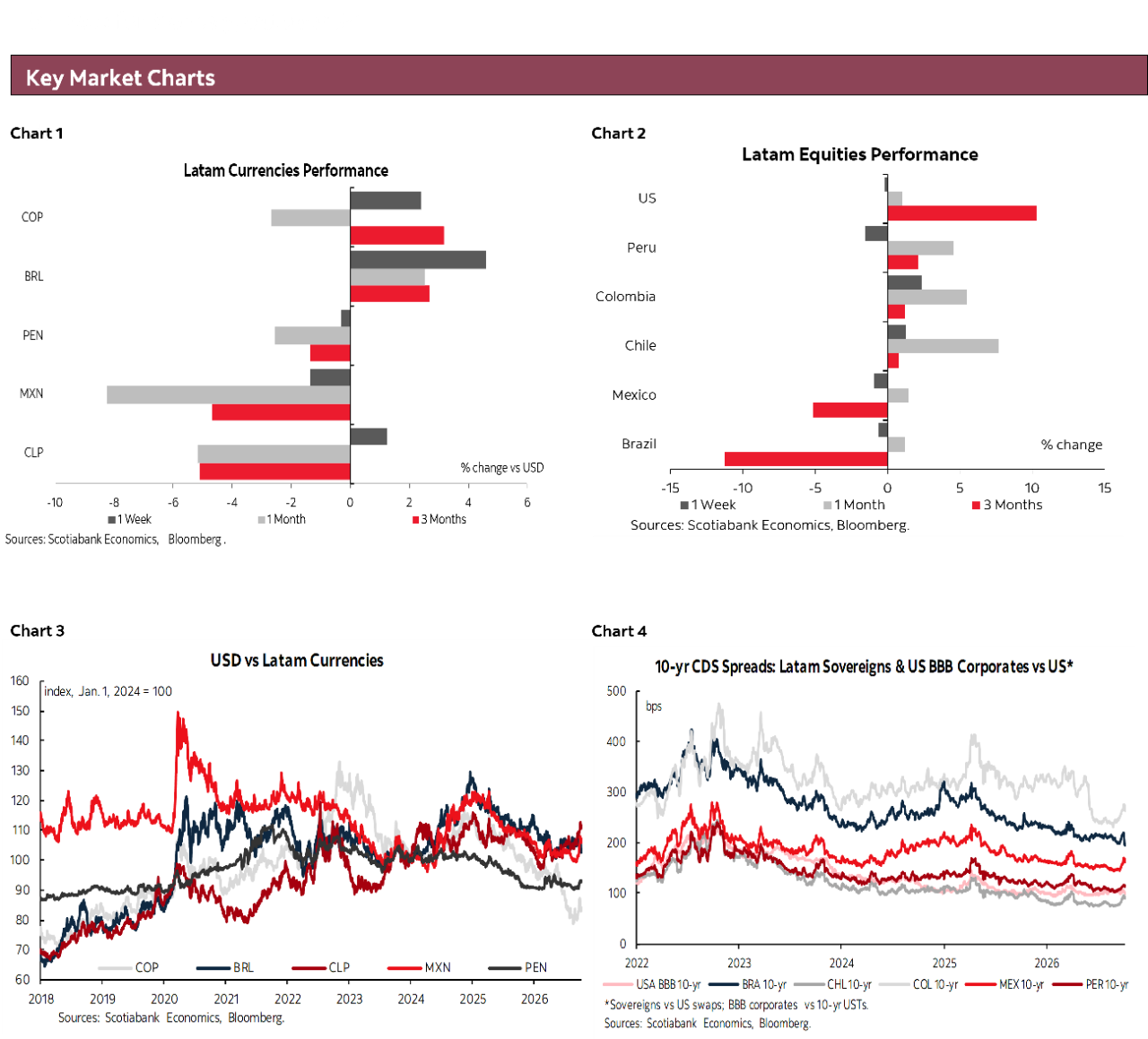
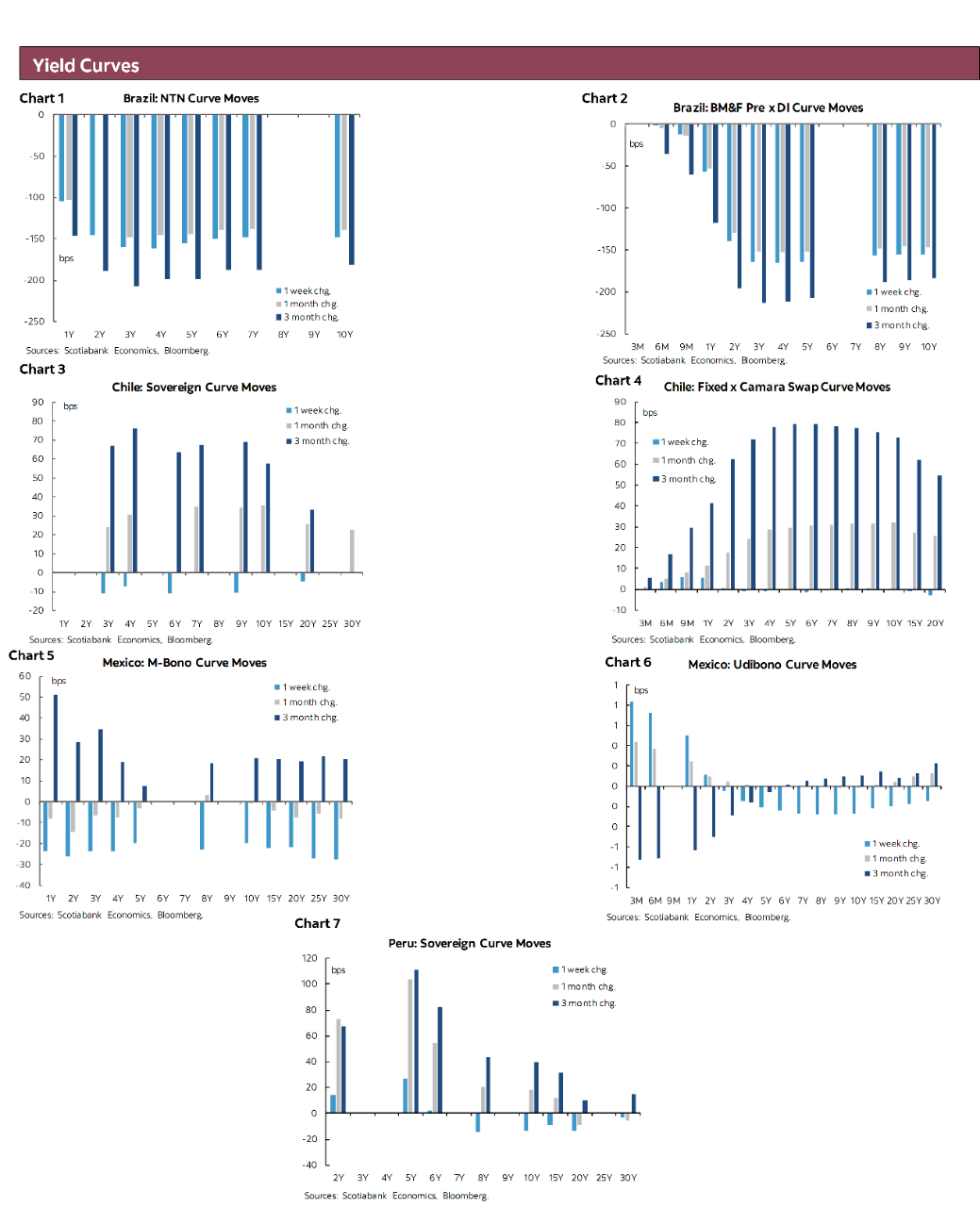
Brazilian assets have clearly bucked the shaky trend seen in other countries, with the BRL gaining close to 5% and the Bovespa equity index rising 8%+ since last Friday’s close on the back of Bolsonaro’s surprise victory against Lula in the Sunday’s vote—ahead of a second-round election on the 25th. Brazil’s yield curve also shifted well lower (e.g. -150bps+ in 10s) with traders taking higher odds of a Bolsonaro presidency as one that reduces the risk premium embedded in Brazilian debt and one that curbs fiscal support (and therefore inflation).
Markets are back to pricing in multiple additional BCB rate cuts over the next few quarters that bring their view roughly in line with that of economists surveyed by the central bank. At writing, traders are wagering on about 175bps in cumulative BCB cuts over the next twelve months, with about 45bps of these across the two remaining announcements of 2026. This time last week, the BCB’s rate was seen only 10 –15bps lower a year from now, and about 20bps by the end of 2026. As for economists, the pre-election view was that the BCB would cut by 125bps by next September, so markets have gone from cuts skepticism to now cuts euphoria relative to economists’ forecasts.
We may get a small downward adjustment in rate cut projections in the BCB’s economists survey results due on Tuesday, but this will likely be a slower grind, particularly as there remains a lot to be seen in terms of Bolsonaro’s fiscal plans (disappointment here could trigger a rebound in yields), nor is his victory guaranteed. There have been very few published polls after the first round election, but Datafolha’s latest released yesterday places Bolsonaro ahead of Lula 49% vs 45% compared to their pre-election October 3rd published results of Bolsonaro trailing 46% vs 47%.
On the data front, August economic activity figures out on Friday will likely continue to show sluggish growth in Brazil in the low-1s, after a modest 1.1% y/y expansion in July. The latest deceleration in growth has come from the services sector, which went from running at a 3mth average pace of 2.5% in May to now 1.7% as of July. We have limited data to go on for estimating the economy’s performance in August as services activity and retail sales figures for the month come out next Wednesday and Thursday. Continuing economic weakness would support the case for the BCB to roll out a quarter-point rate cut at one (or both) of its two remaining meetings this year considering that policy remains highly restrictive.
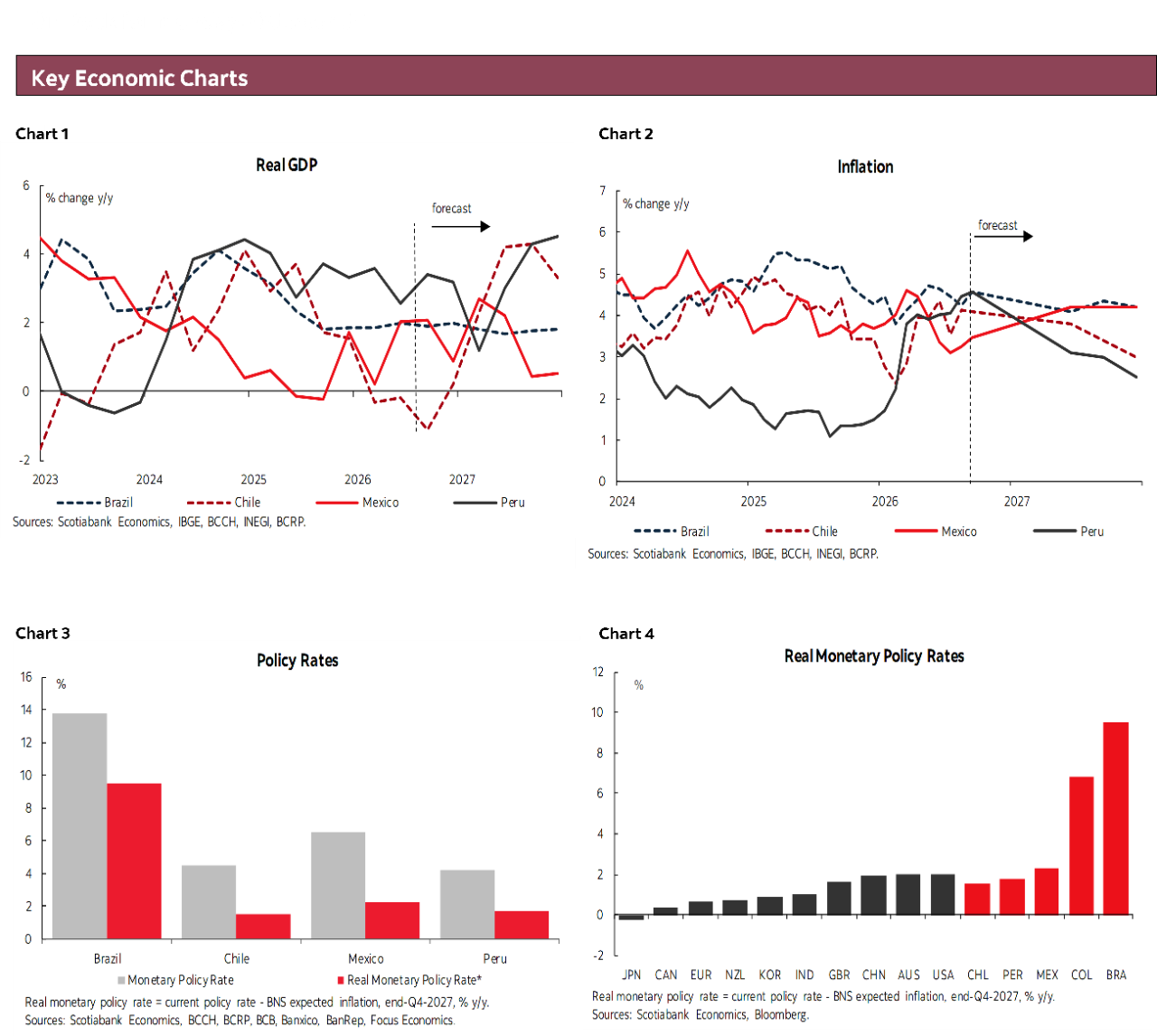
Peru publishes August GDP data on Thursday, which we expect will show a solid 3.3% y/y growth in output that is only a modest deceleration from the 3.6% recorded in July. The country’s headline GDP readings have been materially impacted by the harsh effects of El Niño, with y/y growth wobbling around as the weather phenomenon impacts the fishing, fishing processing, and mining/transportation industries; the suspension of a key gas pipeline due to a leak earlier in the year also dented aggregate economic activity.
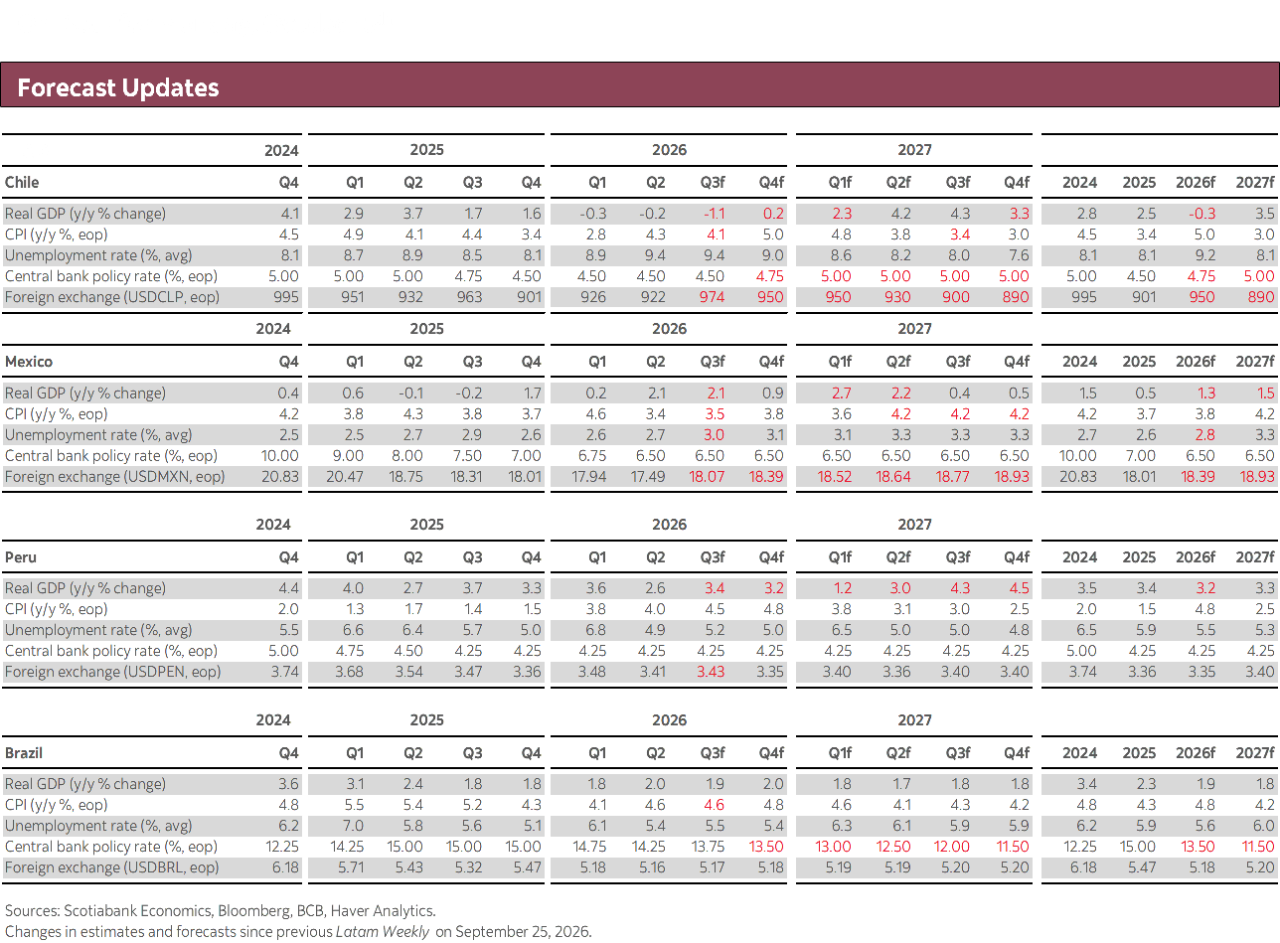
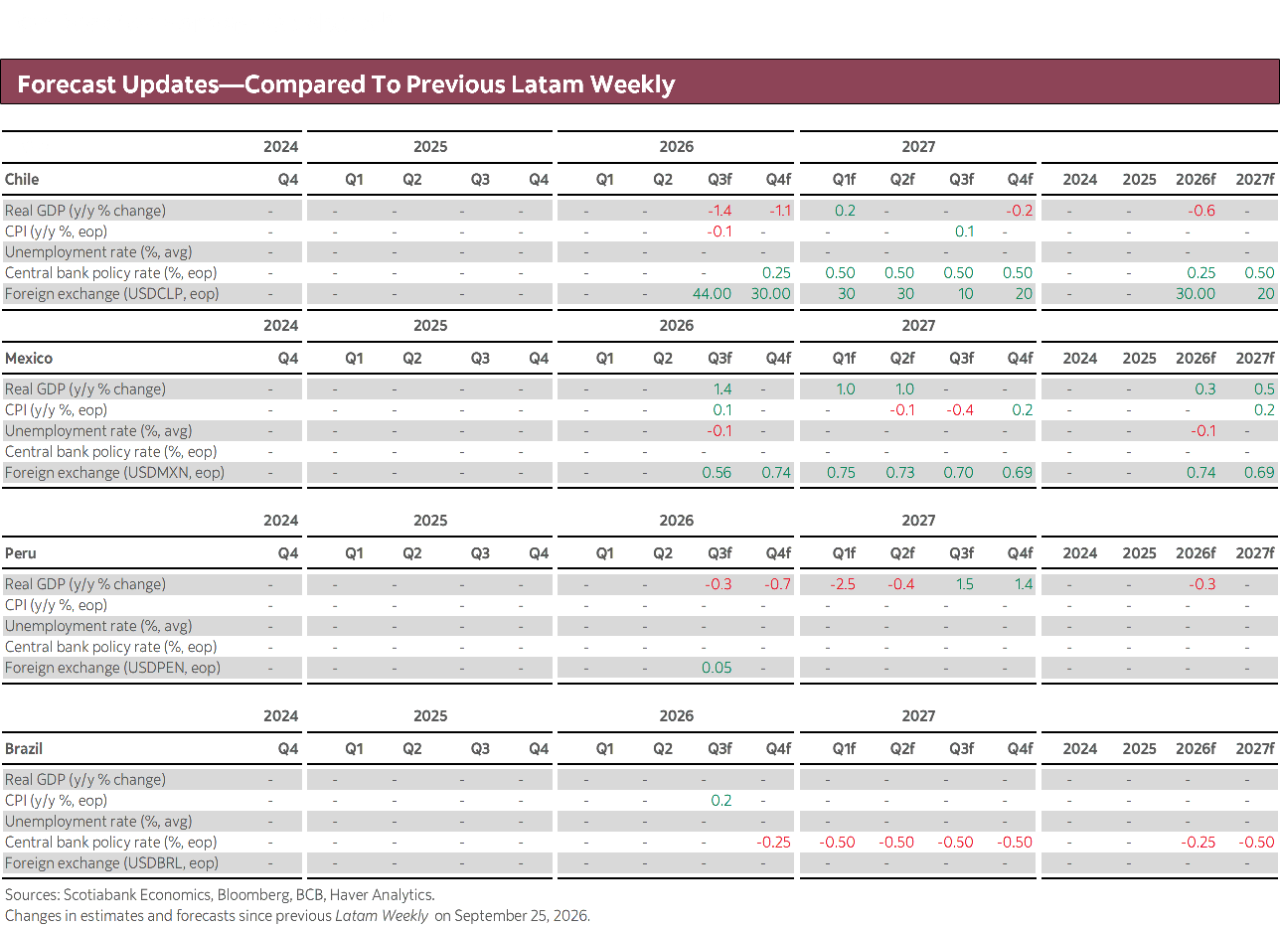
Our team in Peru recently updated their view for 2026 GDP growth (see here) to a lower forecast of 3.2% from 3.5% that combines the strong performance of domestic demand against a greater negative impact from El Niño than had been anticipated, with phenomenon now assumed to be of “extraordinary” intensity rather than “strong,” as previously thought. We estimate that fishing will contract by 27% this year, with an associated ~7% drop in raw materials manufacturing. In contrast, non-primary sectors are estimated to grow by 4.5%, a full percentage point above their expansion last year. As both the primary and non-primary sectors normalise in 2027, growth should hold around the same level (3.3%) next year, which would mean four straight years of 3%+ GDP growth.
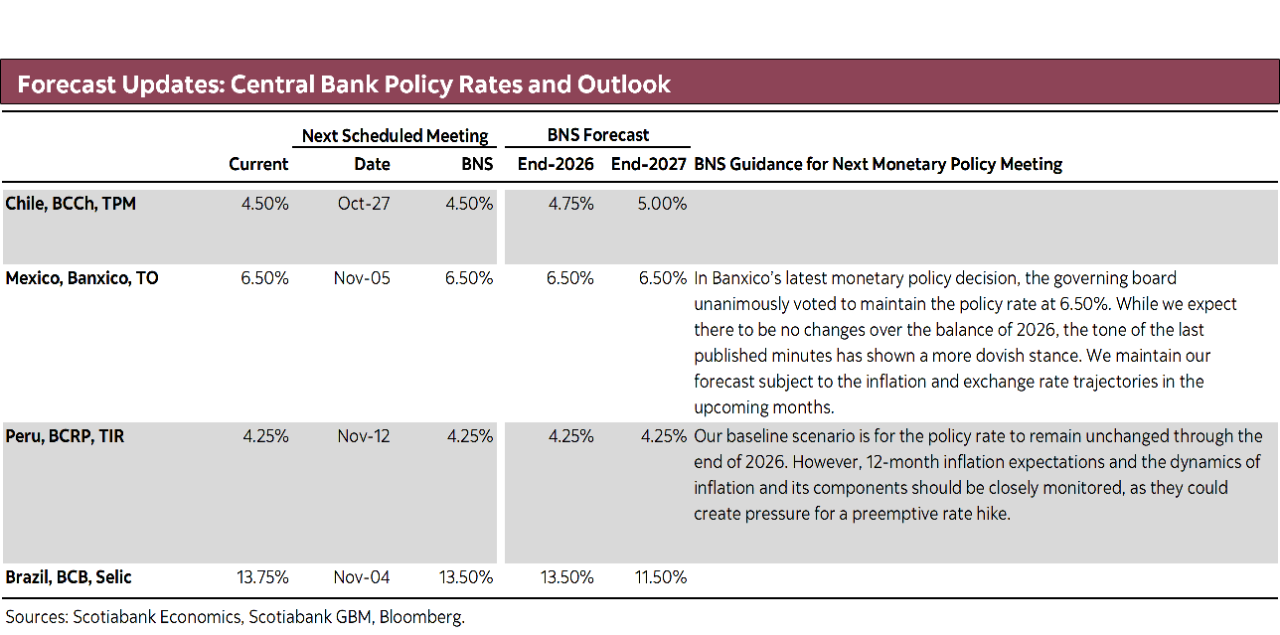
There is little of note out of Mexico and Chile next week, with the former releasing August industrial production data while the latter only has the results of the BCCh’s economists survey. In the case of Chile, we’ll see whether other economists align with our view that the central bank will now opt for a quarter-point increase at one of its next two meetings, with another to come in early-2027. As for Mexico, next week’s data are fairly irrelevant, as the main item of discussion regarding Mexico is Banxico’s dovishness. Mexico’s central bank first decoupled itself from Fed policy decisions as soon as it could at its September 23rd decision and then the minutes to that meeting showed that three of the five members of the board still consider that there is room for additional easing at the November announcement.
It is no surprise then that the MXN has sharply weakened in recent days/weeks, and the strength seen over the past few days in the BRL and COP would suggest that investors may be turning their attention to other high-yielding currencies where pro-business/market presidents have recently begun their terms (de la Espriella in Colombia) or could soon take the reins of the country (Bolsonaro). In line with Banxico’s messaging, and somewhat even ignoring their more dovish inclinations, we think the overnight rate will remain at 6.50% for the foreseeable future, although recent dynamics in the exchange rate and financial stability risks suggest that the bank could be pushed into tightening policy if the latest trends continue.
In today’s report, the team in Mexico go over the main results of the latest Latinobarometer report, which measures tracks indicators regarding democracy, institutional, economic, and social and political issues for the countries in the region.
COUNTRY UPDATES
Latinobarometer 2026: Mexico in the Latin American Context
Rodolfo Mitchell, Director of Economic and Sectoral Analysis
+52.55.3977.4556 (Mexico)
mitchell.cervera@scotiabank.com.mx
Miguel Saldaña, Economist
+52.55.5123.1718 (Mexico)
msaldanab@scotiabank.com.mx
Martha Cordova, Economic Research Specialist
+52.55.5435.4824 (Mexico)
martha.cordovamendez@scotiabank.com.mx
In early October, the Latinobarometer 2026 Report was published, one of the leading public opinion studies in Latin America. For three decades, Latinobarometer has analyzed public perceptions of democracy, institutions, the economy, and a range of social and political issues, allowing for comparisons of the trajectories of the countries covered. This edition draws on 19.2 thousand in-person interviews with adults aged 18 and older across 17 countries in the region, conducted between May and June 2026.
The results reveal a mixed picture. In 2026, 52% of Latin Americans considered democracy preferable to any other form of government, unchanged from 2024 and marking a recovery from the levels observed between 2018 and 2023. Argentina recorded the highest result, at 73%, while Guatemala posted the lowest, at 35%. In Mexico, the indicator stood at 45%, below the 49% recorded in 2024 and seven percentage points below the regional average. At the same time, broad distrust persists regarding the use of public resources: 77% of Mexicans do not trust that taxes will be well spent by the government, similar to the Latin American average of 78%. This share reaches 89% in Peru and falls to 44% in El Salvador. In addition, 35% of Mexicans believe that corruption in state institutions was reduced over the past two years, broadly in line with the regional figure of 34%, although results vary widely, from 73% in El Salvador to 18% in Peru.
Trust in institutions also shows significant differences. In Mexico, the electoral authority receives a 53% confidence rating, well above the regional average of 34% and close to Chile’s 58%, the highest level in the region; by contrast, Venezuela records 15%. Trust in the president has followed a fluctuating path: it rose from 44% in 2020 to 51.2% in 2023 and 67% in 2024, before declining to 40% in 2026. Despite this drop, the result remains above the Latin American average of 33%, within a regional range extending from 78% in El Salvador to 13% in Peru. Meanwhile, confidence in the judiciary stands at 28% in both Mexico and Latin America, while political parties register low levels in both cases, at 18% and 15%, respectively.
Security is another key component of the report. In Mexico, 88% of respondents believe that organized crime holds a great deal or a considerable amount of power, above the 79% recorded in Latin America. Relevant differences are also evident in the international sphere: while 71% of Latin Americans describe their country’s relations with the United States as good or very good, the share declines to 50% in Mexico. Similarly, only 33% of Mexicans view U.S. influence positively, compared with the regional average of 57%.
In conclusion, the regional comparison should be interpreted with caution, as a relatively more favourable position than the Latin American average does not necessarily imply a satisfactory outcome in absolute terms. The contrasts in confidence in the electoral authority, the president, the judiciary, and political parties reflect a heterogeneous institutional environment, compounded by a high perception of the power of organized crime and widespread distrust in the use of public resources. This is consistent with an environment in which the deterioration of the rule of law represents one of the most significant risks to the Mexican economy, as reflected in Banco de México’s Survey and Regional Economic Reports, where both analysts and business leaders identify weak governance as one of the main obstacles to economic growth.
| LOCAL MARKET COVERAGE | ||
| CHILE | ||
| Website: | Click here to be redirected | |
| Subscribe: | anibal.alarcon@scotiabank.cl | |
| Coverage: | Spanish and English | |
| MEXICO | ||
| Website: | Click here to be redirected | |
| Subscribe: | estudeco@scotiacb.com.mx | |
| Coverage: | Spanish | |
| PERU | ||
| Website: | Click here to be redirected | |
| Subscribe: | siee@scotiabank.com.pe | |
| Coverage: | Spanish | |
DISCLAIMER
This report has been prepared by Scotiabank Economics as a resource for the clients of Scotiabank. Opinions, estimates and projections contained herein are our own as of the date hereof and are subject to change without notice. The information and opinions contained herein have been compiled or arrived at from sources believed reliable but no representation or warranty, express or implied, is made as to their accuracy or completeness. Neither Scotiabank nor any of its officers, directors, partners, employees or affiliates accepts any liability whatsoever for any direct or consequential loss arising from any use of this report or its contents.
These reports are provided to you for informational purposes only. This report is not, and is not constructed as, an offer to sell or solicitation of any offer to buy any financial instrument, nor shall this report be construed as an opinion as to whether you should enter into any swap or trading strategy involving a swap or any other transaction. The information contained in this report is not intended to be, and does not constitute, a recommendation of a swap or trading strategy involving a swap within the meaning of U.S. Commodity Futures Trading Commission Regulation 23.434 and Appendix A thereto. This material is not intended to be individually tailored to your needs or characteristics and should not be viewed as a “call to action” or suggestion that you enter into a swap or trading strategy involving a swap or any other transaction. Scotiabank may engage in transactions in a manner inconsistent with the views discussed this report and may have positions, or be in the process of acquiring or disposing of positions, referred to in this report.
Scotiabank, its affiliates and any of their respective officers, directors and employees may from time to time take positions in currencies, act as managers, co-managers or underwriters of a public offering or act as principals or agents, deal in, own or act as market makers or advisors, brokers or commercial and/or investment bankers in relation to securities or related derivatives. As a result of these actions, Scotiabank may receive remuneration. All Scotiabank products and services are subject to the terms of applicable agreements and local regulations. Officers, directors and employees of Scotiabank and its affiliates may serve as directors of corporations.
Any securities discussed in this report may not be suitable for all investors. Scotiabank recommends that investors independently evaluate any issuer and security discussed in this report, and consult with any advisors they deem necessary prior to making any investment.
This report and all information, opinions and conclusions contained in it are protected by copyright. This information may not be reproduced without the prior express written consent of Scotiabank.
™ Trademark of The Bank of Nova Scotia. Used under license, where applicable.
Scotiabank, together with “Global Banking and Markets”, is a marketing name for the global corporate and investment banking and capital markets businesses of The Bank of Nova Scotia and certain of its affiliates in the countries where they operate, including; Scotiabank Europe plc; Scotiabank (Ireland) Designated Activity Company; Scotiabank Inverlat S.A., Institución de Banca Múltiple, Grupo Financiero Scotiabank Inverlat, Scotia Inverlat Casa de Bolsa, S.A. de C.V., Grupo Financiero Scotiabank Inverlat, Scotia Inverlat Derivados S.A. de C.V. – all members of the Scotiabank group and authorized users of the Scotiabank mark. The Bank of Nova Scotia is incorporated in Canada with limited liability and is authorised and regulated by the Office of the Superintendent of Financial Institutions Canada. The Bank of Nova Scotia is authorized by the UK Prudential Regulation Authority and is subject to regulation by the UK Financial Conduct Authority and limited regulation by the UK Prudential Regulation Authority. Details about the extent of The Bank of Nova Scotia's regulation by the UK Prudential Regulation Authority are available from us on request. Scotiabank Europe plc is authorized by the UK Prudential Regulation Authority and regulated by the UK Financial Conduct Authority and the UK Prudential Regulation Authority.
Scotiabank Inverlat, S.A., Scotia Inverlat Casa de Bolsa, S.A. de C.V, Grupo Financiero Scotiabank Inverlat, and Scotia Inverlat Derivados, S.A. de C.V., are each authorized and regulated by the Mexican financial authorities.
Not all products and services are offered in all jurisdictions. Services described are available in jurisdictions where permitted by law.