

We have revised our 2026 GDP growth forecast downward from 3.5% to 3.2% (table 1). The primary reason is that we now assume a Coastal El Niño phenomenon of “Extraordinary” intensity, rather than the “Strong” intensity considered in our July forecast. This is already having a greater negative impact on primary sectors so far this year and is expected to cause these sectors collectively to contract by nearly 2% in 2026, compared to our previous forecast of a 0.7% decline.
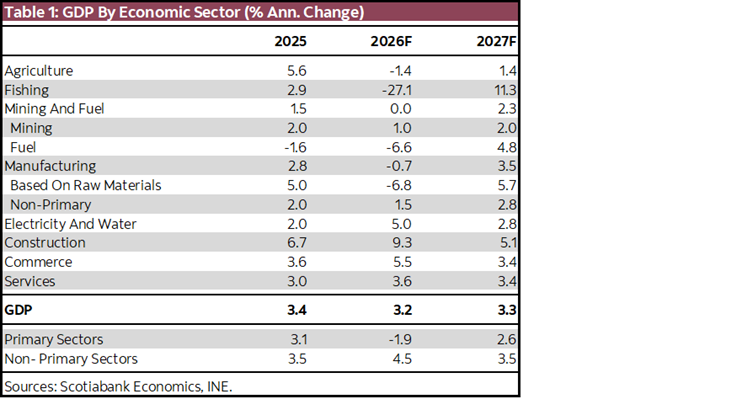
However, we maintain our forecast of approximately 4.5% growth for non-primary sectors linked to domestic demand, driven by improved business and consumer confidence following the presidential runoff election in June. Consequently, we anticipate record sales of new homes in Lima and all-time high sales of new vehicles nationwide. The expansion of formal employment, supported by double-digit private investment growth, rising real wages (despite a rebound in inflation), and positive trends in consumer credit are boosting sectors such as construction, commerce, and services.
PRIMARY SECTORS
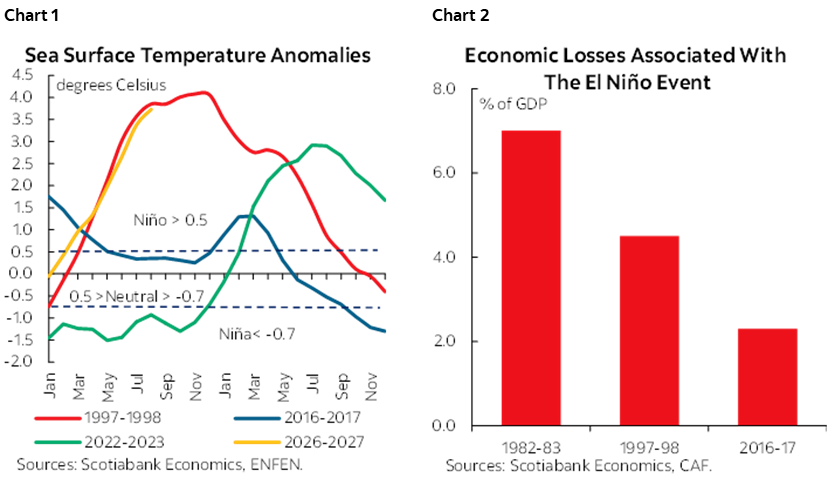
The latest statement from the Multisectoral Commission in charge of the national study on the El Niño phenomenon (ENFEN) indicates that, as of August, the Coastal El Niño developing off Peru’s coast reached “Extraordinary” intensity. This level is expected to persist until January before gradually weakening and concluding during the second quarter of 2027.
The current warming of sea waters resembles the “Extraordinary” El Niño phenomenon of 1997–98 (chart 1), which reduced growth by 1.7 percentage points and generated economic losses of nearly US$ 3.5 billion, equivalent to 4.5% of that year's GDP (chart 2). According to our latest projections, the current El Niño phenomenon (FEN) is expected to shave approximately 1 percentage point off GDP growth in 2026.
The fishing sector (-27.1%) would be primarily affected by reduced anchoveta catches due to the intensity and duration of the FEN. Anchoveta, a cold-water species that is the backbone of Peru's fishing industry, tents to migrate southward or move to deeper waters when sea temperatures rise, making it harder for the industrial fleet to catch. During the first fishing season in the north-central region (April–July), anchoveta landings hovered around 472,000 tons, compared to 2.5 million tons the previous year. Furthermore, the persistence of warm waters during the second half of the year would impact the second season (November–January); as a result, the anchoveta catch is projected to be around 1.5 million tons in 2026 (-65%)—the lowest catch level since 1998, when the last “extraordinary” FEN occurred. This would also affect fish-meal production, with a consequent impact on the primary manufacturing sector (-6.8%). This decline would be partially offset by slight growth in catches of species for direct human consumption (DHC), driven by greater availability of jumbo flying squid as well as warm-water species such as bonito and mahi-mahi, among others.
The agricultural and livestock sector (-1.4%) is expected to experience a greater-than-anticipated negative impact due to unusually high temperatures associated with the “extraordinary” El Niño phenomenon; these conditions hinder proper crop development and increase pest prevalence, thereby affecting yields. Furthermore, regarding crops destined for export, a smaller percentage of the harvest meets the optimal conditions for shipment abroad, impacting export volumes for products such as mangoes, blueberries, grapes, and avocados, among others. In addition to the above-normal rainfall expected from December onward, particularly along the northern coast, below-normal rainfall is likely in the central and southern highlands due to the Global El Niño (like the “extraordinary” event of 1981–1982). This could impact crops destined for the domestic market during the first half of 2027.
The mining and hydrocarbons sectors are to remain broadly unchanged in 2026 (0.0%), broadly in line with previous estimates. Mining output (+1%) is unlikely to show significant momentum despite high metal prices, given the absence of major new mining projects starting operations this year. Copper and gold production would post modest increases, while iron ore production would grow at a double-digit rate due to a statistical rebound following the logistical issues experienced by Shougang Hierro Perú in 2025Q2. Zinc production is expected to decline as Antamina continues to extract ore with a higher copper content, at the expense of zinc output. Regarding the hydrocarbons subsector (-6.6%), the decline would be slightly steeper than initially expected. In addition to temporary reduction in natural gas and natural gas liquids production following the March incident on the Camisea gas pipeline, maintenance work at Block 95, the country's largest oil field, temporarily reduced crude oil production during 2026Q3.
NON-PRIMARY SECTORS
The construction sector (+9.3%) would lead GDP growth, driven primarily by the favourable trend in private investment. All major components of private investment are currently expanding. Diversified investment, excluding mining and residential, stands out, particularly in transport infrastructure, energy, industrial, and commercial projects, supported by significantly improved post-election business expectations (chart 3). Meanwhile, mining investment would continue to benefit from high mineral prices, though it remains concentrated on operational efficiency improvements and brownfield projects in the absence of major greenfield projects, with Tía María being the main exception. Residential investment should also maintain its positive trajectory, supported by a growing wage bill, which is encouraging self-construction activities such as home expansions and renovations, and by mortgage rates that remain below historical averages, continuing to support mortgage lending and sales of new formal housing in Lima.
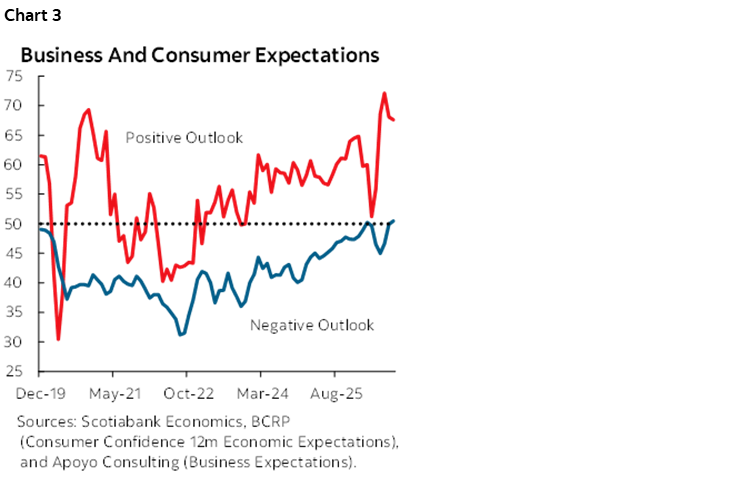
The commerce sector (+5.5%) would record its highest annual growth rate since 2012, excluding the post-pandemic rebound. This performance is supported by employment growth, with 240,000 formal private-sector jobs created nationwide in the first half of 2026, rising wages (up nearly 5% during the same period), and consumer credit driven by low delinquency rates and more competitive lending conditions. Retail sales continue to show strong momentum, particularly in supermarkets, department stores, home furnishings, and hardware and home improvement stores. Additionally, new vehicle sales are expected to hit record highs, supported by consumer confidence that has returned to pre-pandemic levels, higher incomes, and a stronger Sol, which reduces the local-currency price of new imported vehicles.
The services sector (+3.6%) is expected to show an acceleration in its growth rate, particularly in activities linked to consumption and private investment. As a result, restaurants and hotels, other services (particularly personal services), and business services (including marketing, security, outsourcing, and consulting) are likely to outperform the sector average. The acceleration in the financial services is also noteworthy, reflecting stronger credit demand from both businesses and individuals.
Finally, non-primary manufacturing (+1.5%) would show divergent performance trends. On one hand, industries linked to the construction sector, such as cement, steel, bricks, and ceramic flooring and tiling, as well as capital goods manufacturing, are expected to benefit from private investment. On the other hand, the consumer goods industry would show mixed results. Food industry should remain resilient, supported by stronger private consumption drives and warmer weather associated with El Niño, which tend to boost demand for beverages. Other industries are expected to be negatively affected, particularly textiles and apparel due to weaker winter-related demand and lower export volumes to the US. Personal care and cleaning products are also facing stronger competition from imports.
Despite the increasingly severe impact of El Niño on primary sectors, we expect Peru's economy to grow by 3.2% in 2026, as resilient domestic demand continues to offset weather-related disruptions and support activity across non-primary sectors.
DISCLAIMER
This report has been prepared by Scotiabank Economics as a resource for the clients of Scotiabank. Opinions, estimates and projections contained herein are our own as of the date hereof and are subject to change without notice. The information and opinions contained herein have been compiled or arrived at from sources believed reliable but no representation or warranty, express or implied, is made as to their accuracy or completeness. Neither Scotiabank nor any of its officers, directors, partners, employees or affiliates accepts any liability whatsoever for any direct or consequential loss arising from any use of this report or its contents.
These reports are provided to you for informational purposes only. This report is not, and is not constructed as, an offer to sell or solicitation of any offer to buy any financial instrument, nor shall this report be construed as an opinion as to whether you should enter into any swap or trading strategy involving a swap or any other transaction. The information contained in this report is not intended to be, and does not constitute, a recommendation of a swap or trading strategy involving a swap within the meaning of U.S. Commodity Futures Trading Commission Regulation 23.434 and Appendix A thereto. This material is not intended to be individually tailored to your needs or characteristics and should not be viewed as a “call to action” or suggestion that you enter into a swap or trading strategy involving a swap or any other transaction. Scotiabank may engage in transactions in a manner inconsistent with the views discussed this report and may have positions, or be in the process of acquiring or disposing of positions, referred to in this report.
Scotiabank, its affiliates and any of their respective officers, directors and employees may from time to time take positions in currencies, act as managers, co-managers or underwriters of a public offering or act as principals or agents, deal in, own or act as market makers or advisors, brokers or commercial and/or investment bankers in relation to securities or related derivatives. As a result of these actions, Scotiabank may receive remuneration. All Scotiabank products and services are subject to the terms of applicable agreements and local regulations. Officers, directors and employees of Scotiabank and its affiliates may serve as directors of corporations.
Any securities discussed in this report may not be suitable for all investors. Scotiabank recommends that investors independently evaluate any issuer and security discussed in this report, and consult with any advisors they deem necessary prior to making any investment.
This report and all information, opinions and conclusions contained in it are protected by copyright. This information may not be reproduced without the prior express written consent of Scotiabank.
™ Trademark of The Bank of Nova Scotia. Used under license, where applicable.
Scotiabank, together with “Global Banking and Markets”, is a marketing name for the global corporate and investment banking and capital markets businesses of The Bank of Nova Scotia and certain of its affiliates in the countries where they operate, including; Scotiabank Europe plc; Scotiabank (Ireland) Designated Activity Company; Scotiabank Inverlat S.A., Institución de Banca Múltiple, Grupo Financiero Scotiabank Inverlat, Scotia Inverlat Casa de Bolsa, S.A. de C.V., Grupo Financiero Scotiabank Inverlat, Scotia Inverlat Derivados S.A. de C.V. – all members of the Scotiabank group and authorized users of the Scotiabank mark. The Bank of Nova Scotia is incorporated in Canada with limited liability and is authorised and regulated by the Office of the Superintendent of Financial Institutions Canada. The Bank of Nova Scotia is authorized by the UK Prudential Regulation Authority and is subject to regulation by the UK Financial Conduct Authority and limited regulation by the UK Prudential Regulation Authority. Details about the extent of The Bank of Nova Scotia's regulation by the UK Prudential Regulation Authority are available from us on request. Scotiabank Europe plc is authorized by the UK Prudential Regulation Authority and regulated by the UK Financial Conduct Authority and the UK Prudential Regulation Authority.
Scotiabank Inverlat, S.A., Scotia Inverlat Casa de Bolsa, S.A. de C.V, Grupo Financiero Scotiabank Inverlat, and Scotia Inverlat Derivados, S.A. de C.V., are each authorized and regulated by the Mexican financial authorities.
Not all products and services are offered in all jurisdictions. Services described are available in jurisdictions where permitted by law.