

HIGHLIGHTS
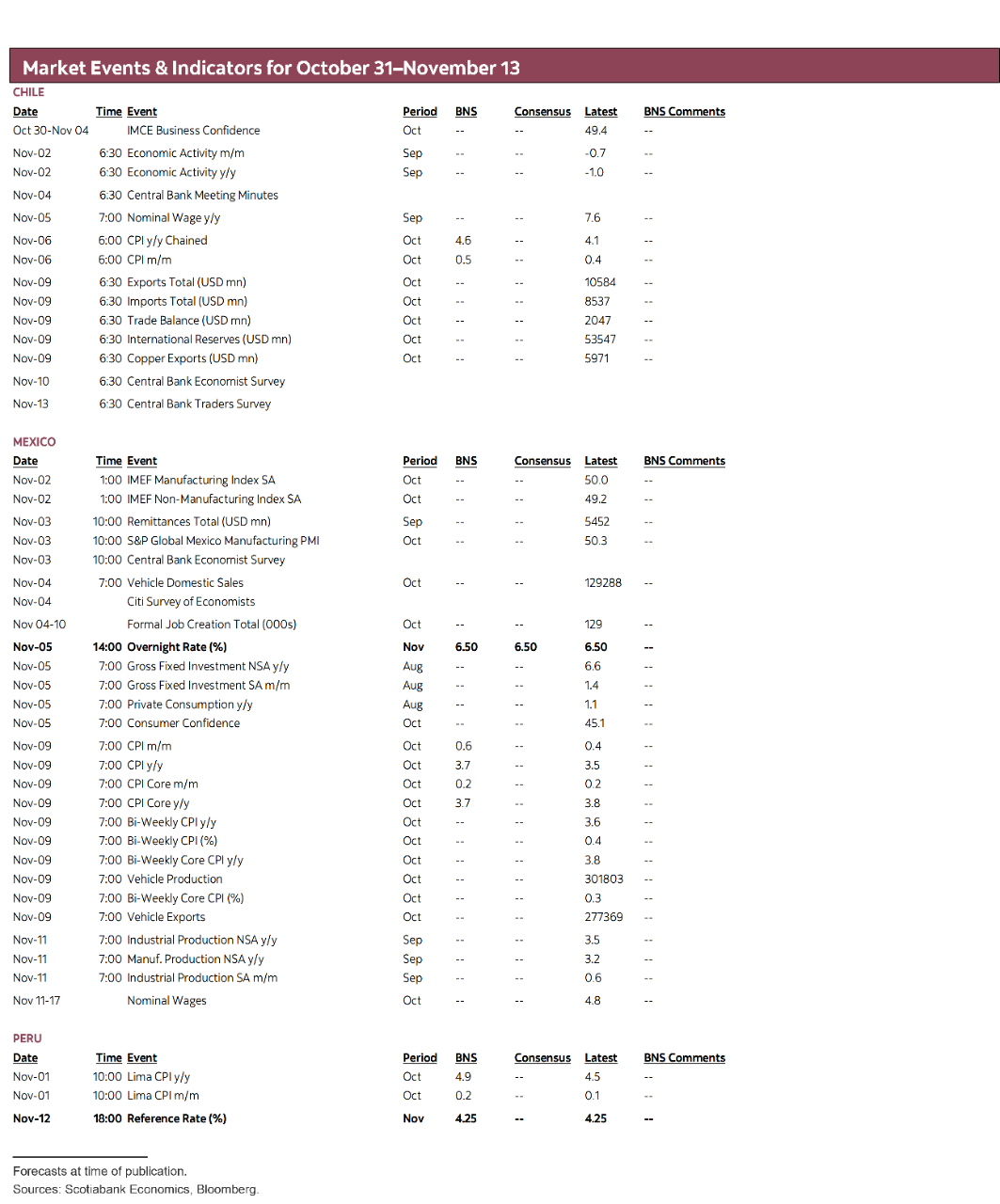
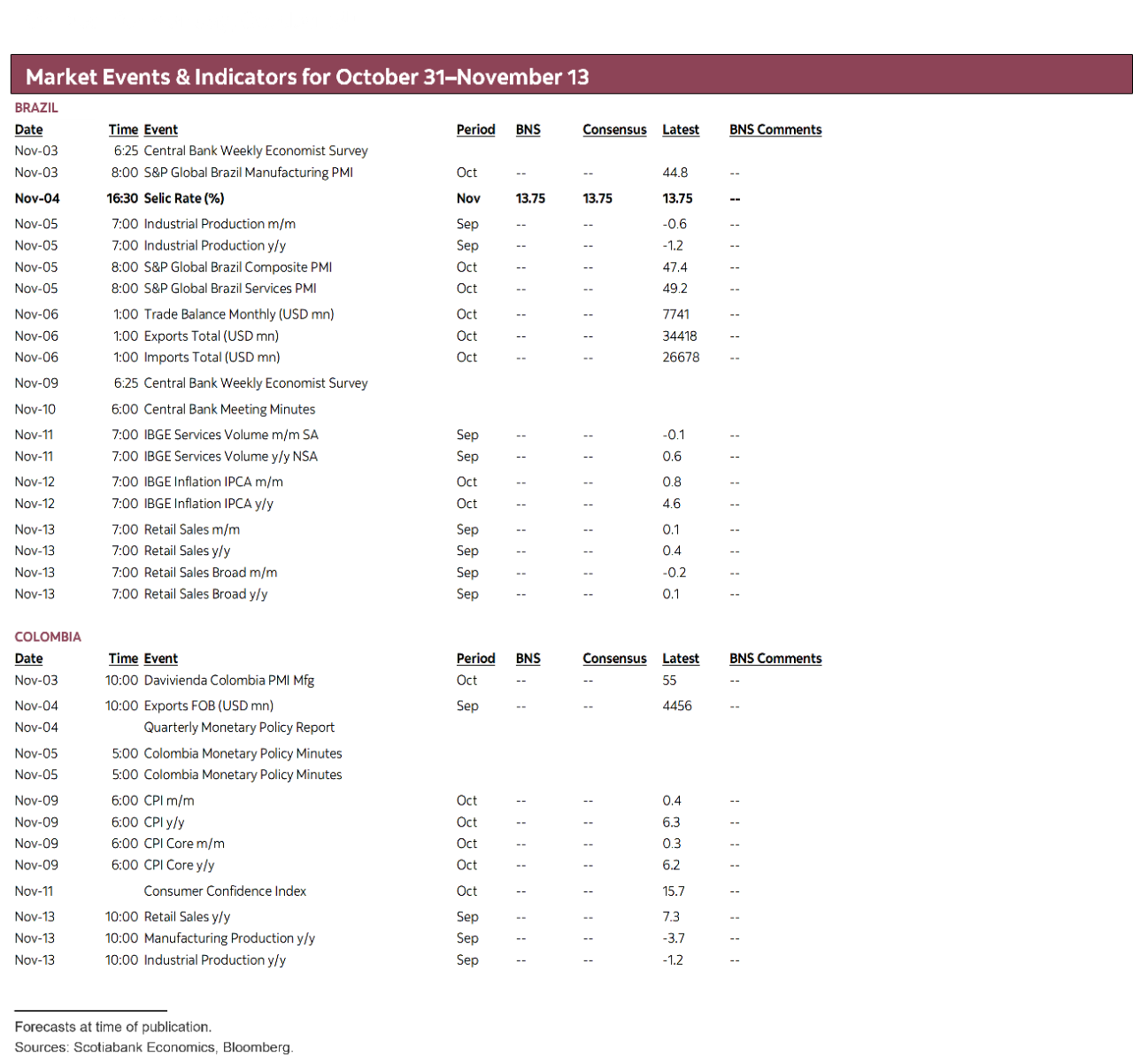
- Rate decisions in Mexico, Brazil, the U.K., and others, inflation data out of Peru, Chile, and the Eurozone, U.S. and Canadian employment reports, more tech earnings results, and Tuesday’s U.S. midterm elections make up a packed schedule for next week.
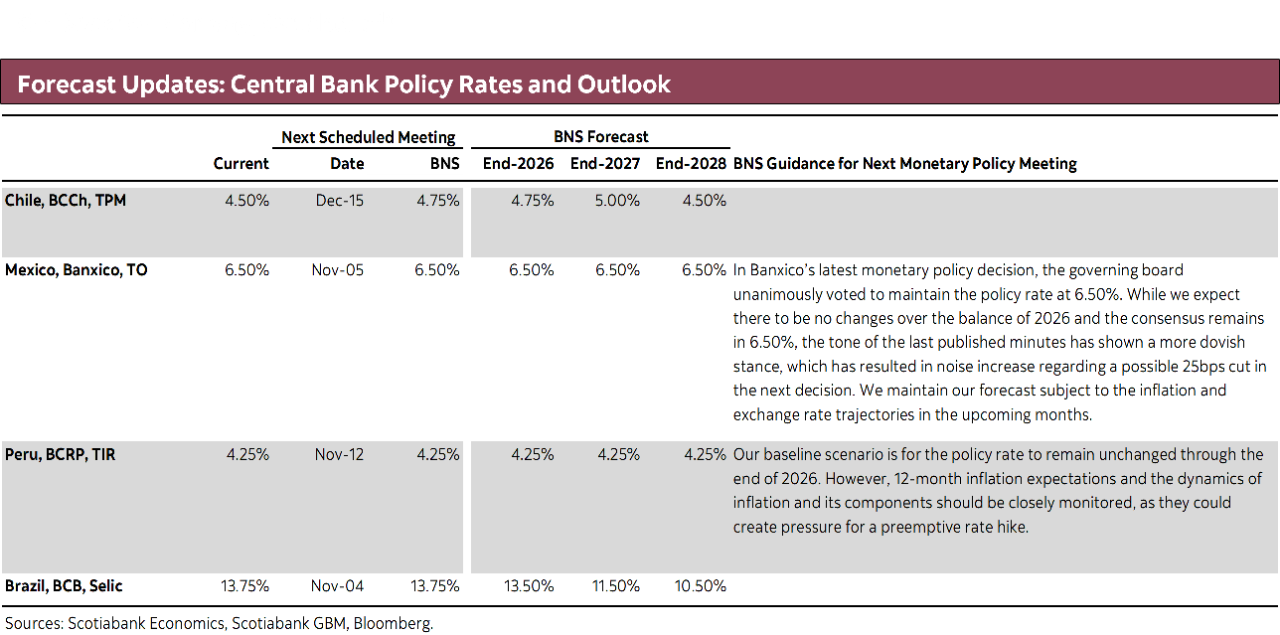
- There may be room for the BCB to consider a 25bps rate cut next week, as going from 13.75% to 13.50% would still leave the policy stance highly restrictive, but we think the BCB will err on the side of caution to get more clarity on the fiscal trajectory for how this may impact growth and inflation.
- Banxico’s latest decision and the minutes to that meeting have left the door open to additional cuts, as our local team discusses in today’s report. When measured by within target headline and core inflation, and some remaining economic slack, one could build a case. But above range services inflation, limited signs of serious convergence to the 3% goal, and growing external risks call for an extended hold.
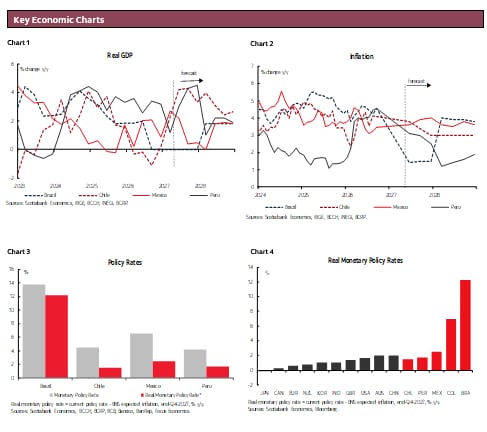
- Peru’s October CPI release due on Sunday is the focus of the team in today’s Weekly, with their estimates calling for a 0.2% m/m increase in headline prices that would bring y/y inflation from 4.5% to 4.9%. For Chile, we project that CPI rose by 4.6% y/y on a 0.5% m/m gain in prices in October, up significantly from 4.1% y/y in September, with fuel and food prices driving the monthly increase.
Chart of the Week
BANXICO AND BCB, PERUVIAN AND CHILEAN CPI
Juan Manuel Herrera, Director
+52.55.2299.6675
juanmanuel.herrera@scotiabank.com
- Rate decisions in Mexico, Brazil, the U.K., and others, inflation data out of Peru, Chile, and the Eurozone, U.S. and Canadian employment reports, more tech earnings results, and Tuesday’s U.S. midterm elections make up a packed schedule for next week.
- There may be room for the BCB to consider a 25bps rate cut next week, as going from 13.75% to 13.50% would still leave the policy stance highly restrictive, but we think the BCB will err on the side of caution to get more clarity on the fiscal trajectory for how this may impact growth and inflation.
- Banxico’s latest decision and the minutes to that meeting have left the door open to additional cuts, as our local team discusses in today’s report. When measured by within target headline and core inflation, and some remaining economic slack, one could build a case. But above range services inflation, limited signs of serious convergence to the 3% goal, and growing external risks call for an extended hold.
- Peru’s October CPI release due on Sunday is the focus of the team in today’s Weekly, with their estimates calling for a 0.2% m/m increase in headline prices that would bring y/y inflation from 4.5% to 4.9%. For Chile, we project that CPI rose by 4.6% y/y on a 0.5% m/m gain in prices in October, up significantly from 4.1% y/y in September, with fuel and food prices driving the monthly increase.
It’s non-stop next week, all around the globe. Rate decisions in Mexico, Brazil, the U.K., Australia, Norway, and Sweden, inflation data out of Peru, Chile, and the Eurozone, U.S. and Canadian employment reports, more tech earnings results, and Tuesday’s U.S. midterm elections make up a packed schedule where every day will have something major for markets to trade on (note that Mexico is out on Monday). It will be a pivotal week for markets that are heading into the Friday close with deepened risk aversion in equities after deflating tech optimism.
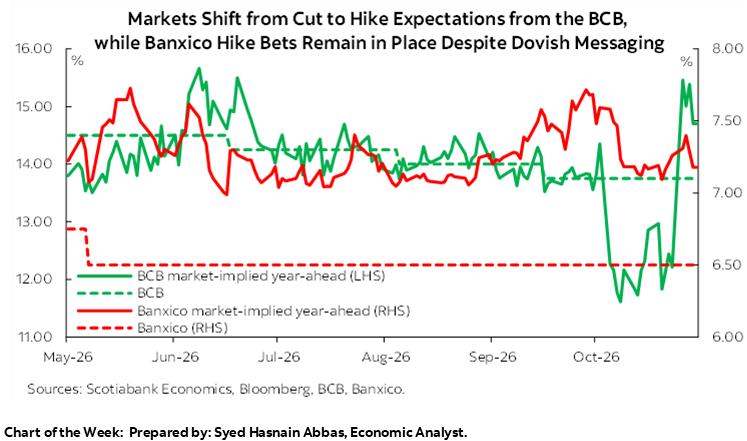
It’s been evident for a few years now, but last weekend’s election results in Brazil showed again that polls are but a rough guide of where final vote tallies may end up. For Brazil, sharp gains on Bolsonaro’s first round victory have been more than erased by Lula’s surprise win in the second-round vote with the Bovespa down nearly 20% since last Friday’s close, the BRL around 8% weaker, and markets going from expecting ~100bps in BCB cuts by next June to now seeing ~100bps in hikes (more on this below).
There’s much less market risk from Tuesday’s elections in the U.S. as Democrats are ~95% odds to take the House, and this has long been an expected flip (started the year at ~80%, according to Polymarket), while their betting market odds to take the Senate have risen to nearly 75% (from 35% in early-2026). The latter race still leaves room for surprise, and possibly give a small lift to equities if next week’s vote delivers a Republican Senate win instead of a Democratic sweep that would be seen as less friendly to the AI buildout, the oil and gas sector, or deregulation. On the other hand, a split Congress could mean greater gridlock. A worrying scenario is one where tight margins lead to certification delays or challenges that delay final results or result in social unrest.
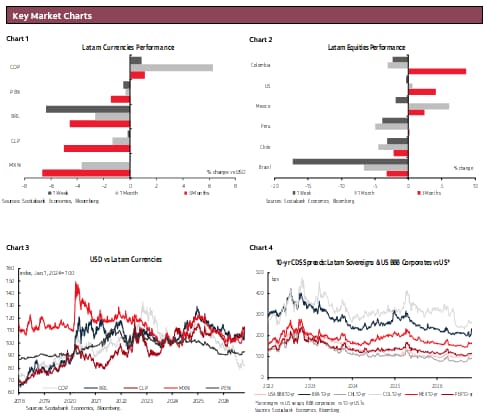
Coming back to Brazil, the outlook for monetary and fiscal policy, and local assets has drastically shifted in recent days—overcorrecting the sharp positive reaction after the early-October vote. From rising to as much as a 30% year-to-date gain through mid-October, the local stock index is now only up about 5%, or about half of Mexico’s (its closest regional peer) YTD gain. For the BRL these numbers go +10% YTD as of last Friday to now just around +1%, which at least still leaves it as one of only about 10 major currencies that have gained on the USD this year (the MXN is close to 5% weaker YTD).
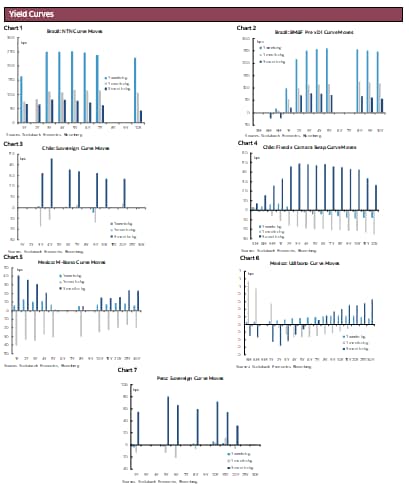
Fiscal worries under another Lula presidency (even if there still wasn’t that much clarity on what Bolsonaro’s plans were) also led to a steep rise in Brazilian yields. The 10yr yield had reached as low as 12.50% three weeks ago, but it’s closing the week at ~15.20%—or net +100bps from pre-first round. Brazil had avoided a good deal of the selloff in global sovereigns since July, and going as far as benefitting from Bolsonaro’s rising victory odds to see 10s fall by ~25bps from end-Jun to end-Sep at the same time as U.S. rose 80bps. But that outperformance has now been fully erased and Brazilian 10s sit 150bps higher YTD, compared to ~90bps for Peru, about twice the increase for the U.S. and Chile, and Mexico’s modest 15bps rise. Of the major economies that we follow, that YTD increase is the worst of all, just 5bps higher than France’s.
It’s been a total rollercoaster for BCB rate expectations pricing over the past year, with the political outlook playing a key role in the market’s view of the path ahead for the BCB. Since kicking off the easing cycle in March, the BCB has lowered the policy rate by 125bps as gradually slowing growth and inflation allow it to carefully ease highly restrictive rate settings. A key limit to the BCB’s rates downside was Lula’s fiscal expansion, and while the role of fiscal support has narrowed in recent months, his campaign pledges (if followed through on, to some degree) are looking to add back to this and counteract, thus pressuring inflation.
There may be room for the BCB to consider a 25bps rate cut next week, as going from 13.75% to 13.50% would still leave the policy stance highly restrictive considering inflation is at 4.6% as of the October IPCA-15 reading (at about the same level as year-ahead inflation expectations); well above the real neutral rate of 5%. Just under half of those polled by Bloomberg expect such a move, with the majority expecting a hold. We think the BCB will err on the side of caution to get more clarity on the fiscal trajectory for how this may impact growth and inflation, with the added consideration of where the BRL will head.
Nevertheless, we believe additional cuts are coming (and are appropriate), just not next week, or if one comes next week it will likely be accompanied by a hawkish message that cools economists’ expectations for policy loosening over the course of 2027. Markets are looking a bit too extreme in their narrative shift. As mentioned earlier, a 200bps knee-jerk shift in BCB rate pricing since last Friday is exorbitant, more so when it’s not just a reduction in cut bets but going from chunky cut bets to chunky hike bets. A key input into the BCB’s Wednesday decision will be the results of the bank’s economists survey due for release on Tuesday, with a large jump in inflation expectations motivating a rate hold the following day.
Turning to Mexico, we’ve often mentioned of late that Banxico’s communications with a dovish tilt are at odds with what we’re seeing in data or recent MXN weakness. Banxico’s latest decision and the minutes to that meeting have left the door open to additional cuts, as our local team discusses in today’s report. On the one hand, sure, core inflation remains below 4% and there may still be some economic slack in the country. But, one could also say that core inflation remains relatively high, even in the 2–4% target range, services inflation hasn’t budged much lower from the 4.5% zone, and GDP recorded its best y/y expansion in three years in the Q3-26, at 3.2% y/y.
The MXN was also just shy of printing a 19-handle on Friday morning, on a combination of Banxico’s lingering dovishness and global risk aversion. Superpeso talk is clearly out the window, as the MXN has lost about 10% against the USD since end-August to stand as the worst performing major currency over this period, followed by the CLP about 6% lower. Notably, the Japanese yen, an important funding currency for MXN carry trades, is up about 1.5% in the last two months, and the Swiss franc is also looking not too shabby with its 2% decline. A rate cut next week, which only a small minority of economists are projecting would certainly represent a big hit for the MXN—regardless of if it’s accompanied by messaging that additional cuts are highly unlikely.
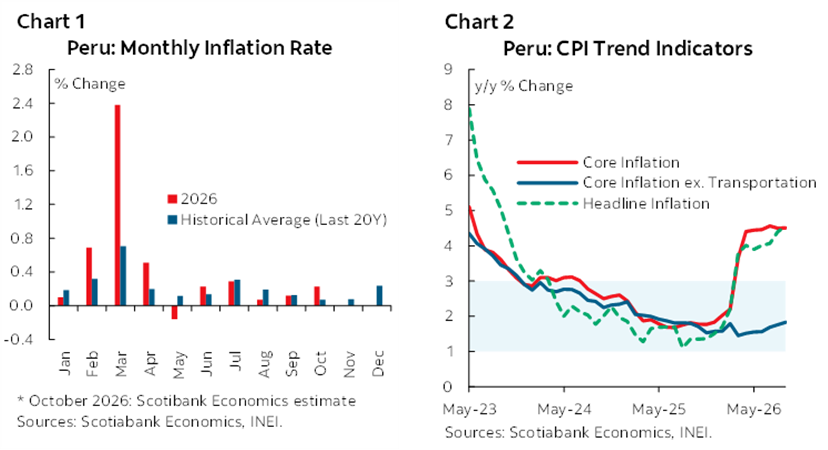
Peru’s October CPI release due on Sunday is the focus of the team in today’s Weekly, with their estimates calling for a 0.2% m/m increase in headline prices slightly above the long-run October average of 0.07% m/m, but which would bring y/y inflation from 4.5% to 4.9%. Such an ‘above-seasonal’ reading would be the first time in six months that the price change deviates significantly from the long-term average—with the pre-October streak helping to keep BCRP rate hike bets at bay. But blame El Niño and fuel prices for the slightly hotter price gain on a monthly basis and also a less favourable base of comparison that partly results in the 0.4ppts jump in the y/y number.
Ahead of the BCRP’s November 12th rate announcement, it’s key to look at the narrower core excluding transportation inflation which as of September stood at 1.8% y/y—i.e. lower than the midpoint of the 1–3% target band—reflecting limited second-round effects from El Niño or energy prices. Year-ahead inflation expectations are currently sitting at 3.1%, above the target ceiling and rising from 2.03% in January, but when looking at our actual year-ahead forecasts, i.e. for October, inflation should be back within the target range. Still, continued increases in inflation expectations could mean that the BCRP’s current nominal target rate of 4.25% would translate into a sub-1% real ex-ante rate, or less than half the ~2% neutral rate.
We project that Chilean CPI rose by 4.6% y/y on a 0.5% m/m gain in prices in October, up significantly from 4.1% y/y in September (0.4% m/m). The vast majority of the monthly price increase is due to come from volatile items as non-volatiles inflation is expected to print a much more moderate 0.1% gain. Around a third to a half of the m/m price rise will owe to fuels, with some additional pressure coming from fresh produce, meat, and housing costs. Our team is penciling in a 0.15ppts drag from Cyber Monday discounts alike that seen last October.
We project that the BCCh will hike by 25bps at its December announcement, with this week’s decision teeing up such a move by noting that “inflation risks have increased significantly,” with significant upward revisions to inflation forecasts set to come at the bank’s December update. On Wednesday, we’ll see whether our hike call is reinforced in the minutes to the BCCh’s meeting, which we suspect included a discussion over a possible rate hike. As of today, markets are pricing in about a 40–50% chance of a hike in December, with a full quarter-point increase priced in by the January announcement.
On Monday, Chilean September economic activity is on tap and may show a less bad print after the 1% y/y contraction recorded in August when mining output fell by 17.4% y/y—its sharpest loss since 2017 amid a combination of weather, depleted mines, and other issues. Data for September published this morning showed that copper output fell 15.1% y/y, but retail sales had a strong showing (+4.4% y/y) and manufacturing surprisingly grew (+2% y/y). Non-mining output managed a solid expansion of 1.4% y/y in August, however, its best showing since December, although non-resources economic activity is still tracking a decent slowdown for the year, averaging 0.5% y/y YTD growth compared to 3% in the year-to-August in 2025, as it also suffers from a harsh El Niño and other weather shocks alongside a slowdown in hiring—that includes three straight months of year-on-year job losses.
COUNTRY UPDATES
Mexico—Are Conditions Falling into Place for Banxico to Deliver Another One-Off Rate Cut?
Rodolfo Mitchell, Director of Economic and Sectoral Analysis
+52.55.3977.4556 (Mexico)
mitchell.cervera@scotiabank.com.mx
Miguel Saldaña, Economist
+52.55.5123.1718 (Mexico)
msaldanab@scotiabank.com.mx
Martha Cordova, Economic Research Specialist
+52.55.5435.4824 (Mexico)
martha.cordovamendez@scotiabank.com.mx
Banco de México’s tone shifted meaningfully in September. The Governing Board unanimously kept the policy rate at 6.50% but dropped its explicit guidance that rates would remain unchanged and adopted a more data-dependent stance. It stated that future decisions would be contingent on the evolution of inflation, its drivers, and financial conditions. Although the central bank continues to anticipate economic slack, it maintains an upward-biased balance of risks to inflation.
Consistent with this shift, the minutes reinforced the view that there is room for an additional cut, though not necessarily for the start of a new monetary easing cycle. Arguments emerged within the Board in favour of considering a one-off reduction if inflation continues to evolve favourably, while a meeting-by-meeting approach, without committing to a predetermined path, was also advocated. The most cautious interpretation is therefore that a fine-tuning of the monetary policy stance may be possible.
The main argument in favour of an adjustment is that disinflation continues alongside economic slack. Between the first half of July and the first half of September, core inflation declined from 3.95% to 3.79%, while Banxico noted that economic activity likely expanded at a more moderate pace in the third quarter (although the preliminary Q3 GDP reading came in at 3.2%) and that slack would persist throughout the forecast horizon. This suggested that, while activity has shown signs of recovery, there are still no broad-based demand pressures that would require the current degree of monetary restraint to remain unchanged.
Another relevant factor is the greater independence of Mexican monetary policy from the Federal Reserve. In September, the Fed raised its rate by 25 basis points, while Banxico held its own at 6.50%. Mexico’s decision reflects that its monetary policy response will depend primarily on domestic conditions and their impact on the inflation outlook, rather than mechanically following moves by the United States and most central banks around the world.
In our view, however, room for cuts remains limited. Persistent core inflation remains among the main upside risks, alongside potential trade disruptions, geopolitical conflicts, cost pressures, and a possible depreciation trend in the peso. Banxico also maintains an upward-biased balance of risks to inflation and does not expect convergence to the 3% target until the fourth quarter of 2027.
The latest information discussed in this note therefore presents mixed signals. Supporting a cut, core inflation remains below 4%, goods inflation is relatively contained, and some degree of slack persists. Arguing against one, services inflation remains more persistent, headline inflation has recently picked up, and external risks remain elevated. At the same time, the recovery in activity reduces the urgency of providing monetary stimulus, although it does not necessarily contradict the presence of slack.
In short, Banxico has opened the door to an additional cut, but the bar for delivering it remains high. A policy rate reduction could be misinterpreted amid a combination of persistent services inflation, external risks, and stronger-than-expected activity. Nevertheless, we do not rule out a cut by Banxico given a pause by the Federal Reserve, contained inflation (on the non-core side), and a weak exchange rate that nevertheless appears to remain at levels that do not cause concern.
Peru—Inflation on the Rise: Will the BCRP Stay on Hold?
Ricardo Avila, Senior Analyst
ricardo.avila@scotiabank.com.pe
The October inflation report will be released on November 1st. We expect headline inflation to increase by around 0.2% month-on-month, above the 20-year historical average of 0.07%, excluding the pandemic period. If our estimate materializes, this would mark the first time in six months that monthly inflation deviates meaningfully from its historical average, mainly due to El Niño-related pressures and higher fuel prices.
While some key items in the household consumption basket, such as chicken and eggs, have recorded price declines, a broader range of products is expected to post increases, most notably fish, onions, potatoes, and rice.
In addition to the price pressures observed during the month, an unfavourable base effect would also push annual inflation higher, as monthly inflation stood at -0.1% in October 2025. Against this backdrop, we expect annual inflation to rise from 4.5% in September to 4.9% in October, exceeding our year-end forecast of 4.8%, as well as the forecasts of the Central Reserve Bank of Peru (BCRP) at 4.2% and the LatinFocus consensus at 4.3%.
We expect annual headline inflation to continue rising over the summer months, particularly in January and February, reaching around 5.5%. Price pressures could be even stronger; however, we anticipate a significant correction in March due to a favourable base effect, given that monthly inflation reached 2.4% in March 2026.
Looking ahead to the BCRP’s next monetary policy meeting, scheduled for November 12th, annual headline inflation will be an important signal, but not the only one. The Central Bank will also closely monitor other indicators due to be released ahead of its decision:
1. Core inflation excluding transportation
This indicator seeks to capture underlying price dynamics by excluding volatile goods and services (food, energy and transportation) from the household consumption basket and will be released on November 1st. It currently stands at 1.8%, below the midpoint of the BCRP’s 1%–3% inflation target range. This suggests that, so far, inflationary pressures stemming from higher fuel prices and El Niño have not become broad-based across the rest of the consumption basket.
This contrasts with developments in 2022–2023, when the indicator faced significant upward pressure, reaching 4.8% year-on-year, amid the inflationary effects associated with the Russia-Ukraine war. As the main pressures on headline inflation in October are expected to remain concentrated in food and energy, we expect this measure to show no significant increase and to remain below 2.0%.
2. Twelve-month-ahead inflation expectations
This indicator will be released on November 5th. In September, twelve-month-ahead inflation expectations stood at 3.09%, above the BCRP’s 1%–3% target range for the third consecutive month. We expect the October reading to remain relatively close to the previous month’s level.
However, an increase above 3.20%, which we do not expect given that inflation should already be back within the target range by October 2027, would constitute a relevant signal for the BCRPs monetary policy decision. Such an outcome would increase the likelihood of a policy rate hike.
Overall, there are arguments both for keeping the policy rate unchanged and for further monetary tightening. Based on the information currently available, we believe the BCRP is more likely to keep its policy rate unchanged once again. Nevertheless, the decision will depend to a significant extent on developments in inflation excluding food, energy, and transportation and, particularly, on twelve-month-ahead inflation expectations, both of which will be available ahead of the meeting.
| LOCAL MARKET COVERAGE | ||
| CHILE | ||
| Website: | Click here to be redirected | |
| Subscribe: | anibal.alarcon@scotiabank.cl | |
| Coverage: | Spanish and English | |
| MEXICO | ||
| Website: | Click here to be redirected | |
| Subscribe: | estudeco@scotiacb.com.mx | |
| Coverage: | Spanish | |
| PERU | ||
| Website: | Click here to be redirected | |
| Subscribe: | siee@scotiabank.com.pe | |
| Coverage: | Spanish | |
DISCLAIMER
This report has been prepared by Scotiabank Economics as a resource for the clients of Scotiabank. Opinions, estimates and projections contained herein are our own as of the date hereof and are subject to change without notice. The information and opinions contained herein have been compiled or arrived at from sources believed reliable but no representation or warranty, express or implied, is made as to their accuracy or completeness. Neither Scotiabank nor any of its officers, directors, partners, employees or affiliates accepts any liability whatsoever for any direct or consequential loss arising from any use of this report or its contents.
These reports are provided to you for informational purposes only. This report is not, and is not constructed as, an offer to sell or solicitation of any offer to buy any financial instrument, nor shall this report be construed as an opinion as to whether you should enter into any swap or trading strategy involving a swap or any other transaction. The information contained in this report is not intended to be, and does not constitute, a recommendation of a swap or trading strategy involving a swap within the meaning of U.S. Commodity Futures Trading Commission Regulation 23.434 and Appendix A thereto. This material is not intended to be individually tailored to your needs or characteristics and should not be viewed as a “call to action” or suggestion that you enter into a swap or trading strategy involving a swap or any other transaction. Scotiabank may engage in transactions in a manner inconsistent with the views discussed this report and may have positions, or be in the process of acquiring or disposing of positions, referred to in this report.
Scotiabank, its affiliates and any of their respective officers, directors and employees may from time to time take positions in currencies, act as managers, co-managers or underwriters of a public offering or act as principals or agents, deal in, own or act as market makers or advisors, brokers or commercial and/or investment bankers in relation to securities or related derivatives. As a result of these actions, Scotiabank may receive remuneration. All Scotiabank products and services are subject to the terms of applicable agreements and local regulations. Officers, directors and employees of Scotiabank and its affiliates may serve as directors of corporations.
Any securities discussed in this report may not be suitable for all investors. Scotiabank recommends that investors independently evaluate any issuer and security discussed in this report, and consult with any advisors they deem necessary prior to making any investment.
This report and all information, opinions and conclusions contained in it are protected by copyright. This information may not be reproduced without the prior express written consent of Scotiabank.
™ Trademark of The Bank of Nova Scotia. Used under license, where applicable.
Scotiabank, together with “Global Banking and Markets”, is a marketing name for the global corporate and investment banking and capital markets businesses of The Bank of Nova Scotia and certain of its affiliates in the countries where they operate, including; Scotiabank Europe plc; Scotiabank (Ireland) Designated Activity Company; Scotiabank Inverlat S.A., Institución de Banca Múltiple, Grupo Financiero Scotiabank Inverlat, Scotia Inverlat Casa de Bolsa, S.A. de C.V., Grupo Financiero Scotiabank Inverlat, Scotia Inverlat Derivados S.A. de C.V. – all members of the Scotiabank group and authorized users of the Scotiabank mark. The Bank of Nova Scotia is incorporated in Canada with limited liability and is authorised and regulated by the Office of the Superintendent of Financial Institutions Canada. The Bank of Nova Scotia is authorized by the UK Prudential Regulation Authority and is subject to regulation by the UK Financial Conduct Authority and limited regulation by the UK Prudential Regulation Authority. Details about the extent of The Bank of Nova Scotia's regulation by the UK Prudential Regulation Authority are available from us on request. Scotiabank Europe plc is authorized by the UK Prudential Regulation Authority and regulated by the UK Financial Conduct Authority and the UK Prudential Regulation Authority.
Scotiabank Inverlat, S.A., Scotia Inverlat Casa de Bolsa, S.A. de C.V, Grupo Financiero Scotiabank Inverlat, and Scotia Inverlat Derivados, S.A. de C.V., are each authorized and regulated by the Mexican financial authorities.
Not all products and services are offered in all jurisdictions. Services described are available in jurisdictions where permitted by law.