- BoC hiked 50bps, less than expected…
- ...but still plans further increases while opening up optionality on the pace
- The BoC essentially forecasts a global recession
- Today’s decision may have been correct, but it went against Governor Macklem’s pre-meeting guidance and may have prematurely loosened financial conditions.
- Bank of Canada overnight rate:
- Actual: 3.75%
- Scotia: 4%
- Consensus: 4%
- Priced: 4%
- Prior: 3.25%
The Bank of Canada hiked its policy rate by 50bps which was less than expected while guiding that further rate increases were in store. It opened the door to slowing the pace again into the next meeting via either a 25 or 50bps hike but shut it against pausing.
As a result, the Canadian rates curve rallied big time as the two-year yield plunged by 24bps, the 5-year yield dropped by 18bps and the 10-year yield fell 19bps. The aftermath even dropped the very long-end by 12bps on the day. Some of this may be a repositioning undershoot, like when the wind suddenly shifts on a small sailboat and everyone dives to the other side. CAD initially depreciated by ½% against the USD but clawed its way back throughout the communications due to widespread weakening of the USD that still leaves CAD as an underperformer against almost every other major currency pair in the aftermath of the communications. Now if the Fed doesn’t surprise and sticks to hawkish messaging, then CAD could resume its downside vulnerability against the USD.
ANOTHER UNRELIABLE CANADIAN BOYFRIEND
I’ll come back to the case for why the BoC did what it did today in a moment and how it may have been the right thing to do, but in terms of explaining the third market surprise this year the rub here concerns pre-meeting guidance from the Bank of Canada and the fact that Governor Macklem pretended like he never even said those things. This is true on two counts.
First, on October 14th, Macklem said at the conclusion of IMF meetings that he agrees under-tightening is the bigger risk. Well, he not only just under-tightened relative to expectations, he also seemed to pivot his language and is now balanced toward the risks of under- and over-tightening. Macklem said this in the press conference:
“We are trying to balance the risks on both sides. We don't want to under-tighten because Canadians will have to continue to cope with high inflation. We're also very conscious that the economy will slow more than needed and we'll undershoot our inflation target and we don't want to do that either.”
Second, and on that same day, Macklem had said they were watching the USD very closely because it may mean to the BoC that "there's more work to do on interest rates." Just before that, Macklem said on October 6th (emphasis added):
“I won't predict the C$. Normally when we raise interest rates the Canadian dollar appreciates. That does some of our work for us. We're not getting that this time. What that means is that other things equal there is going to be more to do on interest rates. We are going to take those exchange rate movements into account going forward in terms of what we need to do on interest rates.”
In central bank speak, that was pretty explicit guidance to expect more rather than less today. Other central bank Governors like the RBA’s Lowe and BoJ’s Kuroda are more careful and circumspect when commenting on their currencies, noting they are monitoring them, and viewing passthrough effects as probably temporary. Macklem’s comment had explicitly opted for a different approach that went about as explicitly toward saying he’d hike by more because of CAD weakness, yet he didn’t. Maybe they are assuming a weak currency in future to guide further rate hikes instead of a bigger one today, but today certainly didn’t help the case that they are really all that terribly fussed by the C$. Markets could push them on that now.
Why not act more on the currency now? It may be that the BoC’s CAD concerns abated somewhat in the past week as the currency appreciated by a few pennies on broader USD weakness that itself may be wishful thinking that the Fed is about to pivot, but if so, then this presents the chicken-and-egg problem. CAD appreciated in part due to broad USD movements but also in part because markets expected Macklem to do more today by at least matching expectations for what the Fed is expected to do next week.
Further on that point, when asked to address the scope for the BoC to diverge from the Fed, Macklem said:
“I'm going to let the Fed take their own decisions and we've taken ours. The Fed will focus upon their domestic mandate and we're focused upon ours. One of the values of independent monetary policy with a flexible exchange rate is that we can conduct monetary policy in the interests of Canadians.”
That may be very true, to a point, but Macklem’s concerns about the C$ in the lead-up to today obviously implicitly took into account the Fed’s likely path forward. In fact, you could say it was a direct signal the BoC was along for the ride at least in the short-term and because of the currency. Instead, Macklem has today opted for policy divergence from the Fed that will likely weigh upon the Canadian dollar—all else equal—and continue to present upside risk to inflation.
When asked to account for whether he changed his mind that CAD depreciation would fan inflation and the BoC needed to do more on rates, SDG Rogers “our monetary policy framework assumes a floating dollar in the market. We have seen a departure from the pattern between CAD movements and oil. The forecast we put out today takes into account the view that CAD weakness will feed through into higher import price inflation.” Ok, but you said X on the currency before the meeting and did Y. How come? No answer.
This erratic pattern of surprising markets with sudden pivots seems habitual at the BoC. The BoC promised years of staying on hold and reeled in mortgage borrowers by over-stretching its abilities to provide forward guidance and forecast inflation. The BoC ignored all the abundant signs of inflation risk throughout 2021 and then whipsawed everyone this year. Macklem’s December 2021 speech was clearly hawkish and set up priced expectations for a rate hike in January that they whiffed on. The BoC then panicked by hiking 100bps in July and hence more than expected upon suddenly realizing they were way behind in the fight against inflation. The lead up to today’s decision is documented above as they again surprised markets relative to forms of forward guidance. The BoC needs to be much more careful in its communications in my view.
This is a serious matter because it speaks to the reliability of BoC guidance and using it to infer next steps. If there needs to be longer-lived forward guidance into a future crisis like, oh, say a recession, then borrowers and markets would be extremely well-advised to discount it in a fool me once shame on me, fool me twice (thrice, etc….) shame on you sense.
BoC’S FORWARD GUIDANCE
And so on that note, take what it says about the future rate path with extreme reservations but here we go anyway.
The BoC continues to guide that “the policy interest rate will need to rise further.”
It places greater data conditionality around future moves by now saying “Future rate increases will be influenced by our assessments of how tighter monetary policy is working to slow demand, how supply challenges are resolving, and how inflation and inflation expectations are responding."
Ergo, the BoC is more data dependent at the margin. That was likely to arrive within the next 2–3 meetings including today’s as the likely terminal rate approached, but hiking by less than expected and upping the data conditionality is relatively dovish on both counts.
What’s more is that Macklem opened the door to another possible downshift in the pace of hikes at the December meeting. When asked whether this is a pivot from the Bank of Canada that big rate increases are now coming to an end and we are returning to more traditional quarter point increases, Macklem responded by saying:
“100, then we did 75, today we did 50. We have signalled very clearly rates will have to rise further. That could mean another big increase or more normal 25 point increases. It's going to depend upon how the effects of higher interest rates are flowing through to demand.”
Thus, we will spend the next several weeks up to the December 7th statement-only decision placing high dependence upon the next CPI report on November 16th and especially core measures, the next two Canadian employment reports including next Friday’s, Q3 GDP on November 29th, other domestic data, plus what the Federal Reserve and markets do in the meantime. Such elevated data dependence makes it highly premature to judge the outcome at this stage.
When asked whether the signal today is that a policy pause or a skip along a still hiking path is possible in the next decision or whether the BoC is only focused upon the pace and scale of rate hikes, Macklem said:
“I am closer to the second part. We have been clear that rates will have to rise further. We will determine the pace based upon developments going forward.”
WHY DID HE GO SMALLER?
It’s not that there is not a good case for opting for a smaller rate hike with the strong caveat on the currency connection. I think that actually makes some sense at this point and so kudos to being a tad more cautious. The beef is more focused upon the unreliability of the BoC’s forward guidance tool and concern it may be useless if needed in bigger ways in future.
When asked why he opted for a smaller rate hike today and the next meeting, Macklem said:
“This is another larger than normal step. Inflation is high and generalized, we remain in excess demand, the economy is slowing but that's needed, near-term inflation expectations are high and that could bleed into longer-term expectations and become embedded. We felt we needed a bigger than normal step for these reasons. We also see that the economy is slowing and revised our growth lower well below trend to give supply the chance to catch up. On 50 versus 75, coming into this meeting interest rates were already considerably higher and there are now clear signs that the economy is slowing and we judged that we needed to move from very big steps to a big step and we still judged that they need to rise further.”
Macklem also sounded more cautious about the lagging effects:
“We will be watching closely how the effects of higher interest rates work through the economy and how they affect spending. We are already seeing clear signs that the rate increases we have done are having an impact upon the economy. It will take time for the rate increases to work through the economy and we'll be watching how that works through inflation. These are not things that our models are equipped to deal with."
In fact, while he emphasized that models can be useful, he spent considerable time trashing their usefulness in our times. At a senior leadership level this caution against over-reliance upon models is extremely wise.
Further, when asked whether financial stability concerns or financial markets liquidity may have had some bearing on the BoC’s decision to offer only a 50bps hike today, SDG Rogers intimated as such when she said “We have seen financial conditions tighten considerably. Now is a time for central banks and market participants to be vigilant.” Very true, accidents commonly lurk in the shadows at this point in a tightening cycle….
FORECASTS
The BoC’s forecast for the global economy is essentially that of a global recession. Global GDP is projected to grow by just 1.5% in 2023 and mildly accelerate to 2.5% in 2024. That’s a global economy that is stalling out and that will be marked by recessionary conditions in multiple areas.
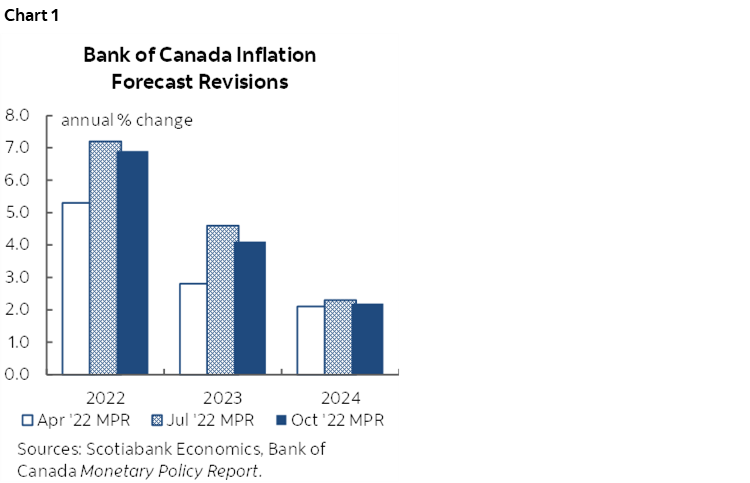
The BoC’s Canadian inflation forecasts were marked down a touch (chart 1) but are still high throughout the forecast horizon with 2022 inflation down to 6.9 from 7.2% y/y, 2023 down a half point to 4.1% and 2024 little changed at 2.2% from 2.3%. So they're saying it takes until 2024 to get inflation in line with their 2% target, bearing in mind their inflation forecasting track record…
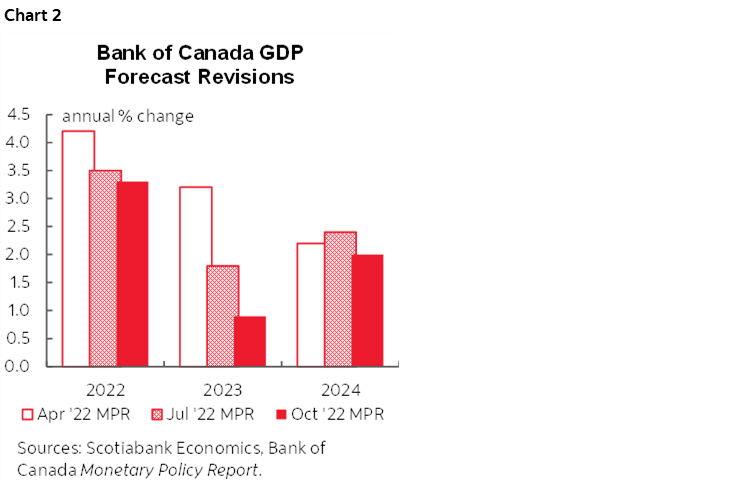
Growth forecasts were also marked down as chart in chart 2.
RECESSION RISK
When asked whether a recession is likely at this point or have you changed your assessment of a soft landing, Macklem said:
“Our latest outlook has growth stalling for the next several quarters. 2–3 quarters of slightly negative growth are just as likely as 2–3 quarters of slightly positive growth. That's not a contraction but it is clearly a sign that the economy is slowing. With growth slowing that will give supply the opportunity to catch up to demand and relieve price pressures in our economy. With our new projections we can be clear we are expecting roughly no growth for the next several quarters and a solid pick-up thereafter.”
I can get over the continued reference to “front-loading” rate hikes when it’s not front-loading if you’re reacting ages after inflation risk and actual inflation soared. But I’ll be pleasantly surprised if the worst we see is the BoC’s forecast for the Canadian economy. 350bps of rate hikes in eight months with more to come as significant parts of the rest of the world economy stumble likely poses greater downside risk to the economy than the BoC is letting on.
INFLATION DRIVERS
I thought a very good question in the press conference concerned asking the Governor to explain chart 19 in the MPR that shows a breakdown of what is expected to push inflation lower over the next 2–3 years. Very good because it speaks to what the BoC is hanging its hat upon. The main emphasis is upon the category labelled “other factors" and the hope that they will diminish in order to bring inflation lower as opposed to all of the other drivers of the break down of their inflation forecast in that chart. Other drivers are defined in the MPR to include:
"These potentially include the pass-through of elevated energy costs to the prices of other goods and services as well as elevated shelter costs. Specifically, high energy costs seem to have passed through to inflation much more than is usual. It will take some time for these unusually large impacts to fully recede."
There is an awful lot more guiding inflation forecasts than these considerations. Plus, against this hope is the downgraded forecast range for potential GDP (basically the economy’s capacity to produce goods and services without stoking inflation) to 1.4–3.3% in 2023 (from 1.8–3.3% previously) and 1.4–3.5% in 2024 (from 2.0–3.5% previously). Fiddling with potential GDP forecasts that are at the very best a total guess doesn’t lend much, but when they are raised or the range is tightened it implies the sudden belief that the supply side will do more to cool inflation than was the case in the prior forecast in July which may come true but flags a significant part of what they are counting upon.
INFLATION EXPECTATIONS
During the press conference, Macklem observed that inflation expectations are starting to ease. If they mean their own surveys, then charts 1 and 2 here say otherwise. Consumers’ expectations continue to push higher in the 1- and 2-year timeframes and are volatile further out, while business expectations were steadily high and little changed from the prior surveys in July. Consumers' 1- and 2-year ahead expectations moved higher in the BoC's survey and the 5-year ease a touch along a highly volatile pattern. Business expectations for >3% inflation remained unchanged in this survey versus the July version.
NOW VERSUS THE 1970S
I thought Macklem’s answer to the differences between inflation now versus the 1970s might be worth repeating for clients. Macklem said:
“Monetary policy frameworks have changed a lot. In the 1970s we had abandoned the system of fixed exchange rates but didn't replace it with another anchor and so central banks were adrift and expectations became unmoored. That's why back then it takes a severe recession to bring them back down. We have had a clear inflation target for 30 years and longer run expectations remain reasonably anchored. In the 1970s there was a long period of excess demand but this time we've gone from the deepest recession ever to the faster recovery into excess demand. By front-loading our response that is slowing spending and hopefully we will start to see clear signs that inflation is starting to slow down.”
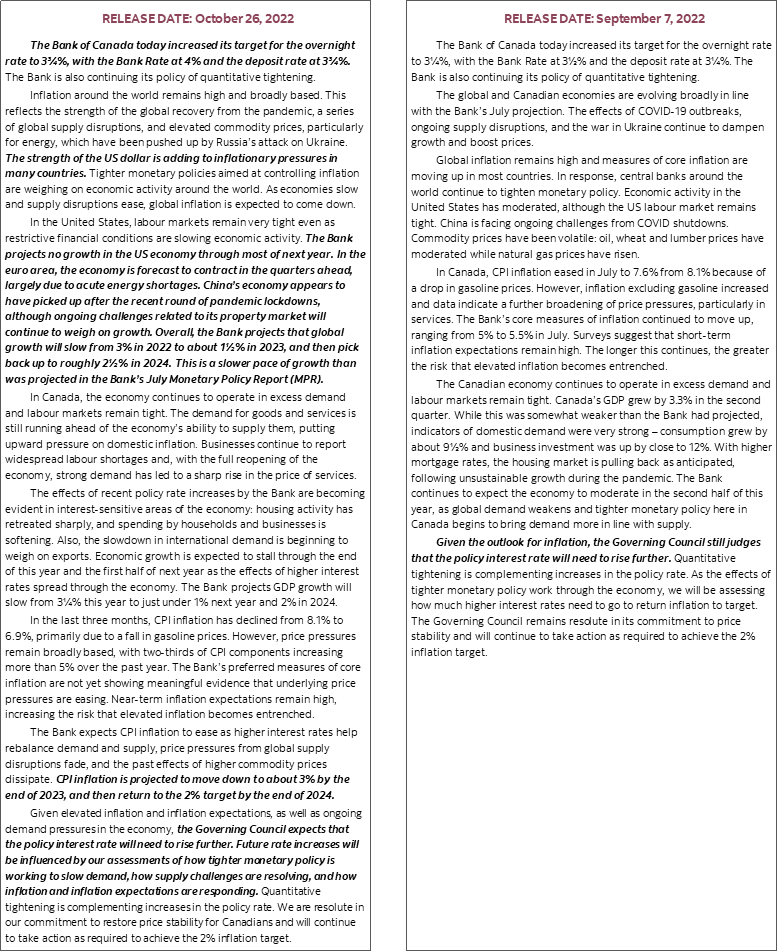
Please see the attached statement comparison, bearing in mind that an MPR-statement is typically a much lengthier full re-write with new forecasts.