

Key takeaways
Facing uncertainty and conflict risks, NATO has a new defence spending target of 5% of GDP by 2035 – but implementation will determine security gains
Allies should fulfill this obligation strategically and lean into comparative advantage rather than ticking boxes – and NATO’s framework should incentivise this
In Canada, expanding core defence capabilities and fortifying systems key to national security will require immense investments in energy, minerals, Arctic infrastructure, ports, grids and resilient supply chains fit for modern warfare. Canada will have to build faster than it ever has.
This new target is a meaningful fiscal redirection for Canada we must grapple with. But this capital-intensive build-out could also offer a material boost to domestic growth if enough gains are captured at home.
Canada and its allies find themselves in a suddenly more divided and unstable world, with sovereignty under threat and conflict risks in multiple regions.
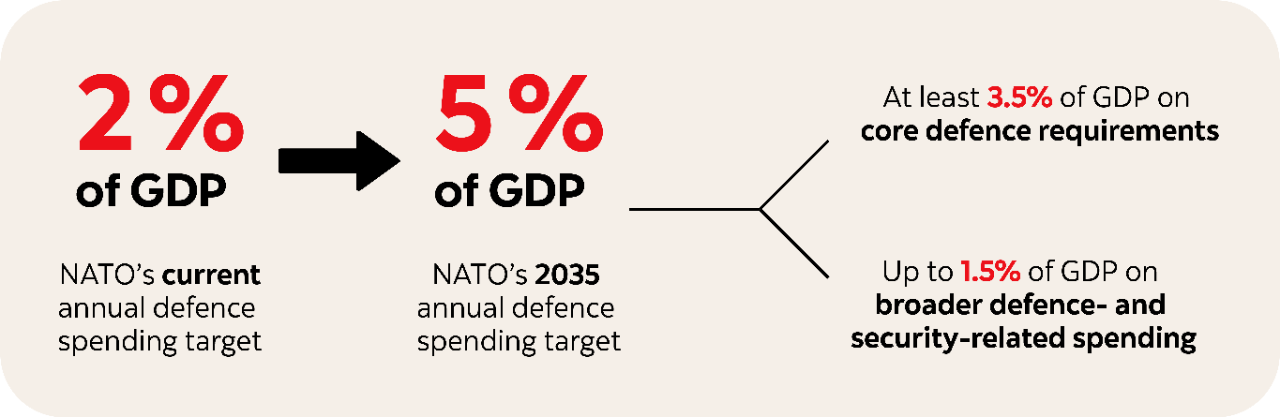
In response to this new reality, members of the North Atlantic Treaty Organization (NATO) have committed to spending 5% of Gross Domestic Product (GDP) on defence by 2035 – a significant increase from the 2% minimum commitment adopted in 2014 but not consistently met by Canada until 2025.
After decades of underinvestment, it is essential that Canada execute new defence spending effectively, both to maximize collective security gains and to support the domestic economy following years of lackluster growth.
A new era of defence spending
The modern defence landscape has grown beyond just the battlefield. Conflicts like the Iran war have shown that access to key systems and goods are more precarious than previously thought, and our definition of national security and defence investment have widened accordingly. Energy systems, critical minerals, strategic infrastructure and supply chains are now part of a country’s actual security architecture.
NATO’s new 5% commitment reflects this holistic view of security, breaking expenditure down into two buckets: at least 3.5% of GDP on core defence requirements (think personnel, weaponry, etc.) and up to 1.5% of GDP on broader defence- and security-related investments. The latter will be the infrastructure – from ports to power systems to critical mineral projects – that lays the foundation for successful defence.
Execution matters
A spending threshold is not a strategy – how Canada and its NATO allies reach 5% is what matters.
Within the core defence bucket, building a powerful arsenal will mean balancing important traditional military assets with the technologies increasingly shaping modern warfare, such as drones, sensors, satellites, cyber resilience, data, and integrated air and missile defence.
It’s important that NATO’s forward-looking spending framework – which remains in its early stages – is flexible enough to empower Allies to invest in areas they have the most to offer. Without this, countries may end up ticking boxes for the sake of meeting their commitments instead of flexing their comparative advantages, which could stretch each dollar further.
For Canada, this means advocating for a NATO framework that recognizes non-traditional security investments in areas like energy, minerals, Arctic infrastructure, ports, grids and resilient supply chains.
On a NATO-wide level, there is a risk that Allies overlook meaningful non-traditional security investments under NATO’s existing framework of at least 3.5% toward core defence and up to 1.5% on broader defence/security spending. The 1.5% bucket should function as a floor for strategic investment, not an effective ceiling, especially for countries with a comparative edge but inevitable competing national priorities.
Defence spending can support growth in Canada
Canada has only recently met NATO’s former target of 2% of GDP established in 2014. The government has stated that it already meets the still-loosely defined 1.5% component, while core spending is on a path to 2.5% by 2030. This suggests Canada still has a long road ahead to the new 5% target.
We must move swiftly but purposefully. Defence spending can either trickle out of Canada through imports, or it can be invested at home by prioritizing Canada-based supply chains. For a current snapshot: roughly 55% of Canada’s defence supply chain is Canada-based.
To move in the right direction, Canada must balance speed, cost and domestic capability through a strong Build–Partner–Buy framework:
Build in situations that can feasibly develop Canada’s industrial capability and sovereign control;
Partner where scale and technology challenges require it;
Buy abroad only where necessary and in ways that minimize reliance on other countries.
However, increasing domestic spending is easier said than done. Limited by absorption capacity, we can only effectively spend as fast as we can actually build. Ignoring this could lead to delays and bottlenecks, inflationary pressures, increased debt, over-reliance on imports and lost opportunities for domestic growth.
As it stands, the federal government estimates that the domestic defence sector comprises roughly 600 firms, supports about 81,000 jobs, generates around $14.3 billion in annual revenues and contributes about $9.6 billion to GDP.
Looking forward, Canada’s new defence strategy seeks to upscale domestic capacity and sets explicit targets for boosting defence acquisitions, exports, industry revenue and research and development.
Canada’s push to meet NATO’s new defence target will include immense investments in infrastructure to support critical systems for security objectives such as energy security. If this infrastructure spending were incremental and not overlapping with existing spending commitments, it would require roughly $30 billion per year, or an increase in public infrastructure spending of nearly 12% each year. Canada has simply never built at this pace.
Hard fiscal choices
In addition to how Canada spends, another relevant question is where we get the money.
Currently, Canada’s net debt-to-GDP ratio is low relative to many of our peers, but a deficit-financed approach to achieving the 5% target could test our fiscal advantage, especially if spending does not translate into domestic growth. The Parliamentary Budget Officer estimates this could cause the federal debt to grow by more than six percentage points by 2035.
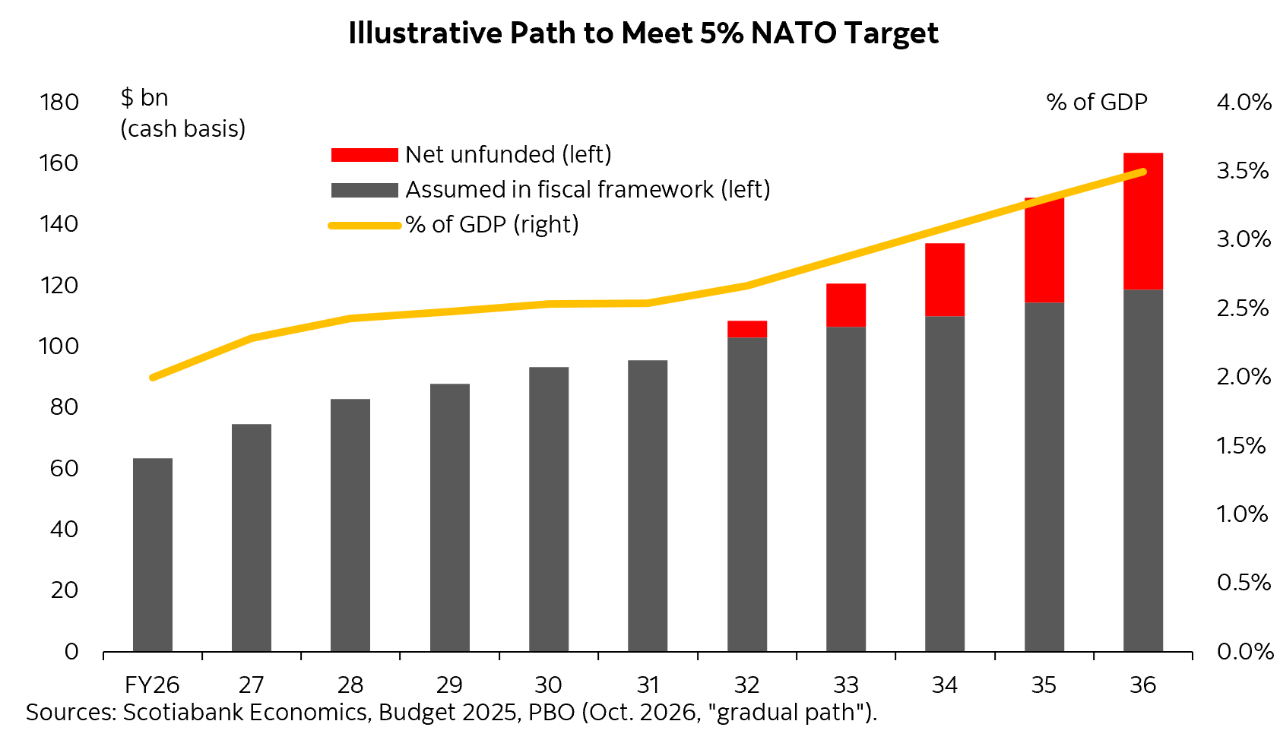
Eventually, the federal government will need to release details on its spending plan such as whether it’s paying for the new spending through borrowing, increased taxation or reduced spending in other areas as well as how much of its defence goals will be met with new versus existing spending commitments.
Evidently, tough choices lie ahead, and purposeful spending is imperative to fortifying Canadian defence and enabling growth.
This article is based on a recent report by Rebekah Young, Scotiabank’s Vice President of Economic Policy: More than a Number: Canada’s Defence Scale-Up Challenge in NATO’s Next Frontier, with updated data from the Parliamentary Budget Office.
