

HIGHLIGHTS
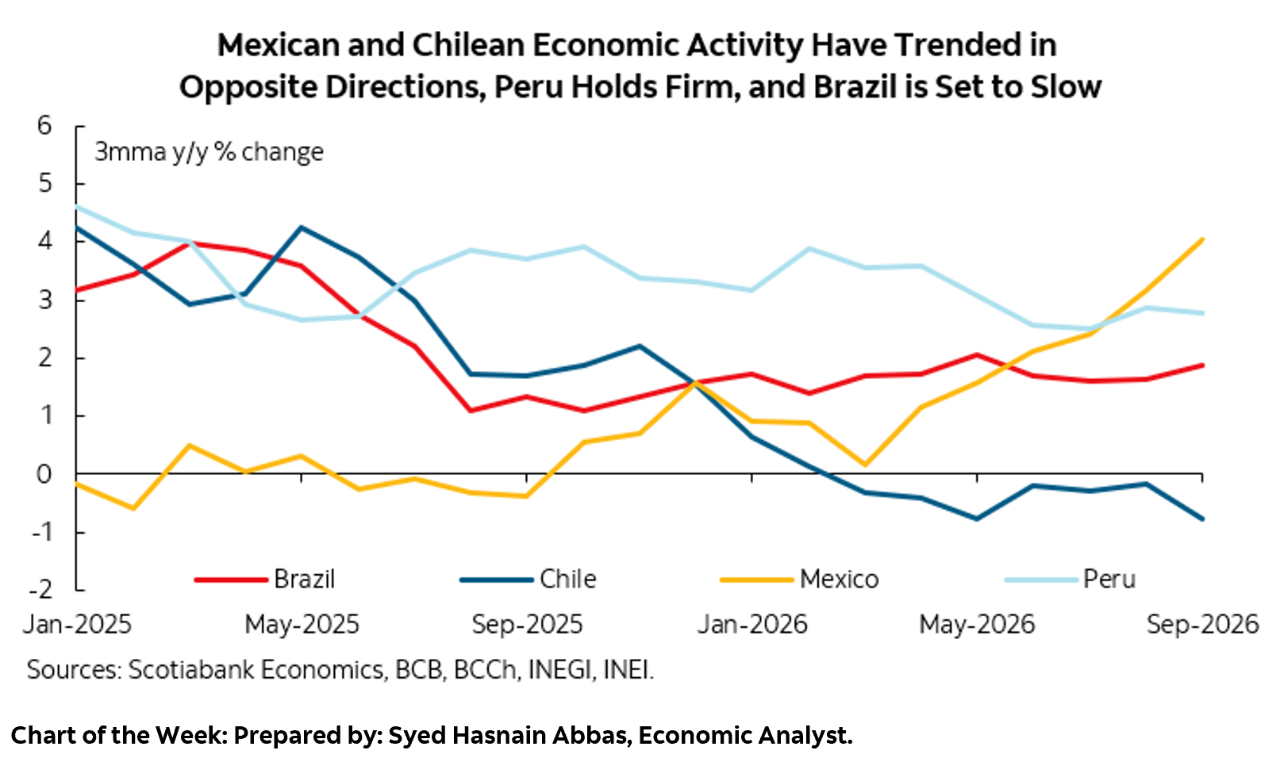
- Regional economic activity readings and the minutes to Banxico’s latest meeting are next week’s highlights in Latin America.
- The team in Peru covers their forecast for a 2.8% y/y rise in output in September that would round up Q3-26 to a 3.3% y/y increase in GDP. However, near-term economic expectations have weakened, as we look ahead to El Niño shocks that are expected to depress growth to the low-1s in Q1-27.
- From Chile, the team discusses its expectations for BCCh policy, predicting a 25bps rate hike (with a half-point hike under discussion) at the bank’s December announcement and a view that the BCCh will not choose to stop its foreign reserves accumulation programme.
- Our economists in Mexico go over the 2027 Federal Expenditure Budget approved earlier this week, which sees real spending increasing by 1.3%, and outlines a 3.4% of GDP budget deficit where borrowing requirements would fall only slightly from 4.1% to 3.9% of GDP.
Chart of the Week
REGIONAL GDP, BANXICO MINUTES
Juan Manuel Herrera, Director
+52.55.2299.6675
juanmanuel.herrera@scotiabank.com
- Regional economic activity readings and the minutes to Banxico’s latest meeting are next week’s highlights in Latin America.
- The team in Peru covers their forecast for a 2.8% y/y rise in output in September that would round up Q3-26 to a 3.3% y/y increase in GDP. However, near-term economic expectations have weakened, as we look ahead to El Niño shocks that are expected to depress growth to the low-1s in Q1-27.
- From Chile, the team discusses its expectations for BCCh policy, predicting a 25bps rate hike (with a half-point hike under discussion) at the bank’s December announcement and a view that the BCCh will not choose to stop its foreign reserves accumulation programme.
- Our economists in Mexico go over the 2027 Federal Expenditure Budget approved earlier this week, which sees real spending increasing by 1.3%, and outlines a 3.4% of GDP budget deficit where borrowing requirements would fall only slightly from 4.1% to 3.9% of GDP.
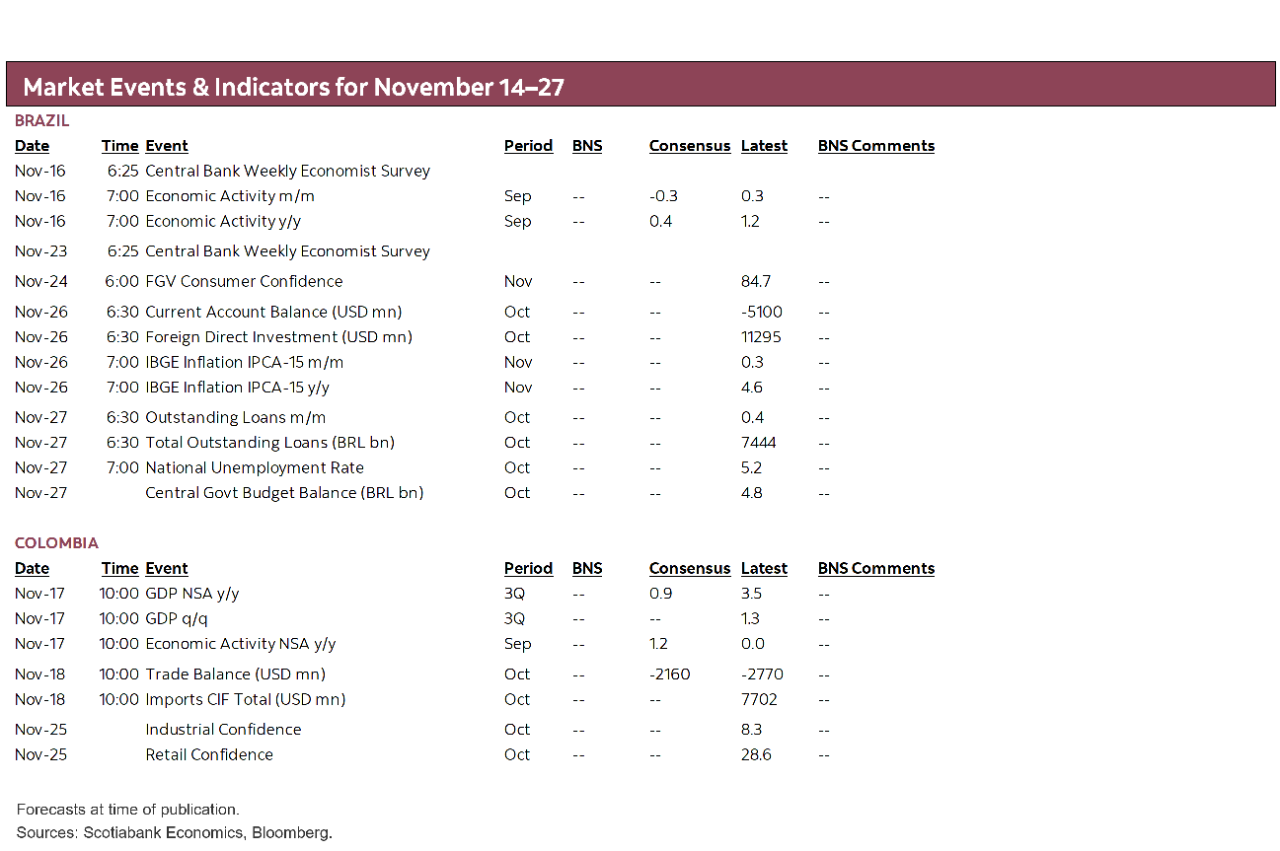
Regional economic activity readings and the minutes to Banxico’s latest meeting are next week’s highlights in Latin America, with global markets eyeing U.S. retail sales data and the Fed’s minutes, U.K. and Canadian CPI, Nvidia’s quarterly results, and Anthropic’s IPO. Choppy global equity markets will likely focus on the latter two events for the bulk of trading direction, while fixed income will take its cue from data and a parade of central bank speakers—and the unknowns regarding the war in the Middle East.
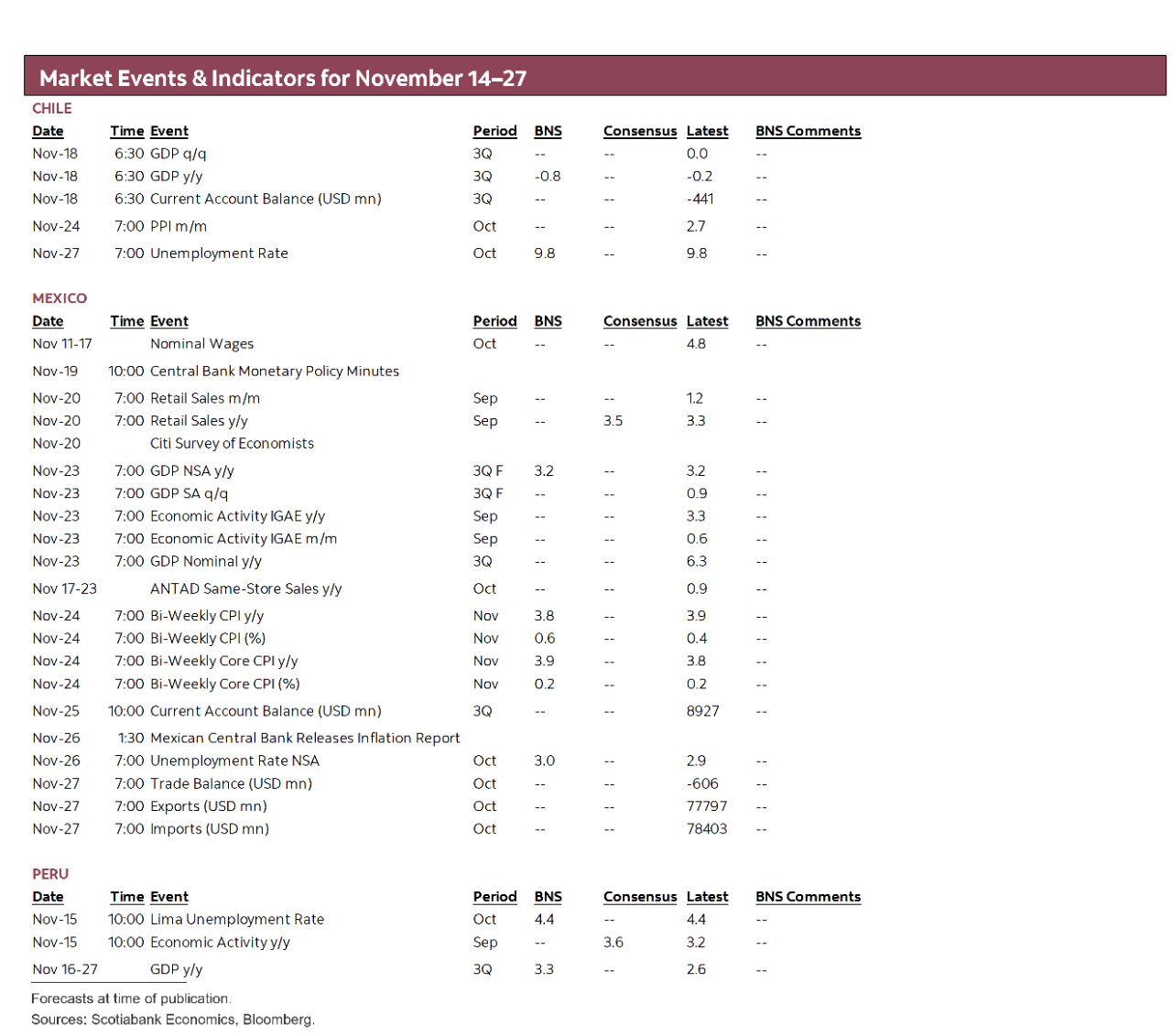
Peru is first up with the release of September GDP data on Sunday, with the team covering in today’s report their expectation for a 2.8% y/y rise in output that would round up the third quarter to a 3.3% y/y increase in GDP, up from 2.6% in Q2-26. As our economists discuss, indicators of domestic demand relating to private investment (e.g. double-digit gains in business loans and cement sales) and consumption (e.g. auto sales +66% y/y) showed strong growth at the close of Q3.
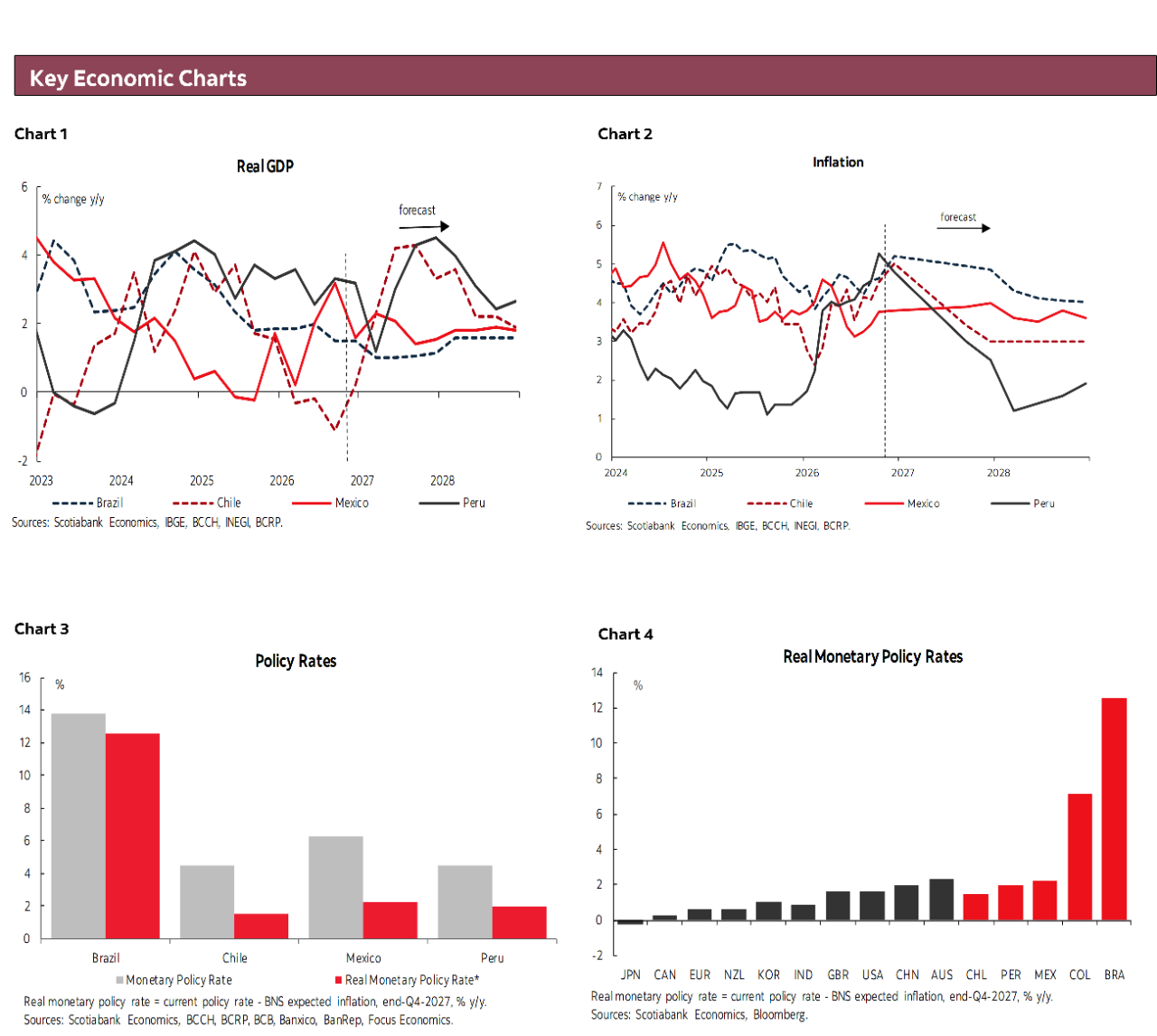
While the third quarter is looking to have closed strongly, there has been a sharp deterioration in short-term economic expectations in recent months, undoing a good deal of the recovery in optimism following the election of Fujimori to the presidency. Businesses and economists are bracing for a harsh impact from El Niño in the hemisphere’s summer months. We estimate that Peru will hold on to three-handled growth in Q4-26 (3.2% y/y) but slow considerably to a 1.2% y/y expansion in the first quarter of 2027. As El Niño shocks dissipate, growth will accelerate to around the mid-4s in the second half of next year, for a full-year expansion of 3.3%.
Brazil comes next, publishing September economic activity data on Monday. The country’s economy is estimated to have slowed from 1.2% y/y in August to the 0.5% zone at the close of the third quarter—which would mark its weakest reading since February, though we think an upside surprise is likelier given better than expected retail sales data published this morning. The monthly figures from the BCB are a rough guide to quarterly GDP data from the IBGE, but based on a 0.5% reading next week, economic activity would slow from 1.7% in Q2-26 (2% in quarterly expenditure GDP data) to 1% in Q3-26 (compared to our estimate for expenditure GDP to slow to 1.5%). We expect that Brazil’s economy will roughly hold around the same pace of growth in Q4-26, but slow to the low-1s across all of 2027.
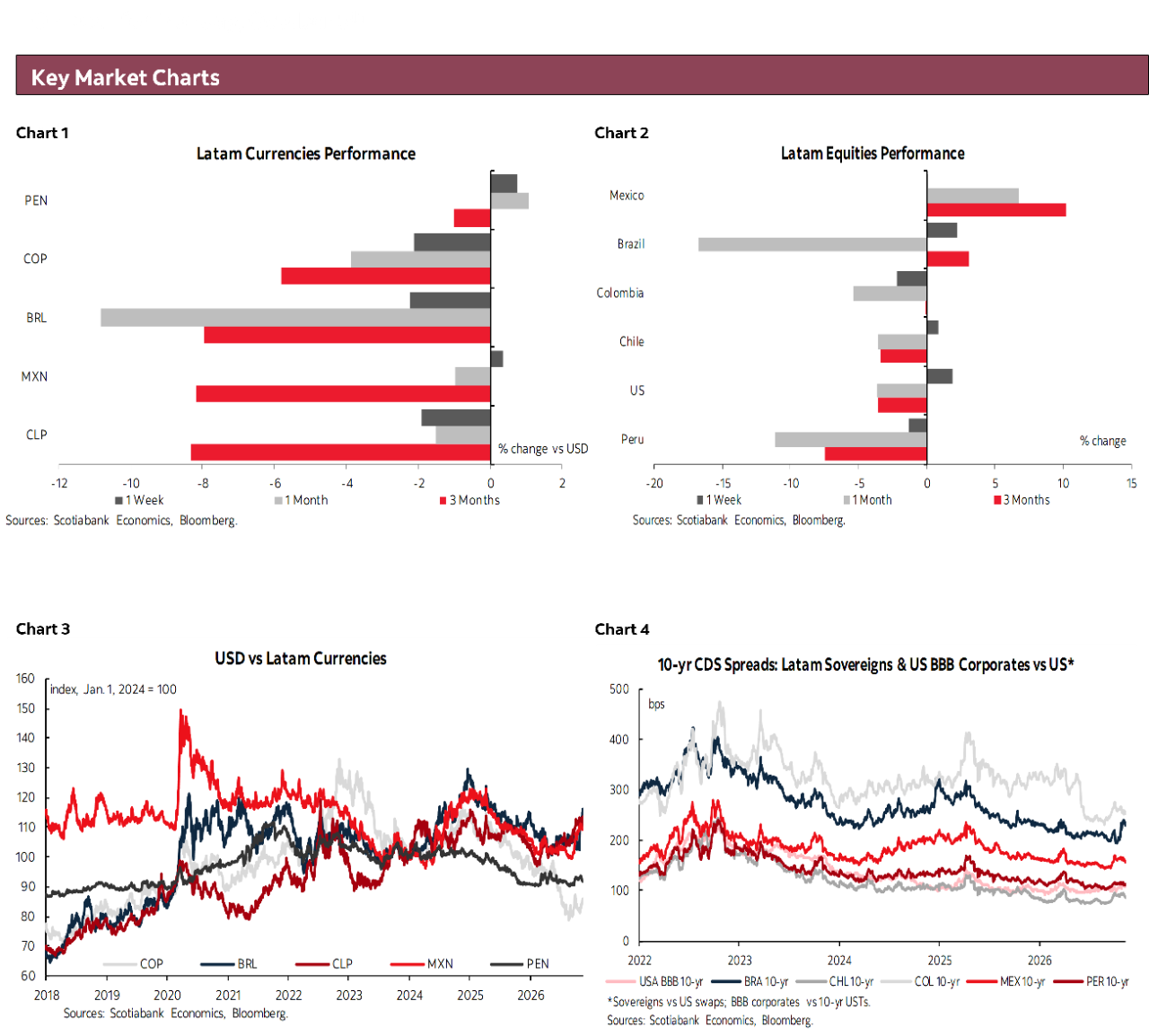
Q3-26 economic figures for Brazil are very backward-looking and of little relevance for the path ahead for growth and monetary policy. The surprise re-election of Lula in the late-October presidential vote has weakened private sector growth prospects over the quarters to come, while introducing fresh inflation risks thanks to increased Bolsa Familia payments (already in place) and other campaign promises to be delivered on (with fiscal adjustments falling short of offsetting the higher fiscal burden), as well as triggering a sharp depreciation in the BRL. October inflation data published yesterday slightly undershot estimates, while still showing a slight acceleration, and conditions continue to point to steady BCB policy rates to close the year. A cooling of financial risks (BRL, fiscal) would allow the BCB to cut in Q1-27, but it is now looking to ease policy by significantly less than we had expected pre-election.
On Tuesday, Colombian Q3 GDP data are due for release. The median economist polled by Bloomberg estimates a sharp slowdown in growth from 3.5% y/y in Q2-26 to around 1% in Q3-26 as a weak start to the quarter was compounded by the impact of the August earthquake. The monthly economic activity index grew by only 1.1% y/y in July, followed by a flat y/y performance for August, with y/y contractions in the primary and secondary sectors for each of July and August, and the services sector’s 1.1% y/y rise in August representing its worst showing since 2024. September retail sales and industrial production data published this morning came in above expectations, which marginally lifts the odds of an upside surprise, as the economy partially recovered from the August earthquake shock, while setting up a firmer expansion in Q4-26.
With Chilean economic activity data to September at hand, we know that the country’s GDP shrank by 0.8% y/y in Q3-26, and data for the quarter due for release on Wednesday provide little of note since it covers industry-based estimates rather than expenditures accounts details that will not arrive until early-2027. Chile’s GDP performance in 2026 has been marked by a strong contraction in mining output on a combination of aging mines, floods, and accidents, accompanied by a weakened ex-mining performance. Our team expects another y/y contraction in October owing to adverse weather conditions impacting the services sector.
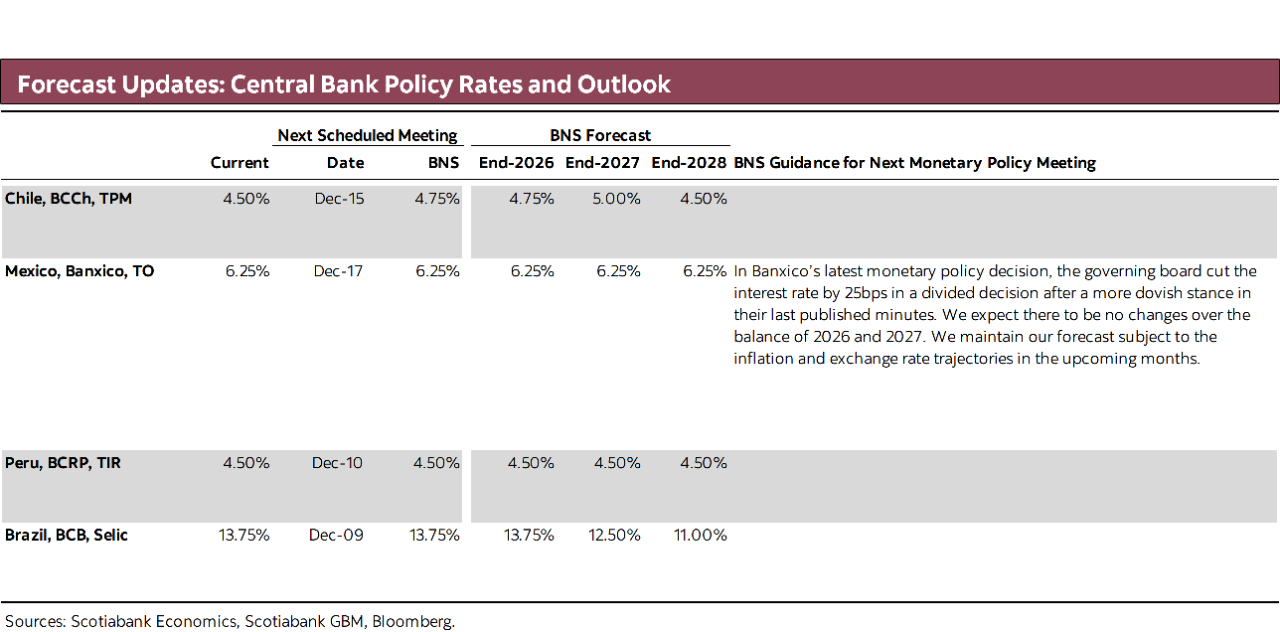
In today’s report, the team in Chile discusses its expectations for the BCCh, predicting a 25bps rate hike (with a half-point hike under discussion) at the bank’s December announcement and a view that the BCCh will not choose to stop the foreign reserves accumulation programme that began in August 2025. CLP weakness risks to inflation have intensified in recent months and recent government fuel price measures are but a small offset to the overall energy prices shock.
Finally, Banxico publishes on Thursday the minutes to last week’s policy meeting where it decided to lower the overnight rate by 25bps in what was a relatively teed-up move but one that we had expected would not come. The rate cut was accompanied by clear guidance that the policy rate would remain at 6.25% for the time being, and comments from officials since (including Governor Rodriguez) reinforced the message of stability. Now, we’ll have to see whether there was a discussion around when (down the line) there may be conditions that allow a resumption of policy easing, and we’ll also be interested in the view of the two board members (Borja and Heath) who voted to keep policy unchanged.
This week, Mexico’s lower chamber approved the 2027 Federal Expenditure Budget, as covered by our local economists in today’s Weekly. The approved plan sees real spending will increase by 1.3%, and outlines a 3.4% of GDP budget deficit where borrowing requirements would fall only slightly from 4.1% to 3.9% of GDP, thus signaling a very slow fiscal consolidation; debt-to-GDP will rise from 54% in 2026 to 55% in 2027. The Budget will provide some support to growth via physical investment, health, and education spending but falls short of representing a significant fiscal boost.
COUNTRY UPDATES
Chile—Fuels, Inflation, International Reserves, and Monetary Policy
Anibal Alarcón, Senior Economist
+56.2.2619.5465 (Chile)
anibal.alarcon@scotiabank.cl
- We do not see a stop to reserves accumulation as an option and reiterate our call for a 25bps hike in December, with a 50bps move under discussion
The contribution of fuels CPI is set to decline in November, although geopolitical risks remain elevated and we cannot rule out a reversal of the recent drop in oil prices. The government has announced mitigation measures for fuels that imply a smaller impact on short-term inflation. Specifically, if the expected price reversals in gasoline and diesel materialize next week, the lower inflationary contribution to m/m November CPI would be around 0.06–0.08ppts. Meanwhile, assuming international fuel prices and the exchange rate remain at current levels, the lower contribution from fuels to December CPI would be around 0.05ppts. Overall, fuels would contribute 0.09% to November CPI, while their contribution to December CPI would reach -0.05%.
While fuel measures only partially offset the cost shock, the Chilean peso’s multilateral depreciation continues to feed directly into tradable goods inflation, and this depreciation shock has intensified at the margin. The peso has weakened not only significantly against the USD, but also across a broad range of currency pairs. The spot Real Exchange Rate (1986=100) currently stands around 112, well above the equilibrium range estimated by the central bank (94–106).
This naturally raises the possibility of suspending the accumulation of International Reserves. However, at Scotiabank, we rule out such an option. Our view is based on four considerations. First, the reserves-to-GDP ratio has not increased materially despite reserve accumulation reaching approximately USD6.7bn since the program began in August 2025. Indeed, reserves-to-GDP stood at 13.4% at the start of the program and is currently close to 14.5%. Second, the purchasing mechanism was refined for this latest reserve accumulation process, substantially mitigating exchange-rate effects. Third, the IMF’s Flexible Credit Line (FCL), renewed at 500% of quota, will continue to decline at the next renewal, withdrawing foreign-currency liquidity. Fourth, we do not observe any shortage of USD liquidity. Therefore, suspending the reserve accumulation program, as occurred in three of the previous five accumulation episodes since 2008, would establish a precedent that we do not believe is shared by the current Board.
Following the release of the December Monetary Policy Report (MPR), the Central Bank is likely to consider either a 25bps increase in the policy rate or a more forceful 50bps adjustment. A 25bps hike remains our baseline scenario, consistent with our write-up in the September 25th Latam Weekly (“Time to Reassess the Central Bank’s Neutral Stance?”). However, we cannot rule out a 50bps hike if November CPI comes in materially above what is currently priced in forward markets (0.4% m/m). We acknowledge that markets remain largely agnostic regarding the size of the December adjustment despite the hawkish tone of the October policy meeting. Therefore, a 25bps increase in the policy rate, followed by meeting minutes showing that a 50bps adjustment was actively discussed, could be sufficient to anchor inflation expectations more firmly. The policy strategy will depend crucially on near-term inflation developments and the evolution of additional supply-side shocks.
At the upcoming monetary policy meeting, the BCCh will likely face a weak October GDP print, affected by adverse weather conditions and demanding comparison bases, alongside November inflation approaching 5% y/y. Nevertheless, September activity data revealed that the conditions for a recovery in growth remain in place when weather-related disruptions are absent. Indeed, commerce posted its strongest expansion since January 2025, with services showing a similarly robust performance. Although October GDP is likely to surprise negatively, posting a significantly negative year-on-year reading (Scotiabank estimates between -2% and -1% y/y, compared with the Economic Expectations Survey's 0% y/y projection), the outcome will largely reflect calendar effects and negative carry-over from demanding comparison bases. In addition, October activity is expected to show the impact of adverse weather conditions, particularly through weaker services activity. This would reinforce our forecast of a 0.3% contraction in GDP during 2026. Even so, the BCCh is likely to maintain a baseline scenario of economic recovery in 2027, supported by stronger investment growth.
Mexico—Lower Chamber Approves the 2027 Federal Expenditure Budget (PEF)
Rodolfo Mitchell, Director of Economic and Sectoral Analysis
+52.55.3977.4556 (Mexico)
mitchell.cervera@scotiabank.com.mx
Miguel Saldaña, Economist
+52.55.5123.1718 (Mexico)
msaldanab@scotiabank.com.mx
Martha Cordova, Economic Research Specialist
+52.55.5435.4824 (Mexico)
martha.cordovamendez@scotiabank.com.mx
The Lower Chamber’s approval of the 2027 PEF barely changed the fiscal stance or the macroeconomic priorities originally set out by the Ministry of Finance. Total net expenditure remained unchanged at MXN 10.636 trillion, of which MXN 7.433 trillion corresponds to programmable spending and MXN 3.204 trillion to non-programmable spending. Compared with the 2026 PEF, total spending increases by 1.3% in real terms. Consequently, the changes made by Congress were essentially internal reallocations, with no impact on the deficit, financial requirements, or debt.
The main change was a cut of MXN 6,000 million to the INE (National Electoral Institute), equivalent to 14.2% of the resources originally proposed. This amount was fully redistributed to La Escuela es Nuestra (schooling infrastructure and services upgrades, +MXN 3,000 million), the environment (+MXN 1,000 million), AFAC (civil aviation authority, +MXN 700 million), early childhood education (+MXN 618 million), care for women (+MXN 362 million), search for missing persons (+MXN 300 million), and tourism promotion (+MXN 20 million). In addition, MXN 6,500 million within the Environment/Conagua budget was earmarked for two hydraulic projects in Jalisco. This last movement likewise does not represent additional spending, but rather a recomposition within the same budget branch. Altogether, the legislative reallocations represent barely 0.06% of total spending, while health, security, Pemex, the main social programs, and transfers to the states essentially kept the amounts in the original proposal.
Regarding investment, the budget maintains MXN 1.134 trillion, 12.3% lower in real terms than in 2026. However, this contraction mainly reflects a decline in financial investment associated with Pemex. In contrast, physical investment increases by 3.5% in real terms, to MXN 1.027 trillion, concentrated in energy, railways, highways, and water. This could support activity and expand productive capacity, although its impact will depend fundamentally on project execution, local content, and the ability to spur private investment. At Pemex, programmable spending remains at MXN 527.1 billion, and the transfer for amortizations and prior loans falls from MXN 263.5 billion in 2026 to MXN 81.1 billion in 2027, reducing initial budgetary pressure, although without eliminating the risks associated with its financial situation.
On the social front, the structure of the budget likewise does not change substantially. Priority programs maintain resources of close to MXN 1.025 trillion, dominated by pensions, while health retains functional spending of close to MXN 1.106 trillion, 10.9% higher in real terms than in 2026. Likewise, federalized spending (spending transfers to sub-federal governments) amounts to MXN 3.048 trillion, 4.6% higher in real terms, with no aggregate changes relative to the proposal. Therefore, the approved reallocations particularly favour education, early childhood, the environment, and care for women, but without altering the high rigidity of spending stemming from pensions, revenue-sharing transfers and earmarked contributions, social programs, and debt service.
From a fiscal perspective, the PEF maintains a budget deficit of MXN 1.359 trillion, equivalent to 3.4% of GDP, a public sector borrowing requirement (PSBR, RFSP in Spanish) of 3.9% of GDP, and a primary surplus of close to 0.6%. The financial cost reaches MXN 1.575 trillion, equivalent to 4.0% of GDP, while the SHRFSP (historical balance of the PSBR) would rise from 54.0% of GDP in 2026 to 55.0% in 2027. In this sense, the budget points to a gradual fiscal consolidation, but one that is still insufficient to reduce debt as a share of GDP. The high financial cost, spending rigidity, and the risks associated with Pemex continue to limit fiscal space.
In sum, Congress modified the composition of spending at the margin, but not its macroeconomic stance. The 2027 PEF will provide some support to activity through physical investment, health, education, and transfers, although it will hardly constitute a significant additional fiscal stimulus. With growth forecasts of around 1.8%–2.0% for 2027, economic and fiscal performance will depend far more on infrastructure execution, tax collection, financial costs, Pemex’s situation, and the ability to attract private investment rather than on the reallocations made during legislative approval.
Peru—Domestic Demand Keeps Growth Resilient Despite El Niño Headwinds
Ricardo Avila, Senior Analyst
ricardo.avila@scotiabank.com.pe
As of September, the leading indicators of domestic demand that we closely monitor, particularly those related to private investment and consumption, continued to show strong growth (table 1). Sales of both heavy and light vehicles, as well as imports, continued to grow at double-digit rates. This momentum has been supported primarily by healthy household liquidity, favourable business investment prospects, and a relatively low and stable exchange rate.
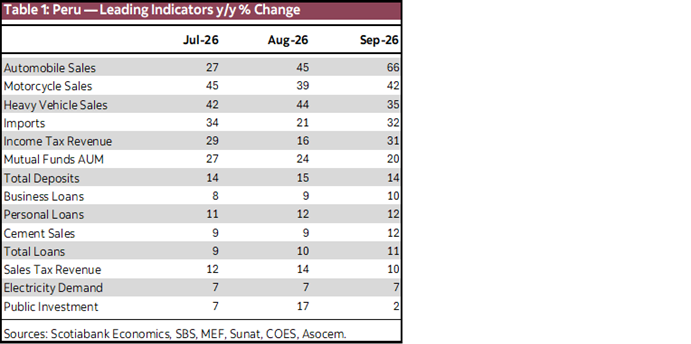
On the savings side, deposits and mutual funds also continued to expand, reflecting favourable labour market conditions. Credit has followed a similar trend, with lending to both households and businesses growing at double-digit rates, reinforcing the positive outlook for economic activity. Meanwhile, key leading indicators, such as cement consumption and electricity generation, show no signs of weakening and remain on a steady growth path. Looking ahead, we expect this momentum to persist, with economic activity remaining supported by robust domestic demand.
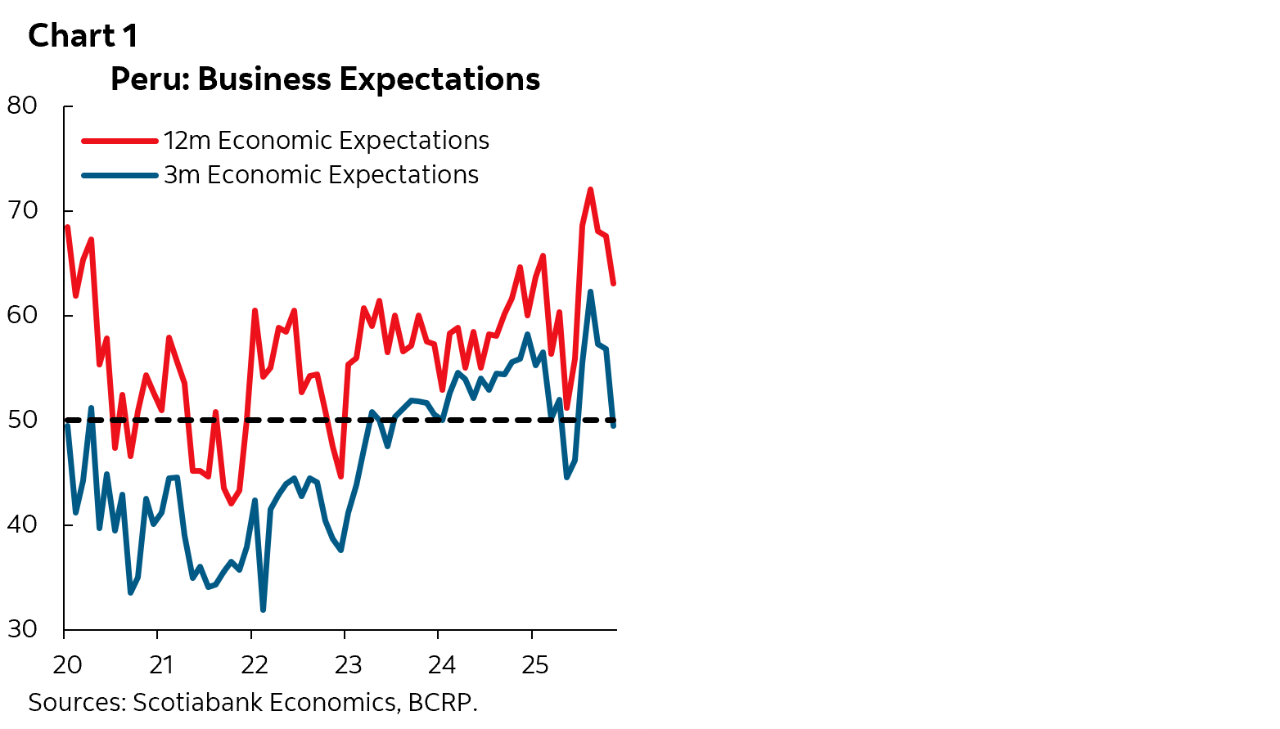
Economic expectations published by the Central Reserve Bank of Peru (BCRP) deteriorated significantly during the presidential election period, with three-month expectations falling into contractionary territory, below the 50-point threshold, for the first time in nearly two years. Following the end of the electoral period and greater certainty about the continuity of an economic framework supportive of private investment, 12-month expectations rose to their highest level since February 2019, while three-month expectations reached their highest level since November 2017.
More recently, expectations have weakened again amid concerns over the impact of El Niño (chart 1). The deterioration has been particularly evident in the three-month outlook, which has fallen back into contractionary territory. Nevertheless, 12-month economic expectations remain firmly in expansionary territory and well above the 50-point threshold. Moreover, most leading indicators of economic activity, including sector-level expectations, companies’ assessments of their current conditions, investment plans, and hiring intentions, continue to perform well and remain in expansionary territory. Against this backdrop, we believe the recent deterioration in sentiment will prove temporary, with confidence gradually recovering as the effects of El Niño on economic activity dissipate.
September GDP figures will be released on November 15th. We estimate that economic activity expanded by around 2.8% y/y, bringing GDP growth in the third quarter of 2026 (3Q26) to 3.3%, up from 2.6% in 2Q26. The stronger performance in 3Q26 relative to the previous quarter would mainly reflect a smaller negative contribution from primary activities, particularly agriculture and fisheries, due to seasonal factors. Primary sectors account for a larger share of total GDP during the second and fourth quarters of the year, meaning that weaker performance in these activities tends to have a more significant impact on aggregate growth during those periods.
We estimate that Peruvian GDP will grow by 3.2% in 2026, supported primarily by sectors linked to domestic demand, which we project will expand by around 4.5%. We estimate that an “extraordinary” El Niño event would subtract around 1 percentage point from annual GDP growth, implying that, in its absence, the economy could have expanded by more than 4.0% this year. Meanwhile, the LatinFocus consensus also projects GDP growth of 3.2%, while economic analysts participating in the BCRP’s Macroeconomic Expectations Survey expect growth of 3.1%.
For 2027, we expect GDP growth of 3.3%, with activity slowing to 1.2% in the first quarter due to the impact of El Niño before recovering over the remainder of the year. This compares with growth expectations of 3.1% from both the LatinFocus consensus and analysts surveyed by the BCRP.
| LOCAL MARKET COVERAGE | ||
| CHILE | ||
| Website: | Click here to be redirected | |
| Subscribe: | anibal.alarcon@scotiabank.cl | |
| Coverage: | Spanish and English | |
| MEXICO | ||
| Website: | Click here to be redirected | |
| Subscribe: | estudeco@scotiacb.com.mx | |
| Coverage: | Spanish | |
| PERU | ||
| Website: | Click here to be redirected | |
| Subscribe: | siee@scotiabank.com.pe | |
| Coverage: | Spanish | |
DISCLAIMER
This report has been prepared by Scotiabank Economics as a resource for the clients of Scotiabank. Opinions, estimates and projections contained herein are our own as of the date hereof and are subject to change without notice. The information and opinions contained herein have been compiled or arrived at from sources believed reliable but no representation or warranty, express or implied, is made as to their accuracy or completeness. Neither Scotiabank nor any of its officers, directors, partners, employees or affiliates accepts any liability whatsoever for any direct or consequential loss arising from any use of this report or its contents.
These reports are provided to you for informational purposes only. This report is not, and is not constructed as, an offer to sell or solicitation of any offer to buy any financial instrument, nor shall this report be construed as an opinion as to whether you should enter into any swap or trading strategy involving a swap or any other transaction. The information contained in this report is not intended to be, and does not constitute, a recommendation of a swap or trading strategy involving a swap within the meaning of U.S. Commodity Futures Trading Commission Regulation 23.434 and Appendix A thereto. This material is not intended to be individually tailored to your needs or characteristics and should not be viewed as a “call to action” or suggestion that you enter into a swap or trading strategy involving a swap or any other transaction. Scotiabank may engage in transactions in a manner inconsistent with the views discussed this report and may have positions, or be in the process of acquiring or disposing of positions, referred to in this report.
Scotiabank, its affiliates and any of their respective officers, directors and employees may from time to time take positions in currencies, act as managers, co-managers or underwriters of a public offering or act as principals or agents, deal in, own or act as market makers or advisors, brokers or commercial and/or investment bankers in relation to securities or related derivatives. As a result of these actions, Scotiabank may receive remuneration. All Scotiabank products and services are subject to the terms of applicable agreements and local regulations. Officers, directors and employees of Scotiabank and its affiliates may serve as directors of corporations.
Any securities discussed in this report may not be suitable for all investors. Scotiabank recommends that investors independently evaluate any issuer and security discussed in this report, and consult with any advisors they deem necessary prior to making any investment.
This report and all information, opinions and conclusions contained in it are protected by copyright. This information may not be reproduced without the prior express written consent of Scotiabank.
™ Trademark of The Bank of Nova Scotia. Used under license, where applicable.
Scotiabank, together with “Global Banking and Markets”, is a marketing name for the global corporate and investment banking and capital markets businesses of The Bank of Nova Scotia and certain of its affiliates in the countries where they operate, including; Scotiabank Europe plc; Scotiabank (Ireland) Designated Activity Company; Scotiabank Inverlat S.A., Institución de Banca Múltiple, Grupo Financiero Scotiabank Inverlat, Scotia Inverlat Casa de Bolsa, S.A. de C.V., Grupo Financiero Scotiabank Inverlat, Scotia Inverlat Derivados S.A. de C.V. – all members of the Scotiabank group and authorized users of the Scotiabank mark. The Bank of Nova Scotia is incorporated in Canada with limited liability and is authorised and regulated by the Office of the Superintendent of Financial Institutions Canada. The Bank of Nova Scotia is authorized by the UK Prudential Regulation Authority and is subject to regulation by the UK Financial Conduct Authority and limited regulation by the UK Prudential Regulation Authority. Details about the extent of The Bank of Nova Scotia's regulation by the UK Prudential Regulation Authority are available from us on request. Scotiabank Europe plc is authorized by the UK Prudential Regulation Authority and regulated by the UK Financial Conduct Authority and the UK Prudential Regulation Authority.
Scotiabank Inverlat, S.A., Scotia Inverlat Casa de Bolsa, S.A. de C.V, Grupo Financiero Scotiabank Inverlat, and Scotia Inverlat Derivados, S.A. de C.V., are each authorized and regulated by the Mexican financial authorities.
Not all products and services are offered in all jurisdictions. Services described are available in jurisdictions where permitted by law.