

HIGHLIGHTS
- A busy week awaits, with Mexican fixed investment, Peruvian CPI, Chilean and Brazilian GDP on tap in Latam, alongside U.S. and Canadian employment data and the BoC’s decision in the G10.
- Trade developments will remain key for Mexico and Canada next week, with Mexican officials hoping they can soon reach an agreement with the U.S. on lower tariffs on passenger vehicles and light trucks.
- In today’s report, the team in Mexico takes a closer look at Q2-26 GDP figures, with INEGI publishing industry-level details earlier this week. Mexico’s economic mix remains lacklustre on balance, as services gets little help from other corners of the economy.
- The team in Peru goes over their expectation for the country’s economy to remain strong in the third quarter of the year, resisting headwinds from higher inflation and El Niño, as domestic demand strings a seventh consecutive quarter of 5%+ y/y gains in Q2.
Chart of the Week
KEY LATAM AND G10 DATA AHEAD
Juan Manuel Herrera, Director
+52.55.2299.6675
juanmanuel.herrera@scotiabank.com
- A busy week awaits, with Mexican fixed investment, Peruvian CPI, Chilean and Brazilian GDP on tap in Latam, alongside U.S. and Canadian employment data and the BoC’s decision in the G10.
- Trade developments will remain key for Mexico and Canada next week, with Mexican officials hoping they can soon reach an agreement with the U.S. on lower tariffs on passenger vehicles and light trucks.
- In today’s report, the team in Mexico takes a closer look at Q2-26 GDP figures, with INEGI publishing industry-level details earlier this week. Mexico’s economic mix remains lacklustre on balance, as services gets little help from other corners of the economy.
- The team in Peru goes over their expectation for the country’s economy to remain strong in the third quarter of the year, resisting headwinds from higher inflation and El Niño, as domestic demand strings a seventh consecutive quarter of 5%+ y/y gains in Q2.
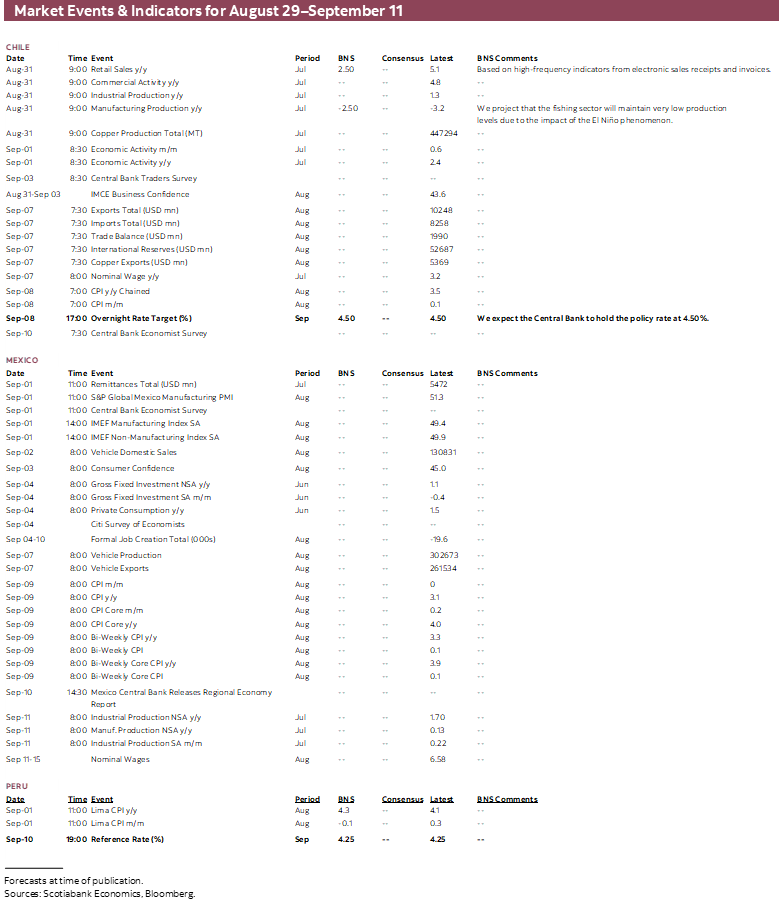
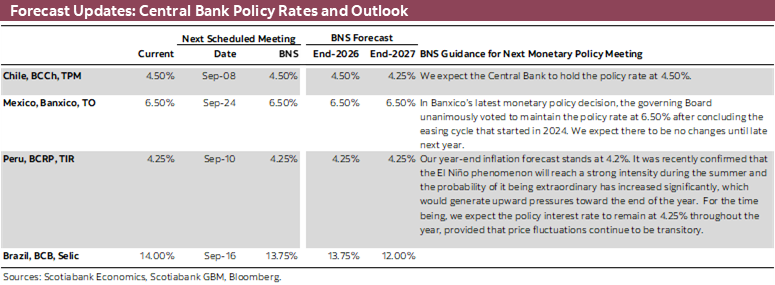
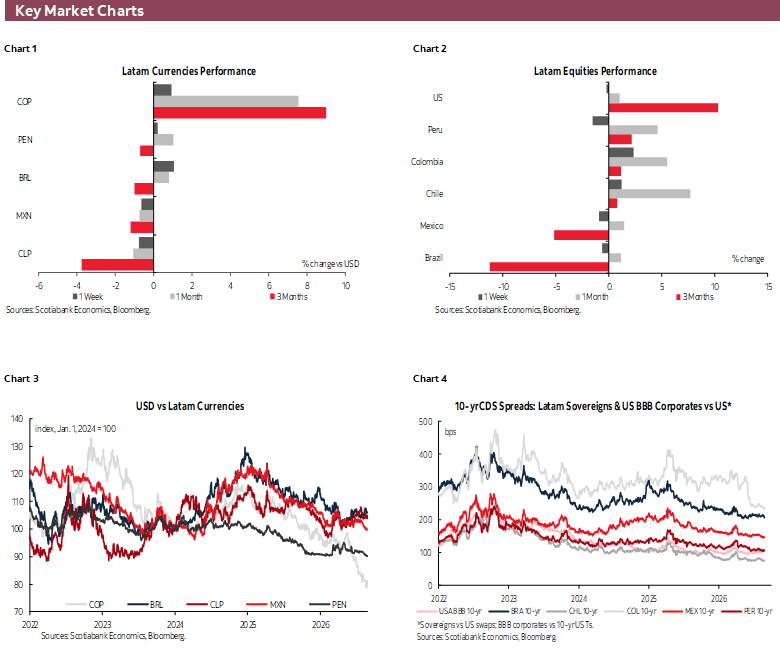
It’s a busy start to the final month of the third quarter, with major data on tap from Latam (Mexican investment, Peruvian CPI, and Brazilian and Chilean GDP) and the G10 (e.g. U.S. and Canadian jobs) and ongoing geopolitical risks (tariffs and the Middle East) set to give plenty for markets to chew on. A new cycle of central bank decisions kicks off with the Bank of Canada on Wednesday, but we’ll have to wait until the BCCh on September 8th for the next Latam central bank announcement—running until Colombia’s on the 30th. On Tuesday, Mexico’s president Sheinbaum will present the government’s annual report to Congress, before going on a tour of the country for the following three to four weeks.
Who knows what will happen on the USMCA front or U.S. tariffs, but we’ll watch for possible developments in trade negotiations, with Mexico’s Economy Minister Ebrard claiming that talks between the two countries will continue on a weekly basis. Ebrard stated that Mexico is seeking a reduction in auto tariffs to 15% from 25%, which would be the same level that the U.S. and Canada had reportedly agreed to before talks broke down. Among the reasons for the breakdown in talks was that the U.S. wanted light trucks to still be subject to the higher 25% duty rate, which would also be a tough pill to swallow for Mexican exporters.
In the first half of the year, light trucks accounted for 44% of the total USD value of Mexican finished vehicle exports to the U.S.—much higher than the 13% share in the case of Canada. There may be some comfort in the fact that a higher proportion of U.S. content in pickup trucks means these face lower effective duties (averaging ~9.5% vs nearly 15% in passenger vehicles. in H1-26), but high 25% tariffs were seen as only temporary and Mexico will likely not want to formalize these for a longer period.
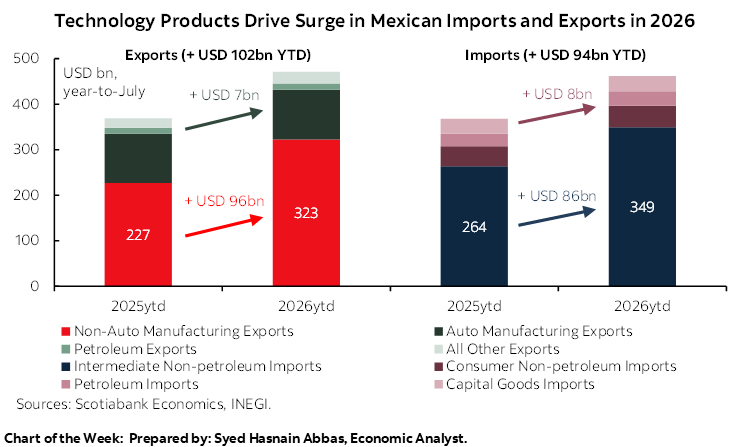
Another risk for Mexico is that the U.S. rolls out tariffs on certain technology products that have so far been mostly exempt from the U.S.’s various tariff waves. Tariffs on servers would particularly impact Mexico, as these goods have accounted for a large share of the rise in Mexican exports in recent quarters—albeit incorporating a high share of foreign goods, reflected in the country’s swelling imports bill (see chart on the front page). The new technology goods tariffs reportedly remain under discussion but are an important development to watch and could be used as a negotiating tool by the U.S. administration in extracting Mexican concessions.
In today’s report, the team in Mexico takes a closer look at Q2-26 GDP figures, with INEGI publishing industry-level details earlier this week. The mix of growth in the second quarter of the year was relatively positive, with a solid gain in services accompanied by a pickup in non-residential construction—although this may only be temporary due to World Cup related works. Mexico’s economic mix remains lacklustre on balance, as services gets little help from other corners of the economy, such as the manufacturing sector which did have a solid q/q gain in Q2 but remains in negative growth y/y, while on the expenditures side, private investment in machinery and equipment remains significantly depressed.
On Friday, Mexico publishes fixed investment data for June to wrap up the quarter. Fixed investment grew by 6% and 1.2% y/y in April and May respectively, compared to an average decline of 3.3% in Q1-26—when private machinery and equipment outlays shrank by 8.2% y/y. The latter did not materially pick up in available Q2 data (0.8% in April, -1.4% in May), while overall fixed investment growth was buoyed by the public sector (tied to the World Cup); there may have been some residual public works spending in June.
Now, there’s a high chance that next week’s data will show a massive year-on-year increase considering a very low base of comparison in June 2025, when private investment fell by 10.5% m/m. Investment tends to decline m/m from May, but even if we were to assume that it fell by 0.5% in June 2026, this would still translate into about a 5% y/y rise. Thus, focus on seasonally adjusted data, particularly on private equipment investment. That same day, we get formal job numbers that are also worth a look.
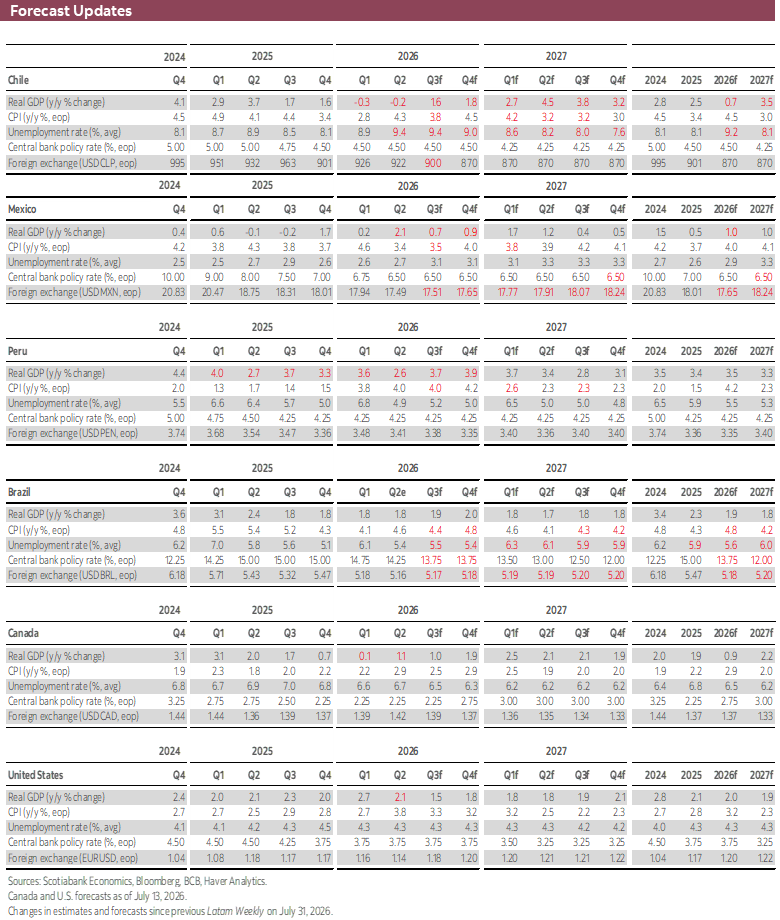
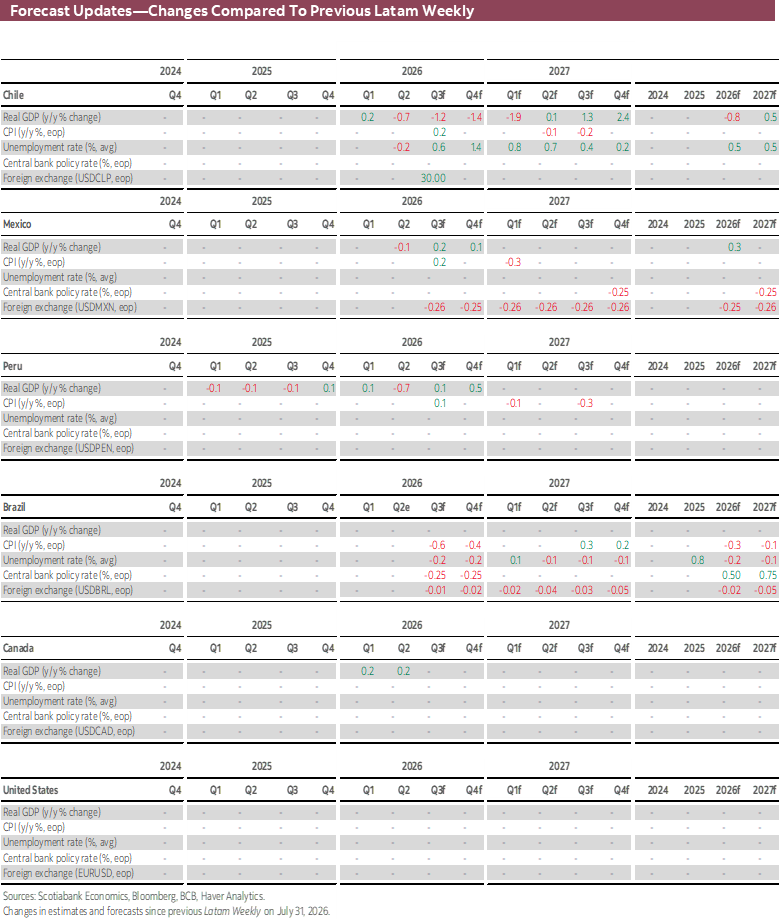
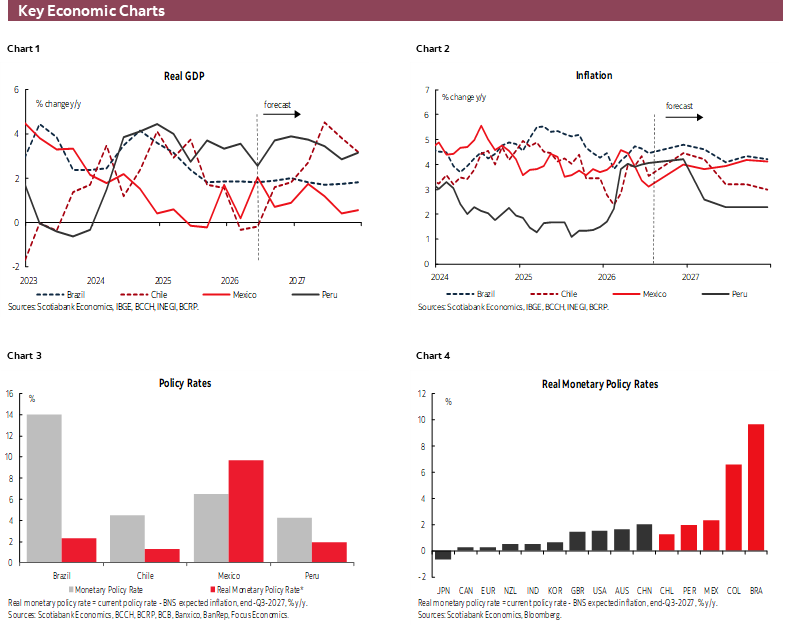
Peru is first out in the region with August CPI data on Tuesday. We project that inflation accelerated from 4.1% to 4.3%. While we estimate that prices fell 0.1% m/m, compared to the 20yr August average 0.24% monthly rise, this year’s August print runs into the issue that August 2025 saw a seasonally unusual 0.29% m/m drop, resulting in a weak base of comparison that pushes the y/y reading higher from July’s. External and weather-related price pressures have lifted inflation in 2026 and will likely keep it around the 4% level over the balance of the year. We project that headline inflation will close 2026 at 4.2% before considerably slowing to 2.6% in Q1-27, ending next year at 2.3%.
As the team in Lima discusses today, Peru’s economy is expected to remain strong in the third quarter of the year, resisting headwinds from higher inflation and El Niño. Peru’s had a disappointing Q2 in terms of GDP growth, clocking in at 2.6% y/y, but the bulk of this slowdown from the 3.5% y/y average in the previous three quarters owed to one-off or transitory shocks such as weak exports due to depressed fishing volumes amid El Niño. Domestic demand rose by 5.2% y/y last quarter, its seventh consecutive quarter of 5%+ y/y gains, as solid trend in household spending and investment now get an additional boost from improved business and consumer confidence following the presidential elections.
Chile starts the week with a macro flood of retail sales, industrial production, and copper output figures for July that will set the starting point for Q3 GDP growth, with July economic activity data due on Tuesday. We estimate that real retail sales grew by about 2.5% y/y, or about half of the outsized 5% y/y gains in May and June, with a monthly decline likely considering solid increases in the prior two readings—and some Cyber Day (early-June) timing effects. As in the case of Peru, we anticipate some weakness in manufacturing output that reflects the impact of El Niño on the fishing sector, and therefore on the processing of seafood products, resulting in a y/y loss for the sector. It’ll be easier to make a call regarding the performance of economic activity in July once we have the Monday data at hand, but the y/y GDP reading has a high bar to clear for a positive print given last July’s solid 1% m/m gain and the fact that the Chilean economy has practically stagnated over the last year or so.
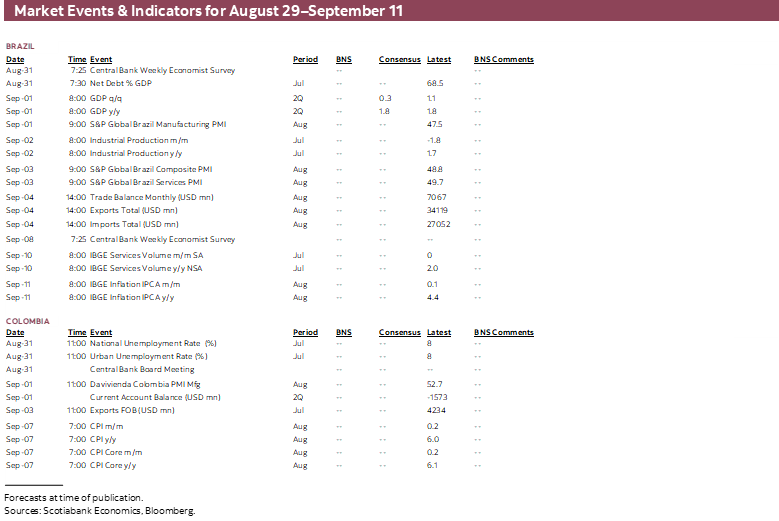
That same day, Brazilian Q2 GDP is expected to come in at around the same growth pace as in Q1, at 1.8% y/y. Highly restrictive policy rates continue to restrict spending with their impact likely to be seen more clearly in y/y data over the balance of the year as fiscal supports (that are now fading) still managed to buoy y/y growth in recent prints. The y/y reading may be little changed from the first quarter, but we expect a considerable slowdown on a q/q basis, falling from 1.1% in Q1 to around 0.5% in Q2, more clearly reflecting a retreat in fiscal tailwinds. This deceleration would also be in line with the post-pandemic pattern in Brazilian GDP data, where first quarter data have tended to show a strong gain that is then followed by more muted growth over the remainder of the year (which points to some possible issues in seasonal adjustments). Slowdown aside, Brazil’s economy is decently chugging along considering monetary policy, inflation, and electoral anxiety.
COUNTRY UPDATES
Mexico—GDP Was Better than Expected in Q2, Although Downside Risks Persist
Rodolfo Mitchell, Director of Economic and Sectoral Analysis
+52.55.3977.4556 (Mexico)
mitchell.cervera@scotiabank.com.mx
Miguel Saldaña, Economist
+52.55.5123.1718 (Mexico)
msaldanab@scotiabank.com.mx
Martha Cordova, Economic Research Specialist
+52.55.5435.4824 (Mexico)
martha.cordovamendez@scotiabank.com.mx
The release of the GDP for the second quarter of 2026 offered a somewhat more complete view of Mexico’s economic landscape in recent months.
Revised GDP figures for Q2-26 showed growth that was partly expected (chart 1), given the positive readings in recent IGAE releases. GDP posted an annual increase of 2.1% (marginally revised from 2.2% which had then surprised the Bloomberg median of 1.6%), with broad-based growth across all economic activities. The agricultural component increased by 4.8%, driven by gains in agriculture (5.0%), livestock (4.9%), and services related to agriculture (5.5%), while fishing, hunting, and trapping declined (-1.3%).
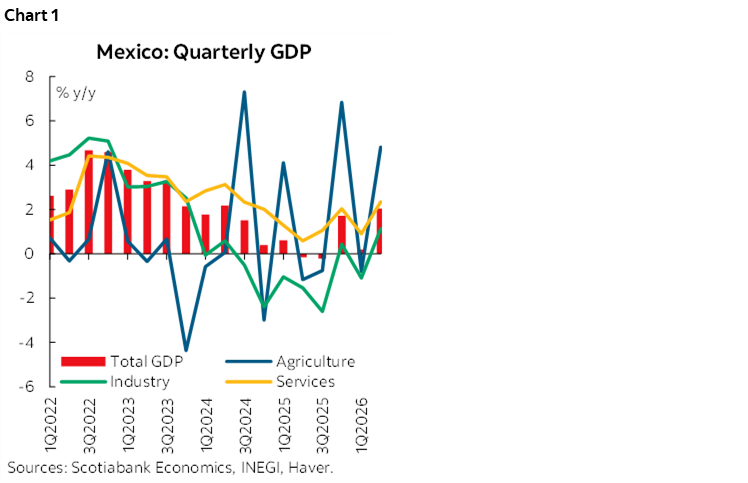
Secondary activities posted a 1.1% increase, reaching their strongest level in nine quarters (Q3-23). This stronger momentum can be attributed to mining, which grew 4.9%—driven by mining-related services at 51.7%—as well as construction, which expanded 4.8% due to an 8.3% increase in non-residential construction—possibly supported by World Cup-related works. Meanwhile, utilities continued to contract by -0.14%, and manufacturing declined by -0.42%, with most of its components either stagnant or posting slight decreases. Services, for their part, grew 2.4%, with wholesale trade standing out with an 11.3% increase—as seen in recent readings of the Monthly Survey of Commercial Enterprises, where wholesale trade has been particularly strong.
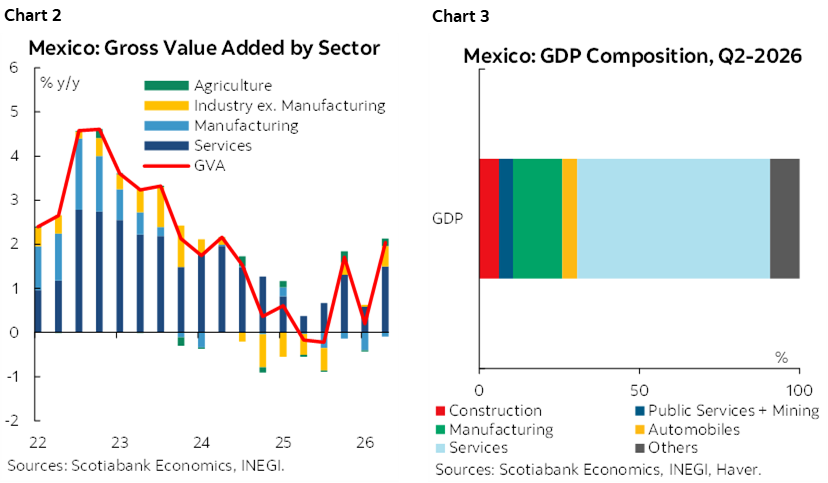
An interesting point to observe has been the composition of the economy’s growth drivers in recent years (chart 2). Services continue to, broadly support growth since the post-pandemic recovery and much of 2022 and 2023, when they combined with industry and manufacturing, that contributed consistently to GDP amid strong external demand and the reactivation of global supply chains. However, since 2024, manufacturing’s contribution has been minimal—and even negative in several quarters—while the contribution of industry as a whole has declined significantly (chart 3). What may explain this shift is the erosion of the main manufacturing engine, as investment conditions have deteriorated due to insecurity, institutional instability, weak rule of law and contract enforcement, trade uncertainty, among other factors. In this context, growth expectations for 2026 have begun to adjust, although moderately and with narratives that remain cautious. Following the Q2-26 performance, the analyst consensus has remained broadly stable within a range of 1.1% to 1.2% for the end of the year. The most notable move came from Banco de México, which, in its quarterly inflation report, revised its growth estimate from 1.1% to 1.5%, explaining that the adjustment mainly reflects the stronger performance of activity in Q2.
Looking ahead, we’ve raised our 2026 growth forecast from 0.9% to 1.0% but remains conditional on the evolution of the macroeconomic outlook, with a balance of risks clearly skewed to the downside. The export sector appears to be the driver with the greatest potential after several months of double-digit increases, especially in non-automotive manufacturing. However, factors such as business closures, a cooling labour market, the structural issue of informality, and persistently weak gross fixed investment will remain key to assessing whether this increase in economic activity was temporary or can be sustained over the coming quarters.
Peru—Domestic Demand Expected to Remain Solid in Q3-26 Despite the Threat of an El Niño Event
Pablo Nano, Deputy Head Economist
pablo.nano@scotiabank.com.pe
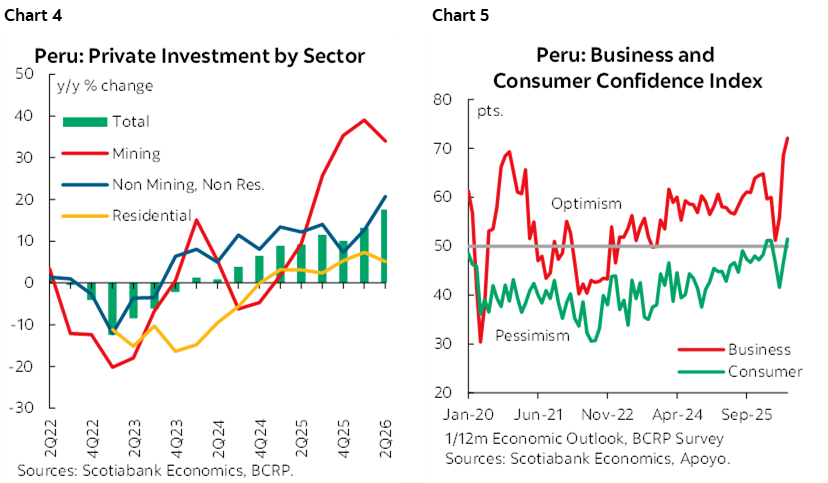
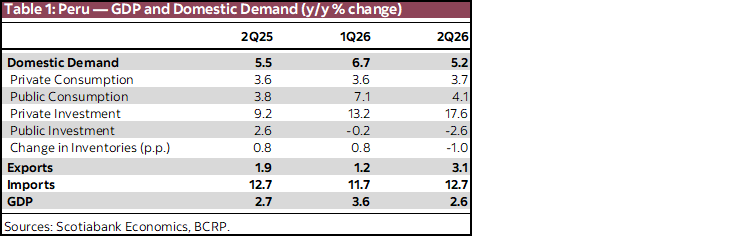
We project domestic demand growth of around 5% y/y in Q3-26, broadly in line with the pace recorded in Q2-26. The rebound in business expectations in July suggests that private investment will continue expanding at a double-digit rate (charts 4 and 5), led by mining companies amid record-high copper prices. In addition, private consumption is expected to maintain a growth rate similar to that observed in Q2-26, supported by improving consumer confidence and favourable household expectations following the change of government. This latter factor is also expected to positively influence the execution of public investment by the central government, particularly in projects aimed at mitigating the effects of the El Niño phenomenon.
According to data from the Central Reserve Bank of Peru (BCRP), domestic demand expanded by 5.2% y/y in the second quarter of 2026, broadly in line with our forecast of 5%. Domestic demand growth was twice as strong as GDP growth (2.6% y/y), which was affected by weak export volume performance, particularly in fishmeal, impacted by El Niño conditions, and non-traditional exports.
At a more disaggregated level, private investment stood out for its strong performance, completing four consecutive quarters of double-digit growth. This expansion was supported by the recovery in business confidence following the presidential runoff election results, a favourable external environment reflected in record-high terms of trade, and supportive credit conditions, including stable local currency interest rates and lower delinquency rates. Meanwhile, private consumption continued its positive trajectory, driven by higher employment and income levels, as well as greater access to consumer credit.
DOMESTIC DEMAND PERFORMANCE IN Q2-26
Private investment (+17.6% y/y) recorded broad-based growth, with mining investment (+34.0% y/y) leading the expansion amid elevated mineral prices, particularly copper. This environment supported higher investment by companies such as Southern Peru, especially in the Tía María project, and Antapaccay through the Coroccohuayco project. In addition, non-mining and non-residential investment (+20.7% y/y) showed strong momentum in sectors such as electricity, particularly distribution activities; infrastructure, including the construction of Lima Metro Line 2; telecommunications, through network modernization and coverage expansion; and manufacturing, supported by increased installed capacity. Residential investment (+5.1% y/y) accumulated six consecutive quarters of growth, driven by both self-construction and formal real estate activity, the latter benefiting from mortgage interest rates that remain below their historical average.
Private consumption (+3.7% y/y) continued to expand, supported by improvements in employment, real incomes, and consumer lending. During Q2-26, nearly 240,000 formal private sector jobs were created, particularly in services, commerce, and agribusiness. The wage bill increased by 4.4% y/y, albeit at a slower pace than Q1-26’s 7.3% gain mostly due to higher inflation, while consumer credit expanded by 6.4% amid easier financing conditions and declining delinquency rates. The strength of private consumption was reflected in both imports of durable consumer goods, including automobiles, whose sales have reached record highs, motorcycles, and televisions, as well as in domestic retail sales, particularly in the food segment.
Public investment (-2.6% y/y) declined further in Q2-26 due to weaker project execution by the central government (-17.8% y/y). This was largely explained by lower spending on comprehensive flood protection and stormwater drainage projects led by the National Infrastructure Authority (ANIN), as well as the completion of the first phase of the Bicentennial Schools construction program. This decline was partially offset by stronger performance among subnational governments (+8.1%), reflecting higher investment by local governments in transportation, education, and housing, as well as increased spending by regional governments in education, healthcare, and sanitation.
Public consumption (+4.1% y/y) remained on a growth path, although at a slower pace than in Q1-26. Higher expenditures on goods and services were the main drivers, particularly payments for professional services, consulting contracts, maintenance services, and PEN 1.6 billion advance payment for the acquisition of fighter aircraft for the Armed Forces, according to BCRP information. Wage expenditures also continued to grow, supported by increased disbursements in the education, public security, healthcare, and defense sectors.
| LOCAL MARKET COVERAGE | ||
| CHILE | ||
| Website: | Click here to be redirected | |
| Subscribe: | anibal.alarcon@scotiabank.cl | |
| Coverage: | Spanish and English | |
| MEXICO | ||
| Website: | Click here to be redirected | |
| Subscribe: | estudeco@scotiacb.com.mx | |
| Coverage: | Spanish | |
| PERU | ||
| Website: | Click here to be redirected | |
| Subscribe: | siee@scotiabank.com.pe | |
| Coverage: | Spanish | |
DISCLAIMER
This report has been prepared by Scotiabank Economics as a resource for the clients of Scotiabank. Opinions, estimates and projections contained herein are our own as of the date hereof and are subject to change without notice. The information and opinions contained herein have been compiled or arrived at from sources believed reliable but no representation or warranty, express or implied, is made as to their accuracy or completeness. Neither Scotiabank nor any of its officers, directors, partners, employees or affiliates accepts any liability whatsoever for any direct or consequential loss arising from any use of this report or its contents.
These reports are provided to you for informational purposes only. This report is not, and is not constructed as, an offer to sell or solicitation of any offer to buy any financial instrument, nor shall this report be construed as an opinion as to whether you should enter into any swap or trading strategy involving a swap or any other transaction. The information contained in this report is not intended to be, and does not constitute, a recommendation of a swap or trading strategy involving a swap within the meaning of U.S. Commodity Futures Trading Commission Regulation 23.434 and Appendix A thereto. This material is not intended to be individually tailored to your needs or characteristics and should not be viewed as a “call to action” or suggestion that you enter into a swap or trading strategy involving a swap or any other transaction. Scotiabank may engage in transactions in a manner inconsistent with the views discussed this report and may have positions, or be in the process of acquiring or disposing of positions, referred to in this report.
Scotiabank, its affiliates and any of their respective officers, directors and employees may from time to time take positions in currencies, act as managers, co-managers or underwriters of a public offering or act as principals or agents, deal in, own or act as market makers or advisors, brokers or commercial and/or investment bankers in relation to securities or related derivatives. As a result of these actions, Scotiabank may receive remuneration. All Scotiabank products and services are subject to the terms of applicable agreements and local regulations. Officers, directors and employees of Scotiabank and its affiliates may serve as directors of corporations.
Any securities discussed in this report may not be suitable for all investors. Scotiabank recommends that investors independently evaluate any issuer and security discussed in this report, and consult with any advisors they deem necessary prior to making any investment.
This report and all information, opinions and conclusions contained in it are protected by copyright. This information may not be reproduced without the prior express written consent of Scotiabank.
™ Trademark of The Bank of Nova Scotia. Used under license, where applicable.
Scotiabank, together with “Global Banking and Markets”, is a marketing name for the global corporate and investment banking and capital markets businesses of The Bank of Nova Scotia and certain of its affiliates in the countries where they operate, including; Scotiabank Europe plc; Scotiabank (Ireland) Designated Activity Company; Scotiabank Inverlat S.A., Institución de Banca Múltiple, Grupo Financiero Scotiabank Inverlat, Scotia Inverlat Casa de Bolsa, S.A. de C.V., Grupo Financiero Scotiabank Inverlat, Scotia Inverlat Derivados S.A. de C.V. – all members of the Scotiabank group and authorized users of the Scotiabank mark. The Bank of Nova Scotia is incorporated in Canada with limited liability and is authorised and regulated by the Office of the Superintendent of Financial Institutions Canada. The Bank of Nova Scotia is authorized by the UK Prudential Regulation Authority and is subject to regulation by the UK Financial Conduct Authority and limited regulation by the UK Prudential Regulation Authority. Details about the extent of The Bank of Nova Scotia's regulation by the UK Prudential Regulation Authority are available from us on request. Scotiabank Europe plc is authorized by the UK Prudential Regulation Authority and regulated by the UK Financial Conduct Authority and the UK Prudential Regulation Authority.
Scotiabank Inverlat, S.A., Scotia Inverlat Casa de Bolsa, S.A. de C.V, Grupo Financiero Scotiabank Inverlat, and Scotia Inverlat Derivados, S.A. de C.V., are each authorized and regulated by the Mexican financial authorities.
Not all products and services are offered in all jurisdictions. Services described are available in jurisdictions where permitted by law.