

HIGHLIGHTS
- Mexican and Brazilian H1-August CPI are the data highlights in a relatively empty Latam and global calendar, where U.S. PCE and Canadian GDP are the focus in the G10 alongside the Jackson Hole Symposium.
- Canada’s trade agreement with the U.S. (if confirmed) may pave the way or act as a negotiating blueprint to lowering U.S. tariffs on Mexico, including a possible reduction in non-U.S. content auto duties to 15% from 25%.
- In today’s report, the team in Chile covers the latest GDP data that showed the country strung two negative quarters, falling into recession and raising the bar for growth to exceed 1% in 2026.
- Our economists in Mexico discuss the continued strength in international trade, with exports growing by 25%+ y/y in H1-26, resisting tensions with the U.S. and a still-unresolved USMCA renewal.
Chart of the Week
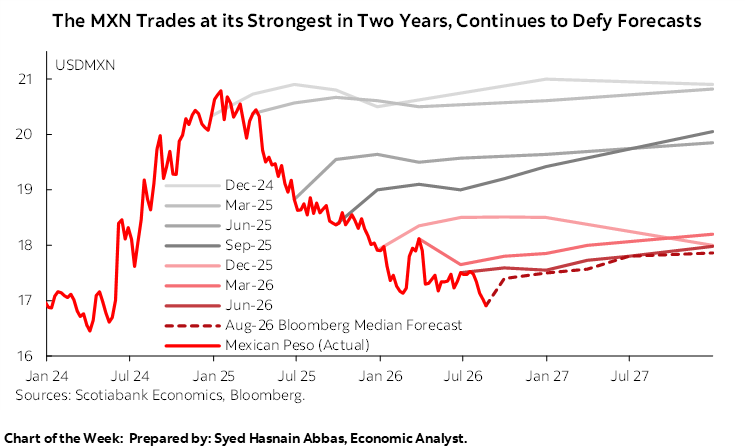
MEXICAN AND BRAZILIAN CPI, EYES ON USMCA DEVELOPMENTS
Juan Manuel Herrera, Director
+52.55.2299.6675
juanmanuel.herrera@scotiabank.com
- Mexican and Brazilian H1-August CPI are the data highlights in a relatively empty Latam and global calendar, where U.S. PCE and Canadian GDP are the focus in the G10 alongside the Jackson Hole Symposium.
- Canada’s trade agreement with the U.S. (if confirmed) may pave the way or act as a negotiating blueprint to lowering U.S. tariffs on Mexico, including a possible reduction in non-U.S. content auto duties to 15% from 25%.
- In today’s report, the team in Chile covers the latest GDP data that showed the country strung two negative quarters, falling into recession and raising the bar for growth to exceed 1% in 2026.
- Our economists in Mexico discuss the continued strength in international trade, with exports growing by 25%+ y/y in H1-26, resisting tensions with the U.S. and a still-unresolved USMCA renewal.
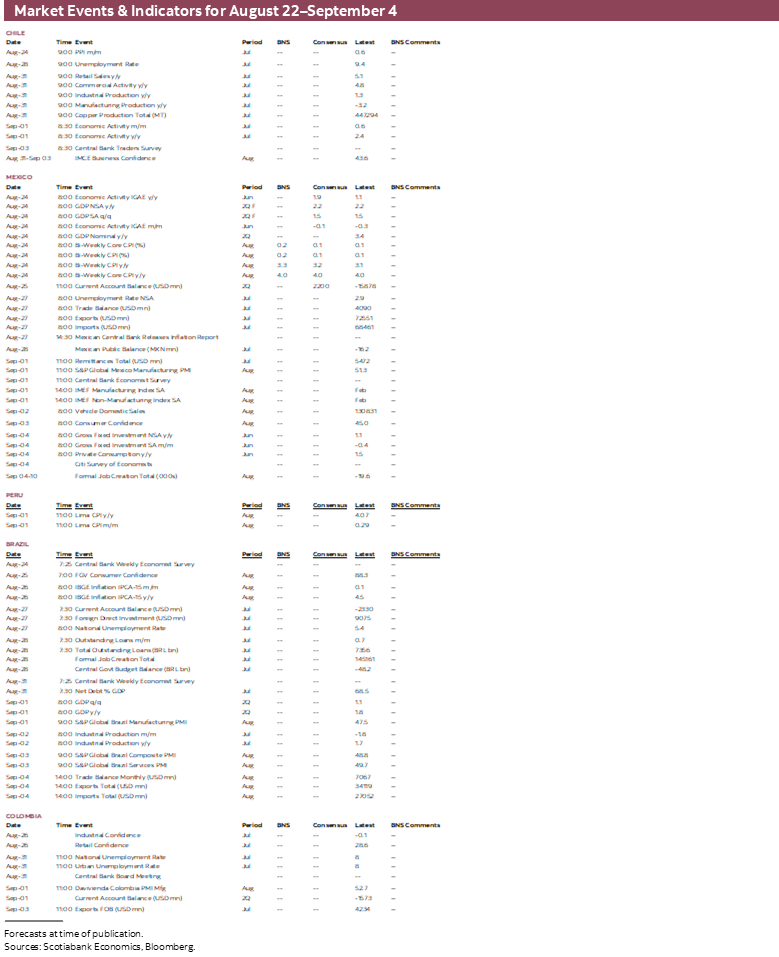
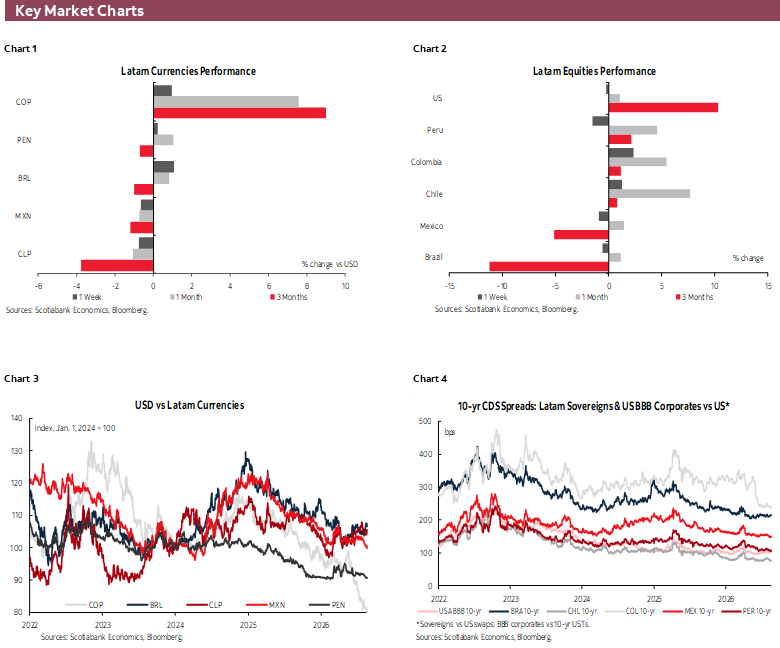
Next week presents a limited economic release schedule in Latam and around the globe that leaves markets liable to centre their attention on the Jackson Hole Symposium during the latter half of the week, developments on the U.S. trade policy front, anxiety in Treasury markets, and U.S.-Iran tensions. Nvidia’s second quarter results will also be a major test for markets searching for direction, with the S&P 500 heading towards a ~1.5% loss for the week—though not far from all-time highs.
Mexico and Brazil are out with mid-month CPI on Monday and Wednesday, respectively. Mexico also publishes June economic activity, revised Q2-26 GDP figures, and international trade data for July. Banxico also publishes its quarterly report, on the heels of its latest upward revision to its inflation forecasts. Brazil’s calendar is much emptier, with July unemployment as the other data point worth watching. Chile releases July unemployment and PPI figures, while Peru’s and Colombia’s schedules are bare of anything noteworthy. Outside of Latam, U.S. PCE for July (and Q2 GDP revisions) and Canada’s Q2 GDP release are the highlights.
In today’s report, the team in Chile covers the latest GDP data that showed the country strung two negative quarters, falling into recession. A multitude of headwinds, from energy prices to fiscal tightening, conspired in the first half of the year to mark Chile’s worst two-quarter stretch since the pandemic shock, setting the country on track for a sub-1% expansion in 2026. Our economists in Mexico discuss the continued strength in international trade, with exports growing by 25%+ y/y in H1-26, resisting tensions with the U.S. and a still-unresolved USMCA renewal, as Mexico plays a key role in the technology supply chain supporting the U.S. AI buildout, albeit with limited value-added gains.
Over the next few days, we may see Canada and the U.S. reach an agreement that lowers trade barriers between the two countries that could serve as a blueprint for Mexico’s talks with the U.S., especially on the topic of autos with reports noting that the U.S. may lower its duty rate to 15% from 25% on the non-U.S. content of USMCA-compliant vehicle imports from Canada. At writing, there are no details on whether the U.S. may only tariff non-USMCA content or if Canada has agreed to a U.S.-specific share in autos to meet USMCA requirements—one that Mexico may have to concede, alongside trade measures against Chinese imports that parallel the U.S.’s.
Mexican CPI is expected to hold practically unchanged in H1-Aug in headline and core terms, at 3.2% and 4% respectively (with some rounding possibly resulting in small beats/misses). Services inflation has cooled somewhat from the 4.5–4.6% area in April–June, but remains fairly elevated at around 4.4% with limited signs of quickly retreating towards the top of Banxico’s 2–4% tolerance band—with this stickiness partly responsible for the bank’s latest revisions higher to their inflation forecasts. As for headline inflation the large upswing and then downswing on agricultural prices has seemingly concluded or is showing signs of stabilizing. The base of comparison in H1-Aug 2025 for agricultural goods is also perhaps not as amenable to a lower print than in recent weeks.
On the economy front, June’s IGAE should not surprise, growing 2.9–3% y/y to line up with the quarterly Q2 GDP flash that came in at 2.2% y/y for the quarter as a whole, but may offer some details on the industry-specific drivers of the country’s performance at the close of Q2—possibly showing tailwinds from the FIFA World Cup (although these have fallen short of what was expected prior to the event). The Q2-25 GDP revision published at the same time may see modest tweaks versus the initial print alongside a detailed industry breakdown, but we’ll have to wait for the expenditure breakdown to gauge trends on consumption, investment, and international trade contributions.
Economists are expecting a bit more movement in Brazil’s IPCA-15 reading for August, falling to about 4.3% from 4.5% previously to reach its lowest point since April and possibly March. In August, rural and residential consumers got a one-time electricity bill discount financed by the sale of energy produced by the Itaipu Hydroelectric plant. With the credit reversing in September, the measure is only a temporary downward pressure on inflation, so the focus will be (more than usual) on the story that core prices are telling—e.g. personal and recreation services hanging around the high-5s y/y since the start of the year.
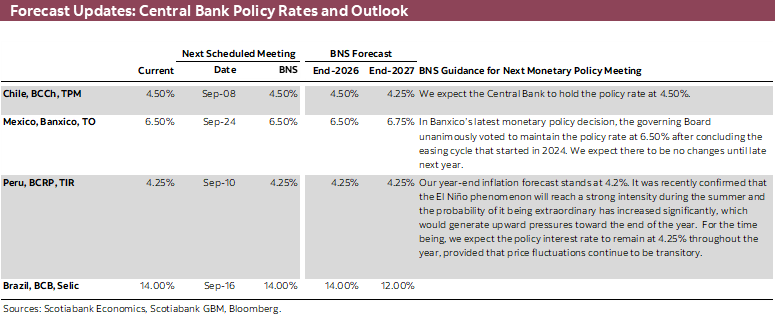
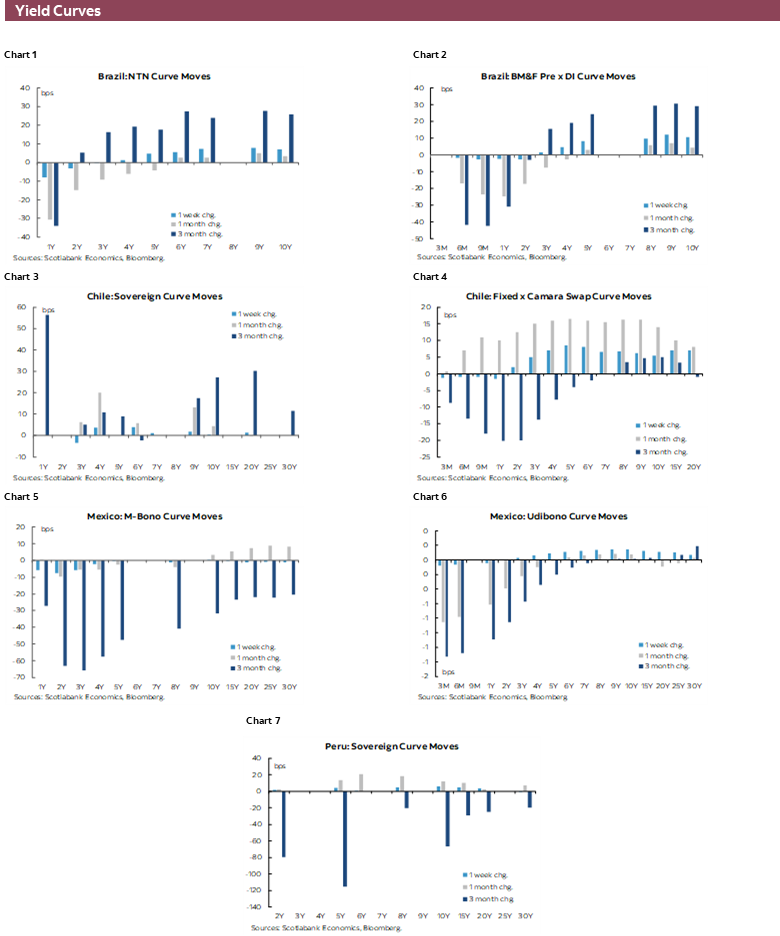
Markets are fairly convinced that the BCB will announce a final 25bps cut at its rate announcement in early-September (80% priced in), while future inflation prints and risks around the country’s fiscal trajectory will determine whether the bank can roll out more cuts or hold at 13.75%. On public finance matters, the electoral campaign for the October elections is now in full swing (and free radio and TV blocks open on the 28th), and we’ll be waiting for concrete proposals on mending Brazil’s fiscal trajectory. For the moment, it would look like it’s Lula’s race to lose, with odds favouring him at 60–65% over Bolsonaro’s 30–35%, although the latter’s odds have crawled back from as low as 20–25% in late-July and polls still show that Lula is within reach at about 3ppts above Flavio.
COUNTRY UPDATES
Chile—GDP Contracted Again in Q2, Confirming that the Economy Entered a Technical Recession
Anibal Alarcón, Senior Economist
+56.2.2619.5465 (Chile)
anibal.alarcon@scotiabank.cl
ECONOMIC ACTIVITY WOULD NOT GROW BY MORE THAN 1% THIS YEAR
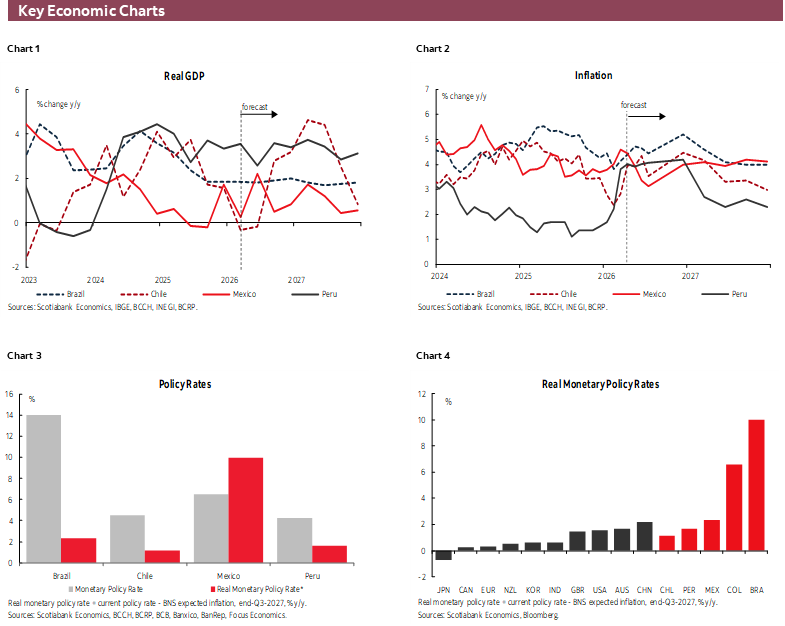
National Accounts figures for the second quarter released by the Central Bank confirmed a new contraction in economic activity, both in seasonally adjusted quarter-on-quarter terms and on an annual basis. Considering the decline already recorded in the first quarter, the economy entered a technical recession, the first since the pandemic, a situation that is virtually unmatched in any other major country. With these figures in hand, it has become difficult to achieve a growth rate of 1.5% this year, leading us to incorporate a significant downside bias to our 2026 GDP growth forecast. For next year, to the extent that the pipeline of investment projects materializes and confidence indicators recover, GDP could expand by more than 3%.
GDP contracted 0.3% y/y in the first half of the year. During the first six months of the year, economic activity faced multiple simultaneous supply and demand shocks, including lower fruit production, the impact of the El Niño phenomenon on the fishing sector, an adverse external backdrop, a reduction in the inflow of Argentine tourists, and fiscal tightening, preventing the economy from avoiding an economic contraction. This occurred despite the government partially modifying its initial strategy of rapidly passing through higher international fuel prices to domestic consumers, given the adverse effects such a measure would have generated on private consumption during the second quarter.
From the expenditure side, the contraction in the second quarter was broad-based, reflected in declines in both investment and private consumption. This performance took place amid a significant fiscal consolidation process, materialized through spending cuts exceeding USD 2bn to date, aimed at financing the recently approved National Reconstruction Act. According to estimates from the Ministry of Finance, this reform implies a reduction in fiscal revenues in the short term that would not be fully offset by stronger economic growth prospects over the medium term.
In the second quarter, GDP contracted 0.2% y/y, mainly explained by a 6.4% y/y decline in the mining sector. While economic activity in the sector has faced several challenges this year, including the impact of the El Niño phenomenon, maintenance shutdowns, and lower productivity, among others, year-ago comparison bases in the second quarter were particularly demanding following a very strong 2025 for some private mining companies. In fact, mining GDP expanded 0.6% q/q SA during the period, standing out for its positive contribution to overall GDP. Meanwhile, construction GDP contracted again both in annual terms and in seasonally adjusted quarter-on-quarter terms, highlighting the difficult situation facing the sector, particularly in the residential segment. Real estate investment remains stagnant, with no new projects in the pipeline pending the incentives that the National Reconstruction Act is expected to provide to boost new home sales. The contraction in construction GDP is also generating a negative impact on employment, with more than 120,000 jobs still not recovered since the pandemic.
Total consumption contracted 1.3% q/q in the second quarter of 2026. As expected, the shock from international fuel prices and their rapid pass-through to domestic prices had a significant impact on private consumption (-0.5% q/q), which contracted in both goods and services. Along the same lines, public consumption fell 3.8% q/q, likely reflecting the fiscal consolidation measures implemented by the government to finance the National Reconstruction Act. Similarly, investment declined 0.3% q/q, mainly due to another contraction in its construction component (-0.5% q/q), completing four consecutive quarters of seasonally adjusted declines.
The second half of the year will benefit from favourable comparison bases. While annual comparison bases are supportive, economic activity will need to accelerate in the coming months to achieve, albeit with some difficulty, average annual growth of 1%. Based on our forecasts, GDP could expand by even less than that if key sectors of the economy, such as construction, fail to show a recovery.
Mexican Exports Amid Trade Uncertainty
Rodolfo Mitchell, Director of Economic and Sectoral Analysis
+52.55.3977.4556 (Mexico)
mitchell.cervera@scotiabank.com.mx
Miguel Saldaña, Economist
+52.55.5123.1718 (Mexico)
msaldanab@scotiabank.com.mx
Martha Cordova, Economic Research Specialist
+52.55.5435.4824 (Mexico)
martha.cordovamendez@scotiabank.com.mx
In recent months, trade uncertainty in North America has increased due to the renegotiation of the USMCA, in a context in which the United States decided not to renew the agreement automatically, opting instead for a process of annual reviews. Despite recent bilateral tensions between the United States and Mexico, and between the United States and Canada, as well as the uncertainty these tensions have generated, economic integration among the three countries remains high. This has allowed the external sector to continue to be one of the strongest drivers of the Mexican economy.
Discussions around the USMCA have focused on several issues. On the one hand, the United States’ main priorities are to increase regional and U.S. content in industries such as the automotive sector, in order to limit China’s participation in regional supply chains, and keep sectors considered strategic subject to tariffs for countries outside the region. On the other hand, Mexico and Canada, in their respective bilateral negotiations, seek to reduce their exposure to tariffs in key industries for their economies, such as steel and the automotive industry, while preserving the legal certainty that has characterized the agreement. These discussions have resulted in an environment of high uncertainty, affecting issues such as location decisions—for example, automotive plants of various brands—investment horizons, compliance costs, among others.
However, at least in Mexico’s case, these tensions have not significantly affected trade flows. In recent months, Mexican exports have posted double-digit growth, rising 25.8% in the first half of 2026—and with exports specifically to the United States accounting for more than 80% of Mexico’s total exports—reaching record levels during this period. This momentum allowed Mexico to achieve a larger surplus than the one recorded in the same period last year.
At the sectoral level, recent growth has been led by non-automotive manufacturing exports, especially sectors linked to technology and advanced manufacturing, such as computer, electronic, and electrical equipment. Over the medium term, specialization in these advanced manufactures could represent a growing opportunity for Mexico—although the country is primarily an assembler of these products rather than necessarily a producer—in a context of rapid adoption of new technologies driven by the rise of artificial intelligence.
In this context, the USMCA review represents both a risk and an opportunity. On the one hand, stricter rules of origin or the proliferation of tariff measures could increase costs and reduce certainty for new investments. On the other hand, the process offers the possibility of strengthening regional competitiveness through changes in Mexico’s manufacturing production platform. The recent strength of Mexican exports shows that North American production integration remains a strategic asset; the challenge will be to preserve that advantage in an increasingly complex and competitive trade environment.
| LOCAL MARKET COVERAGE | ||
| CHILE | ||
| Website: | Click here to be redirected | |
| Subscribe: | anibal.alarcon@scotiabank.cl | |
| Coverage: | Spanish and English | |
| MEXICO | ||
| Website: | Click here to be redirected | |
| Subscribe: | estudeco@scotiacb.com.mx | |
| Coverage: | Spanish | |
| PERU | ||
| Website: | Click here to be redirected | |
| Subscribe: | siee@scotiabank.com.pe | |
| Coverage: | Spanish | |
DISCLAIMER
This report has been prepared by Scotiabank Economics as a resource for the clients of Scotiabank. Opinions, estimates and projections contained herein are our own as of the date hereof and are subject to change without notice. The information and opinions contained herein have been compiled or arrived at from sources believed reliable but no representation or warranty, express or implied, is made as to their accuracy or completeness. Neither Scotiabank nor any of its officers, directors, partners, employees or affiliates accepts any liability whatsoever for any direct or consequential loss arising from any use of this report or its contents.
These reports are provided to you for informational purposes only. This report is not, and is not constructed as, an offer to sell or solicitation of any offer to buy any financial instrument, nor shall this report be construed as an opinion as to whether you should enter into any swap or trading strategy involving a swap or any other transaction. The information contained in this report is not intended to be, and does not constitute, a recommendation of a swap or trading strategy involving a swap within the meaning of U.S. Commodity Futures Trading Commission Regulation 23.434 and Appendix A thereto. This material is not intended to be individually tailored to your needs or characteristics and should not be viewed as a “call to action” or suggestion that you enter into a swap or trading strategy involving a swap or any other transaction. Scotiabank may engage in transactions in a manner inconsistent with the views discussed this report and may have positions, or be in the process of acquiring or disposing of positions, referred to in this report.
Scotiabank, its affiliates and any of their respective officers, directors and employees may from time to time take positions in currencies, act as managers, co-managers or underwriters of a public offering or act as principals or agents, deal in, own or act as market makers or advisors, brokers or commercial and/or investment bankers in relation to securities or related derivatives. As a result of these actions, Scotiabank may receive remuneration. All Scotiabank products and services are subject to the terms of applicable agreements and local regulations. Officers, directors and employees of Scotiabank and its affiliates may serve as directors of corporations.
Any securities discussed in this report may not be suitable for all investors. Scotiabank recommends that investors independently evaluate any issuer and security discussed in this report, and consult with any advisors they deem necessary prior to making any investment.
This report and all information, opinions and conclusions contained in it are protected by copyright. This information may not be reproduced without the prior express written consent of Scotiabank.
™ Trademark of The Bank of Nova Scotia. Used under license, where applicable.
Scotiabank, together with “Global Banking and Markets”, is a marketing name for the global corporate and investment banking and capital markets businesses of The Bank of Nova Scotia and certain of its affiliates in the countries where they operate, including; Scotiabank Europe plc; Scotiabank (Ireland) Designated Activity Company; Scotiabank Inverlat S.A., Institución de Banca Múltiple, Grupo Financiero Scotiabank Inverlat, Scotia Inverlat Casa de Bolsa, S.A. de C.V., Grupo Financiero Scotiabank Inverlat, Scotia Inverlat Derivados S.A. de C.V. – all members of the Scotiabank group and authorized users of the Scotiabank mark. The Bank of Nova Scotia is incorporated in Canada with limited liability and is authorised and regulated by the Office of the Superintendent of Financial Institutions Canada. The Bank of Nova Scotia is authorized by the UK Prudential Regulation Authority and is subject to regulation by the UK Financial Conduct Authority and limited regulation by the UK Prudential Regulation Authority. Details about the extent of The Bank of Nova Scotia's regulation by the UK Prudential Regulation Authority are available from us on request. Scotiabank Europe plc is authorized by the UK Prudential Regulation Authority and regulated by the UK Financial Conduct Authority and the UK Prudential Regulation Authority.
Scotiabank Inverlat, S.A., Scotia Inverlat Casa de Bolsa, S.A. de C.V, Grupo Financiero Scotiabank Inverlat, and Scotia Inverlat Derivados, S.A. de C.V., are each authorized and regulated by the Mexican financial authorities.
Not all products and services are offered in all jurisdictions. Services described are available in jurisdictions where permitted by law.