

OVERVIEW
- Key Insights from Customer Transactions
- COVID-19, the Canadian Economy and Scotiabank’s Transactions Data
- Business Transactions Data Details
- Retail Transactions Data Details
- Other High-Frequency Indicators of Activity
- Caveats
1. Key Insights from Canadian Customer Transactions
This presentation is part of the weekly series intended to draw insights about the state of the Canadian economy from the flow of Scotiabank’s retail and non-retail transactions data.
Key takeaways from the payments data in this week’s publication:
Updated to March 7th, business sector transactions continued to signal expanding activity, but with signs of slowing growth in incoming transactions more recently:
Growth in incoming payments in wholesale, retail and manufacturing sectors subsided in the last few weeks. Firms in the wholesale sector enjoyed a strong influx in transactions in mid-February, which seems to have run its course now. Growth in manufacturing payments has fallen below last year’s levels recently.
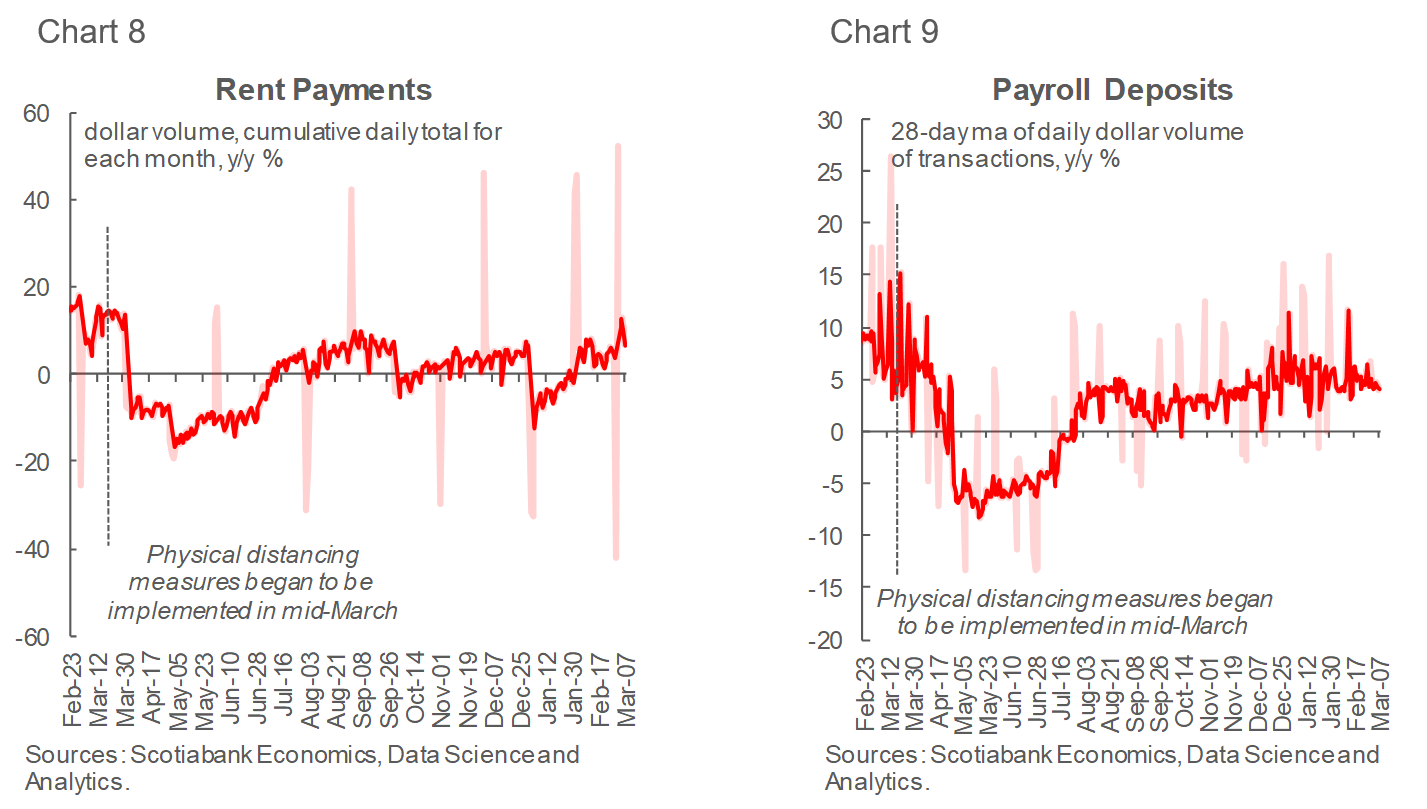
Growth in outgoing payments remained stable, with steady payroll and rent payments, the latter likely in response to the pickup in the emergency rent subsidy program (CERS).
Growth in consumer card spending fluctuated around zero in early March (data to March 9th), recovering after a restrictions-induced slowdown in late December and January:
The pattern of spending is consistent across provinces and spending categories, with growth in purchases of clothing and hardware rising significantly since mid-February’s re-opening.
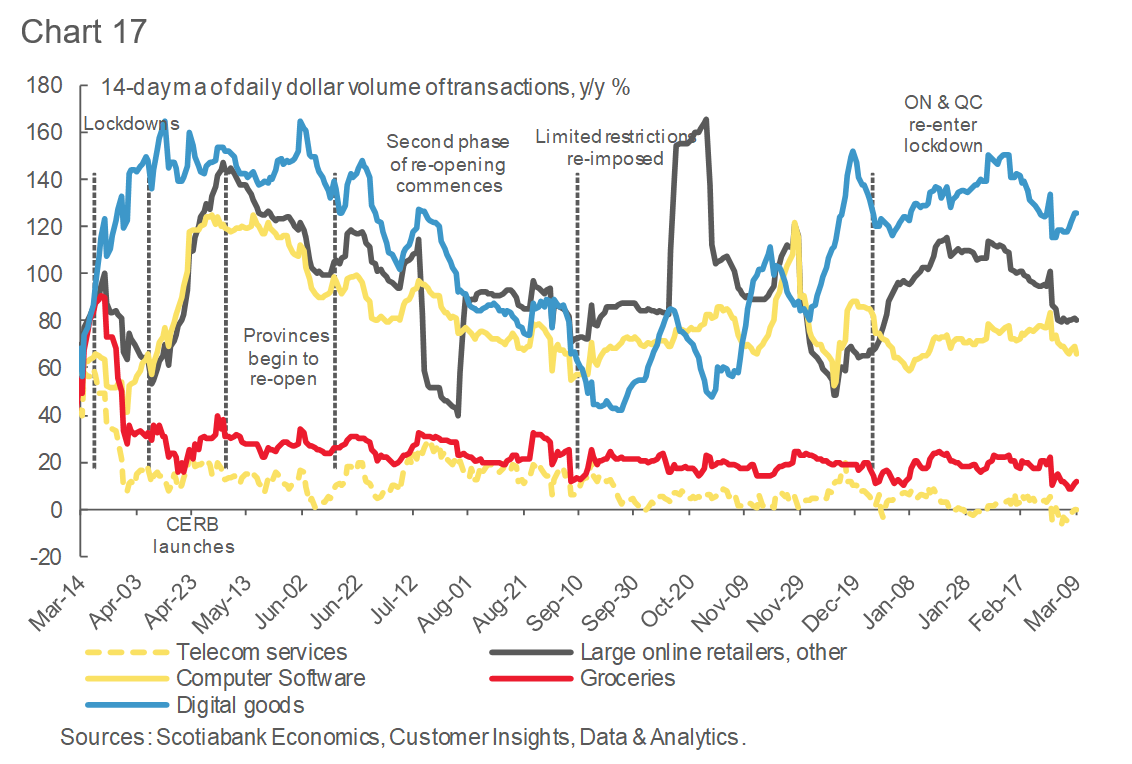
Growth in spending on digital goods and at large online retailers has downshifted slightly, but continues to run at significantly higher levels than last year.
2. COVID-19 and the Canadian Economy: Scotiabank Transactions Data
We present data on retail and non-retail transactions, which capture distinct but related aspects of economic activity in Canada.
The data comprises actual observed daily transactions going through debit or credit card payment networks in the retail space, and automated funds transfers (AFTs) in the non-retail space.
The transactions are anonymized and aggregated to protect the privacy of Scotiabank’s clients.
The AFT payments show bill payments to/from companies in Canada.
Incoming payments can be associated with company revenue, and outgoing payments can be associated with costs.
Debit and credit card payments can be used to measure the evolution of retail spending at various types of establishments.
The transactions can serve as a measure of economy-wide retail spending, and of the extent to which households are resuming pre-COVID levels of activity.
Note that the use of electronic payments has increased because of COVID-19, so comparisons to year-ago levels can be misleading. These data are best used to observe directional movements rather than to make specific assessments on the level of activity.
In the current circumstances, comparing the dollar volumes of transactions in the current year to its level of a year ago should help track growth through the re-opening phase.
3. Business Transactions Data: Business Payment Growth Slightly Weaker Recently
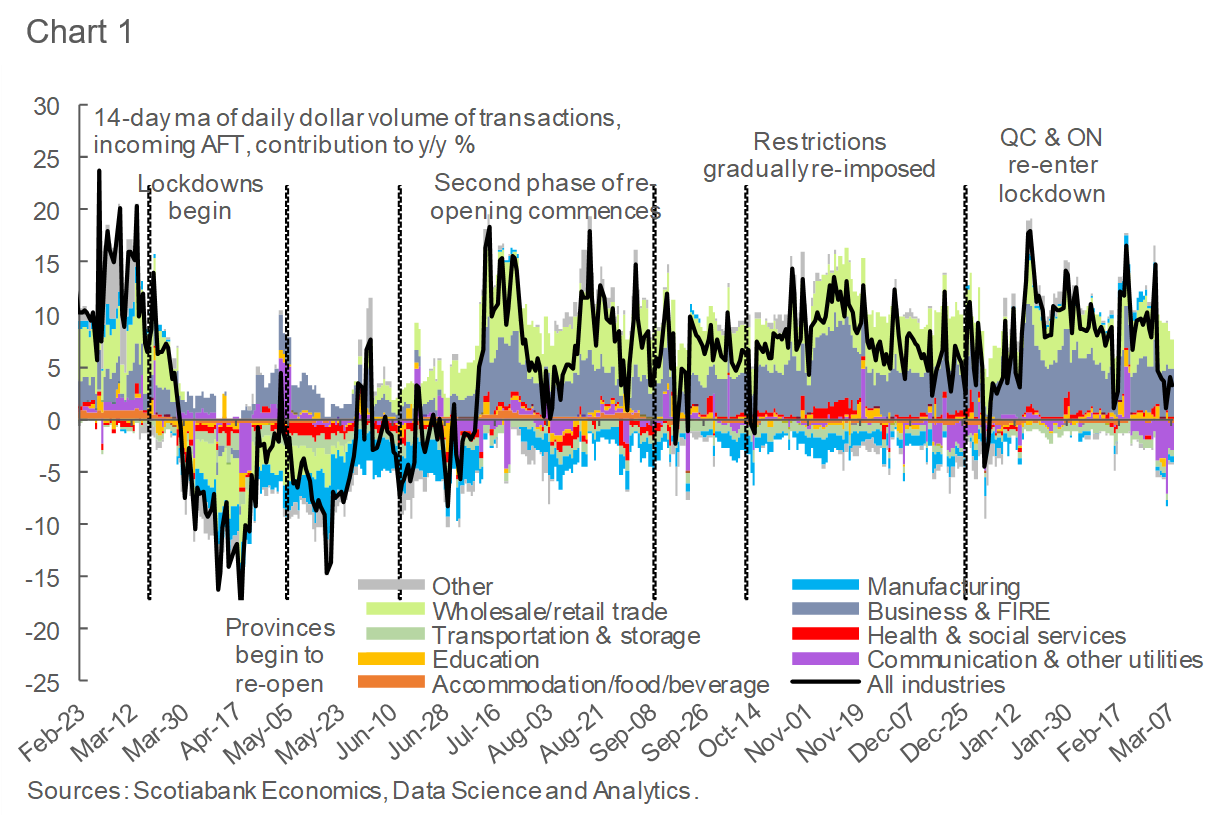
Business sector transactions continued to signal expanding activity, but with signs of growth slowing in incoming payments more recently (Chart 1):
A slowdown in payments is partly driven by weaker spending on communications and other utilities, which includes cable and a range of services such as water, gas and hydro.
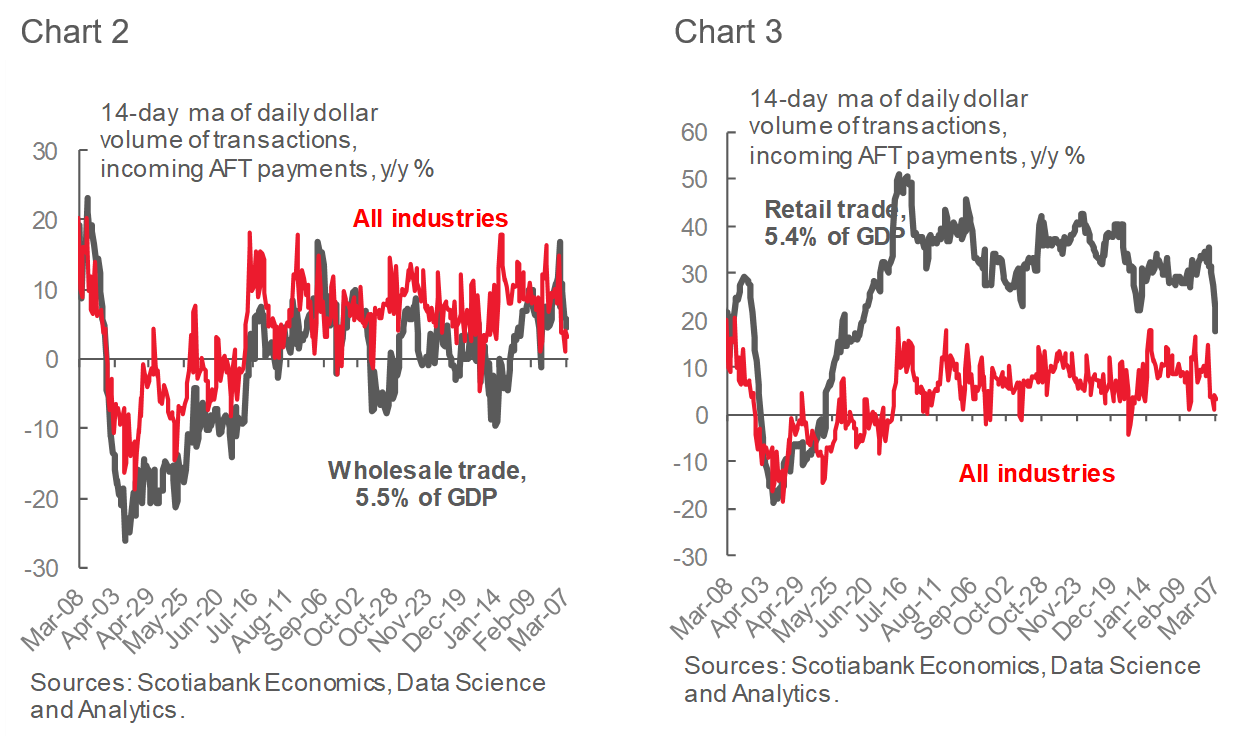
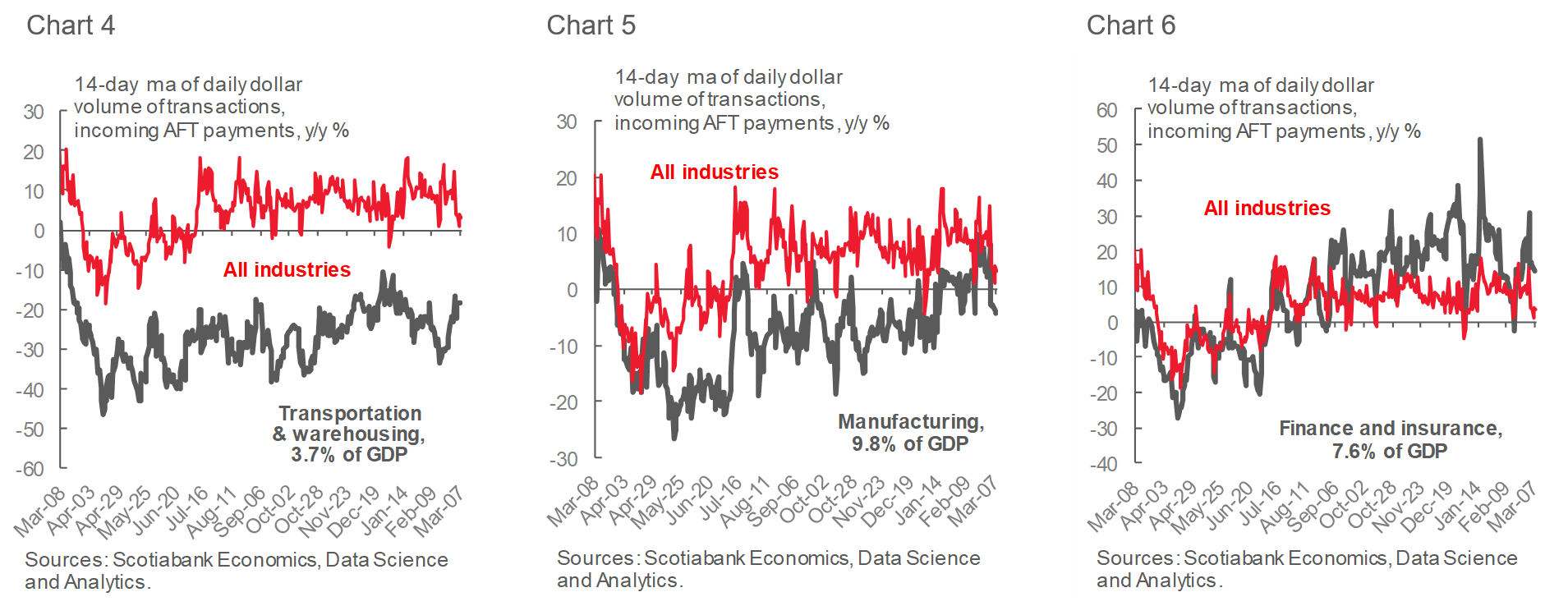
Growth in incoming payments in wholesale, retail and manufacturing sectors subsided in the last few weeks. Firms in the wholesale sector enjoyed a strong influx in transactions in mid-February, which seems to have run its course now. Growth in manufacturing payments has fallen below last year’s levels recently (Charts 2-6).
3. Business Transactions Data: Wholesale/Retail Transactions Normalize
3. Business Transactions Data: Manufacturing Payment Flow Weaker
3. Business Transactions Data: Growth in Bill Payments Positive
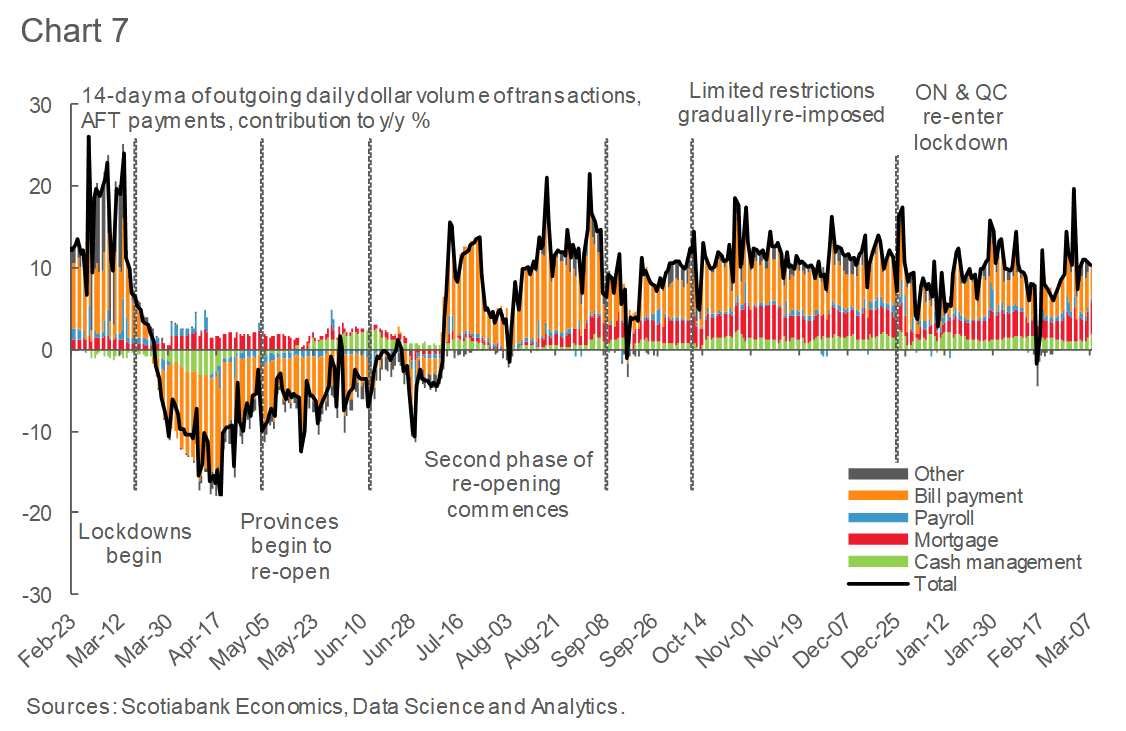
Growth in outgoing payments remained stable, with steady payroll and rent payments, the latter likely in response to the pickup in the emergency rent subsidy program (CERS) (Charts 7-9).
The Canada Emergency Rent Subsidy program continued to ramp up through February, with the most recent data showing over 1.7 billion dollars approved so far (data to March 7, 2021).
Increases in payroll deposits were in line with a muted impact of the latest round of restrictions seen so far in the labour markets outside of retail and hospitality sectors.
3. Business Transactions Data: Rent/Payroll Payment Growth Remains Strong
4. Retail Transactions Data: Total Spending Growth Fluctuated Around Zero Recently
Growth in consumer card spending fluctuated around zero in early March (data to March 9th), recovering after a restrictions-induced slowdown in December and early January (Chart 10).
Spending on credit explained most of the recovery since mid-February.

4. Retail Transactions Data: Growth in Hard-hit Provinces Improves the Most
- Since mid-February, spending has improved the most in provinces that imposed the strictest lockdowns in late December and early January (Charts 11-14).

4. Retail Transactions Data: Travel Spending Starting to Inch Higher
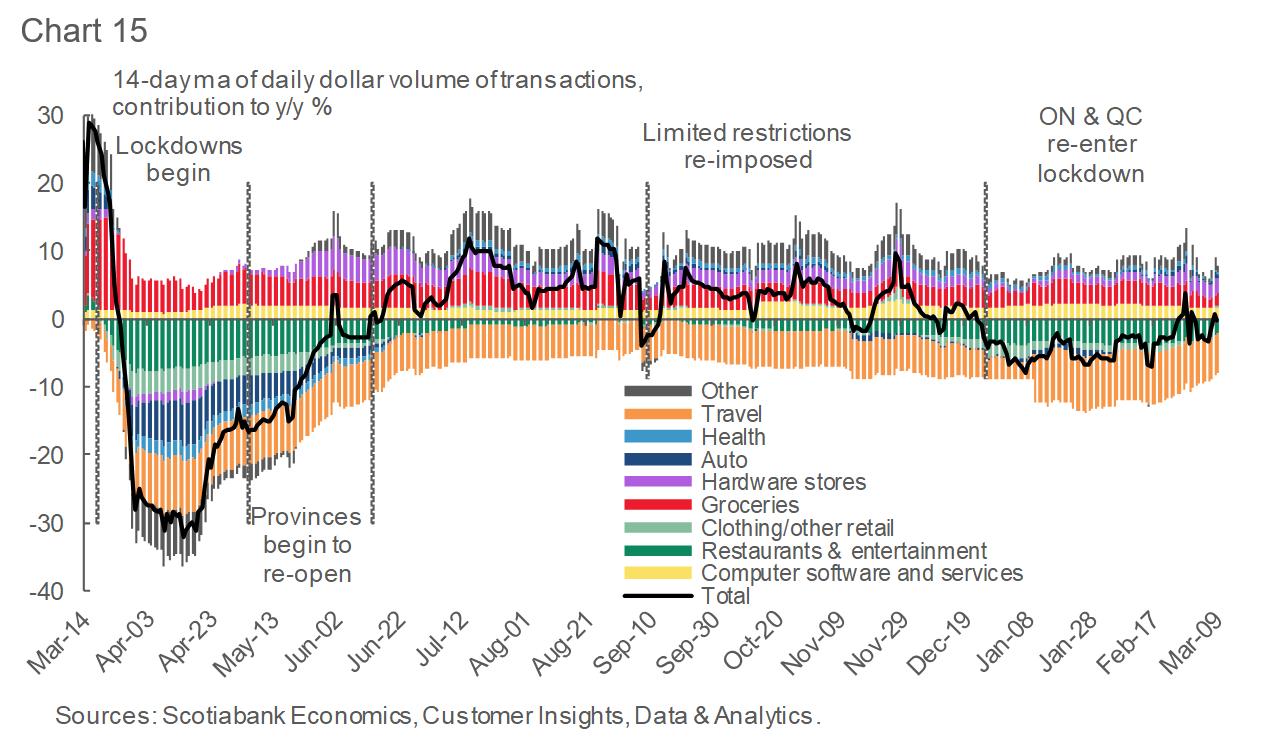
- Categories with positive y/y growth remained relatively stable, but the sectors that remained under water since the pandemic have shown the most improvement since mid-February (Chart 15).
4. Retail Transactions Data: Clothing, Hardware Spending Jump Higher
Growth in purchases of clothing and hardware has been rising significantly since mid-February’s re-opening (Chart 16).
Home renovation spending continued to leap higher, in line with a red-hot Canadian housing market and the increased desire to improve living space with more time spent at home.

4. Retail Transactions Data: Purchases of Digital Media Moderated Recently
- Growth in spending on digital goods and at large online retailers has downshifted slightly, but continues to run at significantly higher levels than last year (Chart 17).
5. Other High-Frequency Indicators Of Activity
Charts 18-31 Google Searches, Various Keywords, Dining and Transportation Data

6. Caveats
Note that the mapping from the volume of transactions to measures of economic activity (e.g. GDP) is imperfect, and so care must be taken when drawing the implications.
The data is observed at daily frequency and embeds different types of seasonal patterns.
For retail payments, the volume and types of payments are different depending on the day of the week and the season.
For non-retail payments, both the day of the week and the season are important. In addition, some payments are tied to the calendar date (e.g. rent payments are made on the first day of each month), some payments have a bi-weekly schedule, etc.
To smooth out most of the day-to-day seasonality we use a 14-day moving average of the dollar volume of transactions, taking a y/y% change to remove any remaining seasonal patterns related to the calendar date.
In addition to seasonality, there is normal payment volatility related to the random nature of the transactions process and the impact of regional and economy-wide events (weather, labour strikes, etc.).
The volatility of this nature may or may not be related to economic activity as measured by GDP and so, as mentioned above, care must be taken in drawing inference.
For business transactions, which are inherently more lumpy compared to retail spending, data towards the end of the sample can be revised as some AFT payments are recorded with a lag. As a result we exclude the last few days of data of business transactions only.
Nikita Perevalov* (Scotiabank Economics)
Taha Jaffer, Jason Liang (Data Science and Analytics)
Roland Merbis, Artur Motruk (Customer Insights & Analytics)
* Director of Economic Forecasting, 437.775.5137, nikita.perevalov@scotiabank.com
DISCLAIMER
This report has been prepared by Scotiabank Economics as a resource for the clients of Scotiabank. Opinions, estimates and projections contained herein are our own as of the date hereof and are subject to change without notice. The information and opinions contained herein have been compiled or arrived at from sources believed reliable but no representation or warranty, express or implied, is made as to their accuracy or completeness. Neither Scotiabank nor any of its officers, directors, partners, employees or affiliates accepts any liability whatsoever for any direct or consequential loss arising from any use of this report or its contents.
These reports are provided to you for informational purposes only. This report is not, and is not constructed as, an offer to sell or solicitation of any offer to buy any financial instrument, nor shall this report be construed as an opinion as to whether you should enter into any swap or trading strategy involving a swap or any other transaction. The information contained in this report is not intended to be, and does not constitute, a recommendation of a swap or trading strategy involving a swap within the meaning of U.S. Commodity Futures Trading Commission Regulation 23.434 and Appendix A thereto. This material is not intended to be individually tailored to your needs or characteristics and should not be viewed as a “call to action” or suggestion that you enter into a swap or trading strategy involving a swap or any other transaction. Scotiabank may engage in transactions in a manner inconsistent with the views discussed this report and may have positions, or be in the process of acquiring or disposing of positions, referred to in this report.
Scotiabank, its affiliates and any of their respective officers, directors and employees may from time to time take positions in currencies, act as managers, co-managers or underwriters of a public offering or act as principals or agents, deal in, own or act as market makers or advisors, brokers or commercial and/or investment bankers in relation to securities or related derivatives. As a result of these actions, Scotiabank may receive remuneration. All Scotiabank products and services are subject to the terms of applicable agreements and local regulations. Officers, directors and employees of Scotiabank and its affiliates may serve as directors of corporations.
Any securities discussed in this report may not be suitable for all investors. Scotiabank recommends that investors independently evaluate any issuer and security discussed in this report, and consult with any advisors they deem necessary prior to making any investment.
This report and all information, opinions and conclusions contained in it are protected by copyright. This information may not be reproduced without the prior express written consent of Scotiabank.
™ Trademark of The Bank of Nova Scotia. Used under license, where applicable.
Scotiabank, together with “Global Banking and Markets”, is a marketing name for the global corporate and investment banking and capital markets businesses of The Bank of Nova Scotia and certain of its affiliates in the countries where they operate, including; Scotiabank Europe plc; Scotiabank (Ireland) Designated Activity Company; Scotiabank Inverlat S.A., Institución de Banca Múltiple, Grupo Financiero Scotiabank Inverlat, Scotia Inverlat Casa de Bolsa, S.A. de C.V., Grupo Financiero Scotiabank Inverlat, Scotia Inverlat Derivados S.A. de C.V. – all members of the Scotiabank group and authorized users of the Scotiabank mark. The Bank of Nova Scotia is incorporated in Canada with limited liability and is authorised and regulated by the Office of the Superintendent of Financial Institutions Canada. The Bank of Nova Scotia is authorized by the UK Prudential Regulation Authority and is subject to regulation by the UK Financial Conduct Authority and limited regulation by the UK Prudential Regulation Authority. Details about the extent of The Bank of Nova Scotia's regulation by the UK Prudential Regulation Authority are available from us on request. Scotiabank Europe plc is authorized by the UK Prudential Regulation Authority and regulated by the UK Financial Conduct Authority and the UK Prudential Regulation Authority.
Scotiabank Inverlat, S.A., Scotia Inverlat Casa de Bolsa, S.A. de C.V, Grupo Financiero Scotiabank Inverlat, and Scotia Inverlat Derivados, S.A. de C.V., are each authorized and regulated by the Mexican financial authorities.
Not all products and services are offered in all jurisdictions. Services described are available in jurisdictions where permitted by law.