

- Canada’s federal Finance Minister tabled his second budget on November 5th. As broadly expected, it is a fiscally expansive plan (and then some).
- Budget 2026 carries a final price tag of a $151.2 bn over its five-year planning horizon (FY27–31), while showing a $158.3 bn in fiscal savings on the other side of the ledger. Big numbers on both sides of the balance sheet leave the bottom line nearly indiscernible from the spring update (~$7 bn improvement over 5 years).
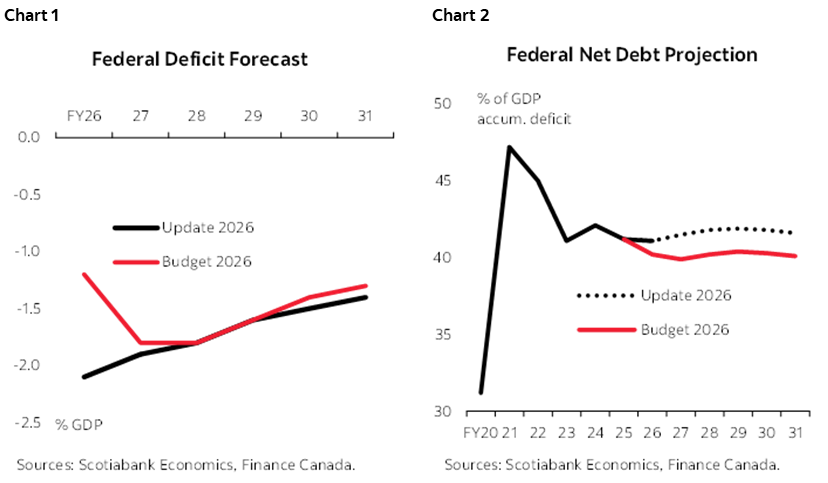
- As a share of output, the deficit trajectory contracts marginally faster from an expected 1.8% of GDP this year to 1.3% by FY31 (~0.1 ppt annual improvement). The debt trajectory similarly shows a marked improvement with the level settling at 40.1% of GDP—for a 1.5 ppts improvement—relative to the spring projection (charts 1 & 2).
- While backward looking, last year’s shortfall (FY26) showed a surprise improvement ($39.3 bn versus an earlier-projected $66.9 bn) owing to strong revenue tailwinds.
- A substantial share of new spending was expected—notably the pre-announced $36 bn Productivity Mega Deduction—that reflects about a quarter of the budget package. Investments in Indigenous infrastructure—at $26.6 bn is another component. Earlier-announced tariff relief, investments in connectivity infrastructure, and defence spending are also folded in. In total, a wide range of ‘investment’ related measures reflect almost 60% of the new spending package.
- The budget contains substantial measures for vulnerable households. On top of earlier-announced measures, the budget announces another top up to the Grocery benefit ($4.7 bn in 2027). There is also a substantial $16.5 bn in investments related to non-market housing and supportive infrastructure.
- Canada's continued investment push remains the right course but it compounds near-term inflation risk as the Bank of Canada begins removing accommodation. Continued fiscal expansion from other orders of government adds to that pressure.
- Execution risk is also mounting. Capacity constraints make coordinated, disciplined delivery critical to expanding productive capacity and sustaining investor confidence ahead.
- The budget lands in a busy global environment and is unlikely to stir much immediate market reaction in isolation. Clear signs of tangible progress will increasingly matter more than policy commitments.
- Canada’s investment play is a long game. The case for it is stronger, but so are the headwinds to delivery.
AN EVOLVING PLAN FOR AN EVOLVING ENVIRONMENT
Federal Finance Minister Champagne tabled his second budget on November 5th. It lands once again in an environment of persistent uncertainty in the aftermath of consequential US mid-terms. The definitive blue sweep has taken some tail risks off the table, but the policy implications—now and two years out—are still unclear. This backdrop gives the Carney government continued impetus to advance its investment-led agenda, backed by a solid majority and more than two years remaining to advance it.
The budget advances a broader sovereignty agenda aimed at reducing reliance on the US by building a stronger domestic economy. Titled “Masters of Our Destiny”, it builds on the national security strategy released a week prior—the first in more than two decades—which unites economic, foreign and defence policy under one framework. The budget puts fiscal numbers to this plan including (finally) details on its defence spending profile.
The trillion-dollar ambition still anchors the economic plan. Last year’s budget put federal balance sheets at the centre of a push to crowd in private capital, lift investment and improve Canadians’ welfare. The government has since assembled an impressive pipeline of potential government-backed projects and introduced a range of legislative changes to improve the investment landscape. This budget builds on those efforts with more capital spending pledges.
The case for the plan remains strong. The fiscal expansion has been well-channeled and leaves the broader narrative largely unchanged: an evolving plan with increasingly more upside to growth but ever-mounting demands on delivery capacity. Global developments of the day may overshadow the budget for now, but markets should remain receptive over the medium term as evidence of progress builds.
RESILIENCE THE NEW R-WORD
Economic resilience provides a stronger starting point for the budget. Considering some were debating the chance of a recession last spring, real GDP is expected to sit a 1% in 2026. Nominal output—important for fiscal capacity—this year alone is expected to sit $55 bn higher than the April outlook—and to maintain momentum thereafter (chart 3).
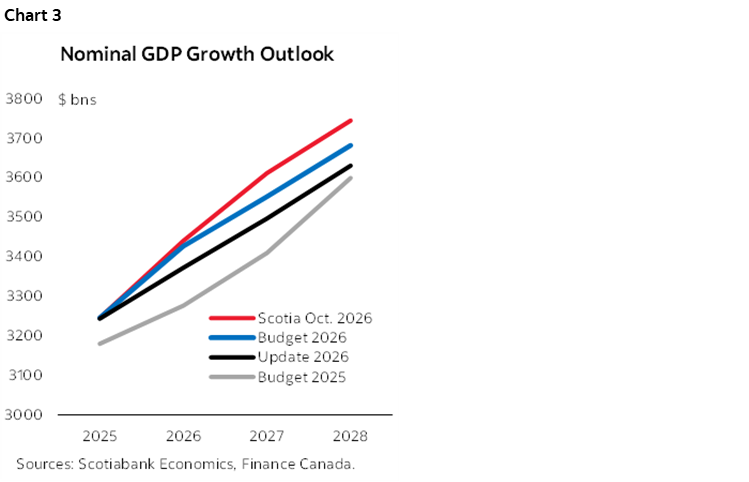
The Iran war’s terms-of-trade boost explains a good part of the gain as real GDP is tracking largely unchanged relative to the April baseline—despite an escalating trade war in the interim. The medium-term baseline based on the average of private sector forecasts is conservative relative to Scotia Economics latest outlook, leaving room for more outperformance ahead—particularly if President Trump is motivated to finalize a trade deal before the new Congress convenes in January.
Even with a more cautious baseline, the stronger economic starting point delivers material fiscal gains. The budget recognizes $158.3 bn in gains over FY27–31 and another $27.5 bn in FY26 (that ended March 31, 2026). Revenues are tracking above earlier expectations (despite foregone revenues from tax cuts), while expenditure increases are more modest.
INVESTING THE SAVINGS
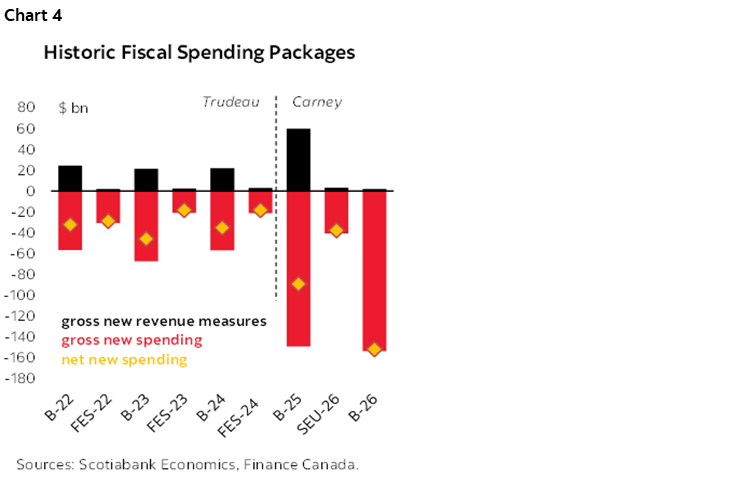
This is another big-spend budget. A steady flow of announcements since April’s update left little doubt about its direction. The 511-page tome sets out $142.1 bn in net new measures over five years (chart 7). Another $9.5 bn in policy developments since April brings total incremental pressures to $151.5 bn. There is minimal offset in terms of revenue-raising measures (chart 4).
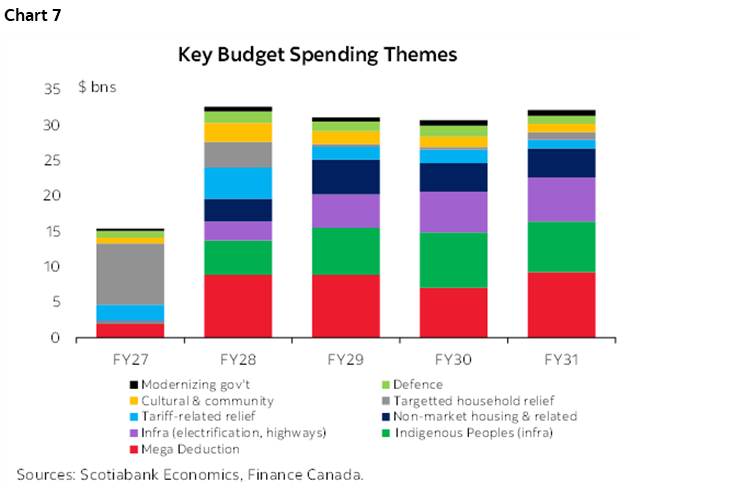
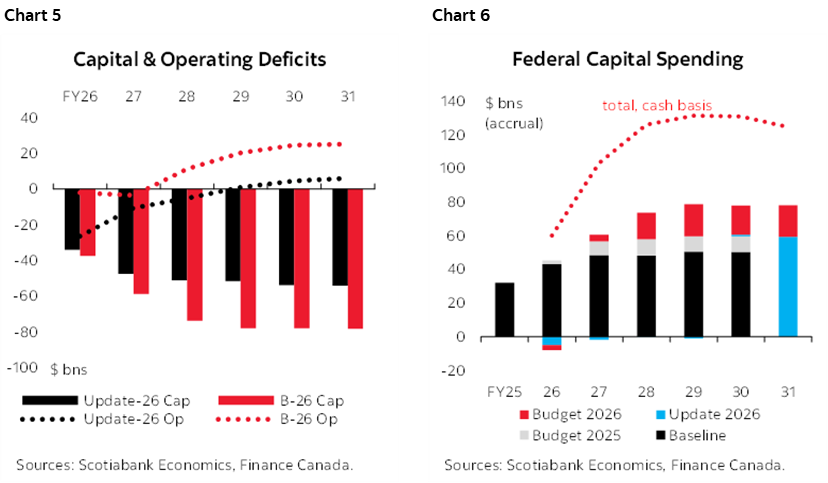
Most new measures (~57%) fall under the government’s expansive definition of capital investment. Its Capital Budgeting Framework, introduced in Budget 2025, limits operating spending while expanding measures that support capital formation. The budget adds $72 bn in ‘capital’ through FY31, while achieving operating surplus in FY28—a year earlier than anticipated—and delivering a cumulative incremental operating surplus of $45.2 bn over years (chart 5). The all-in capital plan now tallies $404 bn in fiscal terms and a hefty $677 bn on a cash basis (chart 6).
A reasonable share of the total spending tally reflects earlier announcements (though it is hard to tease out at first pass). The $36 bn Mega Deduction represents 25% of total new spending over five years. Announced on the margins of September’s Investor Summit, this immediate write-off for two-thirds of investments should provide a meaningful lift to investment outlays, though estimates vary widely. Our pre-budget note summarized its potential impact and key caveats.
There are a range of other targeted tax measures that had been hinted at ahead of budget. Namely, a new Canada Growth Incentive aims to help growth-oriented businesses attract investment vias a new tax exemption for Canadian builders on up to $15 mn in capital gains from investments in eligible Canadian companies, along enhancing the small business rollover to allow increased deferral of taxes on capital gains when proceeds are reinvested in other small businesses. These aim to level the playing field with incentives for US entrepreneurs. There is also a further expansion of the Scientific Research & Experiment Development (SR&ED) to allow commercialization expenses. These are collectively supportive on the margin, and are well-focused on growth-oriented firms, though the budget falls short of a comprehensive tax review (though few people expected that).
There is another range of measures—some new, some known—focused on infrastructure-related plans. This includes a sizable $26.6 bn related to Indigenous community investments including water and housing infrastructure. There are funds towards the electrification agenda, as well as major project investments (with funding booked to take on the full construction and operation costs of the Mackenzie Valley Highway. The government also indicated it plans to bring forward legislation to establish the Canada Growth Fund as an arms-length standalone Crown corporation.
A defence fiscal path is set out in the budget. Incremental new fiscal measures are modest—$6 bn over 5 years for security intelligence— but there has not been a fiscal path set out since 2024. The budget notes that Canada is on track to spend 4% of GDP on defence by the end of the decade and reach 5% by 2035. Cash outlays will exceed $700 bn over fiscal planning horizon under the ‘comprehensive’ definition, while core defence outlays total $451 bn over the period ($303 bn on accrual basis).
There are also substantial investments in vulnerable populations in this budget. Notably, a $11.2 bn package relates to a comprehensive strategy to end homelessness, along with additional investments related to wrap-around supports. It also provides a top-up to Build Canada Homes ($13 bn over 10 years) on a cash basis to accelerate non-market housing options.
The budget also adds more support to Canadian households. In particular, it provides a one-time 50% increase to the Groceries & Essentials Benefit to be delivered in early 2027. For an individual this would reflect about $339, $679 for a family at a fiscal cost of $4.1 bn). The government plans to bring back the Canada Housing Benefit for low-income renters starting in FY29. There are also a range of smaller tax-related measures for low-wage workers. These land on top of the already-known extension of the federal fuel excise tax ($2.9 bn), fund home energy retrofits ($2 bn bn), top-up childcare funding and the expanded and rebranded Groceries & Essentials Benefit booked in April’s update that took effect in July and embeds a 25% annual riser.
The budget also provides a preview of the forthcoming immigration plan. It keeps permanent resident targets stable out to 2029 at 380 k per year, while similarly keeping temporary resident arrivals stable at 370 k per year. As always, this provides minimal line of sight on total population growth, but the annexes modestly notch up total workforce population growth annual contribution to 0.8 ppts over the horizon which is broadly consistent with pre-pandemic growth levels.
G-FORCES
On balance, Budget 2026 reinforces our constructive growth outlook. Our October forecast already includes a 0.3% lift to the medium-term GDP level from the budget’s pre-announced investment incentives, on top of the roughly 0.5% gain incorporated over the past year from the trillion-dollar plan. That said, the budget does add incrementally more than anticipated heading into budget day owing in part owing to considerably more fiscal space.
With considerable policy-driven momentum already embedded, the bar for further near-term growth upgrades is high especially as we look for evidence of even-faster delivery, limited import leakages and easing execution constraints. There was not a lot in the budget related to a comprehensive approach to easing potential bottlenecks such as skilled labour shortages.
The budget relatedly reinforces our hawkish view on the Bank of Canada. Policymakers kicked off a tightening cycle with a 25 bp hike on October 28th and we expect another 75 bps of hikes over the next few quarters. Economic slack is rapidly closing, while the build-out could contribute to near-term inflation pressures before it expands supply. Meanwhile, this budget provides another near-term boost to household spending into next year. Even if warring abates in the Middle East, energy prices will likely have a long tail. Add in a potential trade deal ahead— and a potentially broader lifting of the uncertainty cloud—and that rate call starts to look conservative.
We will revisit the net impact as other provinces table their plans in the weeks ahead, as trade talks evolve, and more broadly as the US policy agenda take shape, but the directional bias is clear.
ADDING (IT) UP
The budget’s net fiscal impact is actually modestly positive at $7 bn over the 5-year horizon (chart 8). Folding in the backward-looking FY26 improvement, it improves government books by $34.4 bn to budgetary shortfalls over the horizon. Fiscal developments of $158.3 bn entirely offset $151.2 bn in net new spending over the next five years (FY27-31). This includes an additional $12 bn in debt-service charges over this horizon.
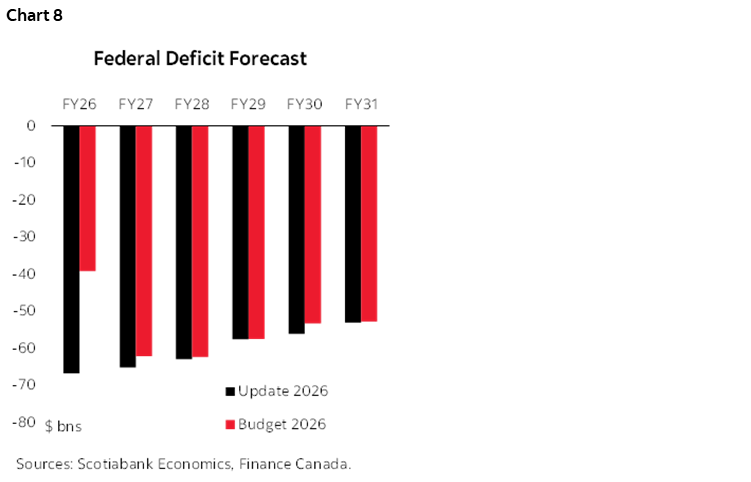
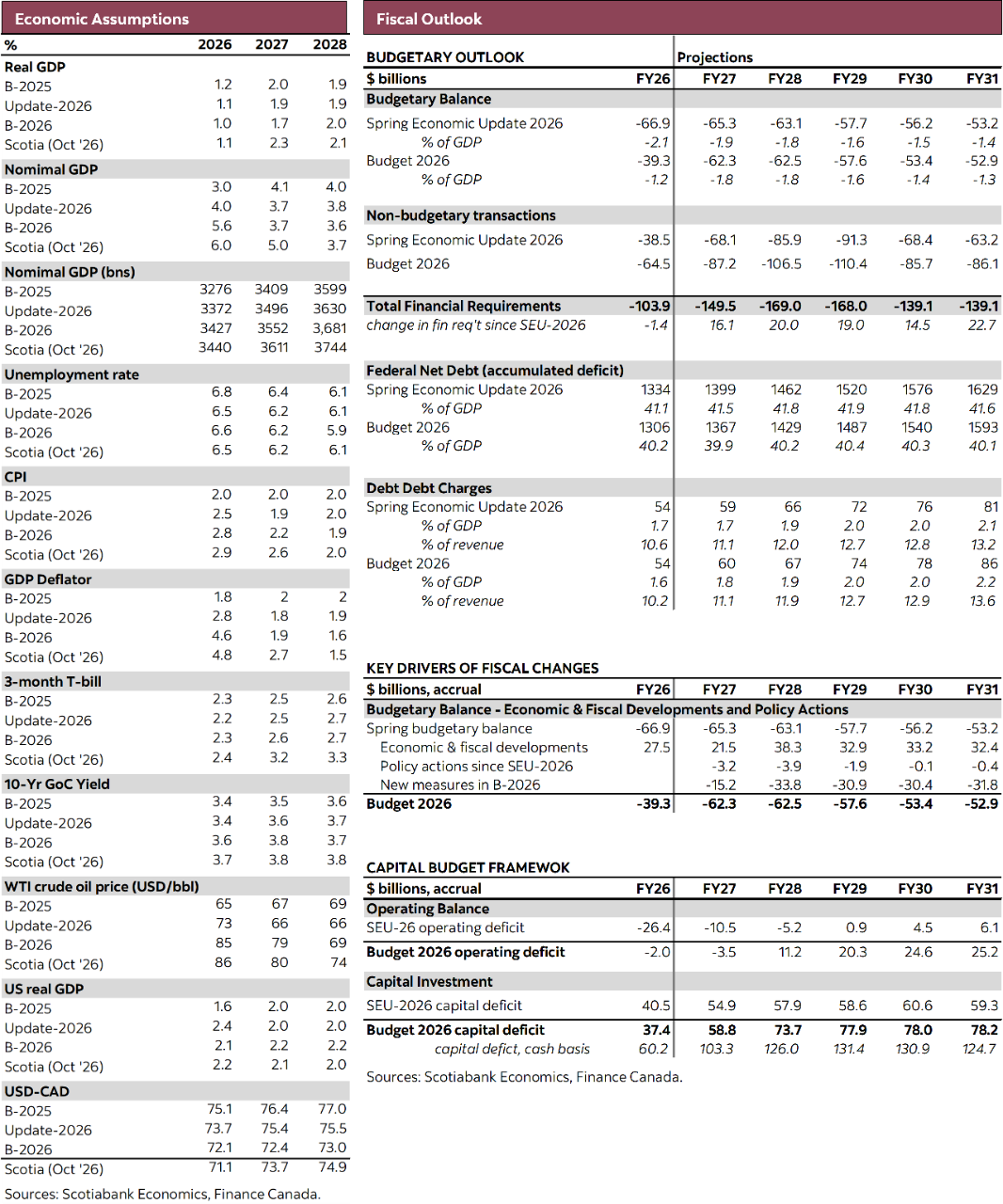
The fiscal path improves modestly as a share of output. The budgetary shortfall is now expected to peak at 1.8% this year and next before narrowing to 1.3% by FY31 with a stronger GDP denominator cushioning, in part, the impact. This puts deficits roughly ~0.1 ppts below the spring trajectory over the medium term. Debt stabilizes about a one and a half percentage points lower, at 40.1% of GDP, benefiting in part from a lower starting point relative to the spring update. See Tables, back.
The budget also finalizes last year’s numbers. It shows a substantial improvement in the FY26 shortfall at $39.3 bn versus an earlier-anticipated $66.9 bn deficit. This reflects a $27.5 bn in fiscal improvements, notably stronger revenue growth. As a share of GDP, it comes in at 1.2%. (Financial requirements are largely unchanged, consistent with last year’s borrowing activity but the delta is embedded in a largely indecipherable “accounts payable, receivable, accruals and allowances”.
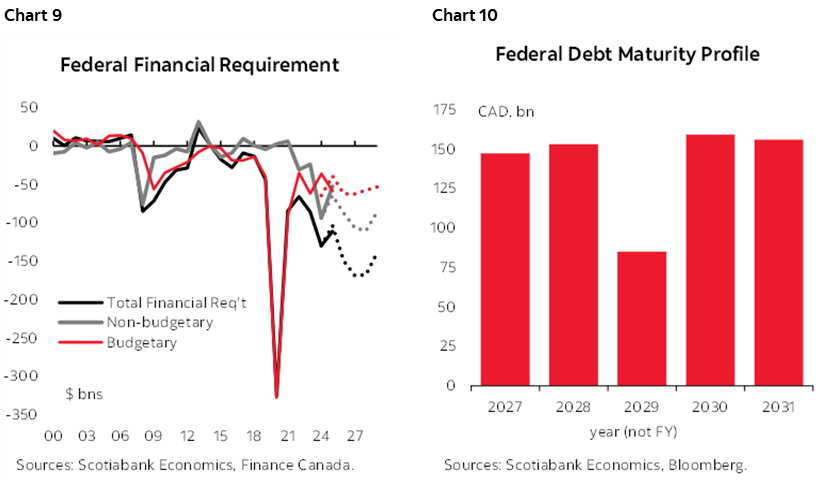
The federal government goes to market with higher issuance than implied by deficits alone. This reflects loans and financial investments, which need cash but create assets rather than immediate expenses. That includes capitalizing the Crown corporations the government increasingly uses as delivery agents. Large capital purchases hit the deficit only through amortization over their useful lives. These non-budgetary needs are projected about $60 bn higher over the 5-year horizon (to $415 bn through FY31 (chart 9). This is on top of still-elevated refinancing needs (chart 10). FY27 bond issuance was maintained at $298 bn (with T-bills up by $16 bn), while FY28 issuance plans are set at $316bn.
R - G + JUDGEMENT (& LUCK)
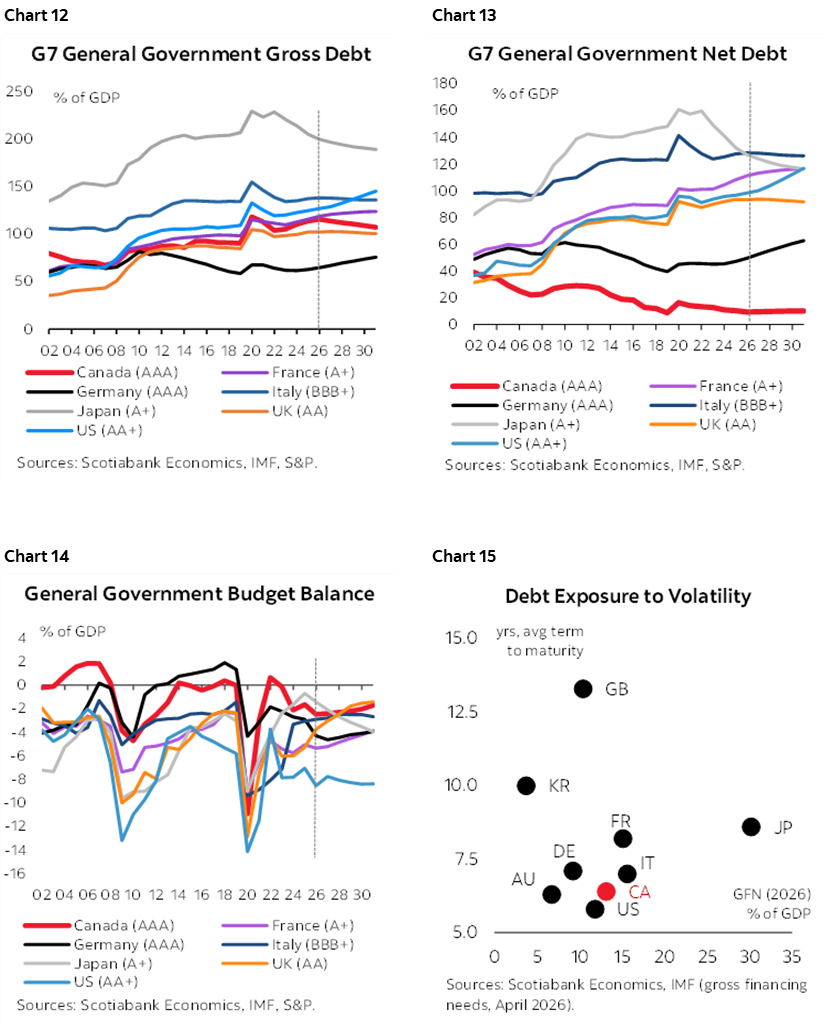
Canada starts from relative fiscal strength. Federal and general government net debt and deficit metrics compare favourably across peers. While Canada’s trajectories broadly trace earlier trajectories, many peers have seen a deterioration in their outlook. Net energy exports have offered some protection against war-related shocks. The composition of Canada’s federal spending has also geared towards productive-enhancing investments, which, along with strong policy institutions, should underpin investor confidence.
These solid foundations support a more favourable medium-term debt outlook. Real growth above the effective real interest rate on debt should continue to put downward pressure on the debt ratio, provided primary deficits do not overwhelm that advantage. Canada remains one of few countries where this differential looks promising, with its more solid fiscal footing helping to offset pressure on financing costs and investment policies supporting stronger growth. Scotia’s more constructive growth outlook would imply an even more favourable trajectory.
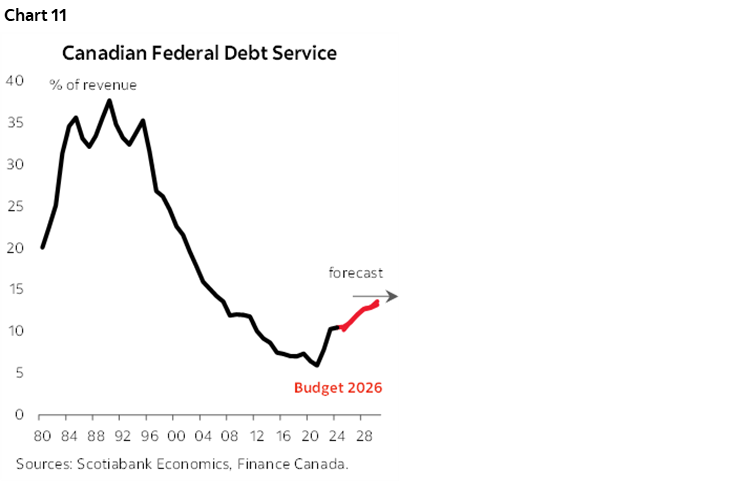
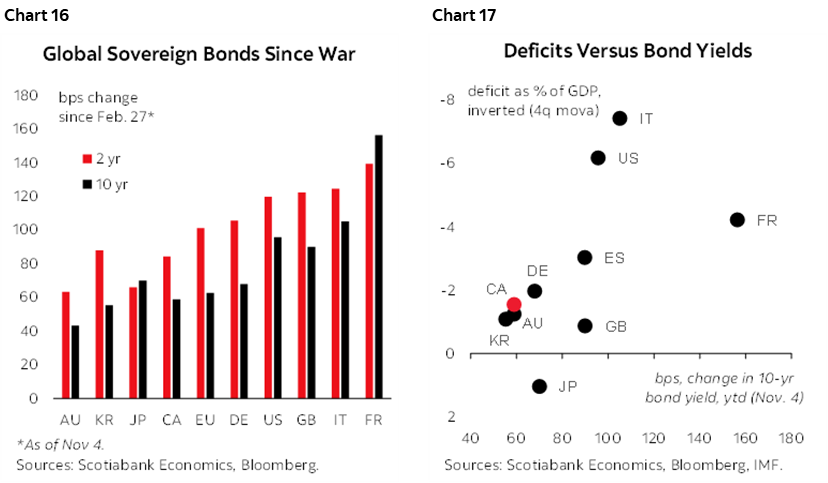
Slower growth or higher borrowing costs could erode that advantage. Trade uncertainty and execution slippage could put growth at risk, while elevated global bond issuance and persistent inflation could further increase the cost of financing. Debt service remains low by historical standards as a share of revenue, but is edging higher (chart 11). The 10-year GoC yield profile is roughly 20 bps above the April baseline over the next two years. Last month’s move toward 4% amid a global bond sell-off underscores Canada’s exposure to external shocks, despite more muted repricing so far.
Canada’s relative strengths should be discounted somewhat in the event of near-term market stress. Substantial pension assets bolster net debt metrics but offer limited near-term funding relief. Average debt maturity and this year’s gross financing needs remain middle of the pack, providing no exceptional funding advantage. Nor can Canada count on a safe-haven bid during global stress. More reassuring, it does have ample policy space and institutionally credibility to respond to such downside scenarios.
See charts 12–17, next page, for a selection of comparative fiscal metrics.
FROM DEMAND TO DELIVERY
Budget 2026 keeps momentum on Canada's investment plans. Signs of traction are promising, but the year ahead is critical. Gains in investment should increasingly show up in hard data, yet ambition likely still outpaces real-world constraints. The government will need to keep working with partners to close that gap, so investment can proceed at a sustained pace that delivers meaningful results for Canadians.
DISCLAIMER
This report has been prepared by Scotiabank Economics as a resource for the clients of Scotiabank. Opinions, estimates and projections contained herein are our own as of the date hereof and are subject to change without notice. The information and opinions contained herein have been compiled or arrived at from sources believed reliable but no representation or warranty, express or implied, is made as to their accuracy or completeness. Neither Scotiabank nor any of its officers, directors, partners, employees or affiliates accepts any liability whatsoever for any direct or consequential loss arising from any use of this report or its contents.
These reports are provided to you for informational purposes only. This report is not, and is not constructed as, an offer to sell or solicitation of any offer to buy any financial instrument, nor shall this report be construed as an opinion as to whether you should enter into any swap or trading strategy involving a swap or any other transaction. The information contained in this report is not intended to be, and does not constitute, a recommendation of a swap or trading strategy involving a swap within the meaning of U.S. Commodity Futures Trading Commission Regulation 23.434 and Appendix A thereto. This material is not intended to be individually tailored to your needs or characteristics and should not be viewed as a “call to action” or suggestion that you enter into a swap or trading strategy involving a swap or any other transaction. Scotiabank may engage in transactions in a manner inconsistent with the views discussed this report and may have positions, or be in the process of acquiring or disposing of positions, referred to in this report.
Scotiabank, its affiliates and any of their respective officers, directors and employees may from time to time take positions in currencies, act as managers, co-managers or underwriters of a public offering or act as principals or agents, deal in, own or act as market makers or advisors, brokers or commercial and/or investment bankers in relation to securities or related derivatives. As a result of these actions, Scotiabank may receive remuneration. All Scotiabank products and services are subject to the terms of applicable agreements and local regulations. Officers, directors and employees of Scotiabank and its affiliates may serve as directors of corporations.
Any securities discussed in this report may not be suitable for all investors. Scotiabank recommends that investors independently evaluate any issuer and security discussed in this report, and consult with any advisors they deem necessary prior to making any investment.
This report and all information, opinions and conclusions contained in it are protected by copyright. This information may not be reproduced without the prior express written consent of Scotiabank.
™ Trademark of The Bank of Nova Scotia. Used under license, where applicable.
Scotiabank, together with “Global Banking and Markets”, is a marketing name for the global corporate and investment banking and capital markets businesses of The Bank of Nova Scotia and certain of its affiliates in the countries where they operate, including; Scotiabank Europe plc; Scotiabank (Ireland) Designated Activity Company; Scotiabank Inverlat S.A., Institución de Banca Múltiple, Grupo Financiero Scotiabank Inverlat, Scotia Inverlat Casa de Bolsa, S.A. de C.V., Grupo Financiero Scotiabank Inverlat, Scotia Inverlat Derivados S.A. de C.V. – all members of the Scotiabank group and authorized users of the Scotiabank mark. The Bank of Nova Scotia is incorporated in Canada with limited liability and is authorised and regulated by the Office of the Superintendent of Financial Institutions Canada. The Bank of Nova Scotia is authorized by the UK Prudential Regulation Authority and is subject to regulation by the UK Financial Conduct Authority and limited regulation by the UK Prudential Regulation Authority. Details about the extent of The Bank of Nova Scotia's regulation by the UK Prudential Regulation Authority are available from us on request. Scotiabank Europe plc is authorized by the UK Prudential Regulation Authority and regulated by the UK Financial Conduct Authority and the UK Prudential Regulation Authority.
Scotiabank Inverlat, S.A., Scotia Inverlat Casa de Bolsa, S.A. de C.V, Grupo Financiero Scotiabank Inverlat, and Scotia Inverlat Derivados, S.A. de C.V., are each authorized and regulated by the Mexican financial authorities.
Not all products and services are offered in all jurisdictions. Services described are available in jurisdictions where permitted by law.