

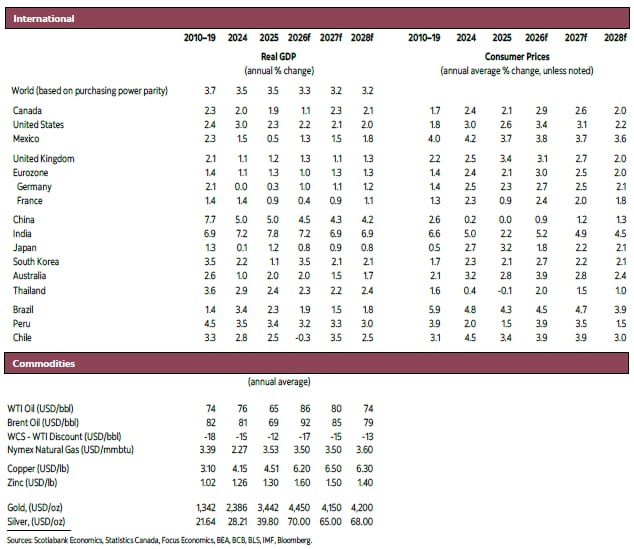
- The broad growth outlook is little changed, and recent data reinforce the view that economic activity remains resilient. Historical revisions show that the U.S. economy entered the second half of the year with more momentum than previously estimated, while Canadian activity has continued to hold up broadly as expected, recovering from the soft patch earlier in the year. Tighter financial conditions provide some offset to these positive forces, but the net drag on activity should remain relatively contained.
- Canada’s investment outlook has strengthened further. The recently announced accelerated depreciation measure provides an additional boost to investment, although near-term GDP effects should be muted as part of the demand impulse leaks into imports. Over time, stronger capital spending should raise the economy’s productive capacity.
- Inflation pressures are proving more persistent in both Canada and the U.S., turning the monetary policy outlook more restrictive. Higher oil prices have lifted the inflation profile, while the recent surge in diesel prices is expected to feed more gradually into a broader range of consumer prices. Together with firm activity, this should require further tightening from both the Fed and the BoC.
Economic activity continues to hold up broadly as expected, but renewed inflation pressures give little choice for central banks but to tighten monetary policy. The recent data flow suggests that the U.S. economy has been more resilient than previously estimated, while Canadian activity continues to hold up. Beyond the incoming data, accelerated depreciation measures should provide a substantial lift to Canadian business investment and productive capacity in the medium run. However, this is partly offset by tighter financial conditions.
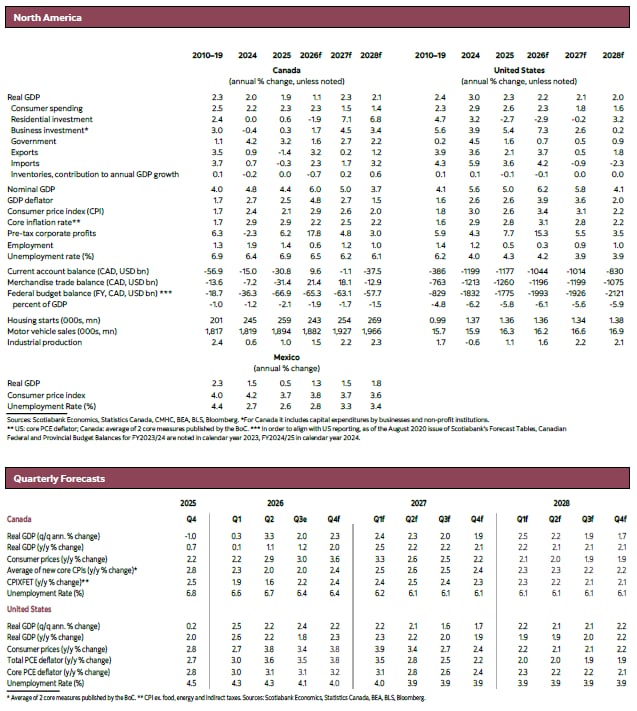
The broad growth outlook remains intact, with the U.S. economy expected to expand at a moderate pace and Canadian growth accelerating in 2027. In the U.S., resilient consumption and AI-related investment should support activity in the near term, although restrictive interest rates and weaker job and real income growth will gradually weigh on household demand over the forecast period. In Canada, trade disruptions will constrain exports, but stronger business investment, public infrastructure and defence spending should provide an important offset and expand productive capacity over time. Inflation remains the key risk in both countries, particularly as elevated diesel prices and tariffs feed into broader price pressures with a lag.
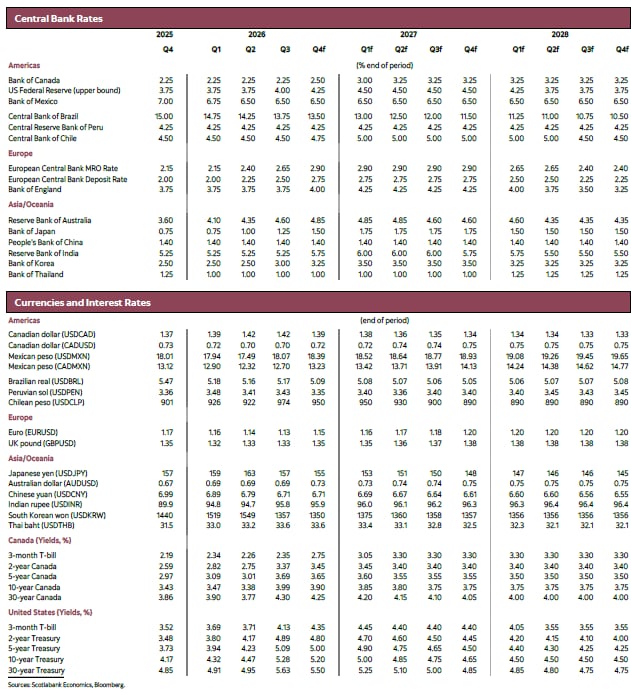
Persistent inflation and resilient activity should lead the Fed to raise rates twice more this year, taking the federal funds rate to 4.5% in early 2027, before reversing those hikes in 2028 as the economy slows. The BoC should also withdraw stimulus and move into restrictive territory, raising its policy rate to 3.25% in 2027.
RECENT DATA CONFIRM RESILIENT ECONOMIC ACTIVITY
Historical revisions suggest that the U.S. economy entered the second half of the year with more momentum than previously estimated. Second-quarter GDP growth was revised up to 2.2%, while earlier data were also adjusted higher. Much of the revision reflects stronger business investment—and potential output—and therefore does not materially change our assessment of the degree of excess demand in the economy. The revisions reinforce the resilience of the expansion but, on their own, have limited implications for our inflation or policy rate outlook.
Canadian activity has also evolved broadly in line with our expectations. Real GDP was flat in July, but the comparatively strong flash estimate from Statistics Canada for August suggests that third-quarter growth should remain healthy. This is consistent with our view that the weakness seen at the beginning of the year was temporary and that the economy carried reasonable momentum into the second half of 2026.1
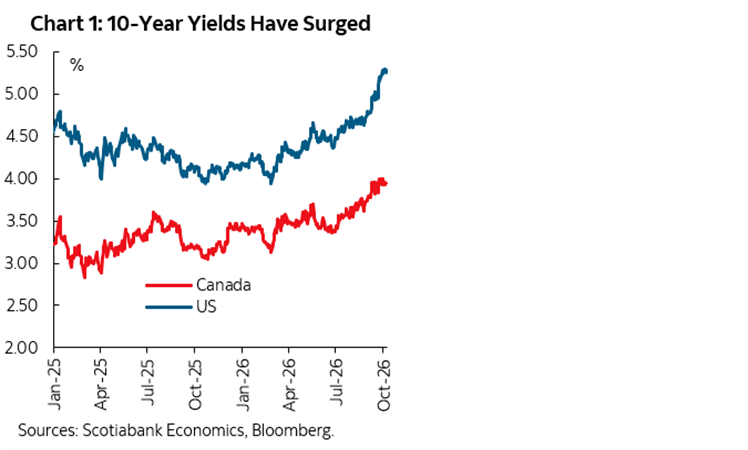
Financial conditions have tightened more quickly and sharply than we expected, particularly in the U.S. (chart 1). We interpret this as a reflection of a stronger economy and more acute inflation pressures, which have pushed up short-term rates expectations, alongside heavy demand for capital from the AI build-out. The net aggregate macroeconomic drag should therefore be relatively contained, although the effects will vary across sectors, with household spending being more affected than business investment for instance. In Canada, the tightening has been smaller in absolute terms, but the economy’s greater sensitivity to interest rates leaves household spending and other rate-sensitive sectors more exposed. Overall, tighter financial conditions provide an important, though only partial, offset to the recent positive forces supporting the Canadian economy.
INFLATION PRESSURES ARE PROVING MORE PERSISTENT
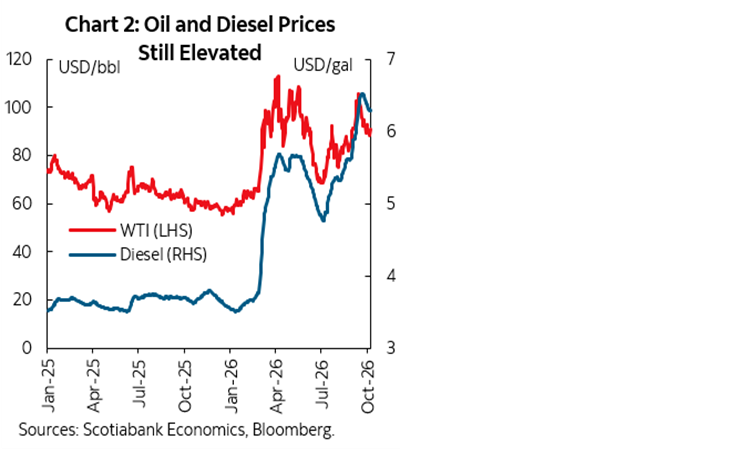
The inflation profile is revised up again in response to higher oil prices (chart 2). Also, the surge in diesel prices since the summer adds another layer of inflation pressure, gradually feeding into a broader range of consumer prices, often with a substantial lag, as our recent analysis shows. For example, we estimate that the effect on food prices will peak roughly 18 months after the initial shock. On its own, the recent increase in diesel prices raises our core inflation forecast by 0.2 percentage points in both countries. This matters for the Fed and the BoC: central banks can look through a temporary rise in energy prices, but a shock that spreads more broadly across the economy is harder to ignore.
THE GROWTH OUTLOOK HOLDS FIRM
United States
The broad U.S. growth outlook for 2026–28 is little changed, with growth close to potential and around 2.1% for the next two years. In the near term, the economy should continue to expand at a moderate pace, supported by resilient consumer spending and strong business investment. Consumption is expected to slow gradually thereafter as support from buoyant equity markets fades, real income slows due to rising inflation, and restrictive interest rates weigh more heavily on demand in 2027. We expect some recovery in 2028 as monetary policy starts to normalize. Business investment should remain robust this year, supported by AI-related capital spending and healthy corporate finances, but should moderate in 2027 and 2028 after several exceptionally strong years and as tighter financial conditions constrain further expansion.
Inflation is still the most troubling part of the U.S. outlook. Price pressures extend beyond energy, and the delayed pass-through of tariffs into goods’ prices is becoming visible. Elevated gasoline and diesel prices are also particularly important. We expect this to keep inflation from improving materially over the next few quarters. But as household spending weakens in 2027, and the effect of energy prices starts to fade, we should see some improvement, with total PCE inflation converging towards 2% in late 2027 and into 2028.
Canada
Canada’s outlook is characterized by two opposing forces: the lift from the transformation agenda against the drag from the trade war. Trade disruptions should visibly weaken exports in the fourth quarter of this year, although fiscal initiatives and stronger business investment will provide important offsets.
We continue to expect growth to accelerate in 2027, as the federal transformation agenda supports stronger business investment and public spending, while elevated energy and non-energy commodity prices further reinforce the investment outlook through stronger terms of trade and national income.
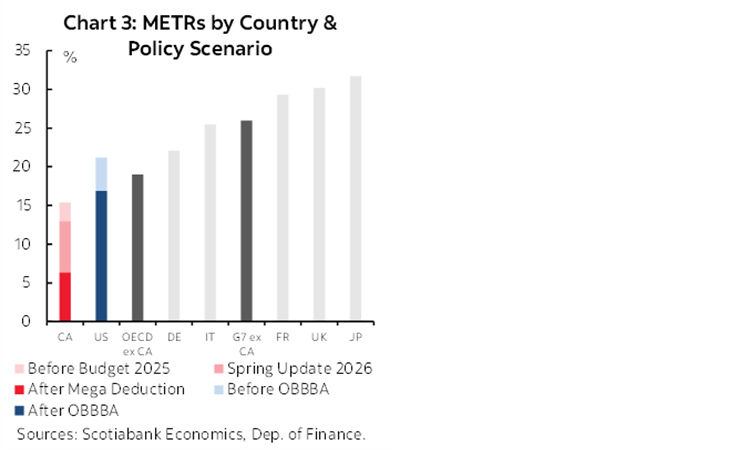
A key part of the positive investment outlook is Canada’s recently introduced “Productivity Mega-Deduction” measure, which introduces immediate expensing for a wide range of depreciable capital and significantly reduces the Marginal Effective Tax Rate on new investments (chart 3). We estimate that the measure will lift investment by around 3% by 2028. The near-term effect on GDP is more modest because part of the increase in capital spending will leak into imports, particularly for machinery and equipment. The longer-run implications are more meaningful: stronger investment gradually adds to the capital stock, lifting productivity and the economy’s productive capacity. By the end of 2028, we estimate that the measures will raise the level of Canadian GDP by about 0.3%.
We forecast GDP growth to remain healthy in 2028 with investment remaining an important support, but to moderate slightly to 2.1%, as consumption softens in response to a restrictive monetary stance. The labour market should continue to normalize, with the unemployment rate settling close to 6%.
Inflation in Canada remains better contained than in the United States, but the risks are still tilted to the upside in our opinion. Elevated oil prices will keep total CPI above 3% for the next few quarters. Inflation should then slow in 2027 as oil prices normalize and remain close to 2% in 2028. And like in the U.S., the recent diesel price surge is expected to feed through a broader set of inflation pressures in Canada. Along with the impact of retaliatory tariffs, this puts upward pressure on core inflation in 2027.
CENTRAL BANKS REMAIN FOCUSED ON INFLATION
The resilience of the U.S. economy and persistent inflation pressures should lead the Fed to raise rates twice more, taking the federal funds rate to 4.5% in early 2027 (chart 4). With monetary policy already restrictive, we think this additional tightening will be sufficient to bring the economy into better balance and inflation back toward target. The hikes also reflect some form of risk management, helping the Fed preserve its inflation-fighting credibility and lean against upside risks to prices. Combined with tight financial conditions that should slow the economy, the Fed should reverse these hikes through 2028.
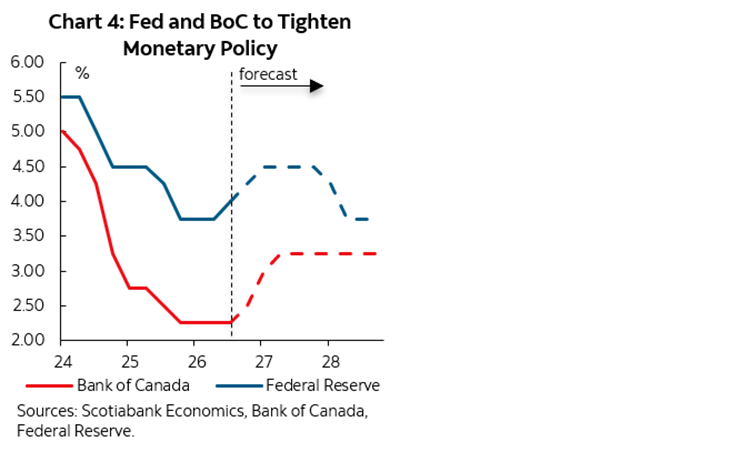
The BoC faces a similar challenge. Although inflation is better contained than in the U.S., persistently high energy and diesel prices are building additional cost pressures in the pipeline. Monetary policy cannot address this source of inflation, but the Bank of Canada still has a price-stability mandate and must limit the extent to which higher energy costs spill into broader prices. Recent growth has also held up well, suggesting that excess supply is being absorbed more quickly than expected. Against this backdrop, the BoC has little room to maintain an accommodative stance. The policy rate will likely need to move into restrictive territory to lean against these inflation risks. We forecast it to reach 3.25% in the second quarter of 2027 and keep it there well into 2028.
RISKS
Geopolitical tensions and further increases in energy prices. Our baseline assumes that geopolitical tensions gradually ease, and that oil supply recovers over time. However, inventories still need to be rebuilt, and the possibility of more prolonged or renewed supply disruptions remains significant. Crude prices could stay high for a longer period, and diesel prices could rise even further, adding strains on the supply chain. Such an outcome would directly lift headline inflation and raise transportation and production costs throughout the economy. This would require a stronger response from central banks.
A larger-than-expected fiscal and investment impulse in Canada. Governments could introduce additional measures to cushion the economic effects of the trade dispute. A larger fiscal package would support Canadian growth in 2027, but it would also add to demand and inflation at a time when the economy is already proving resilient. The response to the Productivity Mega-Deduction and the major-projects agenda could also be stronger than we currently assume. If these measures generate a larger wave of private investment, growth and productive capacity would ultimately be higher, but the initial demand effects could push inflation and the Bank of Canada’s policy-rate path above our baseline.
A renewed escalation in trade tensions. The latest round of tariffs has already weakened the Canada-U.S. trading relationship, but the dispute could escalate further. Beyond the immediate effects on exports and activity, repeated challenges to existing trade arrangements could have more lasting consequences for business confidence and capital spending. They could also make the CUSMA review more difficult and increase uncertainty around the durability of future agreements. For Canada, this would represent a clear downside risk to growth, although additional tariffs or retaliation could simultaneously add to inflation pressures.
A more disruptive rise in bond yields. Higher long-term yields can shift from being a growth story to a market turbulence story. Pressure from persistently elevated term premium and further weakness in treasuries could eventually spread to equity markets, and the resulting additional tightening in financial conditions could weigh more heavily on the economy.
1 Canada’s 2026 population growth was revised higher, implying a larger labour supply and greater productive capacity. While this allows activity to expand faster without necessarily adding inflation pressure, it also lowers measured productivity for a given level of output. We view these effects as broadly offsetting, leaving our forecasts for aggregate activity, inflation and interest rates largely unchanged.
DISCLAIMER
This report has been prepared by Scotiabank Economics as a resource for the clients of Scotiabank. Opinions, estimates and projections contained herein are our own as of the date hereof and are subject to change without notice. The information and opinions contained herein have been compiled or arrived at from sources believed reliable but no representation or warranty, express or implied, is made as to their accuracy or completeness. Neither Scotiabank nor any of its officers, directors, partners, employees or affiliates accepts any liability whatsoever for any direct or consequential loss arising from any use of this report or its contents.
These reports are provided to you for informational purposes only. This report is not, and is not constructed as, an offer to sell or solicitation of any offer to buy any financial instrument, nor shall this report be construed as an opinion as to whether you should enter into any swap or trading strategy involving a swap or any other transaction. The information contained in this report is not intended to be, and does not constitute, a recommendation of a swap or trading strategy involving a swap within the meaning of U.S. Commodity Futures Trading Commission Regulation 23.434 and Appendix A thereto. This material is not intended to be individually tailored to your needs or characteristics and should not be viewed as a “call to action” or suggestion that you enter into a swap or trading strategy involving a swap or any other transaction. Scotiabank may engage in transactions in a manner inconsistent with the views discussed this report and may have positions, or be in the process of acquiring or disposing of positions, referred to in this report.
Scotiabank, its affiliates and any of their respective officers, directors and employees may from time to time take positions in currencies, act as managers, co-managers or underwriters of a public offering or act as principals or agents, deal in, own or act as market makers or advisors, brokers or commercial and/or investment bankers in relation to securities or related derivatives. As a result of these actions, Scotiabank may receive remuneration. All Scotiabank products and services are subject to the terms of applicable agreements and local regulations. Officers, directors and employees of Scotiabank and its affiliates may serve as directors of corporations.
Any securities discussed in this report may not be suitable for all investors. Scotiabank recommends that investors independently evaluate any issuer and security discussed in this report, and consult with any advisors they deem necessary prior to making any investment.
This report and all information, opinions and conclusions contained in it are protected by copyright. This information may not be reproduced without the prior express written consent of Scotiabank.
™ Trademark of The Bank of Nova Scotia. Used under license, where applicable.
Scotiabank, together with “Global Banking and Markets”, is a marketing name for the global corporate and investment banking and capital markets businesses of The Bank of Nova Scotia and certain of its affiliates in the countries where they operate, including; Scotiabank Europe plc; Scotiabank (Ireland) Designated Activity Company; Scotiabank Inverlat S.A., Institución de Banca Múltiple, Grupo Financiero Scotiabank Inverlat, Scotia Inverlat Casa de Bolsa, S.A. de C.V., Grupo Financiero Scotiabank Inverlat, Scotia Inverlat Derivados S.A. de C.V. – all members of the Scotiabank group and authorized users of the Scotiabank mark. The Bank of Nova Scotia is incorporated in Canada with limited liability and is authorised and regulated by the Office of the Superintendent of Financial Institutions Canada. The Bank of Nova Scotia is authorized by the UK Prudential Regulation Authority and is subject to regulation by the UK Financial Conduct Authority and limited regulation by the UK Prudential Regulation Authority. Details about the extent of The Bank of Nova Scotia's regulation by the UK Prudential Regulation Authority are available from us on request. Scotiabank Europe plc is authorized by the UK Prudential Regulation Authority and regulated by the UK Financial Conduct Authority and the UK Prudential Regulation Authority.
Scotiabank Inverlat, S.A., Scotia Inverlat Casa de Bolsa, S.A. de C.V, Grupo Financiero Scotiabank Inverlat, and Scotia Inverlat Derivados, S.A. de C.V., are each authorized and regulated by the Mexican financial authorities.
Not all products and services are offered in all jurisdictions. Services described are available in jurisdictions where permitted by law.