

- Renewed trade tensions are the most important development since our July forecast. The latest U.S. tariffs and Canada’s retaliation will weigh on Canadian activity, although the macroeconomic impact is much smaller than the broader tariff threats contemplated 18 months ago. More fundamentally, the breakdown in negotiations raises questions about the durability and credibility of future trade agreements.
- Canada enters this renewed period of uncertainty from a much stronger position than it did six months ago. Growth rebounded sharply in the second quarter, led by unexpectedly healthy household spending and a recovery in exports. The decline in the unemployment rate since the spring provides further evidence that the weakness seen earlier this year was temporary.
- The U.S. economy continues to expand at a moderate pace, but inflation pressures have broadened. Household spending remains healthy despite limited job creation, while business investment continues to benefit from AI-related capital spending and elevated equity valuations. Recent inflation strength appears to extend well beyond energy prices and may increasingly reflect tariff pass-through.
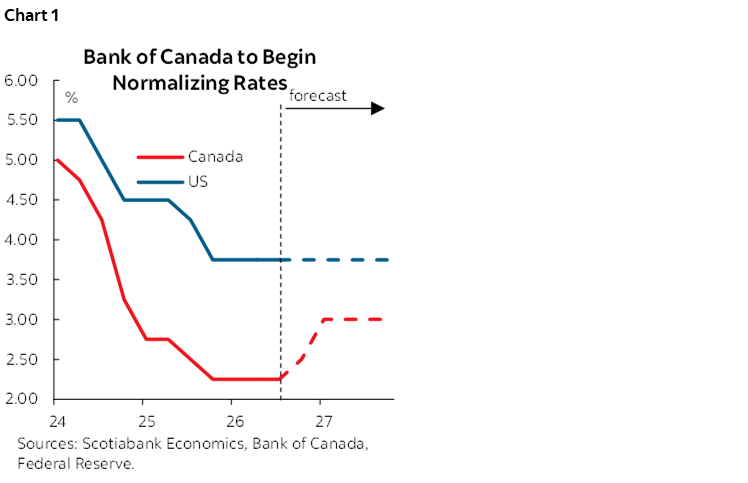
- The monetary policy outlook has turned more hawkish. The Fed is likely to stay on hold, as monetary policy is sufficiently restrictive to bring inflation back into a more comfortable zone. In Canada, we expect the BoC to begin removing stimulus in December, as firmer growth and upside inflation risks argue for a gradual withdrawal of monetary support.
The new U.S. tariffs and Canada’s retaliation are the most important developments since our last forecast. While the headline rates are high, the measures are narrowly targeted, and their macroeconomic impact should be much smaller than the broader tariff threats contemplated 18 months ago. The bigger concern is the damage to the bilateral trading relationship. The breakdown in negotiations, combined with tariffs on traded goods that had previously been protected under CUSMA, raises doubts about the reliability and durability of future agreements. That could weigh more persistently on business confidence and investment, although the effect may be muted because consumers and firms have become more accustomed to elevated trade policy uncertainty. Our In Focus box provides more detail on the impact of these renewed tensions.
That said, the renewed tensions come as the Canadian economy is performing much better than expected. Strong second-quarter growth, together with upward revisions to the first quarter, confirms that the weakness earlier this year was temporary. Household consumption was firmer than forecast, and exports rebounded strongly, reinforcing the view that momentum has recovered. Higher oil prices have also lifted Canadian income and should continue to support activity.
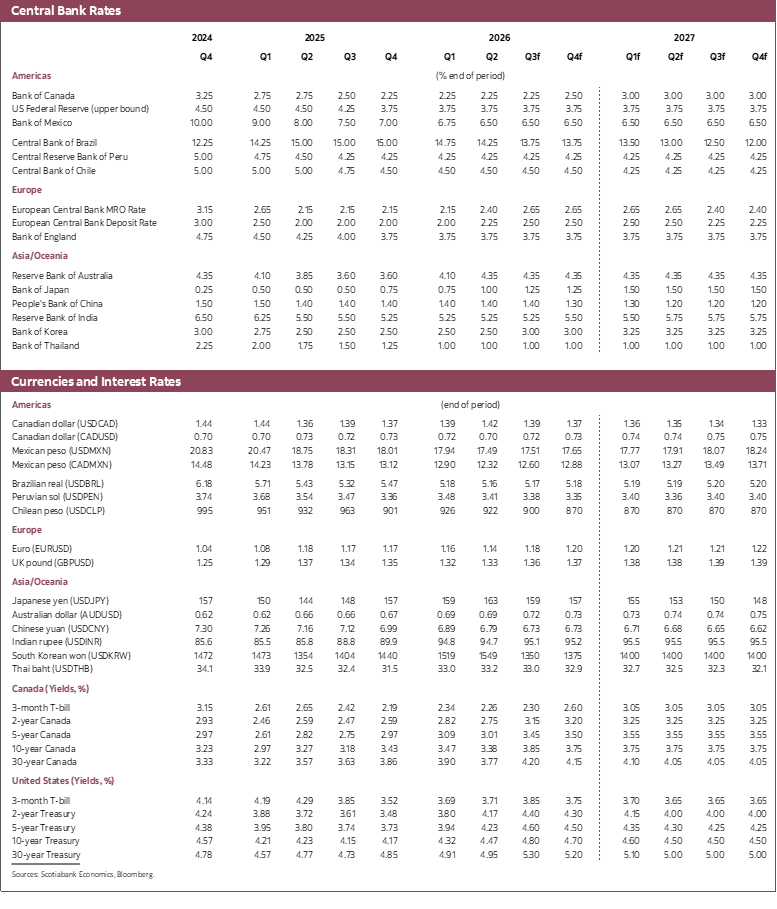
Overall, our Canadian GDP growth forecast is little changed from July, but retaliatory tariffs and higher oil prices add a temporary inflation impulse. We expect the Bank of Canada to begin removing monetary stimulus with a 25 basis point rate increase in December (chart 1).
The U.S. backdrop is different. Growth has been somewhat slower than expected, but private domestic demand remains resilient. We expect consumption to slow, though still outpace population growth, supported by healthy equity markets. Business investment should also remain firm, helped by AI-related capital spending and supportive financial conditions. Inflation is the more troubling development, with price pressures showing few signs of easing. This should keep the Federal Reserve on hold to maintain a restrictive policy.
UNITED STATES: CONSUMER RESILIENCE HAS ITS LIMITS
The broad U.S. growth narrative is little changed from our previous forecast. Real GDP increased by 1.5% annualized in the second quarter, somewhat slower than expected and down from 2.1% in the first quarter. While the headline number is weak, there is resilience in domestic demand. In particular, consumption was surprisingly robust despite generally soft job growth (chart 2).
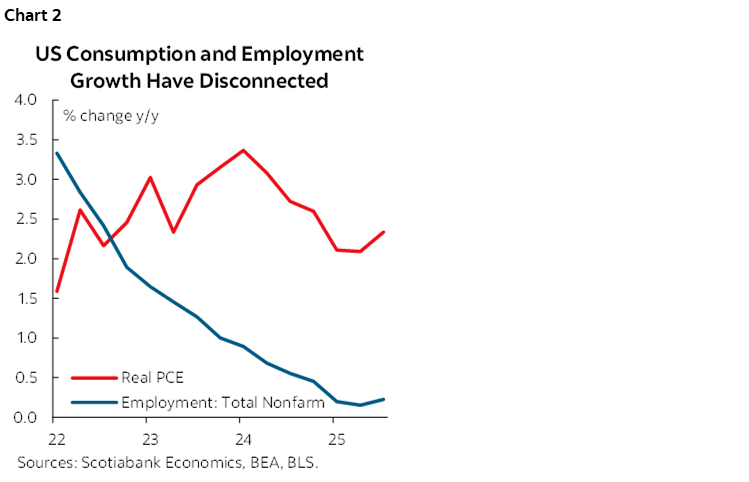
We attribute a lot of the recent strength to the heightened effects of strong equity markets on consumption. Household balance sheets and equity market gains continue to provide support, particularly among higher-income households. Still, these gains are expected to slow going forward. Coupled with elevated interest rates, slowing real income growth, and less excess saving, household spending should moderate. On the flip side, business investment should remain an important source of growth, supported by AI-related capital expenditures, strong corporate balance sheets and elevated equity valuations. The composition of growth therefore remains similar to that described in our previous forecast, although the anticipated slowdown in consumption is proving more gradual.
Inflation presents a more concerning picture. Price pressures have remained elevated in recent months, and not just because of higher energy prices: core inflation also remains firm (chart 3). As we have discussed before, part of this strength may reflect the delayed pass-through of tariffs into goods prices. Firms were initially able to cushion the impact by drawing down pre-tariff inventories or compressing margins, but their ability to absorb higher costs may be diminishing. Moreover, in an economy operating in excess demand, firms have greater scope to pass higher costs on to consumers. We continue to expect U.S. inflation to remain above 3% into next year.
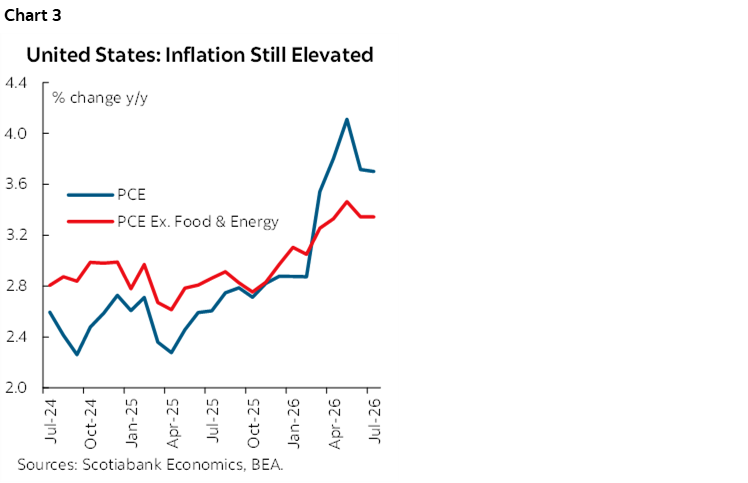
The inflation backdrop will be an important concern for the Fed, so we no longer expect U.S. rate cuts this year or next. At the same time, rate hikes are not part of our base case, as monetary policy already appears restrictive enough to bring inflation gradually back toward target next year. Policy is therefore likely to remain tight for the foreseeable future and continue weighing on the economy. That said, a more hawkish Fed response remains possible, especially if inflation pressures prove more persistent.
CANADA: STRONGER MOMENTUM MEETS NEW TARIFFS
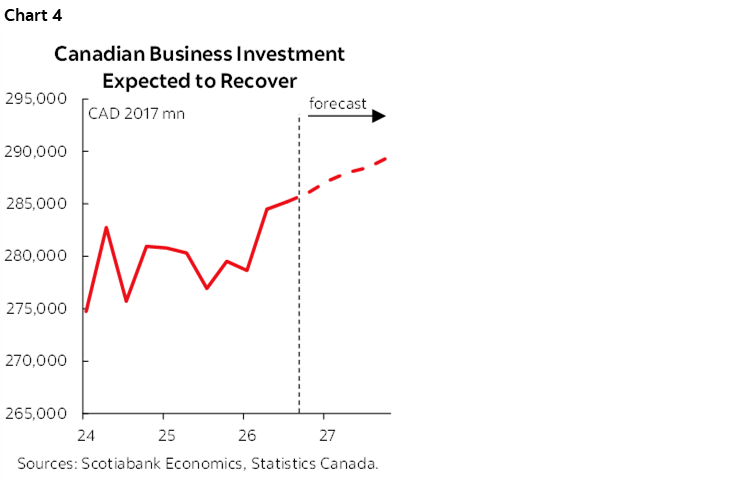
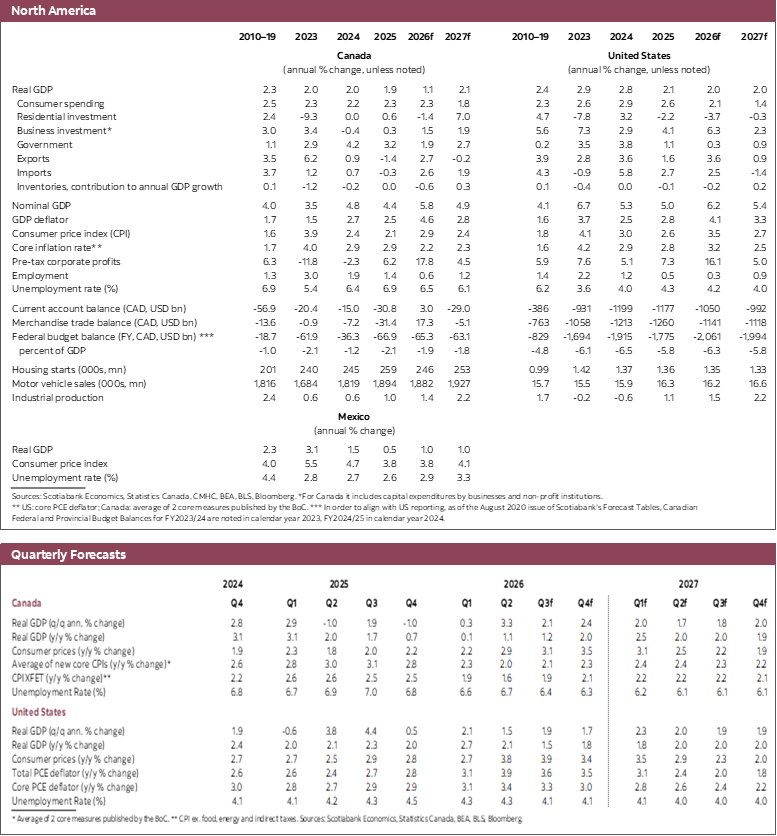
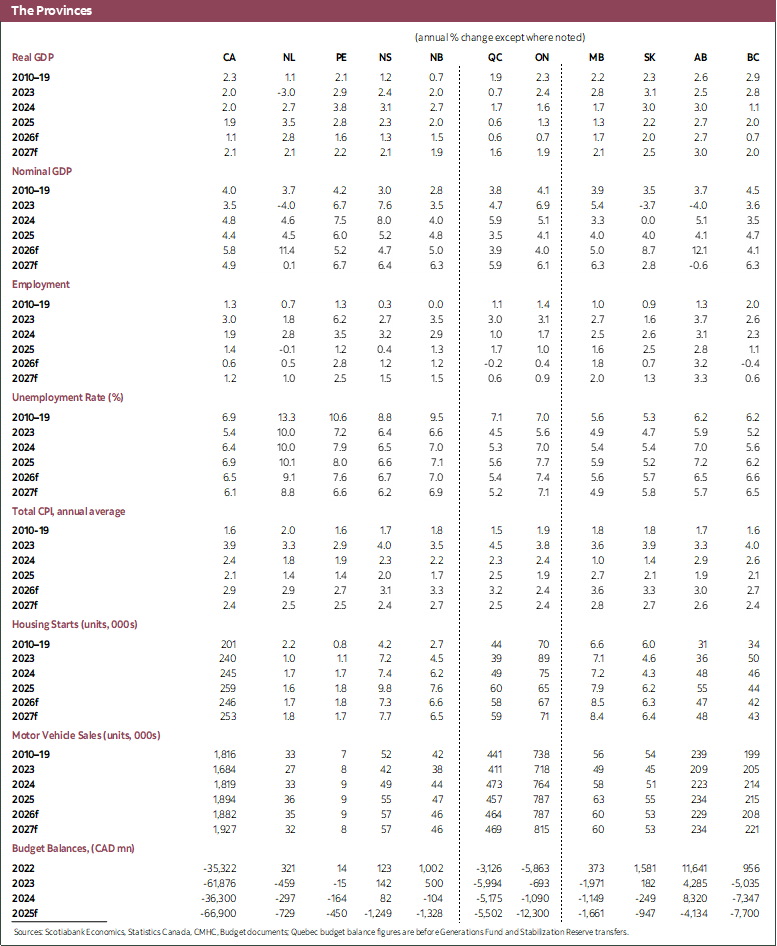
Canadian economic growth should remain healthy in the near term. We expect GDP growth to average 1.1% in 2026 before accelerating to 2.1% in 2027, although these annual figures mask divergent quarterly dynamics. The relatively modest annual growth rate in 2026 largely reflects the weak start to the year. Looking through that weakness, growth should remain healthy and above potential through the rest of the year before gradually slowing in 2027. Government spending and business investment should provide important support going forward (chart 4), but renewed trade tensions are expected to weigh on exports in the second half of this year and into 2027.
Higher commodity prices will continue to provide an additional lift through the terms-of-trade channel. As a net energy exporter, Canada receives a national income gain when the price of its exports rises relative to the price of its imports. Higher energy revenues support corporate profits, government revenues and capital spending, eventually feeding into employment and household income. These gains are partly offset by the effect of higher gasoline prices on purchasing power, but the net impact on Canadian activity is positive.
The federal government’s economic transformation agenda should also become a more visible source of growth in 2027. The initial boost will come from higher public investment, including infrastructure and defense-related spending. Over time, these investments should also support private capital spending by improving expected returns on new projects. We expect the impact on growth to become more meaningful, and to increase gradually, over 2027–28. While these measures should ultimately lift Canada’s productive capacity, they will add to demand in the near term as projects get underway. That will put additional pressure on the economy’s productive apparatus and create some upside pressure on inflation.
Labour market conditions have been volatile recently but have generally improved in recent months. The unemployment rate has declined and employment growth has recovered from the weak readings seen earlier in the year. Although the labour market is not yet tight, these developments are consistent with the broader pickup in growth and demand. Renewed trade tensions are still likely to weigh on labour market conditions later this year, mainly by slowing hiring in trade-exposed sectors. However, support from the transformation agenda, other fiscal initiatives and healthy growth should provide an important offset.
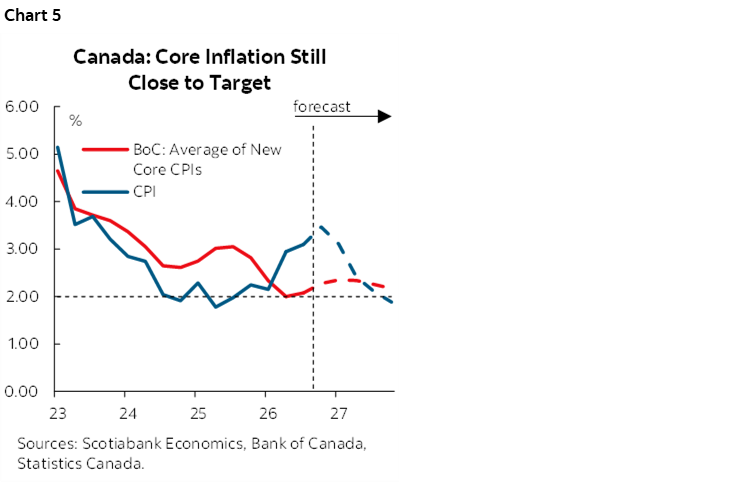
On inflation, the recent data flow has been encouraging but upside risks have increased. Total CPI remains elevated at 3%, but core inflation is close to the 2% target, suggesting that underlying price pressures are still broadly under control (chart 5). We expect headline inflation to remain elevated in the near term, reflecting higher oil prices. As oil prices normalize, those pressures should gradually ease. Important upside risks nevertheless remain. Geopolitical tensions could push oil prices higher still, while producer prices and our underlying cost-pressure measure continue to point to important risks to the upside.1 We are particularly concerned about the potential spillovers from elevated gasoline and diesel prices to broader transportation and production costs, and ultimately to CPI inflation. The most likely outcome remains a gradual return of inflation toward target, but geopolitical risks and lingering cost pressures leave the distribution of risks tilted to the upside.
Against this backdrop, we expect the Bank of Canada to begin normalizing rates in December. Although an October hike is possible, it is not our base case. Trade policy uncertainty remains elevated, and core inflation is still broadly well behaved, giving the BoC room to wait for more evidence before moving. The timing of rate hikes is therefore highly uncertain, but the direction of travel is clearer: with growth firming and inflation risks tilted to the upside, interest rates are likely to increase this year. We also see risks to growth as broadly balanced, making a gradual withdrawal of stimulus a prudent form of risk management. In particular, removing some stimulus would help guard against a more damaging scenario in which elevated oil prices feed into broader price pressures and begin to de-anchor inflation expectations (see the outcome of such a scenario analysis here). A shift toward a more neutral stance would therefore be appropriate.
RISKS TO INFLATION ARE TILTED TO THE UPSIDE
- Further escalation in trade tensions. The latest escalation clearly raises the downside risks around trade policy. By calling into question the reliability and credibility of future trade agreements with the U.S., the dispute could have longer-lasting implications for business confidence, investment decisions and the upcoming CUSMA review.
- Persistent geopolitical tensions and upside oil price risks. Geopolitical tensions in the Middle East continue to restrict oil supply. Our forecast assumes tensions de-escalate and supply gradually recovers, but inventories will still need to be rebuilt, and longer disruptions cannot be ruled out. That leaves crude prices vulnerable to further increases. Such a scenario would lift headline inflation and could feed into inflation expectations, requiring a stronger monetary policy response.
- Fiscal policy could provide more stimulus. Federal and provincial governments could introduce a sizeable fiscal package this fall to cushion the impact of the trade tensions. That would strengthen the growth impulse in 2027, add further inflation pressure, and likely push the BoC toward a higher policy rate path. The major-projects initiative is another upside risk, especially if it triggers a larger private investment response than we have built into our forecast.
1 We argued in a previous note that rising cost pressures act as an amplifier of upside inflation risks.
IN FOCUS: THE MACROECONOMIC IMPACT OF RENEWED TRADE TENSIONS
The latest dispute started after bilateral talks failed and the U.S. imposed 50% tariffs on roughly $20 billion of Canadian goods. Canada responded with dollar-for-dollar counter-tariffs on U.S. goods, with rates of 15%, 25% and 50%, effective September 8th. The U.S. measures cover only about 5% of Canada’s exports to that market, but they are notable because they hit goods that had previously benefited from CUSMA protection. On September 8th, the U.S. escalated further by barring Canadian products from federal procurement (see more details here).
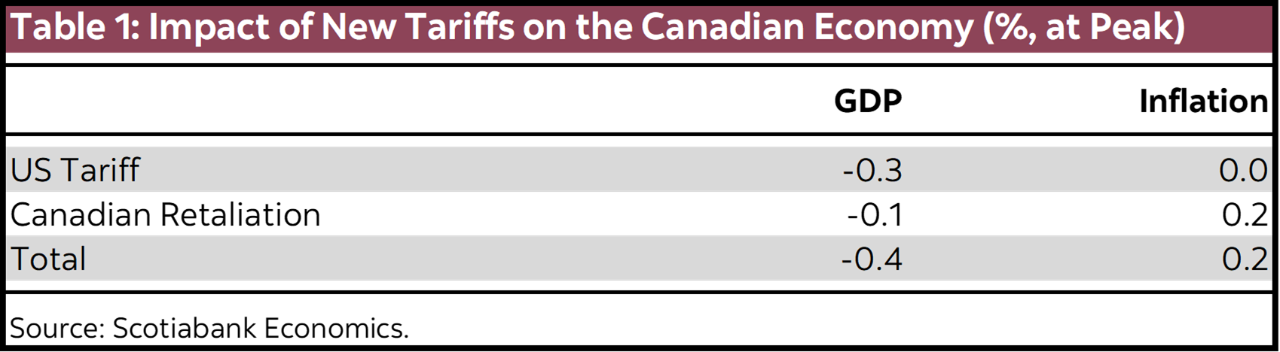
Overall, the product-level tariff rates are high, but the increase in the effective tariff rate on Canadian exports to the U.S. is much smaller, at roughly 3.5 percentage points. Our simulations suggest that the direct impact of U.S. tariffs would lower the level of Canadian GDP by about 0.3% at its peak around mid-2027, mainly through weaker exports. Higher U.S. prices reduce demand for affected Canadian goods, forcing exporters to cut production, hiring, investment and purchases from domestic suppliers. The national impact is manageable, but the pain will be much larger for exposed industries and communities.
Canadian retaliation adds a second, smaller hit to activity, worth about 0.1% of GDP. Tariffs on U.S. imports raise costs for households and businesses, reducing purchasing power and weighing on consumption and investment. Some of that impact should be softened as buyers switch to domestic suppliers or imports from other countries. Tariff revenues are also recycled into support for affected firms, providing a partial offset.
Overall, we estimate that this new wave of tariffs will lower the level of Canadian GDP by about 0.4% and raise inflation by 0.1 to 0.2 percentage points (table 1). Taken on its own, that inflation hit points to a somewhat higher policy rate path.

DISCLAIMER
This report has been prepared by Scotiabank Economics as a resource for the clients of Scotiabank. Opinions, estimates and projections contained herein are our own as of the date hereof and are subject to change without notice. The information and opinions contained herein have been compiled or arrived at from sources believed reliable but no representation or warranty, express or implied, is made as to their accuracy or completeness. Neither Scotiabank nor any of its officers, directors, partners, employees or affiliates accepts any liability whatsoever for any direct or consequential loss arising from any use of this report or its contents.
These reports are provided to you for informational purposes only. This report is not, and is not constructed as, an offer to sell or solicitation of any offer to buy any financial instrument, nor shall this report be construed as an opinion as to whether you should enter into any swap or trading strategy involving a swap or any other transaction. The information contained in this report is not intended to be, and does not constitute, a recommendation of a swap or trading strategy involving a swap within the meaning of U.S. Commodity Futures Trading Commission Regulation 23.434 and Appendix A thereto. This material is not intended to be individually tailored to your needs or characteristics and should not be viewed as a “call to action” or suggestion that you enter into a swap or trading strategy involving a swap or any other transaction. Scotiabank may engage in transactions in a manner inconsistent with the views discussed this report and may have positions, or be in the process of acquiring or disposing of positions, referred to in this report.
Scotiabank, its affiliates and any of their respective officers, directors and employees may from time to time take positions in currencies, act as managers, co-managers or underwriters of a public offering or act as principals or agents, deal in, own or act as market makers or advisors, brokers or commercial and/or investment bankers in relation to securities or related derivatives. As a result of these actions, Scotiabank may receive remuneration. All Scotiabank products and services are subject to the terms of applicable agreements and local regulations. Officers, directors and employees of Scotiabank and its affiliates may serve as directors of corporations.
Any securities discussed in this report may not be suitable for all investors. Scotiabank recommends that investors independently evaluate any issuer and security discussed in this report, and consult with any advisors they deem necessary prior to making any investment.
This report and all information, opinions and conclusions contained in it are protected by copyright. This information may not be reproduced without the prior express written consent of Scotiabank.
™ Trademark of The Bank of Nova Scotia. Used under license, where applicable.
Scotiabank, together with “Global Banking and Markets”, is a marketing name for the global corporate and investment banking and capital markets businesses of The Bank of Nova Scotia and certain of its affiliates in the countries where they operate, including; Scotiabank Europe plc; Scotiabank (Ireland) Designated Activity Company; Scotiabank Inverlat S.A., Institución de Banca Múltiple, Grupo Financiero Scotiabank Inverlat, Scotia Inverlat Casa de Bolsa, S.A. de C.V., Grupo Financiero Scotiabank Inverlat, Scotia Inverlat Derivados S.A. de C.V. – all members of the Scotiabank group and authorized users of the Scotiabank mark. The Bank of Nova Scotia is incorporated in Canada with limited liability and is authorised and regulated by the Office of the Superintendent of Financial Institutions Canada. The Bank of Nova Scotia is authorized by the UK Prudential Regulation Authority and is subject to regulation by the UK Financial Conduct Authority and limited regulation by the UK Prudential Regulation Authority. Details about the extent of The Bank of Nova Scotia's regulation by the UK Prudential Regulation Authority are available from us on request. Scotiabank Europe plc is authorized by the UK Prudential Regulation Authority and regulated by the UK Financial Conduct Authority and the UK Prudential Regulation Authority.
Scotiabank Inverlat, S.A., Scotia Inverlat Casa de Bolsa, S.A. de C.V, Grupo Financiero Scotiabank Inverlat, and Scotia Inverlat Derivados, S.A. de C.V., are each authorized and regulated by the Mexican financial authorities.
Not all products and services are offered in all jurisdictions. Services described are available in jurisdictions where permitted by law.