

ON DECK FOR WEDNESDAY, SEPTEMBER 9th

KEY POINTS:
- Oil prices continue to surge as US-Iran war escalates…
- …carrying bond yields higher, while pushing equities lower
- CAD and CGBs care more about oil prices than fresh US trade actions
- Trump escalated his unprovoked trade war against Canada…
- …and here’s what he did, along with the associated math…
- …as the impact is a tiny rounding error
- Trump’s procurement ban on Canadian firms doesn’t amount to a hill of beans
Oil prices are up again as the US war with Iran continues to escalate. Brent is 3% higher and has crossed US$100/barrel for the first time in the conflict. WTI is over US$95/barrel—also a high for the conflict. The WTI futures curve is at a new record high into next year for the war period (chart 1). The US had no strategy for the war, no buy-in from Congress or allies, and no exit plan and it’s all coming home to roost. There has been no regime change, Iran’s stockpile of enriched uranium still exists, the country continues to have large stockpiles of drones and missiles to inflict damage on neighbouring countries and US military bases, and Iran still has help from the Houthis, Russians and others. I note this because it reinforces the narrative that oil prices will be higher for longer with no end in sight for what remains Iran’s strategy of managed irresolution through US midterms.
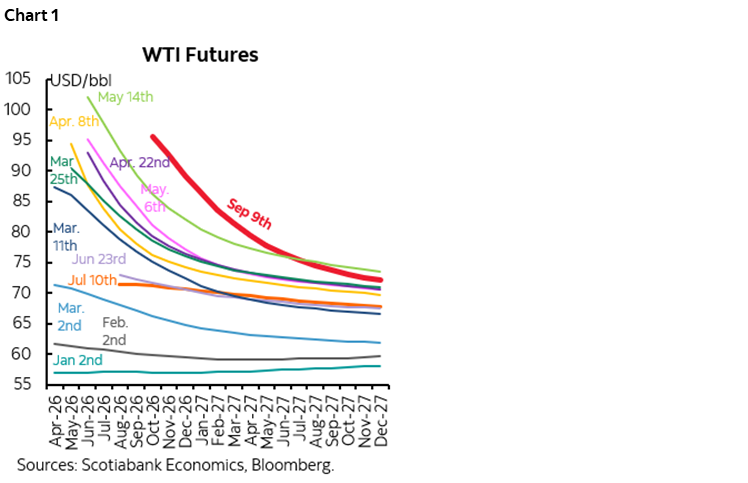
The effect is doing more to lift Canada’s economy than the foolish escalation of the unprovoked trade war by the US against Canada. Since the breakdown of talks on August 21st, WTI and Brent oil prices are up by about US$8+/barrel.
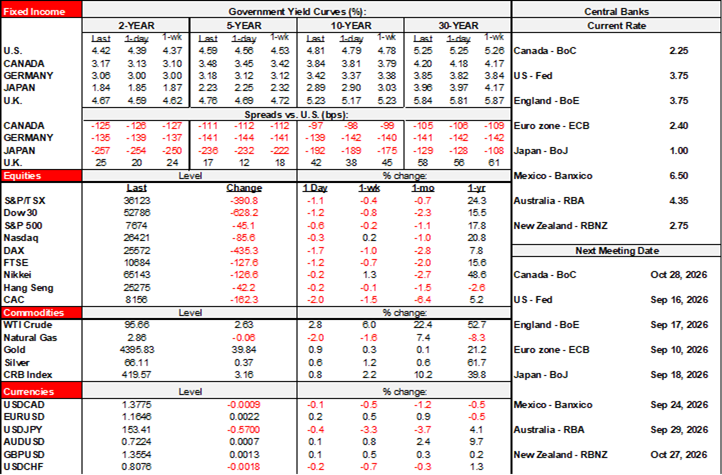
US Treasury yields are hitting American pocketbooks again with most tenors up by about 2bps. The US 2-year yield has soared by almost 100bps since the war began. The 30-year fixed mortgage rate remains at an eye-watering 6¾% that kills off US housing demand. Yields on gilts and EGBs are up by 6–9bps across 2s through 10s and a little less at the very long-end. Canadian government bond yields are up by more than in the US with 2s cheaper by 4bps in a bear flattener move. Equities are suffering with US futures down by ½% and TSX futures down by less. European cash markets are down by 1–2%.
Currencies are mixed but generally signalling less appetite for the USD. CAD largely ignored tariff headlines and is firm to the dollar.
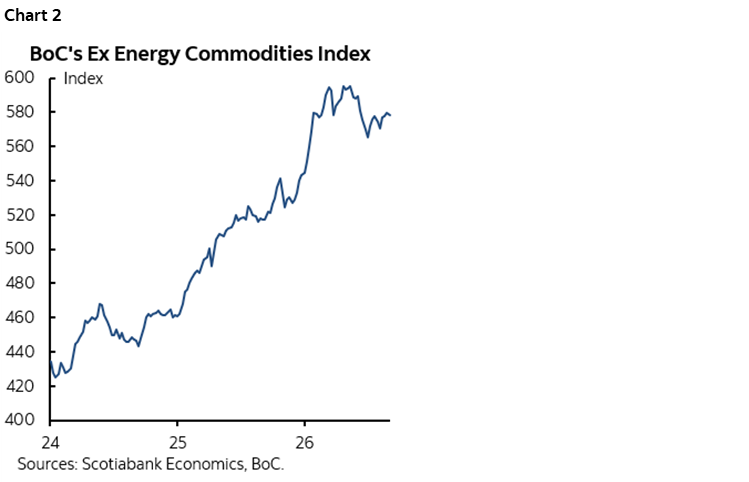
I don’t see material damage to Canada from yesterday’s US tariff and procurement actions that we estimate to be small potatoes (see below). I do see higher oil and other commodity prices—such as the BoC’s commodity price index ex-energy (chart 2)—putting additional pressure on the BoC to hike as soon as the October 28th meeting. OIS is pricing a full hike at the December meeting and a third of one in October. Why wait, when Governor Macklem upped the warnings about inflation risk ahead of a full round of forecast updates with guidance pointed toward raising the inflation outlook that would make it rather anticlimactic to do all that and then hold.
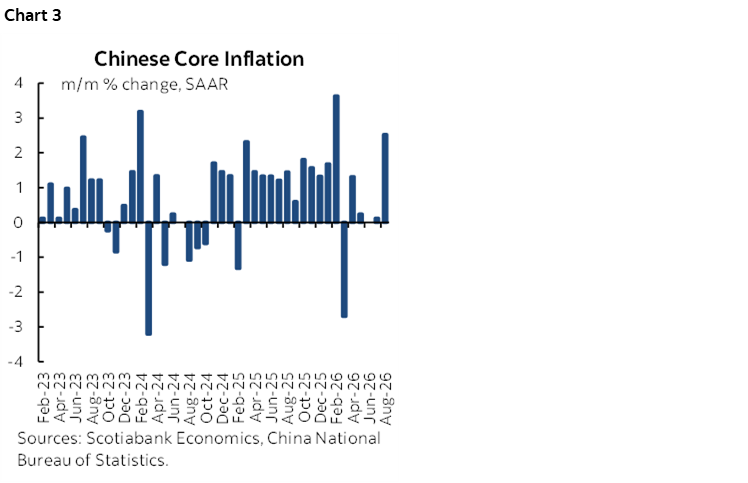
Other overnight developments were very light. China’s CPI figures for August landed at 0.8% y/y, matching consensus (0.5% prior). Core CPI was up by 1% y/y (0.9% consensus and prior). The PBOC continues to come nowhere close to its inflation target as has been the case for years. That said, the month-over-month change in core CPI accelerated which requires more evidence but serves as a warning on pass through (chart 3). Producer price inflation acceleration to 3.8% y/y (3.6% consensus, 3.5% prior).
US TRADE WAR AGAINST CANADA
Canadian Prime Minister Carney’s video yesterday (here) explained his approach to embracing investment and moving away from the US as the American administration turns increasingly isolationist. If this were about oratory skills and eloquence, then Carney would have Trump beaten hands down. The message is basically that Canada is moving on, throwing open investment opportunities to firms elsewhere and signing more trade and investment agreements with friendlier nations and regions like the expected announcements on a deal with the EU next week. Carney will be warmly greeted by Europe as the poster boy of the resistance to rally behind.
What follows will address the US attacks on Canada through procurement changes and then US tariff actions.
TRUMP’S PROCUREMENT CHANGES ARE IMMATERIAL
The Trump administration’s actions to bar Canadian firms from some US government procurement programs doesn’t amount to a hill of beans. His social media post about it is here. The post concerns one of the procurement programs where US federal, state, local and tribal governments can get commercial products and services.
First, it’s a threat absent concrete action.
Second, never trust figures that Trump tosses around including this time—and everyone should know this by now. When he cites the size of the program in question—the GSA’s Multiple Award Schedules—at US$50 billion he is a) citing the entire size of the program as it applies to all US-domiciled and foreign businesses, and b) overstating its aggregate size.
This post and this one suggest that the entire MAS program is roughly US$40 billion/year.
Depending upon the method, we figure that the share of this program attributable to Canadian firms is between a few hundred million dollars per year and the low single-digit billions.
That’s chump change. And there are ways of working around such a prohibition if truly enacted, such as selling through US firms, adding a little more value in the US etc.
As for the claim that Canada unfairly blocks US firms from Buy Canada programs, you started it back in Trump 1.0 (here).
The other claims against Canada in Trump’s social media post are also false. Canada is not ripping off the US on trade. Canada has the same quota and tariff system on dairy that the US imposes on Canadian exports and that Trump signed himself in his first term.
THE LATEST US TARIFF ACTIONS ON CANADA
The Trump administration escalated its trade war against Canada last evening. So far, Canada has only responded through this social media post by Dominic LeBlanc. I’m sure PM Carney will weigh in at some point probably today.
Trump says it’s a retaliation but recall that the US started this nonsense and Canada’s latest move yesterday as Canada’s previously threatened tariffs went into effect was in retaliation to the 50% US tariffs that were implemented on about C$28 billion of imports from Canada on August 22nd.
Chart 4 summarizes our math by drawing upon trade data down to HS8 level codes in trade databases. A few of us were up very late last evening to share preliminary findings and with shout-outs to Jay Parmar and Anthony Bambokian on our team.
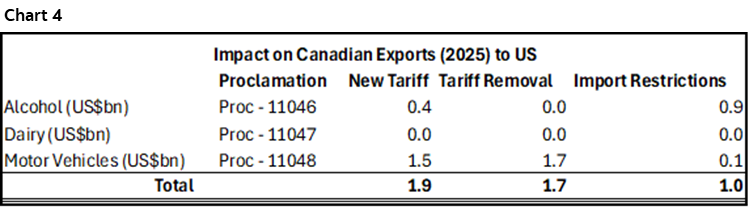
We estimate that new tariffs will apply to about C$3 billion of Canadian exports to the US while removed tariffs apply to about C$2 billion of Canadian exports to the US and the banned exports only amount to about C$0.7 billion.
These actions are face saving by the US administration, not substantive in nature and that’s a positive. The tariffs will go into effect on either September 15th or 29th depending on the individual tariffs, which may signal either room for negotiation or, more likely, an implementation lag.
Three of the announcements are product bans. The US claims it has not previously banned imports from Canada, but 50% tariffs are a de facto ban regardless of what you call it and so I don’t buy that line from the US administration.
- The US is banning imports of certain motorcycles (here). Canada exported only about US$0.1B to the US under this category in 2025. This is very small potatoes.
- The US is banning imports of certain dairy products (here). Canada exported basically nothing to the US under this category in 2025.
- The US is banning imports of certain alcoholic beverages (here). Canada only exported about $400 million (C$550 million) to the US last year.
The other two announcements imposed higher tariffs as follows:
- Motor vehicles (here): The curious thing here is that the new US tariffs that are supposedly to address alleged Canadian treatment of motor vehicles—like Canada’s tariffs on Harley-Davidson and Indian motorcycles—have nothing to do with motor vehicles. It’s a long list in two annexes that we have incorporated into our math.
- Alcoholic beverages (here): Here the list doesn’t just address Canadian alcohol but targets wonderful Canadian cheeses perhaps on the logic that they pair nicely with wine. Everything from chinchilla pelts (who knew…) to outboard motor boats with a length under 7.5 meters (love the metric units…).
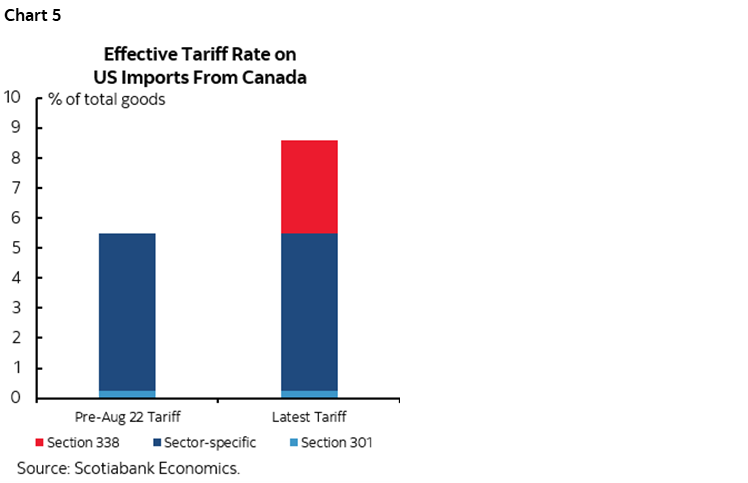
The impact of the latest moves raises the effective tariff rate on US imports from Canada by an immaterial amount to the prior 8.6% ETR on all Canadian goods exports to the US. The tariff rate prior to the new US tariffs on August 22nd is shown in the left hand bar and then the right hand side bar adds the August 22nd tariffs with an immaterial contribution from yesterday’s moves to 9.1% from 8.6% previously (chart 5). This includes all tariffs prior to the Section 338 tariffs that the US imposed on August 22nd after the break down of talks, plus those August 22nd tariffs, plus yesterday’s announced tariffs. The small volume of affected exports is nevertheless subject to very high US tariffs.
The US also repeated its threatened 50% tariff on auto imports from Canada on January 1st covering assembled vehicles and parts with no CUSMA exemption. I would give precisely 0% odds to this happening and if it did, then it would shut down the US auto sector within days while throwing out of work many thousands of American workers.
DISCLAIMER
This report has been prepared by Scotiabank Economics as a resource for the clients of Scotiabank. Opinions, estimates and projections contained herein are our own as of the date hereof and are subject to change without notice. The information and opinions contained herein have been compiled or arrived at from sources believed reliable but no representation or warranty, express or implied, is made as to their accuracy or completeness. Neither Scotiabank nor any of its officers, directors, partners, employees or affiliates accepts any liability whatsoever for any direct or consequential loss arising from any use of this report or its contents.
These reports are provided to you for informational purposes only. This report is not, and is not constructed as, an offer to sell or solicitation of any offer to buy any financial instrument, nor shall this report be construed as an opinion as to whether you should enter into any swap or trading strategy involving a swap or any other transaction. The information contained in this report is not intended to be, and does not constitute, a recommendation of a swap or trading strategy involving a swap within the meaning of U.S. Commodity Futures Trading Commission Regulation 23.434 and Appendix A thereto. This material is not intended to be individually tailored to your needs or characteristics and should not be viewed as a “call to action” or suggestion that you enter into a swap or trading strategy involving a swap or any other transaction. Scotiabank may engage in transactions in a manner inconsistent with the views discussed this report and may have positions, or be in the process of acquiring or disposing of positions, referred to in this report.
Scotiabank, its affiliates and any of their respective officers, directors and employees may from time to time take positions in currencies, act as managers, co-managers or underwriters of a public offering or act as principals or agents, deal in, own or act as market makers or advisors, brokers or commercial and/or investment bankers in relation to securities or related derivatives. As a result of these actions, Scotiabank may receive remuneration. All Scotiabank products and services are subject to the terms of applicable agreements and local regulations. Officers, directors and employees of Scotiabank and its affiliates may serve as directors of corporations.
Any securities discussed in this report may not be suitable for all investors. Scotiabank recommends that investors independently evaluate any issuer and security discussed in this report, and consult with any advisors they deem necessary prior to making any investment.
This report and all information, opinions and conclusions contained in it are protected by copyright. This information may not be reproduced without the prior express written consent of Scotiabank.
™ Trademark of The Bank of Nova Scotia. Used under license, where applicable.
Scotiabank, together with “Global Banking and Markets”, is a marketing name for the global corporate and investment banking and capital markets businesses of The Bank of Nova Scotia and certain of its affiliates in the countries where they operate, including; Scotiabank Europe plc; Scotiabank (Ireland) Designated Activity Company; Scotiabank Inverlat S.A., Institución de Banca Múltiple, Grupo Financiero Scotiabank Inverlat, Scotia Inverlat Casa de Bolsa, S.A. de C.V., Grupo Financiero Scotiabank Inverlat, Scotia Inverlat Derivados S.A. de C.V. – all members of the Scotiabank group and authorized users of the Scotiabank mark. The Bank of Nova Scotia is incorporated in Canada with limited liability and is authorised and regulated by the Office of the Superintendent of Financial Institutions Canada. The Bank of Nova Scotia is authorized by the UK Prudential Regulation Authority and is subject to regulation by the UK Financial Conduct Authority and limited regulation by the UK Prudential Regulation Authority. Details about the extent of The Bank of Nova Scotia's regulation by the UK Prudential Regulation Authority are available from us on request. Scotiabank Europe plc is authorized by the UK Prudential Regulation Authority and regulated by the UK Financial Conduct Authority and the UK Prudential Regulation Authority.
Scotiabank Inverlat, S.A., Scotia Inverlat Casa de Bolsa, S.A. de C.V, Grupo Financiero Scotiabank Inverlat, and Scotia Inverlat Derivados, S.A. de C.V., are each authorized and regulated by the Mexican financial authorities.
Not all products and services are offered in all jurisdictions. Services described are available in jurisdictions where permitted by law.