

Canadian consumer insolvencies picked up in September, but so far remain well below the long-run average.
Consumer insolvency filings are expected to rise through the end of the year as household support measures, such as debt payment deferrals, have started to expire, while employment remains below the pre-pandemic level.
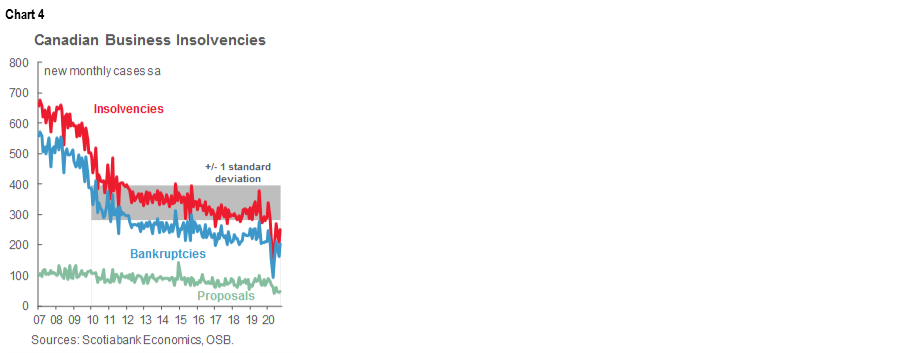
Insolvencies in the business sector picked up slightly in September, as the virus case count continued to rise and several provinces introduced new restriction measures.
CONSUMER INSOLVENCIES BEGIN TO CLIMB
Canadian consumer insolvency filings continued to climbed in September, at 7.7K cases reaching the highest level since March of this year (chart 1). While this represents a sharp jump over the previous month, the filings remain over 35% below last year’s levels.
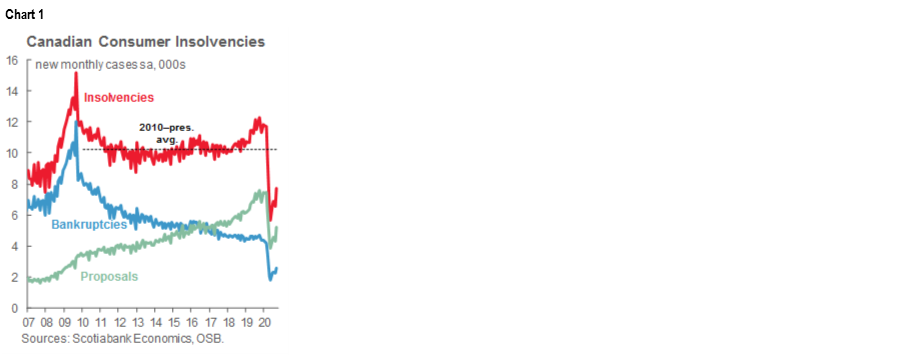
Canadian consumer insolvency filings dropped off sharply in March as the lockdowns affected the normal operation of courts. While employment levels declined through March and April (chart 2), the introduction of household support measures such as the Canada Emergency Response Benefit (CERB) and debt payment deferrals kept new insolvencies at all-time lows through the pandemic. As a result, the pressure for some form of arrangement with creditors was reduced, and eventually employment began to grow amid broader signs of economic recovery.
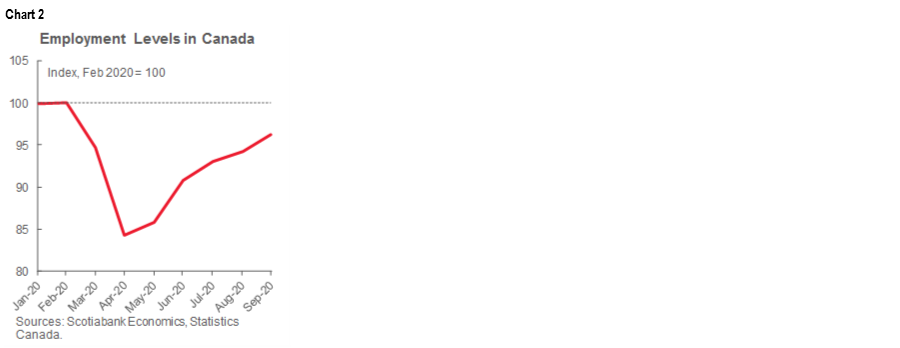
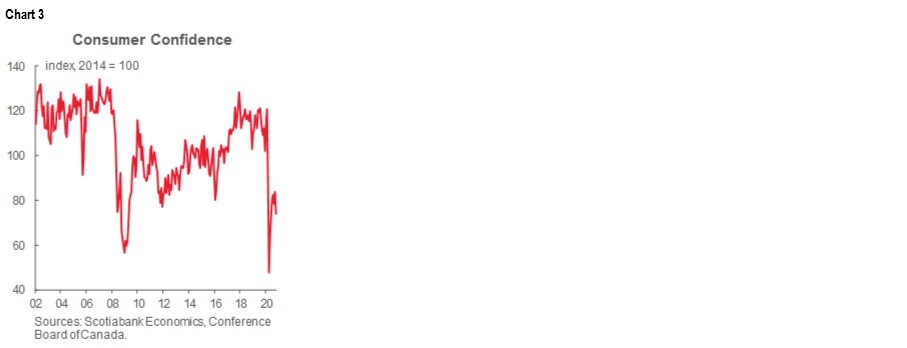
September was the last month of household support measures. The applications for debt payment deferrals were no longer broadly available past the end of September. The expiry of the CERB at the end of September was partly offset by temporary changes to EI benefits. In the face of the second wave of the virus, with employment still below February’s levels, and consumer confidence declining recently (chart 3), it is likely that insolvency filings will continue to rise through the end of the year.
BUSINESS INSOLVENCIES SHOW UPTICK, BUT REMAIN LOW
Canadian business insolvencies picked up in September (+21.5% m/m sa), though still remained below the long-term average (chart 4). While some regions re-introduced measures designed to contain the spread of the virus following a sharp uptick in new COVID-19 cases, the support measures such as the Canada Emergency Business Account (CEBA), and Canada Emergency Rent Subsidy (CERS), the latter depending on the passage of legislation, will continue to be available for businesses with applications through the end of 2020. The course of business insolvency filings is dependent on the evolution of the virus and the policies adopted to limit its spread, as well as the effectiveness of support measures introduced by the Government of Canada.
DISCLAIMER
This report has been prepared by Scotiabank Economics as a resource for the clients of Scotiabank. Opinions, estimates and projections contained herein are our own as of the date hereof and are subject to change without notice. The information and opinions contained herein have been compiled or arrived at from sources believed reliable but no representation or warranty, express or implied, is made as to their accuracy or completeness. Neither Scotiabank nor any of its officers, directors, partners, employees or affiliates accepts any liability whatsoever for any direct or consequential loss arising from any use of this report or its contents.
These reports are provided to you for informational purposes only. This report is not, and is not constructed as, an offer to sell or solicitation of any offer to buy any financial instrument, nor shall this report be construed as an opinion as to whether you should enter into any swap or trading strategy involving a swap or any other transaction. The information contained in this report is not intended to be, and does not constitute, a recommendation of a swap or trading strategy involving a swap within the meaning of U.S. Commodity Futures Trading Commission Regulation 23.434 and Appendix A thereto. This material is not intended to be individually tailored to your needs or characteristics and should not be viewed as a “call to action” or suggestion that you enter into a swap or trading strategy involving a swap or any other transaction. Scotiabank may engage in transactions in a manner inconsistent with the views discussed this report and may have positions, or be in the process of acquiring or disposing of positions, referred to in this report.
Scotiabank, its affiliates and any of their respective officers, directors and employees may from time to time take positions in currencies, act as managers, co-managers or underwriters of a public offering or act as principals or agents, deal in, own or act as market makers or advisors, brokers or commercial and/or investment bankers in relation to securities or related derivatives. As a result of these actions, Scotiabank may receive remuneration. All Scotiabank products and services are subject to the terms of applicable agreements and local regulations. Officers, directors and employees of Scotiabank and its affiliates may serve as directors of corporations.
Any securities discussed in this report may not be suitable for all investors. Scotiabank recommends that investors independently evaluate any issuer and security discussed in this report, and consult with any advisors they deem necessary prior to making any investment.
This report and all information, opinions and conclusions contained in it are protected by copyright. This information may not be reproduced without the prior express written consent of Scotiabank.
™ Trademark of The Bank of Nova Scotia. Used under license, where applicable.
Scotiabank, together with “Global Banking and Markets”, is a marketing name for the global corporate and investment banking and capital markets businesses of The Bank of Nova Scotia and certain of its affiliates in the countries where they operate, including; Scotiabank Europe plc; Scotiabank (Ireland) Designated Activity Company; Scotiabank Inverlat S.A., Institución de Banca Múltiple, Grupo Financiero Scotiabank Inverlat, Scotia Inverlat Casa de Bolsa, S.A. de C.V., Grupo Financiero Scotiabank Inverlat, Scotia Inverlat Derivados S.A. de C.V. – all members of the Scotiabank group and authorized users of the Scotiabank mark. The Bank of Nova Scotia is incorporated in Canada with limited liability and is authorised and regulated by the Office of the Superintendent of Financial Institutions Canada. The Bank of Nova Scotia is authorized by the UK Prudential Regulation Authority and is subject to regulation by the UK Financial Conduct Authority and limited regulation by the UK Prudential Regulation Authority. Details about the extent of The Bank of Nova Scotia's regulation by the UK Prudential Regulation Authority are available from us on request. Scotiabank Europe plc is authorized by the UK Prudential Regulation Authority and regulated by the UK Financial Conduct Authority and the UK Prudential Regulation Authority.
Scotiabank Inverlat, S.A., Scotia Inverlat Casa de Bolsa, S.A. de C.V, Grupo Financiero Scotiabank Inverlat, and Scotia Inverlat Derivados, S.A. de C.V., are each authorized and regulated by the Mexican financial authorities.
Not all products and services are offered in all jurisdictions. Services described are available in jurisdictions where permitted by law.