

This report tracks admissions and issuances of individuals granted permission to permanently and temporarily reside in Canada, and whether these figures are aligning with federal government immigration targets.
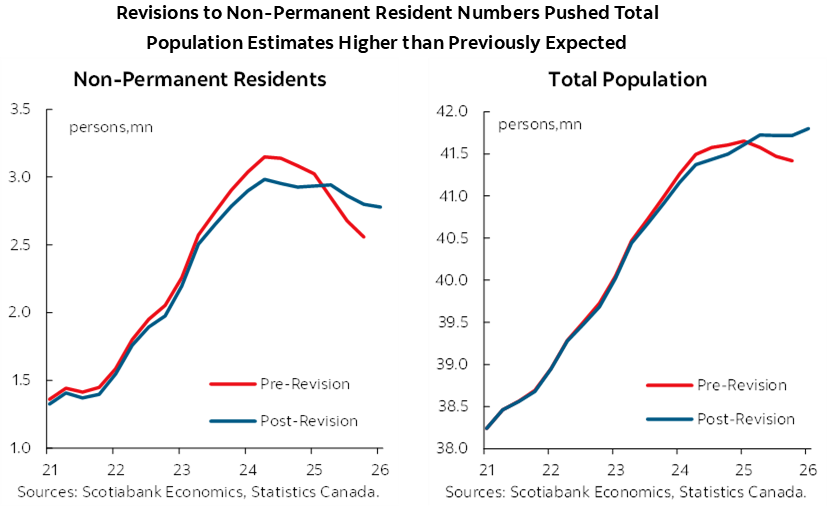
Historic quarterly population estimates have been revised, pushing total levels higher than previously thought
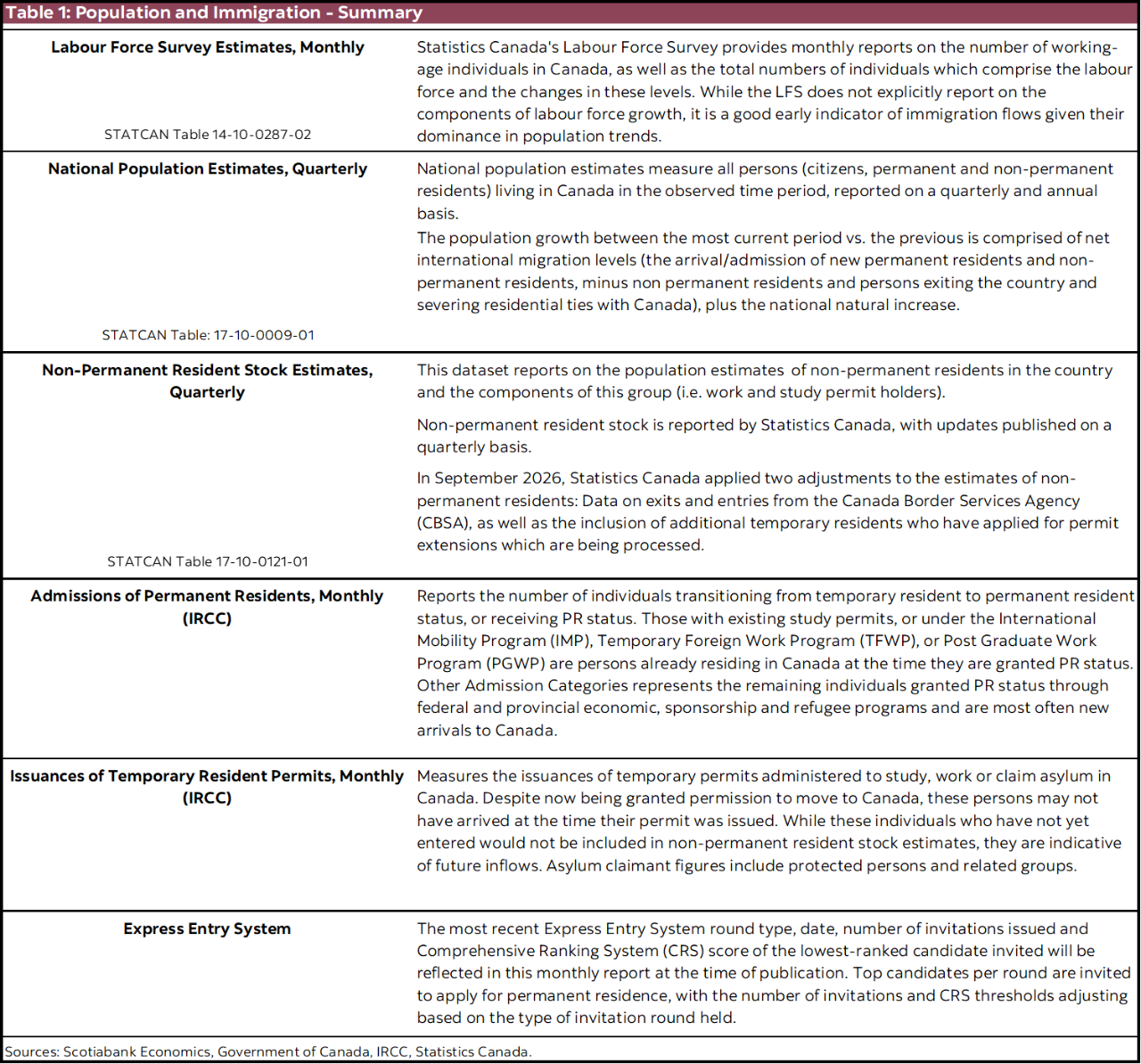
- The release of fresh quarterly population numbers introduced two new adjustments to the estimates of non-permanent residents: entry and exit data from Canada Border Services Agency (CBSA) to estimate the proportion of permit holders who left Canada prior to the expiry of their permits, and the inclusion of individuals who have applied for permit extensions and remain in Canada while their application is being processed but have not yet been accounted for in IRCC administrative data.
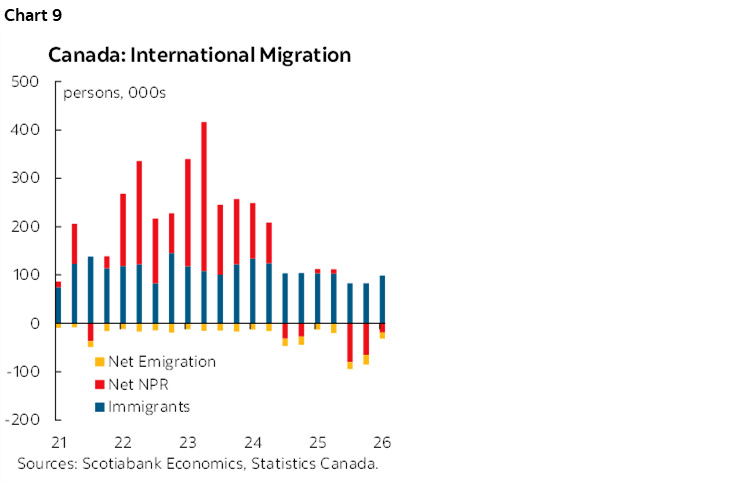
- As a result, significant revisions have taken place, with the historical (Q3-2021 to Q3-2025) non-permanent resident (NPR) population data adjusted lower than previously estimated, while more recent readings (Q4-25 onward) have seen total numbers revised substantially higher. Given Canada’s reliance on immigration for population growth, total quarterly population estimates saw a similar pattern occur, with recent upward revisions erasing the trend of consistent quarterly population contractions (though a single, minor contraction was still recorded over the final months of 2025).
- Though upward revisions to recent NPR population statistics have been recorded across the board, no single category has influenced total population revisions more than work permit holders, with roughly 70–80% of total population adjustments over the last two years attributed to adjustments in the work permit holder population.
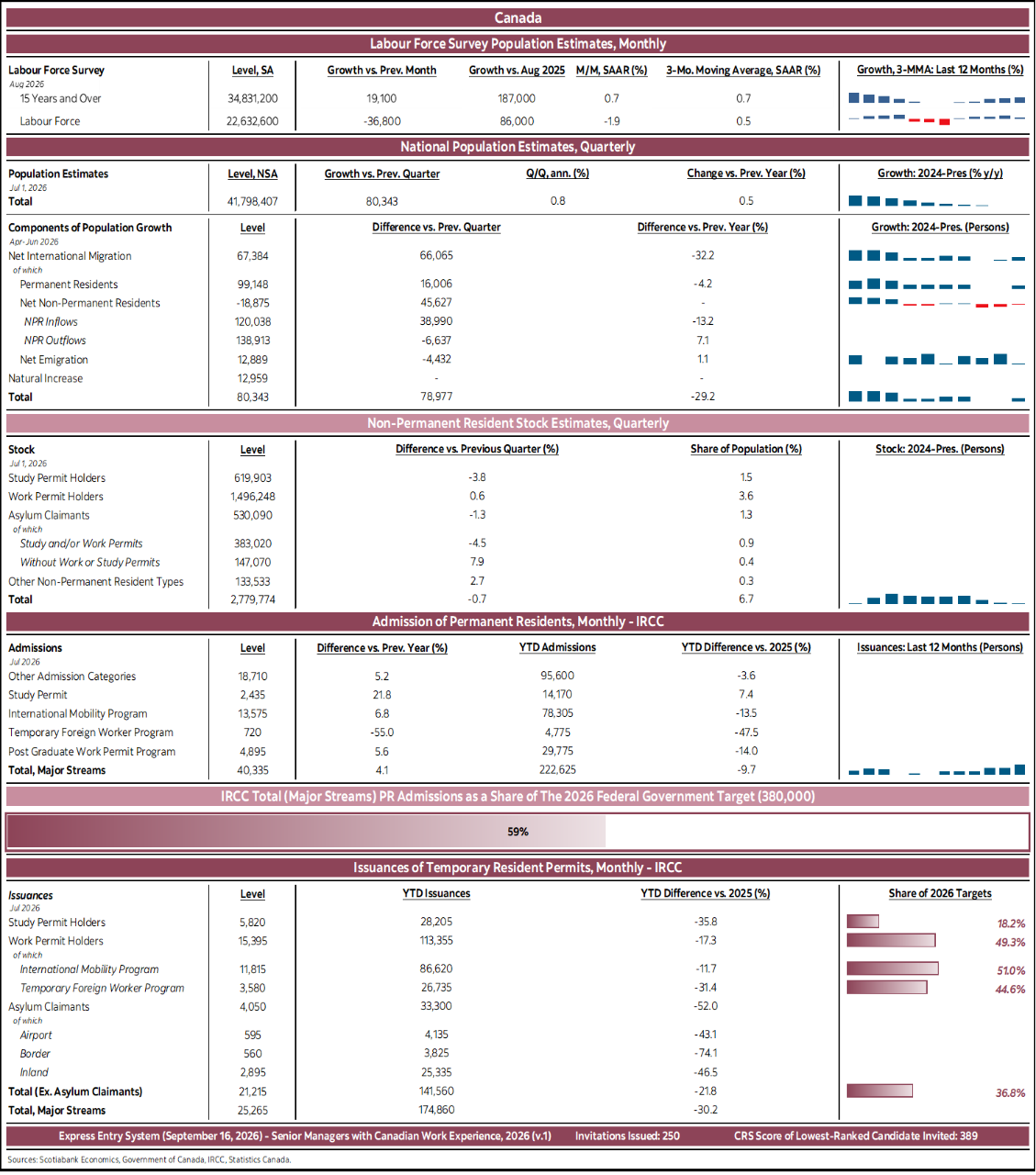
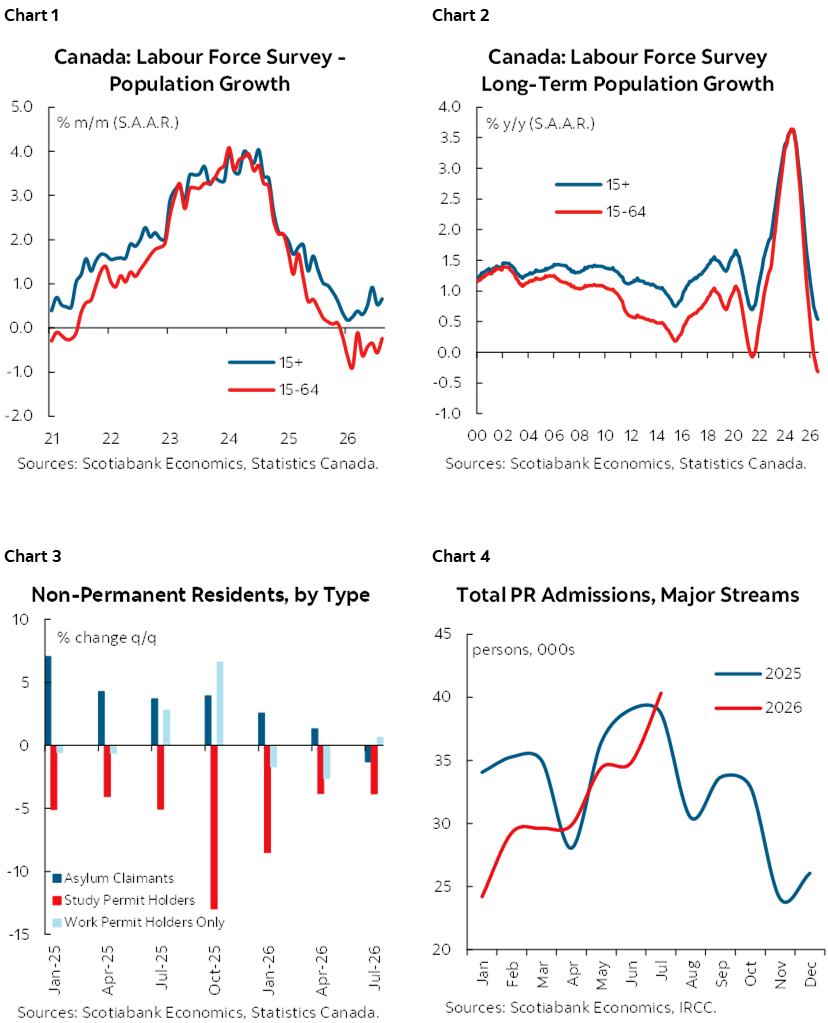
- Therefore, lagged quarterly official national estimates now stand at 41,798,407, an increase of 80,343 (0.2% q/q) vs the previous quarter (which, in turn, was revised to 41,718,064, approximately 0.7% greater than what was initially reported in June). The revisions leave the growth profile in modestly positive territory, with today’s figures putting population growth at 0.5% year-over-year. Today’s methodological revisions bring quarterly estimates closer to Labour Force Survey tracking, which historically has been tracking consistently higher than the national quarterly estimates.
Meanwhile, permanent resident admissions continue to do its thing
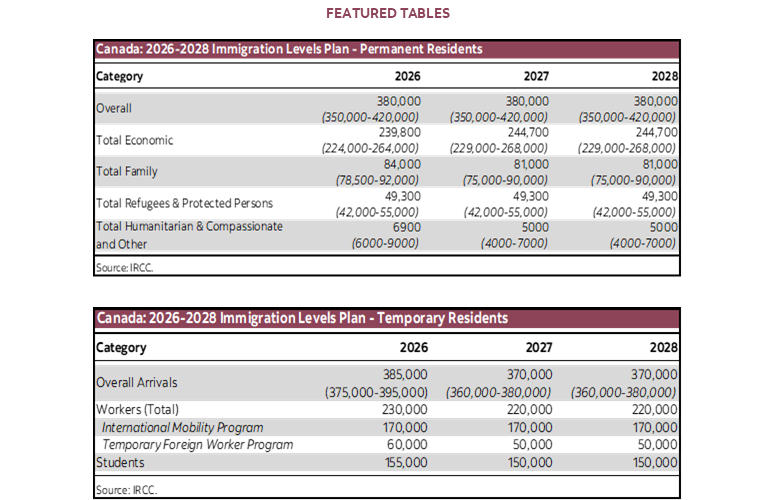
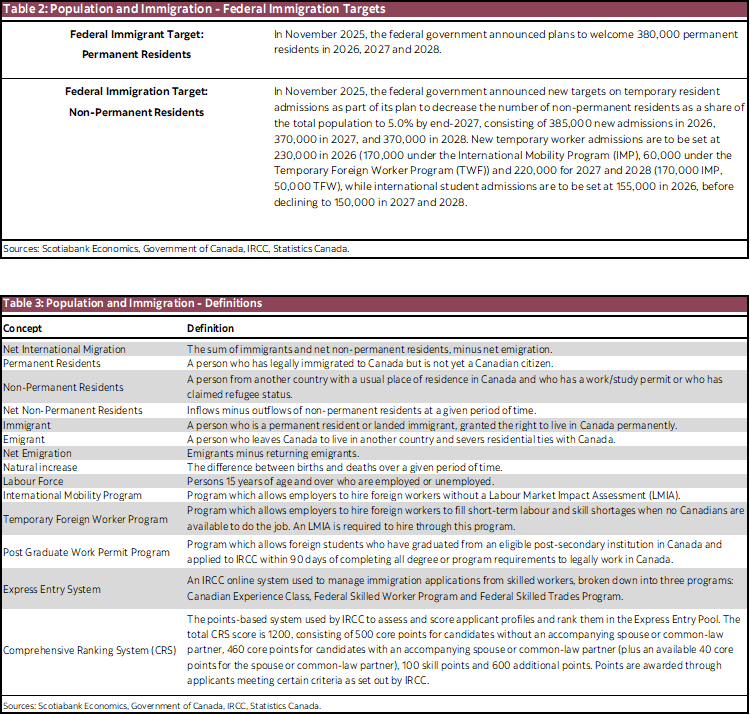
- Between January and July, Canada welcomed just over 222,000 new permanent residents, accounting for just under 60% of the annual target with over half of the year recorded. Of these new admissions, approximately 55% of those have gained PR status under the Economic category, currently tracking below the federal governments plan of 63% of total PR admissions for 2026 to be welcomed under this category.
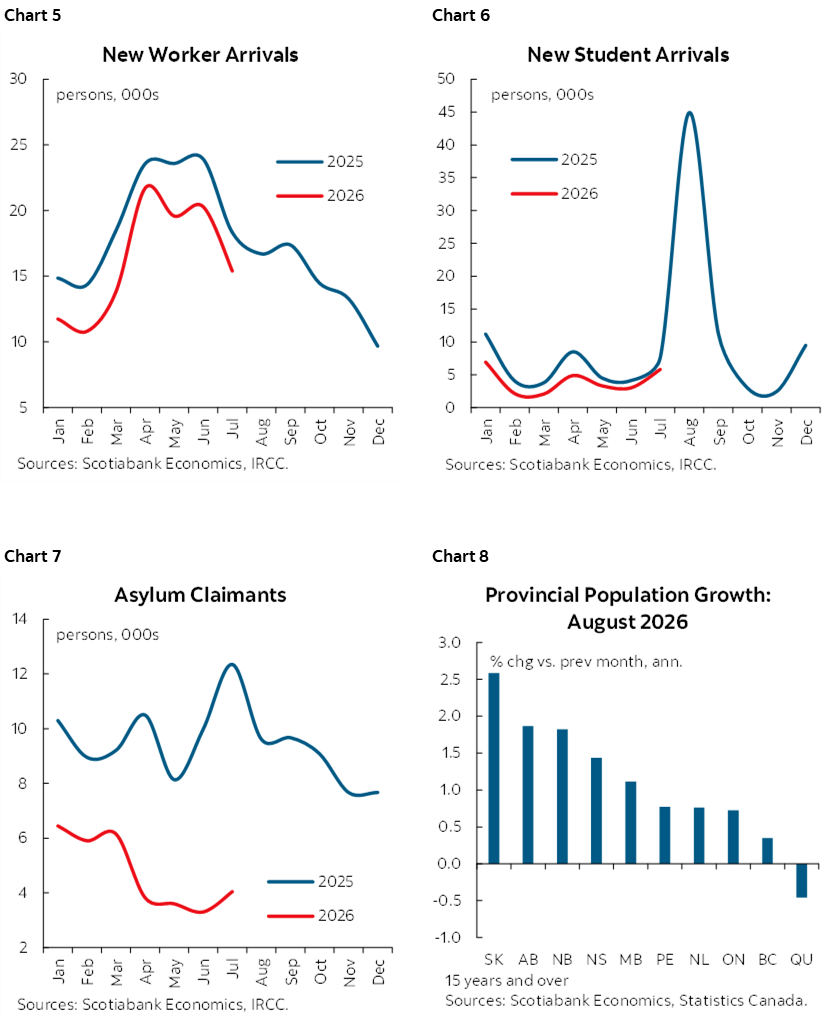
- Interestingly, while the number of study permit holders has been shrinking rapidly since the onset of federal immigration plans, the number of study permit holders transitioning to PR has increased when compared to 2025. In July alone, roughly 2435 study permit holders received PR status, approximately 22% higher vs July 2025, and over 7% greater when comparing year-to-date admissions in 2026 to the corresponding time period a year prior.
- Total issuances, having started the year somewhat slowly, have seen a pickup in pace, particularly over the spring and summer months. As with previous years and targets, the federal government remains on track with overall PR admissions, and it seems unlikely they will significantly over or undershoot their 2026 goal.
New work permit arrivals have steadily picked up as the year has progressed, but the student numbers just aren’t there
- Slightly over 113,000 new work permit holders arrived in Canada between January and July, the vast majority arriving under the International Mobility Program. New work permit arrivals began to pick up pace in the early spring months and so far have managed to remain consistent, with approximately 50% of the federal government’s 2026 temporary work permit cap filled through seven months of the year.
- What was once a stream of new international students arriving in previous years can now be described as barely a trickle. With year-to-date (Jan–July) arrivals recorded at just over 28,200, approximately 18.2% of the 155,000 cap set in place for 2026. Even with the historic August bump in arrivals that comes with the onset of a new school year, total annual international student arrivals will come in far below what would have been anticipated when the current Immigration Levels Plan was crafted in late 2025, though early warning signs last year were there. Tightened immigration policies, higher rejection rates, weaker immigration incentives, and other countries representing viable alternatives to study and eventually settle in, have significantly impacted the number of international students
coming to Canada.
Given recent upward revisions to Canada’s total population, will there be any expectation for the federal government to double down on more restrictive policies in the upcoming Immigration Levels Plan?
- Fall approaches, and with that, the new Immigration Levels Plan outlining the federal government’s permanent and temporary resident admission targets for the following three years. Despite NPR and overall population levels adjusted higher than previously thought, will there be any emphasis on further restrictions on admissions?
- As a result of the revisions, the share of NPR to the total population now stands at 6.7%, an uptick vs the previous quarter’s reporting (6.2%). Despite the upward revisions, population growth has still declined significantly overall from its peak between 2023 and 2024, with year-over-year growth levels still below the pre-pandemic growth rates of around 1%. The overall level of NPRs may be higher than previously estimated, but current immigration policies mean their stock across major temporary categories has been shrinking consistently over recent quarters nonetheless, while new temporary arrival numbers are currently undershooting annual caps (particularly with international students), diminishing the anticipated offset to exits which would occur if total new arrivals were higher. Goals of slowing Canada’s population growth substantially, while reducing the NPR share of the total population to 5%, may take longer than what would have been anticipated in June, but achieving the 5% goal by the end of 2027 remains intact.
- With an economy gaining momentum and labour demands expected to increase nation-wide, it is reasonable to assume that, should there be any deviations from current immigration methods, focus would revolve around ensuring the new Immigration Levels Plan is calibrated to the government’s build agenda, rather than a dogmatic approach to caps and targets.
Featured Chart
DISCLAIMER
This report has been prepared by Scotiabank Economics as a resource for the clients of Scotiabank. Opinions, estimates and projections contained herein are our own as of the date hereof and are subject to change without notice. The information and opinions contained herein have been compiled or arrived at from sources believed reliable but no representation or warranty, express or implied, is made as to their accuracy or completeness. Neither Scotiabank nor any of its officers, directors, partners, employees or affiliates accepts any liability whatsoever for any direct or consequential loss arising from any use of this report or its contents.
These reports are provided to you for informational purposes only. This report is not, and is not constructed as, an offer to sell or solicitation of any offer to buy any financial instrument, nor shall this report be construed as an opinion as to whether you should enter into any swap or trading strategy involving a swap or any other transaction. The information contained in this report is not intended to be, and does not constitute, a recommendation of a swap or trading strategy involving a swap within the meaning of U.S. Commodity Futures Trading Commission Regulation 23.434 and Appendix A thereto. This material is not intended to be individually tailored to your needs or characteristics and should not be viewed as a “call to action” or suggestion that you enter into a swap or trading strategy involving a swap or any other transaction. Scotiabank may engage in transactions in a manner inconsistent with the views discussed this report and may have positions, or be in the process of acquiring or disposing of positions, referred to in this report.
Scotiabank, its affiliates and any of their respective officers, directors and employees may from time to time take positions in currencies, act as managers, co-managers or underwriters of a public offering or act as principals or agents, deal in, own or act as market makers or advisors, brokers or commercial and/or investment bankers in relation to securities or related derivatives. As a result of these actions, Scotiabank may receive remuneration. All Scotiabank products and services are subject to the terms of applicable agreements and local regulations. Officers, directors and employees of Scotiabank and its affiliates may serve as directors of corporations.
Any securities discussed in this report may not be suitable for all investors. Scotiabank recommends that investors independently evaluate any issuer and security discussed in this report, and consult with any advisors they deem necessary prior to making any investment.
This report and all information, opinions and conclusions contained in it are protected by copyright. This information may not be reproduced without the prior express written consent of Scotiabank.
™ Trademark of The Bank of Nova Scotia. Used under license, where applicable.
Scotiabank, together with “Global Banking and Markets”, is a marketing name for the global corporate and investment banking and capital markets businesses of The Bank of Nova Scotia and certain of its affiliates in the countries where they operate, including; Scotiabank Europe plc; Scotiabank (Ireland) Designated Activity Company; Scotiabank Inverlat S.A., Institución de Banca Múltiple, Grupo Financiero Scotiabank Inverlat, Scotia Inverlat Casa de Bolsa, S.A. de C.V., Grupo Financiero Scotiabank Inverlat, Scotia Inverlat Derivados S.A. de C.V. – all members of the Scotiabank group and authorized users of the Scotiabank mark. The Bank of Nova Scotia is incorporated in Canada with limited liability and is authorised and regulated by the Office of the Superintendent of Financial Institutions Canada. The Bank of Nova Scotia is authorized by the UK Prudential Regulation Authority and is subject to regulation by the UK Financial Conduct Authority and limited regulation by the UK Prudential Regulation Authority. Details about the extent of The Bank of Nova Scotia's regulation by the UK Prudential Regulation Authority are available from us on request. Scotiabank Europe plc is authorized by the UK Prudential Regulation Authority and regulated by the UK Financial Conduct Authority and the UK Prudential Regulation Authority.
Scotiabank Inverlat, S.A., Scotia Inverlat Casa de Bolsa, S.A. de C.V, Grupo Financiero Scotiabank Inverlat, and Scotia Inverlat Derivados, S.A. de C.V., are each authorized and regulated by the Mexican financial authorities.
Not all products and services are offered in all jurisdictions. Services described are available in jurisdictions where permitted by law.