

By Patrick Bryden, Ben de Wit and Zeeshan Nayani
This Scotia Growth Institute report explores the federal government’s decision to designate the Pacific Link Pipeline as the first project deemed in the national interest and what it signals for the Building Canada agenda.
The Pacific Link Pipeline, formerly known as the West Coast Oil Pipeline (WCOP), has formally received Schedule 1 designation under the Building Canada Act, signaling federal support for the project as the first to be designated in the national interest. Attention now shifts towards the conditions document fulfillment targeted for September 1, 2027, alongside costs, environmental management, construction timing, and risk management.
With the escalation to Schedule 1 and the one project, one review, one year mandate by the federal government, we believe the Pacific Link project will be watched closely and used as a barometer for Canada’s potential to deliver major projects.
Key points
· A flashing green light. The Pacific Link project’s Schedule 1 designation under the Building Canada Act signals strong federal and provincial support and, in our view, shifts the conversation further from “if” to “how, when, and at what cost” the pipeline will be delivered. As the first Schedule 1 project, Pacific Link will also test the pace of approvals. · Our scenarios point to a large, multi-year investment cycle. Our base case estimates project completion in 2034 at a cost of $43.7 billion, compared with H2/2032 and $35.2 billion in the upside case, and H1/2037 and approximately $65.6 billion (50% cost inflation) as the downside case, expressed in 2026 dollars. · A southern route is certain, although specifics are yet to be finalized. As shown in Exhibit 2 and with the announcement, we believe the Pacific Link route will likely run alongside the Trans Mountain Expansion (TMX) to minimize permitting risk, new land disturbance, and maximize speed, cost effectiveness, and political support, with oil arriving at a terminal that can load supertankers. · Next steps: the conditions document, then FID, then construction. In our base case, we expect the commercial framework and final investment decision (FID) to follow in H1/2028, with full construction beginning in H2/2028 (Exhibit 3). · De-risking the path forward. The path from Schedule 1 designation to construction is becoming clearer as regulatory reform, enhanced marine safeguards, and evolving ownership structures begin to address key risks, although tolls and long-term shipping contracts remain to be finalized. |
Demonstrating a New Approach
The Pacific Link project has been officially designated as Schedule 1 under the Building Canada Act (BCA), which we view as a full-speed-ahead signal from the Government of Canada for getting the project into construction and completed. Since this is the first project to be designated as Schedule 1, there are questions about what specific methods or tools might be used to help accelerate Pacific Link’s development, and, as a consequence of these questions, we believe the pipeline will serve as a major reference point for evaluating Canada’s growth ambitions and its ability to deliver on large-scale projects. Our view is also that the Schedule 1 listing means the government does not ultimately see insurmountable obstacles on Pacific Link’s path to completion, and that the project is now earmarked to demonstrate the Building Canada Strategy.
The announcement of the Pacific Link Pipeline’s Schedule 1 designation closely follows the Canada Investment Summit that occurred in Toronto on September 14 and 15, and we believe that investors are currently giving more attention to Canadian opportunities. The pipeline offers an important and high-profile test case for attracting elements of private investment through public-private partnership, and while we believe that the project will be substantially Canadian in its ownership, financing, and operation, we also see strong opportunities for the project to attract components of indirect, and potentially longer-term direct, foreign investment.
The Schedule 1 listing means that Pacific Link now has broad federal and provincial support, and a key next step for the project is the preparation and issuance of the conditions document that will run alongside all necessary consultations with First Nations. The conditions document is expected to outline the steps necessary for construction to begin, and achieving the outlined conditions will position the project to be fully permitted and approved. As communicated in the project’s Memorandum of Understanding (MOU) between the Government of Canada and the Government of Alberta, the federal government’s intention is to make best efforts to fulfill the conditions document by September 1, 2027, to enable construction.
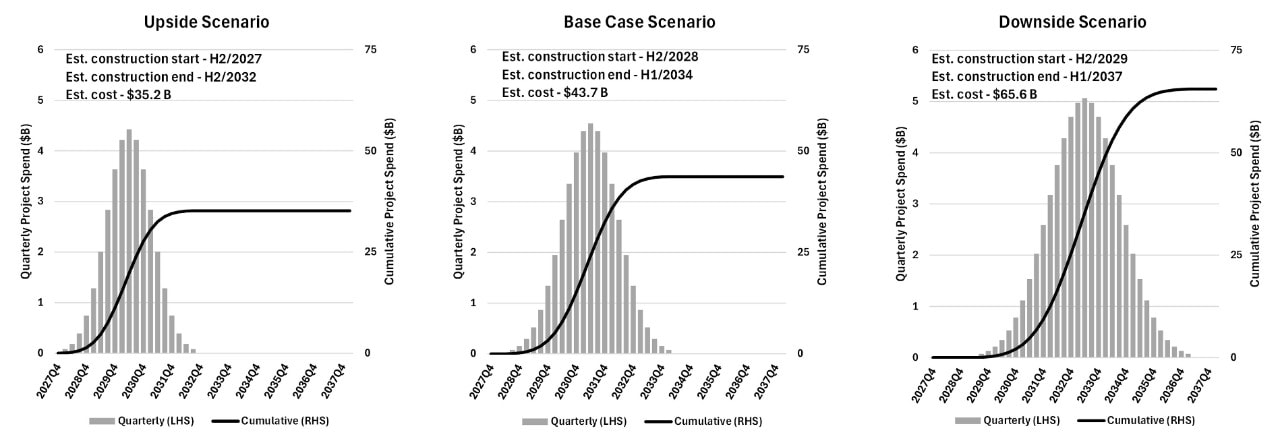
Our view is that the Schedule 1 designation of the Pacific Link project now shifts discussions from “Is this going to happen?” to “How is this going to happen?”, “How much will it cost?”, and “When will it happen?” In Exhibit 1, we present upside, base case, and downside scenario estimates for the pipeline’s development. In the absence of formal cost estimates, we note these are illustrative and subject to change as capital expenditures become formalized. In our base case scenario, we estimate that having the conditions document issued by September 1, 2027, could allow a commercial framework to be finalized in H1/2028, with a final investment decision (FID) to follow soon after, and that full construction could commence by H2/2028. Our estimated construction timeline for the base case is 5.75 years (compared with ~4.5 years for TMX, adjusted for Pacific Link’s requirement of a new export terminal) with total costs of $43.7 billion meeting the top end of the initial estimated range. Further details of each scenario are presented in the following pages, along with key considerations for the project’s development.
Exhibit 1 – Pacific Link Construction Scenarios (Upside, Base Case, and Downside)
Note: Stylized normal distribution spend curve for illustrative purposes.
Source: Pacific Link timing per Government of Alberta, MPO and PMO; Scotia Growth Institute.
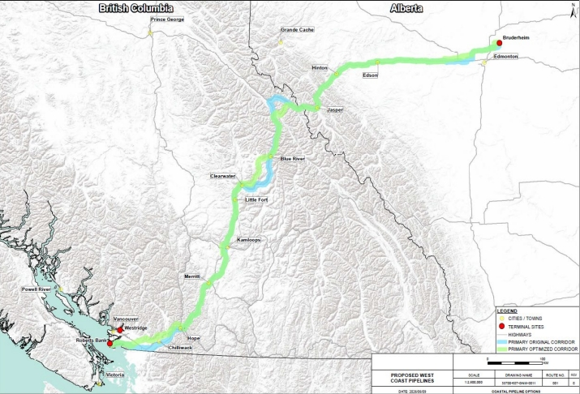
While a southern route has been confirmed, the exact alignment from Bruderheim to Roberts Bank has not yet been finalized; the initial proposal is to closely follow an existing pipeline corridor, as presented in Exhibit 2. Following the route of an existing pipeline, such as the existing Trans Mountain right-of-way, may simplify and accelerate certain aspects of the Pacific Link’s development, and because the historical ban of oil tankers along BC’s Northern Coast, outlined in Bill C-48, remains in effect, an alternative, northern pipeline route is no longer a possibility that we see being pursued.
Potential risks we see for the pipeline are that the project is encumbered with uncertainty through unanticipated legal challenges, or project interruptions or delays, although we believe that Schedule 1 designation of the project means the Government of Canada is expressing its confidence that these potential risks can be managed. Our view is that the recent BCA and Major Projects Office (MPO) efforts appear aimed at streamlining project development processes and decisions across Canada, and that the Pacific Link Pipeline has been spotlighted as an exemplar to demonstrate Canada’s growth ambitions and new approach to project development.
We expect that positive steps towards the completion of the Pacific Link Pipeline along a timeline that resembles our base case or upside scenarios would be a positive catalyst for Building Canada initiatives and particularly build momentum for any projects that may be listed with the BCA’s Schedule 1 designation in the future. Alternatively, if there is a lack of timely progress on the pipeline, it experiences unexpected challenges, or its development begins resembling the downside scenario we have presented, then we believe it could potentially be less optimal for Building Canada initiatives.
A Closer Look at Pacific Link’s Construction Scenarios
Base Case Scenario – Completion in H1/2034 at a cost of $43.7 billion. In this base case scenario, we estimate a full construction start date of H2/2028 that occurs around one year following the issuance of the conditions document. This scenario presents a construction schedule of approximately 5.75 years and operation beginning in H1/2034. The 5.75-year construction period is approximated using the TMX project’s actual construction timeline of ~4.5 years, with an additional contingency because Pacific Link requires a new export terminal to be built as part of the project, new potential route segments, and because labour and supply-chain constraints related to major infrastructure projects may affect the project as other major projects advance between 2028 and 2034. The project’s construction cost is modelled at $43.7 billion (in 2026 dollars), equal to the upper end of the initial estimated range, with annual construction expenditures expected to peak in 2031 at approximately $17 billion.
Upside Scenario – Completion in H2/2032 at a cost of $35.2 billion. In this upside scenario, we estimate a construction start date of H2/2027, based on the optimism indicated in the most recent announcement and press release, but with an accelerated construction period of 4.75 years (relative to the base case of 5.75 years) that would allow the pipeline to begin operation as early as H2/2032. In this scenario, we would expect that any material challenges or potential interruptions are resolved expediently because of the pipeline’s Schedule 1 designation, and that there are notably fewer labour or supply-chain constraints compared to our base case scenario. In this upside scenario, we estimate a total construction cost for the Pacific Link Pipeline of $35.2 billion, equal to the lower end of the initial estimated range, with the annual construction expenditure expected to peak in 2030 at approximately $15 billion.
Downside Scenario – Completion in H1/2037 at a cost of $65.6 billion. In this scenario, we estimate a construction start date of H2/2029. Construction spans 7.75 years (31 quarters) and is modelled to end in H1/2037. This start date assumes a further year delay relative to the base case, since TMX’s legal challenges in 2018 took approximately a year to resolve regarding consultation and marine impacts. The stretched build reflects a potential scenario with labour shortages, weather events such as flooding and wildfires, which are common in western provinces, and potential capacity and wildlife constraints near Roberts Bank. Costing, as a result, is set at 50% above the upper end of proponent estimates (a modest allowance considering TMX’s nearly five-fold cost growth), leading to $65.6 billion in today’s (2026) dollars. Annual spend peaks in 2033 at about $19.7 billion.
Key considerations for the Pacific Link project are that energy megaprojects are rarely symmetrical or neat in their spending, and can often experience delays and cost inflation, however, the Schedule 1 designation through the BCA could mean that the Pacific Link project is less likely to experience challenges that materially impact costs and completion timelines, or at least be better prepared to resolve any issues if they arise. Factors such as long lead times of materials and equipment, seasonal construction windows, and inflationary pressures make costing and completion timeline estimates challenging, and we therefore present the three scenarios as illustrative scenarios, rather than definitive forecasts.
Other notable considerations for the base case, upside, and downside construction scenarios are that they are presented as real, 2026, dollars and final, nominal, spending figures for the project will be subject to inflation depending on the estimated completion timelines that range from 2032 to 2037. The cost of steel pipes, labour, equipment, fuel, financing, and other contingencies are all likely to rise over time, and construction costs may also outpace the Bank of Canada’s targeted rate of inflation when considering the multitude of other infrastructure and development projects that are anticipated to begin in similar timeframes under Building Canada initiatives.
The Pacific Link project differs from the historical pipeline proposals from Alberta to a Coastal BC port that were ultimately unsuccessful, in that the combination of the BCA and the MPO being propelled by the current geopolitical climate are expected to help facilitate timely resolutions to previous obstacles and risks. In Exhibit 3, we present an overview of how designated projects are expected to progress from initial project submission to FID and construction, with a sample timeline for the pipeline that aligns with our base case scenario as presented in Exhibit 1.
While indirect, we see the Schedule 1 designation of the pipeline as a positive indicator for Pacific Link-related projects like the Pathways Project, expansion of upstream oil sands projects, and even adjacent LNG buildouts.
Exhibit 3 – Major Project Evolution
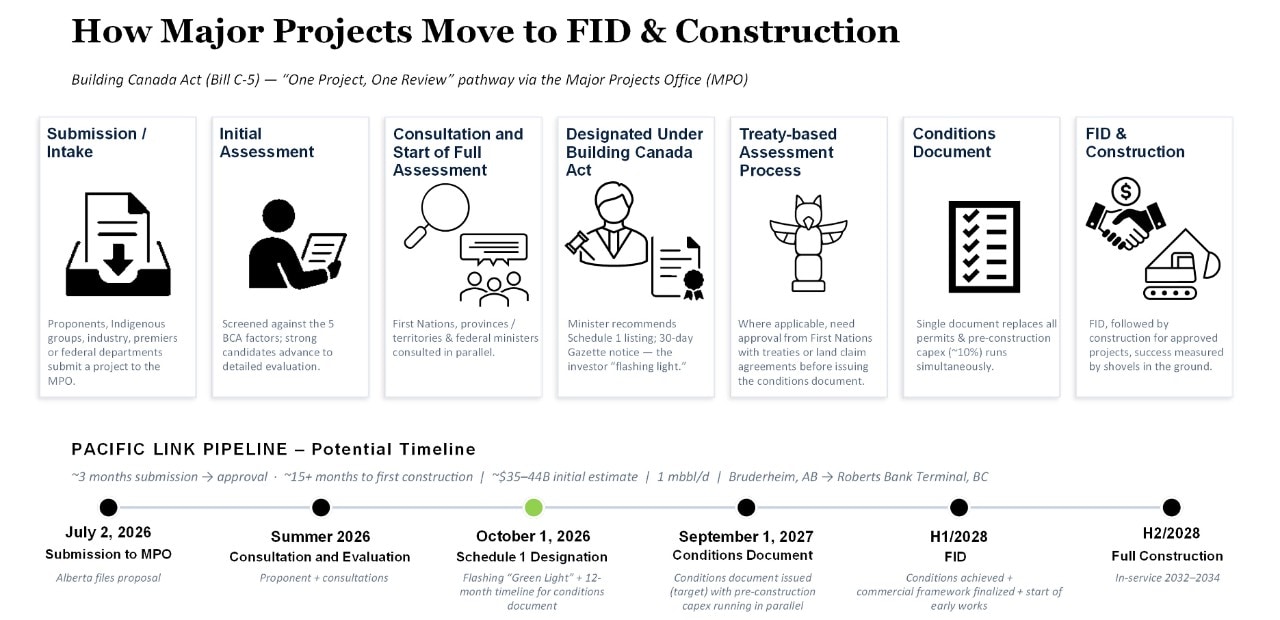
For illustrative purposes; Scotia Growth Institute.
Source: MPO/Building Canada Act (Bill C-5); Canada Gazette (Aug1, 2026); AB-CAN MOU materials; Pacific Link timing per Major Projects Office and PMO.
De-risking the Path Forward
Conditions Document
Bill C-39 – creating a clearer regulatory pathway. Bill C-39 proposes consequential changes to Canada’s federal approval framework, with the objective of moving projects from application to construction faster while maintaining environmental standards and Indigenous rights. For projects regulated under the Canada Energy Regulator (CER), such as interprovincial pipelines, the legislation would place the CER in the lead under the Canada Energy Regulator Act. The CER will coordinate federal assessments, permitting, and Crown consultation, and target all required federal reviews and decisions within one year once a proponent has submitted a complete application and finalized the required studies and permitting information (project proponents have the option to opt out of the one-year timeline should they require more time on assessments or certain permits).
In our view, these reforms could reduce duplication and improve accountability by creating a single project authority and aligning permit decisions with the CER-led review. The framework does not eliminate the underlying work required to advance Pacific Link, however: the one-year period begins only after a complete application is received, and timelines may still be extended where necessary to complete Indigenous consultations. CER-regulated projects will have the ability to assess and review federal permits concurrently with other applicable governmental departments (vs. a waterfall approach) when multiple permits are needed for a project, leading to one federal decision. As such, Bill C-39 could materially improve regulatory certainty, but the pace will still depend on early project definition, complete information, and meaningful consultation.
Sustainable Oceanic Development – pairing infrastructure development with marine safeguards. The federal government recently announced a $1.2-billion ocean protection package that can materially support Pacific Link’s progress towards a conditions document next year. The measures include expanded marine-traffic monitoring, Coast Guard response capacity, VHF radio and radar coverage, nearshore forecasting, marine-pollution recovery planning, and a national marine-mammal oil-spill response plan. The package also includes funding for underwater-noise monitoring and mitigation and $186 million for the Northern Shelf Bioregion Reconciliation Framework Agreement to support Indigenous-led governance, conservation, emergency preparedness, and cumulative-effects work in the Great Bear Sea region.
We view these investments as enabling infrastructure that could help de-risk West Coast export projects by improving baseline data, incident preparedness, and the government’s capacity to address marine impacts as vessel traffic grows, all of which should enable a more expedient environmental permitting process. This plan should not be interpreted as approval of a specific route or terminal, and the stronger monitoring may also result in additional mitigation requirements. Nevertheless, pairing the Pacific Link agenda with greater marine protection supports the government’s position of advancing trade infrastructure and environmental safeguards together.
Commercial Framework and FID
Tolls and contracts – work still to do. According to a recent report by Scotiabank GBM Equity Research analyst Robert Hope, early analysis suggests Pacific Link can support competitive tolls, although the toll structure will be finalized in later stages of the project's development. Initial engagement with potential shippers has occurred, and the project is expected to rely on long-term shipping contracts, though none have been secured to date. Pacific Link is initially expected to operate at ~50% utilization in its first year and reach 90% in subsequent years. In our view, securing long-term shipper commitments will be a key milestone ahead of FID, since a bankable commercial framework will need to define tolls, contracted volumes, and how construction and cost-overrun risk are allocated.
Combined ownership – an emerging template. In September 2026, Finance Minister François-Philippe Champagne reportedly sent letters to all 129 First Nations along the route offering a combined 15% equity stake in TMX. The stake would be purchased collectively at a fair price and divided evenly among participating communities, supported by low-cost debt capital and a one-time $2.5 million payment for each community that formally commits to invest. The letter does not specify the purchase price, timeline, or if the ownership is for the corporation or the expansion pipeline. The Pacific Link project will be built by Trans Mountain Corporation, which leads us to believe that the equity stake may be a pipeline-specific stake as the Pacific Link announcement states that relevant Indigenous communities will be offered a minimum of 10% ownership interest. In our view, the structure ultimately adopted for Trans Mountain could become the template used to define Indigenous participation in Pacific Link and future projects, though no two projects are alike.
Together, Bill C-39, the ocean protection package, a workable tolling framework, and combined ownership across federal, provincial, private (Pembina currently at 10% ownership with the option to scale up to 20%), and potential Indigenous partners, could narrow several of the remaining elements between Schedule 1 designation, conditions, and eventual FID, although each will need to be translated into project-specific decisions and agreements.
