

ECONOMIC OVERVIEW
- A huge week awaits markets, filled with key central bank decisions and top-tier data out of Latam and the G10. BanRep, the BCB, Fed, BoJ, BoE, Norges Bank all announce policy next week. On top of that, US and Canadian jobs, Eurozone and Canadian GDP, and Eurozone CPI, among other key figures, are all on tap outside of Latam. At least some in markets will get one-day breaks thanks to early-November holidays.
- The BCB should stick to guidance and cut its policy rate by 50bps; not enough has changed to go off-guidance. Similarly, BanRep won’t be pressed to start its cutting cycle next week. It will likely begin easing in December, though this will probably not be teed up at the upcoming meeting.
- No surprises from the BCB nor BanRep will contrast with the BCCh’s decision to cut by 50bps on the 26th. A series of Chilean macro data and possible comments from policymakers will help us determine whether this is the new cutting pace (to be replicated in December), a temporary deceleration while conditions are monitored, or a move to be followed by another downshift at year-end.
- Peruvian CPI is expected to come in below 5% for the first time since August 2021, a notable victory for the BCRP that would mean rate cuts may continue—especially amid negative growth that government policy is trying to counter.
- Third-quarter GDP data from Mexico should show a strong expansion, supported by high remittances and a surge in investment—data for which we get next week. But, is the surge in investment figures reliable? And should we underplay the investment strength given that public investment is behind a large share of it?
PACIFIC ALLIANCE COUNTRY UPDATES
- We assess key insights from the last week, with highlights on the main issues to watch over the coming fortnight in the Pacific Alliance countries: Mexico and Peru.
MARKET EVENTS & INDICATORS
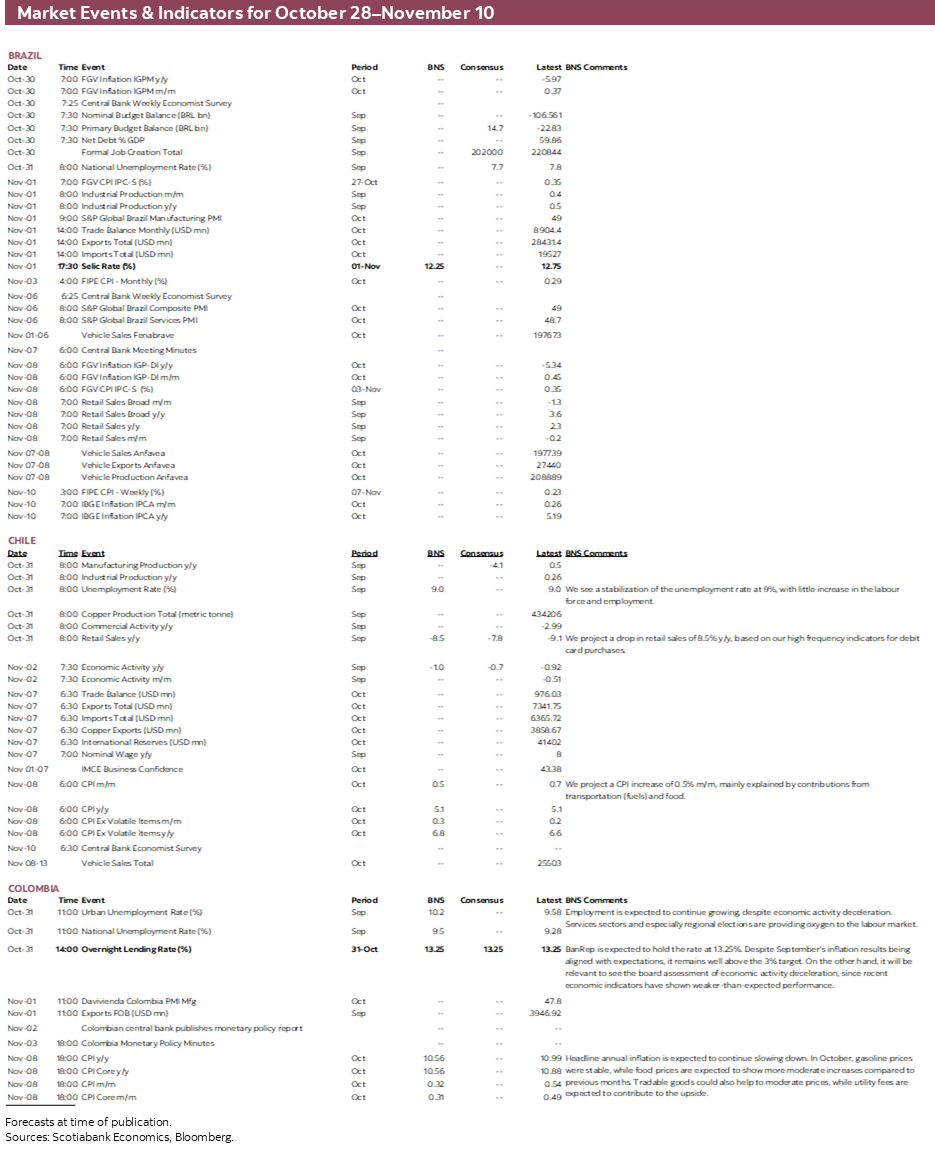
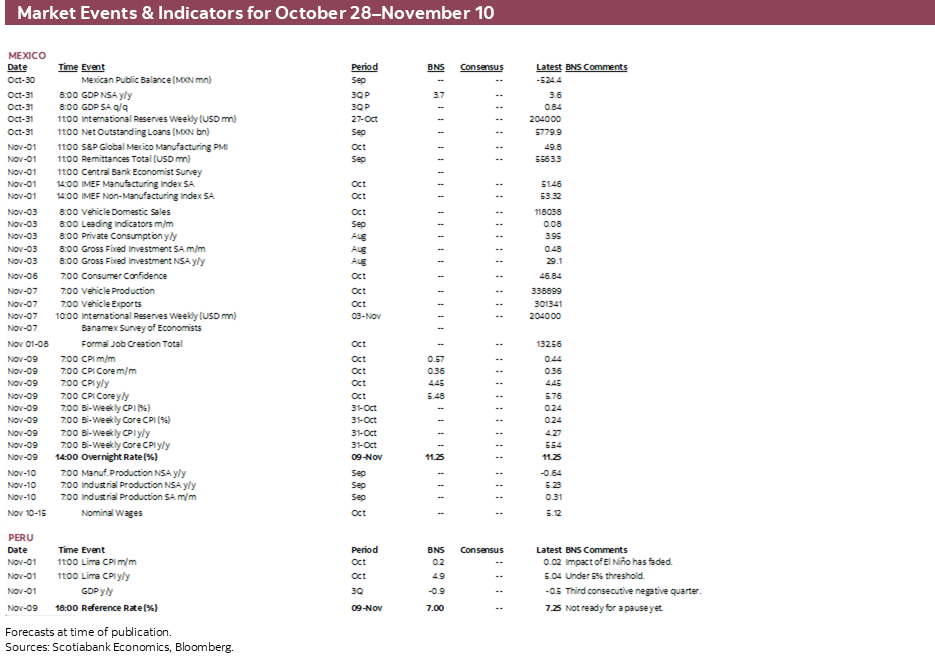
- A comprehensive risk calendar with selected highlights for the period October 28–November 10 across the Pacific Alliance countries and Brazil.
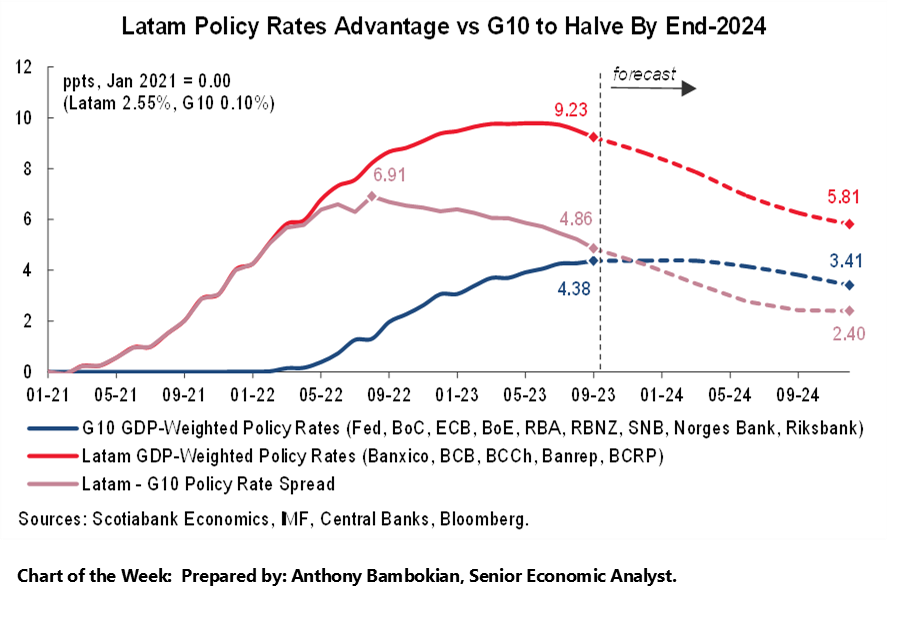
Chart of the Week
ECONOMIC OVERVIEW: BANREP, BCB, FED, BOJ, ETC… AND KEY LATAM & GLOBAL DATA
Juan Manuel Herrera, Senior Economist/Strategist
Scotiabank GBM
+44.207.826.5654
juanmanuel.herrera@scotiabank.com
- A huge week awaits markets, filled with key central bank decisions and top-tier data out of Latam and the G10. BanRep, the BCB, Fed, BoJ, BoE, Norges Bank all announce policy next week. On top of that, US and Canadian jobs, Eurozone and Canadian GDP, and Eurozone CPI, among other key figures, are all on tap outside of Latam. At least some in markets will get one-day breaks thanks to early-November holidays.
- The BCB should stick to guidance and cut its policy rate by 50bps; not enough has changed to go off-guidance. Similarly, BanRep won’t be pressed to start its cutting cycle next week. It will likely begin easing in December, though this will probably not be teed up at the upcoming meeting.
- No surprises from the BCB nor BanRep will contrast with the BCCh’s decision to cut by 50bps on the 26th. A series of Chilean macro data and possible comments from policymakers will help us determine whether this is the new cutting pace (to be replicated in December), a temporary deceleration while conditions are monitored, or a move to be followed by another downshift at year-end.
- Peruvian CPI is expected to come in below 5% for the first time since August 2021, an important victory for the BCRP that would mean rate cuts may continue—especially amid negative growth that government policy is trying to counter.
- Third-quarter GDP data from Mexico should show a strong expansion, supported by high remittances and a surge in investment—data for which we get next week. But, is the surge in investment figures reliable? And should we underplay the investment strength given that public investment is behind a large share of it?
A huge week awaits markets, filled with key central bank decisions and top-tier data out of Latam and the G10. Already, the backdrop of a so far disappointing corporate earnings season (especially in Europe vs mixed in the US) and geopolitical fears have markets trading in risk-off fashion. The slew of policy decisions and data may prompt conservative trading in anticipation and likely volatile trading throughout. Relatively thin markets could also add to whippy price action, as early-November holidays shut trading floors or reduce headcounts. In Latam, these closures take place on Wednesday in Peru and Chile, and on Thursday in Mexico and Brazil. Japanese markets are closed on Friday.
The Fed’s decision on Wednesday is the global highlight, but with a well-telegraphed hold and likely little-changed guidance in store there’s a chance that the BoJ’s decision on Tuesday triggers a greater and longer-lasting reaction in markets. That’s if it surprises with changes to its yield curve control settings. The Fed won’t hike next week, but Friday’s nonfarm payrolls report, ISM survey data, and unit labour cost and employment cost indices, among other releases, will shape hike/hold expectations for its final meeting of the year. Canadian GDP and labour data, Eurozone GDP and CPI, Chinese PMIs, and BoE and Norges Bank decisions round out the ex-Latam week ahead.
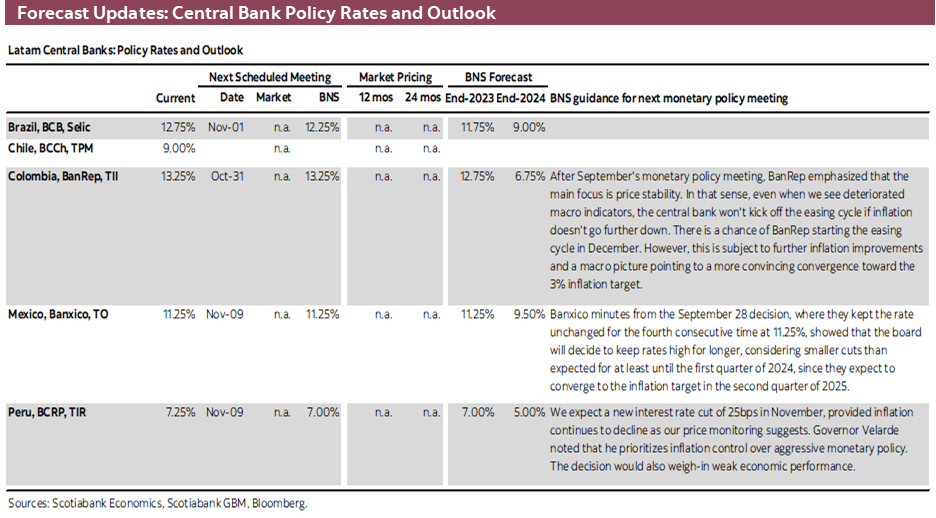
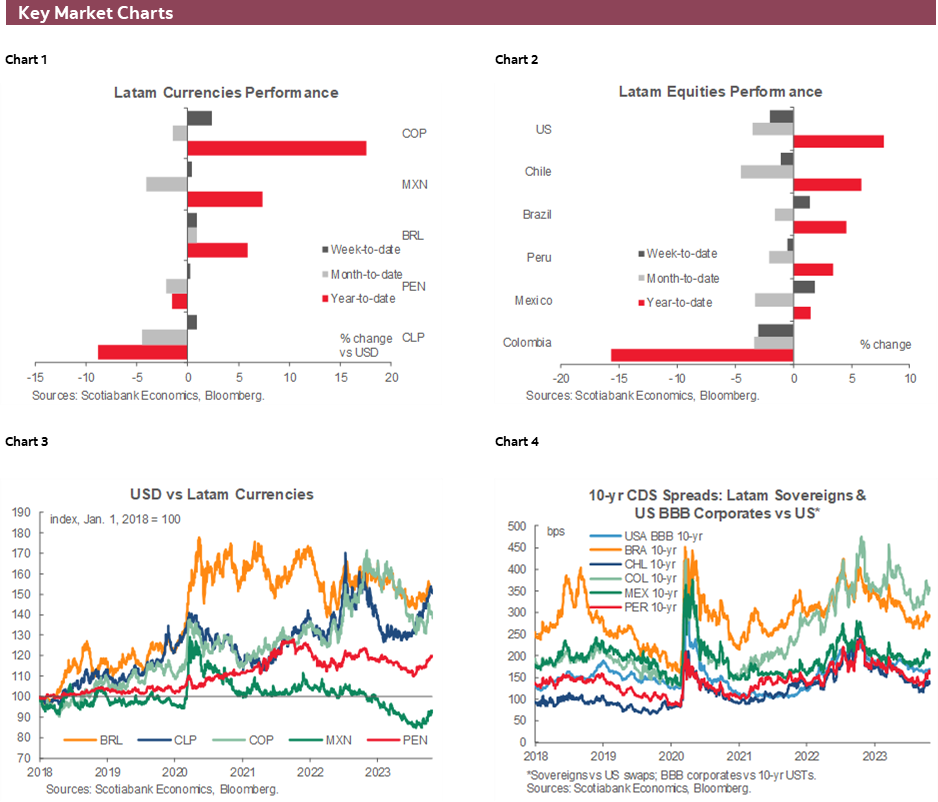
BanRep and the BCB are up next in Latam with policy announcements on Monday and Tuesday, respectively. Neither central bank should surprise. The BCB is not going to stay put, they’ve made it quite clear that they’re prescribing 50bps cuts at next week’s and December’s decisions. Markets are on board (~95bps priced in by year-end) and so are economists polled by the BCB. There’s no need to go off-script and the BRL has been the best performing major currency this month, up ~1.8% so far in October—even beating the haven-bid CHF, up 1.4%.
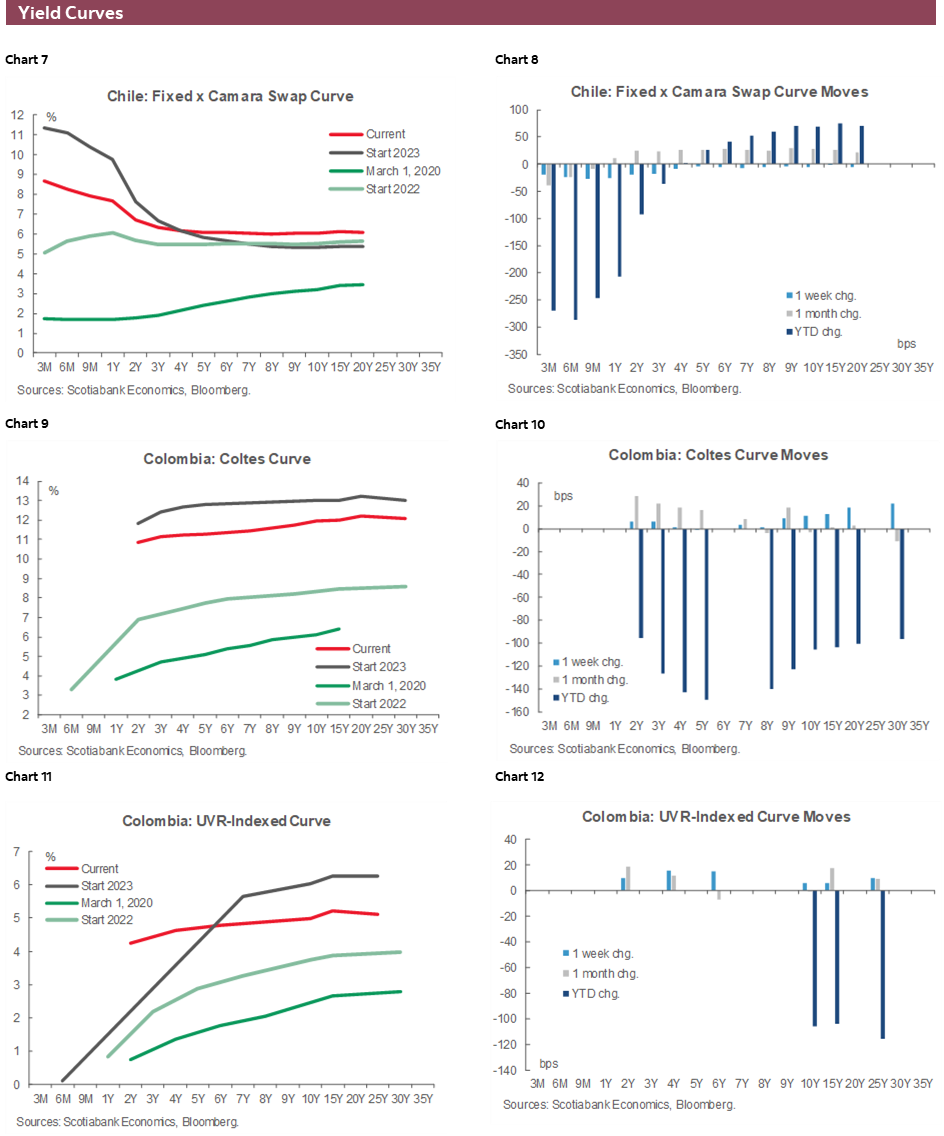
Colombian officials will hold their reference rate at 13.25% as not enough progress has been made in inflation. Core prices growth (ex-food) remains in double digits (as does headline), and economic data, while softer than expected, has not been so negative so as to prompt the start of rate cuts. The shaky external environment and pressure on currencies is also something for officials to consider—as they did in Chile.
Some in the bank’s board may want to begin rate cuts but the bulk of policymakers won’t. Some will want a firmer teeing up of a December cut, but guidance should remain little changed. The bank’s updated forecasts out on Thursday will provide some insights into their thinking and the speed with which they may lower rates; we expect BanRep cuts to start with a 50bps reduction in December. The meeting minutes due Friday should elaborate on how split the decision was and arguments made one way or the other.
Note that we’ll start the week to the results of regional elections on Sunday around the country, which you can read about in last week’s report.
Peru’s markets will be closed for the release of key October CPI data out on Wednesday. Finally, we see inflation falling below the 5% threshold for the first time since August 2021, supporting our projection for another 25bps cut by the BCRP on November 9th. In today’s Weekly, our team in Lima discuss what next week’s data, in conjunction with a third straight quarter of negative GDP growth, mean for the BCRP’s path, but also what economic weakness means for government policy as officials roll out additional spending and moving forward the start of the fishing season. Maybe even some El Niño optimism is creeping in as weather agencies trim their expected chance of a strong episode of the weather phenomenon, which could significantly alter the path of inflation and allow the BCRP to move more comfortably.
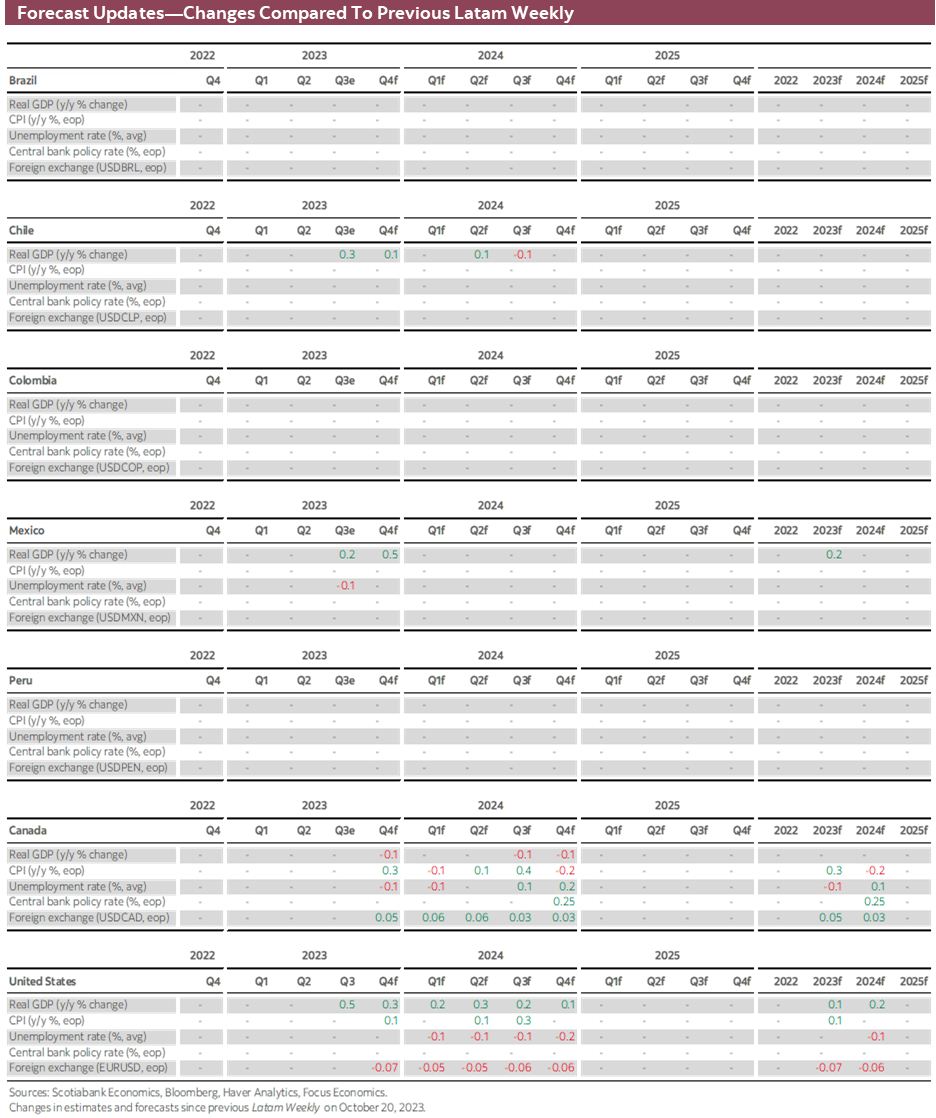
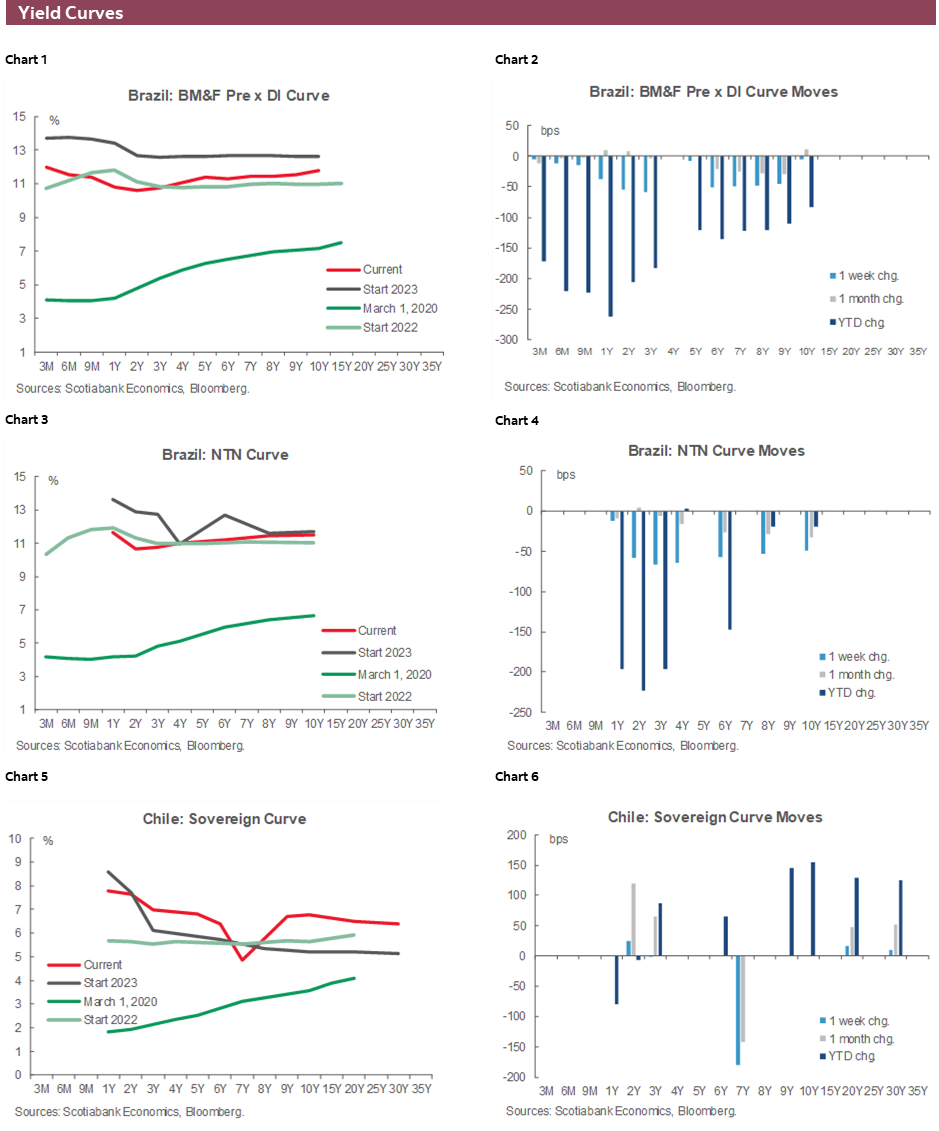
On the 26th, Chile’s central bank was first out the gate in the late-October/early-November Latam policy announcements. And it was a surprising one (see our take here), as their 50bps cut fell short of the 75bps cut expectation of the vast majority of economists and about two-thirds of traders (judging by the results of the BCCh’s traders survey). Chile being out on holidays on Friday meant core local markets could not respond to the surprise decision, so expect sharp moves at Monday’s open to align with those in NDFs or US-listed ETFs. It’s not clear whether the BCCh will again cut by 50bps in December or switch back to a 75bps pace. A 25bps cut to 8.75% looks quite unlikely and would mark a huge deviation from the scenario laid out in the September MPR that projected an overnight rate between 7.75% and 8.00% by year-end. Aside from comments by officials over the week, we also have manufacturing/industrial production, retail sales, and unemployment rate data on Tuesday, ahead of the release of economic activity figures on Thursday, where we see a 1% y/y decline (all data are for September).
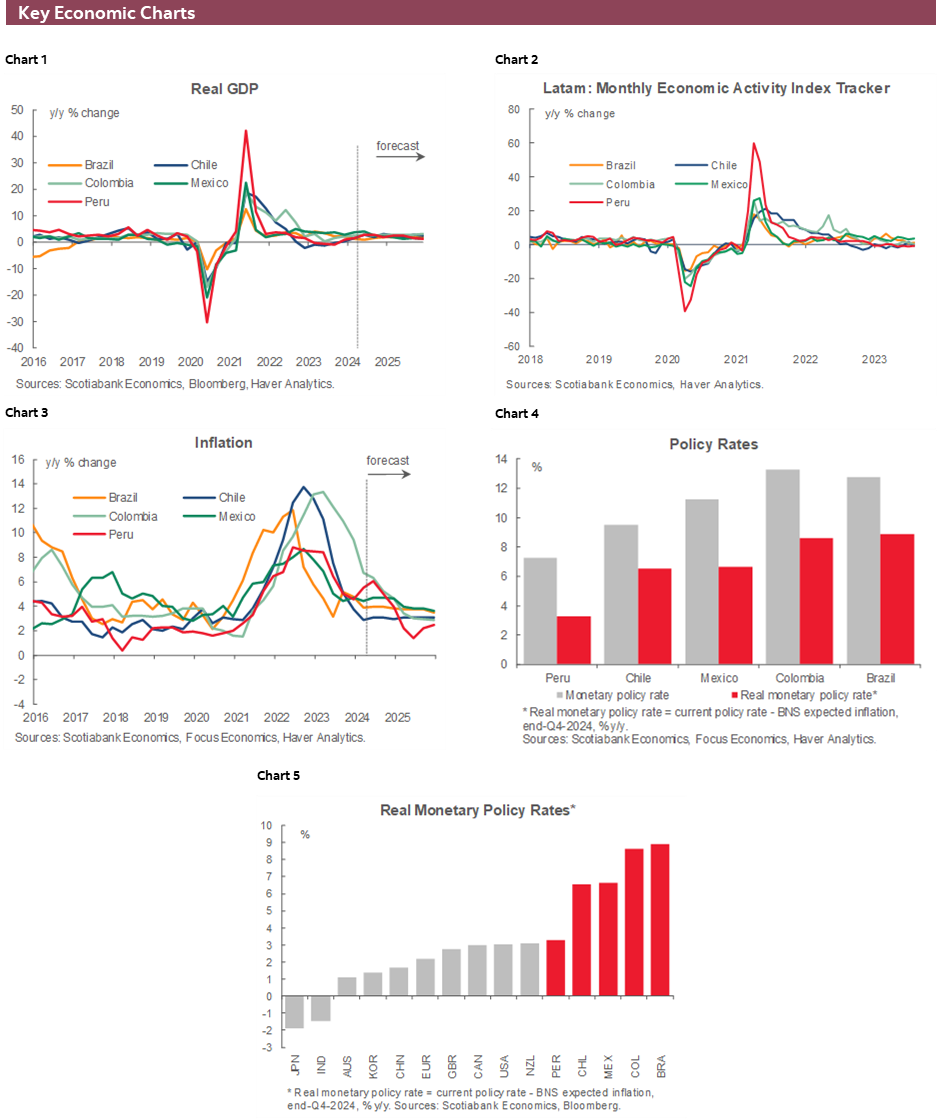
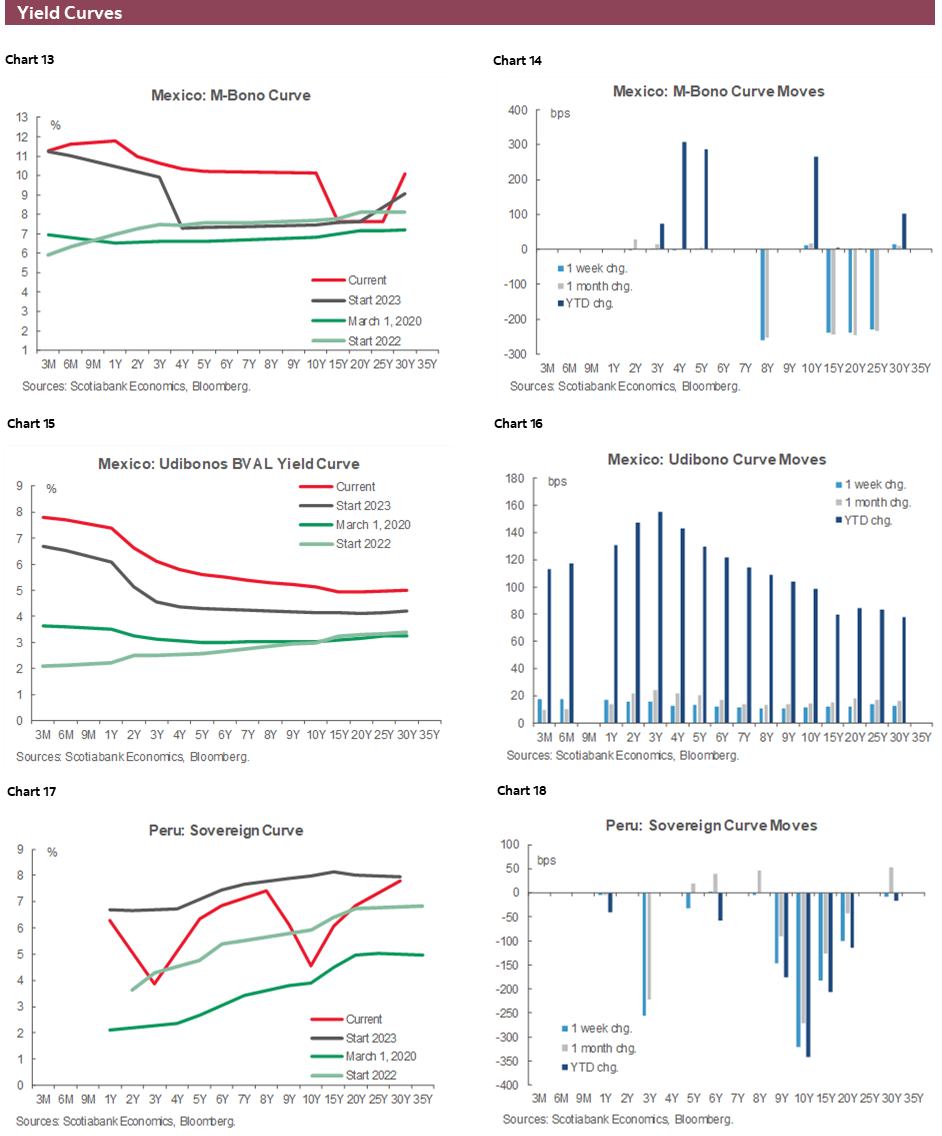
Mexico’s INEGI publishes Q3 GDP data on Tuesday, which we expect to show a 3.7% y/y increase in output that is on par with the 3.6% y/y rise in Q2, and would take growth for the first three quarters of the year to 3.7% y/y versus Q1-Q3-2022. There’s no doubt the Mexican economy is in good shape when looking at headline figures. Some details may not be as solid, but there’s still a well-performing economy on the whole—certainly far from a state that would make Banxico nervous and start thinking about rate cuts. One source of strength is foreign remittances (September data due Wednesday) which have supported household consumption, and another is a surprising increase in investment (August data due Friday). Overall investment numbers may be misleading, however, as a large share of outlays relate to a surge in large public projects and there’s some inconsistencies in INEGI data, as our team in Mexico discusses in today’s Weekly.
PACIFIC ALLIANCE COUNTRY UPDATES
Mexico—Mexican Investment Has Mixed Signals and Results, but the Trend is a Positive
Eduardo Suárez, VP, Latin America Economics
+52.55.9179.5174 (Mexico)
esuarezm@scotiabank.com.mx
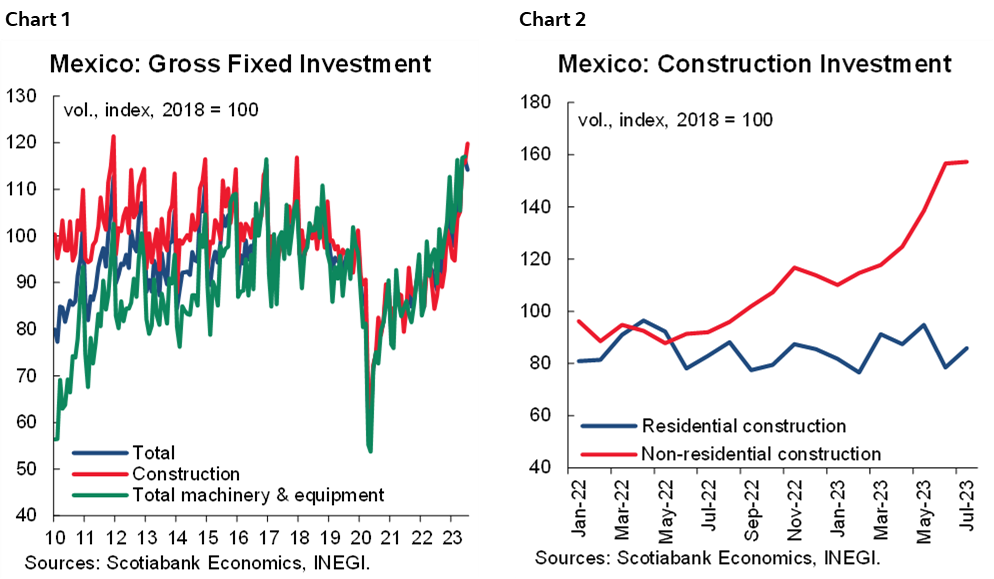
Recent data on investment in Mexico is mixed. The re-basing of the index has made recent data look quite a bit stronger, and total investment is now finally above its pre-2013 levels in volume terms. Construction has underperformed machinery and equipment, but with the reconstructed index, volumes in all the major components are now above pre-2013 levels. The story gets more complex when we look at the finer details. In the construction sub-index, residential construction has strongly underperformed non-residential, which is largely explained by civil engineering works—and government infrastructure programs. There are two elements which make this data somewhat controversial, as local media has written. Part of the controversy comes from somewhat mixed evidence in the data, as local media and analysts argue “hours worked” do not match the reported value of construction. The surge in civil engineering also seems somewhat at odds with the budget, which shows physical investment by the government for 2023 is under-executing the budget, with the approved investment being 3.5% of GDP, vs the updated estimate falling short at 2.8% of GDP. Part of the difference in the later argument could be related to stronger private civil engineering work by private players, related to nearshoring. However the earlier argument would still represent a question mark.
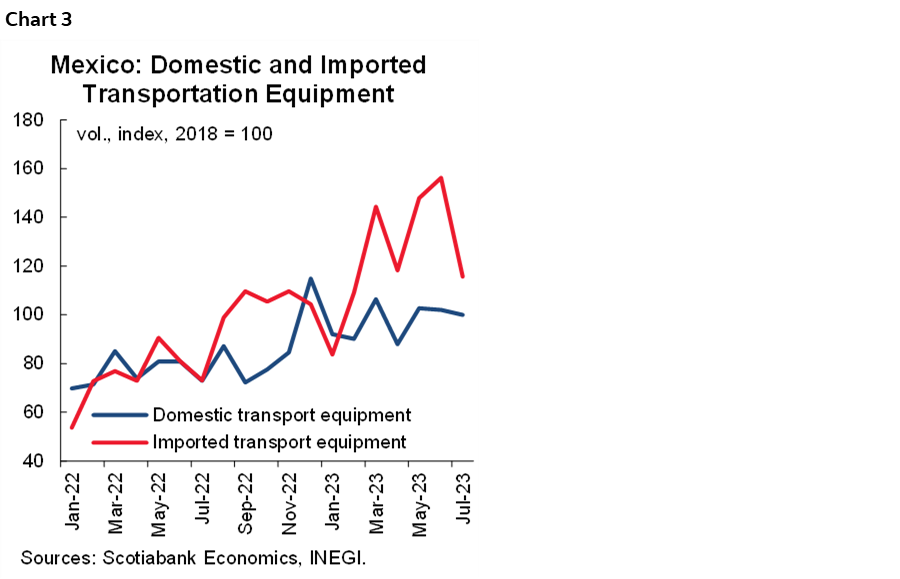
On the machinery and equipment front, it’s notable that the surge we’ve seen in 2023 has been explained by the “imported component”, which in national accounts is a subtraction. Hence, this subcomponent of investment seems to remain a drag on broader GDP. This could partly be explained by the strength of MXN, which has increasingly been referred to as a drag on the manufacturing sector in meetings we’ve had with clients over recent months. However, it’s still positive for future output that we are seeing a recovery on investment overall.
Peru—Silver Linings At Last!
Guillermo Arbe, Head Economist, Peru
+51.1.211.6052 (Peru)
guillermo.arbe@scotiabank.com.pe
Next week, October inflation data will be published. We expect yearly inflation to decline marginally to 4.9%, just enough to breach the 5.0% psychological threshold, which leads us to ratify with additional conviction that the BCRP will lower the reference rate to 7.0% on November 9th. For something has shifted in the balance of motivations that the BCRP faces in determining how aggressive to be in lowering its policy rate going forward. Firstly, 3Q 2023 will be the third consecutive quarter of negative GDP growth and there is nothing like negative growth to convince monetary authorities to temper a contractionary policy. The counter argument has been for some time that there is heightened risk of an inflationary impact coming from El Niño when it recurs in early 2024. However, maybe, just maybe, the 2024 version of El Niño will turn out not to be as vicious as we have been expecting. Two indicators are making us more hopeful. One is that sea temperatures off the Peruvian coast have come down significantly in the past three weeks, and have deviated materially from the trend of the 1997–98 strong Niño that it seemed to have been following. Furthermore, for the first time the U.S. National Oceanic and Atmospheric Administration, NOAA, lowered this month’s likelihood of the 2024 El Niño being a strong episode from 35% previously, to 33% (the probability of a moderate Niño increased from 51% to 55%). Although it is still too early to get our hopes up too much, avoiding a strong Niño would make a big difference in terms of domestic inflation.
The term of the day in Peru is recession. It is all over the papers and being voiced by experts, and this has put the Ministry of Finance under pressure to do something. It is with this in mind, no doubt, that the Ministry of Finance announced its intention to spend an additional PEN 5.4bn (USD1.4bn or 0.5% of GDP) in what remains of 2023. Even though the government intends to direct much of this spending to short-term quick-win projects, complying with this amount additional spending in so little time is a tall order. There will be additional spending, but probably not quite as much as the government hopes. Still, it should help.
The other thing the authorities are doing is moving the date for the seasonal fishing campaign, which normally begins in mid November, to late October. This government hopes to gain three more weeks of fishing before the awaited second-round of El Niño arrives around mid-December and the fish disappear (they migrate to deeper waters and to the south). Even so, the fishing season will be a short one, as normally it runs from mid-November to late January. The success of this decision will be contingent on the fish spawning period having ended, and the fish actually being available.
The two measures together should ensure positive GDP growth in 4Q 2023, which will be a relief. Even so, rather than lead us to change our forecast of -0.2% full-year GDP growth in 2023, the measures simply gives us more confidence that growth will be aligned with our forecast, and not negative, which was something we had been fearing.
| LOCAL MARKET COVERAGE | |
| CHILE | |
| Website: | Click here to be redirected |
| Subscribe: | anibal.alarcon@scotiabank.cl |
| Coverage: | Spanish and English |
| COLOMBIA | |
| Website: | Click here to be redirected |
| Subscribe: | jackeline.pirajan@scotiabankcolptria.com |
| Coverage: | Spanish and English |
| MEXICO | |
| Website: | Click here to be redirected |
| Subscribe: | estudeco@scotiacb.com.mx |
| Coverage: | Spanish |
| PERU | |
| Website: | Click here to be redirected |
| Subscribe: | siee@scotiabank.com.pe |
| Coverage: | Spanish |
DISCLAIMER
This report has been prepared by Scotiabank Economics as a resource for the clients of Scotiabank. Opinions, estimates and projections contained herein are our own as of the date hereof and are subject to change without notice. The information and opinions contained herein have been compiled or arrived at from sources believed reliable but no representation or warranty, express or implied, is made as to their accuracy or completeness. Neither Scotiabank nor any of its officers, directors, partners, employees or affiliates accepts any liability whatsoever for any direct or consequential loss arising from any use of this report or its contents.
These reports are provided to you for informational purposes only. This report is not, and is not constructed as, an offer to sell or solicitation of any offer to buy any financial instrument, nor shall this report be construed as an opinion as to whether you should enter into any swap or trading strategy involving a swap or any other transaction. The information contained in this report is not intended to be, and does not constitute, a recommendation of a swap or trading strategy involving a swap within the meaning of U.S. Commodity Futures Trading Commission Regulation 23.434 and Appendix A thereto. This material is not intended to be individually tailored to your needs or characteristics and should not be viewed as a “call to action” or suggestion that you enter into a swap or trading strategy involving a swap or any other transaction. Scotiabank may engage in transactions in a manner inconsistent with the views discussed this report and may have positions, or be in the process of acquiring or disposing of positions, referred to in this report.
Scotiabank, its affiliates and any of their respective officers, directors and employees may from time to time take positions in currencies, act as managers, co-managers or underwriters of a public offering or act as principals or agents, deal in, own or act as market makers or advisors, brokers or commercial and/or investment bankers in relation to securities or related derivatives. As a result of these actions, Scotiabank may receive remuneration. All Scotiabank products and services are subject to the terms of applicable agreements and local regulations. Officers, directors and employees of Scotiabank and its affiliates may serve as directors of corporations.
Any securities discussed in this report may not be suitable for all investors. Scotiabank recommends that investors independently evaluate any issuer and security discussed in this report, and consult with any advisors they deem necessary prior to making any investment.
This report and all information, opinions and conclusions contained in it are protected by copyright. This information may not be reproduced without the prior express written consent of Scotiabank.
™ Trademark of The Bank of Nova Scotia. Used under license, where applicable.
Scotiabank, together with “Global Banking and Markets”, is a marketing name for the global corporate and investment banking and capital markets businesses of The Bank of Nova Scotia and certain of its affiliates in the countries where they operate, including; Scotiabank Europe plc; Scotiabank (Ireland) Designated Activity Company; Scotiabank Inverlat S.A., Institución de Banca Múltiple, Grupo Financiero Scotiabank Inverlat, Scotia Inverlat Casa de Bolsa, S.A. de C.V., Grupo Financiero Scotiabank Inverlat, Scotia Inverlat Derivados S.A. de C.V. – all members of the Scotiabank group and authorized users of the Scotiabank mark. The Bank of Nova Scotia is incorporated in Canada with limited liability and is authorised and regulated by the Office of the Superintendent of Financial Institutions Canada. The Bank of Nova Scotia is authorized by the UK Prudential Regulation Authority and is subject to regulation by the UK Financial Conduct Authority and limited regulation by the UK Prudential Regulation Authority. Details about the extent of The Bank of Nova Scotia's regulation by the UK Prudential Regulation Authority are available from us on request. Scotiabank Europe plc is authorized by the UK Prudential Regulation Authority and regulated by the UK Financial Conduct Authority and the UK Prudential Regulation Authority.
Scotiabank Inverlat, S.A., Scotia Inverlat Casa de Bolsa, S.A. de C.V, Grupo Financiero Scotiabank Inverlat, and Scotia Inverlat Derivados, S.A. de C.V., are each authorized and regulated by the Mexican financial authorities.
Not all products and services are offered in all jurisdictions. Services described are available in jurisdictions where permitted by law.