

CANADA HOUSING MARKET: HOUSING MARKET STEADY AMIDST UNCERTAINTY
SUMMARY
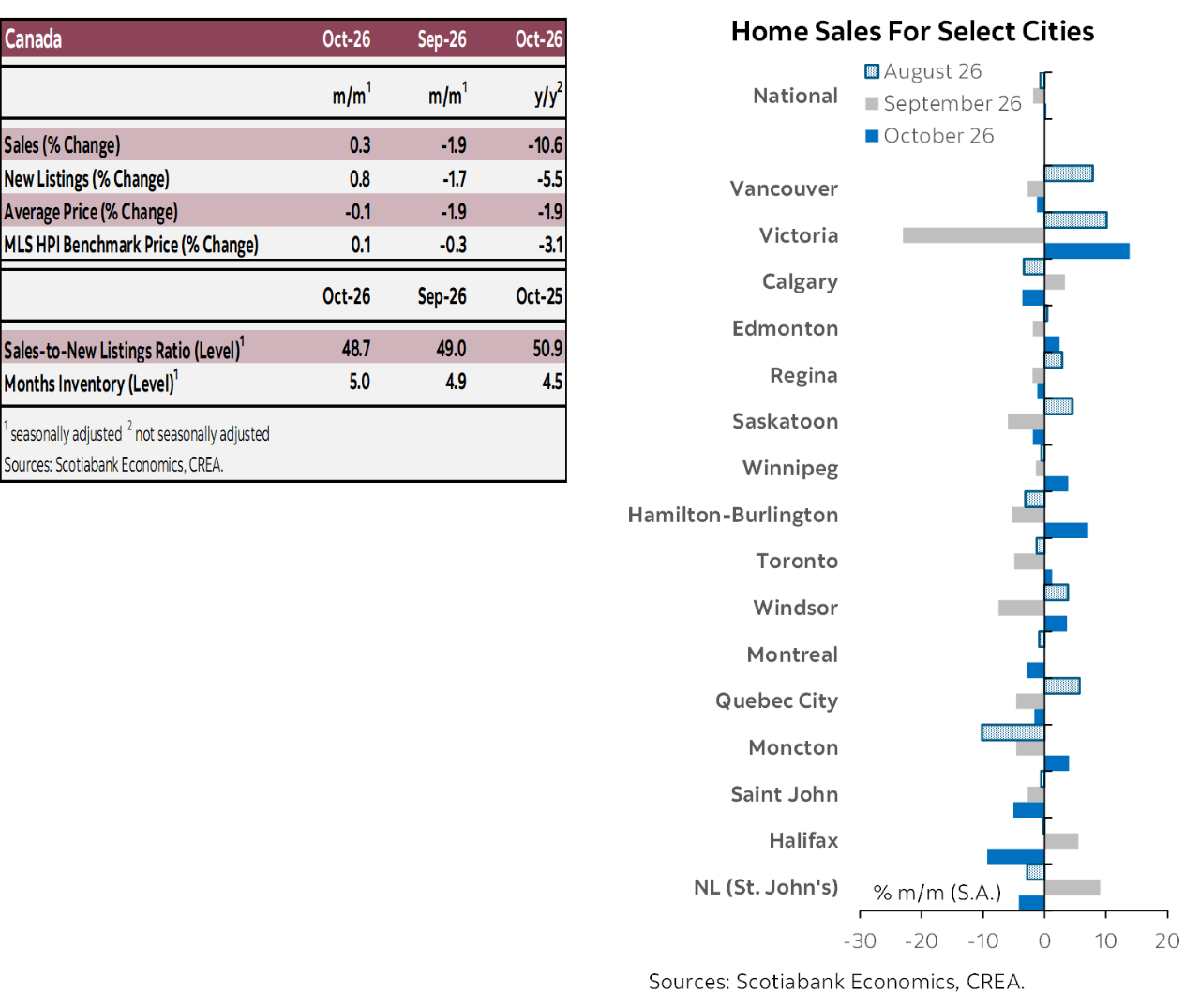
Both national unit sales and new listings edged higher from September to October, while resale market conditions eased modestly for another month. The MLS HPI was roughly unchanged from September and remained below its year-ago level.
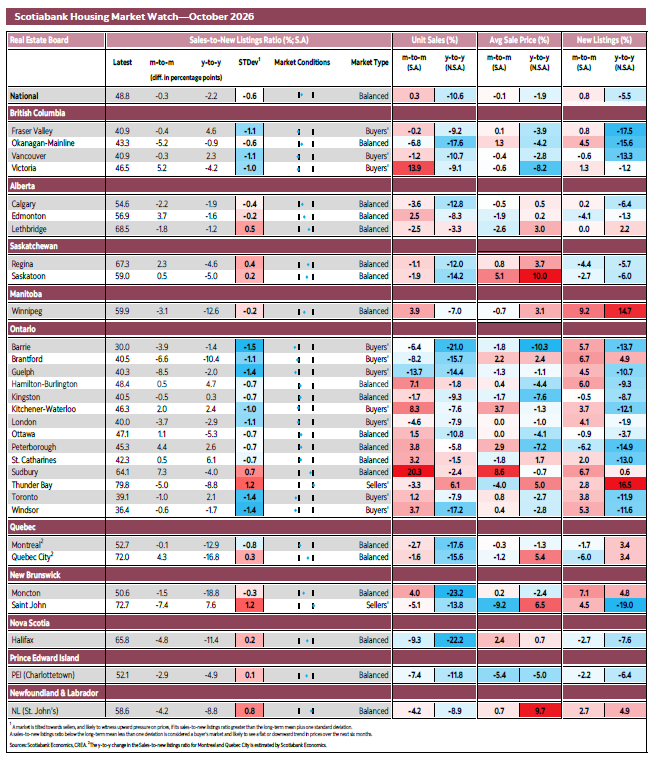
In October, the volume of national sales reported by the Canadian Real Estate Association edged up by 0.3% (m/m, sa), following two consecutive monthly declines. Despite the monthly increase, sales remained 10.6% below their October 2025 level (nsa). Sales movements were mixed across markets, with particularly strong gains in Sudbury (+20.3%), Victoria (+13.9%), Kitchener-Waterloo (+8.3%) and Hamilton-Burlington (+7.1%). At the other end, sales fell notably in Guelph (-13.7%), Halifax (-9.3%), Brantford (-8.2%), Charlottetown (-7.4%), Okanagan-Mainline (-6.8%) and Barrie (-6.4%).
New listings increased nationally by 0.8% (m/m, sa) from September to October. The increase was relatively broad-based compared with sales, particularly across Ontario where listings rose by roughly 6%–7% in Sudbury, Brantford, Hamilton-Burlington, and Barrie. Outside Ontario, Winnipeg (+9.2%) and Moncton (+7.1%) led the increase in listings, though listings declined in several markets elsewhere, including Quebec City (-7.5%), Peterborough (-6.2%), Regina (-4.4%) and Edmonton (-4.1%).
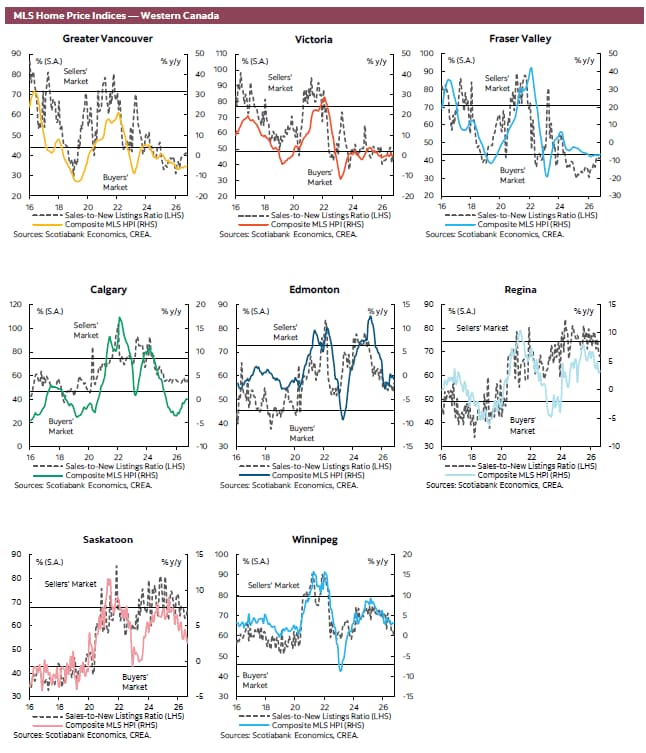
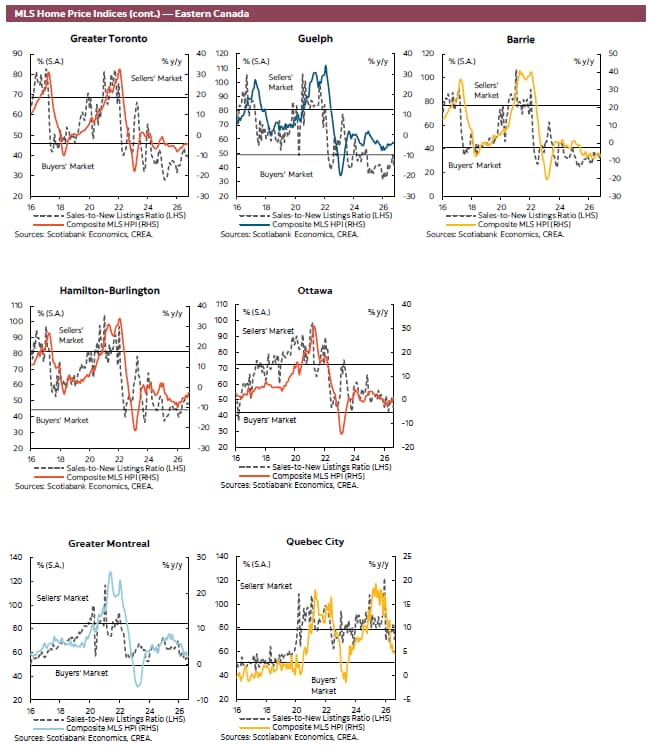
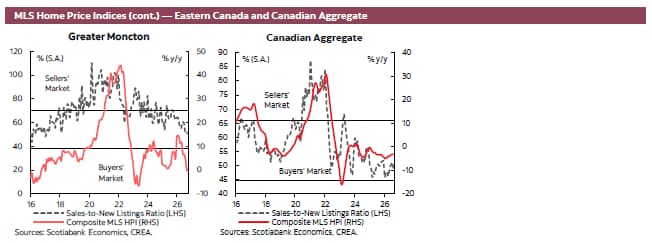
With new listings increasing slightly more than sales, the national sales-to-new listings ratio eased from 49.0% (sa) in September to 48.7% in October, moving slightly closer to the lower end of the 45%–65% range generally associated with balanced national market conditions. Nineteen of the 31 markets remained balanced. Buyer’s-market conditions persisted in several British Columbia and Ontario markets, with Brantford, Guelph and London moving into buyer’s-market territory in October. Thunder Bay and Saint John remained seller’s markets, while St. John’s moved from seller’s territory in September into balanced territory.
Months of inventory rose slightly from 4.9 months in September to 5.0 months in October, in line with its long-term average.
The national MLS House Price Index (HPI) was broadly unchanged in October, edging up by 0.1% (sa) from September. A 0.2% decline in the one-story single-family home segment was offset by a larger increase in the two-story segment (+0.3%), leaving the overall single-family index roughly flat. Townhouse prices also increased by 0.3%, while apartment prices declined by 0.1%. The composite index remained 3.1% below its October 2025 level (nsa), but still roughly 25% above pre-pandemic levels.
IMPLICATIONS
Canada’s housing market continued to move sideways in October, with no large swings in aggregate sales or prices. Following some declines in recent months, market conditions have settled at levels softer than those seen in late spring and early summer, which themselves were considered subdued periods relative to the pandemic housing boom.
The story has been one of heightened uncertainty, buyer hesitation, and continued affordability constraints, despite an easing cycle that brought the Bank of Canada policy rate below its estimated neutral level by mid-2025. The eruption of trade tensions with the U.S. since late 2025, alongside rising geopolitical tensions and renewed inflation pressures stemming from the war with Iran, has added uncertainty about future employment, incomes and borrowing costs. Against that backdrop, prospective buyers have had good reason to remain on the sidelines while awaiting greater clarity.
More recently, that uncertainty has been compounded by tighter financial conditions. Sovereign yields have risen, while the Bank of Canada has gradually adopted a more hawkish stance, culminating in an October rate hike with the possibility of further tightening ahead. That shift matters particularly today because mortgage borrowers had increasingly gravitated toward variable-rate products as policy rates declined. So far in 2026, variable-rate mortgages have accounted for an average 38% of newly advanced mortgages, compared to an average of under 15% in 2024. As the policy rate fell and eventually stabilized at 2.25%, variable mortgages gained a pricing advantage over fixed products, an advantage that widened further recently as higher sovereign yields put upward pressure on fixed mortgage rates.
Today, with fixed mortgage rates already at or above the OSFI stress test floor of 5.25%, borrowers choosing a fixed product must qualify at the contract rate plus two percentage points, creating a considerably high qualification hurdle, especially compared to the lower-priced variable products. But choosing a variable mortgage just as the Bank of Canada appears to be embarking on another tightening cycle changes the calculus. With the previous hiking cycle still fresh in buyers’ minds, and having contributed to a substantial housing correction, hesitation is understandable.
Lower house prices have helped, but for many prospective buyers the combination of prices that remain well above pre-pandemic levels and current borrowing costs still represents an affordability constraint in key markets. In addition, housing markets have a strong expectations and self-reinforcing component. Following the post-pandemic correction, some prospective buyers appear to be waiting for clearer evidence that the market has reached a bottom before entering, alongside any signs of clarity on the trade outlook.
Still, the ingredients for an eventual recovery remain. Canadians are accumulating financial wealth through their exposure to strongly performing equity markets, potentially strengthening their down-payment capacity when they are ready to enter. Early signs of a pickup in immigration intentions could also begin to alleviate some of the demand-side drag. For now, however, uncertainty appears to keep many prospective buyers waiting on the sidelines.
DISCLAIMER
This report has been prepared by Scotiabank Economics as a resource for the clients of Scotiabank. Opinions, estimates and projections contained herein are our own as of the date hereof and are subject to change without notice. The information and opinions contained herein have been compiled or arrived at from sources believed reliable but no representation or warranty, express or implied, is made as to their accuracy or completeness. Neither Scotiabank nor any of its officers, directors, partners, employees or affiliates accepts any liability whatsoever for any direct or consequential loss arising from any use of this report or its contents.
These reports are provided to you for informational purposes only. This report is not, and is not constructed as, an offer to sell or solicitation of any offer to buy any financial instrument, nor shall this report be construed as an opinion as to whether you should enter into any swap or trading strategy involving a swap or any other transaction. The information contained in this report is not intended to be, and does not constitute, a recommendation of a swap or trading strategy involving a swap within the meaning of U.S. Commodity Futures Trading Commission Regulation 23.434 and Appendix A thereto. This material is not intended to be individually tailored to your needs or characteristics and should not be viewed as a “call to action” or suggestion that you enter into a swap or trading strategy involving a swap or any other transaction. Scotiabank may engage in transactions in a manner inconsistent with the views discussed this report and may have positions, or be in the process of acquiring or disposing of positions, referred to in this report.
Scotiabank, its affiliates and any of their respective officers, directors and employees may from time to time take positions in currencies, act as managers, co-managers or underwriters of a public offering or act as principals or agents, deal in, own or act as market makers or advisors, brokers or commercial and/or investment bankers in relation to securities or related derivatives. As a result of these actions, Scotiabank may receive remuneration. All Scotiabank products and services are subject to the terms of applicable agreements and local regulations. Officers, directors and employees of Scotiabank and its affiliates may serve as directors of corporations.
Any securities discussed in this report may not be suitable for all investors. Scotiabank recommends that investors independently evaluate any issuer and security discussed in this report, and consult with any advisors they deem necessary prior to making any investment.
This report and all information, opinions and conclusions contained in it are protected by copyright. This information may not be reproduced without the prior express written consent of Scotiabank.
™ Trademark of The Bank of Nova Scotia. Used under license, where applicable.
Scotiabank, together with “Global Banking and Markets”, is a marketing name for the global corporate and investment banking and capital markets businesses of The Bank of Nova Scotia and certain of its affiliates in the countries where they operate, including; Scotiabank Europe plc; Scotiabank (Ireland) Designated Activity Company; Scotiabank Inverlat S.A., Institución de Banca Múltiple, Grupo Financiero Scotiabank Inverlat, Scotia Inverlat Casa de Bolsa, S.A. de C.V., Grupo Financiero Scotiabank Inverlat, Scotia Inverlat Derivados S.A. de C.V. – all members of the Scotiabank group and authorized users of the Scotiabank mark. The Bank of Nova Scotia is incorporated in Canada with limited liability and is authorised and regulated by the Office of the Superintendent of Financial Institutions Canada. The Bank of Nova Scotia is authorized by the UK Prudential Regulation Authority and is subject to regulation by the UK Financial Conduct Authority and limited regulation by the UK Prudential Regulation Authority. Details about the extent of The Bank of Nova Scotia's regulation by the UK Prudential Regulation Authority are available from us on request. Scotiabank Europe plc is authorized by the UK Prudential Regulation Authority and regulated by the UK Financial Conduct Authority and the UK Prudential Regulation Authority.
Scotiabank Inverlat, S.A., Scotia Inverlat Casa de Bolsa, S.A. de C.V, Grupo Financiero Scotiabank Inverlat, and Scotia Inverlat Derivados, S.A. de C.V., are each authorized and regulated by the Mexican financial authorities.
Not all products and services are offered in all jurisdictions. Services described are available in jurisdictions where permitted by law.