

CANADA HOUSING MARKET: FOR 2025, THE EARLY-YEAR OPTIMISM WAS SIDETRACKED BY RISING GLOBAL TRADE FRICTIONS AND UNCERTAINTY
SUMMARY
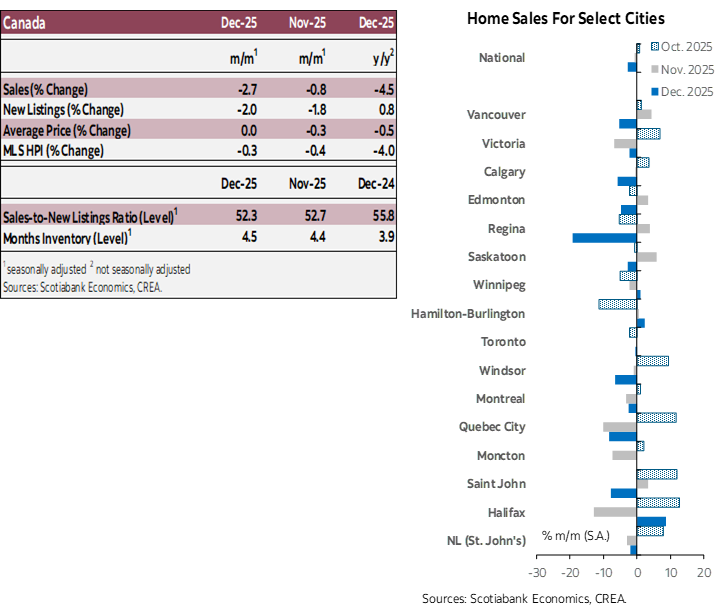
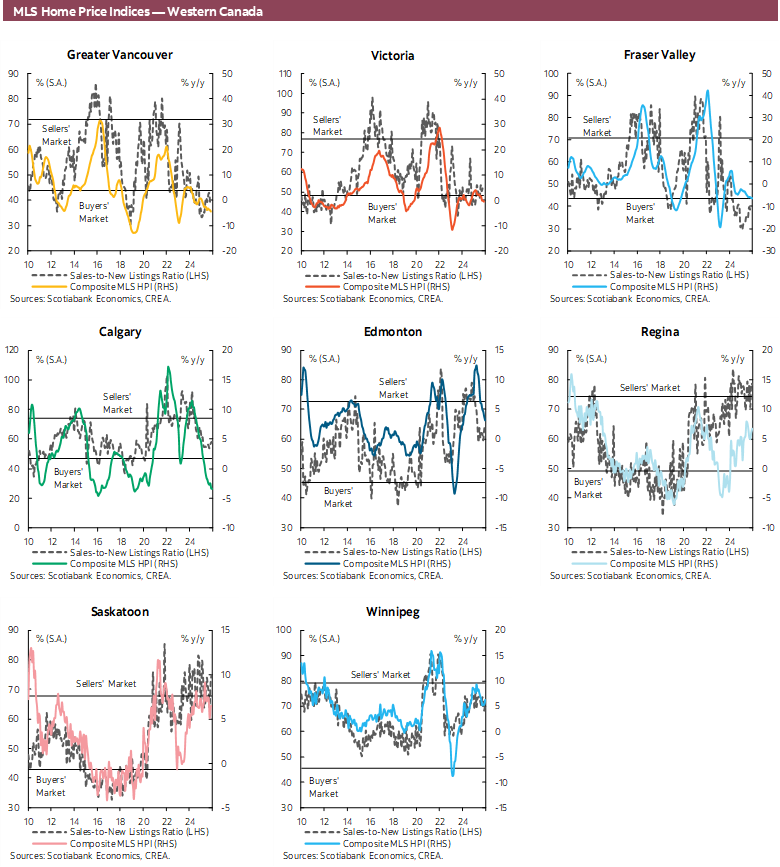
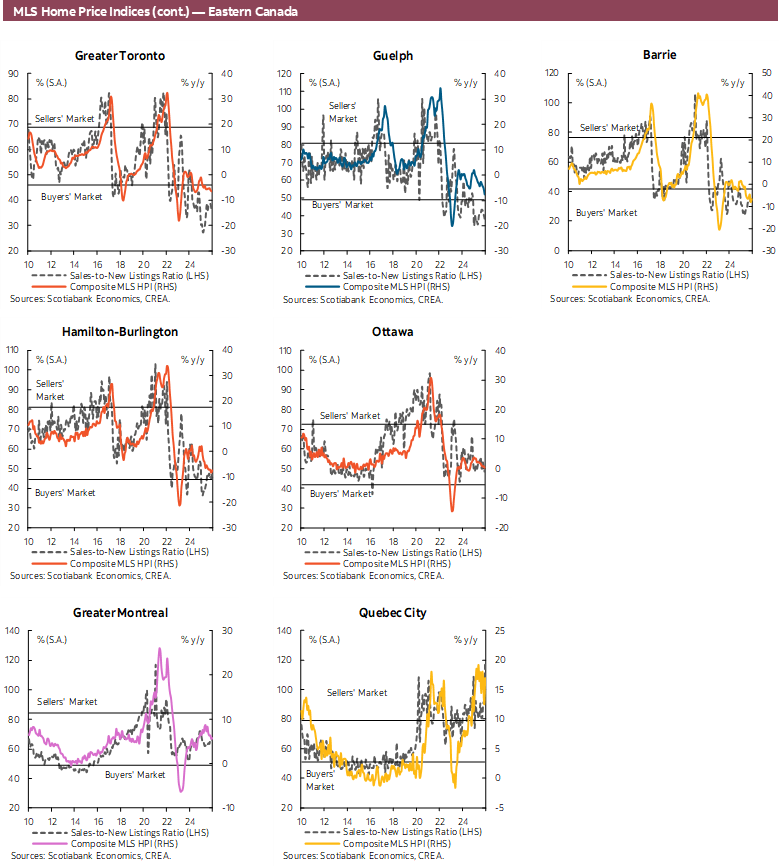
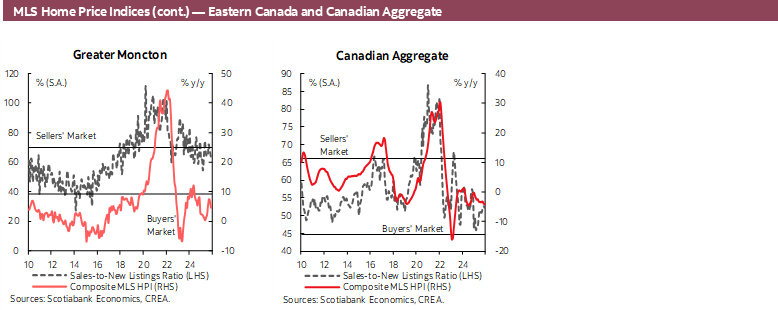
National housing sales (in units) posted another monthly decline in December. The sales-to-new listings ratio—an indicator of market conditions tightness—eased modestly over this period with new listings also declining, but at a lesser pace than sales. The national MLS HPI continued its downward trend in December, consistent with easier housing market conditions nationally.
National (unit) sales fell -2.7% (sa figures) from November to December, after a -0.8% monthly decline in November. In December, they were -10.1% below their most recent peak achieved in November 2024, and –4.5% (nsa figures) below their December 2024 level. National new listings posted their fourth consecutive monthly decline in December with a -2% (sa) print. However, they were in December 0.8% higher than the same month in the previous year.
National resale market conditions eased in December, from both the previous month and from the same month in 2024. The monthly easing reflects a 0.4 percentage point decline (sa) for the sales-to-new listings ratio from November to December—as the decline in sales modestly outpaced that in new listings—as well as a modest rise in months of inventory from 4.4 to 4.5 months over this period. Second, the yearly progression in both the sales-to-new listings ratio—declining by 3.5 p.p.—and months of inventory—rising by 0.6 month—suggests easier resale conditions last December compared to a year earlier.
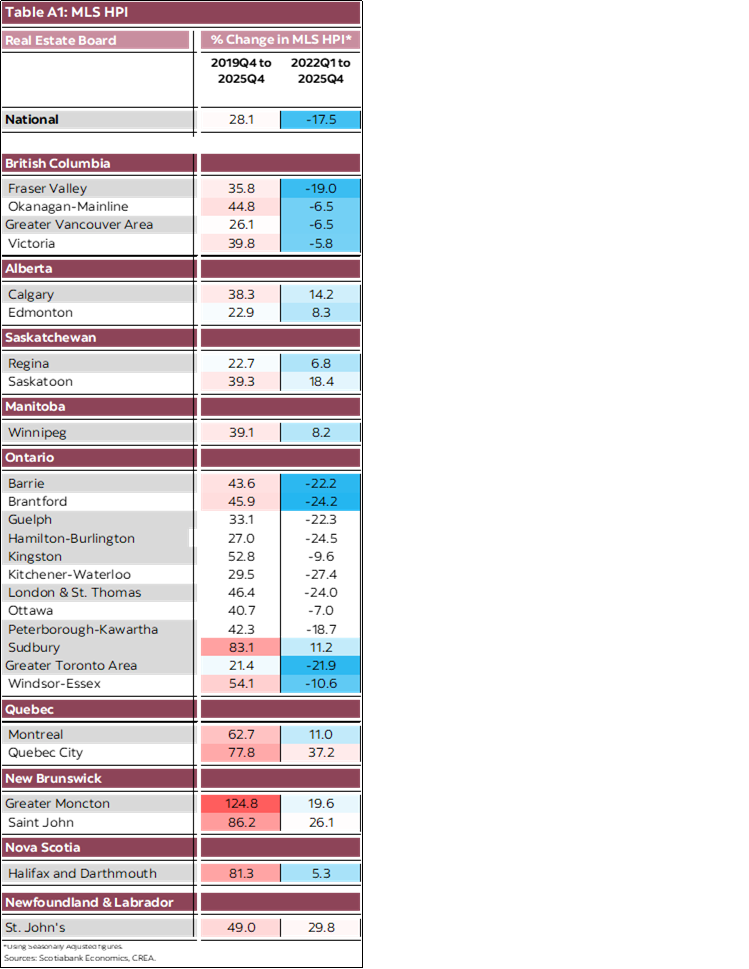
These easier national market conditions contributed to reduce the national MLS HPI further, which declined for every month in 2025, continuing its longer-term downward trend that started in early 2022, when the Bank of Canada started its tightening cycle. This price index was then at its historical peak, and it ended 2025 nearly 19% below this historical peak (from sa figures). Nevertheless, this index was in December close to 30% higher than just before the start of the COVID-19 pandemic in December 2019.
From November to December, the national MLS HPI declined by -0.3%, with all unit types contributing to this decline except for 2-storey single units for which this price index was flat. In the 12-month period to December 2025, the national MLS HPI declined -4% with all unit types contributing to this drop, with the largest declines observed for Apartments (-5.5%) and Townhouse/Row units (-5.1%). From November to December 2025.
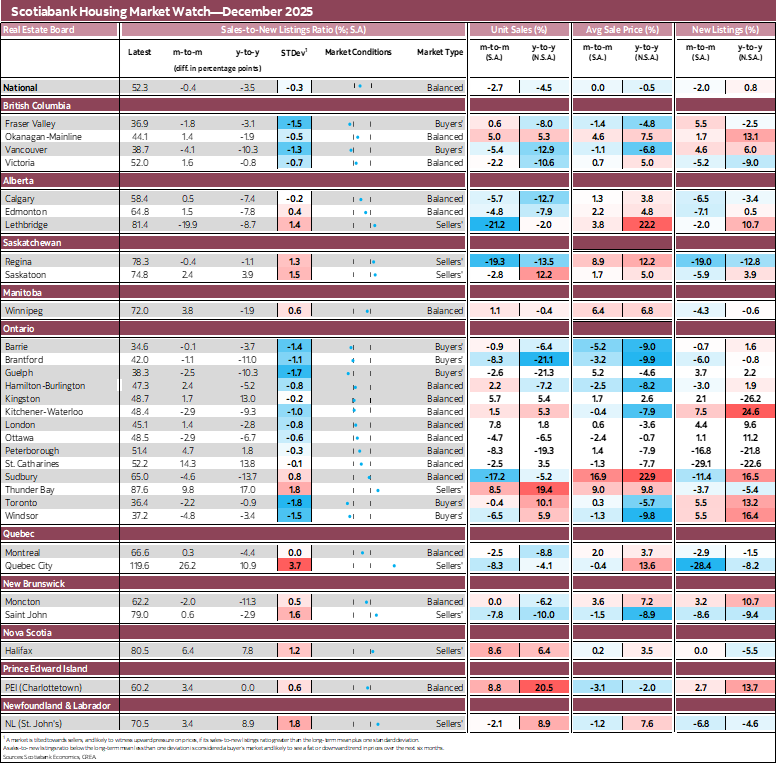
From November to December, sales declined in 20 of the 31 local markets we monitor. Market conditions—as reflected by the sales-to-new listings ratio—eased in 13 of these markets. Over the period since December 2024, the sales-to-new listings ratio cooled in just above 70% of these local markets. Based on this indicator of market conditions, 16 of these markets were deemed balanced in December 2025, while 7 were favouring buyers—all in B.C. and Ontario—and 8 favouring sellers.
Largest monthly declined in sales in December were observed for Lethbridge (-21.2% sa; but following a 40.4% monthly rise in November), Regina (-19.3%) and Sudbury (-17.2%). In the 12-month period to December 2025, eight centres posted declines of at least 10%, with the three largest in Guelph (-21.3%; nsa), Brantford (-21.1%) and Peterborough (-19.3%). Largest increases in sales over this period were observed in Charlottetown (20.5%), Thunder Bay (19.4%) and Saskatoon (12.2%).
IMPLICATIONS
We started 2025 with moderate optimism on the housing market with the expectation it would benefit from the easing in the Bank of Canada policy rate since summer of 2024, along with the resulting decline in mortgage rates. We were also expecting economic and income conditions to firm up in 2025, which would have added support to housing demand. We were also expecting the MLS HPI to start recovering along with tightening housing market conditions.
Then the new U.S. administration started discussing, and subsequently implemented significant tariffs on their imports from most origins, including Canada. It is true that Canada did not face as steep of an effective tariff increase as other countries but was significant enough to slow its exports. And the uncertainty this global trade climate generated contributed to soften domestic economic conditions more broadly, including for the housing market.
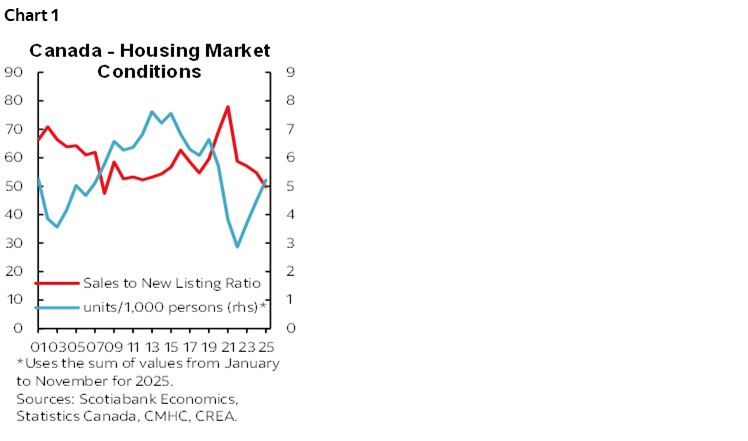
As a result, housing resale activity started 2025 showing monthly declines through March. Housing resales recovered in subsequent months to August but went back to their downward path after. National unit sales have ended 2025 below their December 2024 level as reported above. As a result, national housing market conditions eased in 2025 as reflected by the decline in the sales-to-new listing mentioned above and with the rise—as mentioned in previous reports—in recently completed and unabsorbed dwellings (per capita; chart 1 on page 1).
Not surprisingly, given the softening in market conditions, the national MLS HPI continued its trend decline in 2025 as reported above. But despite this trend decline in 2025, and essentially since early 2022, the national MLS HPI was still significantly above its pre-pandemic level in the last quarter of 2025. This was also the case for all local markets we track that also report this price index (table A1).
And as mentioned in our previous housing market report, we expect a modest tightening in housing market conditions along with an improvement in household employment and income conditions, which should help generate a modest recovery in the national MLS HPI, but likely increasing at a lower than 2% pace. This pace of MLS HPI growth should firm up as market conditions tighten in the medium term (post 2026).
DISCLAIMER
This report has been prepared by Scotiabank Economics as a resource for the clients of Scotiabank. Opinions, estimates and projections contained herein are our own as of the date hereof and are subject to change without notice. The information and opinions contained herein have been compiled or arrived at from sources believed reliable but no representation or warranty, express or implied, is made as to their accuracy or completeness. Neither Scotiabank nor any of its officers, directors, partners, employees or affiliates accepts any liability whatsoever for any direct or consequential loss arising from any use of this report or its contents.
These reports are provided to you for informational purposes only. This report is not, and is not constructed as, an offer to sell or solicitation of any offer to buy any financial instrument, nor shall this report be construed as an opinion as to whether you should enter into any swap or trading strategy involving a swap or any other transaction. The information contained in this report is not intended to be, and does not constitute, a recommendation of a swap or trading strategy involving a swap within the meaning of U.S. Commodity Futures Trading Commission Regulation 23.434 and Appendix A thereto. This material is not intended to be individually tailored to your needs or characteristics and should not be viewed as a “call to action” or suggestion that you enter into a swap or trading strategy involving a swap or any other transaction. Scotiabank may engage in transactions in a manner inconsistent with the views discussed this report and may have positions, or be in the process of acquiring or disposing of positions, referred to in this report.
Scotiabank, its affiliates and any of their respective officers, directors and employees may from time to time take positions in currencies, act as managers, co-managers or underwriters of a public offering or act as principals or agents, deal in, own or act as market makers or advisors, brokers or commercial and/or investment bankers in relation to securities or related derivatives. As a result of these actions, Scotiabank may receive remuneration. All Scotiabank products and services are subject to the terms of applicable agreements and local regulations. Officers, directors and employees of Scotiabank and its affiliates may serve as directors of corporations.
Any securities discussed in this report may not be suitable for all investors. Scotiabank recommends that investors independently evaluate any issuer and security discussed in this report, and consult with any advisors they deem necessary prior to making any investment.
This report and all information, opinions and conclusions contained in it are protected by copyright. This information may not be reproduced without the prior express written consent of Scotiabank.
™ Trademark of The Bank of Nova Scotia. Used under license, where applicable.
Scotiabank, together with “Global Banking and Markets”, is a marketing name for the global corporate and investment banking and capital markets businesses of The Bank of Nova Scotia and certain of its affiliates in the countries where they operate, including; Scotiabank Europe plc; Scotiabank (Ireland) Designated Activity Company; Scotiabank Inverlat S.A., Institución de Banca Múltiple, Grupo Financiero Scotiabank Inverlat, Scotia Inverlat Casa de Bolsa, S.A. de C.V., Grupo Financiero Scotiabank Inverlat, Scotia Inverlat Derivados S.A. de C.V. – all members of the Scotiabank group and authorized users of the Scotiabank mark. The Bank of Nova Scotia is incorporated in Canada with limited liability and is authorised and regulated by the Office of the Superintendent of Financial Institutions Canada. The Bank of Nova Scotia is authorized by the UK Prudential Regulation Authority and is subject to regulation by the UK Financial Conduct Authority and limited regulation by the UK Prudential Regulation Authority. Details about the extent of The Bank of Nova Scotia's regulation by the UK Prudential Regulation Authority are available from us on request. Scotiabank Europe plc is authorized by the UK Prudential Regulation Authority and regulated by the UK Financial Conduct Authority and the UK Prudential Regulation Authority.
Scotiabank Inverlat, S.A., Scotia Inverlat Casa de Bolsa, S.A. de C.V, Grupo Financiero Scotiabank Inverlat, and Scotia Inverlat Derivados, S.A. de C.V., are each authorized and regulated by the Mexican financial authorities.
Not all products and services are offered in all jurisdictions. Services described are available in jurisdictions where permitted by law.