

Next Week's Risk Dashboard
- BoC preview—why hiking is necessary
- BoC myths
- AI-driven inflation is just beginning in Canada
- Fed—No time for surprises
- ECB is facing a rising debt shock
- BoJ to hold but spiking inflation sets up December
- Heavy earnings risk
- Watch Canada for pre-budget trial balloons
- US midterms enter the final stretch
- British Columbia’s election is looking set to backfire on the NDP
- Brazil’s election—testing the asset rally
- Will Israel’s election extend Netanyahu’s reign?
- UK budget—fiscal pressures risk higher bank surcharges
- Inflation updates: US, Australia, Tokyo
- GDP: Canada, Eurozone, US, Mexico
- RBNZ will probably raise its cash rate
- BCCh will probably hold
- BanRep’s volatility lends caution
- BoT hold with ambiguous subsequent direction
- Other global macro
Chart of the Week
Warning—a short introduction has merit considering what lies ahead in this publication! Much of the content pulls together core arguments that explain the Bank of Canada outlook in response to varied queries for a single deeper dive that draws on client presentations, meetings and publications. The crux of the issue is to pay a little more on borrowing costs now so as to lower the risk of paying vastly more in future alongside bigger risks to the economy.
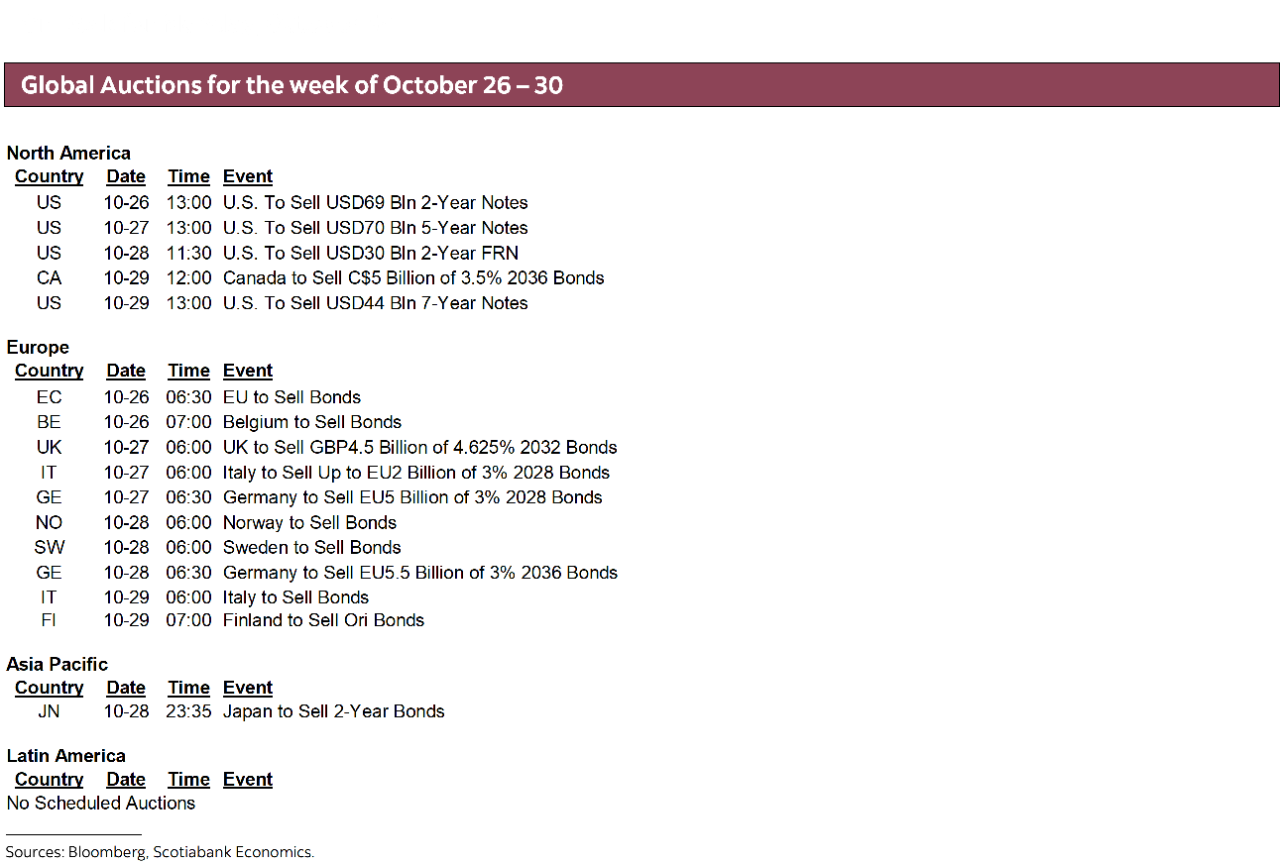
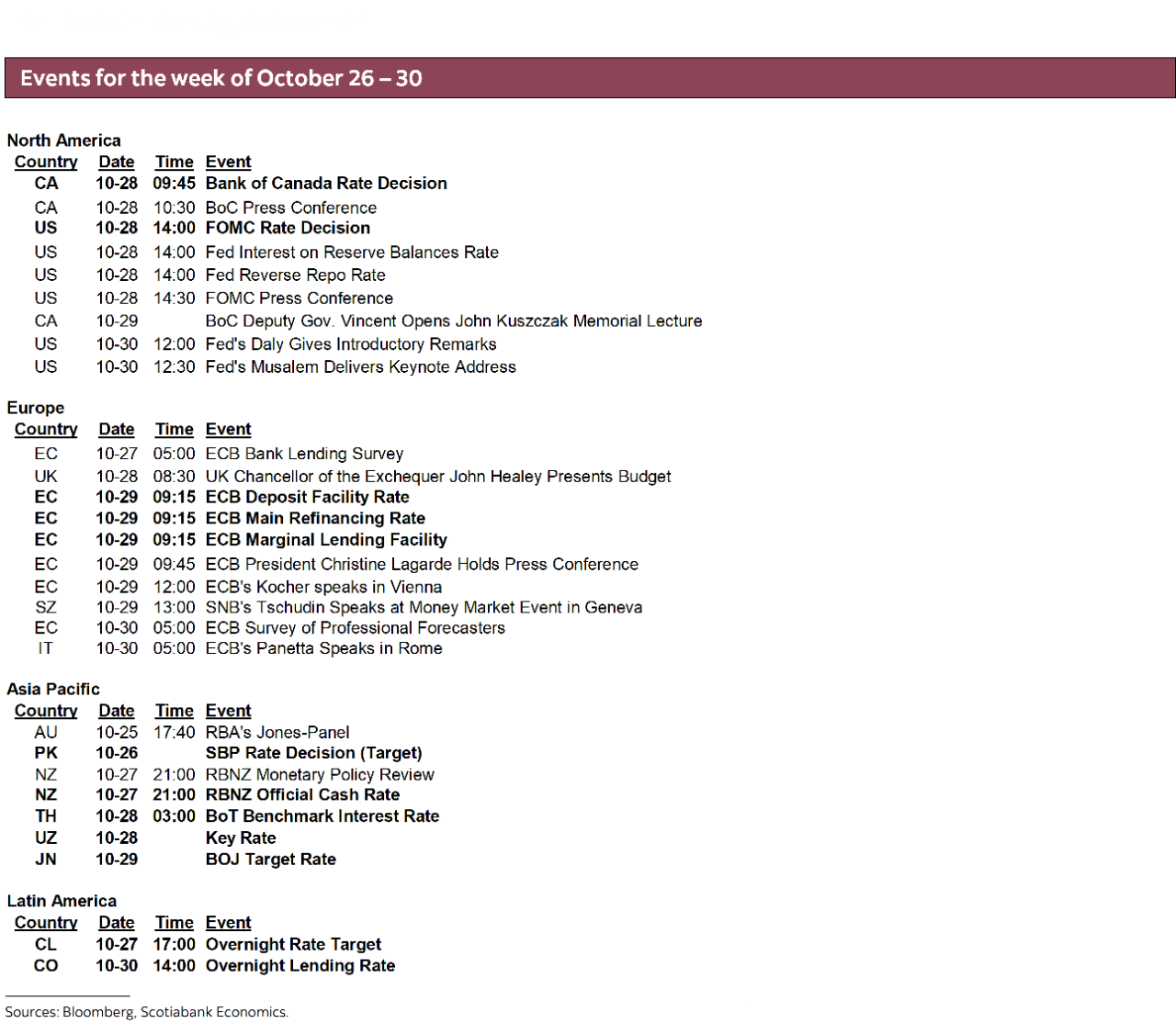
A packed week includes multiple central bank decisions—including majors like the Fed, BoC, ECB and BoJ—alongside several elections in Brazil, Israel, and the Canadian province of British Columbia. The UK budget and a wave of global GDP and inflation figures may also pose significant market risk. So could earnings, with 168 S&P500 firms releasing including more of the ‘Magnificent 7’, such as Amazon (Thursday), Alphabet (Wednesday) and Microsoft (Wednesday). Their reports may be key to wavering risk appetite toward tech stocks. Fifty-eight TSX firms also refresh earnings estimates.
It will also be the final full week of campaigning ahead of the November 3rd US midterm elections as poll mapping onto scenarios for the House and Senate are firmed up, and we could see potential trial balloons ahead of Canada’s November 5th federal budget.
BANK OF CANADA PREVIEW—TO HIKE IS MORE FORGIVING THAN TO HOLD
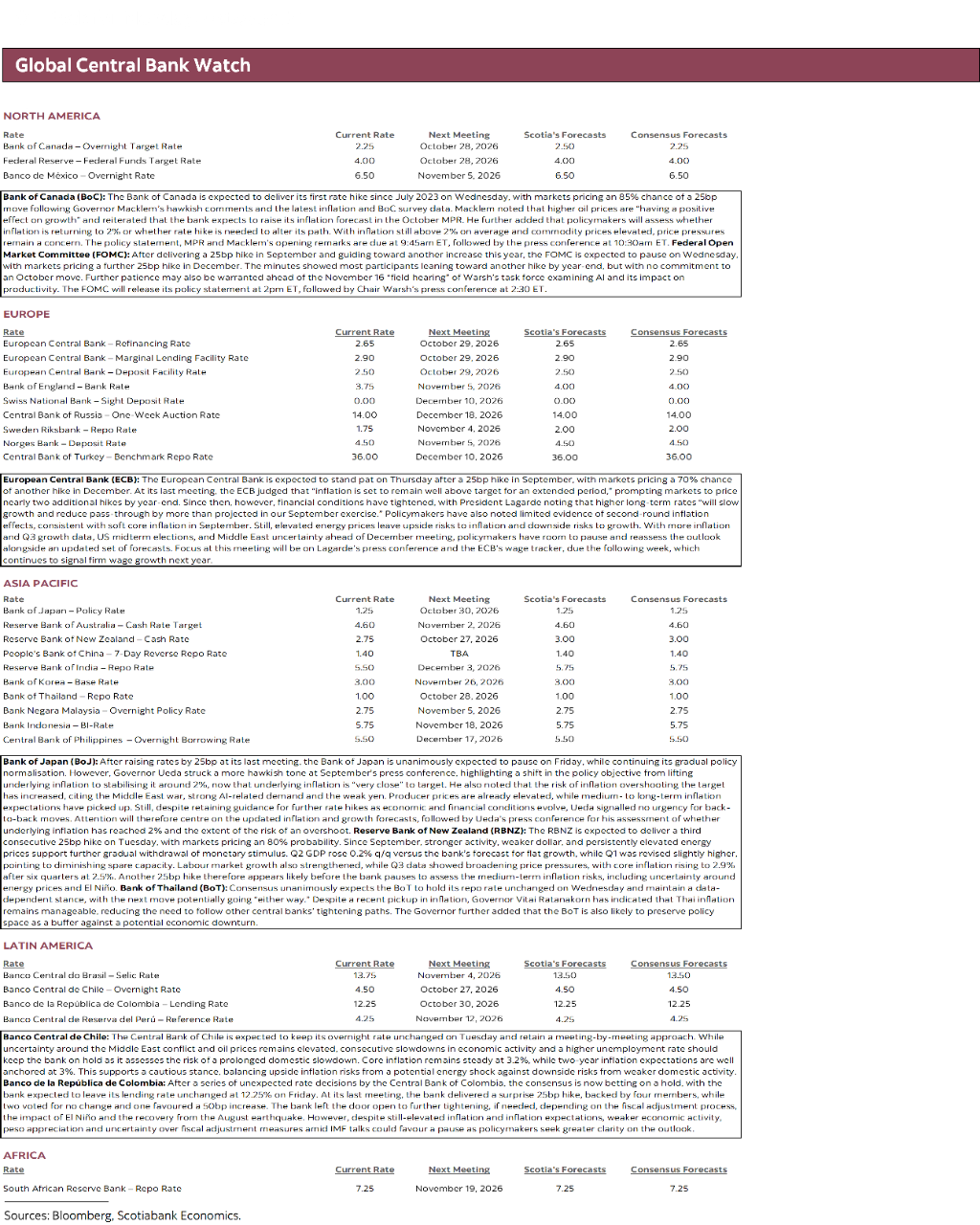
The Bank of Canada is expected to hike its overnight rate by 25bps on Wednesday alongside a full suite of forecasts and communications.
Where and When to Find It
The statement will appear here, the Monetary Policy Report with the forecasts will be here, and Governor Macklem’s opening remarks will appear here, all at 9:45amET. The press conference held by Macklem and SDG Rogers will be available at 10:30amET here, or at CPAC (link tbd), or on other news media sites and Bloomberg at live <go>. The usual recommendation is to run more than one of them simultaneously given frequent tech and/or translation issues.
The Path Forward
Don’t expect terribly clear forward guidance. Macklem hates explicit guidance and tends to speak in cryptic, somewhat cagey ways, at least ever since he overreached on forward guidance in the pandemic. The BoC will let its forecasts do the talking.
Updated Projections
We’ve already heard from Macklem that the BoC will raise its growth and inflation forecasts; he said so at the IMF retreat in Bangkok. Chart 1 compares the BoC’s July forecasts for GDP to our current forecast; we think they’ll need to revise up 2026–28 but are unsure of how much in relation to our views.
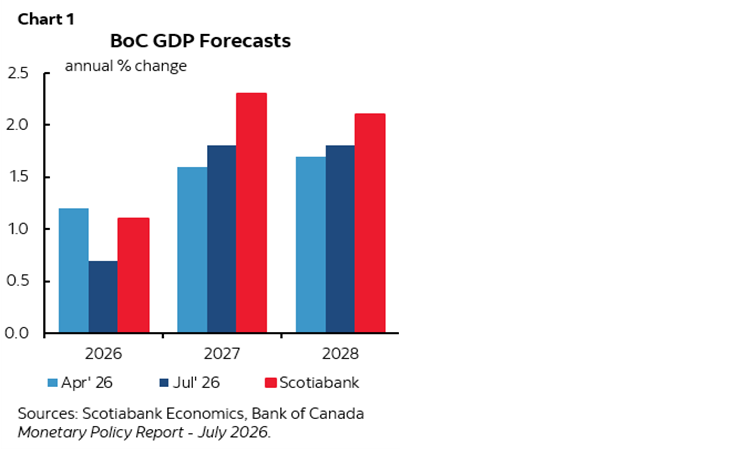
Chart 2 compares inflation forecasts and here too we think they’ll revise up materially but by how much and over what time is uncertain.
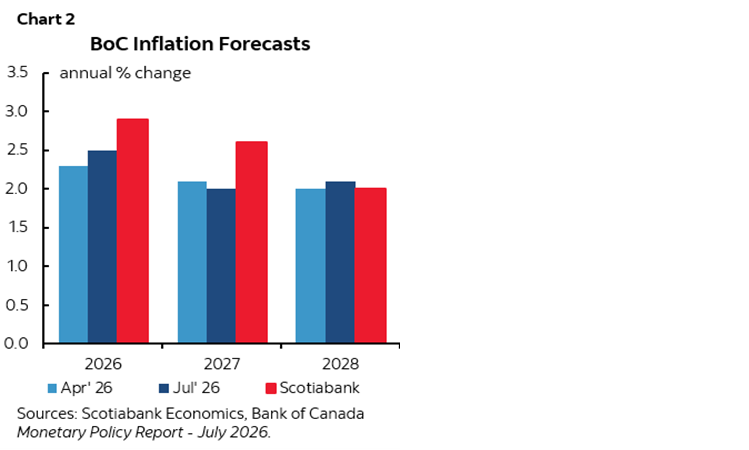
A caution is always that our forecast embeds our known 100bps of hikes and the BoC’s projections will embed an unknown and unpublished policy rate trajectory. The BoC does not provide explicit forward guidance like the FOMC, or Norges Bank etc. Yet absence monetary tightening, we would project higher inflation over a longer period.
Statement Changes
Expect a full statement re-write since we’ll be comparing an MPR statement with emphasis upon fresh forecasts to the prior interim non-MPR statement.
If they “adjust monetary policy as needed” at this meeting, then they will swap out that prior reference with some conditional guidance on further adjustments probably also “as needed.” Firm guidance is unlikely. If markets expect firm guidance, then a hike with nothing could feed impressions of a dovish hike, erroneously or not. That’s something for the BoC to ponder if it wishes to create a scenario in which the market largely neutralizes the higher overnight rate, or not.
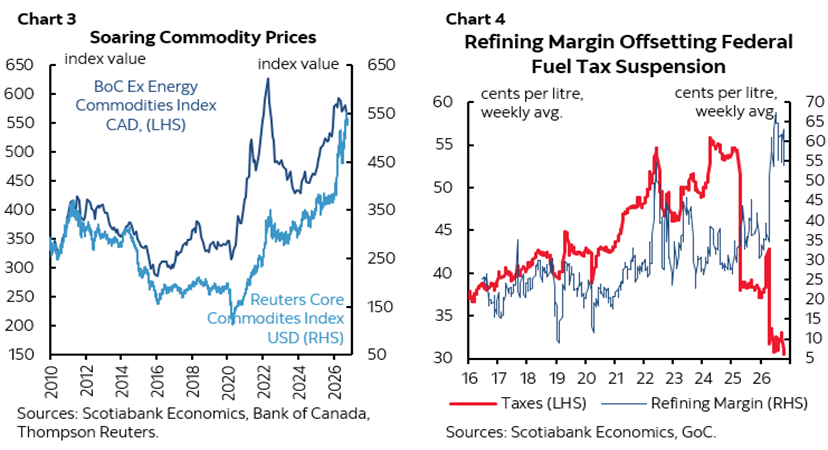
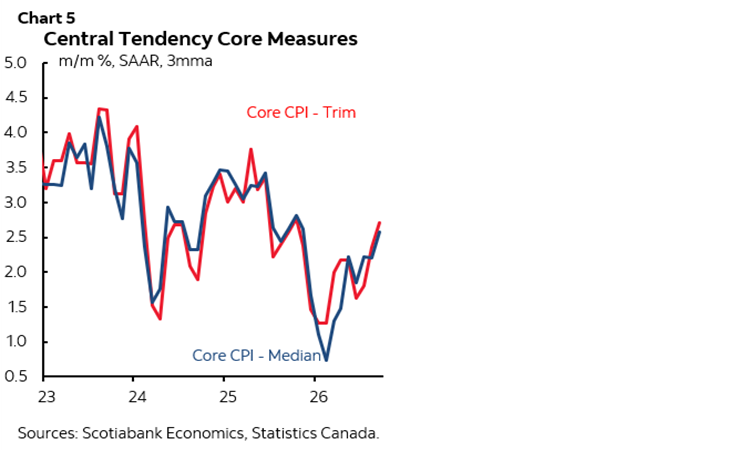
They should change reference to “little evidence” of higher energy prices spreading to other components of inflation. First, it’s not just energy that has lit up among commodities (chart 3). Second, the three-month moving average of m/m SAAR core measures has increased since the September 2nd statement. They are also likely to continue to reference high refinery margins in that high energy prices are not just due to war in the Middle East (chart 4).
They may reinforce tightened financial conditions, but the 5-year GoC bond yield is no higher than it was into the last statement and CAD is weaker. There is also a chicken-and-egg aspect to this; one reason financial conditions have tightened is that they expect the BoC to hike, so absent tightening, that argument would go out the window.
On the external side, US GDP arrives on Friday after the BoC but is expected to be strong and merit repeated reference to “solid” if not strong US growth that benefits Canada.
They are likely to repeat “upside risks to the Bank’s inflation forecast have increased” not least of which since Governor Macklem has been repeating it since then. Part of that may be continued reference to how “New US tariffs and Canadian counter-tariffs will also raise costs for some businesses and could feed into consumer prices over time.”
Low Surprise Risk
A hike is about 85%+ priced. At the time of writing, it isn’t clear what the trimmed consensus is because about half of the domestic banks’ economics shops have stuck their heads in the sand. There is, however, a definite gulf between being 85% priced in markets versus waffling economists.
Is a surprise hold instead of a hike possible? Yes, it has happened in the past. It has never happened under Governor Macklem when it has been priced as high as now.
It would be more awkward not to hike. One reason is that it would ease financial conditions at an awkward juncture for inflation risks and would likely do so by driving lower borrowing costs than what is priced and a weaker Canadian dollar. Another is that it could make the BoC look rather silly in the context of the cues it has been providing which is what provoked the market pricing.
Those cues include two main categories. One goes back to the September 2nd pivot. Those communications eliminated reference to the policy rate being “appropriate” which opened up optionality, pointed to upside risk to inflation, and conditioned October’s decision as dependent upon their forecast updates. Those signals declared October to be a ‘live’ meeting. Second relates to Governor Macklem’s remarks at the conclusion of IMF meetings in Bangkok recently when he guided that the BoC would be raising growth and inflation forecasts and repeated similar warnings. This is about as close as it will ever get to saying ‘hike’ by a Governor who was burned by explicit forward guidance and now loathes it.
After all that, you whiff? Just kidding about that inflation warning?? The BoC’s credibility would be impaired if not shot if it held steady. It would be more difficult to have markets listen to the Governor in subsequent decisions.
So Why Hike?
Scotiabank Economics has been forecasting a 2026H2 hike since last November as a reversal of that Fall’s two insurance cuts that were expected to work through to firmer growth, as happened. It’s not just about higher commodities. A Taylor Rule approximation of the policy rate indicated that this was an undershoot of where the rate should have been, thereby positioning the reductions as insurance cuts that would likely be taken back when they worked later on. And they did work which I’ll come back to.
We delayed that hike to 2026Q4 back in January and have been there since. In choosing either October or December, our guidance on meeting dates has for many weeks been that October is a ‘live’ meeting and we formalized the October call at the start of this past week. There should be no surprises about our long-held guidance and overall consistency. Recall by contrast that markets and other strategists and economists were debating and pricing rate cuts from Q4 last year throughout much of this year.
One key reason to hike is that all measures of inflation are roughly on or above the 2% target and so if they’re data dependent, then on that count alone they have cause to go. Headline CPI is at 3.1% y/y. Trimmed mean CPI and weighted median CPI are running at 1.8% y/y and 1.9% y/y respectively but these measures are not spot y/y measures. They are rather slow-moving m/m weighted contributions summed up to a slow moving, lagging metric that takes too long to identify turning points. Traditional core CPI (ex-food and energy) is at 2.1% y/y. CPI excluding the either most volatile components and indirect taxes is up by 2.2% y/y.
Fresher price signals look at these measures on m/m SAAR terms and after applying some smoothing via a three-month moving average. On that basis, total CPI is at 3.6%, traditional core CPI is 2.6%. CPIX is 2.5%, CPI ex-8 is 2.2%, weighted median is 2.7% and trimmed mean is 2.6%. Chart 5 shows the trimmed mean and weighted median measures.The evidence on inflation is crystal clear across a whole suite of measures taken together—inflation is on or above target and most likely the latter with clear trend evidence of pass through into broader price pressures.
The pressures are likely to intensify.
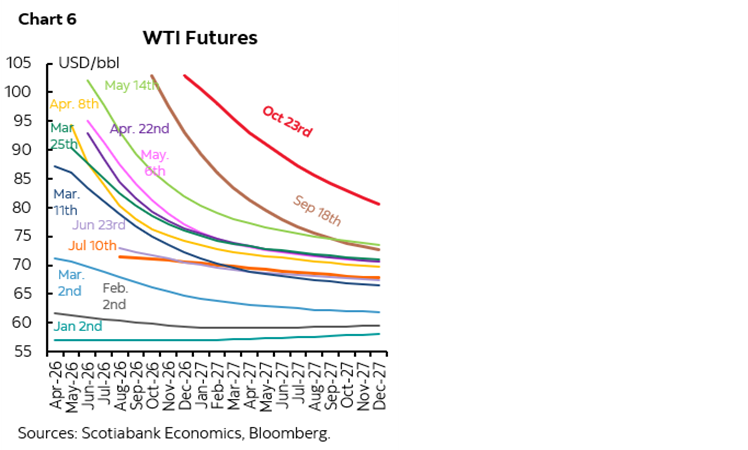
For one, we’re staring at the highest oil futures curve than at any point during the Iran war (chart 6). We have gone into the realm of the BoC’s harshest oil shock scenarios. Further upward pressure is likely given signs of escalation including “finish the job” guidance from President Trump following the midterm elections as he defers another spike in gasoline and diesel prices until after the vote.
It’s also not just about higher energy prices with the BoC’s commodity prices ex-energy index up 30% since the lows in early 2024.
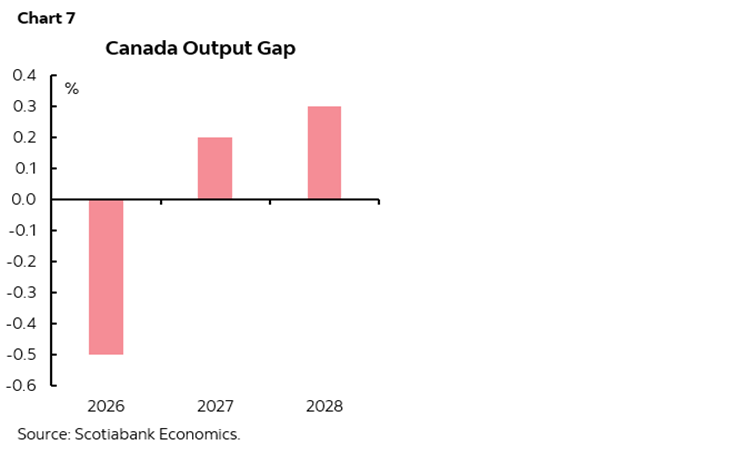
For another, we expect slack in the economy to disappear fairly early into 2027. Supercharged growth in Q2 and then resilient GDP growth in Q3 combined with our Q4 forecast that is at about 2%+ are combining to close off spare capacity (chart 7).
This is a story of resilience. A story about respecting evidence. The facts. And not abandoning the job of a forecaster through excess reliance upon backward data in any event.
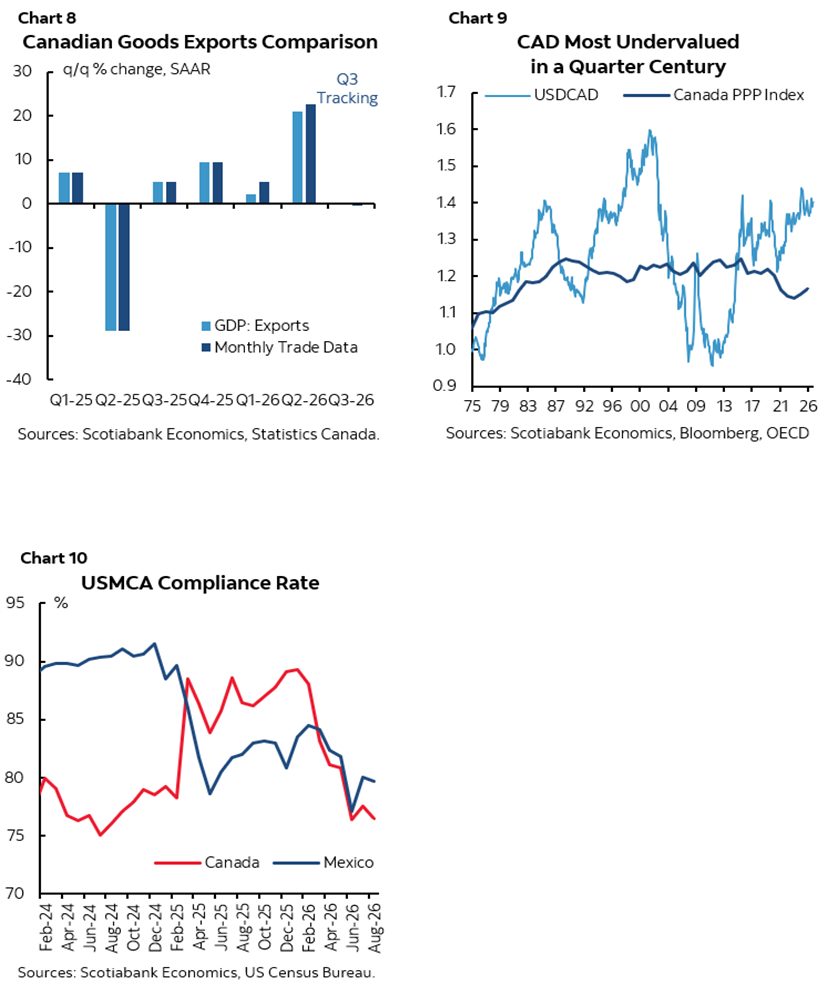
Tariffs would crush exports, you say? Look at chart 8. Solid US growth has generally buoyed an income pull effect on Canadian exports. USDCAD is undervalued by the most in about a quarter century relative to longer-run purchasing power parity guides (chart 9). Since mid-2021, CAD has also depreciated against MXN, the yuan, and several European currencies like sterling and the euro. The vast majority of Canadian exports to the US remain tariff free (chart 10).
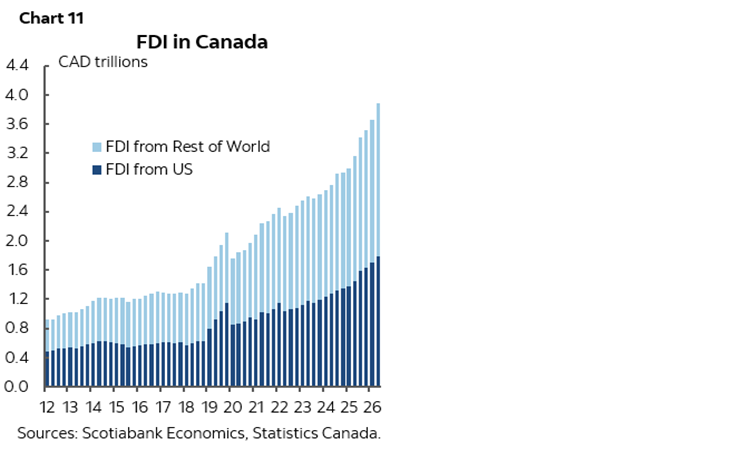
Nobody wants to invest in Canada? Umm, hello, chart 11. Foreign companies are plowing money into physical assets like equipment and structures. This is coming from US companies but especially the rest of the world’s companies beyond the US. As Canada incentivizes more investment through the ‘mega-deduction’ and attempts to seed more private investment with public inducements, there will be more intensive competition for labour and materials. Ditto for defence spending such as plans to build almost 50 ships and hence at a pace that hasn’t been seen since WWII.
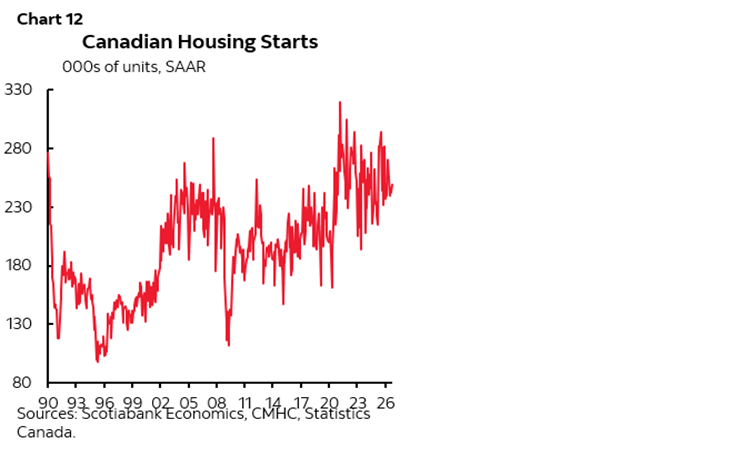
Housing is in the dumps? There’s chart 12.
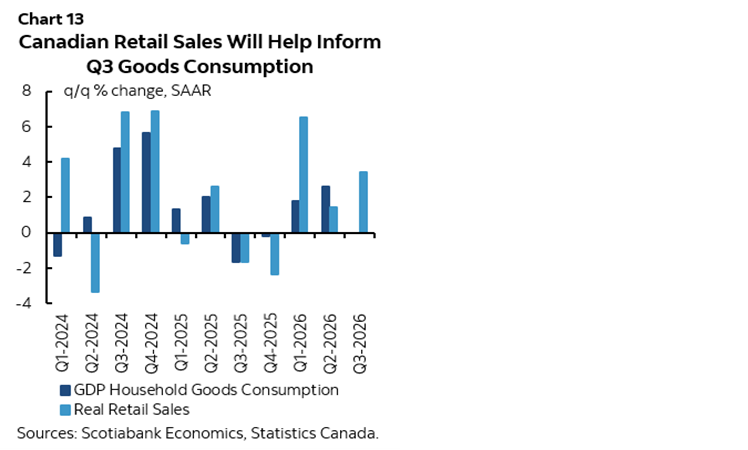
Consumers are in dire straits? Chart 13 says nonsense. Inflation-adjusted consumer spending is tracking another gain in Q3 given correlations between growth in retail sales volumes and how consumption is captured in GDP accounts. Before that, consumption was up 3.3% q/q SAAR in Q2, 2.4% in Q1, and 2.9% in Q4. Some say consumers are in the dumps, but then you look at those numbers and there is no macro evidence to support legitimate challenges among some individual. The BoC’s job is to focus overwhelmingly upon the macro picture.
Also recall that the BoC has warned about the inflation implications from US tariffs, the shock of US trade policy to global supply chains, and Canadian retaliatory tariffs.
Fiscal policy contributions to growth are likely to intensify. The federal Budget on November 5th will put numbers to all of the off-budget announcements since the Spring update and add further to the figures. We’re already getting pre-budget announcements including billions in supports for sectors directly affected by tariffs. We have incorporated a modest lift to growth from the ‘mega-deduction’ that was recently introduced which allow for full equipment expensing on about two-thirds of that type of spending.
Soaring commodity prices benefit an economy like Canada that is a net producer. We’re only six-months into the energy shock with the lagging benefits likely ahead. Selling exports at higher prices relative to imports extracts income from the world economy. That trickles down through aggregate income (nominal GDP) by giving governments more money to spend because they tax the revenues, buoying aggregate corporate profits, and probably buoying household incomes through wages and shareholder distributions and fiscal transfers. With more income across these sectors, more spending activity is likely.
Is there a chance energy prices crater at some point? Perhaps, but it’s not our view, as positive supply side developments on parts of the world are responding to demand such as from Asia, and for the foreseeable future we see greater likelihood of a prolonged negative aggregate supply shock worsening. Monetary policy has to play the evidence and can’t act on a lark out of fear that one day sometime somewhere in the future oil might crash. Deal with it then.
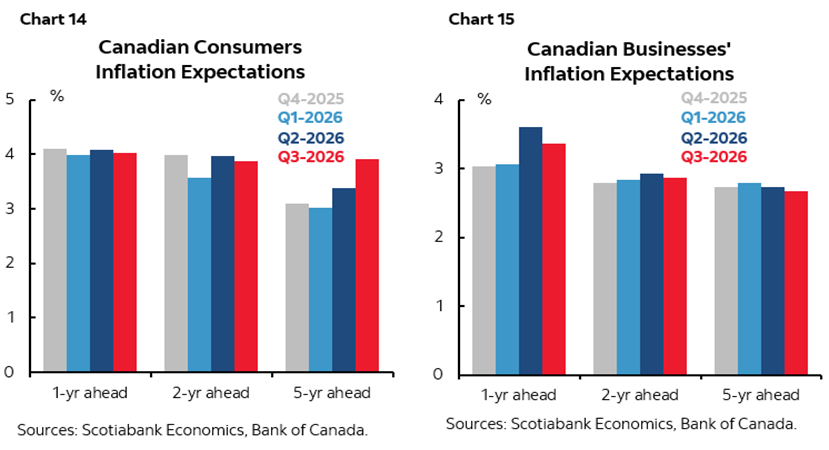
Inflation expectations are elevated over longer-term horizons which was always the trigger point for Macklem to raise his concerns. Consumers expect 5-year inflation to broach 4% and businesses are at about the top end of the 1–3% band 5-years out (charts 14, 15).
Also consider that the supply chain of price pressures remains pointed much higher. Core industrial prices lead core consumer prices and the risks are intensifying with some of that showing up in recent consumer price trends (chart 16). Since the energy shock is only about six-months old, pass through risk is probably concentrated in the period ahead of us.
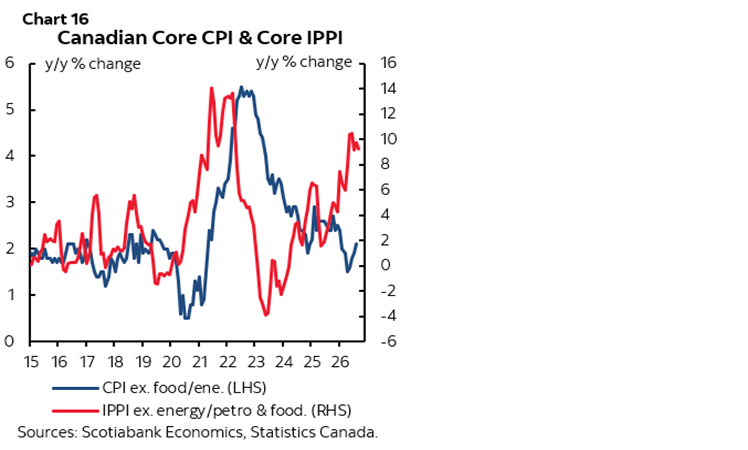
Also see the next section on AI-driven pass through of inflation pressures.
You May Dislike the Alternative More than Hiking Now
The BoC has to be less confident that it has imminent inflation risk under control within the horizon of lagging monetary policy effects on the economy and inflation. At an absolute minimum there is a strong case for taking out insurance against upside risks to inflation.
There is added reason for taking out insurance on its ability to forecast inflation. Chart 17 compares actual inflation to successive MPR forecasts; the BoC routinely underestimates inflation and misses inflection points. It remains to be seen whether a wholesale revamping of its models that has been underway will improve upon this track record.
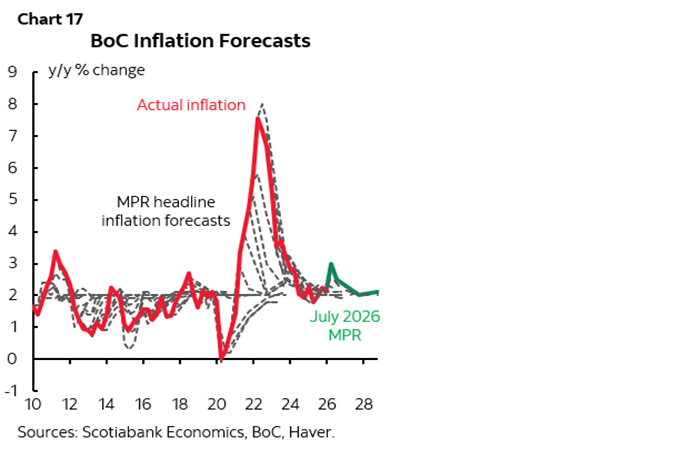
The BoC did not do that in the pandemic. It waited until it felt it had all the answers while denying there was an inflation problem for far too long. The result is in the history books.
People may not like higher rates now. Yet repeating the same mistake would raise the odds of far bigger rate hikes later to counter far higher inflation after letting the problem fester and build upon itself.
So, if you don’t want a hike this week or if the Bank of Canada whiffs, then frankly, don’t complain when you face the higher probability of getting a bigger bill than necessary in future. The biggest risk of larger rate hikes in future would be if the BoC is slow to get off the ground.
The Bank of Canada is Probably Already Behind
So why is the Bank of Canada still sitting at the low end of neutral and at a real policy rate that is around zero if not negative depending on the measure of inflation or expected inflation? If you’re on or above the 2% inflation target and slack is shutting with rising upside inflation risk, then policy should be acting now if not having already hiked. The case for being behind the curve is based upon solid inflation tracking and the lagging effects of monetary policy adjustments that can take 6–18 months to have most of its effects.
Growth prospects are another consideration. Even with 100bps of tightening in our forecast we are projecting real (inflation-adjusted) GDP growth of about 2¼% in 2027. Absent such tightening we would be pushing into the 2½–3% range. You might think great! But the Bank of Canada’s estimated potential rate of growth in Canada’s economy is 1.1% in 2026 and 1.3% in 2027 as per the July MPR pending any future updates. If the BoC did not hike in a material way, then the economy would probably transition toward further toward excess demand and greater inflationary pressures.
Common Myths
Now for some myths about tightening that are sometimes advanced. Some of them are reminiscent of the same myths that were promoted by some throughout the pandemic.
One is a repeat of the pandemic line from other forecast shops that the BoC shouldn’t hike because inflation is supply-driven and monetary policy can’t control supply shocks. It should therefore look through this type of inflation. The counter is that the BoC’s job is to equalize supply and demand through the net impact on slack such that it doesn’t matter if inflation is generated through a negative supply shock or a pick-up in demand or both. The BoC has to target balanced conditions and does so by pulling on the levers that exert influence upon interest-sensitive demand drivers.
A second myth is that you can’t hike because you’ll damage the demand side. Yet that’s the whole point! There is no immaculate disinflation. You’ve got to break some teacups to use the same metaphor I used in the pandemic’s inflation surge. To repeat the point above, if there is no tightening of monetary policy, then inflation risk would be higher.
A third myth is that housing would be crushed and that could sideswipe demand for skilled labour. This is worth a few counter points:
- The worst damage that you can do to housing is to allow inflation to rip and then slam the brakes on later. Hiking earlier than later could mitigate the risk of even higher rates later on and with it more damage to housing. Homebuilders need to understand that the worst risk to their market is a repeat of runaway inflation.
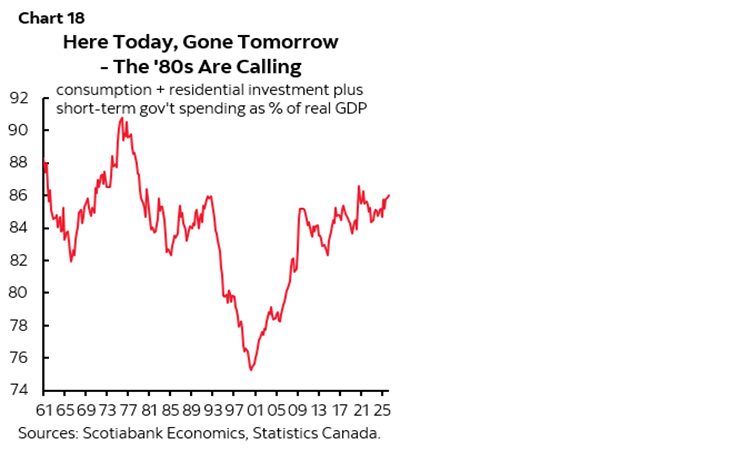
- Short-term drivers of economic activity—like consumer spending, housing and short-term government spending—remain dominant as shares of GDP in ways that harken back to the 1980s (chart 18). The Carney administration is trying to pivot growth drivers toward longer-term investment-led growth that will need resources. That would be made more difficult by maintaining such high shares of activity going into shorter-term spending.
- Not much can be done about oversupply in condos in any event; that has to be worn off over time and it’s not a rates issue versus shaking off prior greed.
- I still think that the Carney administration will be raising immigration targets—this time more so in permanent, highly skilled categories—given reports of skilled labour shortages among small businesses, the need for specialized labour, and as the massive overshoot in temps works off and gets assimilated.
- Besides, the 5-year mortgage rate is driven by the 5-year GoC yield that has risen but at about 3.65%% remains low in real terms even if not as low as the pandemic-generation recalls.
A fourth myth is that you can’t cut because the job market is tanking. First, inflation is job #1 and the job market and wage-inflation connections are not strong enough in the face of inflation’s many and complex drivers to thwart inflation risk. Second, I still don’t believe the jobs numbers (here). They asked us to believe that public sector jobs in health and education sectors in Quebec were cut by tens of thousands in the middle of an election campaign. There are quirks to the Labour Force Survey that merit downplaying the reading. Attempts at scraping the internet for job cut announcements reveal a few thousand nationwide at most and not just in a single month. I wouldn’t be surprised to see a rebound the next month. Further, the Feds are smothering the shock to jobs in some sectors with recent support announcements that may or may not be wise over time.
Fifth on the myths list is that you can’t hike until you have clarity on trade policy risks. Here too there are several counters:
- One counter is that you would never hike rates if the threat of misguided US trade policy lurked around the corner because it is likely to remain misguided while inflation risk creeps higher and higher.
- Even if Canada signs an agreement with the US, it would always be a concern that the US signature’s value has been deeply diminished by the Trump administration.
- Another counter is that trade policy risks may raise inflation risks; within reason, controlling inflation is the BoC’s job, while dealing with the adjustments is more of a job for fiscal and regulatory policies.
- Another counter is that it’s highly unlikely Trump self-immolates the US economy with 50% auto tariffs on Canada that would destroy his own auto sector given the high cross-border integration of supply chains.
- Another counter is that Canada has been afraid of the Sword of Damocles felling the nation’s businesses and leaders for years, yet exports have been remarkably resilient via offsets such as US growth, CAD depreciation and high commodities. There is a higher bar set against the gloomsters on trade after basically six quarters of export resilience dating back to ‘Liberation Day.’ in April 2025.
A sixth myth is that market volatility should mean standing pat on rates. Yet volatility is the one constant in markets. The TSX is only about 3% off its peak, and the S&P 500 is about 2% off the high. Sovereign bond yields seem to be rapidly reversing some of the sell-off in rates with the US 10-year now down 3bps from the high and the Canadian 10-year yield now down by under 20bps. A large, sustained stock market sell off could change the picture, but we’re nowhere close to such concerns.
AI-DRIVEN INFLATION IS JUST BEGINNING IN CANADA
Here’s something you won’t find in any Phillips curve model of Canadian inflation just as it wasn’t to be found in any comparable US model. AI-driven inflation has only just begun to show up in Canada. Just as the Federal Reserve feels it must raise rates in part to address this type of price shock, the Bank of Canada will probably come under pressure to follow suit.
This could be a further source of upward pressure on our existing inflation forecast that requires 100bps of tightening to drive inflation toward about 2½% y/y by the end of next year and about 2¼% into 2028. That forecast does not yet incorporate a meaningful impact from AI-driven inflation. If so, then our 100bps of forecast interest rate hikes is likely light.
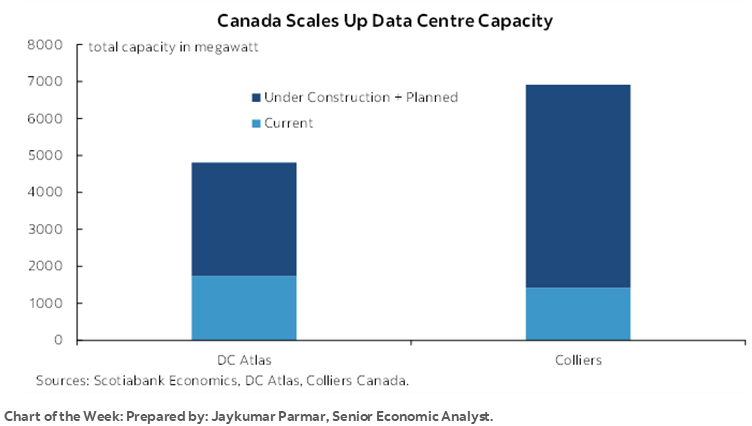
Key is the relatively sudden onslaught of data centre development—including hyperscalers—and plans for an enormous increase in planned gigawatts over coming years. From about 300 now, there are plans to build hundreds more data centres in Canada. Numbers of centres are not the best guide, however, since they don’t power-weight the size and scope of the facilities. That’s why mega- or gigawatts are preferred. By this yardstick, data centres will soar as shown in two recent estimates from independent sources in Jay Parmar’s chart-of-the-week on the front cover of this publication. Colliers (here) estimates that Canada has about 1.415GW of commissioned data centre capacity now, particularly in Ontario and Quebec. They estimate 5.5 GW of planned capacity, led by Alberta but also with BC and Saskatchewan participating. Researchers at Toronto’s York University led much of the work on tracking Canadian data centres (here). Hyperscalers are part of this, including Meta’s 1 GW facility in Alberta. Bell Canada’s AI Fabric centre in Saskatchewan is another 300MW.
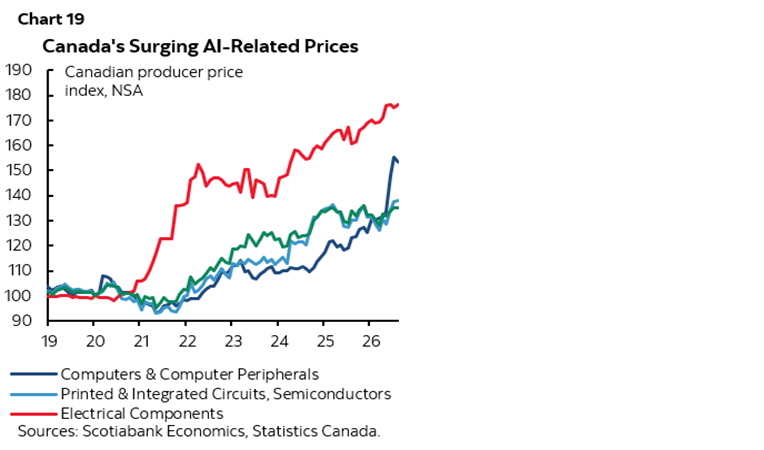
We’ve already known for some time that producer price inflation across electrical components has been picking up (chart 19). Ditto for the US and more powerfully so.
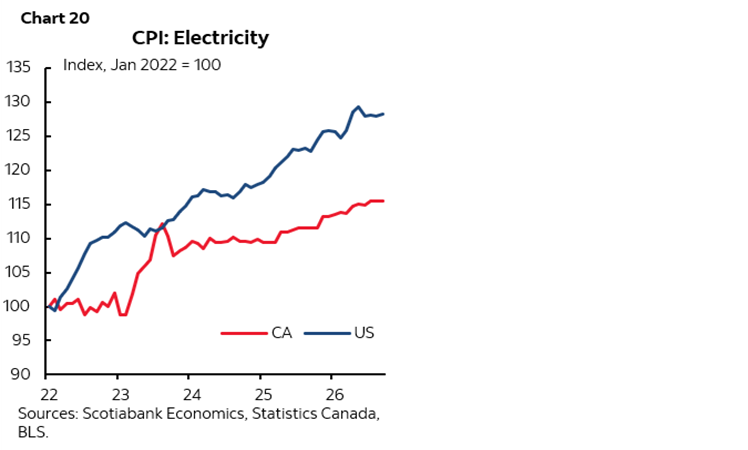
Electricity prices have risen more sharply in the US than in Canada (chart 20). Should Canada catch up to US electricity prices then there may be a gap of 20+ percentage points of increases ahead of us. If this were to happen, then the 1.7% Canadian CPI weight on electricity could directly add over ¼% to CPI inflation plus whatever pass through could unfold.
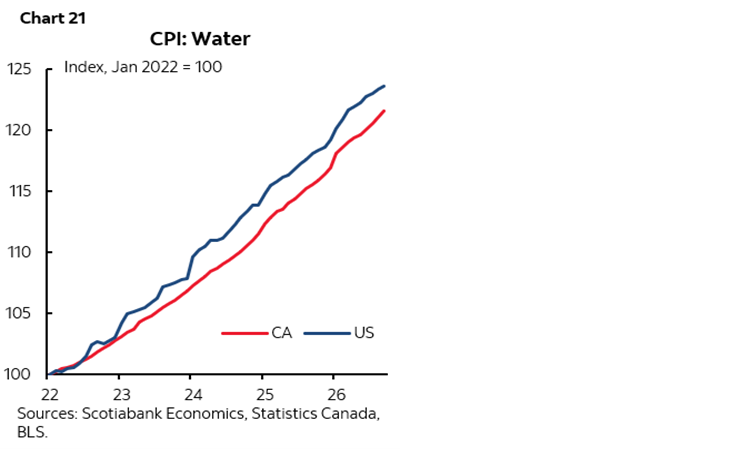
Water is becoming increasingly expensive in both countries (chart 21). Enormous cooling demands of data centres are likely to continue upward pressure. If Canada were to close the gap to the US on these prices, then the weighted impact on Canadian CPI could add 0.1%.
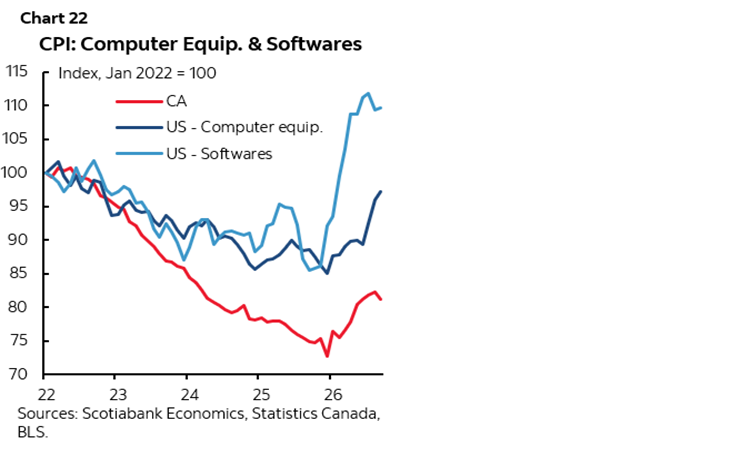
Computer and software prices were in steady decline for years—until AI. Chart 22 shows Canada compared to the US. If Canada were to catch up to the surge in such US prices over just the past year, then this could add up to another 0.1 ppts to CPI.
Other categories like smart phones are importing the global effects of the tech and AI surge but these other examples are more likely to be domestically driven.
In total, it’s feasible that AI could drive around an extra half percentage point to Canadian inflation and possibly more. There is clearly more comfort in pointing to the risks, however, than any firm estimate of the AI effect on Canadian prices.
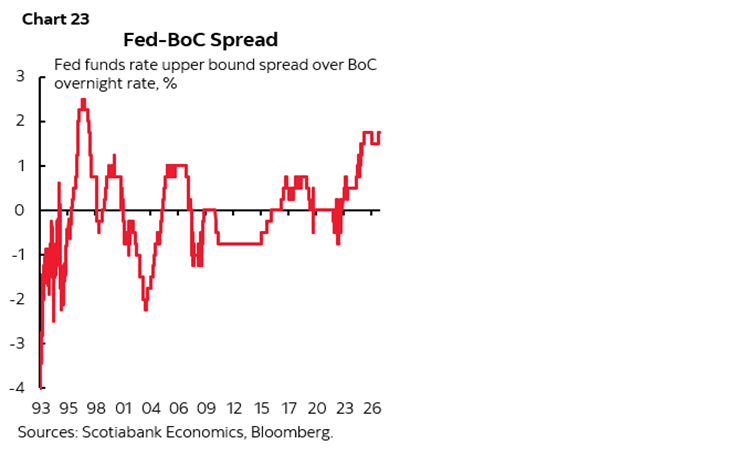
Combine all of the preceding arguments with the possibility Canada embraces US-style AI-driven inflation and that policy rate differential is looking mighty wide at present (chart 23).
FEDERAL RESERVE—WHICH BUSINESS ARE YOU IN?
One-eighth of consensus expects a 25bps hike that the other seven-eighths are rejecting for when the latest FOMC statement arrives on Wednesday at 2pmET. Markets have no chance of a hike priced.
Recall that the dot plot that was delivered at the September FOMC meeting indicated one more hike in 2026Q4 and then ending 2027 unchanged. While Chair Warsh loathes forward guidance, other FOMC officials have generally downplayed the prospect of a hike at this meeting following the one last month.
Markets took Warsh’s comments that were delivered at the IMF meetings in Bangkok the other week as relatively dovish by downplaying odds of a move this week. I’m still not entirely sure why. He said:
“I don’t believe in saying now what I might do at the meetings we have in the balance of this year. It’s a new chapter at the Fed, and we’re not in that business anymore.”
Markets somehow heard ‘I’m not hiking.’ The logic was that he didn’t sound incrementally hawkish or issue forward guidance which is curious because he says he won’t do so.
A surprise hike could have data behind it. Core PCE inflation won’t be released until the day after, but I’ve estimated a rise of 0.4% m/m SA which would be relatively warm. That’s based off CPI, weight differences on key categories, how some producer prices flow through to PCE and other methodological differences.
The FOMC’s focus is not on the full employment side of the mandate these days. Inflation is all the rage. Still, job market readings have been mixed. Only 29k extra nonfarm payroll positions were created in September after the downward revision to August (133k from 162k) and following three soft prior months. September’s gain was driven by a dubious seasonal adjustment factor that particularly impacted leisure and hospitality jobs. Still, the Committee is likely to continue viewing the job market as reasonably solid.
A hike would rattle markets at a fragile moment just before midterms the following week as amid volatility in stocks and bonds. It would further fray the market’s nerves around the Chair’s unstable reaction function.
So, if you’re not in the forward guidance business, maybe it’s also best to stay out of the shock business.
ECB—BOND MARKET TURMOIL
The European Central Bank is priced for no change on Thursday but about three-quarters of a hike at the following meeting on December 17th and 50–75bps of further hikes in total by next September.
While ECB officials speak of the potential for more work to do on inflation and inflation risk, they have noted little evidence of second-round effects of the spike in energy prices to date. Further, President Lagarde stated that the bond sell-off “will slow growth and reduce pass-through by more than projected” in September.
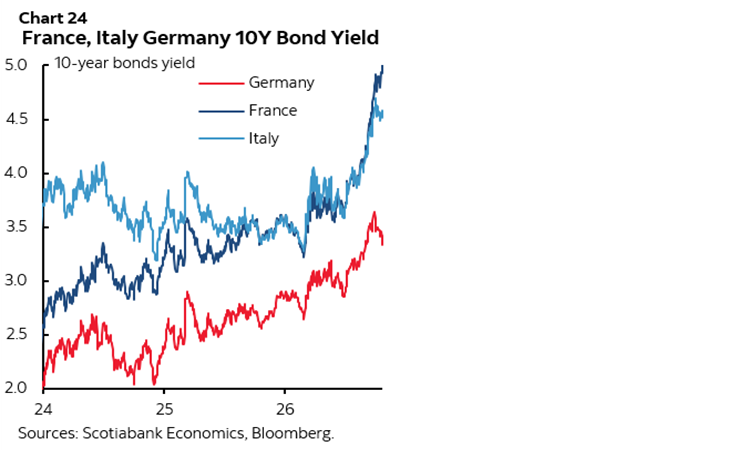
And how. EGBs are in turmoil. France’s 10-year yield has soared from 3.65% at the end of June to over 5% now. Its spread has increased to more than 200bps over 10-year bunds (chart 24). Italy’s 10-year spread over bunds has also increased by about 100bps, indicating correlated bond market strains and some contagion.
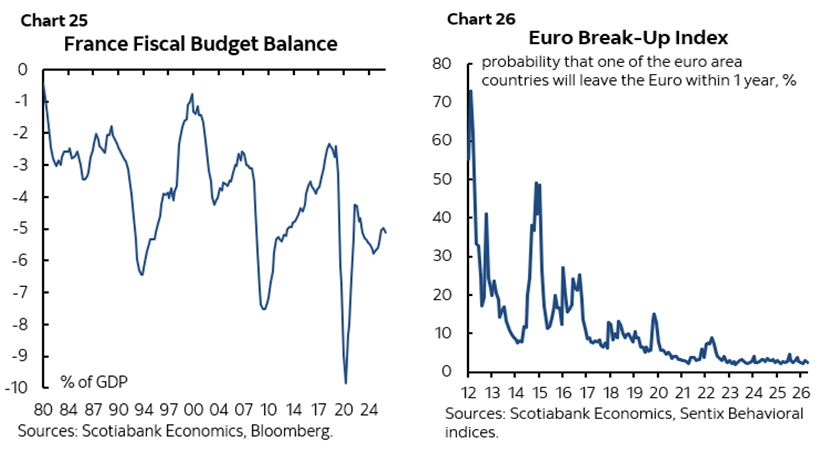
France’s protests, soaring fiscal challenges (chart 25) and the French presidential election by April of next year are contributing to concerns about fiscal sustainability and risks to the future of the EU and eurozone. Still, while only to September, investor surveys point to very low odds attached to the break-up of the eurozone (chart 26).
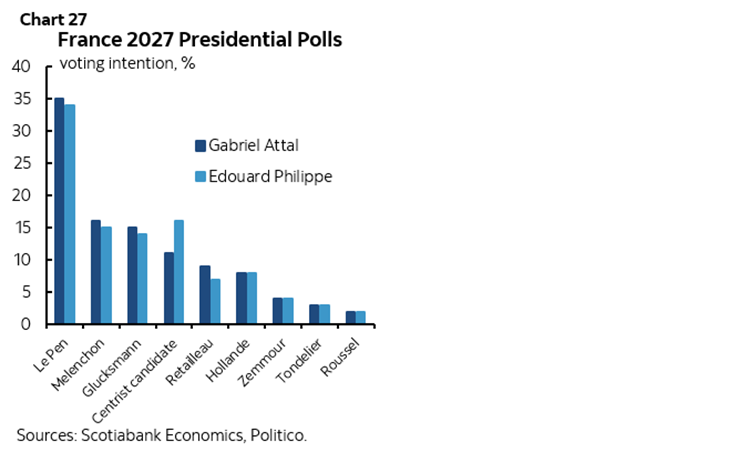
Marine Le Pen—head of the National Rally, formerly named National Front under her father’s leadership—is polling in first place (chart 27). Le Pen’s budget proposals that were presented on September 6th pledged to slash public spending by about 7.5 ppts of GDP to 50% by 2032 through sharply reducing France’s contributions to the European Union. Addressing fiscal challenges could inflame Eurozone risks. Le Pen opposes further enlargement of the EU, such as in Ukraine’s case. She has previously proposed leaving the Eurozone but subsequently claimed to have changed her mind. She favours economic protectionism, opposes further privatization and favours a “Europe of the Nations” over integration. Le Pen would pursue a more isolationist stance and contribute to a more fragmented global order in keeping with elsewhere such as the increasingly withdrawn United States.
Her pledges could be highly destabilizing to the EU and threaten unity against threats from Russia and Trump’s varied assaults. EU leaders are seeking to accelerate the timetable for a budget that would span 2028-2034 before France’s election.
BANK OF JAPAN—FORECASTS TO INFORM NEXT STEPS
The Bank of Japan is priced for no policy rate change on Friday. Consensus unanimously expects no change. Markets have about two-thirds of another hike priced by December 18th after the BoJ raised its rate on September 17th.
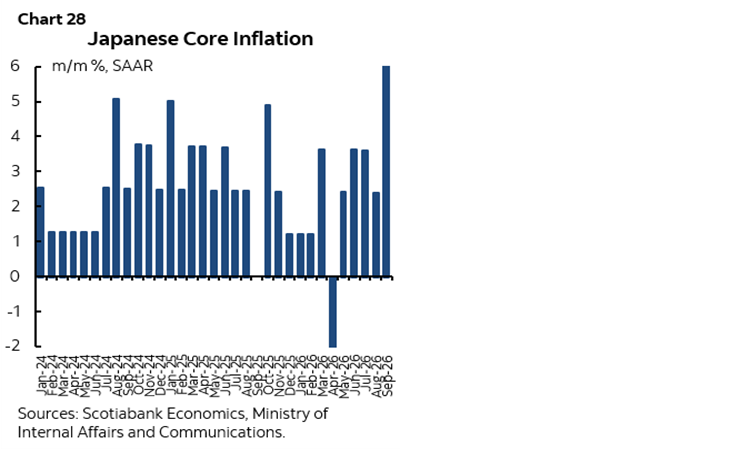
Fresh forecasts are expected with this meeting and may inform the path forward. While Governor Ueda has warned that the risk of inflation overshooting the 2% target has risen, he is not viewed as favouring back-to-back hikes. Strong core inflation (chart 28) is likely to contribute toward a hawkish overall tone at this meeting.
RBNZ—ENOUGH REASON TO GO
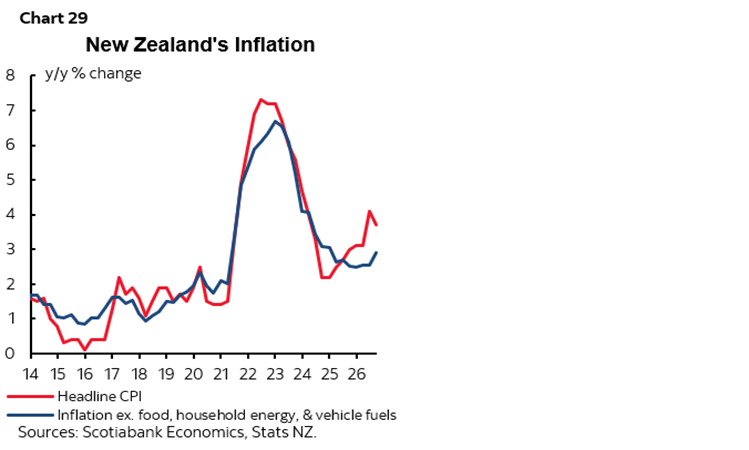
Most of another 25bps increase in the RBNZ’s official cash rate is priced for Tuesday’s decision. Consensus is not unanimous, but further upward pressure on inflation and additional increases expected into Q4 as slack diminishes and energy prices rise could provide enough cover for what would be a cumulative 75pbs of hikes since July (chart 29).
BCCH—CAUTIOUS
Chile’s central bank is expected to hold its overnight rate unchanged at 4.5% on Tuesday. Slowing economic activity and core inflation holding steady may provide enough reason.
BANREP—ONLY THE BRAVE
Next moves by Colombia’s central bank have been a tough nut to crack for a while now. Consensus expectations for hikes in April and July were dashed, while expectations for a hold in September were defied with a hike and BanRep raised by more than expected at the June meeting.
So, when local economists say this one might hold on Friday, they are betting that the previous meeting’s guidance that kept alive prospects for future hikes might be offset by weakening economic activity, peso gains and recovery from the August earthquake.
BOT—FOUR IN A ROW
Thailand’s central bank is expected to extend a policy rate hold at 1% for the fourth straight meeting on Wednesday. Guidance has pointed to the next move potentially either raising or lowering the rate.
ELECTIONS—ISRAEL, BC, BRAZIL
Three elections will be held over coming days in the Canadian province of British Columbia, in Brazil to determine who will be the country’s President, and in Israel to choose a potentially new coalition and PM.
1. BRITISH COLUMBIA—SATURDAY
British Columbians head to the polls on Saturday because who could possibly have anything better to do on a Saturday.
Polls are open from 8amPT (11amET) until 8pmPT (11pmET). Results may start to stream shortly thereafter but if it’s close, then it might take into the wee hours to determine a winner with official, finalized counts to follow. As of Wednesday, about 900k had already cast votes in advance, one-in-four of the 3.74 million eligible voters.
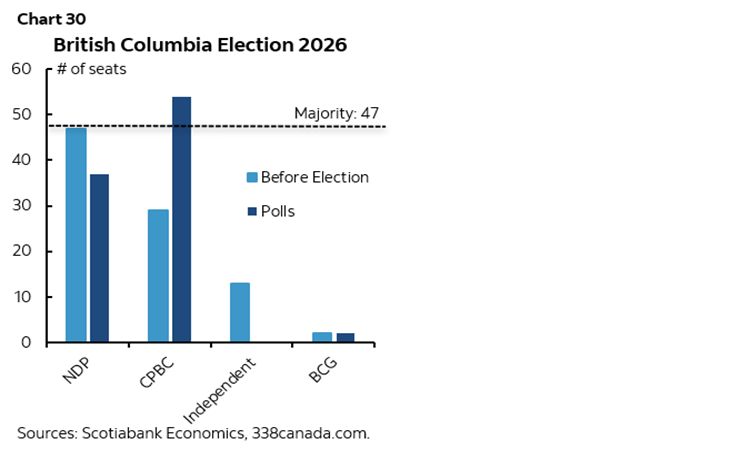
Chart 30 updates poll tracking. This seat-mapping site points to a likely Conservative majority that would be a major backfire against NDP Premier Eby’s early election call.
Otherwise, I won’t repeat what was written in the prior weekly regarding finances, platforms and possible implications for spreads.
2. BRAZIL’S PRESIDENTIAL RUN-OFF—SUNDAY
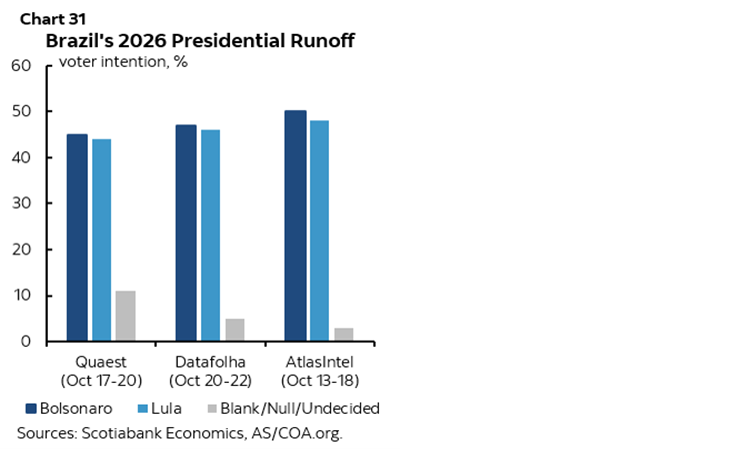
Brazilians choose their President in Sunday’s second-round Presidential run-off vote. Chart 31 shows the son of former President Bolsonaro in the lead over incumbent Luiz Inacio Lula Da Silva (Lula, for short) across three major recent polls until the latest poll that puts the outcome at 50-50 odds.
Voting runs from 7amET until 4pmET. Results will reportedly begin to arrive by 4pmET.
The Brazilian currency—the real—has had a good month and appreciated by over 3% to the dollar ever since the first-round election results on October 4th showed Bolsonaro doing better than expected. Brazilian bond yields were climbing in the lead-up to the election but 2s rallied a bit and the 10s yield has fallen by about 50bps after the election. Brazil’s main stock exchange has rallied by about 9% since the first-round results.
Markets are taking ‘right’ as preferable for ‘left’ after years of fiscal mismanagement and falling short of the Brazilian economy’s potential.
Yet Brazilians a step closer to rewarding with the Presidency a son who pledges to pardon his father who attempted a coup and is accused of plotting assassination attempts against President Lula and Supreme Court judges. A Bolsonaro victory may have further room to be priced in the short-term but raises doubts about the longer term.
Personally, I lean more closely to the narratives in The Economist’s take (here). Bolsonaro is thought to be a friendlier right wing offering to markets.
Time will tell. He has no plan, it’s unclear that his fiscal leanings would be any better than Lula’s irresponsible fiscal mismanagement and pardoning his father would feed public cynicism toward deep rooted corruption. We frankly don’t really know if his policies will truly unleash Brazil’s prospects that have been promising for decades but mismanaged in serial fashion and not least of which because Mr. Bolsonaro doesn’t appear to have any real platform. Don’t fight the short-term right-is-best market bias but perhaps know when to sell absent proof.
3. ISRAEL’S ELECTION—TUESDAY
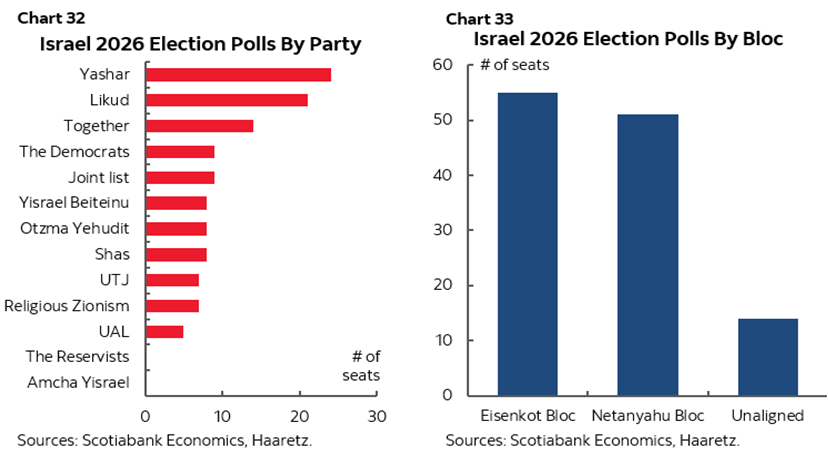
The sixth election in about 7 years will be held on Tuesday. 61 seats are needed for a majority and none of the main blocs are likely to win one; indeed, there never has been one. Israel is about coalitions and playing musical chairs to form a government among willing parties. PM Benjamin Netanyahu has been the longest serving PM in Israel’s history through multiple terms spread out since 1996 and there is no term limit in Israel. Polls by party show his party polling in second place by seat count (chart 32) and his bloc in second place (chart 33).
There are various scenarios around potential coalitions that could be struck. Netanyahu’s main opponent—Gadi Eisenkot—seeks an inquiry into the October 7th, 2023 attack by Hamas on Israel. Mr. Netanyahu may seek whatever coalition is necessary to keep him in power not just because he faces trial on corruption charges and there is an ICC warrant issued against his name for war crimes in Gaza. What coalition emerges could present uncertain implications for the war against Iran.
UK BUDGET—FISCAL PRESSURES PUT BANK SURCHARGE IN PLAY
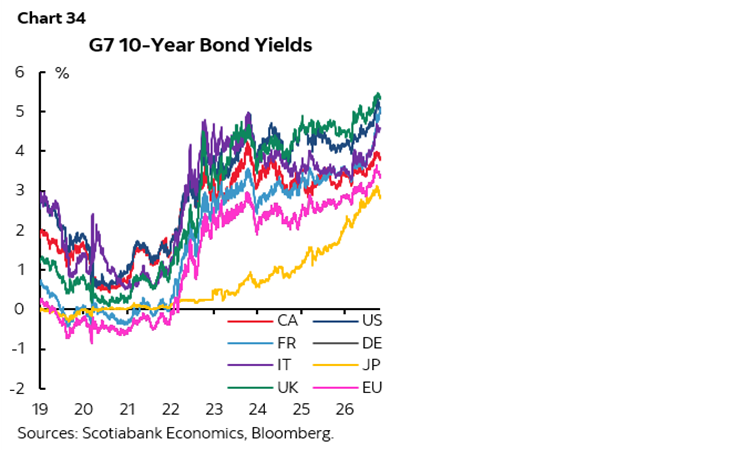
My colleague Jay Parmar explains in this section that in the UK, attention turns to Chancellor John Healey’s first Budget on Wednesday under the new Andy Burnham government, against a difficult backdrop of elevated borrowing costs relative to peers (chart 34), an energy-driven growth shock and mounting cost of living pressures. The central challenge will be balancing market demands for fiscal discipline, with debt elevated and borrowing running ahead of OBR projections, against pressure for household relief and no further tax increases on businesses. That balancing act has become harder as weaker growth and higher inflation following the Middle East war are estimated to have reduced fiscal headroom to £10–20 billion, from £23.6 billion following Chancellor Reeves’ earlier consolidation.
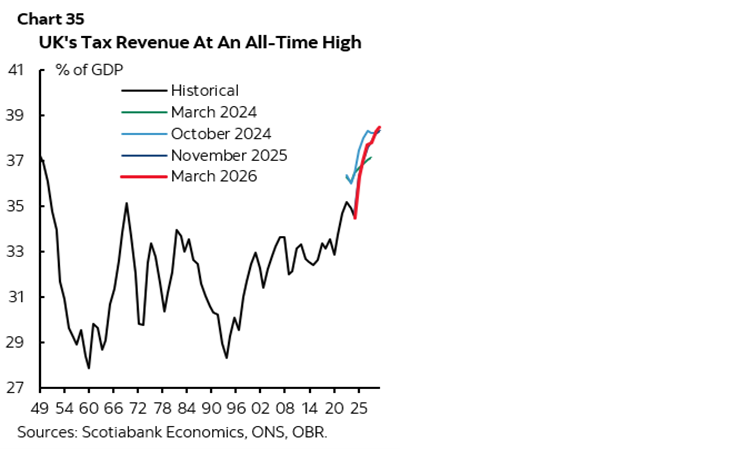
The room for manoeuvre therefore looks limited given existing spending commitments, including higher defence spending targets, alongside pressure to provide new support for households. The government may, however, have some flexibility on capital spending under the fiscal framework. Further revenue raising measures are likely, but an already elevated tax burden (chart 35), alongside pledges not to raise income tax, National Insurance, VAT or capital gains tax, narrows the options. One possibility is an increase in the bank surcharge from 3% to as high as 8%. Spending restraint offers an alternative, though commitments to maintain the costly pension “triple lock” limit the scope for cuts, leaving welfare spending as potential area for savings.
With fiscal space limited and the government unlikely to want to risk adding to the BoE’s inflation challenge, the Budget is therefore likely to favour targeted, temporary support rather than a large fiscal package. This would limit the risk of exacerbating inflationary pressures, pushing gilt yields higher and raising debt-servicing costs, which would further erode the government’s fiscal room.
GLOBAL MACRO—GDP AND INFLATION IN FOCUS
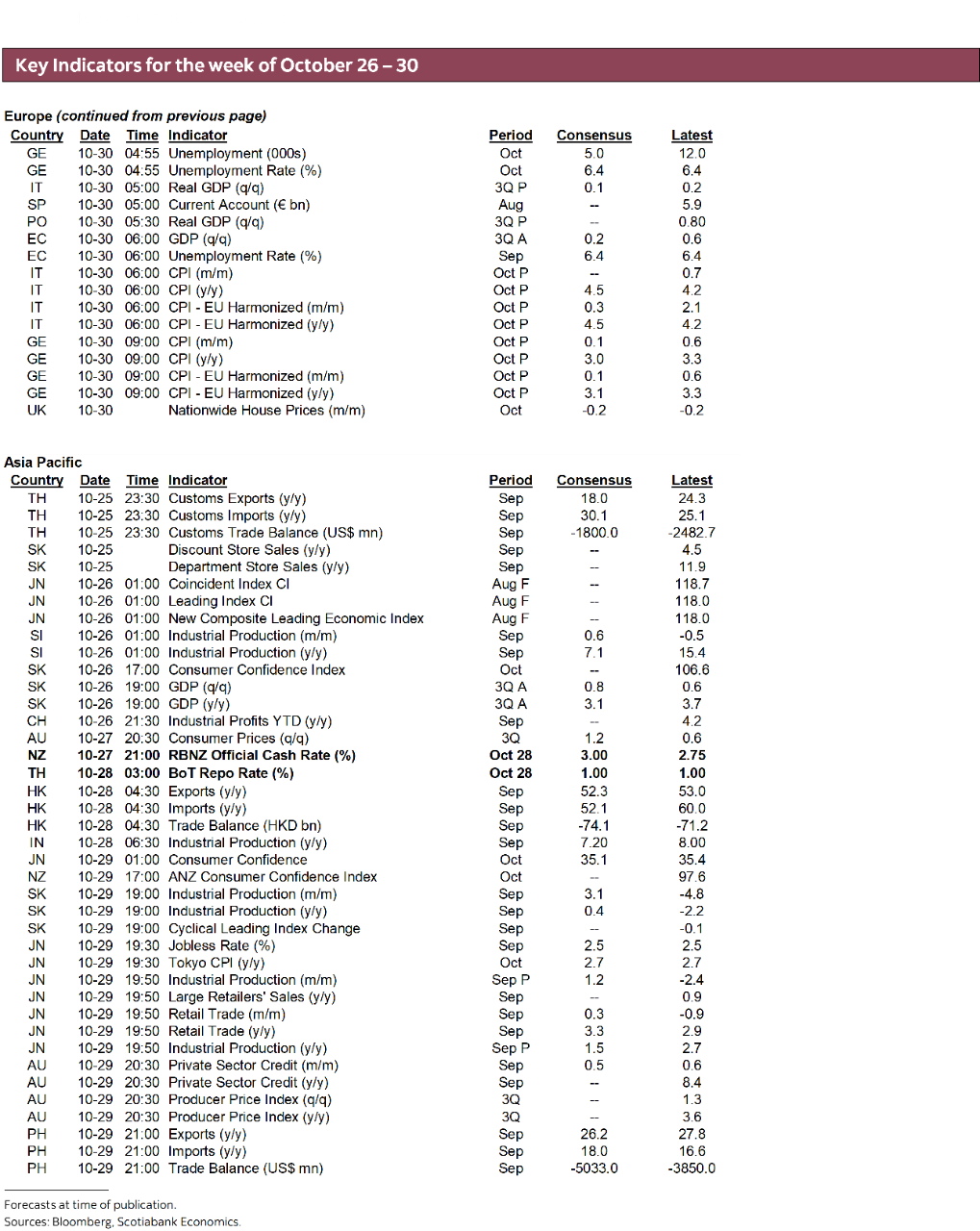
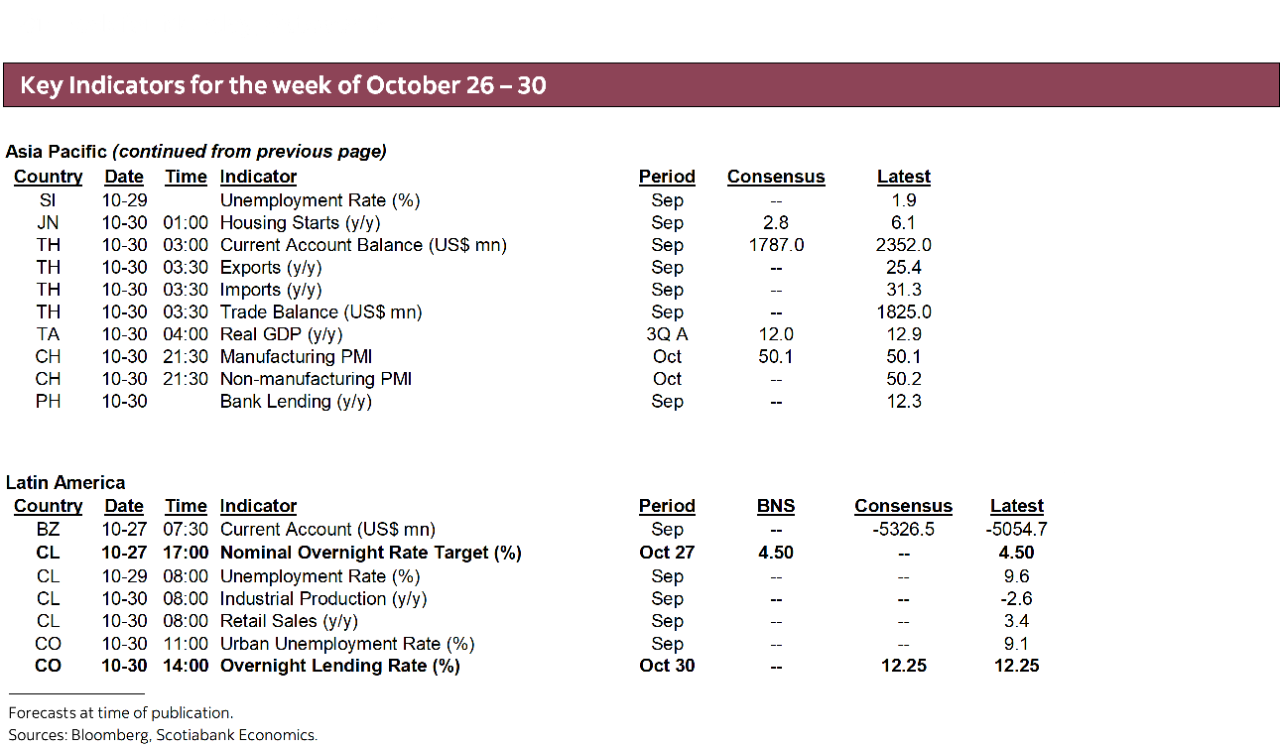
A wave of GDP figures will primarily focus upon the US, Canada, Mexico and Eurozone. US GDP is expected to grow by 3% q/q SAAR (Thursday), but there is a wide variation of estimates. Canada’s economy is expected to post solid GDP growth for the month of August (0.2% m/m SA) and September’s preliminary guidance will help to inform the overall third quarter (Friday). Eurozone GDP is forecast to post very slow growth of under 1% q/q SAAR during Q3 (Friday). Mexico’s economy is expected to slow from 1.4% q/q SA nonannualized in Q2 to well under 1% q/q (Friday).
Inflation figures from three economies are due. Australia releases Q3 and monthly September readings on Tuesday. US PCE may be the showstopper if an estimated 0.4% m/m rise in core PCE materializes and therefore shows persistent near-term upward pressure on Thursday. Thursday’s Japanese CPI reading for Tokyo will be released before the Bank of Japan’s decision and is expected to be little changed around 2.7% headline inflation but possibly cooler core inflation.
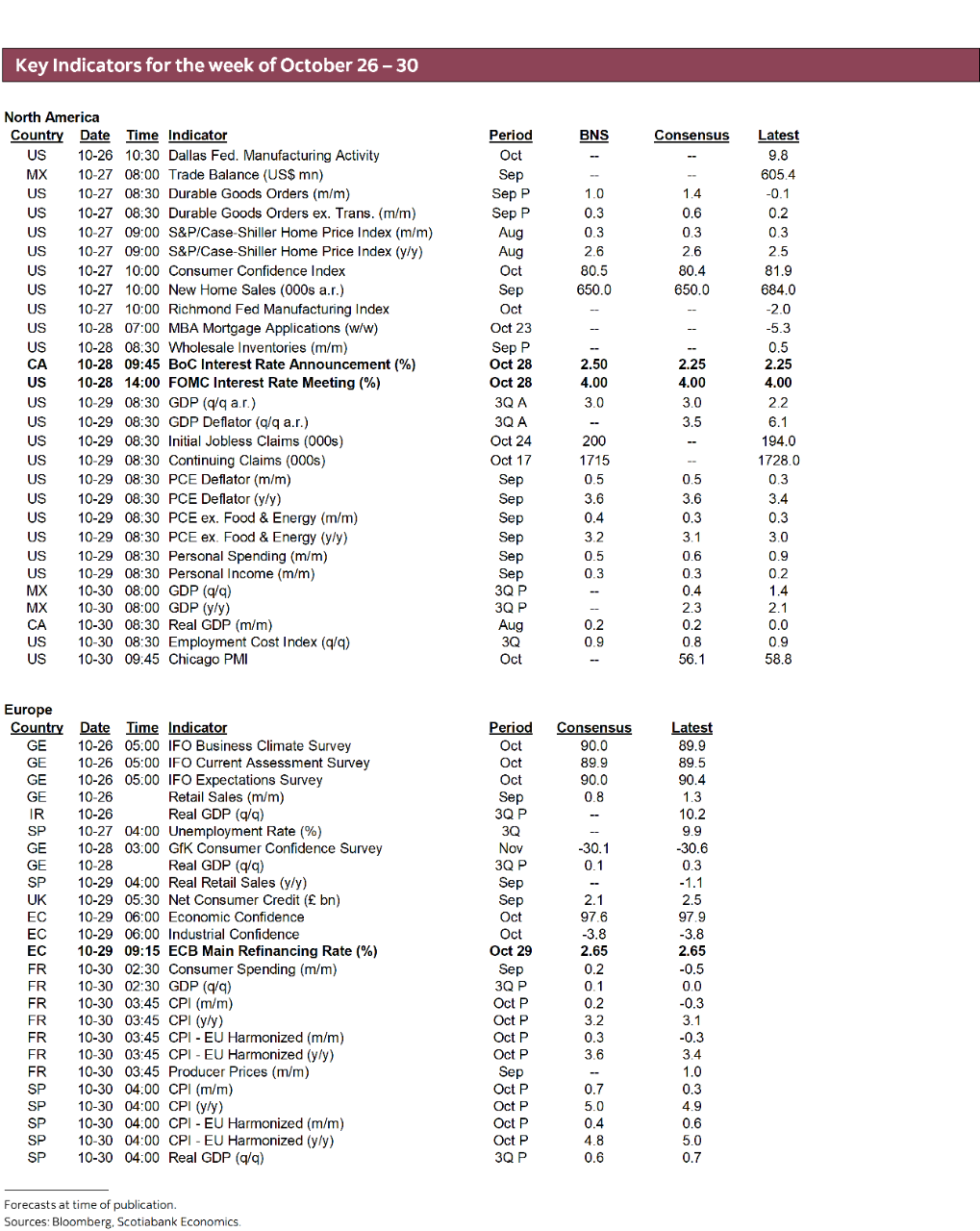
Several other US releases are due and summarized in the accompanying tables. Most of the focus may be upon spending and incomes during September (Thursday), the employment cost index during Q3 (Friday) and consumer confidence (Tuesday).
Japan releases September estimates for the jobless rate, retail sales, industrial output and housing starts on Thursday.
DISCLAIMER
This report has been prepared by Scotiabank Economics as a resource for the clients of Scotiabank. Opinions, estimates and projections contained herein are our own as of the date hereof and are subject to change without notice. The information and opinions contained herein have been compiled or arrived at from sources believed reliable but no representation or warranty, express or implied, is made as to their accuracy or completeness. Neither Scotiabank nor any of its officers, directors, partners, employees or affiliates accepts any liability whatsoever for any direct or consequential loss arising from any use of this report or its contents.
These reports are provided to you for informational purposes only. This report is not, and is not constructed as, an offer to sell or solicitation of any offer to buy any financial instrument, nor shall this report be construed as an opinion as to whether you should enter into any swap or trading strategy involving a swap or any other transaction. The information contained in this report is not intended to be, and does not constitute, a recommendation of a swap or trading strategy involving a swap within the meaning of U.S. Commodity Futures Trading Commission Regulation 23.434 and Appendix A thereto. This material is not intended to be individually tailored to your needs or characteristics and should not be viewed as a “call to action” or suggestion that you enter into a swap or trading strategy involving a swap or any other transaction. Scotiabank may engage in transactions in a manner inconsistent with the views discussed this report and may have positions, or be in the process of acquiring or disposing of positions, referred to in this report.
Scotiabank, its affiliates and any of their respective officers, directors and employees may from time to time take positions in currencies, act as managers, co-managers or underwriters of a public offering or act as principals or agents, deal in, own or act as market makers or advisors, brokers or commercial and/or investment bankers in relation to securities or related derivatives. As a result of these actions, Scotiabank may receive remuneration. All Scotiabank products and services are subject to the terms of applicable agreements and local regulations. Officers, directors and employees of Scotiabank and its affiliates may serve as directors of corporations.
Any securities discussed in this report may not be suitable for all investors. Scotiabank recommends that investors independently evaluate any issuer and security discussed in this report, and consult with any advisors they deem necessary prior to making any investment.
This report and all information, opinions and conclusions contained in it are protected by copyright. This information may not be reproduced without the prior express written consent of Scotiabank.
™ Trademark of The Bank of Nova Scotia. Used under license, where applicable.
Scotiabank, together with “Global Banking and Markets”, is a marketing name for the global corporate and investment banking and capital markets businesses of The Bank of Nova Scotia and certain of its affiliates in the countries where they operate, including; Scotiabank Europe plc; Scotiabank (Ireland) Designated Activity Company; Scotiabank Inverlat S.A., Institución de Banca Múltiple, Grupo Financiero Scotiabank Inverlat, Scotia Inverlat Casa de Bolsa, S.A. de C.V., Grupo Financiero Scotiabank Inverlat, Scotia Inverlat Derivados S.A. de C.V. – all members of the Scotiabank group and authorized users of the Scotiabank mark. The Bank of Nova Scotia is incorporated in Canada with limited liability and is authorised and regulated by the Office of the Superintendent of Financial Institutions Canada. The Bank of Nova Scotia is authorized by the UK Prudential Regulation Authority and is subject to regulation by the UK Financial Conduct Authority and limited regulation by the UK Prudential Regulation Authority. Details about the extent of The Bank of Nova Scotia's regulation by the UK Prudential Regulation Authority are available from us on request. Scotiabank Europe plc is authorized by the UK Prudential Regulation Authority and regulated by the UK Financial Conduct Authority and the UK Prudential Regulation Authority.
Scotiabank Inverlat, S.A., Scotia Inverlat Casa de Bolsa, S.A. de C.V, Grupo Financiero Scotiabank Inverlat, and Scotia Inverlat Derivados, S.A. de C.V., are each authorized and regulated by the Mexican financial authorities.
Not all products and services are offered in all jurisdictions. Services described are available in jurisdictions where permitted by law.