

Next Week's Risk Dashboard
- Canadian inflation –– The BoC already has what it needs
- BoC surveys likely to reveal higher inflation expectations
- Alberta’s secessionists will probably be sent packing…
- …while BC Conservatives are sitting pretty into the election…
- …as both developments could support provincial spreads
- Why Canadian holdings of US government securities have risen
- Global PMIs to inform risks to growth, inflation
- Pre-BoE UK data dump
- Kiwi CPI to inform the RBNZ’s next step
- Tracking Canadian consumer spending
- BI faces a divided consensus
- BoK likely to take a breather after leading
- BSP –– More work to do
- Turkey’s central bank –– it’s all relative
- Russian central bank –– leaving cuts in the rearview mirror
Chart of the Week
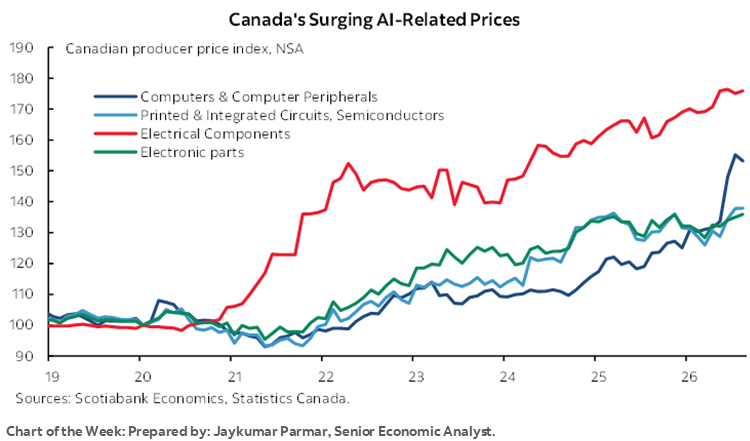
Six years ago, an aging Madonna called Canada ‘boring.’ I can’t say I’ve ever been a fan of hers, but readers of a note like this one certainly wouldn’t complain about a lack of anything interesting happening on the northern side of Lake Ontario.
This week will drive home this point as it’s basically Canada’s turn to shine. There will be two provincial votes coming up including one that is more likely to solidify than divide Confederation, key data, and potentially critical information on the Bank of Canada’s next steps. I suspect the country will emerge stronger after this week, putting aside self-immolating regional divisions. With a rock star Prime Minister acting as the poster man of the global resistance to isolationism, bad economics and division while leading rapid changes that have been afoot for some time now, this country is punching well above its typical weight within most circles of meaningful influence.
With the deserved focus, Canada is also attracting odd attention from folks who normally pay little attention to the country. An example is the conspiracy theory that posits that some combination of clandestine and possibly nefarious behaviour has China parking its officially reported US bond holdings in Canada. Canada, of all places!
First, China’s falling holdings of longer-dated US Treasuries and agencies probably at least partly reflects a narrowing trade surplus with the US over much of the past five years.
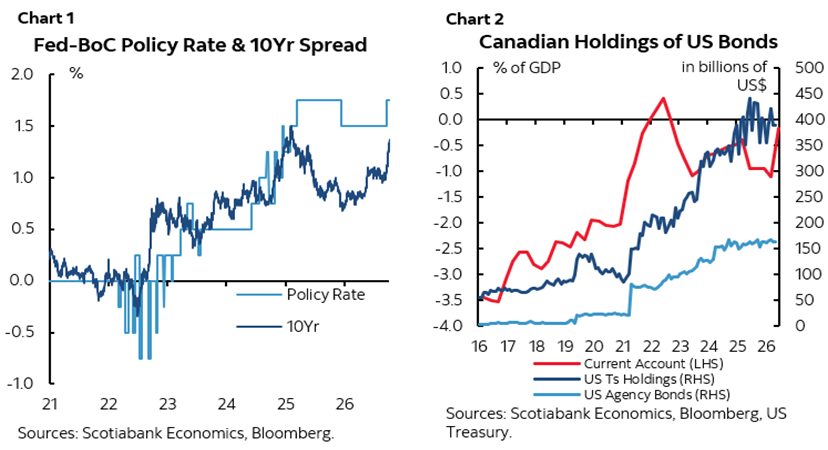
Second, the main reasons for Canada’s rising holdings of US Ts and agencies have been the relative attractiveness of US Ts now versus a few years ago (chart 1) and developments in the balance of payments. Canada’s move toward a balanced current account position from the wide deficits of years past requires less of a capital account surplus to fund the net outflow of trade and investment income receipts. That isn’t incompatible with changes in portfolio and indirect flows that would open up more appetite for US securities with offsets elsewhere (chart 2).
The US will be quiet this week, except for the politicians, given the final two weeks of midterm campaigning. Several regional central bank decisions, US earnings and limited global data risk will also factor into the week’s developments.
CANADIAN INFLATION––ALL THE EVIDENCE THAT’S NEEDED
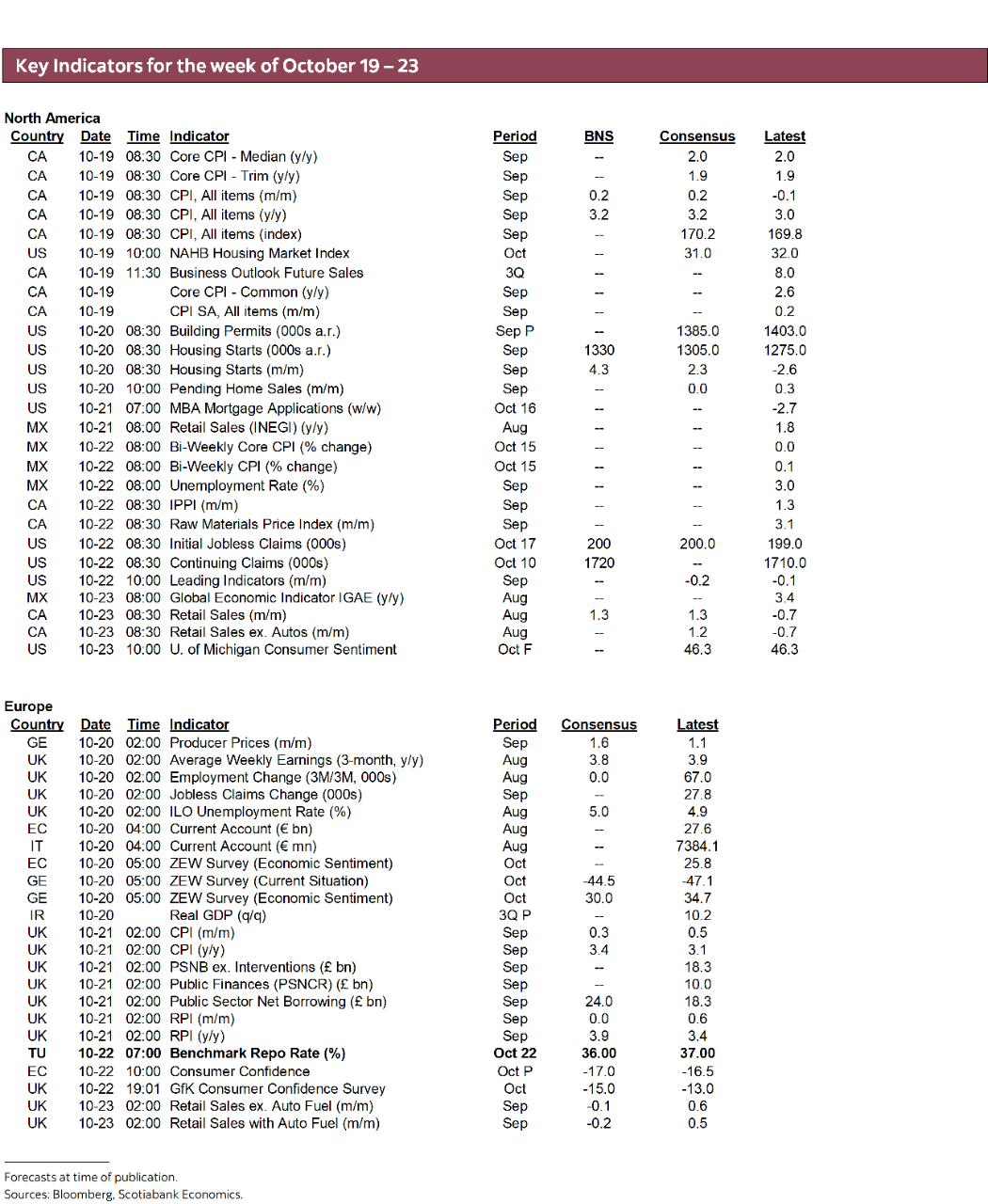
The last set of inflation readings before the Bank of Canada’s next policy decision on October 28th arrives this week. A triple-header includes CPI for September on Monday, followed three hours later by Q3 BoC surveys including measures of inflation expectations, and then three days later by producer prices for the same month.
The suite of readings could be highly impactful to expectations for the October 28th and subsequent decisions by the Bank of Canada.
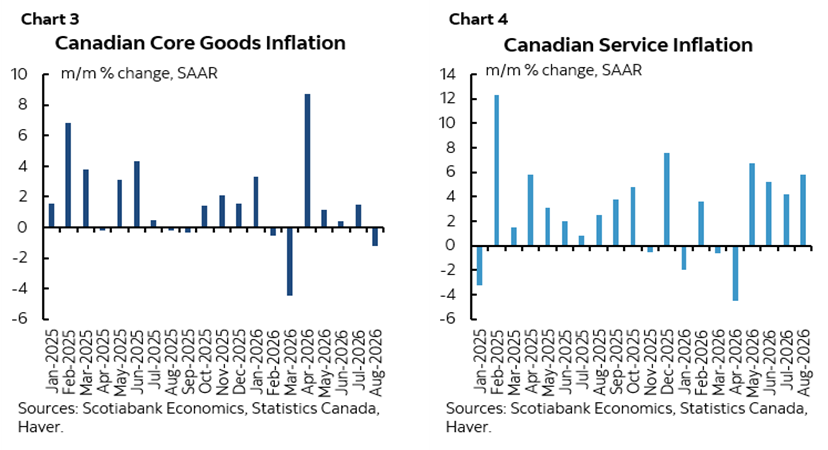
CPI is forecast to post a gain of 0.2% m/m NSA, as per the polling convention, and 3.2% y/y (3.0% prior). Gasoline prices moved higher and food prices will probably contribute very little. Core goods inflation is expected to rebound (chart 3) and core services inflation is expected to remain firm (chart 4).
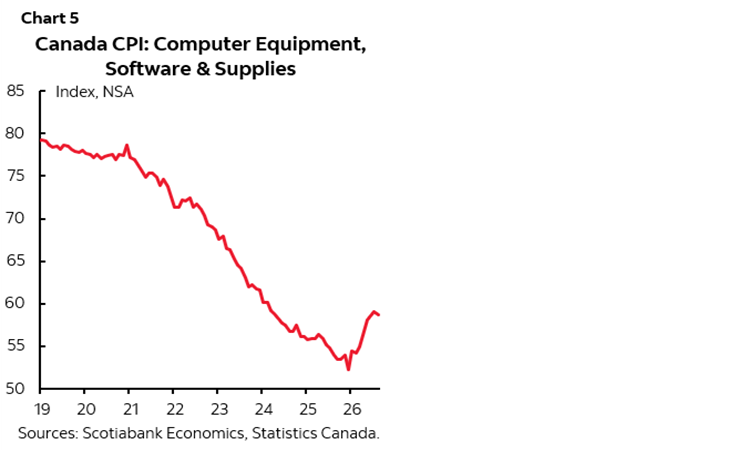
Canada is also in the early stages of getting tech/AI-fed inflation. Chart 5 highlights one example of this point especially when married to the relatively recent surge in data centers (here) with hundreds more expected particularly in Alberta. Other examples include rising water charges and electricity prices in CPI.
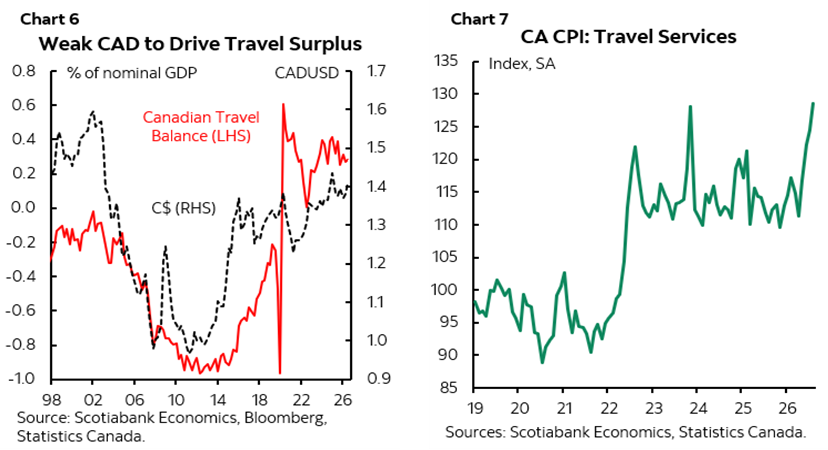
Canada is also seeing a substitution toward domestic travel by Canadians and by foreigners coming to Canada partly in light of the cheap C$ (chart 6). The effect is contributing to spiking travel prices (chart 7).
The trickier part involves estimating measures of core inflation. Traditional core inflation has been running at 3% m/m SAAR or higher for four consecutive months and another firm print is anticipated. It’s pretty obvious that there is pass through of various cost pressures in readings like that.
More difficult to anticipate are the trimmed mean and weighted median measures of inflation in month-over-month terms rather than the slow-moving y/y compounded readings. There just isn’t the amount of advance data needed to make a reasonable attempt at estimating.
Yet those two measures have also been warm at 2¾% m/m SAAR for the past two months. The three main core measures are shown in chart 8.
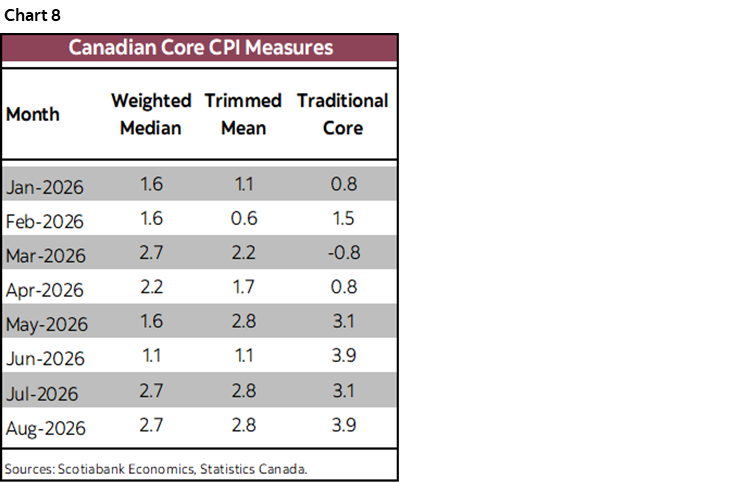
In fact, all measures of inflation are on or above the BoC’s 2% inflation target. Total CPI is running at 3%+ y/y pending the latest update. Traditional core CPI has been running at 2%+ y/y and 3%+ m/m SAAR for four months as noted. Trimmed mean and weighted median CPI have been running at about 2% y/y on average and warmer in the past couple of months.
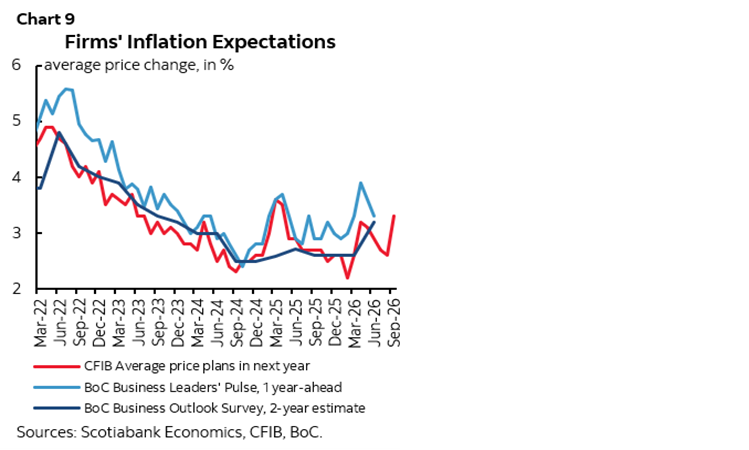
Key in terms of the BoC’s surveys will be whether their measures of inflation expectations follow fresher, higher frequency readings such as the CFIB small business measure that have moved higher (chart 9).
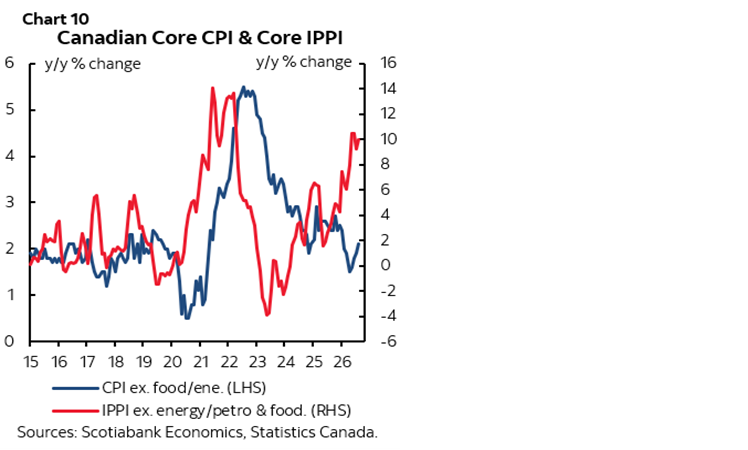
Core producer prices will matter because they’ve been sending up smoke signals on inflation risk for quite a while (chart 10). Movements in producer prices ex-food and energy serve as a leading indicator of core consumer price inflation and could well partially explain the recently warmer readings with potentially more to come.
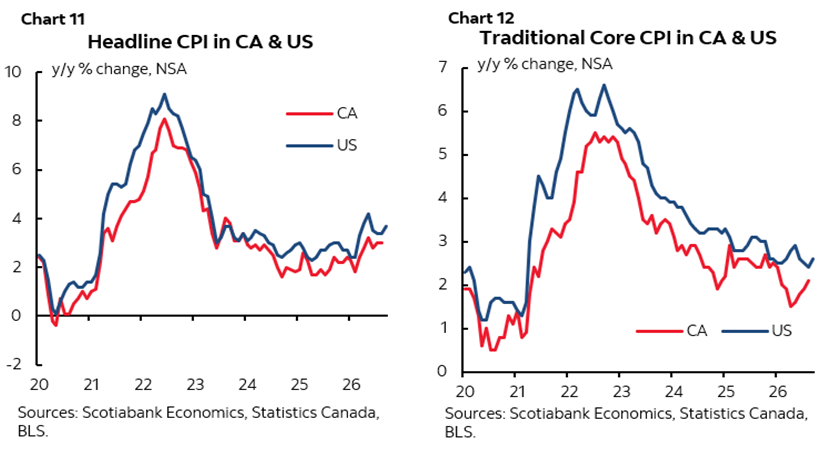
There is also the matter of how Canadian inflation is not an exclusively Canadian phenomenon. Canada and the US are still tightly integrated economies and supply chains reflect this point – notwithstanding the Trump administration’s attempts to cause harm. As a result, Canadian and US headline and core CPI inflation tend to be highly correlated (charts 11, 12). As the US grapples with at least a temporary outburst of inflationary pressures, Canada is likely to do so as well.
Whatever happens, it won’t change my opinion that smoothed inflation is on or above the BoC’s 2% target, so why is the policy rate at the lower bound of the neutral rate range and zero if not negative in real terms? If the BoC is serious about its inflation target, then it has some work to do.
VOTES IN ALBERTA AND BC
The week will start with one important provincial vote and end by transitioning to another.
Alberta Likely to Vote ‘Remain’
First up is Alberta’s 10 referenda questions that are nicely summarized here. The most important is the one that asks “Should Alberta remain a province of Canada, or should the government of Alberta commence the legal process required under the Canadian Constitution to hold a binding provincial referendum on whether or not Alberta should separate from Canada?”
Phew. What a mouthful, and it has been said that the question is too convoluted, wordy, and potentially confusing to some of the voters.
Elections Alberta notes that the ballots will be counted and reported starting with the most important question on separation first. Media outlets will begin coverage after polls close at 9pmET (7pmMT). By law, this large number of questions is given 48 hours for a completed count. Further details are here.
Turnout is key and so far it appears to be high based upon advance polling and mail-ins. Advance voting extended over Tuesday October 13th to Saturday October 17th. Hundreds of thousands have already voted including 658,000 who requested mail-in ballots, 491k who have already sent them in as of this past Wednesday, and half a million who have voted in advance voting so far. That’s about one-quarter of Alberta’s voting age population (491k + 500k). Elections Alberta is expecting turnout of 85%.
A polling aggregator site estimates that 76% of Albertans will choose to remain with individual polls indicating a strong majority in favour of ‘remain.’
We hope so as argued for months (here). Alberta is landlocked and needs collaboration from its neighbours on key matters such as oil pipelines. Alberta would probably be in a weaker position to negotiate trade and investment agreements outside of Canada than within. Alberta does not have its own currency and would struggle if it ever chose to establish one’s credibility. Alberta has no independent central bank. Alberta would have to negotiate the share of federal debts it takes with it. Alberta would likely suffer a negative confidence shock across investors. Alberta, in other words, would likely fare worse than Brexit in the absence of some shock absorbers. Further, “Alberta’s” land could be contested as not being its own. And Alberta under some future scenario marked by plunging oil prices would have no national safety net to fall back into.
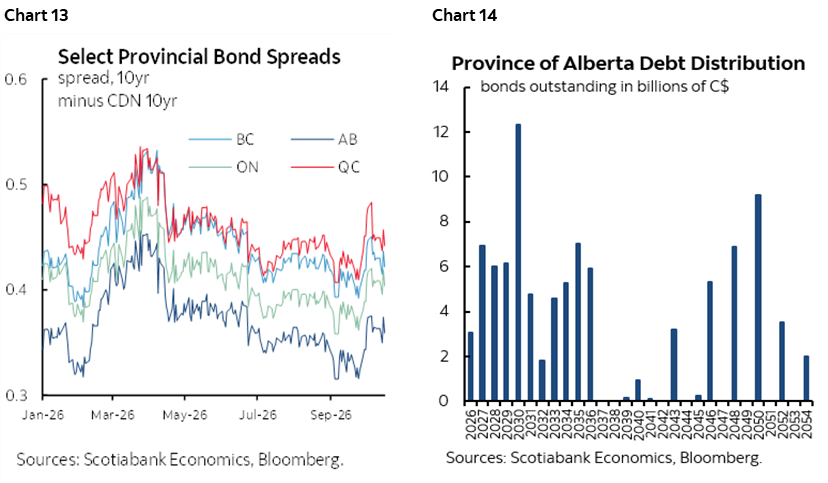
Sweeping away such uncertainty could mildly benefit Alberta spreads, but they’re already the tightest among the provinces over comparable maturity 10-year Canadas (chart 13). A low probability high impact surprise could be greeted very negatively by Alberta bondholders. The province’s debt is distributed across a range of maturities but there is still a lot of short-term debt to be rolled over in coming years (chart 14).
Left stinging in terms of the relationship is US political interference in support of separatists and meddling by people like Elon Musk. A ‘remain’ vote would bat away this foreign interference.
BC Election—Why?
This will be the final week of campaigning in BC ahead of the vote on Saturday October 24th. It’s feeling like a replay of when Ontario Liberal Premier Peterson called an early election back in 1990 —only to lose to the left wing NDP under Bob Rae and his finance minister, nicknamed ‘pink Floyd’.
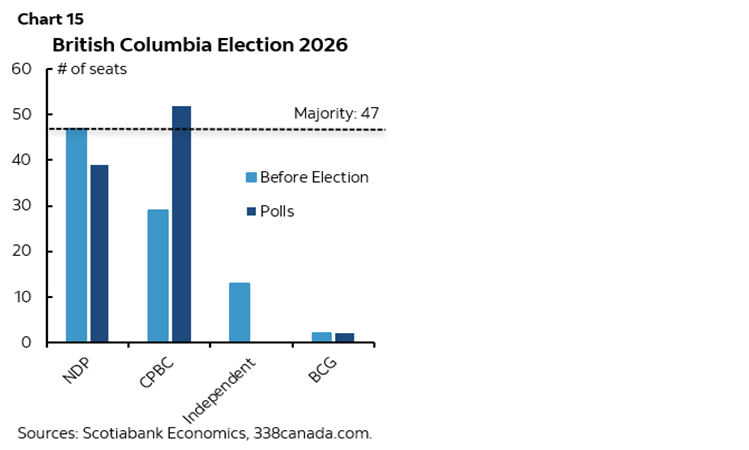
That could be where the parallel stops. This time it was an NDP Premier––David Eby––who called an early election and the provincial Conservatives are polling favourably with a majority within reach (here). The CPBC party is ahead in the polls (chart 15) and seat mapping portrays a high chance at a majority.
This site offers a decent summary of the party platforms. The Conservatives offer a tax cut, greater cooperation on pipelines and various other nuggets.
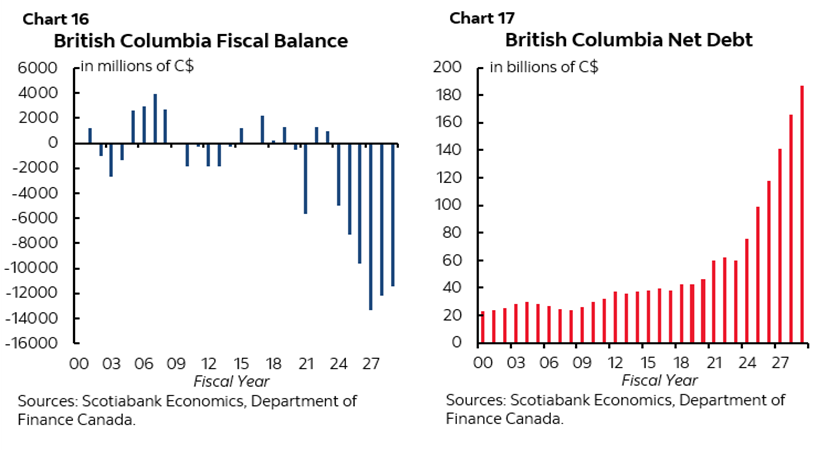
BC’s spreads have been close to Quebec’s as the widest over Canadian 10-year bonds among the biggest four provinces (see earlier chart). Under Premier Eby’s administration, BC has been downgraded eight times in total by the main credit rating agencies. Pending an interim update and the next Spring budget, BC’s finances have been deteriorating and marked by rising deficits (chart 16) and net debt (chart 17).
In fairness to the province, however, it has been battered by various factors such as US tariffs on its lumber industry and a weak N.A. housing market. Our latest forecast expects BC real GDP to grow by only 0.7% this year before perhaps accelerating next year.
CENTRAL BANKS—Opening Acts
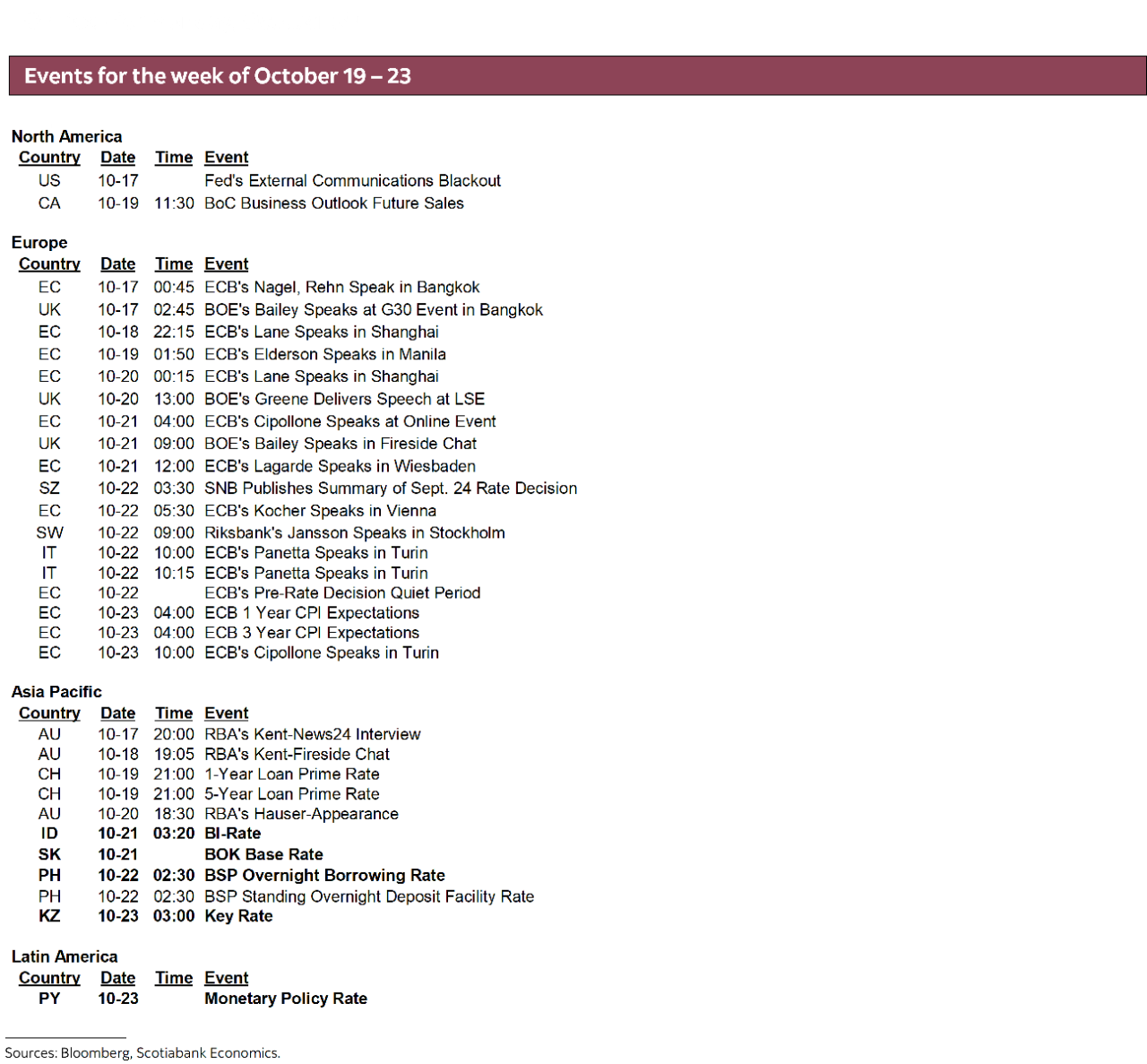
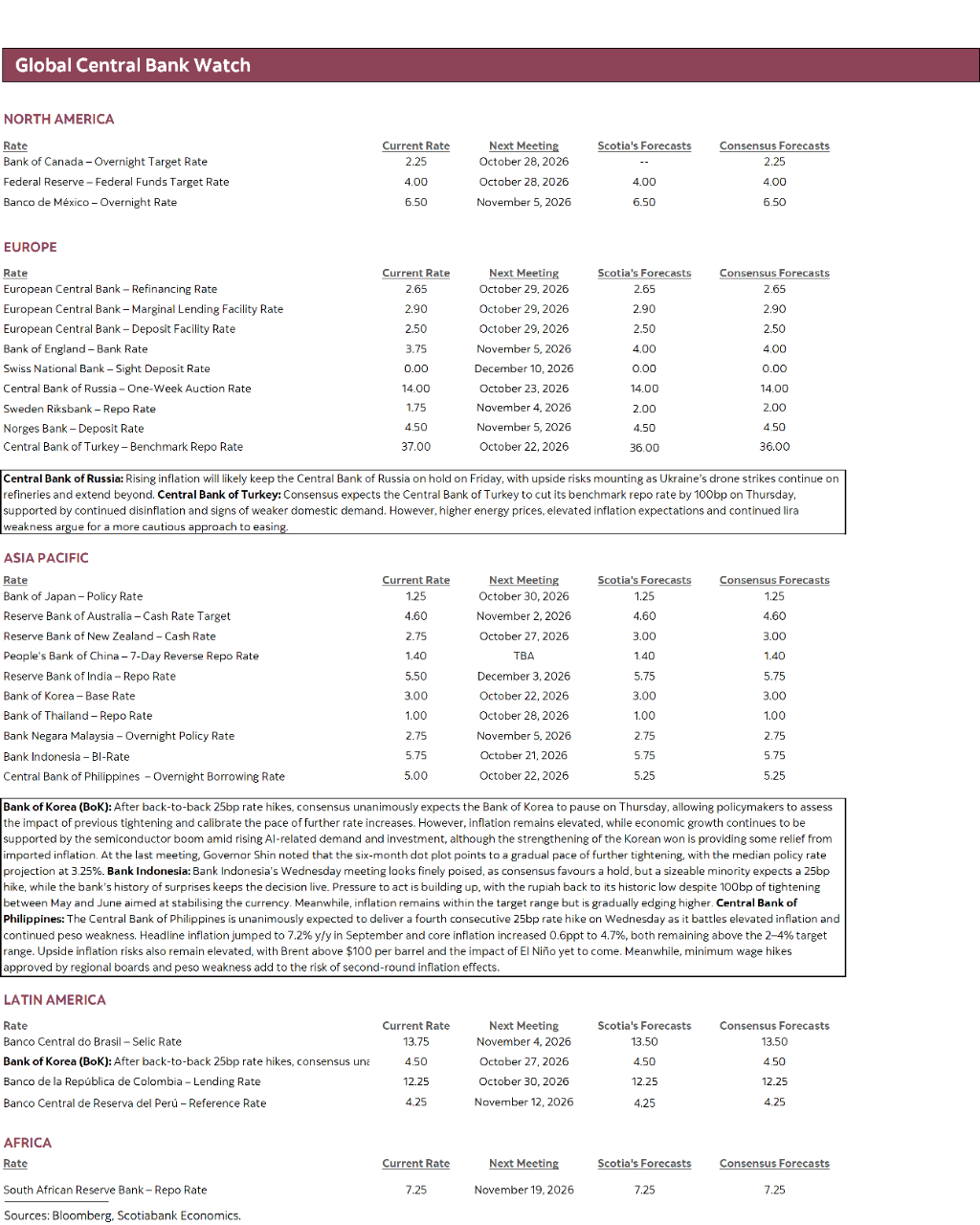
Five regional central banks weigh in with decisions this week as the FOMC slips into blackout followed by the BoC doing likewise. This week’s decisions will be a warm-up act to the start of another round of decisions from the world’s biggest central banks. A possible mixture of hikes, holds and cuts could emerge.
Bank Indonesia—Divided Consensus as Rupiah and Stocks Tumble
About two-thirds of consensus expect no rate change to Bank Indonesia’s reference rate while one-third expect a hike to be delivered on Wednesday. Welcome to the notoriously Wild West of central banking where no guidance and random actions are commonplace and perhaps more acceptable for an EM central bank that the world’s most influential one. Rupiah weakness adds to imported commodity pressures on inflation. New information includes a warning from MSCI Inc. that Indonesia’s emerging-market status was being questioned which could see it removed from global benchmarks. Indonesia’s stock market sank on the news.
Bank of Korea—Hoe vs. Shovel
Consensus unanimously expects a hold at a base rate of 3% on Thursday. 50bps of hikes in the past two months might lend room to take a breather this time. The hikes were positioned as pre-emptive in nature to ward off some of the inflation risk. Governor Shin said at his last press conference “There’s a Korean saying that if you fail to stop something with a hoe, you’ll end up having to stop it with a shovel, meaning the cost of responding too late is much greater.” That’s the talk of insurance hikes. Much like how the BoK led other central banks in this regard when pandemic inflation became feared, it is doing so once more while others – looking at you, BoC – are lagging behind again.
Bangko Sentral ng Pilipinas—Are You Sure That’s Enough?
Consensus unanimously expects BSP to raise its overnight borrowing rate by 25bps to 5.25% on Thursday. Inflation is back on an upswing with total CPI jumping by over a full percentage point to 7.2% y/y in September and surpassing expectations. The easing cycle that brought the rate 225bps lower ended in February. Since then, 75bps of hikes have been delivered with material risk that more of the remaining 150bps of prior easing is poised to be eliminated. Commodity pressures and probable El Niño effects will bolster inflation risk alongside the ongoing effects of peso depreciation. Since March, the peso has dropped by almost 10% to the dollar.
Central Bank of Turkey—It’s All Relative
Most within consensus expect a one-week repo rate cut of -100bps to 36% on Thursday. Inflation remains sky high at about 30% y/y with core CPI at about 29% y/y, but limited progress toward lower readings has been registered. Having said that, the lira has continued to plummet this year, losing 13% of its value to the USD ytd and adding to future inflation risk alongside energy and food prices.
Bank of Russia—Rearview Mirror
Most within consensus expect no change to the key rate of 14% on Friday as the prior easing cycle is in the rearview mirror. Core inflation has recently begun rising once more to 5½% y/y and so it’s not just energy and the effects of Ukraine’s drone attacks that has been lifting total inflation to well over 6% y/y.
EARNINGS—BROADENING OUT
The US Q3 earnings season will continue with 74 S&P firms releasing. Key names will include GE, 3M, KeyCorp, Netflix, Capital One, and Tesla. The names will broader out from this past week’s heavy focus upon key financials.
Of the limited number of firms that have released thus far, about 80% have beaten earnings expectations and 55% have beaten on sales (chart 18). The light breadth and limited sample of under 10% of firms still leaves plenty of room for caution.
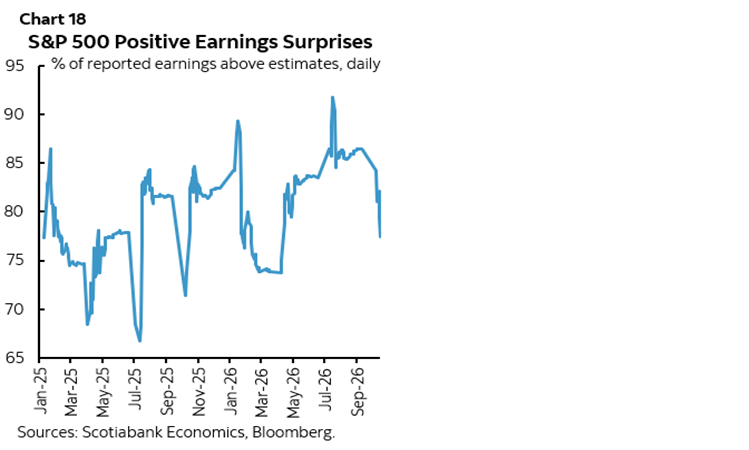
For example, the combined earnings and revenues standing relative to consensus has been weaker across financials, consumer discretionary stocks, and industrials, relative to consumer staples and technology.
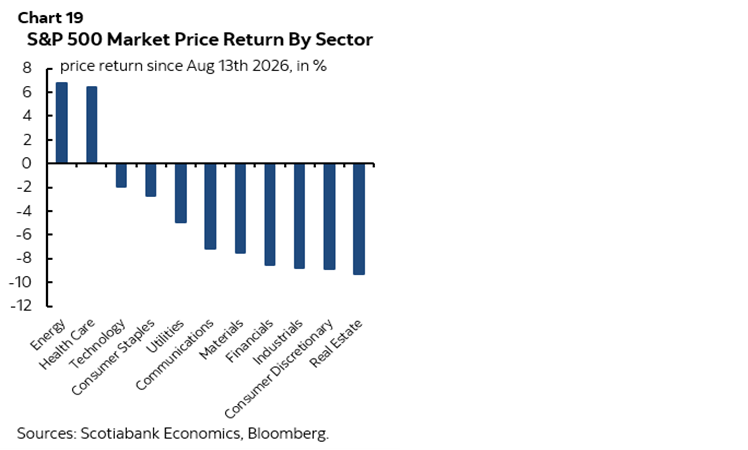
A false narrative, however, is that the recent wavering across equities has been mainly driven by tech stocks. Chart 19 dispels this notion by looking at returns on the S&P since mid-August when the index began to falter. Please see last week’s weekly and other daily notes for views on asset allocation shifts and valuation measures.
GLOBAL MACRO—QUIET IN THE US, EXCEPT FOR THE POLITICIANS
There will be a number of global macroeconomic indicator releases that could influence risk appetite across financial markets this week. PMIs, a monthly UK data dump, updates on Canadian consumer spending, and kiwi inflation are among them. The US will go temporarily quiet. I’ve partnered with Jay Parmar on what follows.
Tracking Canadian Consumer Spending
With two provincial votes, CPI and Bank of Canada surveys, other developments will struggle to garner much attention. Retail sales during August and preliminary guidance for September will be released on Friday. Advance guidance had pointed to a nominal gain of over 1% m/m SA in August, but key will be sales excluding price effects as well as details. Volumes were up by 1.3% q/q SAAR in Q2 and our very tentative tracking leans toward a similarly mild expansion in Q3.
Quiet US Calendar
The US calendar will be dead quiet this week given light data, modest earnings risk, and the pre-decision quiet period at the Fed. That probably means Trump will get all the attention he seeks as midterm coverage dominates with just over two weeks to go until the November 3rd vote. The only readings on tap are ADP’s weekly private payrolls reading (Tuesday) which isn’t terribly helpful, housing starts and pending home sales during September (Tuesday), and weekly jobless claims (Thursday) and oil inventories (Wednesday).
Global PMIs to Inform Growth, Inflation Risks
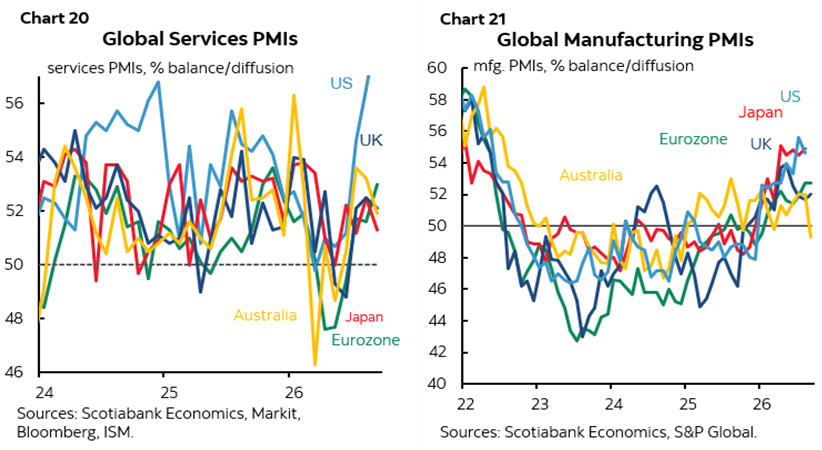
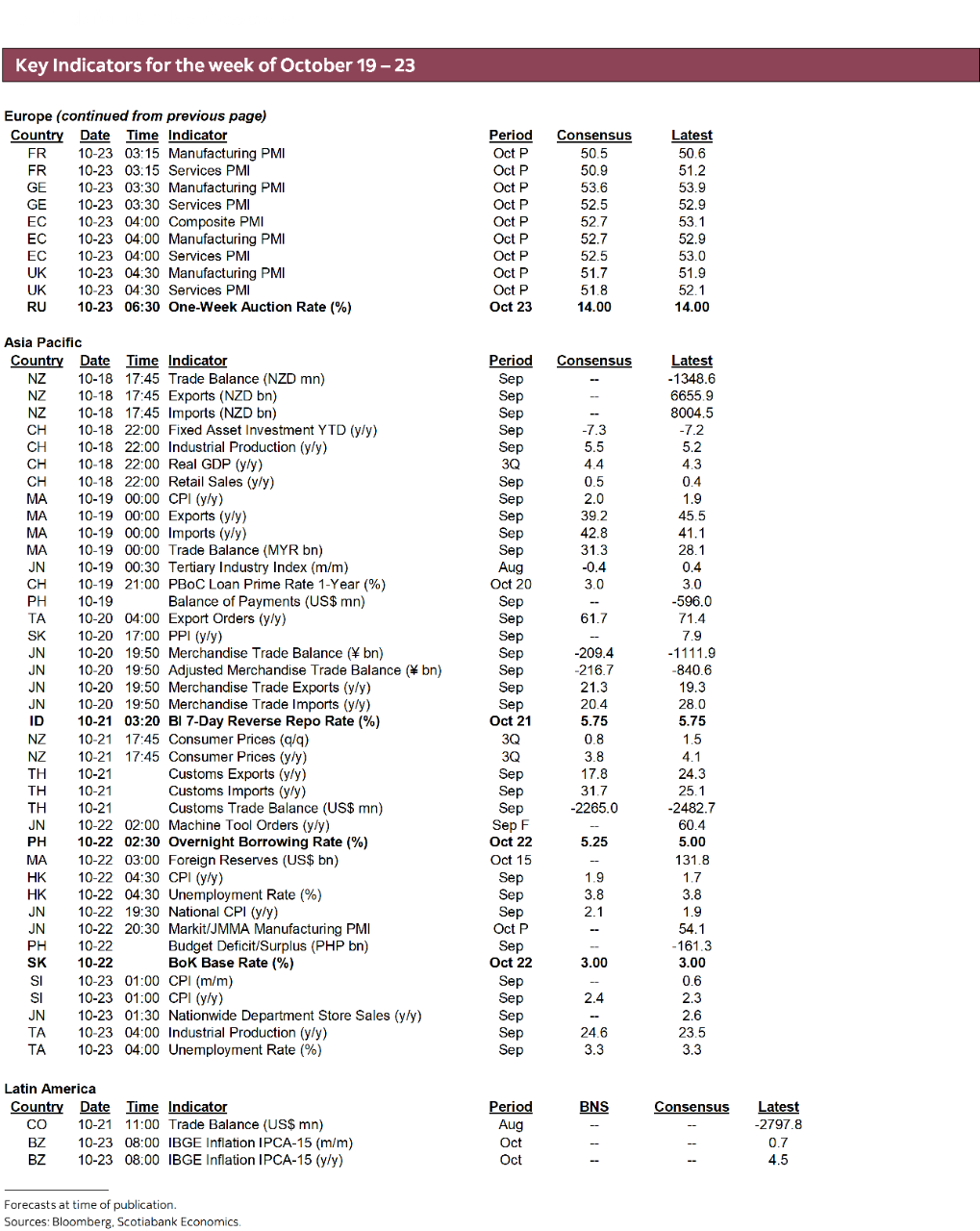
The week concludes with October global PMI releases, starting with Australia and Japan on Thursday, followed by India, the eurozone, the UK, and the US on Friday. The PMIs will offer the first glimpse into whether the strong global growth momentum seen in Q3 is extending into the fourth quarter. Manufacturing activity has remained firmly in expansion territory, supported in part by AI related demand, while services activity has rebounded from the temporary slowdown seen at the onset of the Middle East conflict (charts 20, 21). Beyond headline activity, focus will be on input cost pressures, firms’ ability and willingness to pass higher costs on to consumers, and signs of global supply chain bottlenecks.
Pre-BoE UK Data Dump
The UK calendar is packed with the final labour market, inflation, and consumer spending data ahead of the Bank of England’s November 5th monetary policy meeting. Persistent, elevated energy prices and a higher futures curve have already led markets to price in a 25 bp rate hike in November, putting the focus on whether the incoming data show further evidence of second-round effects on wages and prices.
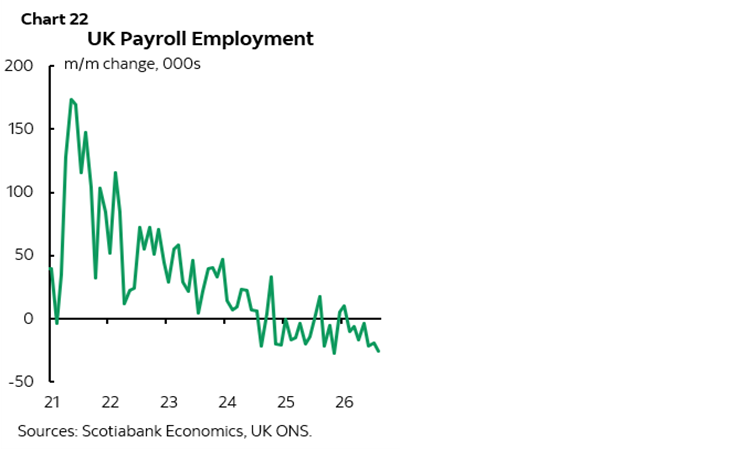
Tuesday’s labour market data are expected to point to further cooling particularly payroll employment (chart 22), with the unemployment rate projected to edge up to 5%. Wage growth will remain key, having continued to run relatively firm at a 4.5% three-month annualized pace. Meanwhile, headline inflation is expected to rise to 3.4% in September and services inflation expected to remain elevated at 3.6%. However, the focus should be on the month-over-month, non seasonally adjusted core inflation reading, which should provide a clearer picture of inflationary pressures at the margin. Finally, Friday’s retail sales report will provide an updated on the consumers, with the focus on core retail sales volume. Consumer spending has remained resilient so far, with Q3 core retail sales tracking 1.7% growth.
Will Kiwi CPI Embolden RBNZ Hike Pricing?
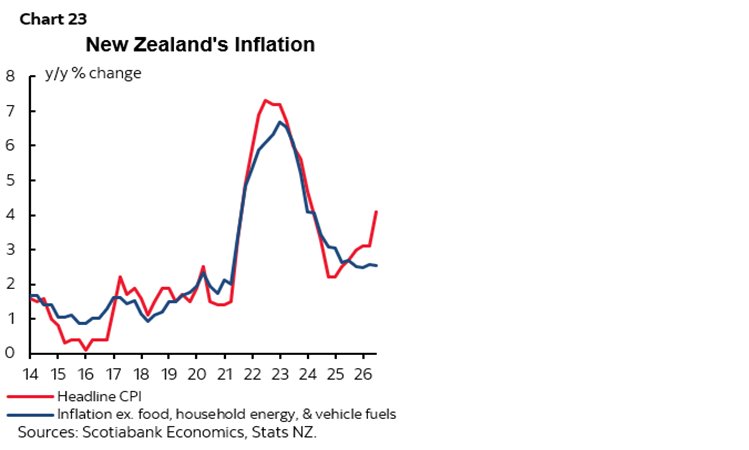
Focus will then shift on New Zealand’s Q3 inflation report, with headline inflation expected to accelerate further by 0.8% q/q, after a 1.5% increase in Q2, largely reflecting higher food & energy prices. However, underlying inflation has been more contained (chart 23), with inflation excluding food, household energy & vehicle fuels remaining within the RBNZ’s 1–3% target range. With markets already pricing in around 20bp of tightening at the October 28th meeting, an acceleration in core inflation would signal broader price pressures and could reinforce expectations for further tightening.
DISCLAIMER
This report has been prepared by Scotiabank Economics as a resource for the clients of Scotiabank. Opinions, estimates and projections contained herein are our own as of the date hereof and are subject to change without notice. The information and opinions contained herein have been compiled or arrived at from sources believed reliable but no representation or warranty, express or implied, is made as to their accuracy or completeness. Neither Scotiabank nor any of its officers, directors, partners, employees or affiliates accepts any liability whatsoever for any direct or consequential loss arising from any use of this report or its contents.
These reports are provided to you for informational purposes only. This report is not, and is not constructed as, an offer to sell or solicitation of any offer to buy any financial instrument, nor shall this report be construed as an opinion as to whether you should enter into any swap or trading strategy involving a swap or any other transaction. The information contained in this report is not intended to be, and does not constitute, a recommendation of a swap or trading strategy involving a swap within the meaning of U.S. Commodity Futures Trading Commission Regulation 23.434 and Appendix A thereto. This material is not intended to be individually tailored to your needs or characteristics and should not be viewed as a “call to action” or suggestion that you enter into a swap or trading strategy involving a swap or any other transaction. Scotiabank may engage in transactions in a manner inconsistent with the views discussed this report and may have positions, or be in the process of acquiring or disposing of positions, referred to in this report.
Scotiabank, its affiliates and any of their respective officers, directors and employees may from time to time take positions in currencies, act as managers, co-managers or underwriters of a public offering or act as principals or agents, deal in, own or act as market makers or advisors, brokers or commercial and/or investment bankers in relation to securities or related derivatives. As a result of these actions, Scotiabank may receive remuneration. All Scotiabank products and services are subject to the terms of applicable agreements and local regulations. Officers, directors and employees of Scotiabank and its affiliates may serve as directors of corporations.
Any securities discussed in this report may not be suitable for all investors. Scotiabank recommends that investors independently evaluate any issuer and security discussed in this report, and consult with any advisors they deem necessary prior to making any investment.
This report and all information, opinions and conclusions contained in it are protected by copyright. This information may not be reproduced without the prior express written consent of Scotiabank.
™ Trademark of The Bank of Nova Scotia. Used under license, where applicable.
Scotiabank, together with “Global Banking and Markets”, is a marketing name for the global corporate and investment banking and capital markets businesses of The Bank of Nova Scotia and certain of its affiliates in the countries where they operate, including; Scotiabank Europe plc; Scotiabank (Ireland) Designated Activity Company; Scotiabank Inverlat S.A., Institución de Banca Múltiple, Grupo Financiero Scotiabank Inverlat, Scotia Inverlat Casa de Bolsa, S.A. de C.V., Grupo Financiero Scotiabank Inverlat, Scotia Inverlat Derivados S.A. de C.V. – all members of the Scotiabank group and authorized users of the Scotiabank mark. The Bank of Nova Scotia is incorporated in Canada with limited liability and is authorised and regulated by the Office of the Superintendent of Financial Institutions Canada. The Bank of Nova Scotia is authorized by the UK Prudential Regulation Authority and is subject to regulation by the UK Financial Conduct Authority and limited regulation by the UK Prudential Regulation Authority. Details about the extent of The Bank of Nova Scotia's regulation by the UK Prudential Regulation Authority are available from us on request. Scotiabank Europe plc is authorized by the UK Prudential Regulation Authority and regulated by the UK Financial Conduct Authority and the UK Prudential Regulation Authority.
Scotiabank Inverlat, S.A., Scotia Inverlat Casa de Bolsa, S.A. de C.V, Grupo Financiero Scotiabank Inverlat, and Scotia Inverlat Derivados, S.A. de C.V., are each authorized and regulated by the Mexican financial authorities.
Not all products and services are offered in all jurisdictions. Services described are available in jurisdictions where permitted by law.