

Next Week's Risk Dashboard
- US nonfarm payrolls preview
- The biennial funny season in US politics will bring more volatility
- US-China mini deal details pending
- Canada’s economy — solid momentum?
- BoC speech on balance sheet plans
- BoC speech on housing markets
- RBA — Going up Down Under
- BanRep — Will the Governor win out this time?
- Inflation is everywhere…
- …as core PCE to inform the Fed’s next move…
- …as EZ CPI to inform the ECB’s next step…
- …ditto for Tokyo CPI and the BoJ…
- US consumers — saving must be highly overrated
- Other global macro reports
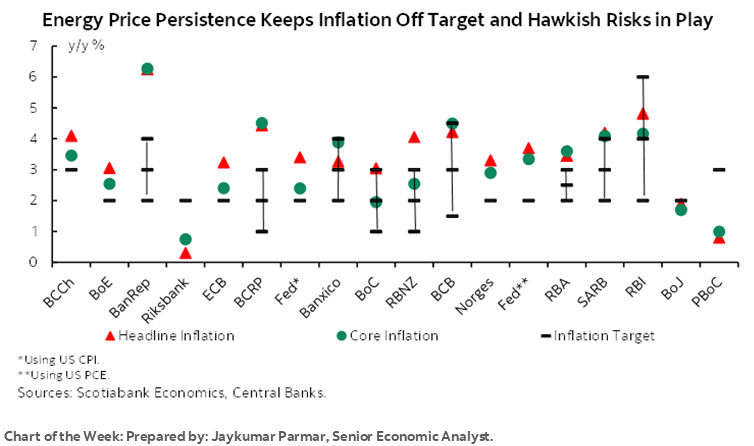
Chart of the Week
With just over five weeks to go until US midterm elections, we’re entering peak biennial funny season for US politics. Showmanship with world leaders, splashy headlines about policy intentions, market jawboning in an effort to improve drivers of affordability pressures, polls aplenty and general attempts at voter appeasement will continue to drive high market volatility. The effects are on display at the highest levels in bond and equity markets and in pockets of markets like potash and soybean prices. The noise is paradise from a trading volume standpoint as year-end draws nearer.
What could play further in this regard is guidance from USTR Jamieson Greer that a partial agreement with China will be announced on Monday that could include agricultural products and medical devices plus select other goods. It won’t be a grand deal by any means given the extended truce on the trade war until January, but it could nibble away at a few micro irritants particularly to groups like US farmers.
There will nevertheless be more important signals in the fundamentals and central bank policy attitudes over the coming week.
A key issue will be whether Friday’s nonfarm payrolls will repeat with another solid gain after the narrow drivers and distorted seasonal adjustments drove 162k rise in July. I’ll explain scepticism. Yet it doesn’t matter much to the FOMC that has declared the labour market to be just fine, but inflation is not.
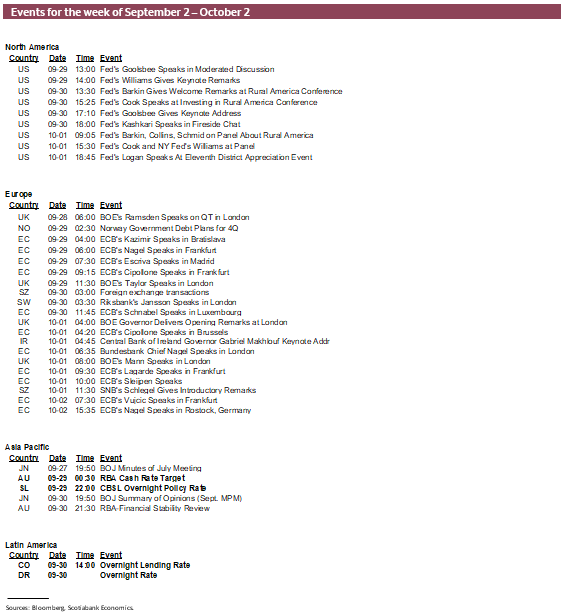
Canada’s economy will be thrust into the spotlight in a holiday-interrupted week with GDP figures. A pair of Bank of Canada speeches may not only inform the policy rate bias but also introduce fresh guidance on balance sheet management tools of relevance to funding and liquidity markets amid evidence of strains. We could see policy shifts being teed up and it’s frankly been too long since the BoC last commented on such matters.
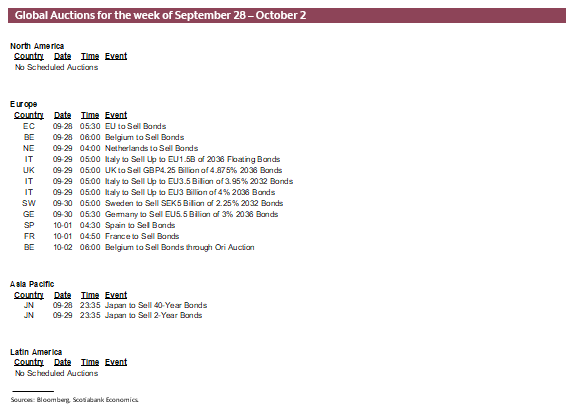
At least one (RBA) of two central banks could hike this week, perhaps both (BanRep the other).
The rest of the week will be dominated by global inflation readings. Fresh measures for September from the Eurozone could inform the ECB’s next step. Australian inflation arrives after the RBA’s decision. Tokyo CPI lands about one month before the BoJ’s next decision. Several other countries will also report fresh inflation readings.
US NONFARM PAYROLLS—EXTRAPOLATE OR DISMISS?
Was August’s reported gain of 162k nonfarm payroll positions an aberration, a technical fluke, or the sign of an accelerating job market? We’ll get the next leg of answers on Friday when nonfarm payrolls for the month of September land along with related measures like the unemployment rate, wage growth and hours worked.
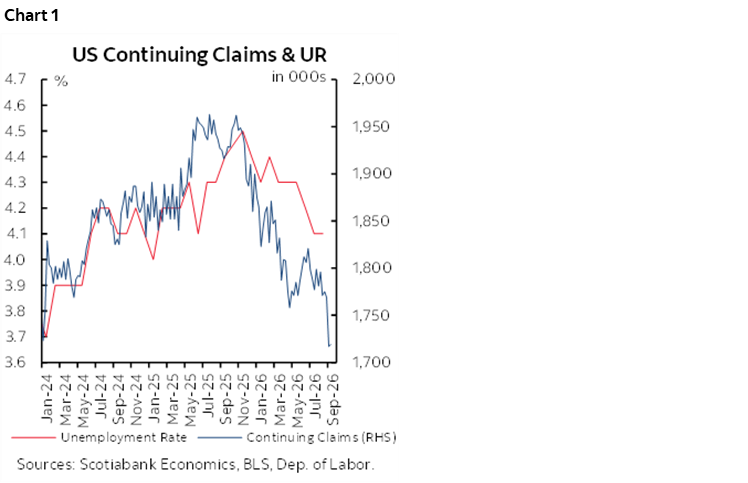
I’ve estimated a rise of about 75k and an unchanged unemployment rate of 4.1%. I wouldn’t say there is much confidence behind these readings with an explanation as to why after trying to rationalize the forecast. The UR could follow continuing claims lower (chart 1) but the wild gains in the household survey measures of employment and the labour force are likely to cool or reverse but the net effect is difficult to ascertain.
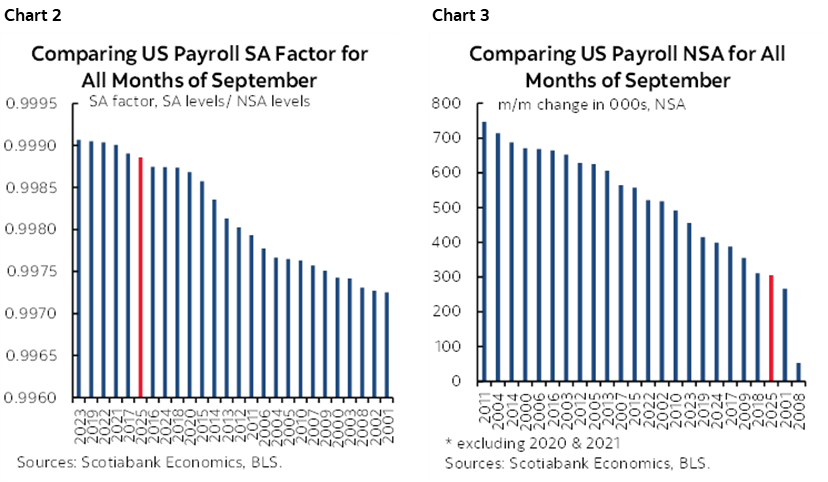
August’s gain was a peculiar one. It occurred due to an abrupt increase in the seasonal adjustment that stood out like a sore thumb compared to multiple recent years and especially in the leisure and hospitality sector. If the SA factor had instead been around last August’s (2025), then only 15k jobs would have been created as argued here. Seasonally unadjusted job growth was lacklustre and in line with a normal August.
Will this tendency repeat itself? I’m not sure. There was no such change in SA factors over prior months. It was the first establishment survey presided over by Trump’s hand-picked BLS Commissioner who had just passed Senate confirmation as the prior month’s report was released. The circumstances looked fishy to me as a strong reason for fading the gain.
Greater reason to expect a cooler reading with more downside than upside potential to my estimate involves noting the potentially one-off drivers of August’s gain.
For one, the San Francisco Fed estimates that payrolls benefited from a weather effect tha t added 40k jobs (here). That high jumping off point for weather effects could be hard to repeat but we perhaps saw it in the form of gains in sectors like construction and leisure and hospitality.
Second government hiring was up by 35k in August which was very much against the longstanding trend. What drove it was a 42k gain in local government hiring in the education sector. This goes against reports of layoffs as ESSA funding has been expiring and driving reduced head counts.
Third, the leisure and hospitality sector gained 62k jobs for the strongest increase in about three and a half years. I’m expecting at least a partial reversal as summertime hiring winds down.
Take out weather and hiring in just the two categories of leisure and hospitality and local government education workers, and payrolls and the entire rest of the labour market only saw about 25k jobs created. That’s without even considering the SA factor argument; in its absence, the rest of the labour market outside of those affected sectors would have probably lost jobs.
Among other considerations are charts 2 and 3 that show the range of SA factors for September and m/m seasonally unadjusted payroll changes in past Septembers. I’ve erred on the side of a higher SA factor than last year’s, leaning toward September 2022 in order to arrive at a payroll gain of 75k along with about a 375k seasonally unadjusted gain that would be consistent with the pattern of slowing unadjusted job gains.
Also recall that Trump’s 50% tariffs on selected imports from Canada kicked in on August 22nd and Canada retaliated on September 8th. Both actions were ahead of the nonfarm reference period but are likely to be small influences upon US jobs.
Layoff trackers are uninteresting for September. There will be more job market readings in advance of payrolls including JOLTS job openings (Tuesday), ADP private payrolls that may land around 60k (Wednesday), Challenger job layoffs (Thursday) and weekly jobless claims.
And so what. The FOMC is focused upon inflation via the price stability part of its dual mandate. It has declared—wisely or not—that the job market isn’t the concern. We’ll see.
CANADA’S ECONOMY—SOLID MOMENTUM?
Canada refreshes GDP figures on Tuesday before local bond markets (but not stocks) shut early at 1:30pmET ahead of the National Day for Truth and Reconciliation when markets will be closed on Wednesday.
We should have a more informed view on Q3 GDP growth and hence sustainability arguments following the rapid 3.3% q/q SAAR pace of GDP growth in Q2. On August 28th, Statcan guided that July GDP was “essentially unchanged” which I’ve taken over time to mean somewhere around -0.1% to +0.1% m/m SA. Our tracking suggests a touch of upside which leans toward mild growth of 0.1% that month. One driver is hours worked that were up 0.6% m/m SA and have grown that rapidly in three of the past four months. GDP is hours times labour productivity, so solid growth in hours is a good start for tracking GDP growth. Other activity readings were mixed.
The preliminary reading for August GDP could well be stronger than July. We know that hours worked were up another 0.6% m/m SA. Other activity readings look supportive after translating advance guidance on nominal readings into value-added GDP tracking.
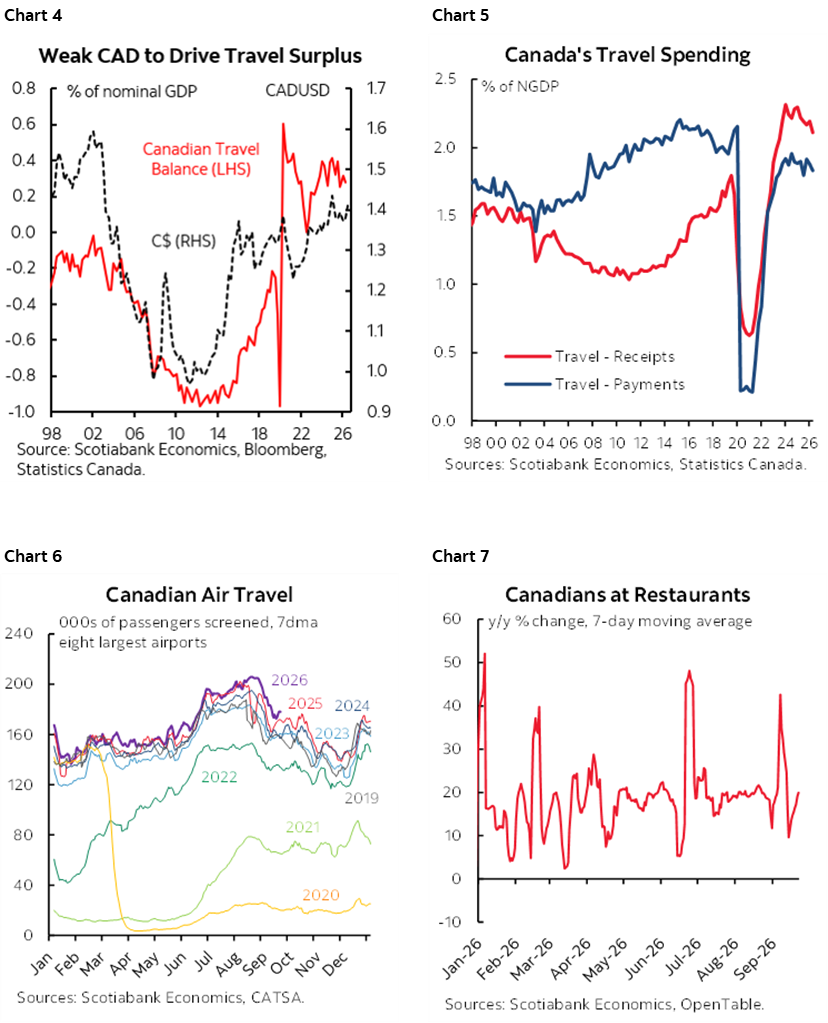
Proxies for service sector activity may add to tracking. Foreign travel spending in Canada has been buoyant while spending by Canadian tourists abroad is weaker than prior years; the heavily undervalued Canadian dollar is a major driver in both directions (charts 4, 5). Air travel usually wanes over late summer in seasonally unadjusted terms but is higher than usual this time (chart 6). I can vouch for that after having difficulty finding a parking spot at Pearson this past week. Growth in restaurant reservations is strong (chart 7).
Given what we know about Q2 GDP and the way we think Q3 is tracking, it could translate into Q3 growth of around 2% q/q SAAR. That wouldn’t be too shabby after 3¼% and would certainly be better than the fears that some had.
This estimate is for monthly production/income-based GDP growth. The more common means of forecasting growth is to use quarterly expenditure-based GDP in the classic Keynesian accounting sense: C+I+G+X-M. That could be meaningfully different as it’s likely that the large inventory drag on Q2 GDP (-4.9 ppts) and the large export addition to GDP growth (4.7 ppts) could swap places but with high uncertainty around their relative magnitudes. In other words, selling down inventories to drive exports in Q2 could reverse via inventory restocking in Q3. That’s why we would advise paying closer attention to final domestic demand (C+I+G ex-inventories) as a better momentum signal and that grew 3.8% q/q SAAR in Q2 and which will be updated only on November 30th.
A side issue is why Governor Macklem did not emphasize Q3 tracking in his recent remarks. His staff surely have their own tracking, but all he did was say Q4 GDP growth might slow to about 1% q/q SAAR—with no data tracking available to support anything other than model noise at this point. That seemed like cherry-picking to me; simply gloss over what was missed to date.
And it matters. That’s because we could be tracking closure of the output gap that is presently in modest excess supply within about 1–2 quarters. If that’s the case, then the BoC may already be behind the inflation battle. Policy should begin tightening in advance of shut capacity especially when the policy rate is at the bottom of the neutral rate range and roughly zero if not negative in real terms alongside a deeply undervalued Canadian dollar.
Further, all measures of inflation are either at or above the BoC’s 2% midpoint of its 1–3% inflation target range. Total CPI is up 3% y/y. Traditional core CPI (ex-food and energy) is up 2.1% y/y and in month-over-month annualized terms it has been running at 3% or higher for four straight months. Trimmed mean and weighted median CPI sit on about 2% y/y and remember these measures are not strict y/y spot readings as opposed to rolling compounded m/m readings. For two months, trimmed mean and weighted median have been at 2¾% m/m SAAR.
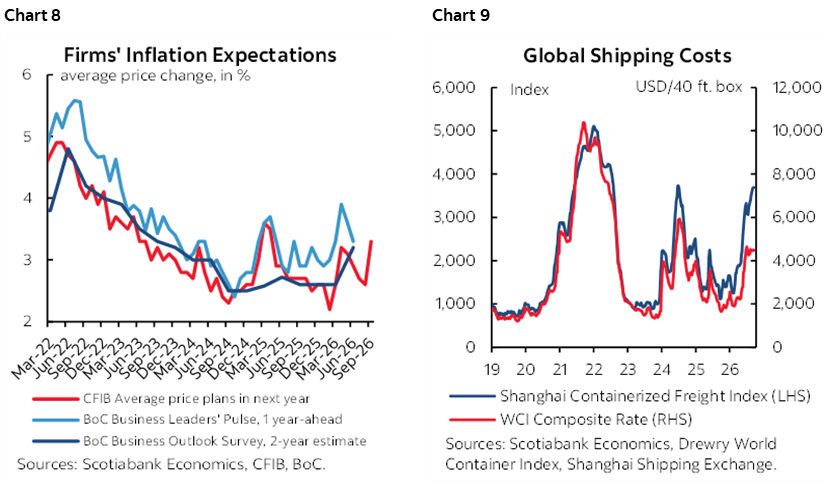
Insofar as expectations are concerned, a small business survey points to higher inflation expectations that tend to be well correlated with the Bank of Canada’s survey measures that are likely to rise when they are released on October 19th (chart 8). In some respects, this is increasingly looking similar to the pandemic era by way of inflation pass through into transportation costs that may be passed through (chart 9).
So, if inflation is your thing as a central bank, then you should be tightening whether in an output gap way of thinking and/or in terms of inflation data dependency. It doesn’t require going hog wild on rate hikes which I wouldn’t expect out of any forward guidance. It should require rebalancing the risks in a step-by-step risk management sense by moving at least toward the middle or upper end of the 2¼% to 3¼% estimated neutral rate range and then evaluating. Otherwise, policy may remain over stimulative from an inflation risk standpoint and here we go again. It would also leave the door open toward an increasing sense that an outright restrictive stance may be required.
BOC SPEECHES COULD INFORM POLICY RATE AND BALANCE SHEET PLANS
What matters, however, may be how the BoC tees things up into the October 28th decision and we could learn more this week. We could also learn more about balance sheet plans.
Before turning to this week’s speeches, recall that Governor Macklem dropped the forward guidance line from the prior statement that deemed the policy rate to be “appropriate,” warned about further upside risk to inflation than previously judged, and closely tied the next rate decision to updated forecasts to be presented at the next meeting. When combined, these arguments along with surpassing the BoC’s expectations for GDP growth and inflation very much make October a ‘live’ meeting. Based on what we know so far, I’d say they go especially given our rising confidence toward the 2027 outlook.
So on we go to comments from two BoC official this week. Deputy Governor Toni Gravelle speaks on ‘Repo markets and monetary policy implementation.” It could be important to the niche world of funding and liquidity management but because it could make other eyes glaze over there is no planned Q&A or press availability. Anything he offers on the economy and policy rate guidance may also be relevant.
Yet this could be an important speech. We haven’t heard from Mr. Gravelle in quite some time. He heads the financial markets division and Fed watchers can think of him as being in a role akin to that of the folks at the NY Fed including their SOMA group. He’s the guy they roll out any time they have something new to say on balance sheet management. The last time he spoke on the topic was January of last year (here).
What could he say?
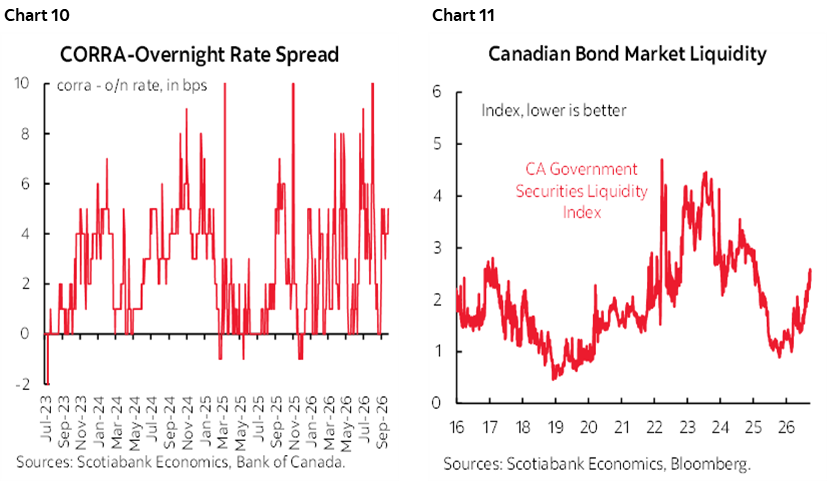
With CORRA still trading about 5bps above the 2¼% overnight rate (chart 10), the BoC still clearly faces challenges in implementing monetary policy by steering all relative rates to its policy rate. Government of Canada bond market liquidity has also deteriorated of late; on chart 11, lower is better. We’ll be watching his remarks on potential new tools, tweaks to existing ones, and/or guidance on liquidity management in funding markets.
Recall that in the quest toward a more normalized balance sheet, the BoC is seeking to achieve two identities. One is to equate interest-bearing assets (holdings of bills and securities purchased through repo) to interest-bearing liabilities represented by settlement balances held at the BoC by CPA members. It’s not there yet despite aggressive expansion of its repo book as bills and repos are well shy of settlement balances. The other identity is to equate GoC bond holdings on the asset side to currency in circulation on the liability side. Here too the BoC is not there yet but could be in the not too distant future.
We’ll be watching closely for guidance on plans for the repo book and t-bill buying in the context of ongoing funding market pressures. We’ll also be monitoring language around an expected return to gross GoC bond buying to offset maturity redemptions next year while currency in circulation keeps growing probably around a longer-run nominal GDP pace. The BoC has long guided it could return to gross buying of Government of Canada to offset maturities when they arrive closer to the point to which they equal currency in circulation which is likely at some point next year. This would not be QE but would be in the normal course of operations. They have guided that markets would be informed by stronger signals the closer they get to the possible changes. Annual buying in the C$10–20B range that ramps up later on is feasible.
Senior Deputy Governor Rogers also speaks on Thursday. Her topic is “Canada’s housing market.” There will be moderated Q&A but no press conference. I doubt we’ll learn much that would further inform potential lift off timing given a) the speech arrives before the next rounds of data for jobs, inflation and GDP among others, and b) it’s still well ahead of the blackout period that commences on October 20th—eight days before the decision and MPR.
CENTRAL BANKS—Deuces Are Wild?
Two central banks will deliver policy decisions that could be a hike-hold draw or even a pair of hikes.
RBA—Going Up Down Under
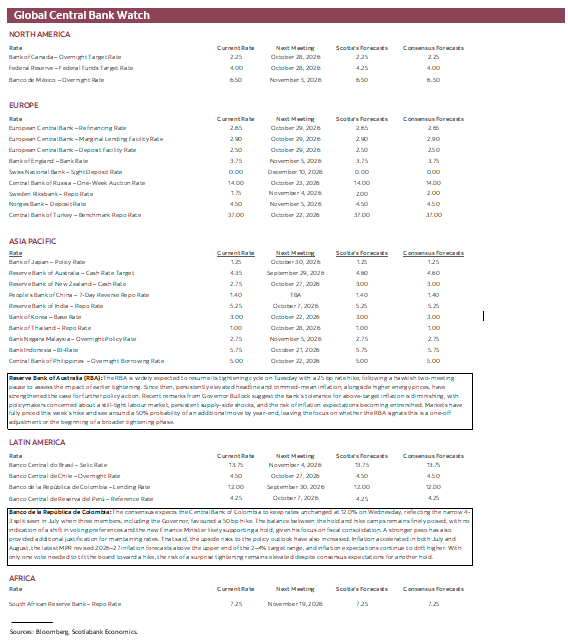
Another quarter-point rate hike is almost fully priced for Tuesday’s decision. Consensus unanimously expects a hike to 4.6% for the first hike since May. That would take the cash rate target up by a cumulative 100bps since February.
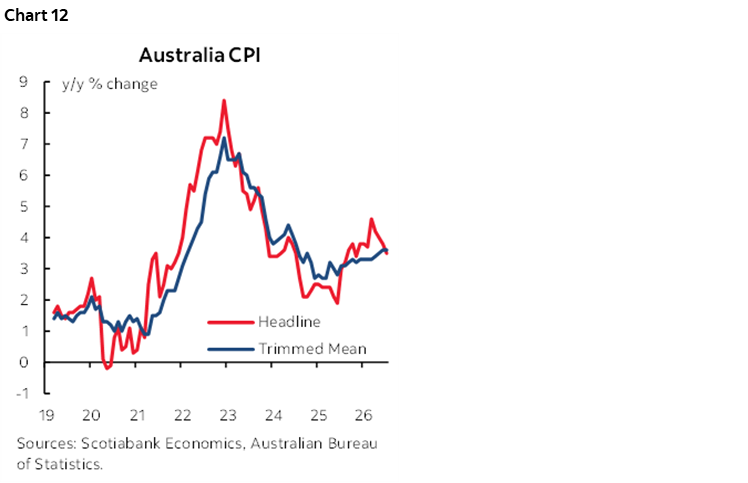
Inflation by multiple measures is cruising above the RBA’s 2–3% target range (chart 12). Total CPI was up 3.5% y/y in July with trimmed mean CPI up 3.6% y/y and an experimental proxy gauge from the Melbourne Institute was up 4.8% y/y in August. Governor Bullock recently sounded incrementally hawkish when she said on September 17th “It’s more important than ever that we bring inflation down to target.” On inflation, she said “It’s much harder to look through when there are persistent shocks because of the risk that will flow through the inflation expectations, I think we have to acknowledge that the trade-off has gotten worse.” She emphasized the need to act quickly because “The longer we’re above the target, then the more concerning it is that inflation expectations will start to adjust.”
Markets are pricing another 25bps hike by the February decision with significant odds of another hike before year-end. They will pay close attention to guidance.
BanRep—Will the Governor Win Out This Time?
Colombia’s central bank is widely expected to leave its overnight lending rate unchanged at 12% on Wednesday but a minority think it could restart hikes.
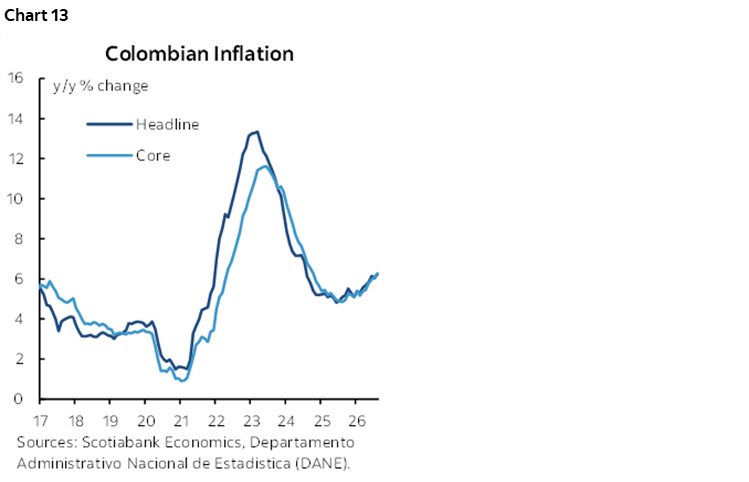
The more hawkish minority may be pointing to the prior meeting in July that revealed a 4–3 hold-hike vote split that had the Governor in the minority hike camp. They may be pointing to growing evidence of a longer commodity price shock amid rising global supply chain pressures while the policy rate gap to the Federal Reserve widens. Inflation is running over 6% y/y in terms of both total CPI and core CPI and on the rise (chart 13).
GLOBAL MACRO—INFLATION IS EVERYWHERE
I’ve partnered with Jay Parmar for parts of this section on weekly indicators.
Markets and central banks are seeing inflation everywhere these days. Perhaps it’s justified. Perhaps it’s a modern-day spin on psychologist Abraham Maslow’s line that “I suppose it is tempting, if the only tool you have is a hammer, to treat everything as if it were a nail.” He’s the same famous psychologist who gave us Maslow’s hierarchy of needs.
What we need to ultimately see is how much of today’s price pressures evolve into the core basket of prices excluding more volatile items like commodities and for how long.
The US will be a major focus. The Fed’s preferred PCE gauges of inflation for August arrive on Wednesday. I’ve estimated 0.3% m/m SA for total PCE and 0.2% for core PCE inflation. Consensus is a tick higher on both. How markets react depends upon who is right; 0.3% and the hawks take flight, but if it’s 0.2, then it could be a third consecutive reading averaging around this relatively tame figure which could suggest more patience in pricing the Fed’s next move. Consensus may be simply going with core CPI that was up 0.3% m/m SA. To get 0.2% takes into account the different weights between CPI and PCE, the pertinent categories of producer prices that are included in PCE, and other methodological differences. It would take more than the last time around to round up the estimate to 0.3%.
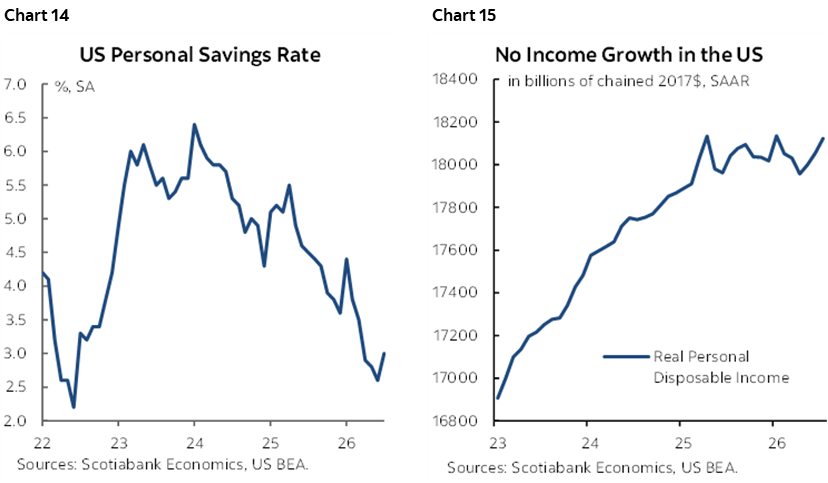
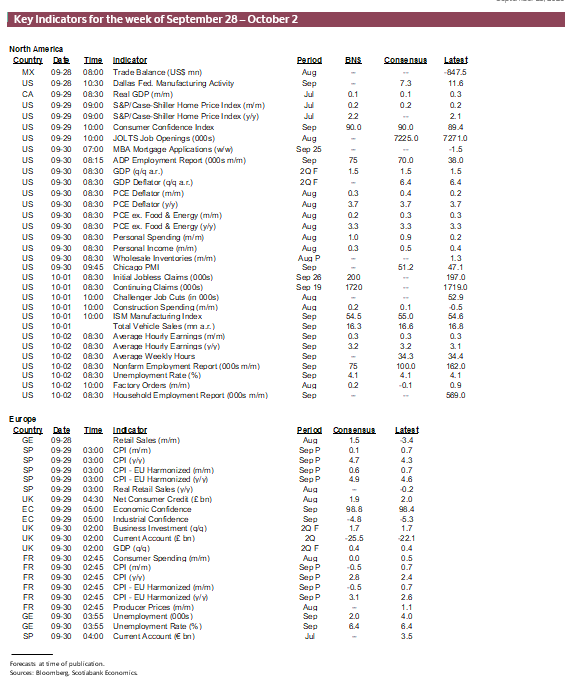
Other US readings are shown in the accompanying tables along with Scotia’s estimates. Real house prices are expected to keep falling (Tuesday). Consumer confidence may move sideways (Tuesday). Modest monthly real income growth against a flat trend will fund expected strength in real personal spending in a way that further erodes the saving rate as shown in charts 14 and 15 (Wednesday). Q2 GDP growth is likely to remain around 1½% q/q SAAR on revision (Wednesday). The first reading for monthly exports and imports in August (Wednesday) will then tee up a hat trick of measures on Thursday including ISM-manufacturing, construction spending and a slightly slower pace of vehicle sales. Factory orders close out the week on Friday after durable goods orders were flat.
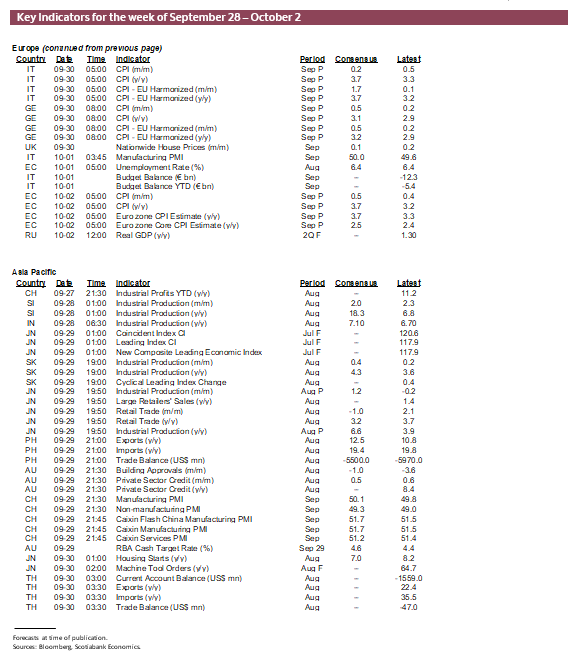
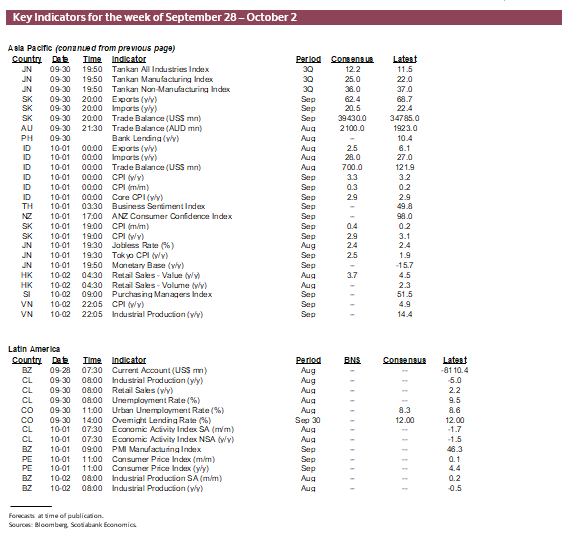
Australia will release its August CPI report on Tuesday, followed by September inflation prints from Switzerland, Tokyo, South Korea, Indonesia, and Peru on Thursday. The week concludes with the Eurozone's September inflation report on Friday.
Australia's inflation report, due shortly after the RBA decision, is likely to have limited immediate policy implications but will represent the first of two inflation readings before the bank's November meeting. Headline inflation is expected to accelerate to 4.2% y/y from 3.5%, while trimmed-mean inflation is also expected to edge higher to 3.7%, reinforcing concerns that underlying price pressures remain persistent.
Focus then shifts to Tokyo CPI on Thursday, ahead of the Bank of Japan's October 30th meeting. After three consecutive firm readings, with the three-month average running above 4% SAAR, another strong print would add to pressure on the BoJ to continue normalizing policy. This comes with markets currently pricing only around a 20% probability of a rate hike in October.
In Peru, both headline and core inflation are expected to remain elevated, although policymakers have increasingly focused on core inflation excluding transportation, which has remained below 2% since April 2025. The BCRP expects inflation to converge toward target as supply shocks fade, although risks from El Niño and ongoing Middle Ea st tensions persist. Any renewed acceleration in the core ex-transportation measure could trigger a more hawkish policy response.
Inflation releases from Switzerland, Indonesia, and South Korea will also be closely monitored, as recent price pressures have challenged central banks' inflation objectives and are likely to increase pressure on policymakers to maintain a more hawkish stance.
Finally, the Eurozone will release its last major inflation report on Friday ahead of the ECB's October 29th meeting. Markets remain divided over whether the ECB will deliver another hike or remain on hold, leaving inflation data and the persistence of higher energy prices as critical inputs. Consensus expects inflation to accelerate further, with particular focus on the month-over-month, non-seasonally adjusted core inflation reading. A stronger-than-expected print, coupled with sustained energy price pressures, could shift market pricing further in favour of an October rate hike.
DISCLAIMER
This report has been prepared by Scotiabank Economics as a resource for the clients of Scotiabank. Opinions, estimates and projections contained herein are our own as of the date hereof and are subject to change without notice. The information and opinions contained herein have been compiled or arrived at from sources believed reliable but no representation or warranty, express or implied, is made as to their accuracy or completeness. Neither Scotiabank nor any of its officers, directors, partners, employees or affiliates accepts any liability whatsoever for any direct or consequential loss arising from any use of this report or its contents.
These reports are provided to you for informational purposes only. This report is not, and is not constructed as, an offer to sell or solicitation of any offer to buy any financial instrument, nor shall this report be construed as an opinion as to whether you should enter into any swap or trading strategy involving a swap or any other transaction. The information contained in this report is not intended to be, and does not constitute, a recommendation of a swap or trading strategy involving a swap within the meaning of U.S. Commodity Futures Trading Commission Regulation 23.434 and Appendix A thereto. This material is not intended to be individually tailored to your needs or characteristics and should not be viewed as a “call to action” or suggestion that you enter into a swap or trading strategy involving a swap or any other transaction. Scotiabank may engage in transactions in a manner inconsistent with the views discussed this report and may have positions, or be in the process of acquiring or disposing of positions, referred to in this report.
Scotiabank, its affiliates and any of their respective officers, directors and employees may from time to time take positions in currencies, act as managers, co-managers or underwriters of a public offering or act as principals or agents, deal in, own or act as market makers or advisors, brokers or commercial and/or investment bankers in relation to securities or related derivatives. As a result of these actions, Scotiabank may receive remuneration. All Scotiabank products and services are subject to the terms of applicable agreements and local regulations. Officers, directors and employees of Scotiabank and its affiliates may serve as directors of corporations.
Any securities discussed in this report may not be suitable for all investors. Scotiabank recommends that investors independently evaluate any issuer and security discussed in this report, and consult with any advisors they deem necessary prior to making any investment.
This report and all information, opinions and conclusions contained in it are protected by copyright. This information may not be reproduced without the prior express written consent of Scotiabank.
™ Trademark of The Bank of Nova Scotia. Used under license, where applicable.
Scotiabank, together with “Global Banking and Markets”, is a marketing name for the global corporate and investment banking and capital markets businesses of The Bank of Nova Scotia and certain of its affiliates in the countries where they operate, including; Scotiabank Europe plc; Scotiabank (Ireland) Designated Activity Company; Scotiabank Inverlat S.A., Institución de Banca Múltiple, Grupo Financiero Scotiabank Inverlat, Scotia Inverlat Casa de Bolsa, S.A. de C.V., Grupo Financiero Scotiabank Inverlat, Scotia Inverlat Derivados S.A. de C.V. – all members of the Scotiabank group and authorized users of the Scotiabank mark. The Bank of Nova Scotia is incorporated in Canada with limited liability and is authorised and regulated by the Office of the Superintendent of Financial Institutions Canada. The Bank of Nova Scotia is authorized by the UK Prudential Regulation Authority and is subject to regulation by the UK Financial Conduct Authority and limited regulation by the UK Prudential Regulation Authority. Details about the extent of The Bank of Nova Scotia's regulation by the UK Prudential Regulation Authority are available from us on request. Scotiabank Europe plc is authorized by the UK Prudential Regulation Authority and regulated by the UK Financial Conduct Authority and the UK Prudential Regulation Authority.
Scotiabank Inverlat, S.A., Scotia Inverlat Casa de Bolsa, S.A. de C.V, Grupo Financiero Scotiabank Inverlat, and Scotia Inverlat Derivados, S.A. de C.V., are each authorized and regulated by the Mexican financial authorities.
Not all products and services are offered in all jurisdictions. Services described are available in jurisdictions where permitted by law.