

Next Week's Risk Dashboard
- Forced family fun at the G20
- BoC —don’t be so sure about the dovish case
- Canadian jobs — still on a tear?
- US nonfarm —the number and the denial
- RBNZ to hike and then what?
- Negara to hold
- Global macro: China PMIs, EZ CPI, inflation & GDP from others
Chart of the Week
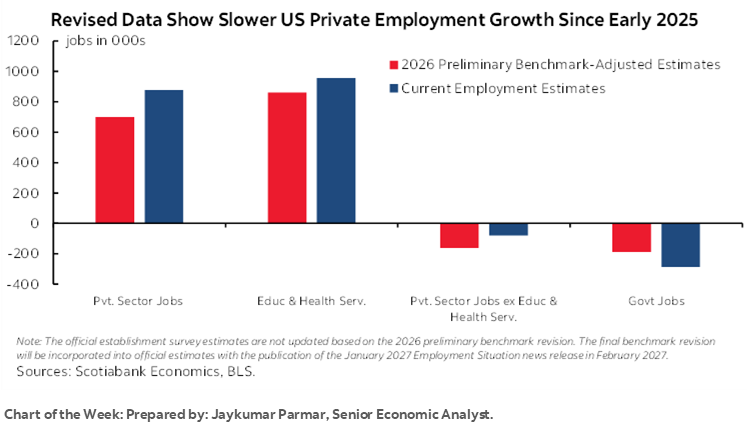
Forced family fun at the start of the week will quickly get down to business over the ensuing days. The US hosts G20 central bankers and finance heads on Monday and Tuesday in North Carolina. If it’s still a family, then it’s a dysfunctional one to say the least that will be lectured on allegedly unfair trade policies, global imbalances, and all the bad things the rest of the world does to the innocent US administration. Politely nod and maybe draw straws to see who distracts and who turns forward the clock on the wall.
Then we get down to business. Three central banks will weigh in (BoC, RBNZ, Negara). Friday’s nonfarm payrolls have already been declared moot by Chair Warsh and I’ll explain why that’s a mistake to declare everything as just peachy in the job market while failing to recognize progress on inflation. Canada will test its streak of three strong employment gains in a row alongside the fastest GDP growth in the G7 when new figures arrive on Friday. The global macro calendar will focus upon top tier releases like Eurozone inflation, China’s PMIs and several other growth and inflation readings.
BANK OF CANADA—DON’T BE SO SURE ABOUT THE DOVISH CASE
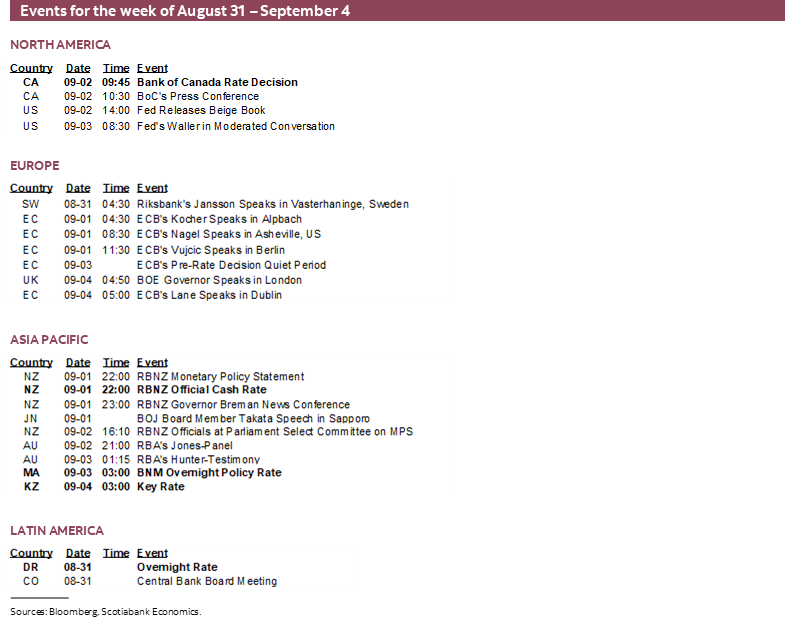
The Bank of Canada delivers its latest decision and communications on Wednesday. The statement arrives at 9:45amET along with Governor Macklem’s written opening remarks to his press conference that itself begins at 10:30amET. The BoC is between MPR forecast meetings in July and the next one on October 28th. There will be no media lock-up and embargoed release of headlines given an ongoing labour dispute with security guards which could mean a somewhat delayed market reaction. Personally, I think that should be habit forming by letting the street do the work properly.
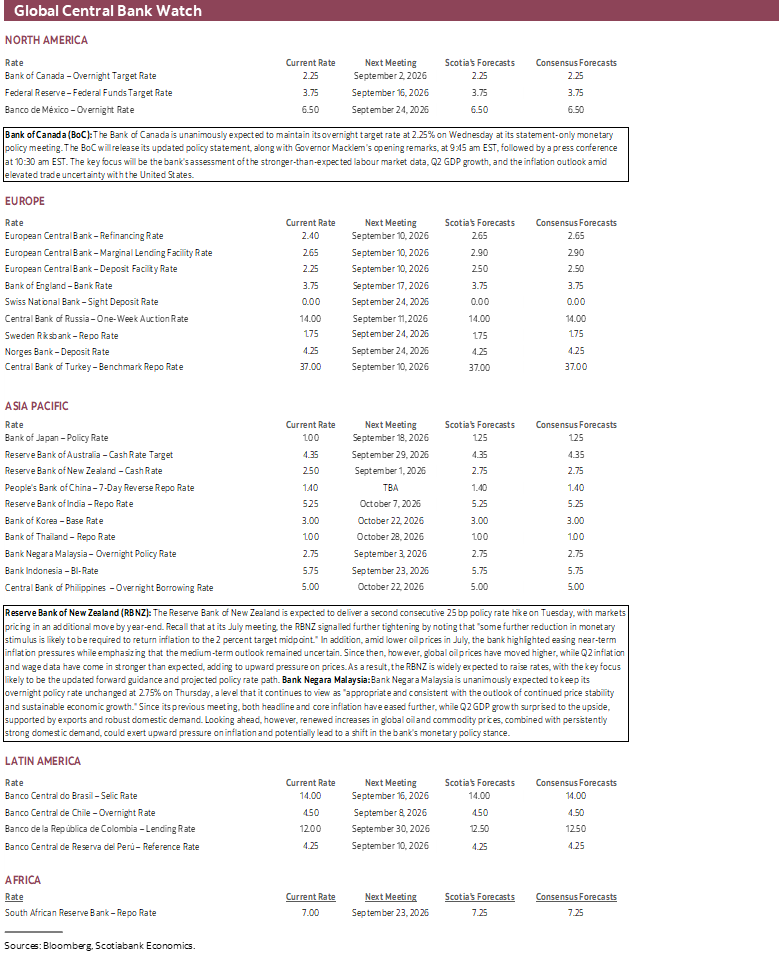
Nobody expects the central bank to adjust its 2¼% policy rate at this meeting. Markets are priced for nothing at this meeting, about one-third of a 25bps hike in October and about two-thirds of a hike at the December 9th meeting. Scotiabank Economics expects a hike in December and two more into next year.
The July statement is likely to face a total re-write since this meeting does not present forecasts. Key may be the concluding paragraph. Will they continue to describe the policy rate as “appropriate”? Probably, for now. They’ll repeat that uncertainty is high. They probably should leave the sentence about continuing to assess and being prepared to adjust “as needed” intact, for now. A case for more dovishness is trade. A case for more hawkishness is also trade but also other matters I’ll explain.
Growth has come on stronger than the BoC anticipated. The July MPR had 2.5% for Q2 GDP growth and was exceeded by almost a full percentage point alongside robust details (3.4%, recap here). Q1 was revised up four-tenths to +0.3%. Key will be when they refresh projections in October given that the BoC had anticipated just 1.5% growth in Q3. Will the upside surprise in Q2 motivate them to downgrade Q3? Or will they go with momentum signs and at least stand by that number if not raise it? The Q2 GDP recap explained that there are considerable signs of consumer momentum into Q3 given strong jobs and as stimulus works through and we may also see a sharp rebound in the oscillating inventory contribution to growth.
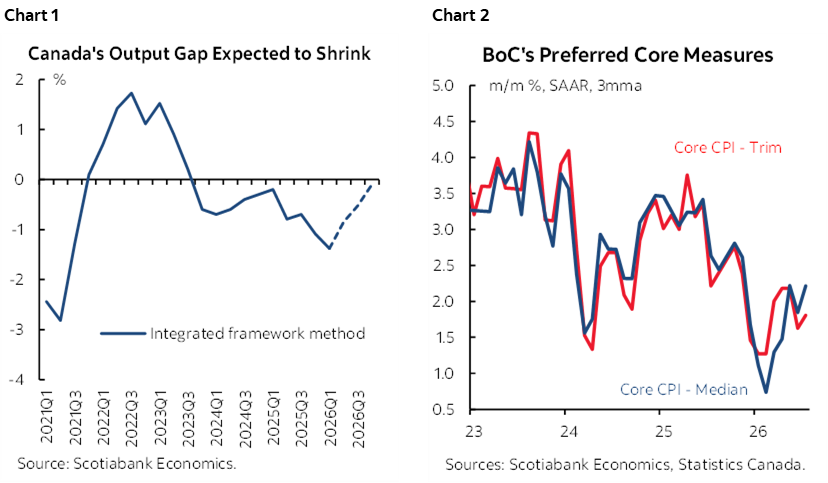
Our forecasts are compatible with closing the traditional output gap measure of slack in the economy by year-end or very early next year (chart 1). If so, then this measure may suggest the BoC is already behind inflation risk given lagging effects of policy adjustments. Still moderate but rebounding trends in underlying inflation have reset the starting point higher which may still merit accommodation but perhaps not at the lower bound of neutral (chart 2). There is probably more upside risk to what we have already incorporated on fiscal policy into a Fall federal budget.
Still, the elephant in the room is how renewed trade tensions with the US could impact the outlook. A first point is that the economy has been more resilient than the most negative economists and journalists have anticipated and so there is a case for not overdoing the doom. Export volumes have posted solid growth for four consecutive quarters despite tariffs that have only been one part of the picture. Further, we forecast 2% GDP growth in 2027 as more fiscal policy supports combine with higher for longer commodity prices as offsets to direct and indirect effects of tariffs and trade policy.
Canada’s retaliatory tariffs could add a handful of tenths of a percentage point to CPI inflation over the coming year. The demand-side disinflationary shock from 50% US tariffs on just C$28B of Canadian exports is likely to be modest. The point being that the impact of trade tensions on inflation cuts in both directions.
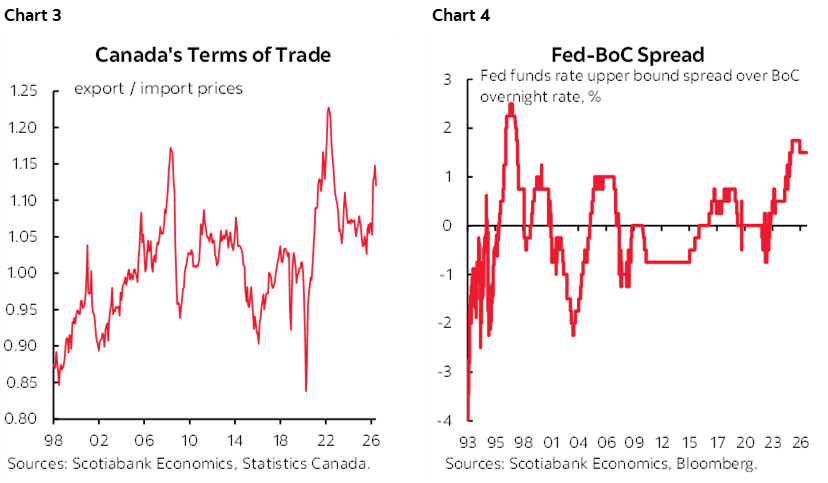
Since the BoC’s July MPR had projected inflation to end 2027 at 2% and 2028 at 2.1%, stronger growth, possibly earlier closure of the output gap, more fiscal stimulus forthcoming, a stronger than anticipated terms of trade (chart 3), and retaliatory tariffs may motivate raising this projection. If the Federal Reserve is truly serious about potentially renewing rate hikes, then the BoC could be dragged higher given a multi-decade high on the current policy rate spread (chart 4).
The BoC will not feel any great urgency to do so yet. They have almost two full months to gestate over how to mix all of the ingredients of a forecast together and present it. A lot could happen between now and then. Emotions are running very high on both sides of the border; emotions make for lousy forecasts. I’m still cautiously optimistic that there is a path to a deal that was almost complete and that it would be more sensible for the US administration to agree to it before they lose one or both chambers in Congress come January.
In fact, it’s getting pretty tiring to hear the naysayers constantly dump on Canada with endless negative headlines. I can’t even read some services any longer. They threw around the ‘r’ word earlier this year and were negative into Q2 only to witness strong numbers that they then dismiss in favour of those same downside risks they’ve been harping on about forever. The bears dominate the media which itself is motivated more by bad news than good news. Lacking in their coverage is too often the requisite amount of balance.
NONFARM—THE NUMBER AND THE DENIAL
Nonfarm payrolls for the month of August won’t matter when the figures land on Friday. That’s because Chair Warsh said so. That is, if you accept his reasoning. I’m very sceptical toward his argument. First, I’ll cover the estimates and rationale and then secondly, I’ll explain my scepticism.
Estimated Change
Payrolls are estimated to rise by just 30k after falling by -23k in July. Revisions may be smaller than the -103k over May and June because the initial sampling rate for payrolls improved in July. The unemployment rate is forecast to tick up to 4.2%.
There are several ingredients that go into this estimate along with other methods.
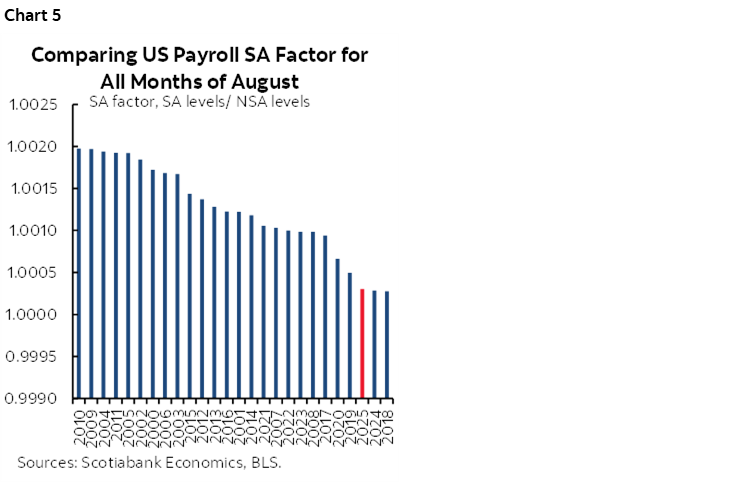
- The seasonal adjustment factor is likely to remain low compared to like months of August in history (chart 5);
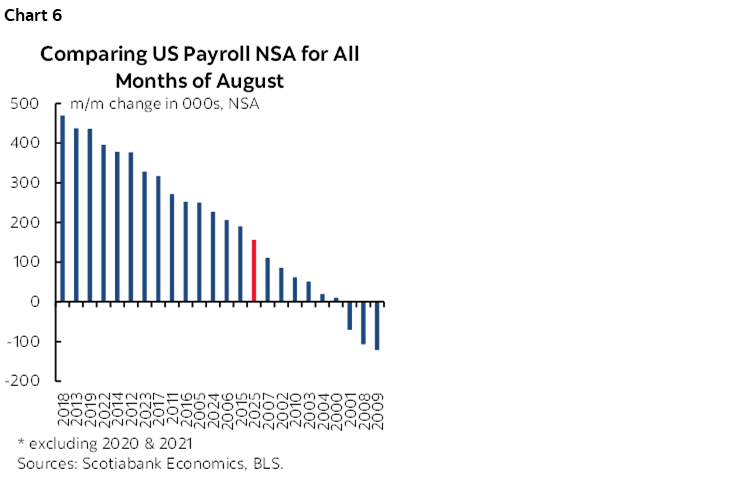
- August is usually an up-month for seasonally unadjusted changes in payrolls and I’ve gone with about 200k this time (chart 6);
- The expiration of ESSER funding is starting to hit the education sector. Local government education sector jobs fell by 50k in July and there is ongoing guidance from school districts about further layoffs.
- Health hiring may be dampening as the lagging effects of ACA subsidy reductions work through. This post elaborates.
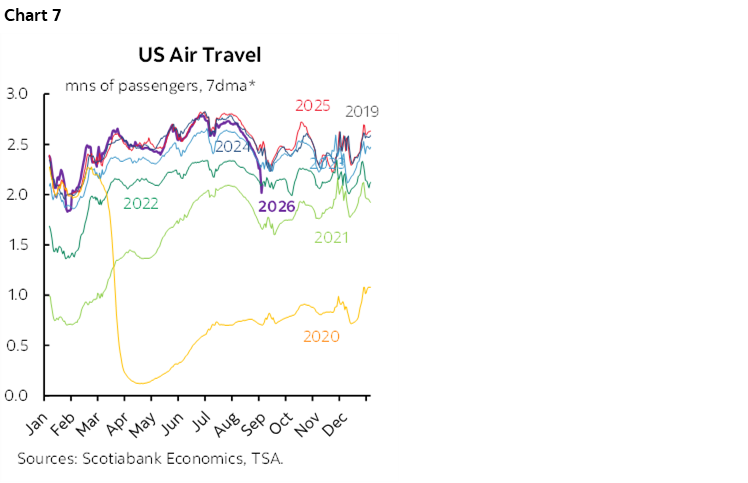
- This may be another soft month for hiring in the leisure/hospitality and retail sectors. US air traffic is tumbling in seasonally unusual ways (chart 7). Retail sales fell in August and have been soft for a couple of months.
- there might be a small negative weather effect given extreme heat, fires and flooding, but the San Francisco Fed’s weather-adjusted payrolls showed no material distortion to July’s jumping off point for estimating August payrolls.
- layoffs are looking normal
- Nothing unusual is expected for birth-death model additions to August’s seasonally unadjusted payrolls compared to prior months of August.
A bottom-up decomposition of the change in payrolls during August is another way of approaching the estimate. Goods sector hiring was unusually strong in July (+25k) due to the construction sector and this is expected to largely drop out. Services hiring is expected to accelerate from basically nothing in July but with very mixed components. Government is expected to be down again largely given the ESSER effect on education jobs at local governments.
Other labour market readings generally indicate tepid job growth. Consumer confidence jobs plentiful picked up a bit in August but remains toward the lows since the pandemic. Job postings have been little changed. Surveys are mixed as S&P PMIs recorded the fastest pace of job growth since the start of last year but mix domestic and foreign operations of companies but we don’t have ISM readings.
We will learn more about the state of the US job market in several other readings that are due out this week but I don’t expect them to materially swing the estimate. JOLTS job openings will be released for the month of July on Tuesday. ADP private payrolls will likely land around 45k during August (Wednesday). ISM-manufacturing and ISM-services will be watched to see if their employment subindices improves like other PMIs indicated. Challenger job cuts during August are due Thursday but are expected to be low. Revelio’s nonfarm payrolls indicator for August will be refreshed on Thursday but tracks poorly. Weekly claims also come out Thursday but are outside of the August reference period. NFIB small business hiring plans will not be released until the following week but plans were rising to July.
Why Warsh Shouldn’t Ignore the Labour Market
Federal Reserve Chair Warsh’s Jackson Hole speech spooked bond markets on Friday. Part of his mission may have been to keep up pressure on yields as the 10-year Treasury has stalled out in the 4.6–4.7% range over recent weeks. Part of his message, however, was that he wants much more evidence on disinflationary pressures and sees nothing wrong with the labour market.
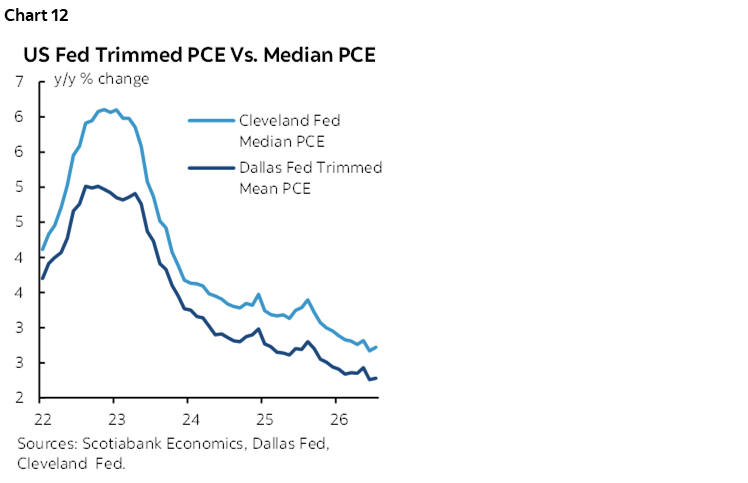
I can understand the former given we only have a few months of soft core CPI and core PCE readings. Still, he has basically abandoned earlier references to alternative central tendency measures of underlying inflation like trimmed mean PCE that is still cruising at just 2.3% y/y. With tariffs being added and commodity prices higher for longer, however, I have less difficulty with his cautions on inflation risk than on the other half of his mandate.
Warsh contends the following:
“On the employment side of the Fed's dual mandate, our country is doing well. Labor markets are quite stable. The jobless rate, at 4.1 percent, remains low by historical standards and has not changed much for a couple of years. When labor supply is barely growing, monthly job gains are naturally going to run low.”
He’s partly right on the unemployment rate. The issue is what to make of that and his tendency to attribute soft jobs to soft labour supply.
A stable unemployment rate is one thing, but job growth and income growth are what drive consumption over time. Private nonfarm payrolls ex-health and education (mostly health) have been weakening long before ICE raids and tighter immigration policy under the Trump administration. The household survey’s job growth—from which the unemployment rate is derived—has also been weak for an extended period. Overall inflation-adjusted growth in personal disposable income has ground to a halt (chart 8).
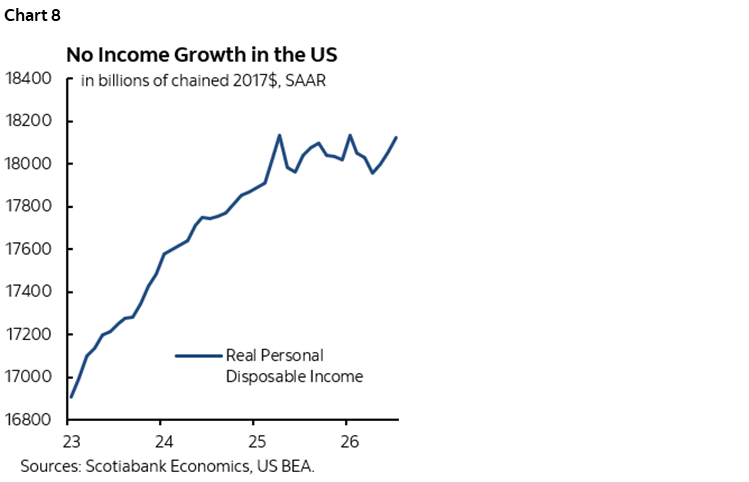
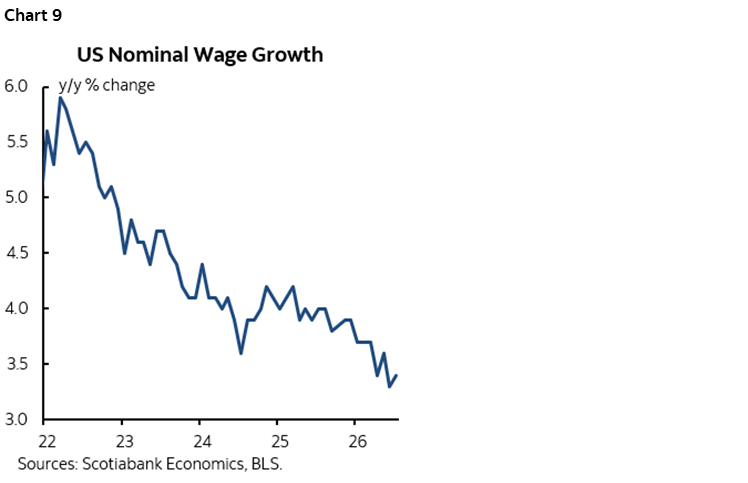
Should you be enthused by the unemployment rate? Or downplay it in unusual times amid tightened immigration policy and more concerned about weak jobs and incomes? So far, US consumer spending has held up because Americans have cut the share of their incomes being saved in half to 3% compared to two years ago. Amid an ongoing negative housing wealth effect. While nominal wage growth continues to slide (chart 9) and is negative in real terms using the PCE inflation rate which should help to ease concerns about second-round price pressures. US consumer dynamics are not terribly favourable and I think that should concern Chair Warsh.
Ultimately it remains uncertain what is driving softness in the pool of available labour. The labour force participation rate is falling sharply (chart 10) due to exits by younger and older workers (chart 11). Is that necessarily all because of ICE raids and immigration policy, or are workers not finding suitable opportunities and dropping out? I don’t understand the foundations behind Warsh’s certainty.
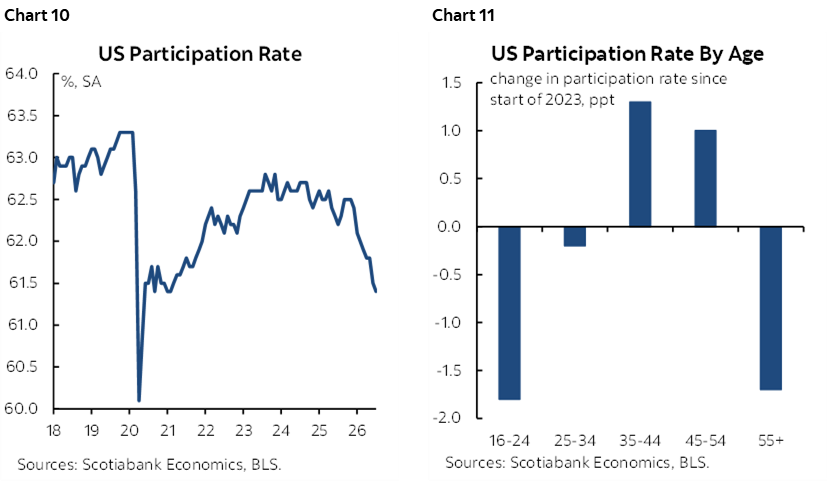
If it’s the latter, then Chair Warsh would be very ill-advised to ignore it. He probably should not ignore what is shown in chart 12 either.
CANADIAN JOBS—STILL ON A TEAR?
Canada refreshes jobs for the month of August on Friday at the same time as US payrolls. That often makes it difficult to disentangle the readings and their effects on Canadian rates and FX if there is any hint of competing directions.
A gain of 20k is expected with a downtick in the unemployment rate to 6.3%.
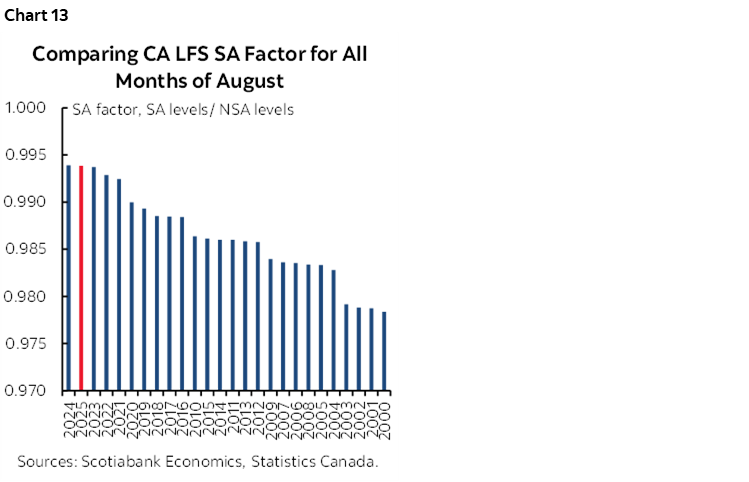
A high seasonal adjustment factor is expected in keeping with the recency bias to how they are calculated and that has driven them to be elevated in the post-pandemic era (chart 13).
August is normally a seasonal down month for employment in Canada with some exceptions (chart 14). I’ve conservatively gone with -50k m/m NSA.
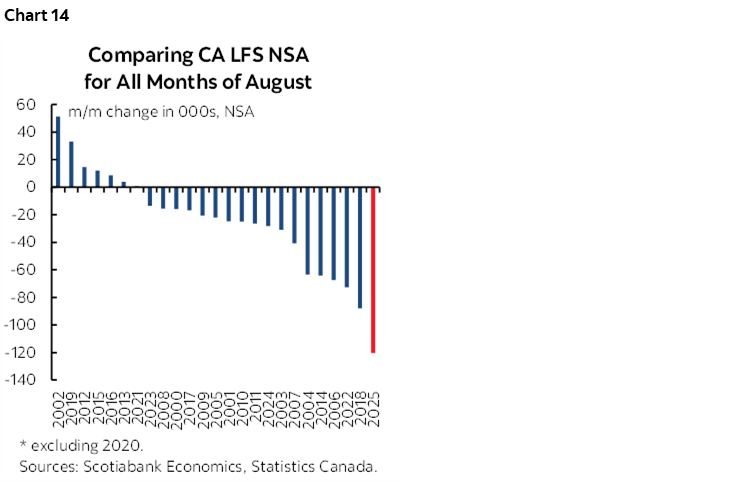
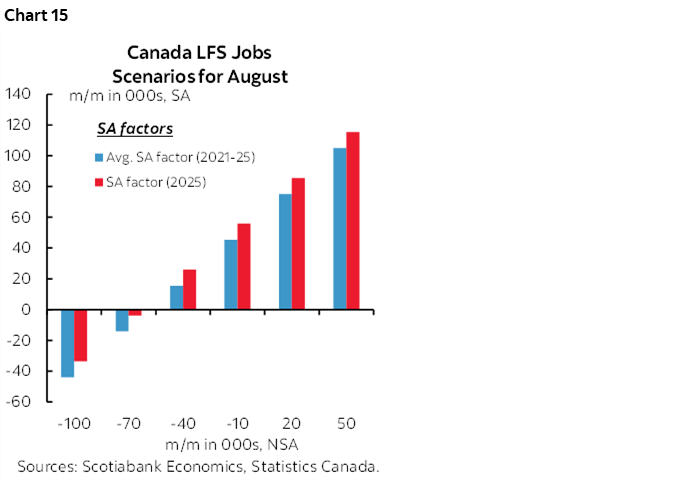
Chart 15 shows scenarios around seasonally unadjusted changes and SA factors and how more often than not they would point to a solid seasonally adjusted gain in jobs.
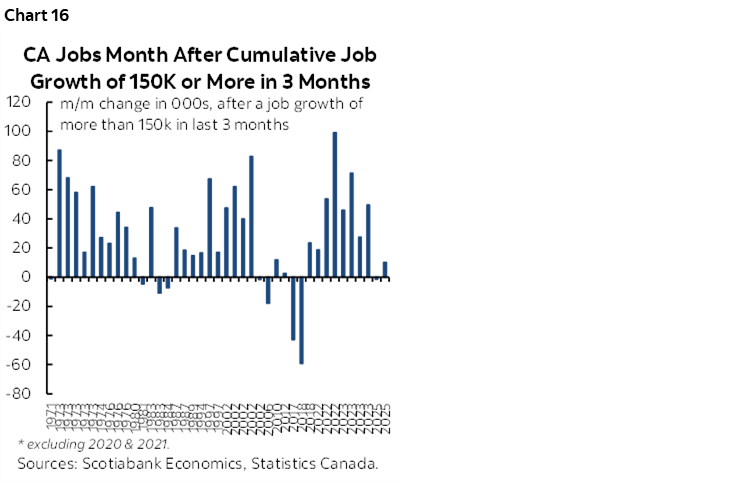
What has also been considered is momentum. The Labour Force Survey uses a panel rotation approach to sampling jobs that rotates out the first month and replaces it with the latest month in a rolling six-month target population of households. This can lead to momentum in hirings or firings by basically asking similar groups of individuals across similar panels. Chart 16 shows that when job growth has exceeded 150k or the prior three months (181k this time), the next month is usually up again.
There were no notable distortions to the prior month’s composition of hiring that would be expected to distort expectations for this month.
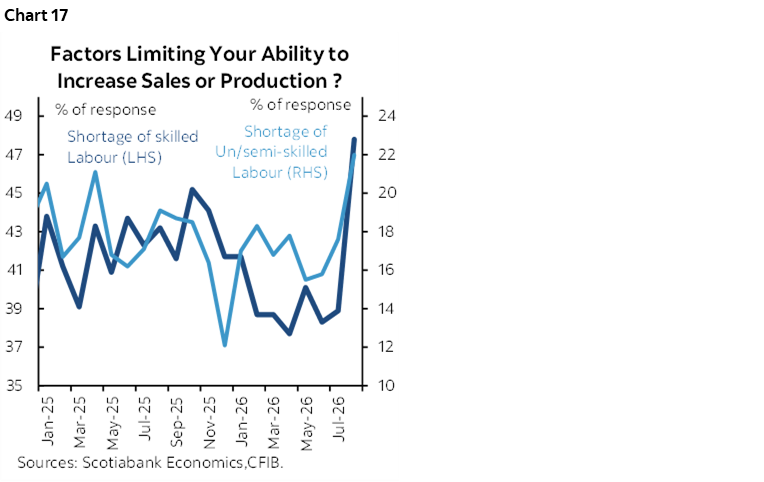
Other readings are not terribly helpful but small business hiring plans are balanced while nevertheless reporting severe worker shortages (chart 17).
There is also a lot to be said for momentum in the economy given strong Q2 GDP and the signs of sustained momentum into Q3 that were explained here. Of particular note is that activity readings for the consumer sector remain buoyant. This matters in an Okun’s “law” sense that posits a correlation between GDP growth and employment growth.
It’s likely too soon to expect weakness in sectors newly affected by additional US tariffs that were announced in July but only implemented this past Friday and hence outside of the LFS reference week. Further, we expect a limited impact upon overall jobs.
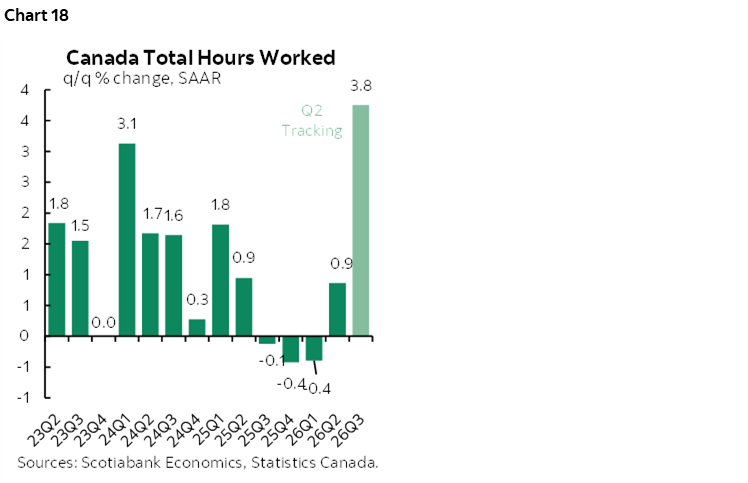
Also key for GDP tracking will be whether momentum in hours worked is sustained (chart 18). This matters since GDP is hours worked times labour productivity.
CENTRAL BANKS—MORE ASIA-PACIFIC HIKES
Only two other central banks will weigh in with policy decisions this week. They are both in the Asia-Pacific region and follow hikes this past week by the Bank of Korea and the central bank of the Philippines. One is expected to hike while the other holds.
RBNZ—Hike, then What?
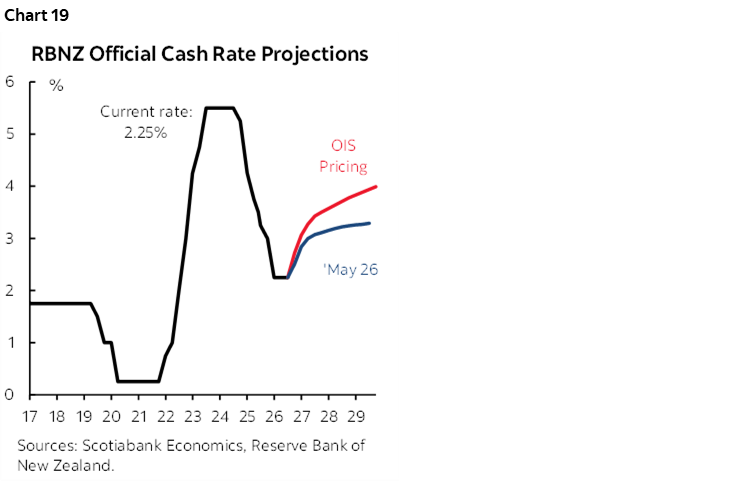
Consensus unanimously expects a 25bps rate hike on Wednesday. Markets are almost fully priced for a hike. This would be the second consecutive hike after the RBNZ hiked in July.
Advance guidance indicated that "some further reduction in monetary stimulus is likely to be required to return inflation to the 2 percent target midpoint."
Key may be the bias given a resurgence of energy and other commodity prices since July. A fresh explicit forward rate path is expected in the context of markets that have been overshooting the prior rate path (chart 19).
Bank Negara Malaysia—A Probable Hold
Consensus is almost unanimous in expecting Negara to hold its overnight rate at 2.75% on Thursday. The one holdout who expects a hike may have most things going against such expectations.
One is that CPI inflation remains low at 1.8% y/y with core CPI matching that rate. That’s within the central bank’s comfort zone. If anything motivates tightening, then decent GDP growth that rebounded to 2.5% q/q SAAR (2.4% consensus, 0% prior) and renewed increases in oil prices since the July 9th meeting might do it. So may a growing sense of the fiscal price being paid for generous fuel subsidies.
GLOBAL MACRO—IT’S NOT JUST ABOUT JOBS
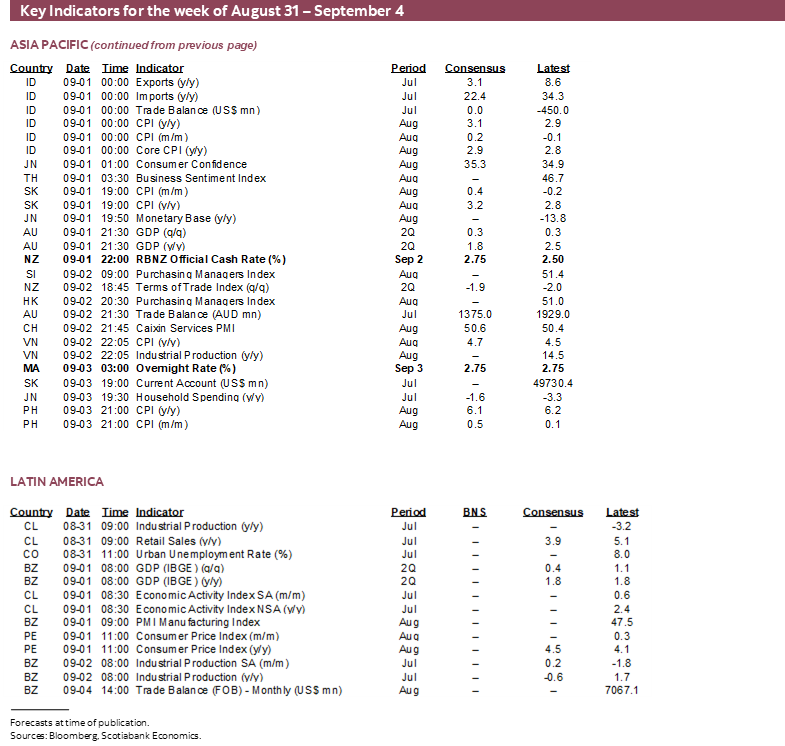
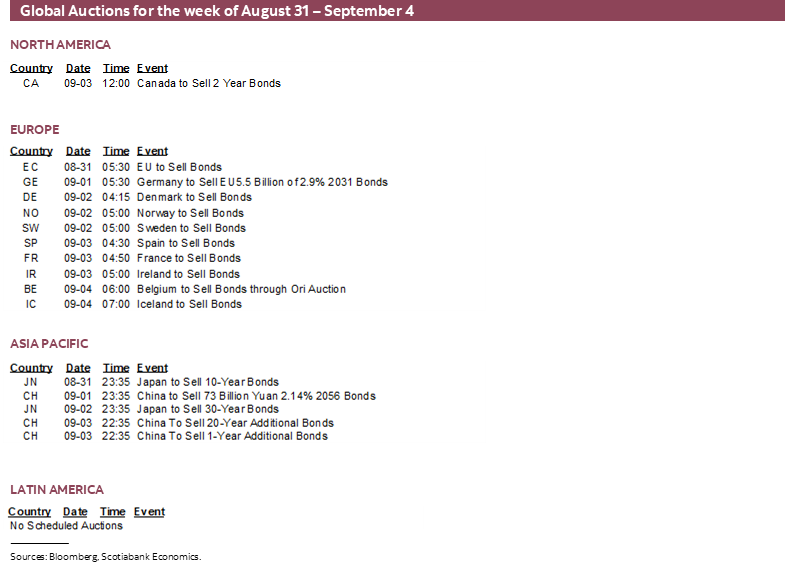
Next week’s global macro calendar will be shaped by August inflation data and Q2 GDP updates from more economies, alongside several activity indicators that will offer timely insights into sectoral and economic trends. Jay and I partner on the following.
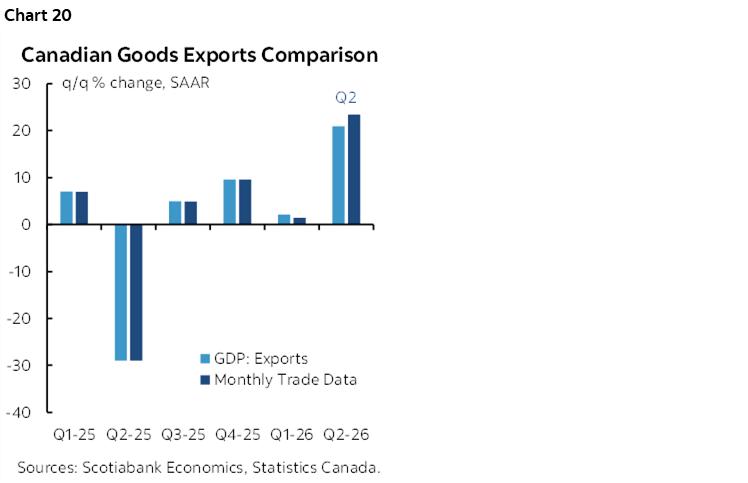
Canada will mostly focus upon Wednesday’s BoC communications and Friday’s jobs report. Additional readings include trade figures for July (Thursday) with exports performing rather well of late (chart 20). PMIs are due out on Tuesday and Thursday plus the Ivey PMI on Friday. Q2 productivity figures (Thursday) will likely rebound in the wake of a strong Q2 GDP report.
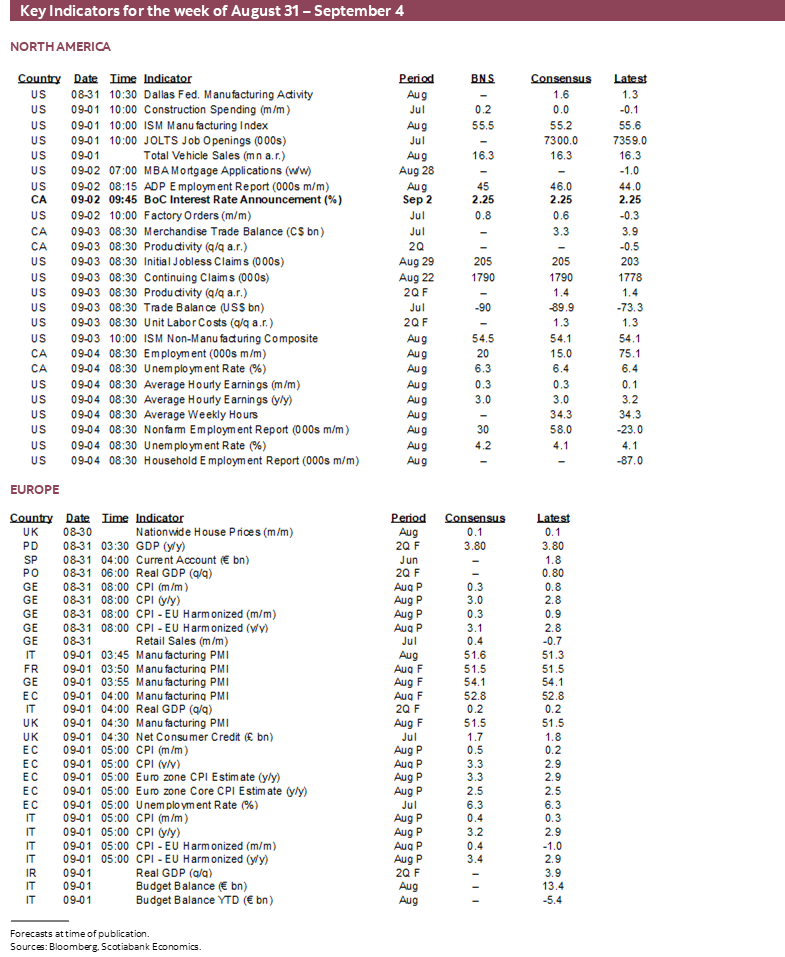
Nonfarm payrolls will dominate the US calendar but watch for a few other lower profile readings. ISM-manufacturing (Tuesday) and ISM-services (Thursday) will refresh soft data on new orders, production, hiring, inventories and prices. Construction spending could pick up from the prior month’s dip (Tuesday). Industry guidance points to a flat month for vehicle sales during August (Tuesday). Factory orders are expected to post a solid gain based on the already known 1.1% rise in big-ticket durable goods orders and will add in nondurable goods (Wednesday). The trade deficit is expected to blow out toward -US$90B from $73B previously when July’s figures are released on Thursday. There is also the Fed’s Beige Book to consider.
Germany on Monday and Italy on Tuesday are set to drive the European inflation releases due this Tuesday, following France’s warm CPI reading and Spain’s tame inflation data last week. The market expects a warm headline print, supported by natural gas prices rising to their highest level of the year, with the month-over-month core CPI and services inflation figures likely to be the key focus.
With global energy prices elevated again in August, central banks will be focused on updated inflation readings in their domestic economies, especially in Peru (Tuesday), South Korea (Tuesday), and Turkey (Thursday), where inflation remains above target. Inflation in Indonesia (Tuesday) and Switzerland (Thursday) is expected to remain under control.
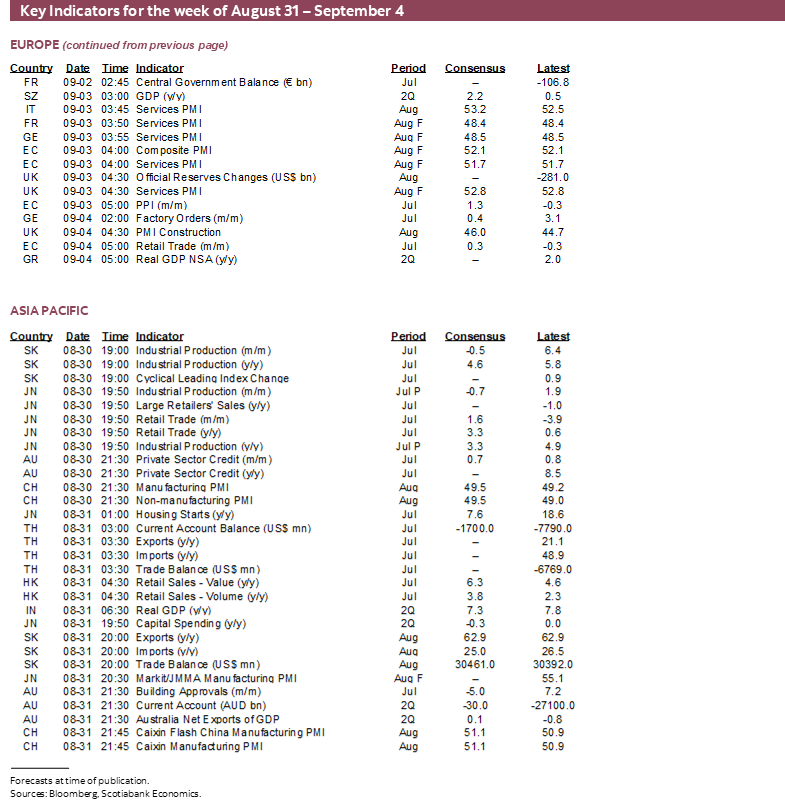
India, the world’s fastest-growing economy, is set to release its Q2 GDP figures on Monday. After expanding by more than 8% year over year in the second half of last year, growth slowed to 7.8% in Q1-26 and is projected to ease further to 7.3% in Q2-26. Higher oil prices are likely to weigh on industrial activity, although domestic consumption and stronger exports should continue to support the economy.
Attention will then turn to Australia’s Q2 GDP release and Chile’s July economic activity data on Tuesday. Australian growth is expected to remain subdued at 0.3% quarter over quarter, with labour market resilience supporting household spending but softer housing market conditions weighing on overall activity.
China will also release two sets of PMIs: the official state PMIs over the weekend and the private, export-oriented PMIs in the first half of the week. Both are expected to rebound after last month’s sharp decline, although the official measure is likely to remain in contraction territory while the private gauge stays above 50.
Finally, Germany’s July factory orders report on Friday will provide an update on the recent improvement in manufacturing activity, while South Korea’s August export data on Monday will be closely watched as a gauge of continued global semiconductor demand.
DISCLAIMER
This report has been prepared by Scotiabank Economics as a resource for the clients of Scotiabank. Opinions, estimates and projections contained herein are our own as of the date hereof and are subject to change without notice. The information and opinions contained herein have been compiled or arrived at from sources believed reliable but no representation or warranty, express or implied, is made as to their accuracy or completeness. Neither Scotiabank nor any of its officers, directors, partners, employees or affiliates accepts any liability whatsoever for any direct or consequential loss arising from any use of this report or its contents.
These reports are provided to you for informational purposes only. This report is not, and is not constructed as, an offer to sell or solicitation of any offer to buy any financial instrument, nor shall this report be construed as an opinion as to whether you should enter into any swap or trading strategy involving a swap or any other transaction. The information contained in this report is not intended to be, and does not constitute, a recommendation of a swap or trading strategy involving a swap within the meaning of U.S. Commodity Futures Trading Commission Regulation 23.434 and Appendix A thereto. This material is not intended to be individually tailored to your needs or characteristics and should not be viewed as a “call to action” or suggestion that you enter into a swap or trading strategy involving a swap or any other transaction. Scotiabank may engage in transactions in a manner inconsistent with the views discussed this report and may have positions, or be in the process of acquiring or disposing of positions, referred to in this report.
Scotiabank, its affiliates and any of their respective officers, directors and employees may from time to time take positions in currencies, act as managers, co-managers or underwriters of a public offering or act as principals or agents, deal in, own or act as market makers or advisors, brokers or commercial and/or investment bankers in relation to securities or related derivatives. As a result of these actions, Scotiabank may receive remuneration. All Scotiabank products and services are subject to the terms of applicable agreements and local regulations. Officers, directors and employees of Scotiabank and its affiliates may serve as directors of corporations.
Any securities discussed in this report may not be suitable for all investors. Scotiabank recommends that investors independently evaluate any issuer and security discussed in this report, and consult with any advisors they deem necessary prior to making any investment.
This report and all information, opinions and conclusions contained in it are protected by copyright. This information may not be reproduced without the prior express written consent of Scotiabank.
™ Trademark of The Bank of Nova Scotia. Used under license, where applicable.
Scotiabank, together with “Global Banking and Markets”, is a marketing name for the global corporate and investment banking and capital markets businesses of The Bank of Nova Scotia and certain of its affiliates in the countries where they operate, including; Scotiabank Europe plc; Scotiabank (Ireland) Designated Activity Company; Scotiabank Inverlat S.A., Institución de Banca Múltiple, Grupo Financiero Scotiabank Inverlat, Scotia Inverlat Casa de Bolsa, S.A. de C.V., Grupo Financiero Scotiabank Inverlat, Scotia Inverlat Derivados S.A. de C.V. – all members of the Scotiabank group and authorized users of the Scotiabank mark. The Bank of Nova Scotia is incorporated in Canada with limited liability and is authorised and regulated by the Office of the Superintendent of Financial Institutions Canada. The Bank of Nova Scotia is authorized by the UK Prudential Regulation Authority and is subject to regulation by the UK Financial Conduct Authority and limited regulation by the UK Prudential Regulation Authority. Details about the extent of The Bank of Nova Scotia's regulation by the UK Prudential Regulation Authority are available from us on request. Scotiabank Europe plc is authorized by the UK Prudential Regulation Authority and regulated by the UK Financial Conduct Authority and the UK Prudential Regulation Authority.
Scotiabank Inverlat, S.A., Scotia Inverlat Casa de Bolsa, S.A. de C.V, Grupo Financiero Scotiabank Inverlat, and Scotia Inverlat Derivados, S.A. de C.V., are each authorized and regulated by the Mexican financial authorities.
Not all products and services are offered in all jurisdictions. Services described are available in jurisdictions where permitted by law.