

Next Week's Risk Dashboard
- What to expect from the transition of power in Congress…
- …from trade, to funding, the debt ceiling, AI, bank regs, and SCOTUS
- US inflation—tone setter for the next FOMC decision
- Heavy Fed-speak to inform December hike risk
- BCRP—pressure to hike may have risen
- BoC not-minutes to be somewhat stale on arrival
- Global macro—UK data dump, several CPI releases
Chart of the Week
Fresh from a massive protest victory in midterm elections, did they learn not to get pulled into the politics of vengeance the last time the Democrats sought to hold President Trump accountable for real and alleged misdeeds? Whether they choose to pursue a more constructive final two years of the Trump presidency may determine risks to the outlook along with prospects into the 2028 Presidential election.
Yet the more pressing issue at hand concerns what could be a very active final two months for the current GOP-controlled Congress. There may be nothing ‘lame’ whatsoever about the so-called lame duck session of Congress before the Democrats take over the House and Senate after January 3rd. I’ll sketch out several examples of potential actions—some of which could be quite impactful.
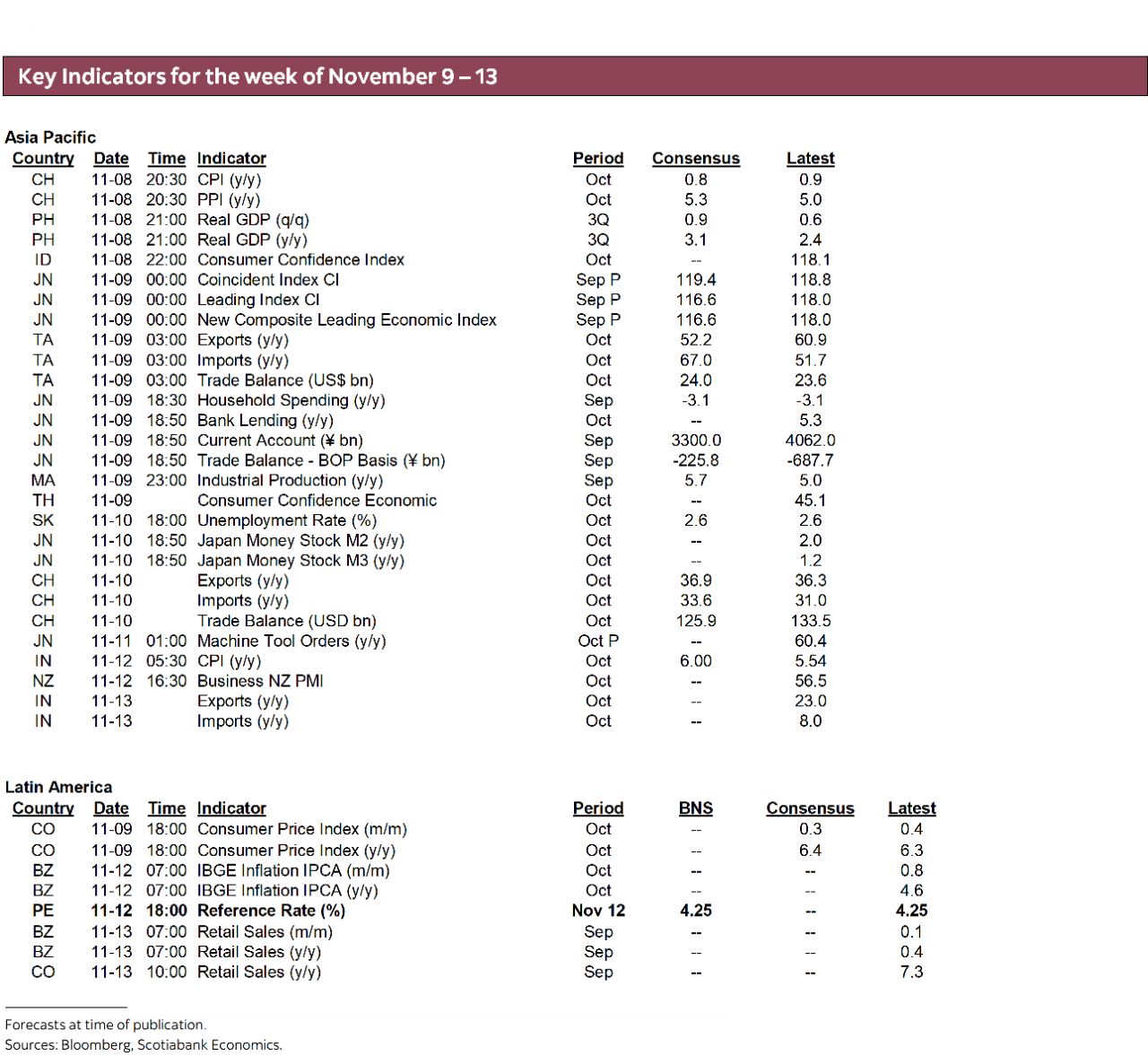
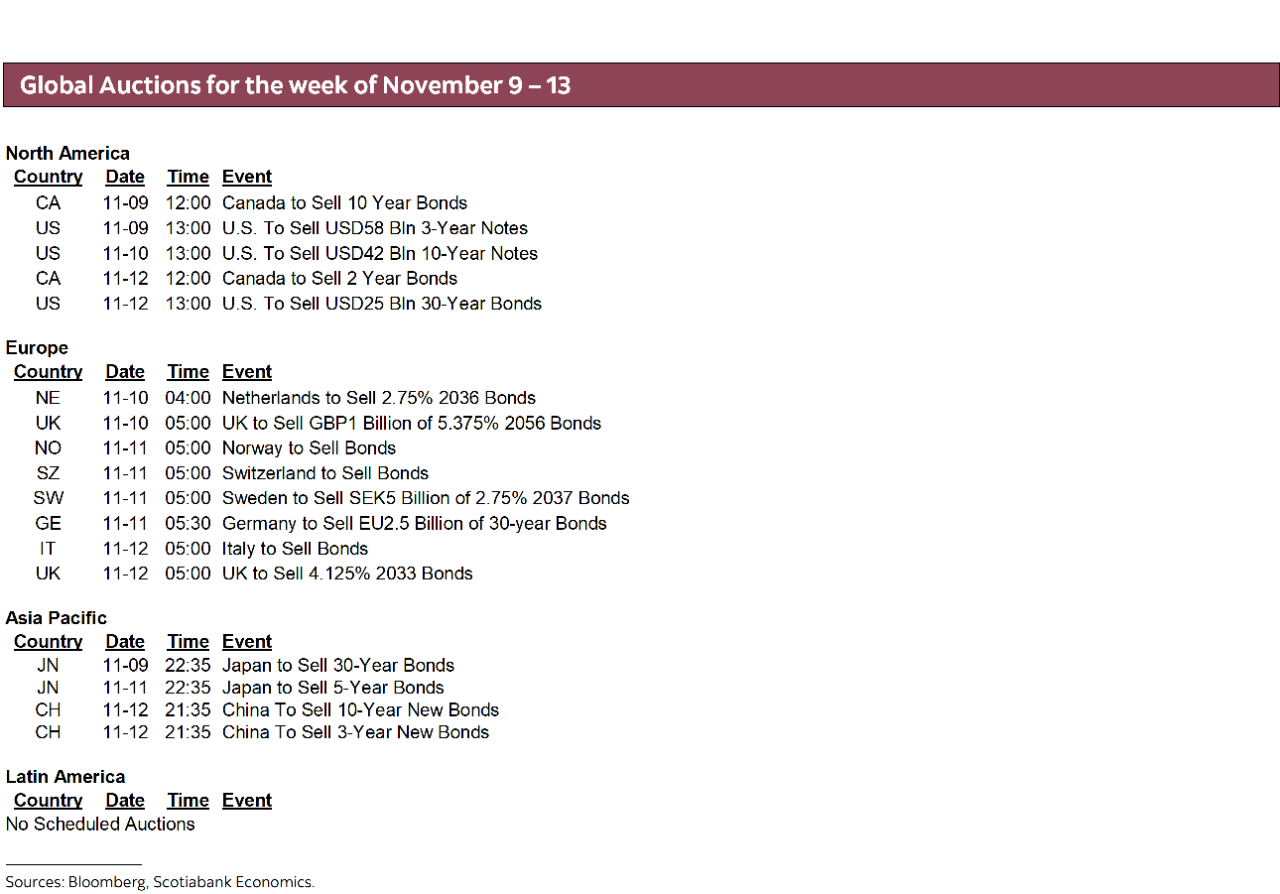
Otherwise, a holiday-interrupted week will bring out much lighter calendar-based developments dominated by US inflation reports. The US Treasury market will shut for Veterans Day on Wednesday, but the NYSE will remain open. Canadian bond markets will be shut for Remembrance Day on Wednesday (buy your poppies!) but the TSX will be open, and many equity participants tend to get a day in lieu.
WHAT TO EXPECT IN THE LAME DUCK SESSION OF CONGRESS
Markets initially reacted favourably to the US midterm elections that swept the Republicans out of Congress and many other state-level roles. There were good reasons for why before sentiment turned sour on AI oversight risks.
One is that perhaps the magnitude of victory by the Democrats put to rest concern that the results would be challenged by Trump who came out saying he would respect the outcome. That allayed fears that an ugly period of election denial could ensue.
Trump also downplayed the risk of escalating the Iran war which we’ll see about. Oil prices have since begun rising again.
There are also reasons to think that the lame duck session of Congress before the Democrats take over after January 3rd may not be so lame duck. Here is a partial list of what could be achieved in a mixture of pros and cons with careful monitoring required.
USMCA 2.0?
I still maintain that this is the window that counts for a potential CUSMA/USMCA 2.0 deal. The power resides in the two highest offices.
If the aim is to get DJT’s signature on a new comprehensive agreement, then do so before having to put it through a Congress controlled by the Democrats. At that point, the Dems control the issues and may seek greater input over matters like labour controls and the environment. Then again, they may agitate toward dropping all tariffs on Canada if successful at securing super majorities in Congress.
A smaller deal and reversal or watering down of prior executive orders is also a possibility outside of Congress.
A sign that a grander deal may be in the works is that both sides in Canada and the US are publicly indicating renewed negotiations with plans to pursue an agreement over coming weeks. PM Carney, for example, recently stated that the US negotiators are “asking less and they’re offering more, but we’re not quite there.” There has also been reporting that USTR Greer is pushing President Trump to strike a trade deal with Canada soon.
Overall, I’m cautiously optimistic and don’t buy the common narrative that Trump will double down against the agreement. If either he or GOP members read the room on vote day, then tariffs, assaults on key trading partners and allies and divisive trade policy were among the factors that cost them the vote.
A meaningful deescalation of trade tensions between Canada and the US could lower uncertainty and raise confidence to spend and invest. It would probably lead us to revise our growth outlook somewhat higher. It would also reinforce conviction in our forecast for the BoC to hike three more times to 3.25%—and possibly more. It would also begin to remove a meaningful discount to the undervalued C$.
Funding Deadline
They will need to address the December 11th funding deadline. A Continuing Resolution had extended funding for US$1.7 trillion of discretionary spending. Congress has yet to pass any of the twelve required appropriations bills and so broad funding requirements could end on December 11th subject to carve-outs and exemptions. Some federal government employees would be furloughed and some non-mandatory programs would lapse in a shutdown scenario. There would be a need for either sweeping appropriations bills to be passed or another continuing resolution to temporarily extend funding.
A lengthy and widespread shutdown amid failure to achieve a funding deal could then pass control over what shape it takes to the Democrats in the new Congress.
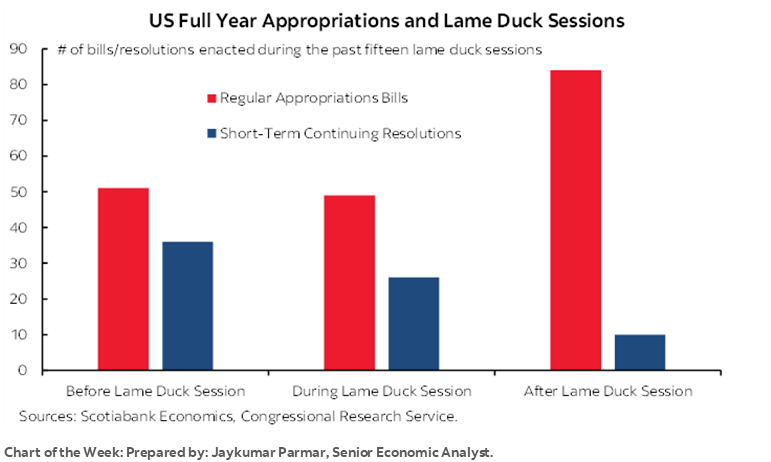
There is precedence for a lot of action on appropriations measures to unfold in the lame duck session. This site includes a history of appropriations bills and continuing resolutions during the different lame duck sessions in history and how fruitful this period can be. This time would require a 60-vote super majority in the Senate to avoid a filibuster, but budget reconciliation may be an option that requires only a normal majority, albeit tied to the FY27 budget.
In all, a series of appropriations bills and funding arrangements could lock in funding through much or all of the remainder of Trump’s term. The effect could reduce uncertainty but may agitate bond markets from an issuance standpoint. Failure to achieve this could be tied to the next key issue.
Raise the Debt Ceiling?
The federal government is just US$600 billion away from hitting the US$41.1 trillion debt ceiling. That’s nothing, given the speed by which money is flying out the door in Washington (chart 1).
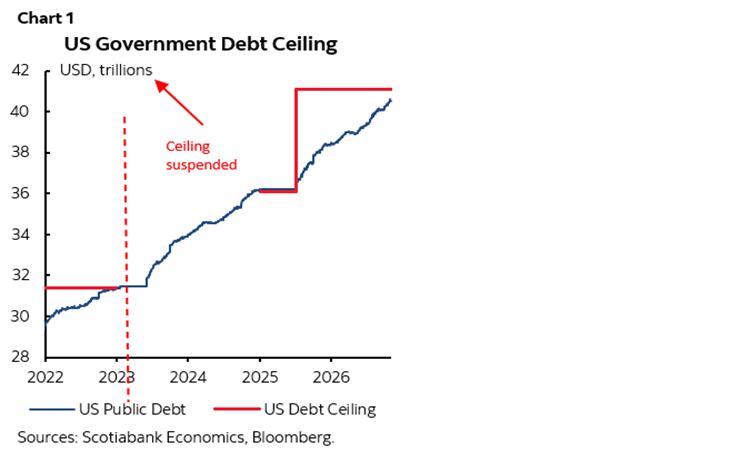
The GOP may get a jump on the Democrats by raising or suspending the debt ceiling now before the Democrats could apply leverage against the administration by seeking compromises. If not, then when paired with the funding deadline, it could create intense frictions with Trump using the debt ceiling as leverage.
The few fiscal hawks still in the Republican party may lean toward a small increase and/or demand spending cuts. A risk is whether the administration may wish to have the issue flare later on when the Democrats take over Congress.
A Reconciliation Bill?
There may be more intensified movement afoot toward securing a reconciliation bill. This presents the opportunity to pass final priorities for the administration. This could include tax measures. It could also address disaster funding and various other policy priorities.
As with all fiscal measures, GOP appetite for anything substantial may be low given concern among some of them about the health of the US fiscal situation and given a possible lack of engagement among those who were voted out.
AI & Data Centres
The Ratepayer Protection Act passed the House in September and applies pressure on data centres to cover the entire cost of their energy demands while insulating other users from the effects of higher electricity and other energy prices. It has yet to pass the Senate. There may be a rush to pass this Act because the Democrats are seeking stronger requirements. There is also the Power Up Act to consider and several other House proposals to address voter concern about the rise of data centres. Expect a lot more on this in the new Congress but Trump is a strong proponent of data centres and would presumably veto overly aggressive measures. For my two cents, data centres should onboard all related costs of development.
Banking Regulations
Several potential bills and actions will require monitoring.
Democratic control of Congress raises uncertainties surrounding bank and nonbank regulations. Sectors like private equity and private credit may invite closer scrutiny, for example. The Democrats could complicate the plans announced in March by the Federal Reserve and other bank regulators to change capital requirements, how they are calculated, and possible levels including an Expanded Risk-Based Approach (EBRA). They may do so via heightened scrutiny, oversight and hearings. Those proposed changes were opposed by some including the Fed’s Michael Barr who issued this statement. There will be heightened pressure to get easier bank regs through the current session under GOP control while regulatory agencies may otherwise continue to operate outside of Congress.
Another issue is the Clarity Act that is the House of Representatives’ response to the GENIUS Act on stablecoins which has yet to pass the Senate.
Another is the 21st Century Road to Housing Act. It has bipartisan support, but a piece of legislation may be pursued before the end of the current session.
Farm Bill extension
The massive collection of subsidies to US farmers expired at the end of September and needs to be addressed probably in this window before the new Congress given the importance of the farming base to Trump.
Stacking the Court?
There is also the matter of whether to force the early departure of Supreme Court judges during the lame duck session so that the Trump administration can have their positions filled during the lame duck session. Clarene Thomas and Samuel Alito may be such candidates. The motive would be to secure a last opportunity to extend a conservative presence as Alito and Thomas are 76 and 78 years of age respectively.
Risks to some or all of these matters may also depend upon the tone in Congress among Republicans themselves. Trump is likely to issue many pardons to protect key figures before the Democrats take charge. There may also be changes to his cabinet, although Trump has denied that Secretary of War Hegseth may be out.
US INFLATION—TONE SETTER FOR THE NEXT FOMC DECISION
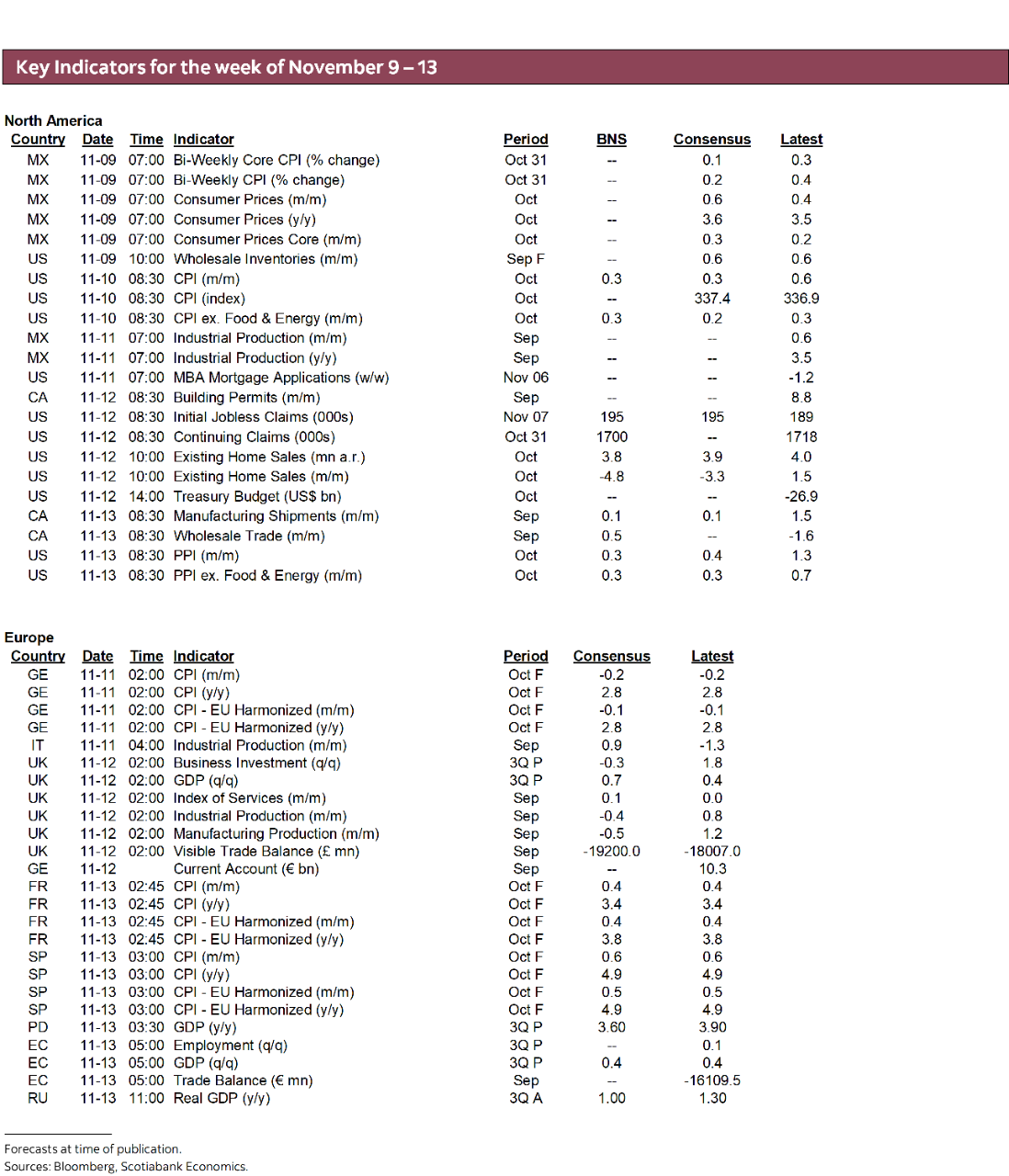
US inflation will be the week’s main event. CPI on Tuesday and then producer prices on Friday will give us what we need for the last estimates of the Fed’s historically preferred inflation gauge to be released on November 25th and before the next policy decision on December 9th. They will also be the last CPI and PPI estimates before that meeting as the next ones will be released the day after.
Ergo, what happens this week will set the tone for parts of the FOMC that pay heed to fresh data evidence.
CPI is expected to rise by 0.3% m/m SA and core CPI (ex-food and energy) is expected to perform similarly. We won’t get official year-over-year rates this time because the BLS did not publish CPI last October due to the government shutdown. Using interpolation methods to develop a rough proxy for last October, we can still infer that the year-over-year total CPI rate may be stable at around 3.7% with core rising to 2.9% (2.6% prior).
Gasoline prices were little changed in October over September. Food prices were probably similarly tame. Because of these two points headline and core inflation measures are expected to be identical.
Core services inflation is estimated to be firm again and is one of the hotter areas of price increases of late (chart 2). One reason we expect this is that energy and other cost pressures continue to get passed on through airfare (chart 3).
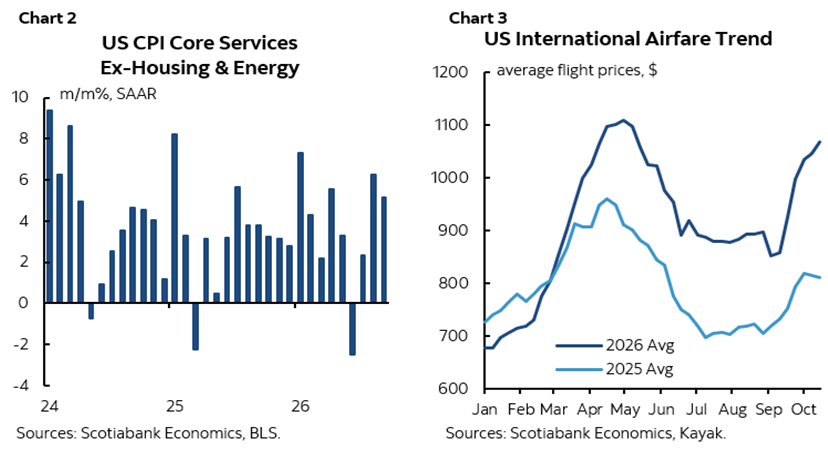
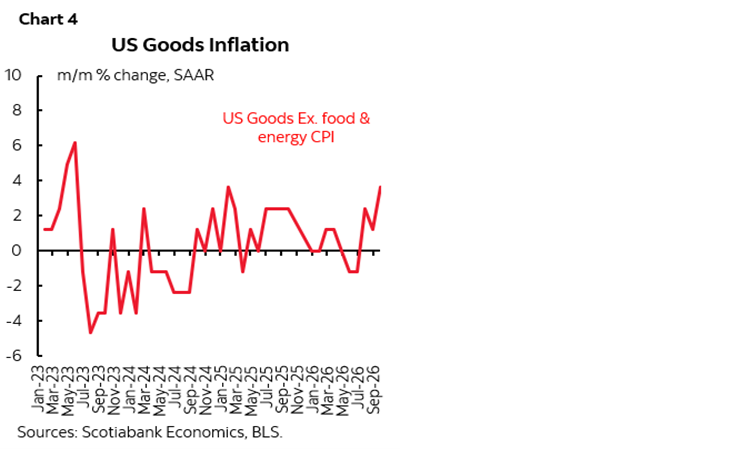
Goods inflation has also picked up (chart 4).
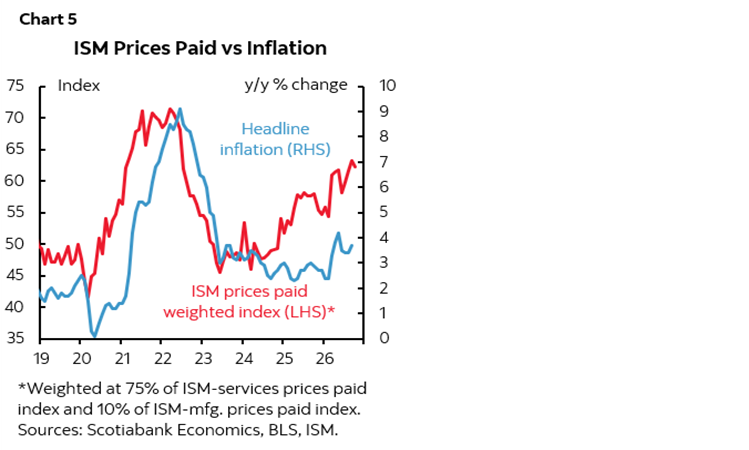
Weighted ISM price signals continue to point toward higher near-term inflation readings (chart 5). Services will be a major part of this.
Housing inflation is expected to be up by 0.2–0.3 as most of the shelter-related price pressures have recently been through hotel and other lodgings away from home.
Vehicle prices may ease given industry tracking of new vehicle prices and the fact that used vehicle prices are coming off a hot prior month.
Also keep an eye on potential increases in weather-affected prices. This piece from the San Francisco Federal Reserve argues that El Niño may have already contributed to price inflation starting as soon as July through expected influences. They argue the effects may dissipate by year-end. If so, then there is risk that markets won’t see through a temporary influence on inflation—and perhaps the Federal Reserve will also find it difficult to do so.
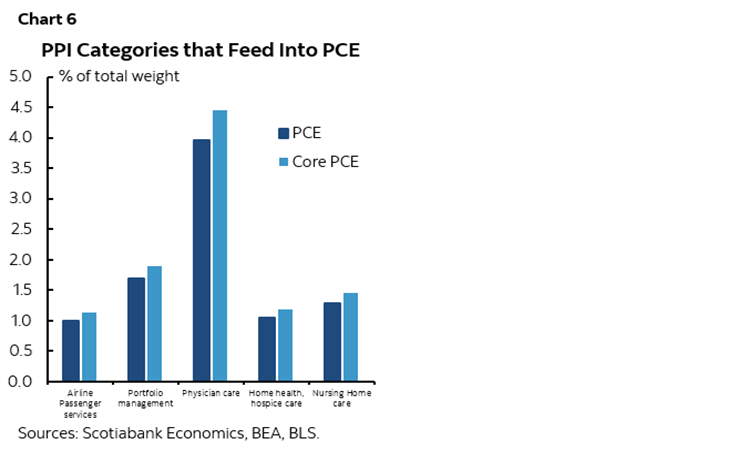
The categories within producer prices that matter to PCE are shown in chart 6 and will be used to supplement a final estimate for the Fed’s preferred inflation gauges.
Apart from the data wiggles, what is driving US inflation in a bigger picture sense?
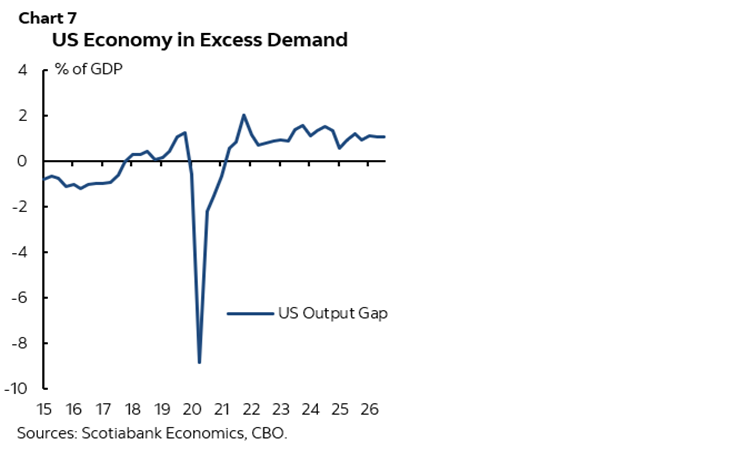
The US economy remains in excess aggregate demand with no slack as captured by the output gap measure (chart 7). It’s easier to pass on cost pressures such as high commodity prices when competitors have little or no slack that would enable them to ramp up marketing and production in order to take someone else’s market share.
There is ongoing tariff passthrough. Industry anecdotes behind ISM price signals referenced US metals tariffs and Canadian retaliatory tariffs in particular (here).
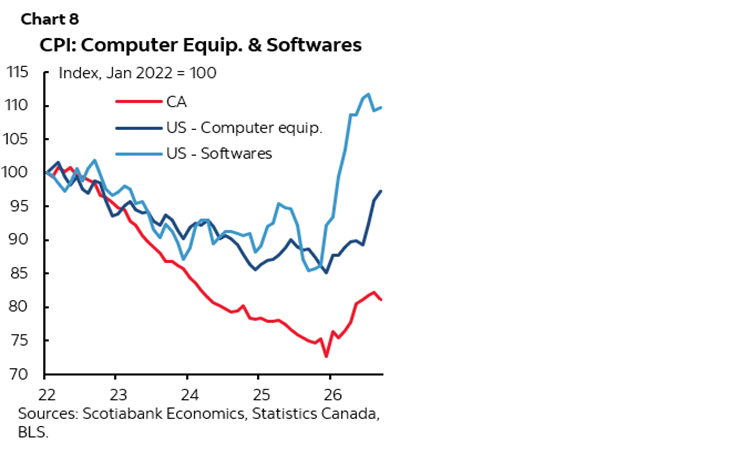
Heavy AI spending continues to drive prices higher in affected categories. Chart 8 offers just one example.
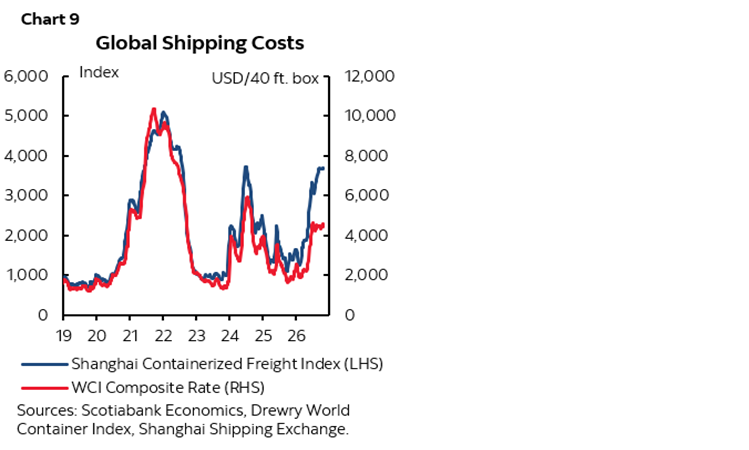
Shipping costs have moved sharply higher this year especially on routes—such as Shanghai to Rotterdam—affected by the Iran war (chart 9).
Key, however, remains whether the first-round drivers of inflationary pressures can be sustained. The longer such cost pressures continue, the more likely that second-round pressures may dissipate. There are a few supporting arguments for this view:
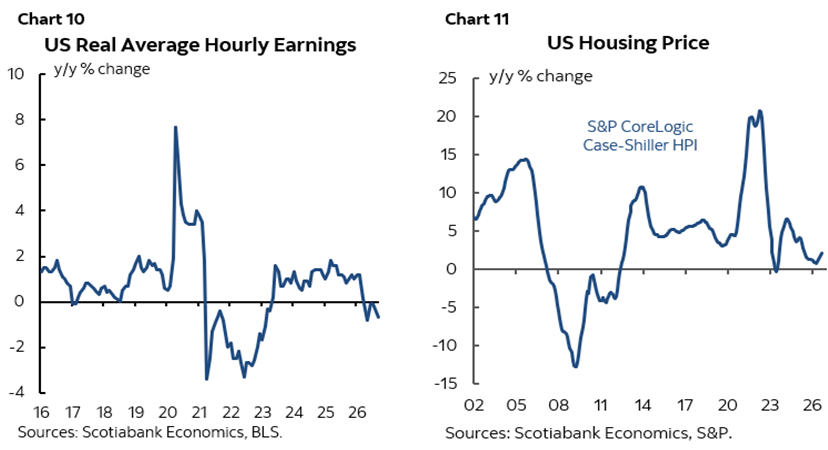
US consumers’ modest nominal wage growth of 3% y/y isn’t keeping up with inflation such that their purchasing power is squeezed (chart 10) while nominal house price increases are so low that knocking inflation off of the trend means they are falling in real terms (chart 11). Consumers are dealing with this by saving less out of paycheques with a saving rate that is close to zero in inflation-adjusted terms, but second-round effects could mean that spending more on gas and groceries crowds out other spending as households repair finances.
US companies tend to respond to cost pressures quicker than elsewhere in the world. They do so by cutting costs, cutting hiring and seeking greater productivity.
The US labour market clears in real time to a much greater extent than elsewhere, such as Europe and even Canada. This means that second round wage pressures are usually less acute in the US and significantly because collective bargaining plays a much smaller role in the US.
CENTRAL BANKS—WAKE RIDING
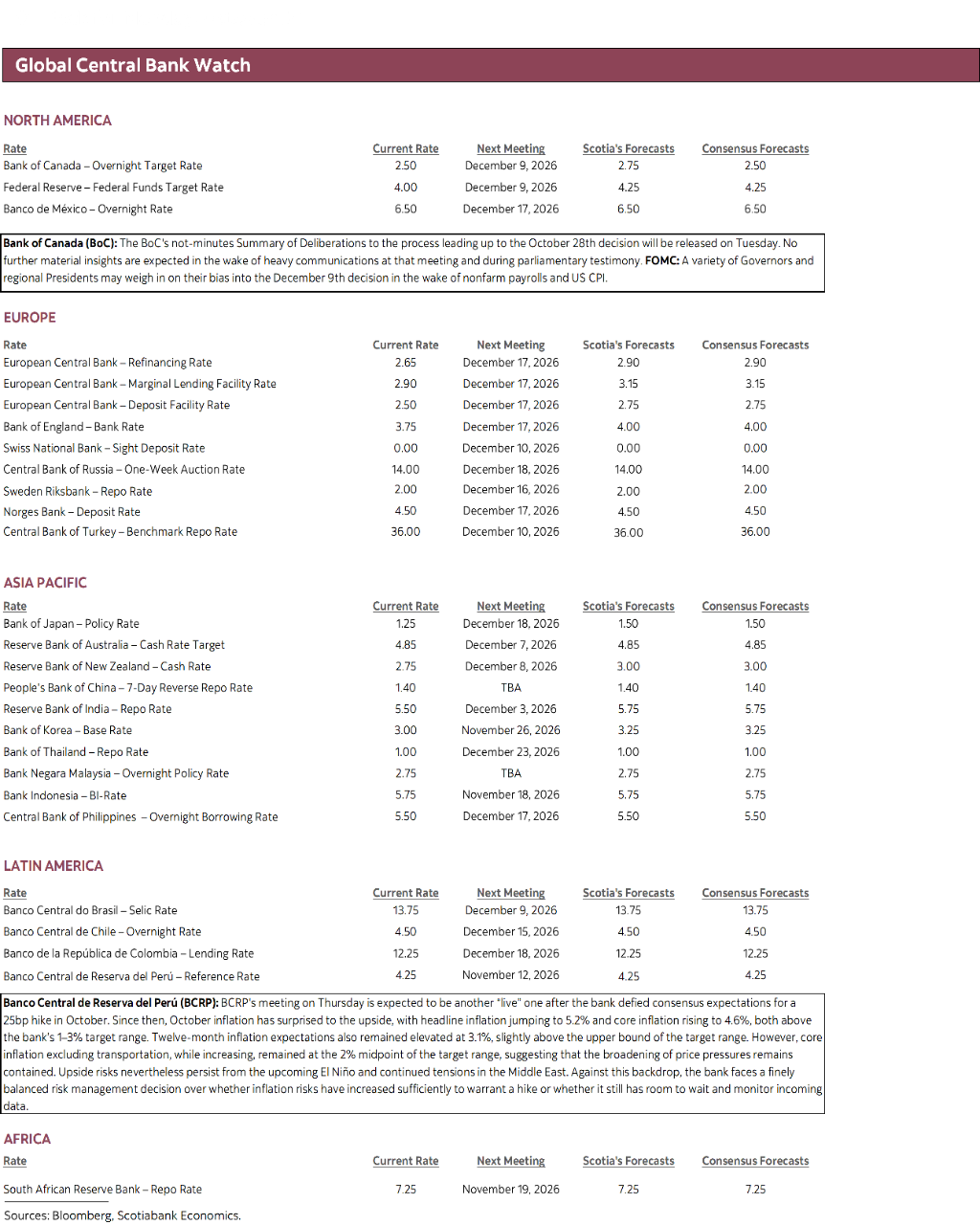
Only a single central bank will weigh in with a fresh policy decision as most of the majors slip into a November lull. A wave of post-data Fed-speak could be impactful and further communications from the Bank of Canada are due.
FOMC Officials to Opine on Next Moves
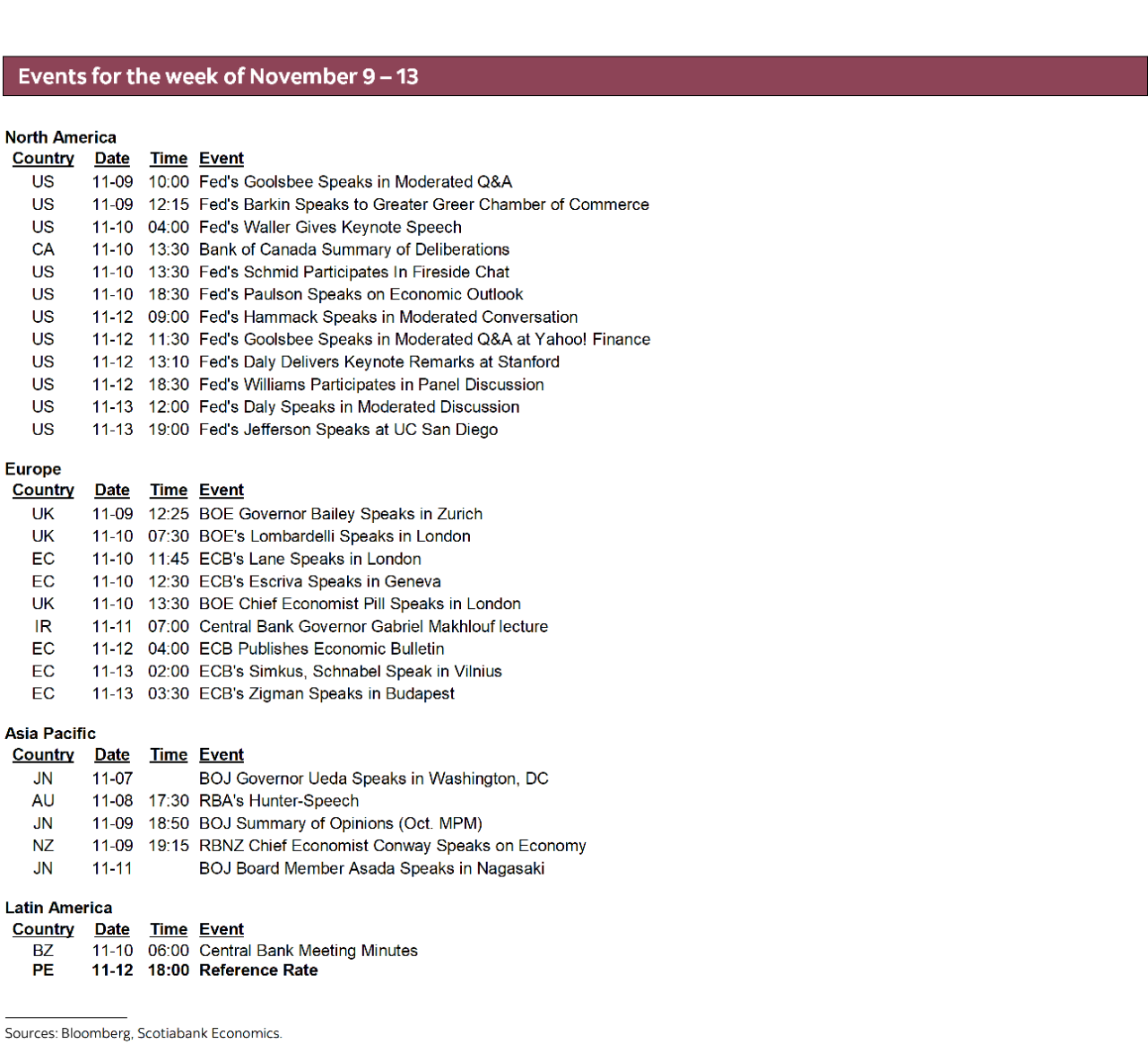
Several FOMC officials will speak in the wake of the latest nonfarm payrolls report (recap here) and Tuesday’s CPI readings. They won’t directly comment on the election but will take it onboard in their thinking about risks to the outlook for inflation including the Iran war. What they say may further inform the likelihood of another rate hike on December 9th. Normally the FOMC delivers what it says in the September dot plot about the year-end rate.
Several Governors (Waller, Jefferson) and regional Presidents (Goolsbee twice, Barkin, Schmid, Paulson, Hammack, Daly twice, and Williams) are on the docket and more may be added.
BoC’s Not-Minutes
The Bank of Canada will publish its not-minutes deliberations to the recent meeting on Tuesday. It will reinforce the rationale for that meeting’s rate hike but is not expected to offer more given the abundance of communication efforts on the day of the decision (recap here) and ensuing testimony before parliamentary committees.
The Summary of Deliberations may be stale on arrival given data on GDP and jobs since the decision day as well as movements in oil prices and the outcome of the US midterms.
Peru’s Central Bank—Stuffed Twice?
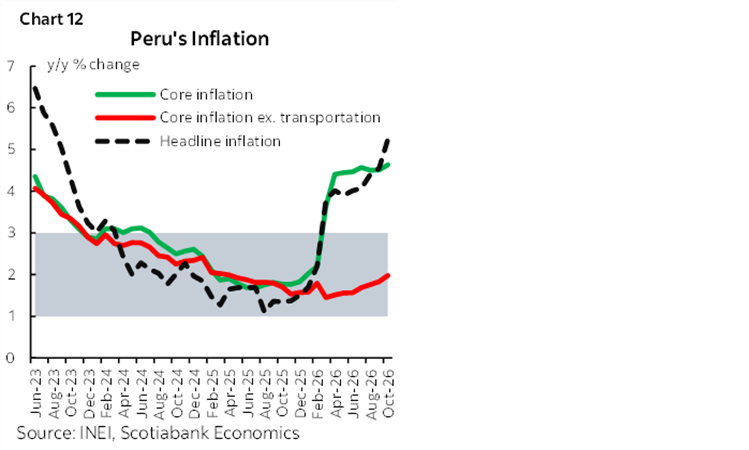
BCRP delivers a decision on Thursday that may raise the reference rate by 25bps to 4.5%. Part of the logic is that the pressure to hike has risen after stuffing expectations for a hike by holding unchanged on October 7th. Inflation has only moved higher since that decision. If BCRP decides to hold again then it may rely upon uncertainty over the outlook for commodity-driven inflation and the USD following the US election, plus the fact that core inflation remains around target (chart 12).
GLOBAL MACRO—PRETTY QUIET!
The global line-up of other macroeconomic indicators beyond US CPI will be rather light this week and here I’ve partnered with Jay Parmar on parts of what follows.
Canada may continue to digest the aftermath of its federal budget as it swings into renewed trade talks with the US that may generate headline risk. The formal calendar is expected to be quiet with just manufacturing sales during September expect to be little changed (Friday) as wholesale trade posts a modest gain (Friday).
US markets may continue to grapple with ongoing election counts but will otherwise mostly focus on inflation stats. The rest of the calendar will be sparsely populated by a handful of readings like an expected slip in existing home sales during October (Thursday), plus weekly jobless claims and ADP private payrolls, and weak real wages during October (Tuesday).
The UK will release preliminary Q3 GDP on Thursday, alongside a breakdown of September activity data. Following stronger than expected growth in the first two months of the quarter, monthly data through August point to a resilient economy, with Q3 growth tracking around +0.7% q/q, up from 0.5% in Q2. Resilient household consumption, as reflected in the latest retail sales data through September, is also expected to support growth. While Q3 growth is tracking above the BoE’s expectations, the key question for markets will be whether this momentum can be sustained into Q4 and next year amid persistent growth headwinds. The OBR’s latest forecasts highlight this divergence, with a modest upgrade to 2026 growth but a more pronounced downgrade to 2027.
On inflation, the focus will be on India’s October CPI print on Thursday, the final reading ahead of the RBI’s December meeting. A 25bp December hike is already priced in, with inflation expected to breach the 6% upper bound of the RBI’s target range. Attention will therefore turn to the core print for signals on the scope for further tightening.
Furthermore, inflation data from Mexico and Colombia on Monday, followed by Norway on Tuesday, will mark one of the final two readings ahead of their respective December central bank meetings, with only Colombia expected to move.
DISCLAIMER
This report has been prepared by Scotiabank Economics as a resource for the clients of Scotiabank. Opinions, estimates and projections contained herein are our own as of the date hereof and are subject to change without notice. The information and opinions contained herein have been compiled or arrived at from sources believed reliable but no representation or warranty, express or implied, is made as to their accuracy or completeness. Neither Scotiabank nor any of its officers, directors, partners, employees or affiliates accepts any liability whatsoever for any direct or consequential loss arising from any use of this report or its contents.
These reports are provided to you for informational purposes only. This report is not, and is not constructed as, an offer to sell or solicitation of any offer to buy any financial instrument, nor shall this report be construed as an opinion as to whether you should enter into any swap or trading strategy involving a swap or any other transaction. The information contained in this report is not intended to be, and does not constitute, a recommendation of a swap or trading strategy involving a swap within the meaning of U.S. Commodity Futures Trading Commission Regulation 23.434 and Appendix A thereto. This material is not intended to be individually tailored to your needs or characteristics and should not be viewed as a “call to action” or suggestion that you enter into a swap or trading strategy involving a swap or any other transaction. Scotiabank may engage in transactions in a manner inconsistent with the views discussed this report and may have positions, or be in the process of acquiring or disposing of positions, referred to in this report.
Scotiabank, its affiliates and any of their respective officers, directors and employees may from time to time take positions in currencies, act as managers, co-managers or underwriters of a public offering or act as principals or agents, deal in, own or act as market makers or advisors, brokers or commercial and/or investment bankers in relation to securities or related derivatives. As a result of these actions, Scotiabank may receive remuneration. All Scotiabank products and services are subject to the terms of applicable agreements and local regulations. Officers, directors and employees of Scotiabank and its affiliates may serve as directors of corporations.
Any securities discussed in this report may not be suitable for all investors. Scotiabank recommends that investors independently evaluate any issuer and security discussed in this report, and consult with any advisors they deem necessary prior to making any investment.
This report and all information, opinions and conclusions contained in it are protected by copyright. This information may not be reproduced without the prior express written consent of Scotiabank.
™ Trademark of The Bank of Nova Scotia. Used under license, where applicable.
Scotiabank, together with “Global Banking and Markets”, is a marketing name for the global corporate and investment banking and capital markets businesses of The Bank of Nova Scotia and certain of its affiliates in the countries where they operate, including; Scotiabank Europe plc; Scotiabank (Ireland) Designated Activity Company; Scotiabank Inverlat S.A., Institución de Banca Múltiple, Grupo Financiero Scotiabank Inverlat, Scotia Inverlat Casa de Bolsa, S.A. de C.V., Grupo Financiero Scotiabank Inverlat, Scotia Inverlat Derivados S.A. de C.V. – all members of the Scotiabank group and authorized users of the Scotiabank mark. The Bank of Nova Scotia is incorporated in Canada with limited liability and is authorised and regulated by the Office of the Superintendent of Financial Institutions Canada. The Bank of Nova Scotia is authorized by the UK Prudential Regulation Authority and is subject to regulation by the UK Financial Conduct Authority and limited regulation by the UK Prudential Regulation Authority. Details about the extent of The Bank of Nova Scotia's regulation by the UK Prudential Regulation Authority are available from us on request. Scotiabank Europe plc is authorized by the UK Prudential Regulation Authority and regulated by the UK Financial Conduct Authority and the UK Prudential Regulation Authority.
Scotiabank Inverlat, S.A., Scotia Inverlat Casa de Bolsa, S.A. de C.V, Grupo Financiero Scotiabank Inverlat, and Scotia Inverlat Derivados, S.A. de C.V., are each authorized and regulated by the Mexican financial authorities.
Not all products and services are offered in all jurisdictions. Services described are available in jurisdictions where permitted by law.