

Next Week's Risk Dashboard
- This holiday shopping season may ignite more inflation…
- …that combined with El Niño effects could drive overreaction by the Fed
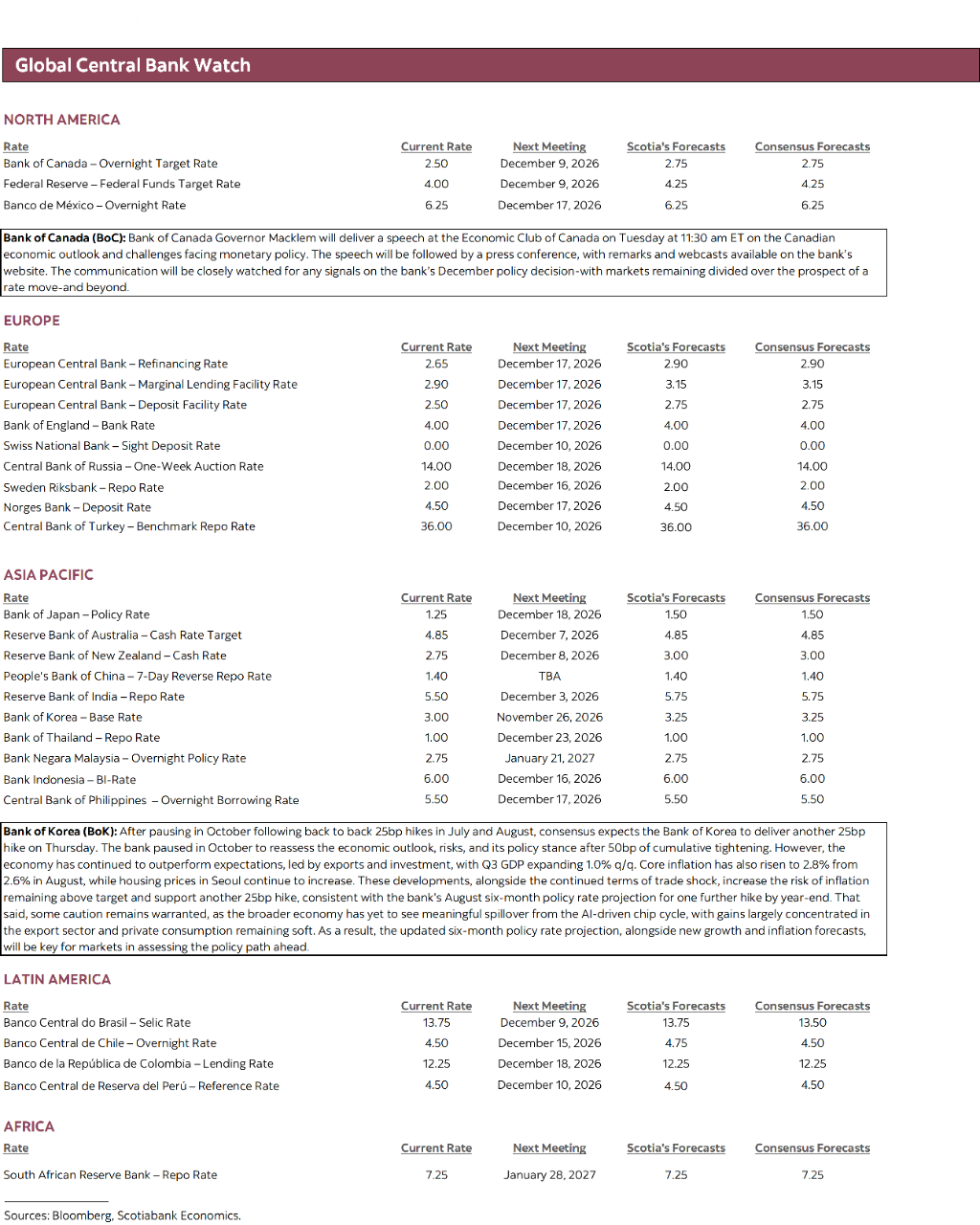
- BoC’s Macklem may firm up December expectations…
- …and why he shouldn’t be fazed by recent job market weakness
- Bank of Korea likely to hike again
- PMIs to inform global growth momentum, supply chain pressures
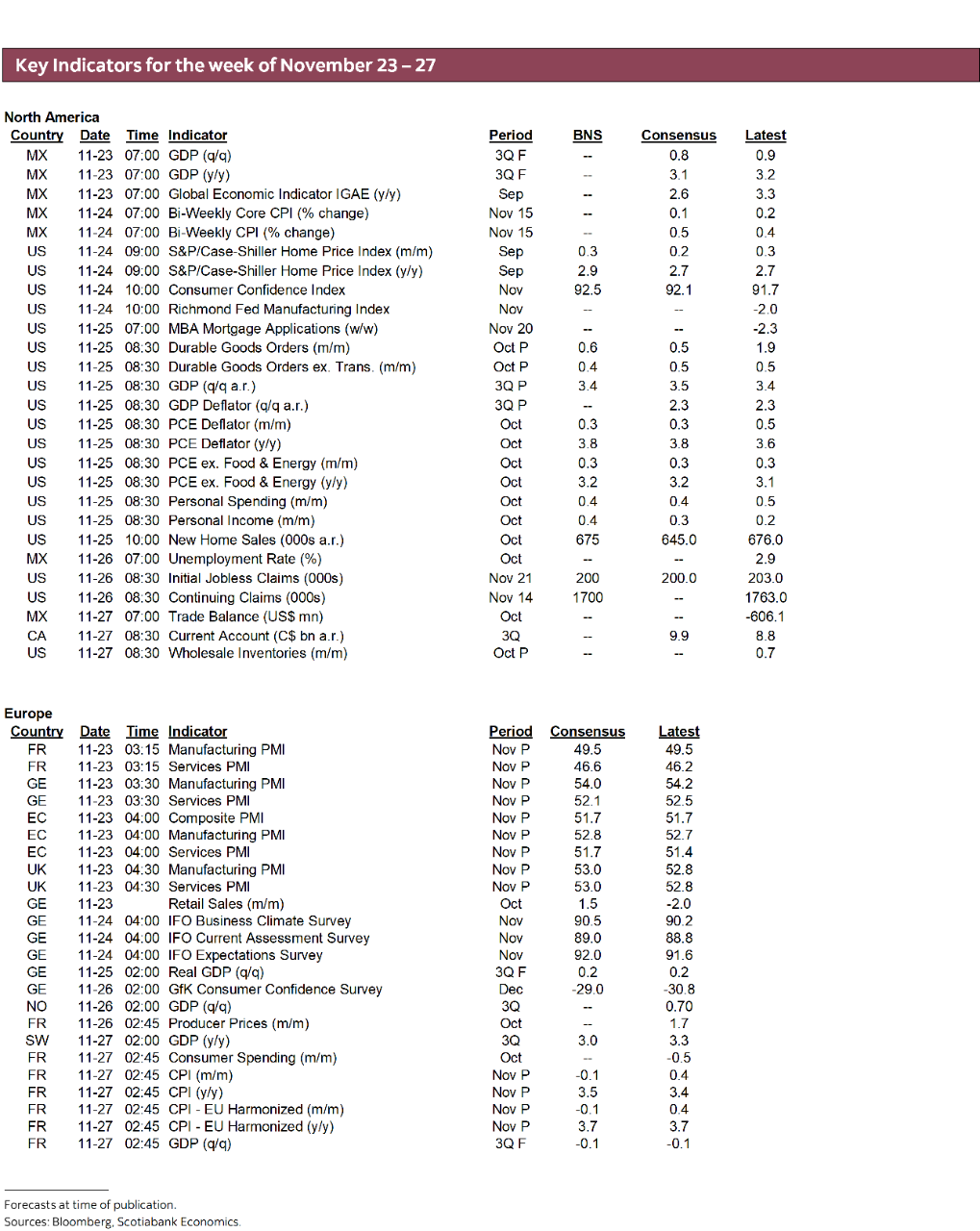
- Inflation updates: US PCE, Eurozone, Japan, Australia
- US to cram in a wave of pre-Thanksgiving macro releases
Chart of the Week
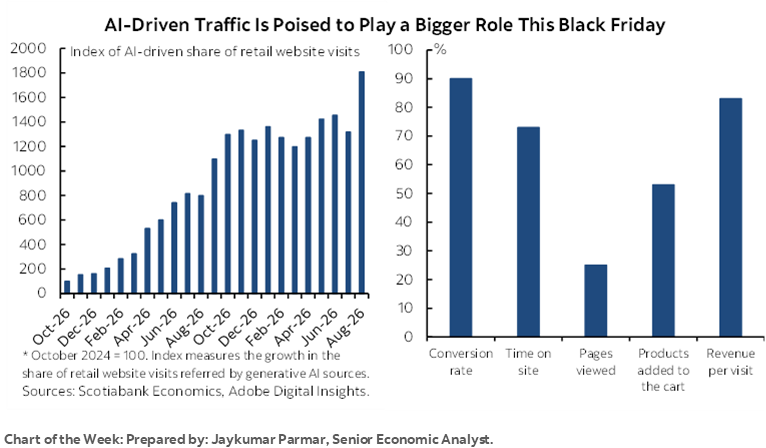
Strong reliance upon near-term inflation data that may be particularly overheated in coming releases may lead the Federal Reserve to become even more hawkish over coming meetings. As US Thanksgiving beckons, the week’s main focus upon holiday sales and inflation readings could bolster this point. Seasonal discounting around turkey time is showing signs of being far less than normal which may mean that after applying seasonal adjustments there could be some really warm numbers ahead.
This could be combined with other unusual seasonal factors. El Niño is probably already adding to inflationary pressures in the US with a reminder link to this piece from the San Francisco Fed.
It’s feasible that the Fed should look through at least some of a potential coming wave of inflationary pressures as El Niño peaks and begins to wane by late year and once muted holiday shopping effects on discounting wane. The other side to more inflamed than usual price pressures could be quite different as seasonal adjustments could overcompensate against a softer price pattern afterward. This may be hard to do and could drive risk of an overreaction by the Committee.
In an otherwise holiday-interrupted week, global markets will consider potentially important pre-blackout guidance from BoC Governor Macklem. I’ll argue that he shouldn’t be fussed by recent softness in the job market and remain laser-focused upon inflation risk. The Bank of Korea will be the only central bank to weigh in with a decision before December’s onslaught of major central banks begins. The price to pay for going on holiday will be for American market participants to cram in a wave of economic indicators on Tuesday and Wednesday. They may miss some of the action in terms of global inflation readings.
THIS HOLIDAY SHOPPING SEASON MAY IGNITE MORE INFLATION
American Thanksgiving is on Thursday. Stocks and bonds will be shut and then subject to an early 1pmET close for stocks and 2pmET for bonds on Friday. Unofficial early closes would surprise no one on Wednesday. The effects will be felt across other markets in the absence of American investors and suspension of trading in US dollar-denominated debt securities overseas.
Eat and shop and not necessarily in that order, or perhaps any order whatsoever. So named because it’s traditionally the time of year when retailers start to turn a profit, Black Friday and then Cyber Monday may set the tone for the holiday shopping season.
Yet the dates are not what they used to be in years past and perhaps particularly so this year. There used to be a cottage industry of folks tracking satellite images of parking lots at malls and monitoring shopper traffic for signs of how robust the season may be. There is some residual attempt at doing so, but the tracking is done much more electronically now with card payments, online traffic statistics and rapid company anecdotes.
What may make this year even less relevant by comparison to prior years is that price discounting is expected to be much less prevalent. In many categories it could be entirely absent which I’ll come back to in a moment.
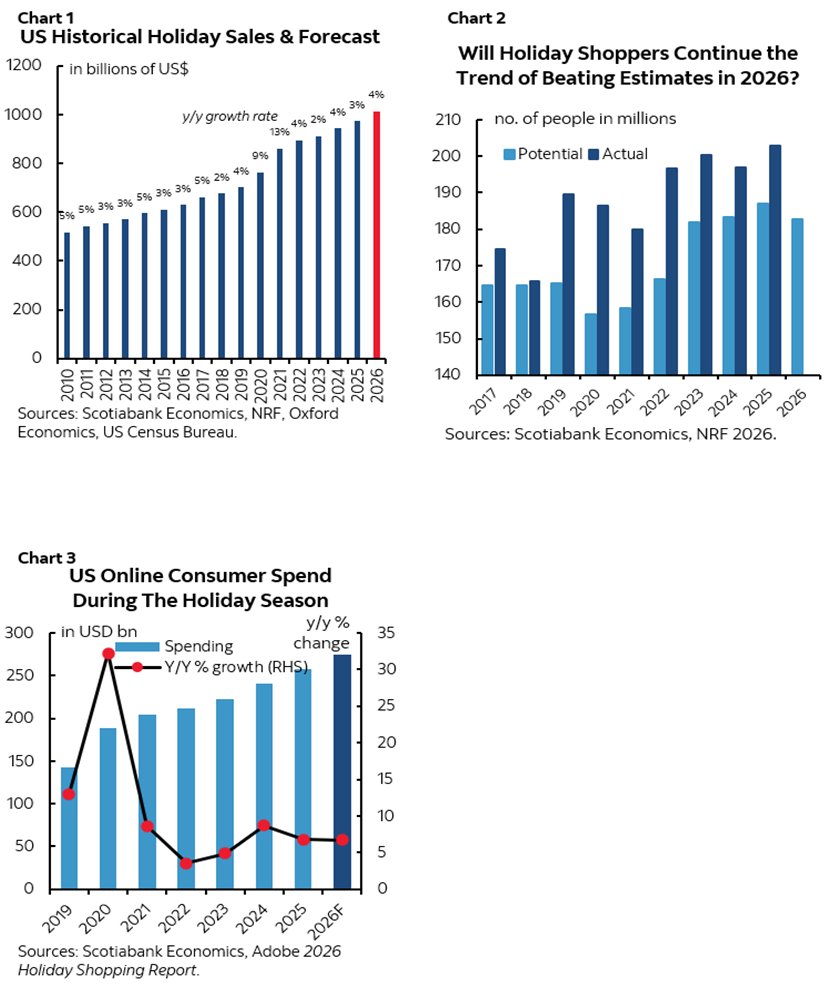
Charts 1–3 provide forecasts for the US holiday shopping season. They include forecasts from various groups for the percentage changes in the value of sales. Because of this, they embed assumptions about price discounting—if any—and the volume of sales. Both count for earnings. Only volumes and industry value-added count for tracking the economy.
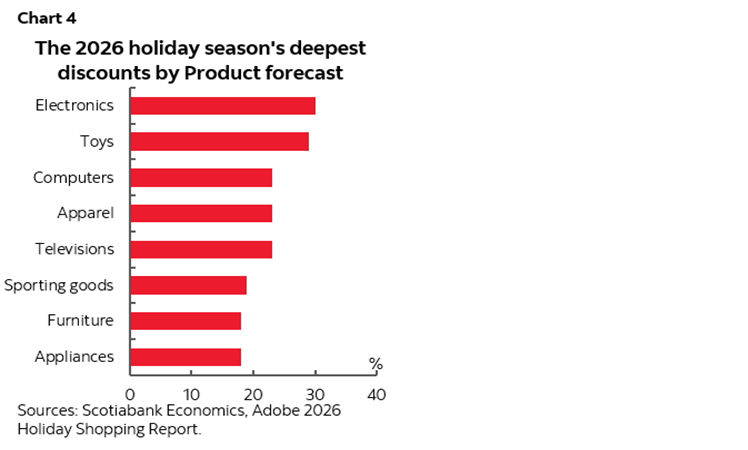
To help inform the price versus volumes breakdown of expectations, chart 4 seems optimistic. It shows the categories that could be subject to the deepest discounts this year. Don’t hold your breath in either the US or Canada.
Charts 5–12 show our tracking of prices by sales category in the US so far this year. The only category where discounting is prevalent this year is if you’re in the market for, say, a bedroom set and fresh sheets! In every other category, the price pressures tend to be more acute than in prior years.
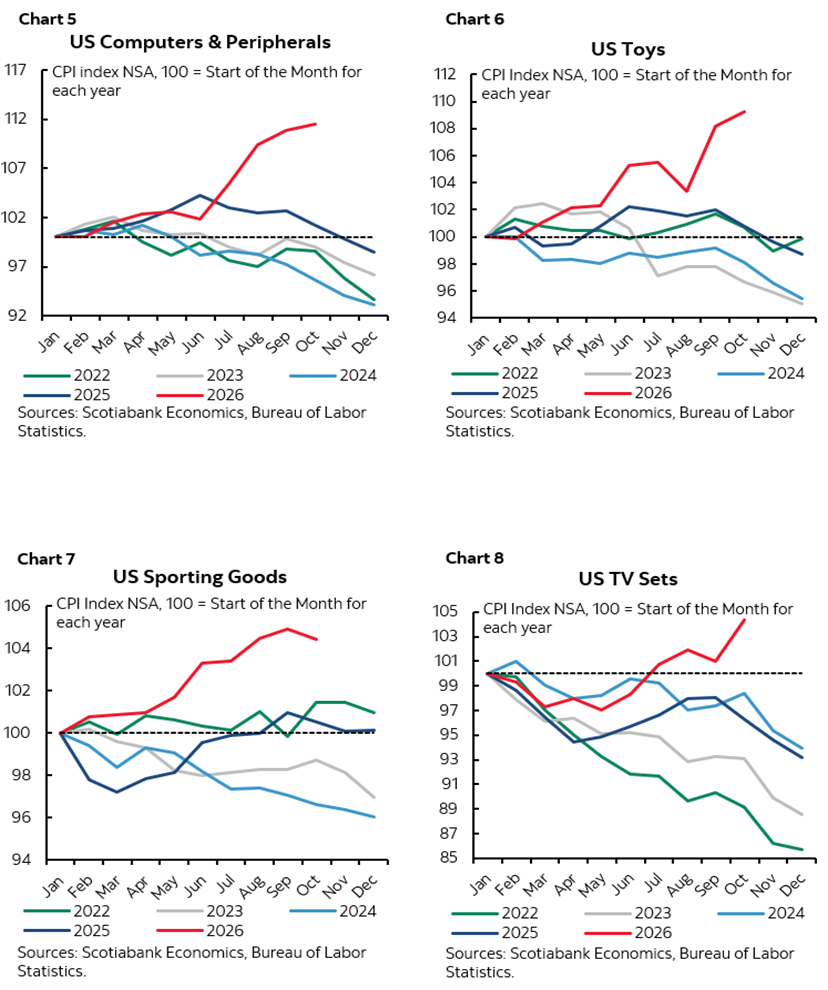
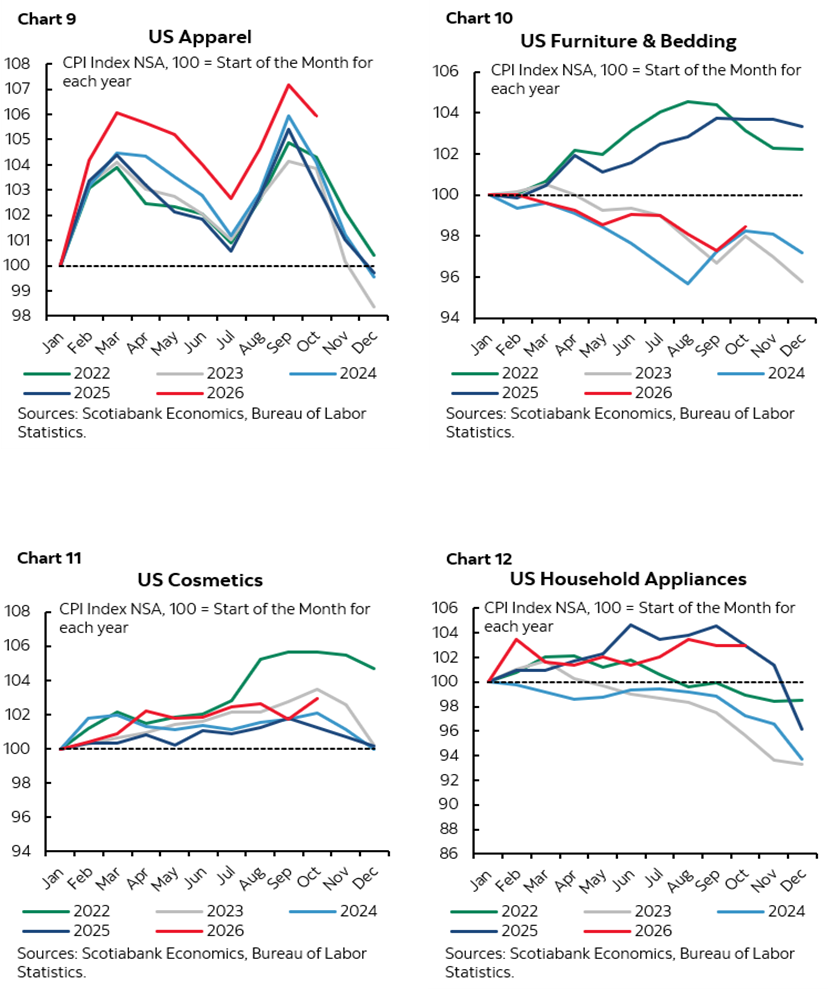
This could mean that if seasonal discounting is less prevalent, seasonally adjusted CPI could be hotter into the holiday season. That’s because at this time of year, SA factors would compensate against seasonal discounting, but if there isn’t any, then SA factors could create some really hot numbers. Thereafter, when SA factors would compensate against post-discounting price pressures, they may go too far in doing so.
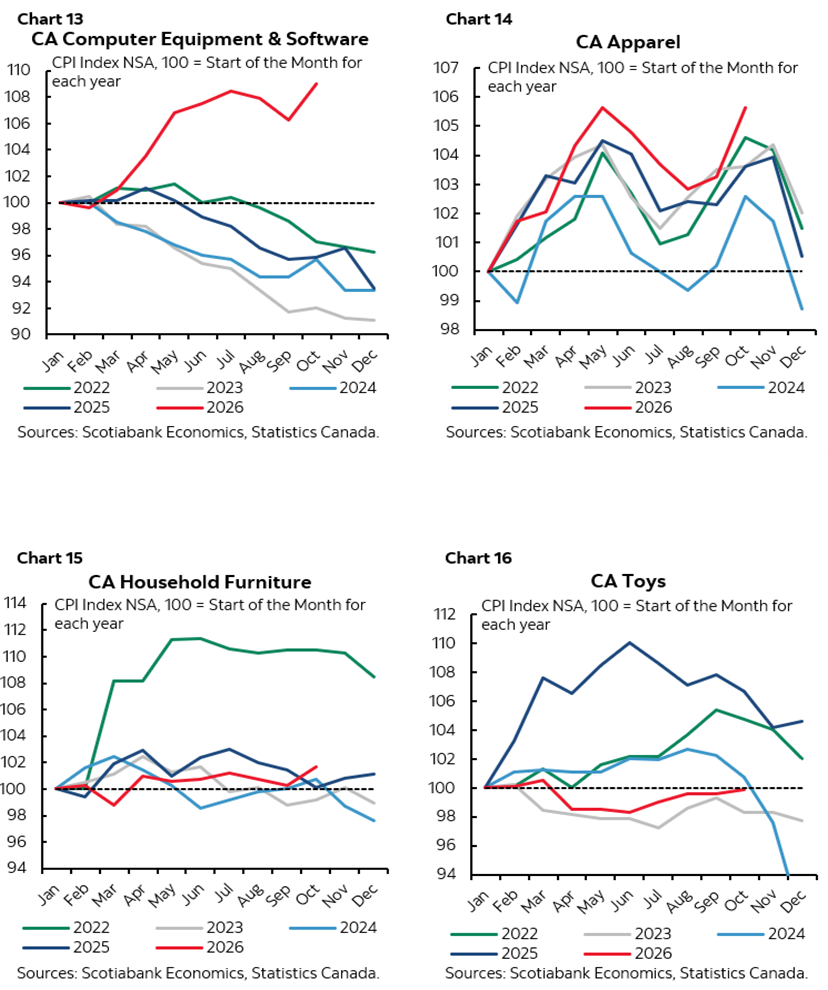
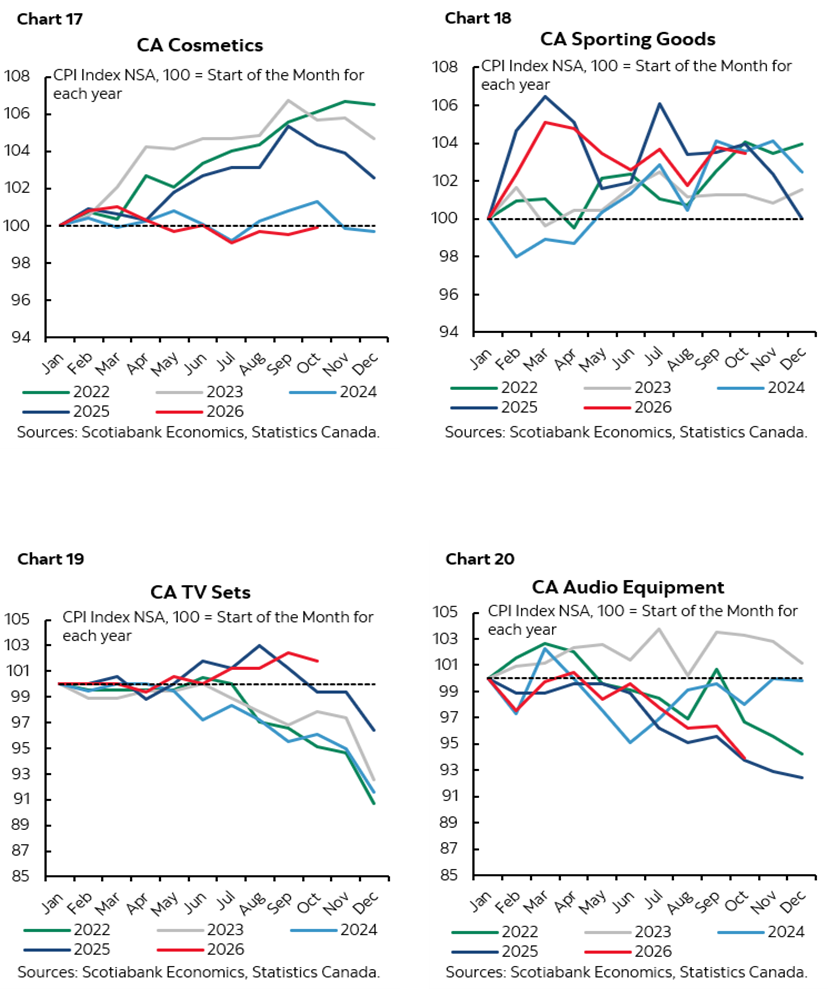
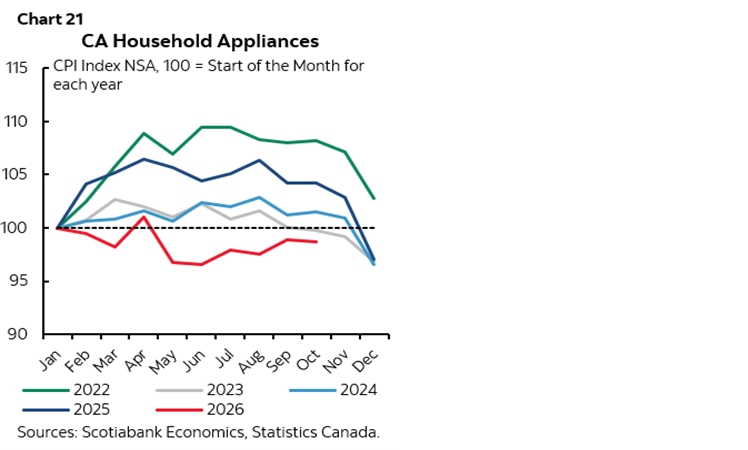
Charts 13–21 do the same thing for categories of Canadian consumer spending. Audio equipment, household appliances, maybe toys and cosmetics are witnessing significant discounting compared to prior years. Like the US, forget about any unusually great deals on electronics and computers partly due to the surging demand for components because of the AI investment craze. Ditto for clothing. While the evidence isn’t quite as strong in Canada, it also points to the possibility that seasonal adjustments may inadequately compensate for stronger than normal price pressures that may exert some upward influence upon Canadian CPI into year-end.
BOC’S MACKLEM—BAH HUMBUG?
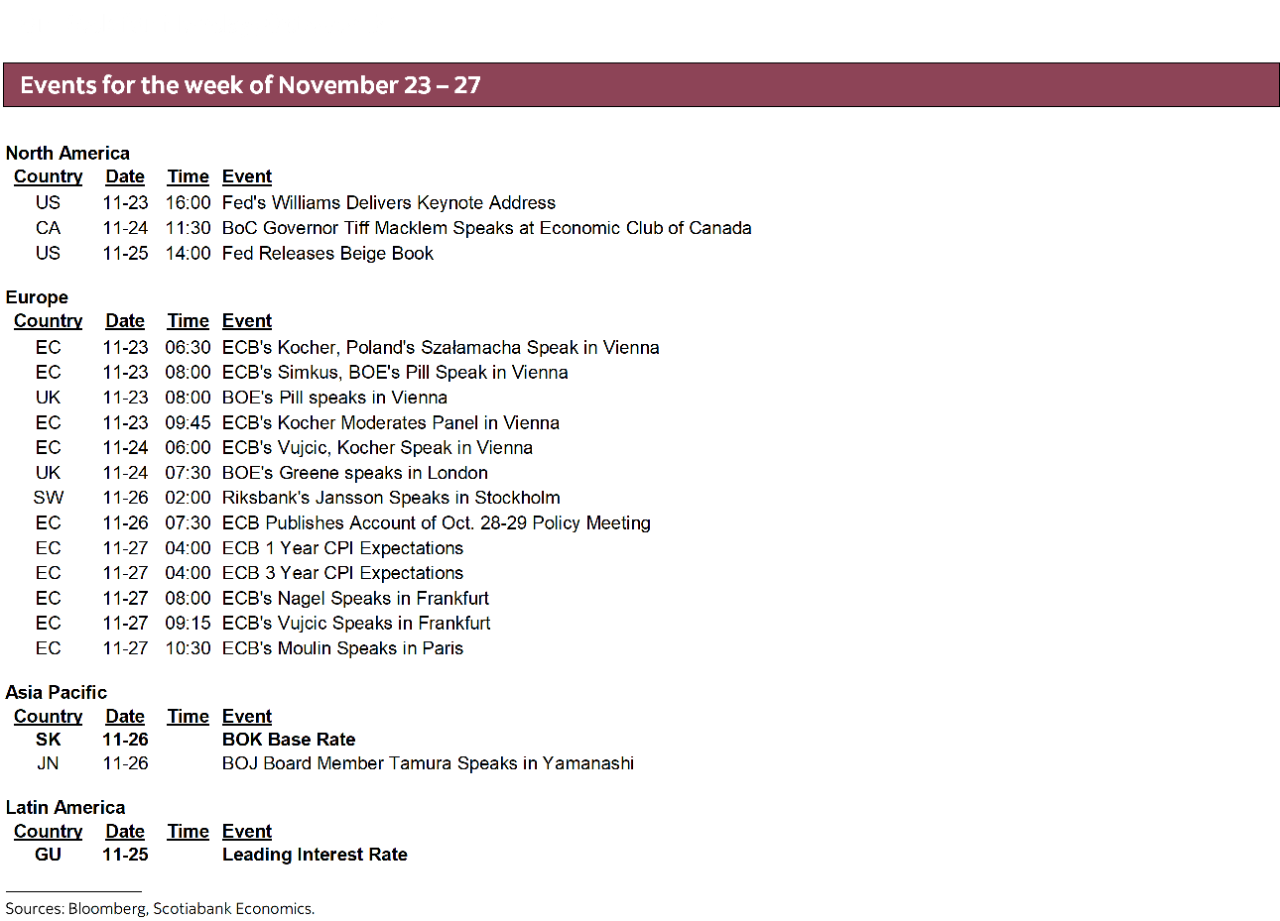
Bank of Canada Governor Tiff Macklem delivers one of two pre-holiday speeches on Tuesday. This one is billed as “an outlook for the Canadian economy and the challenges facing monetary policy,” so what could he be left to address in his more typical pre-holiday speech on December 15th? There will be a press conference during which media may ask impactful questions.
The urgency to speak may reflect a desire to weigh in ahead of the blackout period that begins on December 2nd ahead of the decision seven days later. His speech on the 15th is then likely to rehash what he said in the communications around the fresh policy decision or something else. The only other times since 2021 when Macklem has inserted a speech before the December decision and his year-end speech were in 2022 and 2023 when policy changes were definitely in motion.
These speeches can be impactful to markets especially when policy changes are afoot at inflection points (chart 22). I would expect this one to have a carefully hawkish tone that picks up on the communications around the October decision and subsequently.
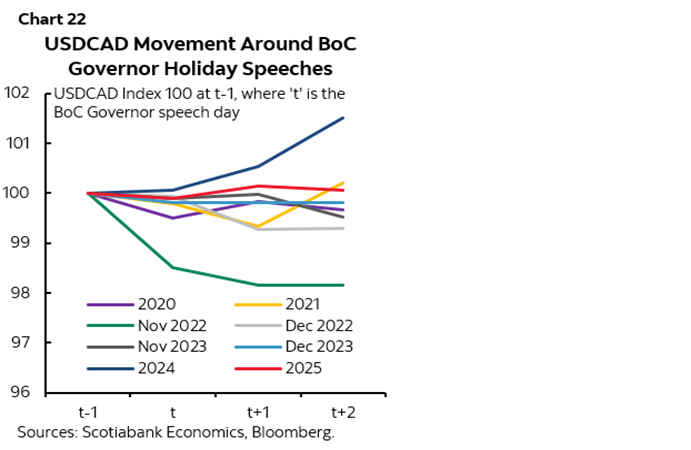
Here is a list of the ones during Macklem’s tenure so far.
- Macklem, 2020: Focused on trade and investment, worried about a second COVID wave. Little market reaction.
- Macklem, 2021: Hawkish slant, pointing to diminishing slack and pivoted toward concern about high inflation. CAD rallied a touch thereafter.
- Macklem, 2022: Generally hawkish tone but shifted toward a tweaking tone after 400bps of hikes with another 75bps to be delivered later. Little market reaction.
- Macklem 2023: Indicated a prolonged hold at 5%, noting it was premature to consider easing but that this could occur before inflation fell to 2%. Markets would subsequently push out expectations for rate cuts.
- Macklem 2024: The speech had an apologetic tone, admitting that public trust in the BoC had been damaged by allowing inflation to surge but that rate cuts would be downsized after a half point reduction that December. The tone generally matched the fresh decision.
- Macklem 2025: Signalled comfort with the present policy rate of 2.25% at “about the right level” with no real market reaction.
I would expect Macklem to continue to drive a hawkish tone. They are fully forward-looking with concern about a sustained overshoot of their 2% inflation target through much of the forecast horizon. That suggests fading data dependence.
A further hike is likely on December 9th. There may be additional information to consider before then, such as trade negotiations, developments in commodity markets and the Iran war, and data.
As a possible further sign, this staff piece was released just this past week. It argues that even when it is uncertain whether a supply shock’s effects on inflation are temporary or longer-lived, there is little cost to front-running a rate response even if the effects turn out to be transitory. The cost to waiting too long may exceed being too forceful too early.
Pair it with Deputy Governor Gravelle’s admission this past week that “we’re seeing the spillover spread” in reference to the impact of higher commodity prices moving into core inflation.
Spillover? And you’re more worried about being too late than too early? Sounds like hike talk to me from a consistency of communications standpoint that builds upon the BoC’s bias shift that began in September.
Macklem may touch upon the state of the labour market and whether this influences his thinking which is the subject of the next section.
WHAT’S GOING ON WITH CANADA’S JOB MARKET?
Would Canada’s recently soft jobs numbers hold the BoC back from hiking? Recall that about 115k jobs have been ‘lost’ over the past three months. This is a very common question across clients. I’ll offer several theories on why they shouldn’t be treated as a barrier and they’re not necessarily mutually incompatible.
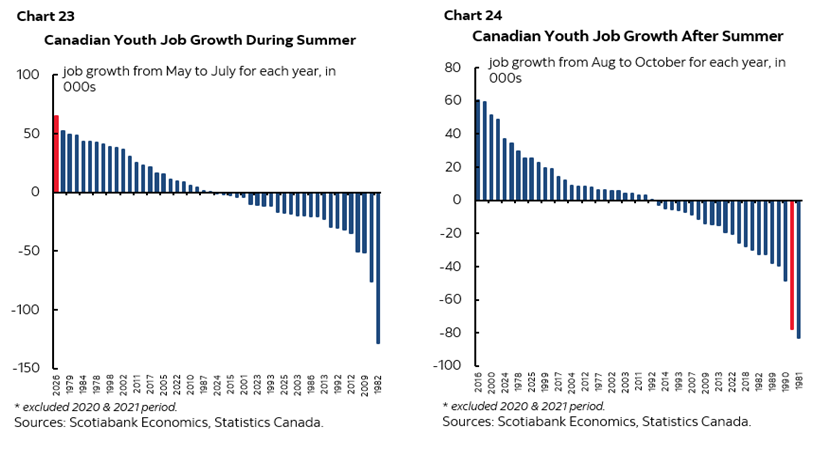
1. Youths have accounted for two-thirds of the job losses in the past three months. Why? This summer job market from May through July was the hottest one on record excluding the pandemic rebound years of 2020 and 2021 (chart 23). Then youths lost more jobs over the August to October period marked by end of summer vacations and the return to school than any other year on record save one—1981 (chart 24). Simply put, what went up faster than ever, went down faster than ever as the student job market stabilized. Why? It was a hot summer for tourism activity that also included the FIFA World Cup and a lot of the workers in that area of the job market tend to be young. Standard seasonal adjustments—particularly given a recency bias to how they are computed—would not have adequately controlled for an outsized summer job market or its outsized unwinding. The BoC should look through this and it’s not under their control in any event. In fact, the folks at Indeed have already been flagging an unusually early rebound in seasonal hiring that could impact the November jobs print just before the December BoC decision (here).
2. Lost jobs reflect a negative shock to labour supply. Canadian jobs are down by 45k ytd. The labour force is down by literally twice as much. You can’t hire if you can’t find workers. Tighter immigration policy is part of this. The pattern has shifted somewhat in the past three months during which the supply of workers shrank by 62k but jobs fell by 115k. We therefore have to consider other explanations for the more recent pattern, such as the first one on this list, but also the following ones. By the way, contrast this to Australia’s recently weak job market; labour supply is up 200k ytd but jobs are up only 74k, indicating an ample supply of available workers but a shortage of opportunities which isn’t really Canada’s issue. This counsels caution in drawing parallels between the job markets influences on both central banks.
3. Hiring and hours worked may have been frontloaded in anticipation of trade risks. Talks collapsed on August 21st. Amid a summertime of threats, it’s possible that companies heaped on hours worked and jobs in order to get product out the door before risks may have increased.
4. I still don’t believe Statcan’s numbers for September when the biggest hit occurred in a 68k drop in employment. Most of them were in the public sector, in health and education, in Quebec and in an election campaign. We can’t verify that with our own internal data. We can’t verify it through public announcements. It would have been highly unusual to fire so many of these workers in an election campaign. The survey is a small sample and done on a rotating 6-month panel basis that only replaces one-sixth of the sample each month. Changes within the sample can be an exaggerated take on what happened to the overall workforce.
I find that each of these theories could play a part in driving the weakness we have seen over recent months.
Further, the outlook for jobs is what matters—not the past few months. Employment is more of a contemporaneous if not lagging economic indicator. As Canada ramps up defence spending, major projects, data centers and commodity-driven investment, it will require a lot of workers. It may not have enough. Canada may need to raise immigration targets once again. How silly it may be to dwell upon the last few months if labour shortages lie ahead.
CENTRAL BANKS—ANOTHER BOK HIKE?
Only one central bank weighs in with a decision this week as markets brace for a year-end onslaught of decisions by global heavyweights in December.
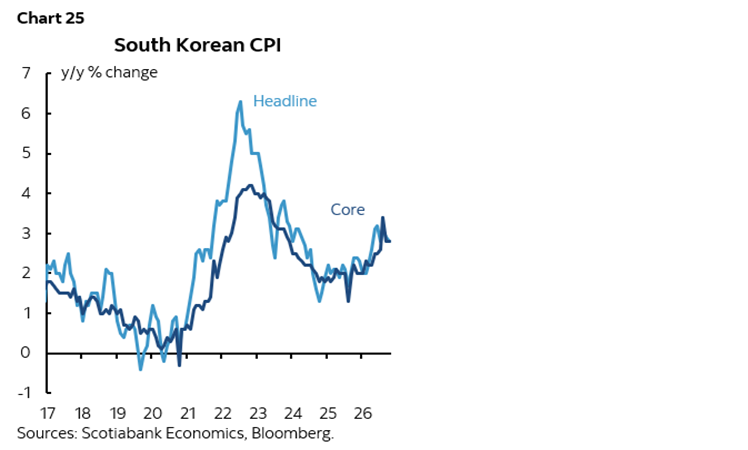
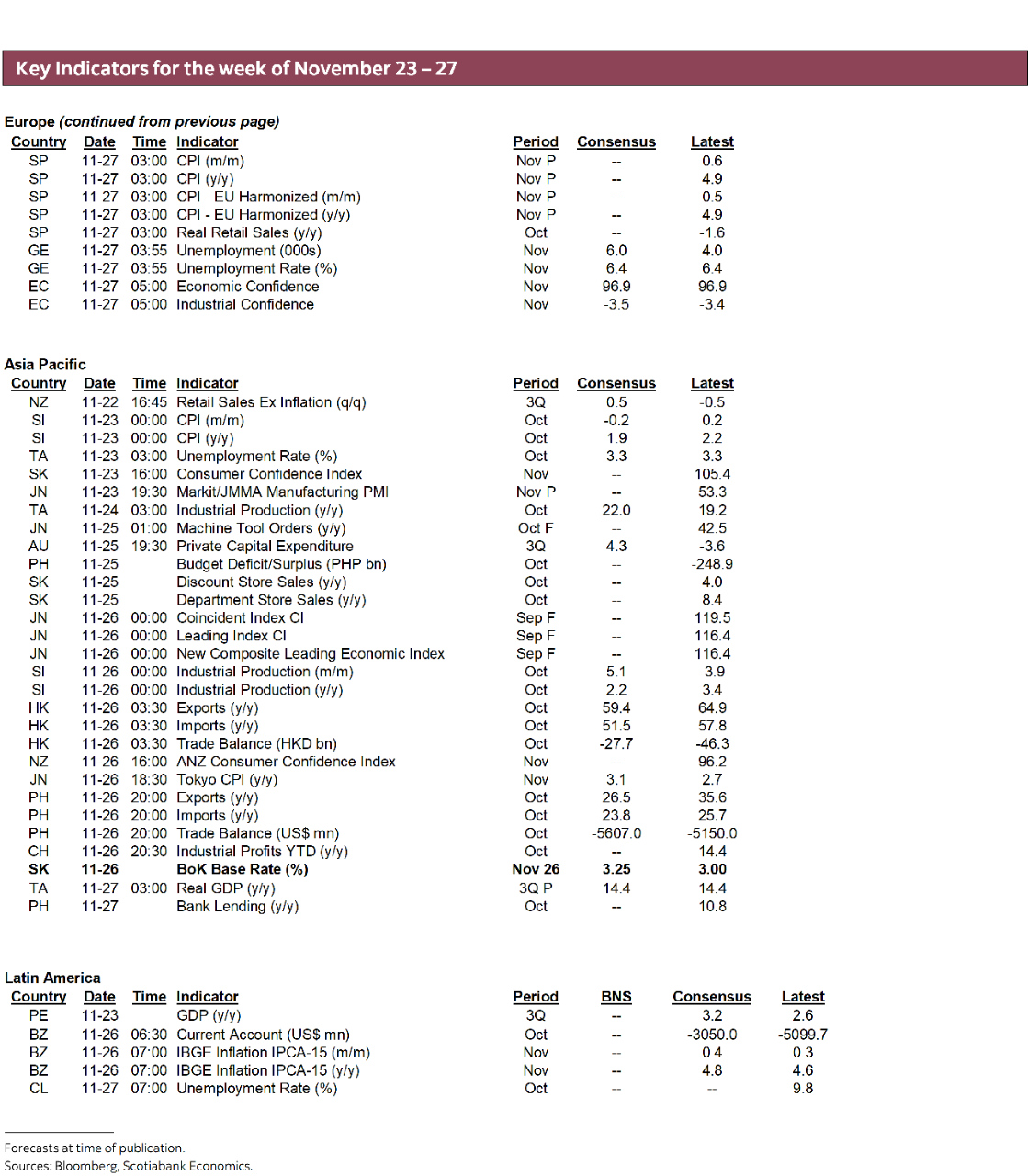
The Bank of Korea weighs in with an update on Thursday. It may resume tightening after pausing in October following two hikes this year in July and August. Since the last decision, GDP growth exceeded expectations for Q3, so did core CPI for October (chart 25), the won has been among the stronger global crosses to the dollar and Seoul’s house prices keep climbing.
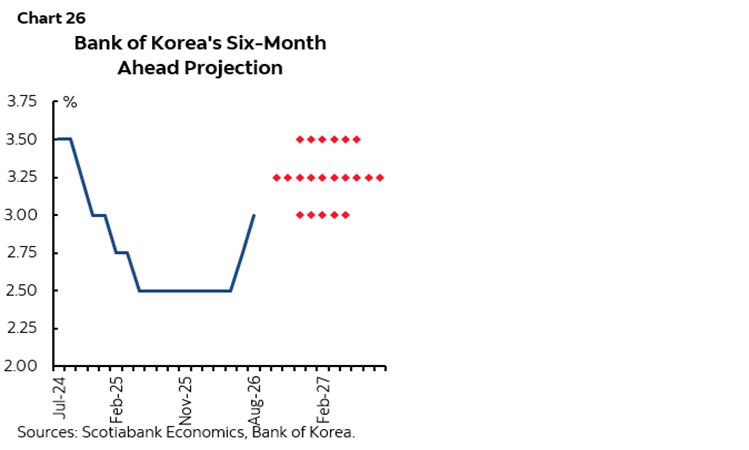
The September Monetary Policy Report (here, page 92) provided explicit forward guidance from the seven Board members and indicated appetite for at least one more hike before year-end (chart 26). The October statement revised up growth expectations while emphasizing data conditionality.
GLOBAL MACRO
A wave of global macro readings will include purchasing managers’ indices, several US reports just before Thanksgiving, and inflation readings out of the Eurozone, Japan and Australia.
Global PMIs—Evaluating Growth Momentum and Supply Chains
My colleague Jay Parmar shares his thoughts for this section on global PMIs. November PMIs across major economies will offer a timely read on growth momentum, with particular attention on signs of rising input costs and selling price pressures across regions. Charts 27 and 28 show the patterns to date. Australia kicks things off on Sunday evening after slipping into contraction territory in October, followed on Monday by readings from the Eurozone, UK, US, and Japan, where recent surveys have generally pointed to continued expansion.
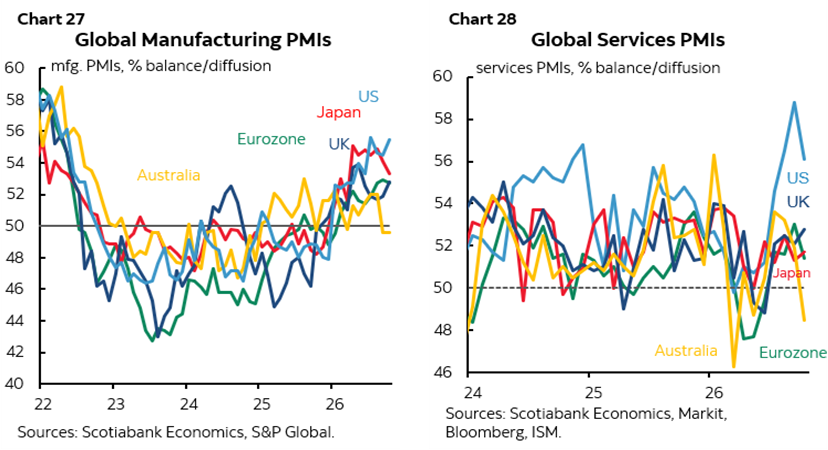
The US flash readings will be a key focus. Business activity has remained close to a five-year high, supported by both manufacturing and services, alongside solid new orders and hiring as firms expanded capacity to meet demand. The bigger question for November will be whether that strength is increasingly accompanied by inflationary pressures. Recent surveys have flagged broad based increases in input costs, ranging from oil related inputs and other commodities to freight and wages, alongside higher selling prices as firms look to pass on the costs.
Elsewhere, the November readings will help test whether global growth momentum is holding up into year-end, particularly amid diverging new order trends, with Australia and the Eurozone showing signs of softer demand while the UK and Japan have remained more resilient. Attention will also be on whether higher commodity and other input costs are beginning to weigh on the growth outlook, alongside any signs of improvement or renewed pressure on supplier delivery times and costs.
Canada Quiet
Canada will mainly follow Governor Macklem’s speech and signs of momentum in holiday sales. Only SEPH payrolls for September are due out (Thursday). They’re a lagging indicator that is often subject to massive revisions each month and that often doesn’t line up with the Labour Force Survey’s component for payrolls.
US—Cramming it All In
Any US indicator that matters will be crammed into Tuesday and Wednesday before a big whooshing sound out the door into Thanksgiving.
Tuesday’s main release will be consumer confidence. November’s reading could improve to the extent to which decent job growth and falling gasoline prices drive it. Confidence is hovering around pandemic-era lows so it’s hard not to imagine some improvement.
Wednesday crams in several releases as follows:
- Personal income (October): Incomes could grow at the fastest pace since May. Wages and salaries are posting decent growth, and incomes will be lifted by two special factors. One is a one-time Medicare premium rebate of $90 to about 21 million Americans. Another is because November 1st was on a Sunday this year, so some payments will be brought forward to October, such as Veterans’ and other military benefits.
- Personal spending: The retail sales control group’s 0.6% m/m SA rise in October is expected to lift total personal spending by a similar to slightly slower pace given close historical correlations.
- PCE: The problem facing spending, however, is that much of the gain is probably due to higher prices. The Fed’s preferred measures of inflation—the PCE and core PCE price deflators—are both expected to rise by about 0.3% m/m SA. November’s readings are informed by CPI, relevant producer price components and methodological differences including different weights on various types of spending. If the core PCE estimate is in the right ballpark, then it would reinforce FOMC communications that lean toward hiking again on December 9th. A lower than expected number could impact rate pricing after an expected December hike.
- Q3 GDP revisions: I don’t think we have enough information to stray from the initial reading of 3.4% q/q SAAR. There may be slight upside potential from positive retail sales revisions. The next revision will be the one to incorporate fuller evidence on services.
- Durable goods orders: October’s reading is expected to continue to be driven by core capital goods orders and especially from the tech-sector. Boeing’s plane orders were strong at an unchanged pace over the prior month.
- New home sales: Will October’s reading get a lift from weather like I believe the upside surprise to housing starts enjoyed? Most estimates don’t think so. It could be that sales remain tepid at such high mortgage rates but good weather enabled brought-forward homebuilding activity. Thank El Niño.
Other US readings will include ADP’s weekly private payrolls gauge (Tuesday), house prices in September (Tuesday), the Richmond Fed’s manufacturing index (Tuesday), weekly jobless claims (Wednesday), the Fed’s Beige Book of regional conditions (Wednesday) and then the merchandise trade report on Friday.
Inflation Elsewhere—Eurozone, Australia, Japan
Several regions other than the US also update inflation measures for November.
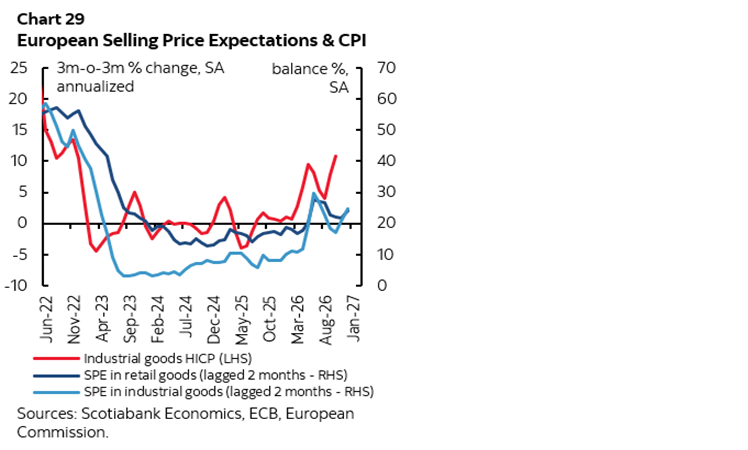
Falling gasoline prices in Europe could motivate a bigger drop in Eurozone CPI in m/m terms but not just yet while core CPI is expected to remain sticky. Super 95 gasoline prices moved slightly lower on average in October over September, but the bigger drop comes in November. Spain and France kick off the readings for October on Friday which will provide a decent indication of what to expect for the following week’s Eurozone tally. Measures of expected selling prices are likely to continue worrying the ECB about second-round pressures (chart 29).
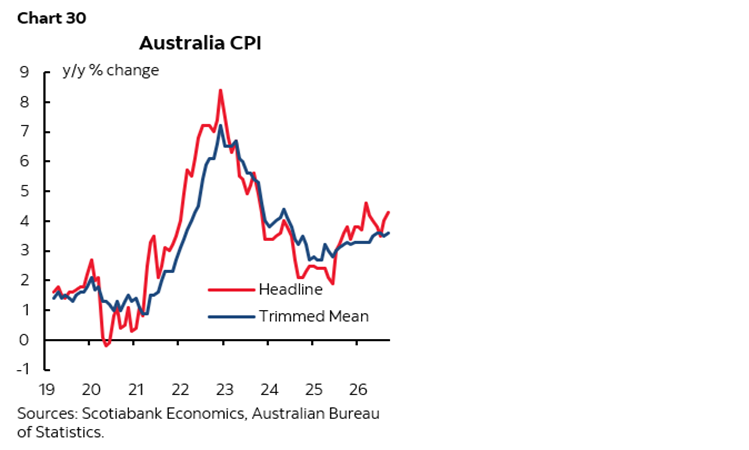
Australia refreshes CPI for October on Tuesday and here too it will be too early to expect gas price relief as prices leapt higher in October. A reading approaching about 4½% y/y is feasible which could keep the RBA on hawkish footings given the pattern to date (chart 30).
Markets are primed for another Bank of Japan rate hike on December 18th, but the last Tokyo CPI reading may influence the bias thereafter especially as gasoline prices begin to plateau. In Japan, however, the drivers of inflationary pressures are broader and more widespread than in some other markets as evidence by expectations for core Tokyo CPI to rise to about 2¾% y/y.
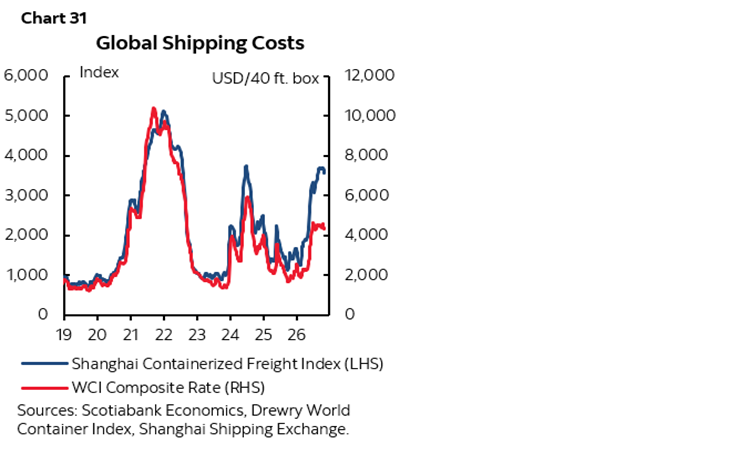
In all cases, surging global shipping costs are among the common drivers of cost-push types of inflationary pressures. Some measures are not far off pandemic highs (chart 31).
DISCLAIMER
This report has been prepared by Scotiabank Economics as a resource for the clients of Scotiabank. Opinions, estimates and projections contained herein are our own as of the date hereof and are subject to change without notice. The information and opinions contained herein have been compiled or arrived at from sources believed reliable but no representation or warranty, express or implied, is made as to their accuracy or completeness. Neither Scotiabank nor any of its officers, directors, partners, employees or affiliates accepts any liability whatsoever for any direct or consequential loss arising from any use of this report or its contents.
These reports are provided to you for informational purposes only. This report is not, and is not constructed as, an offer to sell or solicitation of any offer to buy any financial instrument, nor shall this report be construed as an opinion as to whether you should enter into any swap or trading strategy involving a swap or any other transaction. The information contained in this report is not intended to be, and does not constitute, a recommendation of a swap or trading strategy involving a swap within the meaning of U.S. Commodity Futures Trading Commission Regulation 23.434 and Appendix A thereto. This material is not intended to be individually tailored to your needs or characteristics and should not be viewed as a “call to action” or suggestion that you enter into a swap or trading strategy involving a swap or any other transaction. Scotiabank may engage in transactions in a manner inconsistent with the views discussed this report and may have positions, or be in the process of acquiring or disposing of positions, referred to in this report.
Scotiabank, its affiliates and any of their respective officers, directors and employees may from time to time take positions in currencies, act as managers, co-managers or underwriters of a public offering or act as principals or agents, deal in, own or act as market makers or advisors, brokers or commercial and/or investment bankers in relation to securities or related derivatives. As a result of these actions, Scotiabank may receive remuneration. All Scotiabank products and services are subject to the terms of applicable agreements and local regulations. Officers, directors and employees of Scotiabank and its affiliates may serve as directors of corporations.
Any securities discussed in this report may not be suitable for all investors. Scotiabank recommends that investors independently evaluate any issuer and security discussed in this report, and consult with any advisors they deem necessary prior to making any investment.
This report and all information, opinions and conclusions contained in it are protected by copyright. This information may not be reproduced without the prior express written consent of Scotiabank.
™ Trademark of The Bank of Nova Scotia. Used under license, where applicable.
Scotiabank, together with “Global Banking and Markets”, is a marketing name for the global corporate and investment banking and capital markets businesses of The Bank of Nova Scotia and certain of its affiliates in the countries where they operate, including; Scotiabank Europe plc; Scotiabank (Ireland) Designated Activity Company; Scotiabank Inverlat S.A., Institución de Banca Múltiple, Grupo Financiero Scotiabank Inverlat, Scotia Inverlat Casa de Bolsa, S.A. de C.V., Grupo Financiero Scotiabank Inverlat, Scotia Inverlat Derivados S.A. de C.V. – all members of the Scotiabank group and authorized users of the Scotiabank mark. The Bank of Nova Scotia is incorporated in Canada with limited liability and is authorised and regulated by the Office of the Superintendent of Financial Institutions Canada. The Bank of Nova Scotia is authorized by the UK Prudential Regulation Authority and is subject to regulation by the UK Financial Conduct Authority and limited regulation by the UK Prudential Regulation Authority. Details about the extent of The Bank of Nova Scotia's regulation by the UK Prudential Regulation Authority are available from us on request. Scotiabank Europe plc is authorized by the UK Prudential Regulation Authority and regulated by the UK Financial Conduct Authority and the UK Prudential Regulation Authority.
Scotiabank Inverlat, S.A., Scotia Inverlat Casa de Bolsa, S.A. de C.V, Grupo Financiero Scotiabank Inverlat, and Scotia Inverlat Derivados, S.A. de C.V., are each authorized and regulated by the Mexican financial authorities.
Not all products and services are offered in all jurisdictions. Services described are available in jurisdictions where permitted by law.