

Next Week's Risk Dashboard
- APEC Summit may influence US-China-Canada relations
- Nvidia earnings, Anthropic IPO
- Canada’s last pre-BoC inflation readings are unlikely to be trend busters
- BoC — Is December a ‘Go’?
- BoC has two chances to provide guidance before the next meeting
- FOMC minutes will be stale…
- …but the FOMC is communicating as much as ever
- Fed to tighten in December and probably beyond…
- …but Waller is alone on upsizing
- Fed’s first task force forum to reveal more Qs than As…
- …regarding the evidence on AI’s effects on jobs and productivity
- BI — The Wild West
- SARB likely to skip this time
- Global macro — Aussie jobs/wages, UK jobs/wages…
- …UK CPI, US retail sales, Canadian housing, LatAm GDP
Chart of the Week
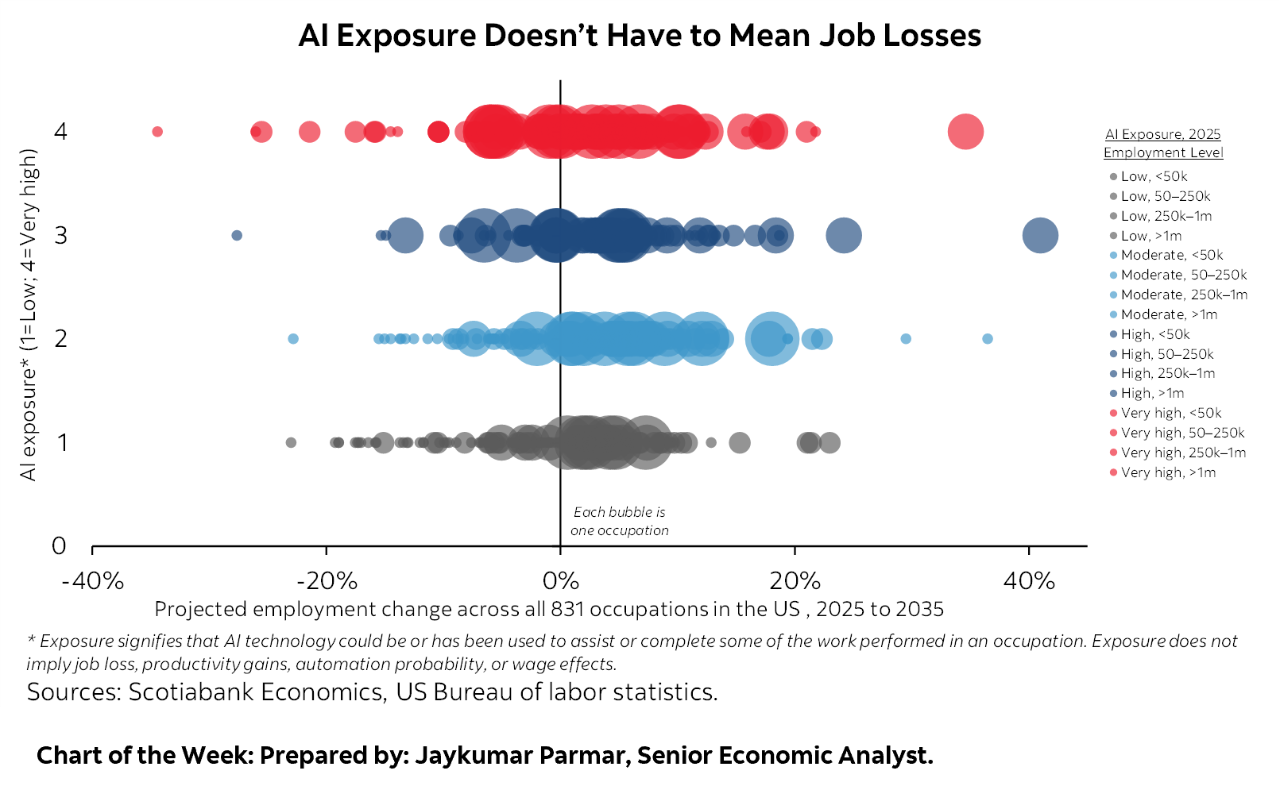
A fascinating week lies ahead with much of the focus upon the four Ps of the AI economy—power, profits, policy and productivity.
The 33rd Asia-Pacific Economic Cooperation (APEC) Leaders’ Meeting will unfold in Shenzhen, China from Wednesday through Thursday and may be the week’s key source of market risk. Trade and technology will be top of mind and particularly in terms of whether US-China relations continue to stabilize, further de-escalate tensions, or spark renewed escalation of tensions. The potential spy scandal at Nvidia may create US-China tensions and a heightened sense of rivalry. Canadian PM Carney will also be in attendance with possible developments in US-Canada and China-Canada relations.
A big week for tech will extend beyond policy spies and policy risks. Nvidia’s earnings (Tuesday) and Anthropic’s IPO pricing on Wednesday and first day of trading on Thursday may extend tech jitters. A common pattern involves getting in and out of IPOs fairly quickly.
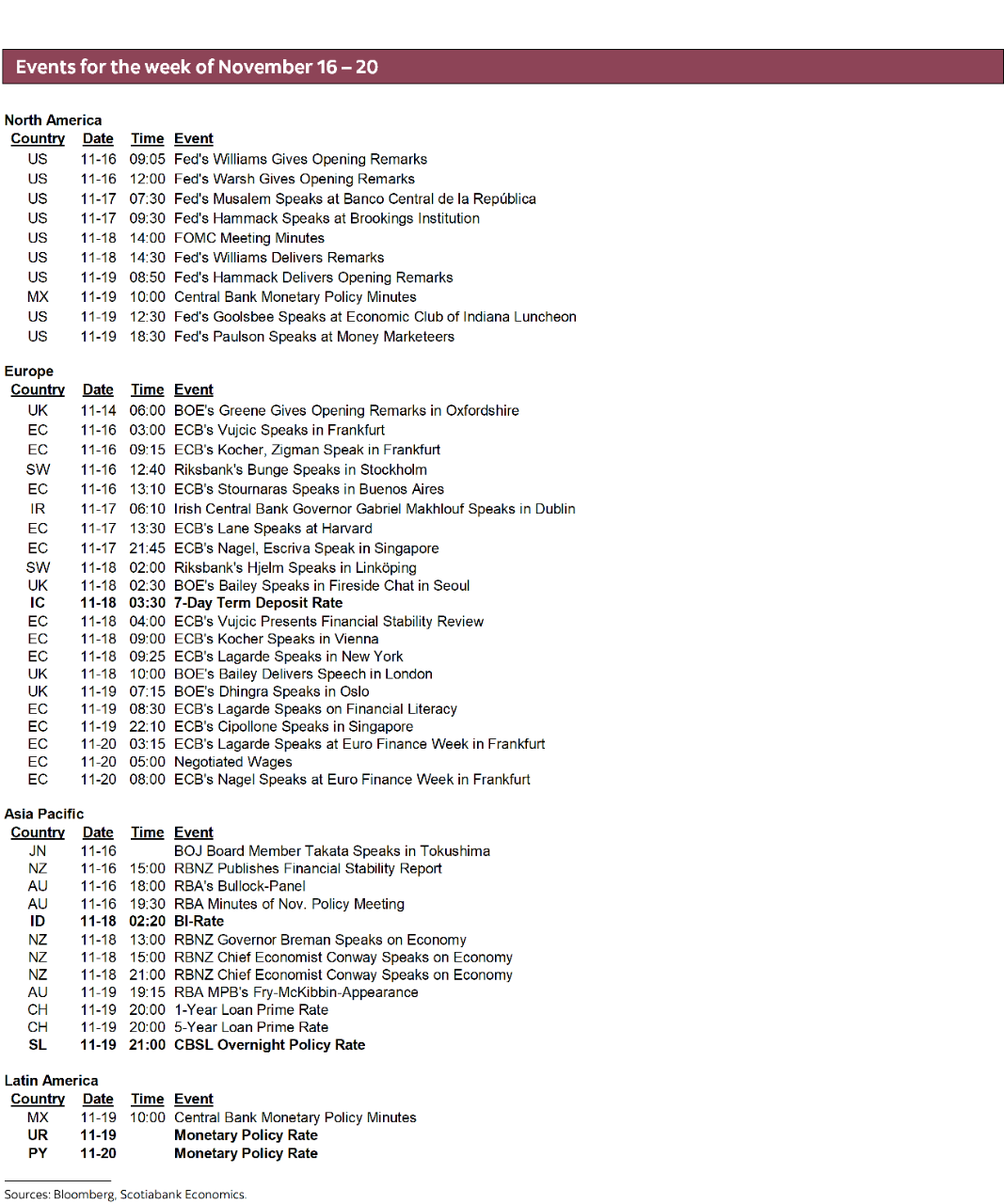
No firm answers are expected as the Federal Reserve’s task forces begin their public communications this week. Canadian CPI, a pair of central bank decisions (BI, SARB), FOMC minutes, a post-CPI BoC speech, and a round of international data across the US, UK, Australia and Latin America will make for an active calendar.
Also shared are views on whether the BoC will hike again in December, the risk that the FOMC upsizes rate hikes in December, and where current thinking sits on AI’s impact upon productivity and jobs in the US. Once again, tech influences will be a recurring theme this week.
CANADIAN INFLATION—UNLIKELY TO BE A TREND BUSTER
Canada reports CPI for October on Monday and producer price figures for the same month on Thursday. It’s the last pair of inflation readings before the Bank of Canada’s December 9th decision and could be impactful.
I’ve roughly estimated a rise of 0.4% m/m NSA that would lift the year-over-year rate to 3.3% from 3.1%. If this estimate is in the right ballpark, then it would be roughly compatible with the Bank of Canada’s smoothed quarterly projection that expects CPI to 3.4% y/y in Q4 from 3% in Q3.
After seasonal adjustment, CPI would be estimated to rise by a similar 0.4% m/m SA.
Key, however, will be measures of core inflation.
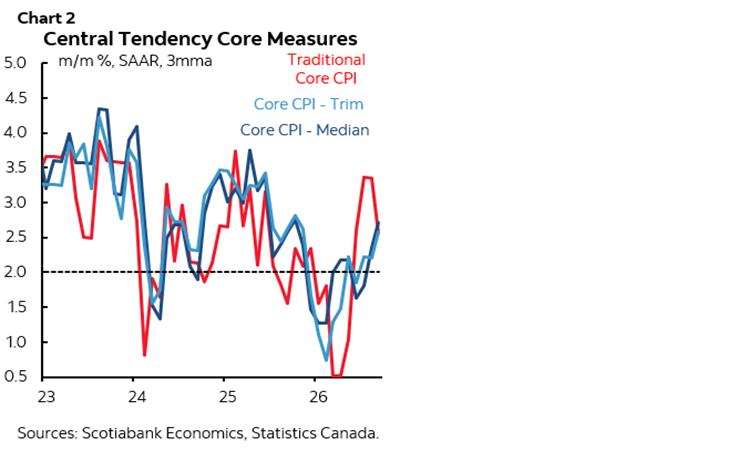
It would take a lot to alter the recent smoothed trend in underlying inflation. The three-month moving averages for traditional core CPI (ex-food and energy), weighted median CPI and trimmed mean CPI have been 2.6%, 2.7% and 2.6% respectively. Traditional core was 3%+ for four straight months until it slowed to 1.5% in September. The other two measures have been above 2% in each of the past three months. The year-over-year TM and WM measures are not helpful since they turn very slowly around inflation shocks, given they are calculated as m/m weighted, compounded price changes summed up over a year.
It’s unclear that the Bank of Canada will be so data sensitive that these figures will matter to the December 9th decision. It is forecast oriented as argued in the section on whether December is a ‘go’ for the BoC.
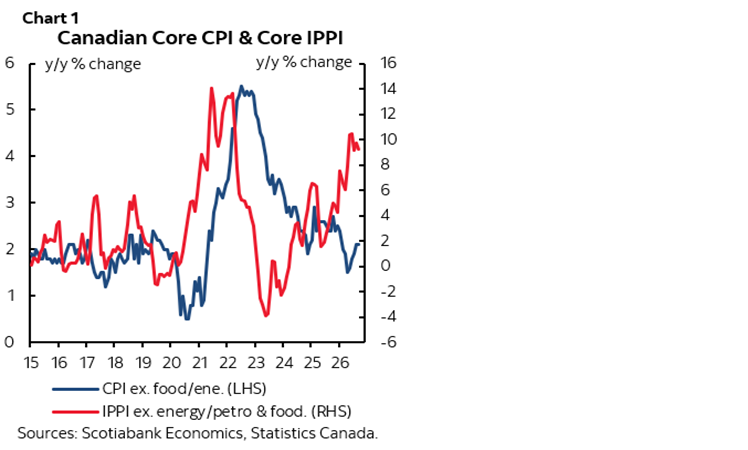
As for producer prices, key is the trend in core industrial prices—ex-food and energy—that have been on a strong upswing as a leading indicator of core CPI inflation (chart 1). This is part of our narrative for volatile but persistent gains in underlying core consumer price inflation.
BANK OF CANADA—IS DECEMBER A ‘GO’?
I still lean toward the BoC going in December but will offer the following arguments for a skip and a hike to 2.5% while flagging several uncertainties that will be monitored. There is no doubt in my mind that they should hike again in December. The arguments for a pause invoke a very low bar set in favour of mild, backward-looking data disappointments that are tangential to the inflation mandate.
A BoC skip case:
- Oil is down $15-20 from the peak in terms of WTI and Brent while Western Canada Select is about $23 off the peak. That means less income being imported into the country than at the peak and hence less trickle down through activity readings.
- Jobs have disappointed for three months with about 115k lost jobs.
- Recent GDP has disappointed, both in terms of monthly and quarterly tracking. Instead of around 2%+ growth in the third quarter, we think we’re tracking about 1½%.
- The BoC said in the October statement that they would 'proceed carefully' and some take this to mean policy adjustments may not be in a straight line as the BoC adopts a gradual pace.
A BoC hike case:
- Inflation, inflation, inflation. All measures are either well above the 2% target—like total CPI over 3% y/y—or roughly on 2%—like the main core gauges in y/y terms. In month-over-month terms, all of these measures have trended toward being well above the BoC’s 2% inflation target at annualized rates (chart 2). Let’s see Monday’s update.
- Getting wigged out after just a quarter point hike would do nothing to contain inflationary pressures into 2027. A pause after meaningful tightening may be appropriate.
- It's not Warsh. The BoC's forecasts call for a sustained overshoot of their inflation target and there is a high bar for a handful of backward-looking short-term readings to knock them off track.
- The BoC’s refined five-year framework agreement placed sole emphasis upon inflation control and downplayed the prior agreement’s references to fully inclusive maximum employment.
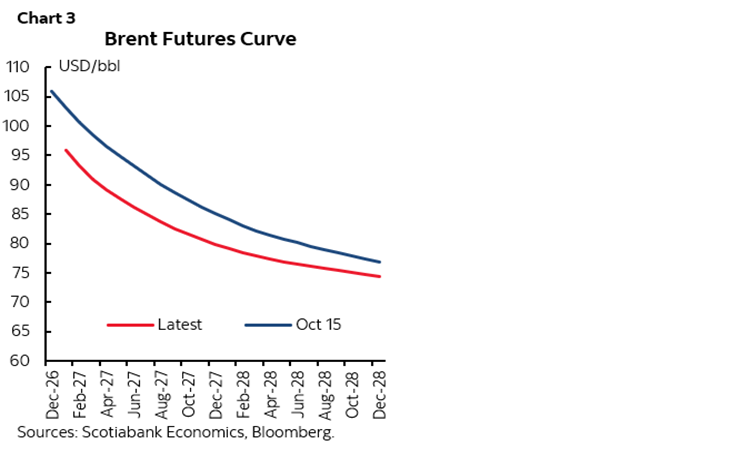
- Oil is still massively higher on the year with lagging cost pass through ahead. WCS remains almost US$20 higher than at the start of the year while Brent is about $35 higher and WTI is over $30 higher. The Brent futures curve has moved only a little lower through 2027 than where it was on October 15th—the date stamp used for the BoC’s forecast assumptions in the October MPR (chart 3). Future risks to oil prices are uncertain but we’re sceptical toward prospects for a sustained abatement of war pressures. Tight refining capacity will also keep energy prices high for the foreseeable future.
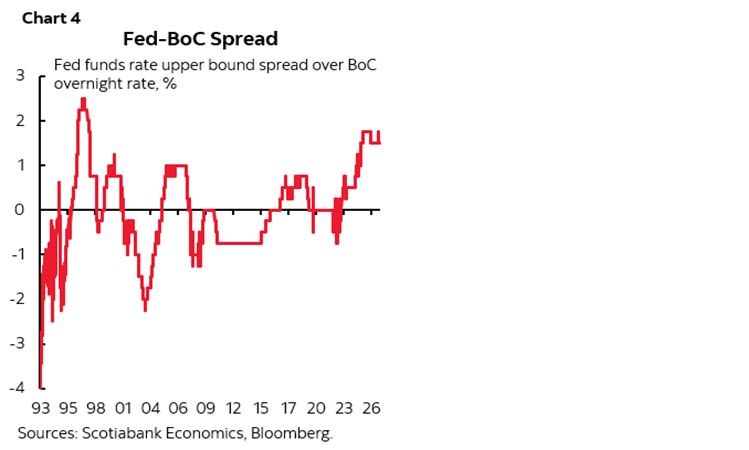
- The FOMC remains on track to hike in December. The Fed-BoC policy rate spread is already historically wide (chart 4). To not follow the Fed given this starting point would widen the negative hot-money disadvantage to holding CAD and therefore potentially add to imported inflation. USDCAD has recently depreciated back to 1.425.
- Commodities still support investment and spending into 2027 and not just energy prices.
- There are more costs to be passed through than just oil and other commodities.
- Fiscal policy is ramping up (versus ramping down in the US), such as the mega-deduction, transfers, slow progress on major projects etc. This will become a bigger driver of growth over 2026–27 as fiscal policy eases by spending the commodity dividend.
- The policy rate would still be low after a hike at 2.5% and negative in real terms which is the rate that matters.
- Jobs have been weak over the past three months mainly because of the youth job market for those aged 15–24 which may have overshot earlier in the summer and may be experiencing a negative supply shock as immigration policy toward temps became tighter.
- Inflation expectations remain elevated in BoC surveys including over the long-term and risk becoming unmoored in a way that feeds further second-round price and wage setting behaviour.
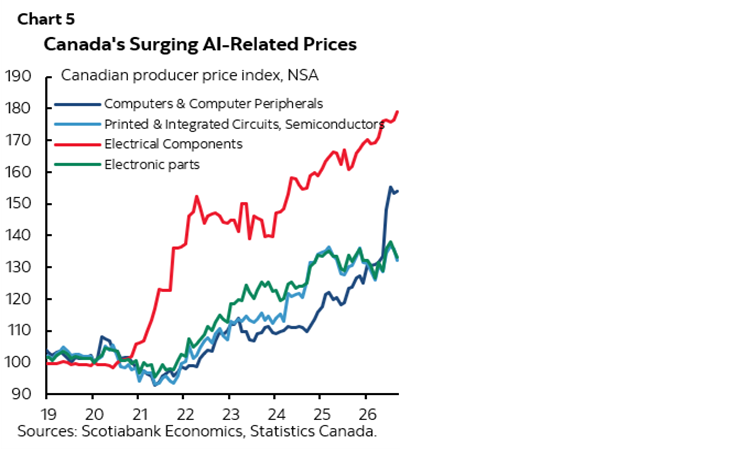
- AI-driven inflation is at a nascent stage of unfolding in Canada in producer prices with pass through risk (chart 5), in some consumer prices like computers and electricity, and in several import prices.
The uncertainties:
- There is a lot more data ahead before the December 9th decision (cpi, jobs, GDP including Q3).
- We are monitoring trade negotiations to see if they're for real this time or just another head fake, and whether we get results before the new Congress convenes. There is significant probability of achieving a partial deal and we’re not ruling out a fuller deal.
- Who to trust regarding the Iran war and the risk of escalation.
- Uncertain implementation and execution of fiscal policy plans, though this is a long-term consideration.
NO WIDESPREAD SUPPORT AT THE FED FOR UPSIZING
Federal Reserve Governor Waller was responsible for spiking short-term market yields around policy expectations into the December meeting when he said the following just before the latest CPI release for October:
“But if the October CPI inflation data out later today are similar to the past two monthly readings—with core CPI inflation around 0.3 percent or even higher—then a stronger policy move may be needed. In that case, I believe a 50 basis point hike in the policy rate should be considered at the December meeting. Hiking only 25 basis points would put our credibility at risk, a risk I am not eager to take.”
Core CPI did indeed land at 0.3%, causing markets to begin pricing not only a full quarter-point hike in December but a chance at 50bps.
Nevertheless, the Fed’s preferred core PCE inflation measure is tracking on the bubble between 0.2% and 0.3% m/m SA and we’ll find out on November 25th. Adjusting core CPI for weighting differences and adding an estimated flat contribution from relevant categories of the producer price index reveals a figure closer to 0.2%.
Does Waller have company for upsizing? We’ll never know what Chair Warsh thinks because he prefers the silent treatment, but so far, it seems as though Waller is on his own in terms of upsizing. There is still a significant amount of data, geopolitical and market risk ahead before the next decision, but at this point it seems that markets are overpricing the policy rate path in the very near term.
- Dallas President Logan (voting) supports at least 50bps of further tightening and possibly “more rapidly this winter” but did not weigh in on upsizing.
- Governor Bowman (voting) argued further tightening is needed but that the drivers of inflation should abate in 2027.
- Governor Barr (voting) said nothing directly on monetary policy, and instead spoke about regulations, how AI is driving inequality etc.
- NY Fed President Williams (voting) said “We need to take actions over time that will ensure that we get inflation back to our 2% goal in a timely manner, and on a sustained basis.” He warned about inflation, would seem to support hiking in December, but “over time” suggests a gradual pace versus upsizing on the size and pace of tightening.
- Philly’s Paulson (voting) said she prefers gradual hikes over sharply accelerating tightening.
- Cleveland’s Hammack(voting) doesn’t believe policy is behind but if it did fall behind then they may need to deliver a larger move.
- KC’s Schmid (nonvoting) said current policy was “fairly accommodative” and more work needs to be done on inflation but did not comment more directly on the monetary policy outlook.
- Chicago’s Goolsbee (nonvoting) said he wanted to keep all options on the table and did not commit to anything at the December meeting while sounding generally hawkish on inflation concerns.
- Boston’s Collins (nonvoting) said “some additional firming, tightening of policy is appropriate soon” and that she may revise up her policy rate path from what she submitted in September. She emphasized “careful” changes which would seem to lean against upsizing.
- San Francisco Fed President Daly (nonvoting) votes starting in January once the annual rotation of regional Presidents occurs. Nothing she said recently suggests that she would upsize but she also warns of ongoing upside pressures on inflation.
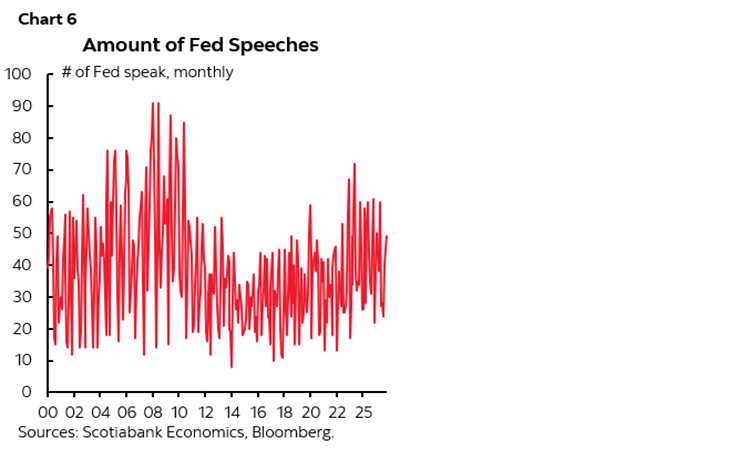
A lot more Fed-speak will unfold this coming week. The only one talking less these days is Chair Warsh as the Committee’s speech counts remain as high as ever (chart 6). It’s clear that the majority of the Committee is rejecting Warsh’s preference for intrigue which makes it difficult for him to truly turn the clock back to the Greenspan era that was marked by few words.
THE FED’S PRODUCTIVITY AND JOBS TASK FORCE—STILL MORE Qs THAN As
The first public glimmer of progress on Fed Chair Warsh’s five task forces may begin to arrive on Monday. Recall that he announced the task forces at the June meeting. That’s when the San Francisco Fed hosts the ‘Productivity and Jobs Task Force Conference’ which is designed to examine the impact of new technologies—like AI—on the labour market.
Chair Warsh will deliver opening remarks that are to last 15 minutes and then it’s onto panels with the agenda available (here). The event is to be live streamed from the same link if you’ve got 3–4 hours to spare. I’ll likely run it in the background notwithstanding the low likelihood of market effects. The tone of the conference is likely to further distance Warsh from his earlier dovish remarks on AI’s possible influences that are now moot.
Warsh had set this date back on October 28th during his press conference following the decision to hold perhaps not coincidentally just days before midterms. At the time, he teased that the hearing would invite a broad range of people and address matters like whether the US is in the midst of a productivity miracle or whether it may happen slowly in future. He noted that the task force requested this particular event to cast a wider net in terms of opinions. That could be good, or a sign they’re unlikely to reveal any great strides forward in our understanding of the matter. My hunch is the latter as the hype has oversold the ability to generate answers.
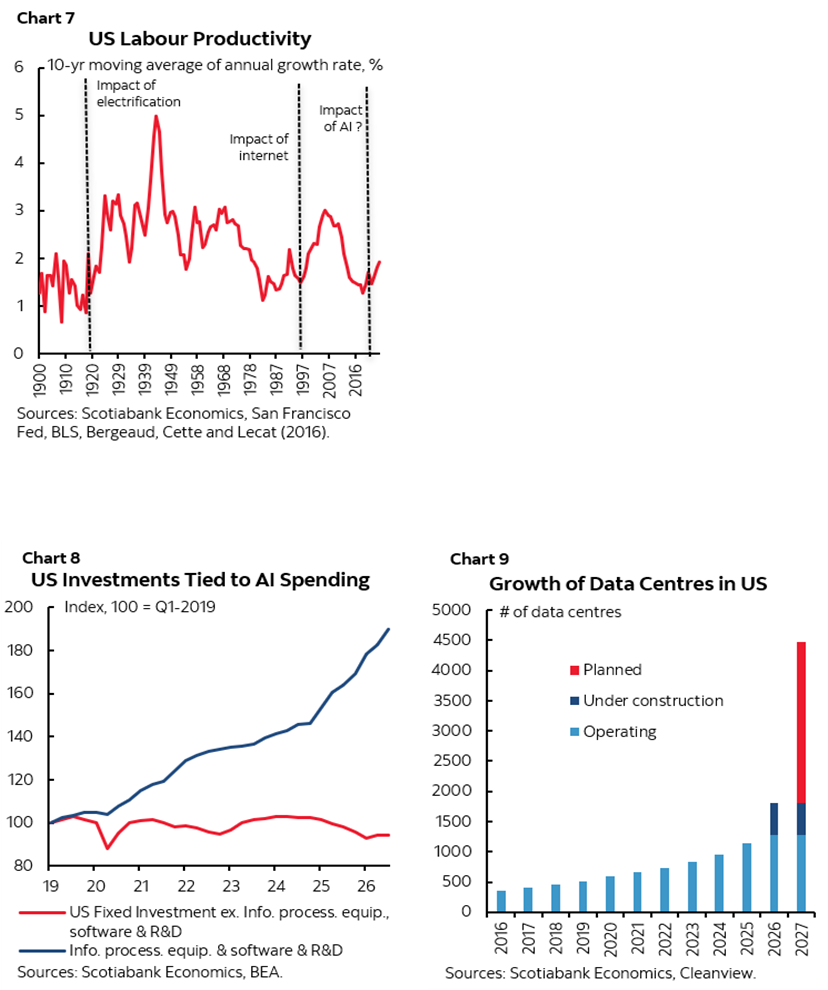
Trend labour productivity growth has picked up recently (chart 7). Whether to claim that this is AI-driven or not is likely a stretch at this point, though AI-related investment remains on a tear (charts 8, 9).
In terms of the impact on jobs, chart 10 shows jobs that are thought to be most vulnerable to losses due to AI versus jobs that may benefit. The categorization is drawn from a collaboration between Indeed and Pulsenomics and I was invited to be one of the dozens of participating members to their regular surveys who are viewed as knowledgeable about US labour market conditions. How does the data line up with the expectations?
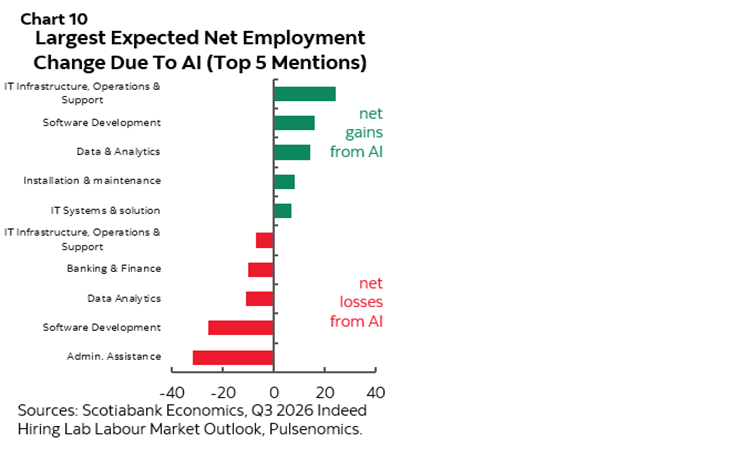
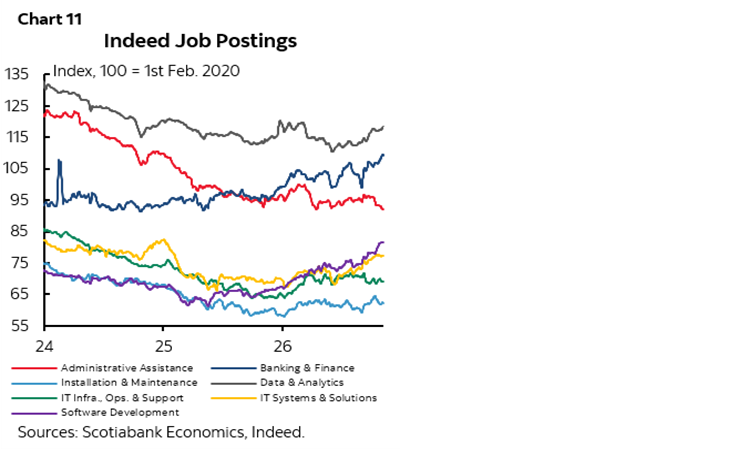
Chart 11 shows postings for jobs that are deemed to be most vulnerable to AI and postings for jobs that are thought to be favourably impacted. The punchline is that there really isn’t much clear evidence that the expectations for winners and losers in the job market are unfolding as yet. Some categories thought to be lifted are indeed getting a lift, but some are not. Some categories that are thought to be negatively impacted are getting hit—namely administrative assistants - but some are not. It’s likely far too early to tell, so there, I just saved you 3–4 hours on Monday.
Examining postings is one approach that is based on actual data. Another approach is to consider the views shown in charts 12–14 and drawn from long-term workforce projections from the Bureau of Labour Statistics (here and here). Some of the biggest expected job losses are in AI-intensive sectors but the BLS forecasters expect net positive job gains over time.
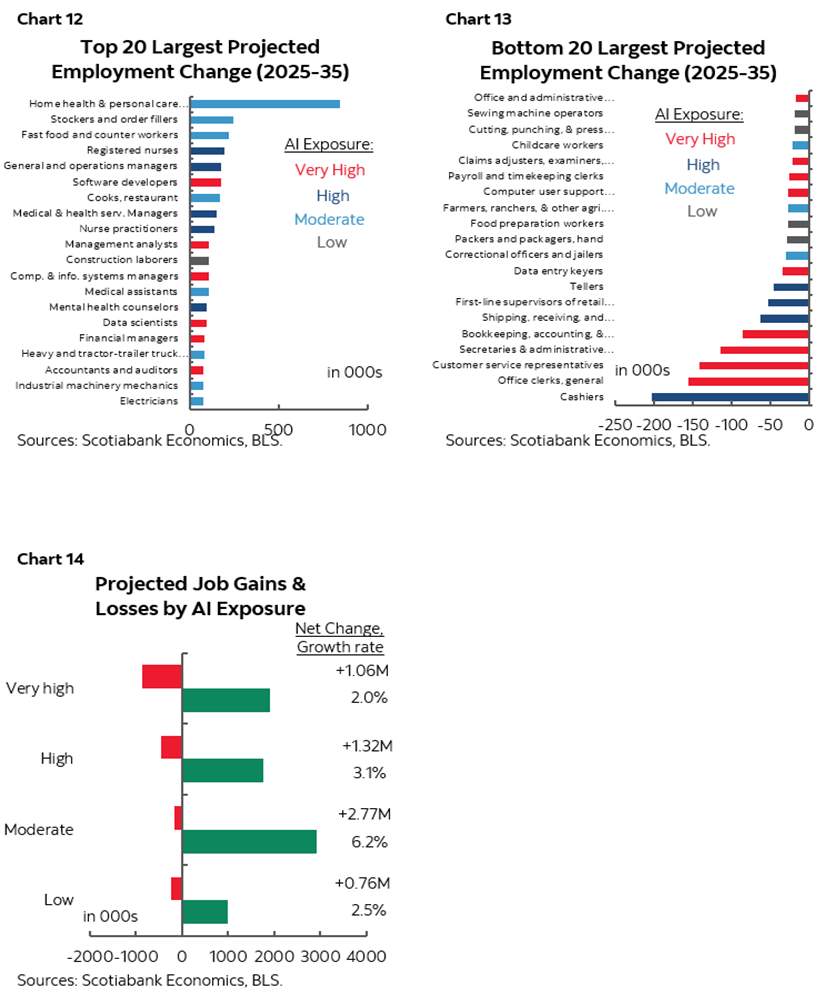
The gap between these two approaches is the key and speaks to something longer than recent jobs postings while monitoring the evolution of developments within the policy horizon of monetary policymakers.
San Fran President Daly’s presentation on AI and the economy that was shared this past Thursday is a worthwhile teaser with some interesting slides. Among her other points are the following:
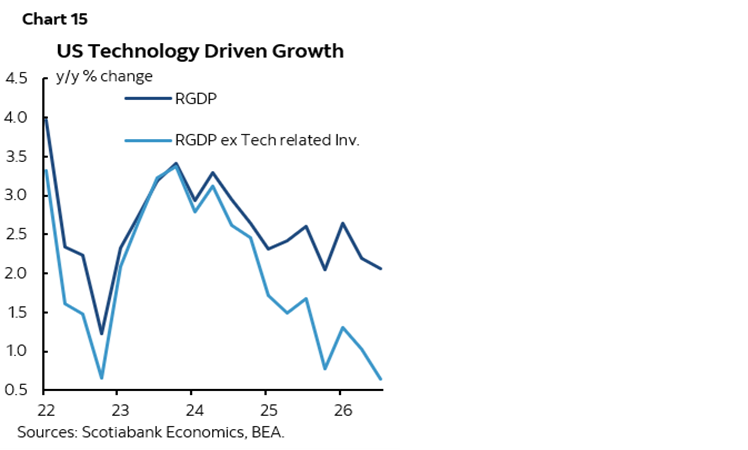
- We would have gotten our slowing narrative for the US economy right if not for the sudden speed with which AI-driven tech investment surged and took many by surprise in such a short time (chart 15). This is an extremely important matter to the 2027 outlook because we can point to multiple reasons for a slowing growth profile that would be fully exposed should AI’s incremental contributions to investment wane amid evidence of cooling pressures.
- Solid labour productivity growth is one thing. Total factor productivity growth has been much less impressive. There has been such a massive surge of cap-ex that is tech-related that it is dragging down overall productivity.
- 83% of firms point to no impact of AI on productivity over the 2024–26 period with 16% saying there has been an impact. 59% say they expect it will over the coming three years.
- Tech-related equipment spending has contributed only about 0.2% of the 3.6% overall rate of PCE inflation. It’s a relatively minor factor which generally confirms our view.
CENTRAL BANKS—DRAW, PARDNER
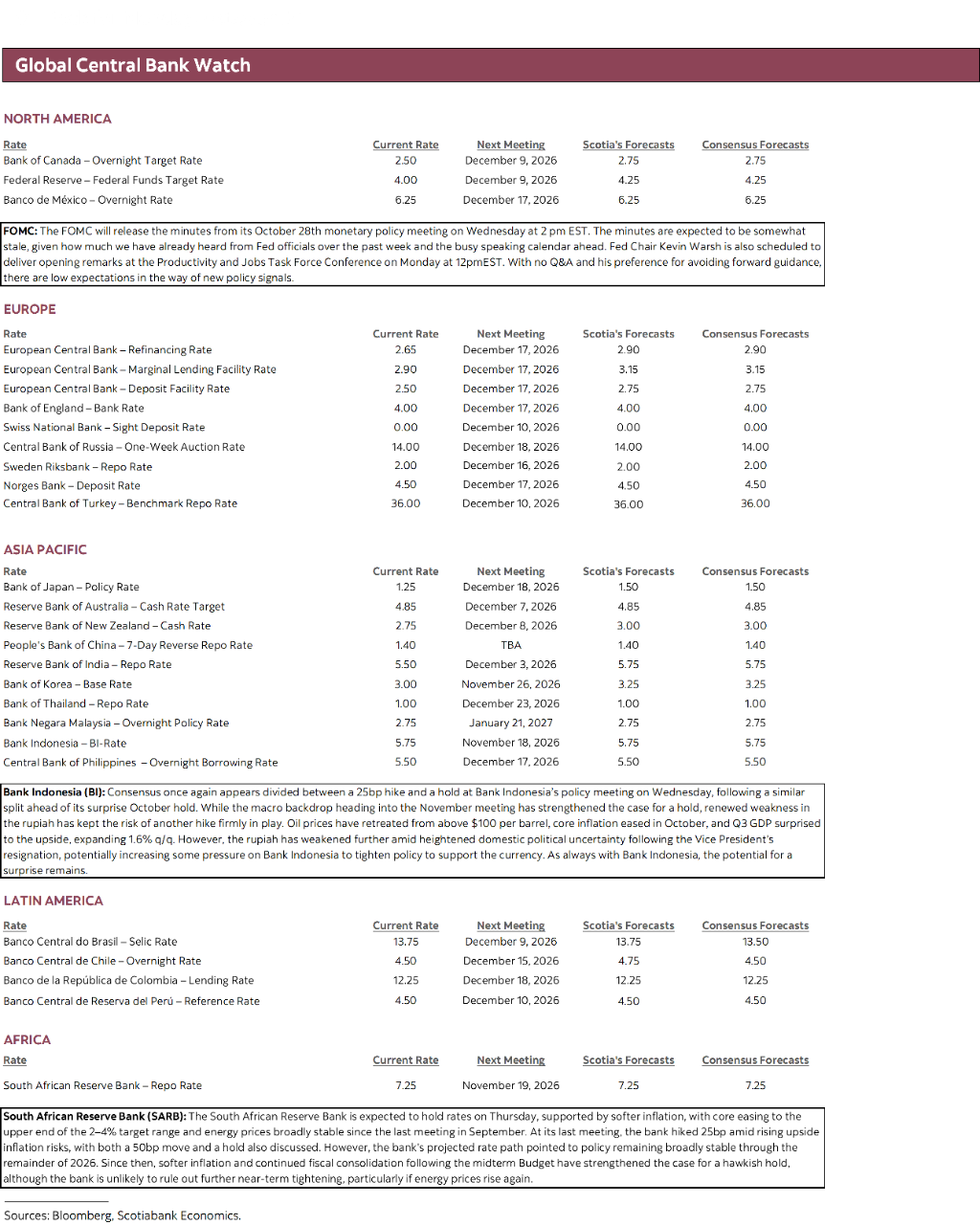
Two regional central banks will offer updated policy stances alongside sundry other communications from others, notably including FOMC minutes and a BoC speech.
Bank Indonesia—I Love a Good Western
Indonesia’s central bank has earned a reputation for being a bit of a wild west frontier. Its policy actions are often erratic and volatile. Wednesday’s decision may be no difference.
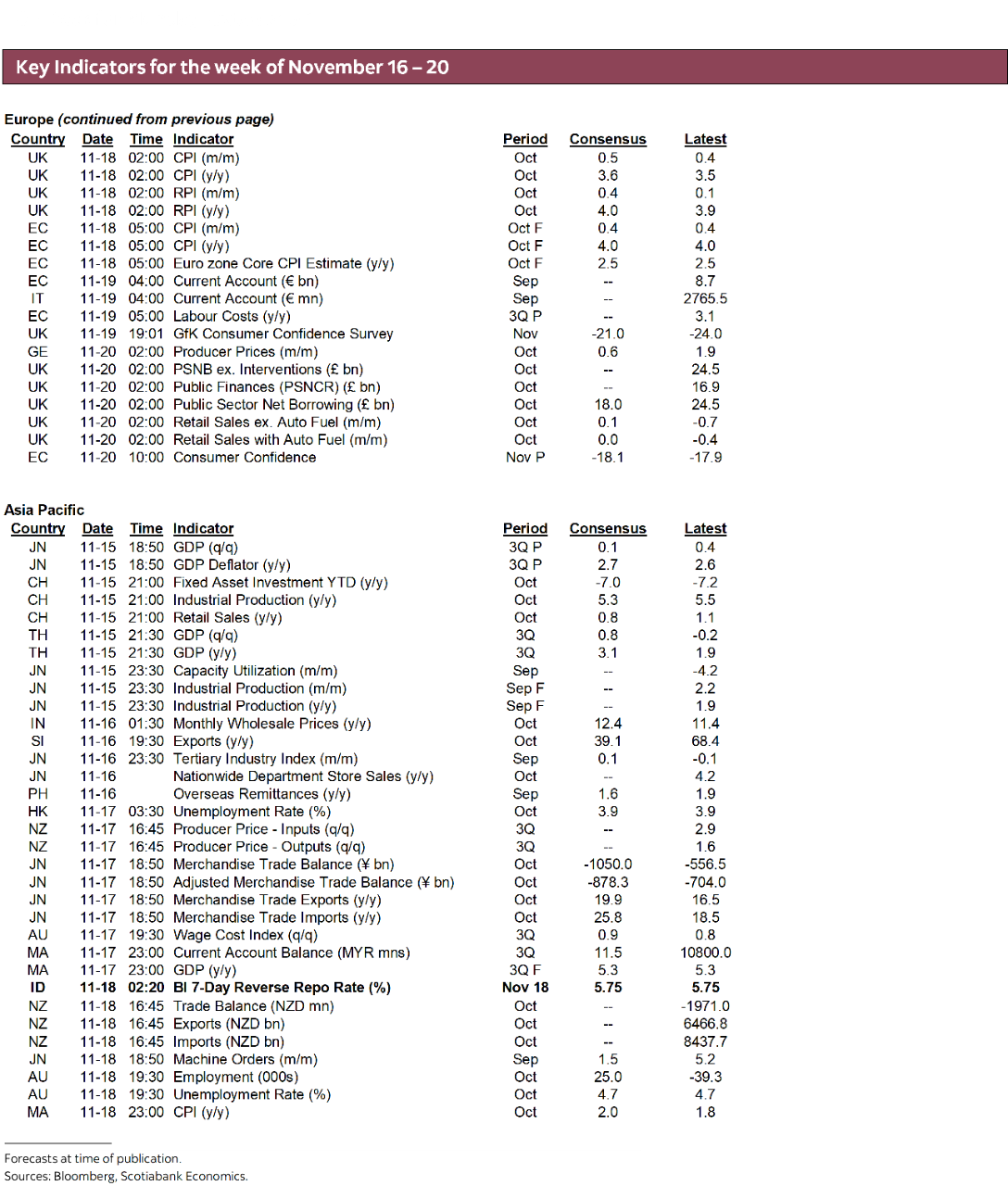
Consensus is drawn right down the middle again, with half expecting a hold at 5.75% and the other half expecting a 25bps hike. It’s a replay of the prior meeting on October 21st when BI sided with the hold camp. The bank holds rupiah stability near and dear to its heart. That makes the depreciation of the currency since the last rate decision when it held and after political instability a bit of a concern in favour of raising the policy rate. Volatile oil prices may prevent BI from prematurely declaring a case for lowered inflation risk.
SARB—They’ve Already Guided a Hold
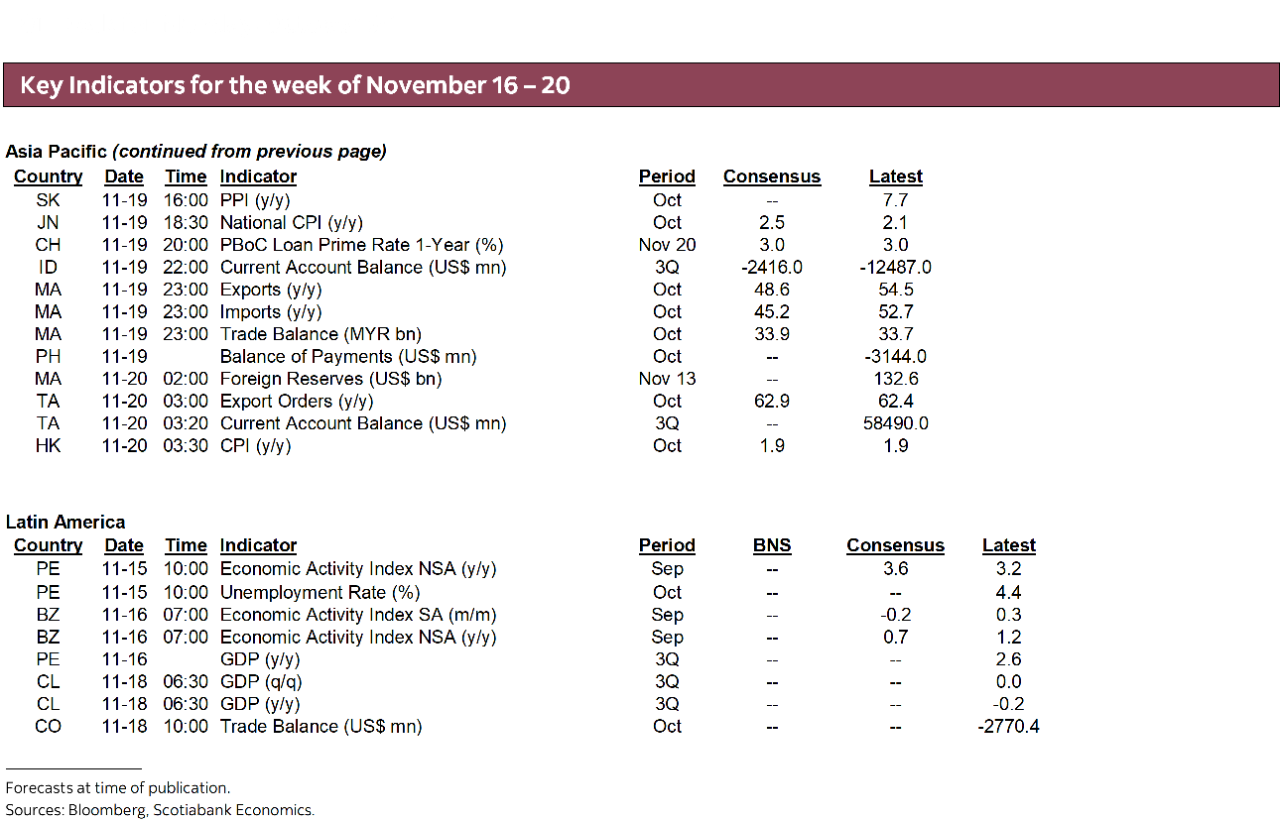
The South African Reserve Bank has employed a gradual approach to monetary easing. Having just hiked in September, it may decide to hold at a repo rate of 7¼% on Thursday. Volatile oil prices and only modest recent progress toward slightly lower inflation could maintain a hawkish stance. The September statement noted that their projections have “the policy rate broadly stable through the remainder of this year. The model shows cuts later in the forecast, as inflation fall to 3% and….moves to a more neutral policy stance.”
BoC Speech Reaction to CPI
Bank of Canada Deputy Governor Gravelle speaks on Wednesday. It is billed by the venue as a ‘state of the economy’ speech. The formal announcement states that the title is “Scenario Analysis and Risk-Management Approach to Monetary Policy.” There will be no press conference. Gravelle generally leads the financial markets and stability roles at the bank. He may react to Monday’s CPI report.
Note that Governor Macklem speaks the following week on November 24th at the Economic Club of Canada.
FOMC Minutes to be Stale on Arrival
Minutes to the October 27th–28th FOMC meeting are stale before they even arrive on Wednesday. They don’t talk less in the Warsh era, for one thing. A massive download of Fed-speak has hit markets from across all officials except the Chair. Fresh warm core CPI and a solid nonfarm payrolls report paired with Fed-speak has raised pricing for the December meeting from about 20bps to approaching 30bps now.
GLOBAL MACRO—PLENTY ELSE TO MULL OVER
The state of job markets in the UK and Australia, whether US consumers continue to spend, the health of several LatAm economies and one of two UK CPI reports before the next BoE decision should provide plenty of fodder for macro enthusiasts. Jay Parmar and I offer the following.
Canada Focused on Housing Updates
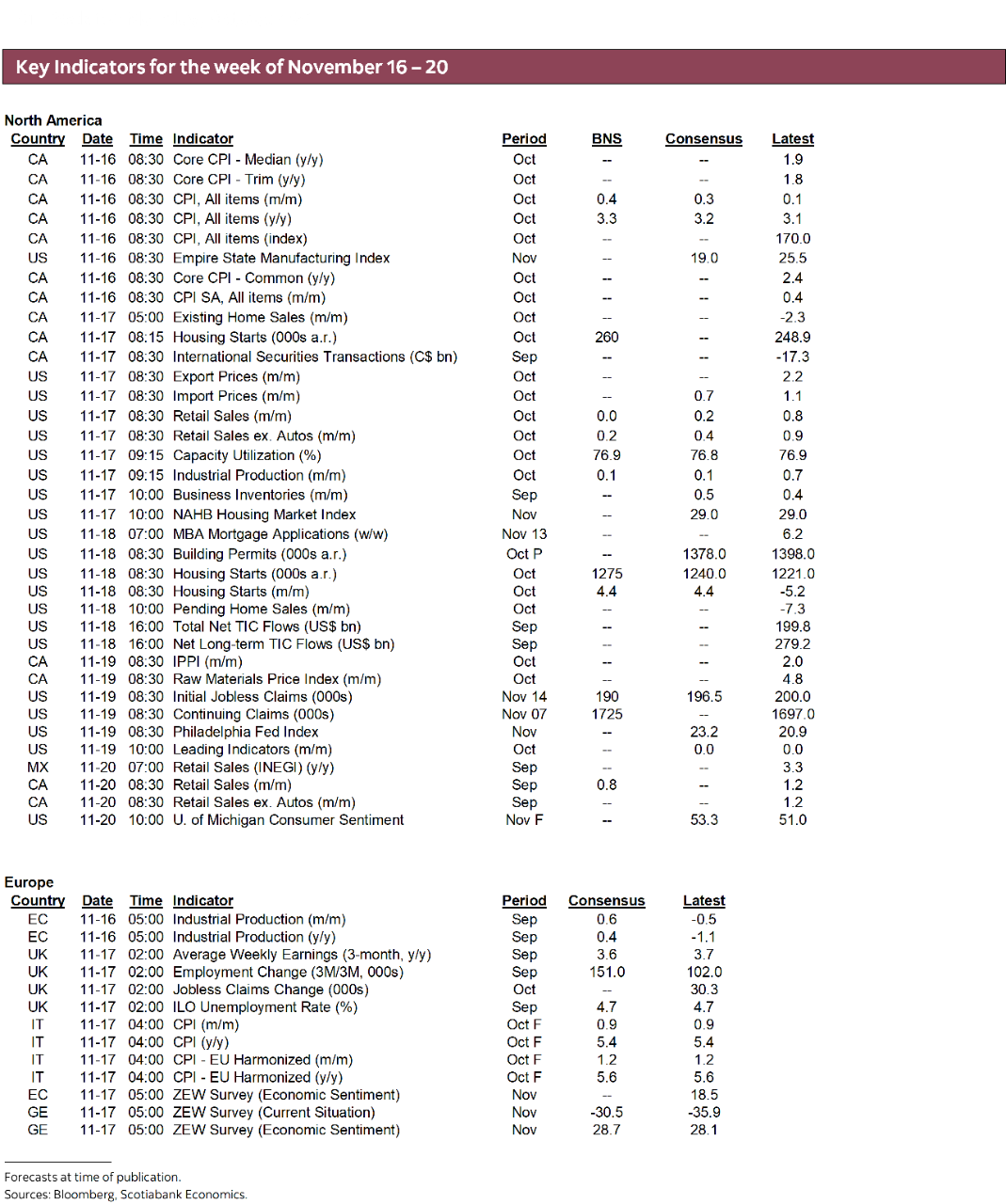
Canada will primarily focus upon CPI as the rest of the week’s line-up is fairly tame. Existing home sales during October (Tuesday) are coming off two consecutive dips. After a string of four straight gains. Housing starts could accelerate based on permit volumes (Tuesday). Retail sales during September had been guided to be up by 0.7% m/m by Statcan but the refreshed estimate may be subject to revision and we’ll get the breakdown in terms of volumes and sectors.
How is US Consumer Spending Doing?
US markets may primarily focus upon the Fed’s conference with otherwise light data due out. Tuesday’s retail sales figures are estimated to be flat based upon what we know about weaker auto sales, gas prices and coming off a strong prior month for sales ex-autos. Industrial output (Tuesday) is probably poised to register a softer gain of just 0.1% m/m after a strong prior gain and based in part upon ISM-manufacturing production signals and expected utility output. Housing starts during October (Wednesday) may rebound from the prior month based on weather and permits.
Tracking LatAm Economies
Updated takes on the health of several Latin American economies will be provided by GDP readings. Peru’s monthly economic activity reading—a GDP proxy—is expected to advance to over 3½% y/y in September (Sunday) and ahead of the November 23rd release of Q3 GDP. Colombia’s economy is expected to decelerate with growth slowing to 1% y/y during Q3 from 3.5% the prior quarter (Tuesday). Chile’s economy has been in a rough spot for quite a while as marked by contractions in three of the past four quarters and with Q3 GDP due out on Wednesday. Brazil will also refresh its monthly GDP proxy on Monday with growth expected to dip to under 1% y/y.
UK and Aussie Job Markets
Both UK and Australia are scheduled to update their labour market readings this week, however, with the RBA and BoE increasingly focused on broadening inflationary pressures, the labour market data will take a secondary role.
Australia’s October employment report on Wednesday is expected to show a modest rebound (+28K) following September’s 40K decline, while unemployment rate is forecast to remain unchanged at 4.7%. Meanwhile, Q3 wage growth is expected to remain elevated at 3.4%, in line with the RBA’s forecast.
The UK releases September and October labour market data on Tuesday, followed by October inflation on Wednesday—one of the final two readings before the BoE’s December 17th meeting. Employment is expected to show signs of recovery amid resilient economic activity. However, attention will remain on elevated wage growth and the updated inflation readings for further signs of second round inflationary pressures taking hold.
One of Two UK CPI Reports Before the Next BoE Decision
The UK also updates CPI figures for October on Wednesday. Core CPI is expected to hover close to 2¾% y/y which probably would not materially dent the 20bps of a hike priced for the December 17th decision. There will be another CPI report released one week before that next decision.
DISCLAIMER
This report has been prepared by Scotiabank Economics as a resource for the clients of Scotiabank. Opinions, estimates and projections contained herein are our own as of the date hereof and are subject to change without notice. The information and opinions contained herein have been compiled or arrived at from sources believed reliable but no representation or warranty, express or implied, is made as to their accuracy or completeness. Neither Scotiabank nor any of its officers, directors, partners, employees or affiliates accepts any liability whatsoever for any direct or consequential loss arising from any use of this report or its contents.
These reports are provided to you for informational purposes only. This report is not, and is not constructed as, an offer to sell or solicitation of any offer to buy any financial instrument, nor shall this report be construed as an opinion as to whether you should enter into any swap or trading strategy involving a swap or any other transaction. The information contained in this report is not intended to be, and does not constitute, a recommendation of a swap or trading strategy involving a swap within the meaning of U.S. Commodity Futures Trading Commission Regulation 23.434 and Appendix A thereto. This material is not intended to be individually tailored to your needs or characteristics and should not be viewed as a “call to action” or suggestion that you enter into a swap or trading strategy involving a swap or any other transaction. Scotiabank may engage in transactions in a manner inconsistent with the views discussed this report and may have positions, or be in the process of acquiring or disposing of positions, referred to in this report.
Scotiabank, its affiliates and any of their respective officers, directors and employees may from time to time take positions in currencies, act as managers, co-managers or underwriters of a public offering or act as principals or agents, deal in, own or act as market makers or advisors, brokers or commercial and/or investment bankers in relation to securities or related derivatives. As a result of these actions, Scotiabank may receive remuneration. All Scotiabank products and services are subject to the terms of applicable agreements and local regulations. Officers, directors and employees of Scotiabank and its affiliates may serve as directors of corporations.
Any securities discussed in this report may not be suitable for all investors. Scotiabank recommends that investors independently evaluate any issuer and security discussed in this report, and consult with any advisors they deem necessary prior to making any investment.
This report and all information, opinions and conclusions contained in it are protected by copyright. This information may not be reproduced without the prior express written consent of Scotiabank.
™ Trademark of The Bank of Nova Scotia. Used under license, where applicable.
Scotiabank, together with “Global Banking and Markets”, is a marketing name for the global corporate and investment banking and capital markets businesses of The Bank of Nova Scotia and certain of its affiliates in the countries where they operate, including; Scotiabank Europe plc; Scotiabank (Ireland) Designated Activity Company; Scotiabank Inverlat S.A., Institución de Banca Múltiple, Grupo Financiero Scotiabank Inverlat, Scotia Inverlat Casa de Bolsa, S.A. de C.V., Grupo Financiero Scotiabank Inverlat, Scotia Inverlat Derivados S.A. de C.V. – all members of the Scotiabank group and authorized users of the Scotiabank mark. The Bank of Nova Scotia is incorporated in Canada with limited liability and is authorised and regulated by the Office of the Superintendent of Financial Institutions Canada. The Bank of Nova Scotia is authorized by the UK Prudential Regulation Authority and is subject to regulation by the UK Financial Conduct Authority and limited regulation by the UK Prudential Regulation Authority. Details about the extent of The Bank of Nova Scotia's regulation by the UK Prudential Regulation Authority are available from us on request. Scotiabank Europe plc is authorized by the UK Prudential Regulation Authority and regulated by the UK Financial Conduct Authority and the UK Prudential Regulation Authority.
Scotiabank Inverlat, S.A., Scotia Inverlat Casa de Bolsa, S.A. de C.V, Grupo Financiero Scotiabank Inverlat, and Scotia Inverlat Derivados, S.A. de C.V., are each authorized and regulated by the Mexican financial authorities.
Not all products and services are offered in all jurisdictions. Services described are available in jurisdictions where permitted by law.