

Next Week's Risk Dashboard
• The US fiscal stimulus debate
• Jobs: US, Canada, NZ
• CBs: BoE, RBA, RBI, Brazil, BoT
• PMIs: US, Canada, China, India, Brazil
• CPI: Indonesia, Tokyo, SK, Thailand…
• …Chile, Colombia, Mexico, Peru, Brazil
• Global industrial/trade updates
• Global earnings
Chart of the Week
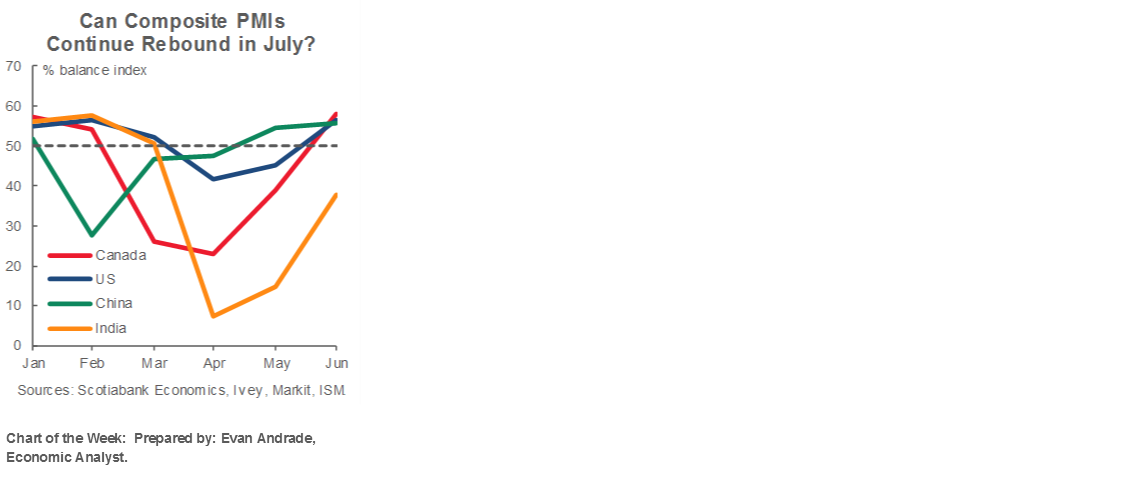
The coming week could well set the broad market direction over the duration of the summer. Key debates over US stimulus prospects after Fitch’s warning shot and the sustained healing of job markets and the broader economy will be informed across multiple jurisdictions. Generally constructive outcomes are expected.
Focal points over the coming week will include the following:
The US fiscal stimulus debate;
Jobs: US, Canada, NZ;
CBs: BoE, RBA, RBI, Brazil, BoT;
PMIs: US, Canada, China, India, Brazil;
CPI: Indonesia, Tokyo, SK, Thailand, Chile, Colombia, Mexico, Peru, Brazil;
Global industrial/trade updates;
Global earnings.
1. JOBS, JOBS, JOBS
The US, Canada and New Zealand update job growth figures over the coming week. World markets will be on edge as they await the US numbers. My estimate is more off consensus for Canada than the US, while New Zealand’s report is only a quarterly Q2 reading that will likely show a strong decline that masks a potential turning point as the quarter evolved.
US Nonfarm Payrolls – Positively Hopeful
The estimate for US nonfarm payrolls in July arrives on Friday after ADP’s estimate on Wednesday. In the end, only a tiny minority within Bloomberg’s consensus that is still evolving have chosen to go negative. 96% of economists in the sample so far are calling for a positive nonfarm reading with a median estimate of 1.7 million. I submitted an estimate of 2 million before knowing consensus, which is in the ballpark of this median estimate. The so-called ‘whisper’ number estimated by traders and other market participants stands at just over 1 million. Thus, the broad spectrum of opinion is aligned toward another payroll gain.
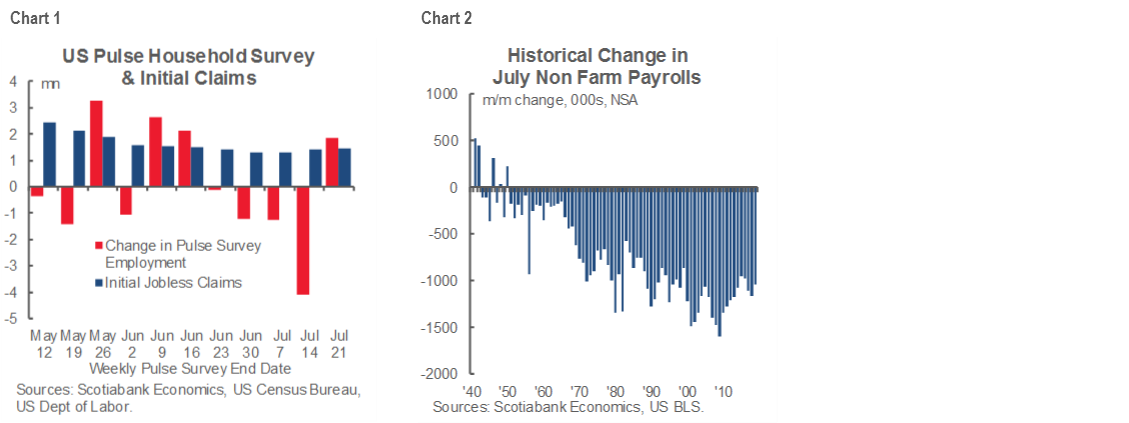
Even though weekly jobless claims have risen over the past two weeks, this is outside of the reference period for the July nonfarm payrolls report and how payrolls changed since June. Furthermore, some cite the Census Bureau’s Household Pulse Survey (here) that showed a decline in employment during July (red bars, chart 1) as a worrisome indication. The massive caveat here is that the Pulse survey is not seasonally adjusted because it has a very limited sample size since inception in April of this year. Seasonally unadjusted nonfarm payrolls almost always decline at this time of year (chart 2).
What is instead being counted upon is a continued effort to recall furloughed workers through reopening plans that have only been partially thwarted by rising covid-19 case counts. Still, amid expectations for a third consecutive increase in jobless claims next week, it may well be that greater risk will surround August payrolls one month later.
Canada—Out On A Limb
By contrast to nonfarm, the call for Canadian jobs is somewhat out on a limb compared to consensus. After 953k jobs were recouped in June, a near replay could be in the cards for Friday’s Labour Force Survey estimate. The median consensus estimate is for under half of Scotia’s 900k call.
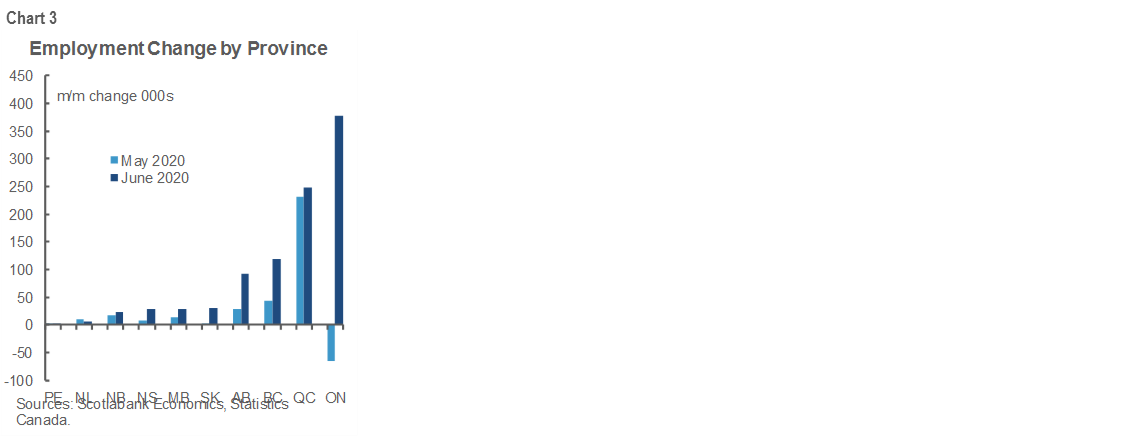
One approach is to point to Quebec’s experience after their earlier reopening experience and how this may be replicated across the country as reopening efforts fanned out. Enter chart 3. Recall that the province gained 231k jobs in May and another 248k in June as it began reopening the economy in early May and kept rolling out reopening efforts through June into July while sustaining the pace of hiring activity. Ontario had a somewhat lagging reopening experience and lost 65k jobs in May and then regained 378k jobs in June. BC followed a similar pattern with just 43k recalled in May and 118k in June. Ditto for Alberta that also lagged Quebec’s pick up from 28k in May to 92k in June. If Quebec were to continue regaining lost jobs through July and be joined by expedited hiring across the other provinces in similar fashion to Quebec’s back-to-back performances, then we could well be positioned for a rather strong overall report.
2. US STIMULUS TALKS—ANY DAY NOW!
The House of Representatives is already off on August recess but on 24 hour recall notice. The Senate leaves from August 10th to September 7th. Hanging in the air are the stimulus negotiations.
As this publication goes to print, negotiations are to extend throughout the weekend. The USD and broader appetite for US assets may be vulnerable to disappointment, but the underlying assumption remains that a deal of some sort will ultimately be struck as such brinksmanship tactics are just the way Congress works.
There are multiple stumbling blocks including for how long and by what magnitude the CARES Act provision for an extra US$600/week in jobless benefits may be extended. The Democrats are also holding out on an extension of jobless benefits and an extension of a moratorium on evictions in favour of using this position to extract greater leverage in broader stimulus negotiations, such as enhanced aid to state and local governments.
Some have noted that the CARES Act results in overpayment of individuals compared to what they used to earn through pre-Covid employment (here). This may be holding furloughed workers back from returning. Others have noted that a side benefit to the high CARES Act payments is that while the unemployment rate may be biased higher than would otherwise be the case by keeping some workers sidelined, the result may be a lower mortality rate through to year-end (here). In fact, the authors estimate that the mortality rate would rise by a higher amount than the unemployment rate would fall if not for CARES Act payments. Lower mortality could conceivably arise from mitigating a sudden return to work that further amplifies case counts and could also arise from compassionately helping despondent people to meet their obligations. Another argument could well be that overpaying unemployed Americans is a net form of short-term stimulus to the overall economy that, despite the adverse incentives to return to work, applies some stimulus where it will be spent as an offset to other still difficulty applying stimulus to deeply troubled parts of the US economy. As a crude simple example, governments cannot force people to fly, attend movie theatres or dine-in, but paying more benefits could result in consumers spending the sum on other things which we’ve seen in strong consumption numbers of late. This argument reasons that the aim is to provide macroeconomic stimulus with microeconomic imperfections of a sort.
There are merits to each of these arguments and it’s uncertain exactly where the middle ground lies. At least in the short-run, the balance likely leans more toward overshooting requirements rather than, say, the Republicans’ first proposal to abruptly cut CARES Act payments from 150% of pre-shock income to 70% of income assuming states can transition as rapidly to such a system as the two-month timeline could require by September. The speed and magnitude of such an adjustment may be a goal over time, but an extend-and-taper approach would likely be preferable to such a sudden shock given the state of the job market.
On balance, my view remains in favour of more of an insurance argument. This is arguably the last chance at a stimulus deal before the new Congress sits in January and likely for some time afterward given the US election and the ensuing lame duck session that are likely to grind US policymaking to a halt. A, say, US$1 trillion stimulus package would be the bare minimum needed absent downside risks; should such risks crystalize, then Congress is likely to have its hands tied over the next six months or so. That could represent a period of market vulnerability amid limited further Fed powers. Going big now could effectively throw more of a security blanket over this likely period of policy inaction.
3. CENTRAL BANKS—MORE TALK THAN CUTS
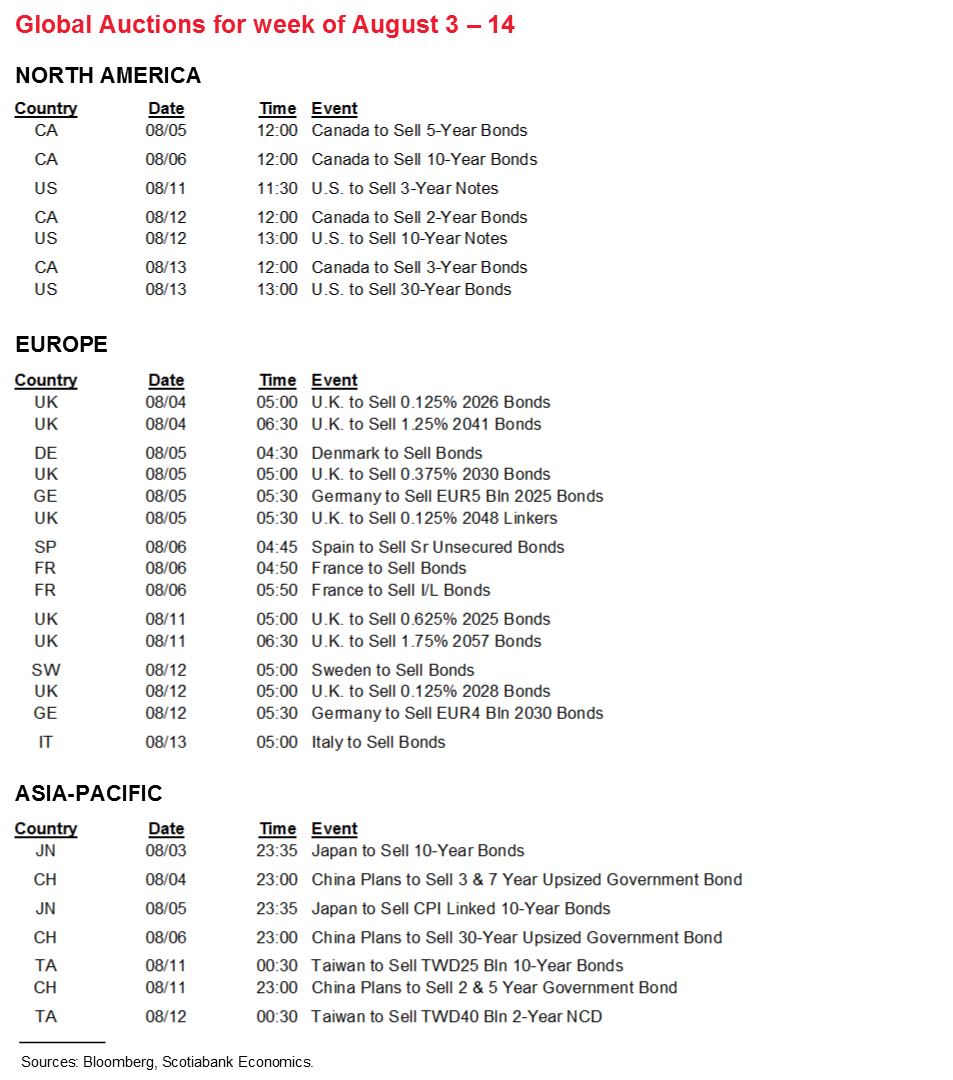
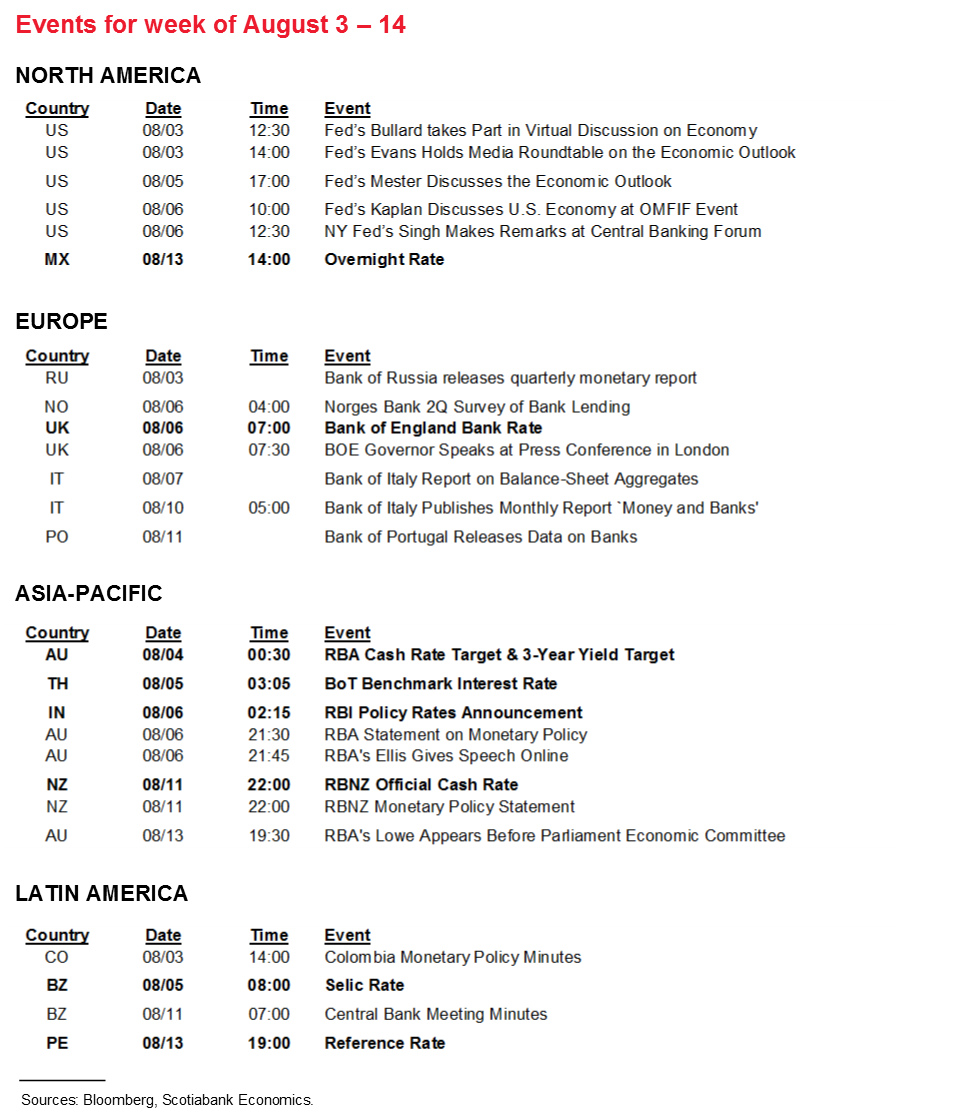
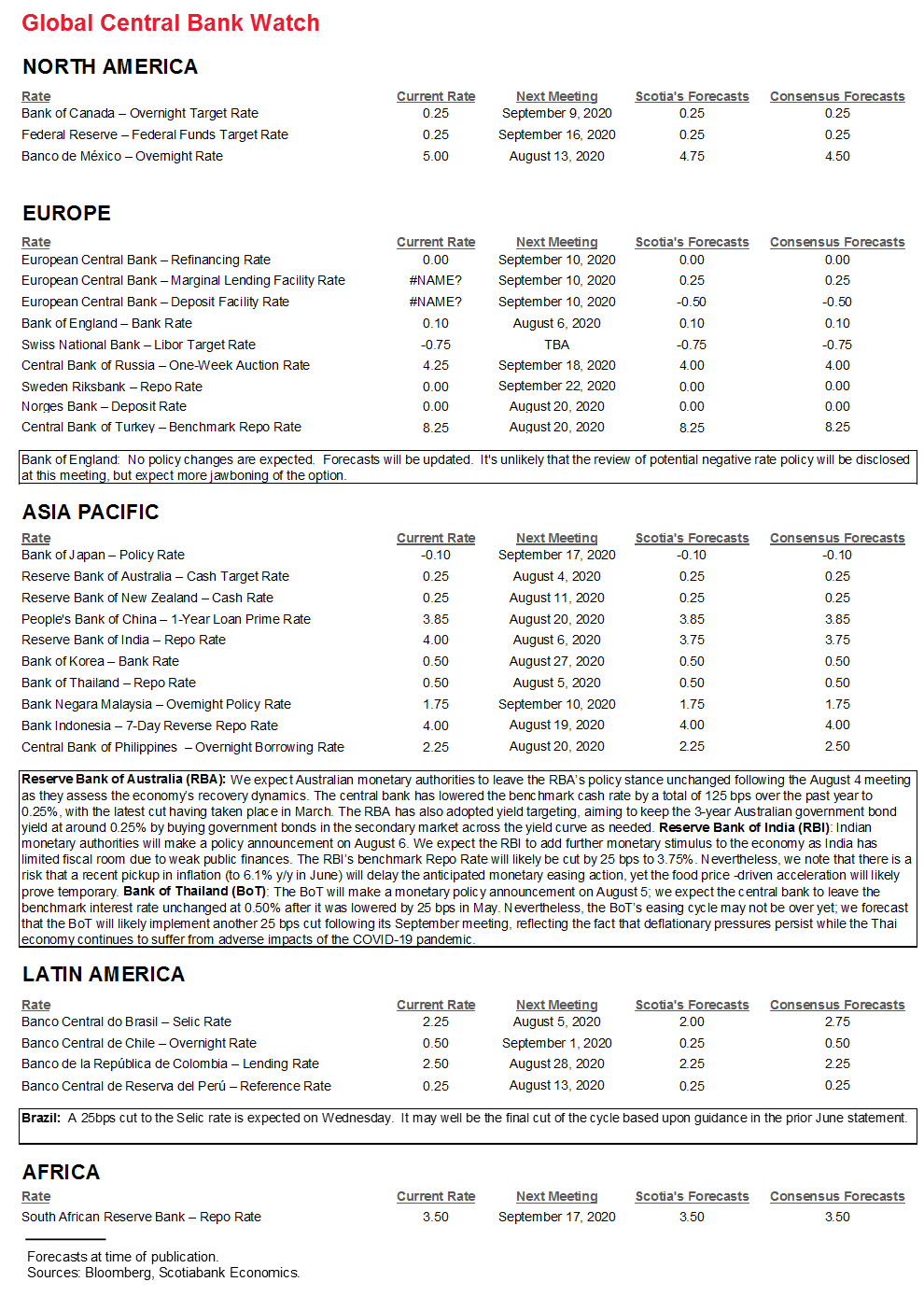
Five central banks will offer fresh assessments and policy decisions over the coming week. Expectations are outlined below in chronological order. Two are expected to cut (Brazil, RBI), and the other three are expected to hold while jawboning options like negative rates at the Bank of England.
RBA (Tuesday): No policy changes are anticipated with the cash rate stayed at 0.25% along with the three year yield target. RBA Governor Lowe’s recent speech (here) combined with the minutes to the July 7th meeting (here) leaned against negative rates, A$ intervention and direct financing of government and resisted putting a range to the 0.25% 3 year target that would result in bond buying to enforce the target by instead saying it was a judgement call. The government extended the wage subsidy program from the end of September to the end of March which takes some pressure off the central bank.
Brazil (Wednesday): The central bank is expected to cut its Selic rate by -25bps to 2%. It may well be the final cut of the cycle after the central bank noted in its June statement (here) that “any possible adjustment to the current monetary stimulus would be residual.”
Bank of Thailand (Wednesday): The BoT is expected to hold its policy rate at 0.5% with cut risk. The odds of a cut may have been reduced after BoT Assistant Governor Vachira Arromdee recently remarked that that sparking ‘excessive volatility’ in the baht was something the central bank wished to avoid against an uncertain outlook. She noted that “We cannot predict the outbreak of foreign capital flows in the second half.”
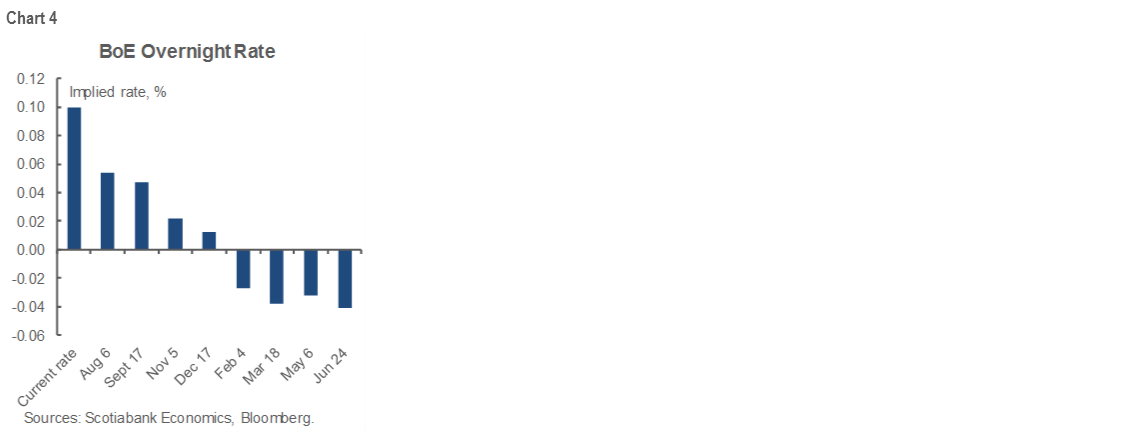
Bank of England (Thursday): No change to the 0.1% Bank Rate is expected. Forecasts will be updated and could showcase the MPC’s bias toward downside risks. Expect further jawboning on the negative rate option, but it’s unlikely that the results of the BoE’s review of this option will be disclosed just yet. At present, markets are pricing a marginally negative policy rate commencing in early 2021 (chart 4).
RBI (Thursday): A lot has happened since May 22nd, but that was the last time the Reserve Bank of India delivered a policy decision. A -25bps cut is possible to a 3.75% repo rate on Thursday. Minutes to the May meeting (here) noted that the RBI is “maintaining headroom to back up the revival of activity when it takes hold” with “an accommodative stance as long as it is necessary to revive growth and mitigate the impact of COVID-19 on the economy, while ensuring that inflation remains within the target.” Since then, inflation fell to 6.1% y/y with core at 4.9% compared to a medium-term inflation target of 4% +/- 2%.
4. PMI MOMENTUM INTO Q3
More purchasing managers’ indices will arrive from the US, Canada, China, India and Brazil over the coming week. They are useful because of their freshness as among the first batch of readings each month and because they can lead broad measures like changes in GDP growth. Thus, they are an important recovery signal.
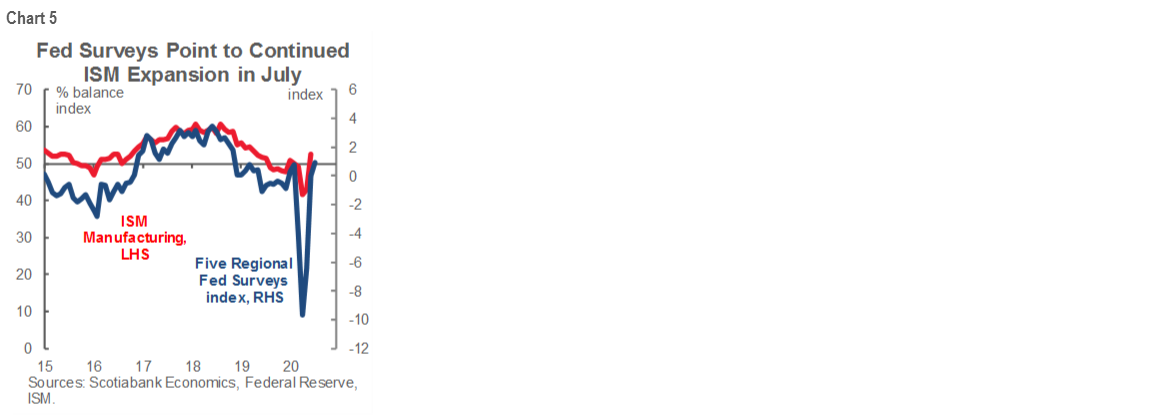
Key to world markets will be the US ISM gauges. ISM-manufacturing arrives on Monday with ISM-services following up on Wednesday, both for the month of July. As chart 5 indicates, the average of the regional manufacturing gauges from Federal Reserve District Banks points to a modest gain given correlations to ISM. It’s feasible that the regional surveys may under represent upside risk to ISM given they tend to underrepresent rebounding sectors like autos. On net, a rise from 52.6 in June to about 54 ½ in July seems defensible. ISM-services might face the opposite risk by slipping somewhat from 57.1 in June given the concentrated effect of social distancing and rising covid-19 case counts as aspects of the services sector such as bars and restaurants.
Canada’s Ivey PMI for July will be released Friday. It rarely impacts markets, but is among the suite of indicators worth tracking by way of recovery evidence. The big upswing in June from 39.1 to 58.2 reflected reopening plans. A further rise could reflect ongoing reopening efforts across the provinces. That said, unlike PMIs elsewhere, this one combines response from purchasing managers in the public and private sectors which makes it a bit of a hodge podge PMI that makes it difficult to tell whether the degree to which government versus private activity is driving a rebound.
China’s PMIs will be the private Caixin ones that will be monitored for whether they confirm the state’s PMIs that show stalled progress. The Caixin manufacturing PMI is due out on Sunday evening (eastern time) and the services and composite PMIs arrive two days later.
India’s Markit PMIs then arrive over Monday and Wednesday. The country’s measures fell much more sharply than elsewhere with the composite plunging from 57.6 in February to just 7.2 in April, but they’ve since partially rebounded to a still contractionary 37.8 reading. The march toward balance at the 50 threshold is being partly restrained by India’s rising covid-19 cases and protective measures.
Brazil’s PMIs will also come out on Monday and Wednesday and the July readings could continue to show at least near term gains despite the 2.6 million covid-19 cases that exist along an exploding curve.
5. EARNINGS, INFLATION AND RECOVERY READINGS
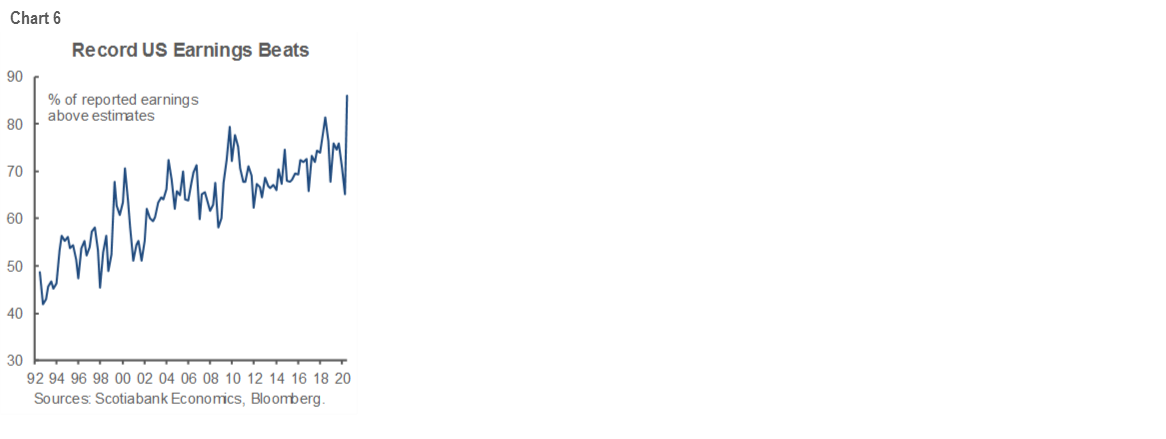
Multiple other readings that will track the pace of the economic recovery and implications for inflation will emerge across the world. The global earnings calendar will remain heavy, but with about two-thirds of the S&P500 having released, the scope for further season-shifting surprises is pretty limited during a much better than feared season (chart 6).
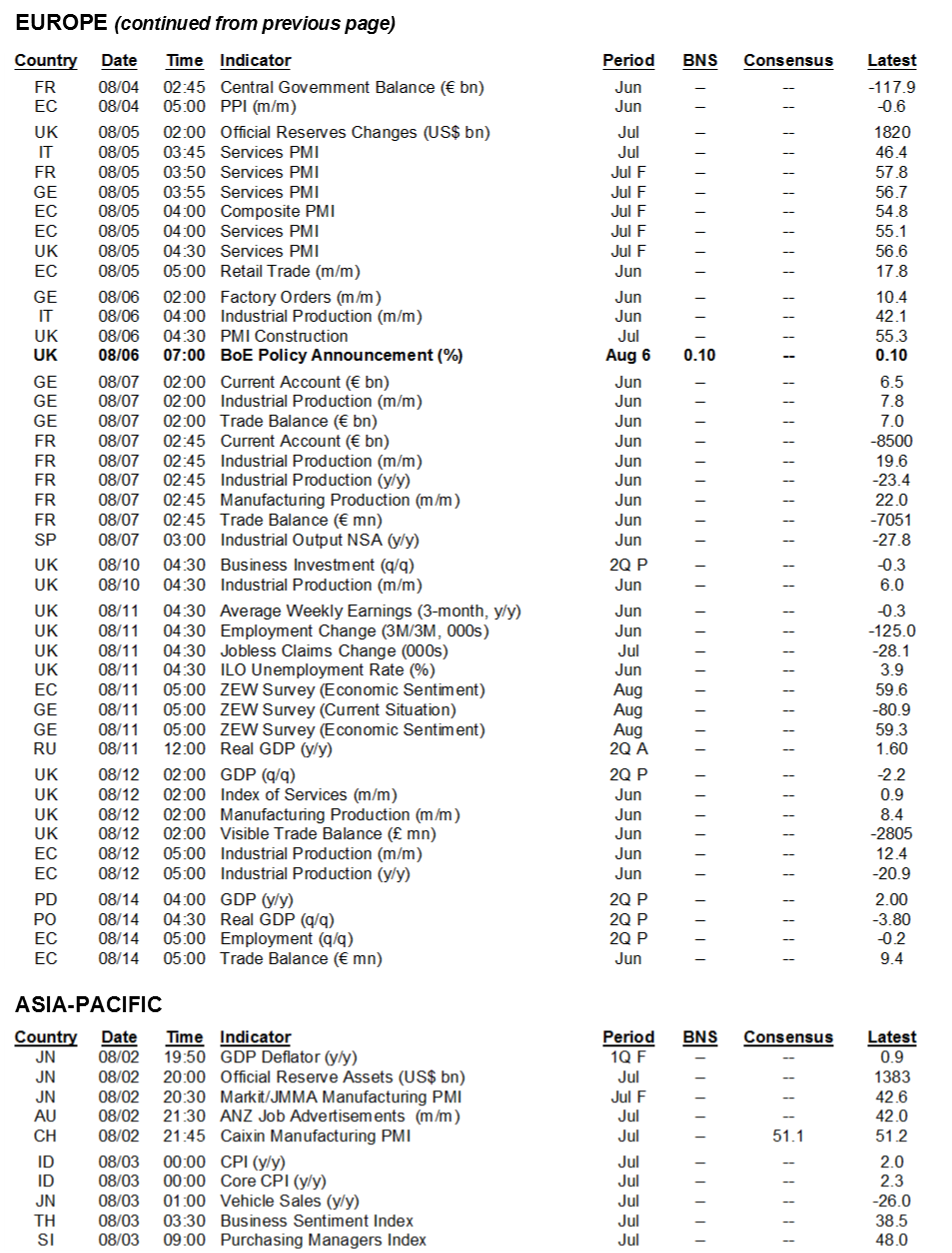
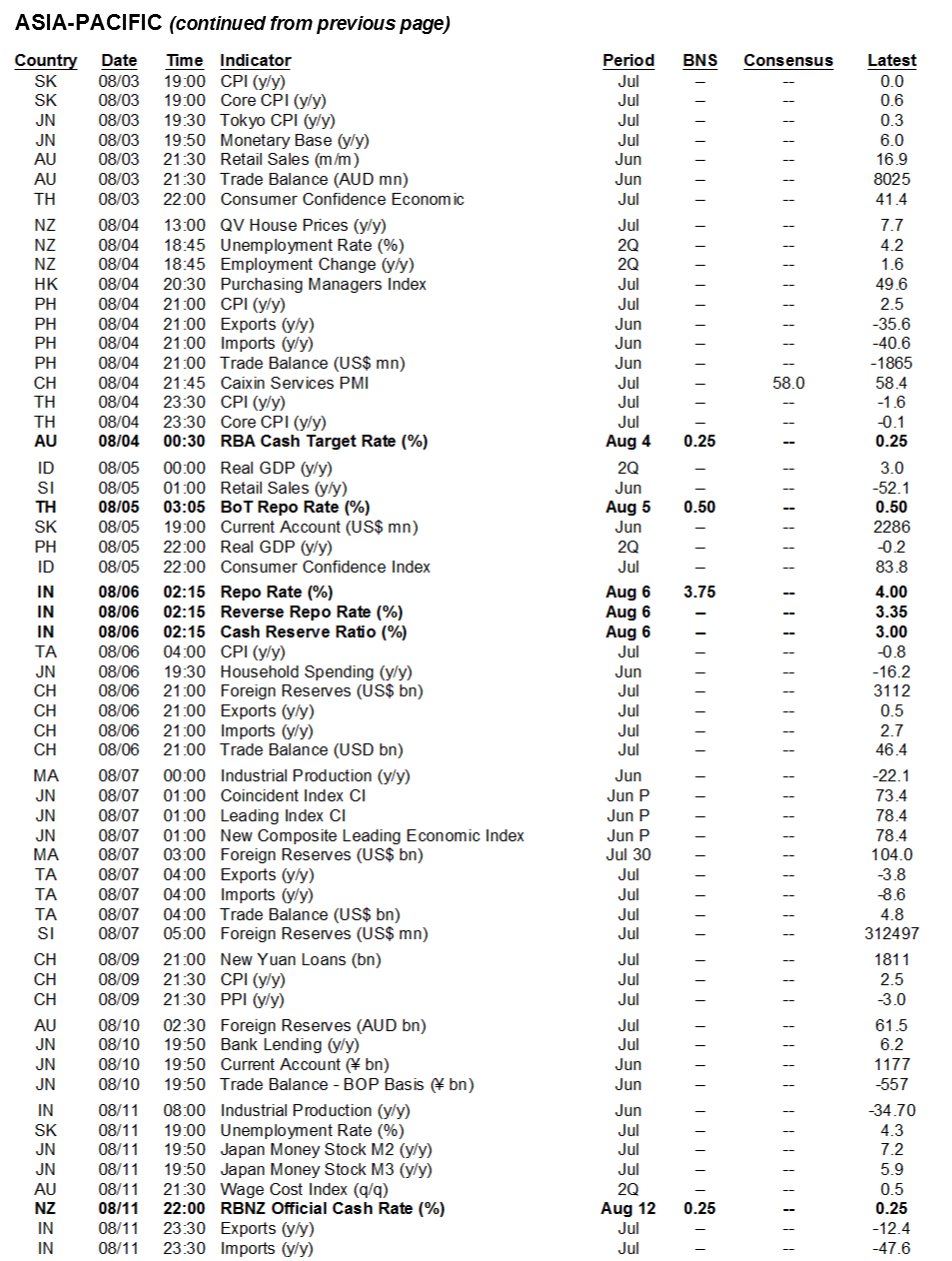
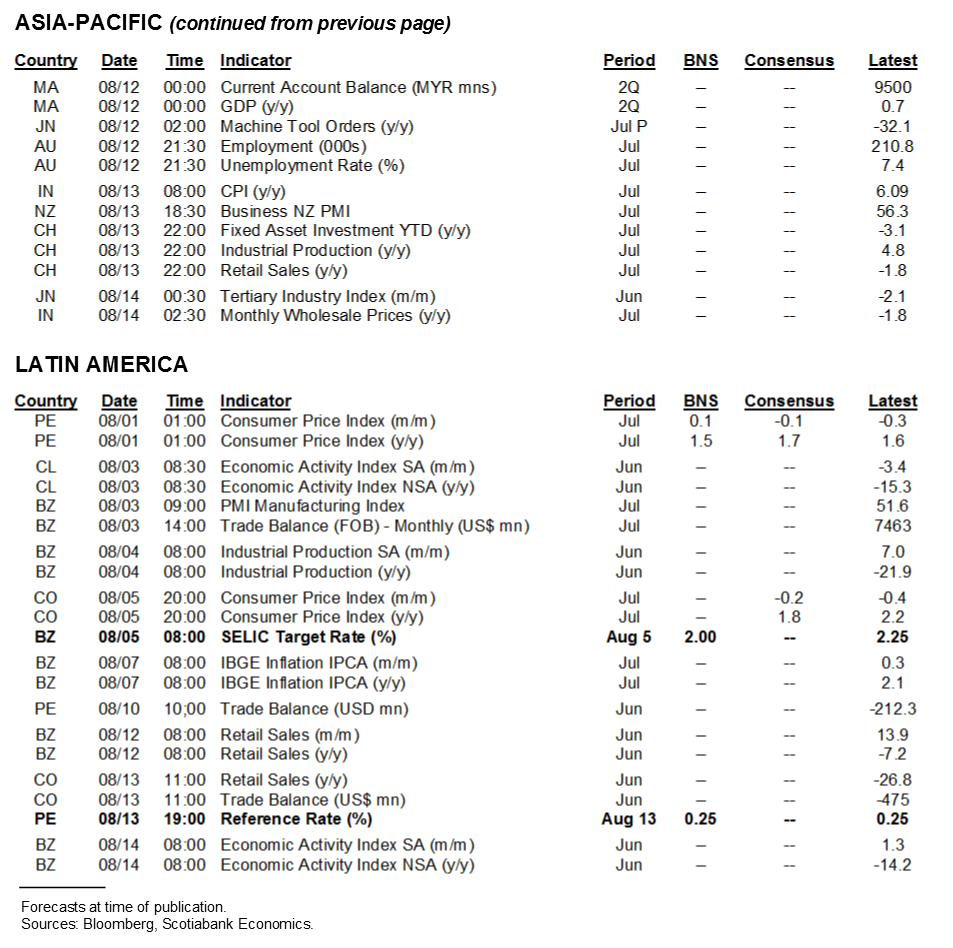
LatAm markets will focus upon inflation readings starting with Peru on Saturday, Colombia and Chile on Wednesday, and then Mexico and Brazil on Friday. Asia-Pacific markets will also take in inflation updates from Indonesia (Monday), Japan (Monday), Philippines and Thailand (Tuesday) and Taiwan (Thursday).
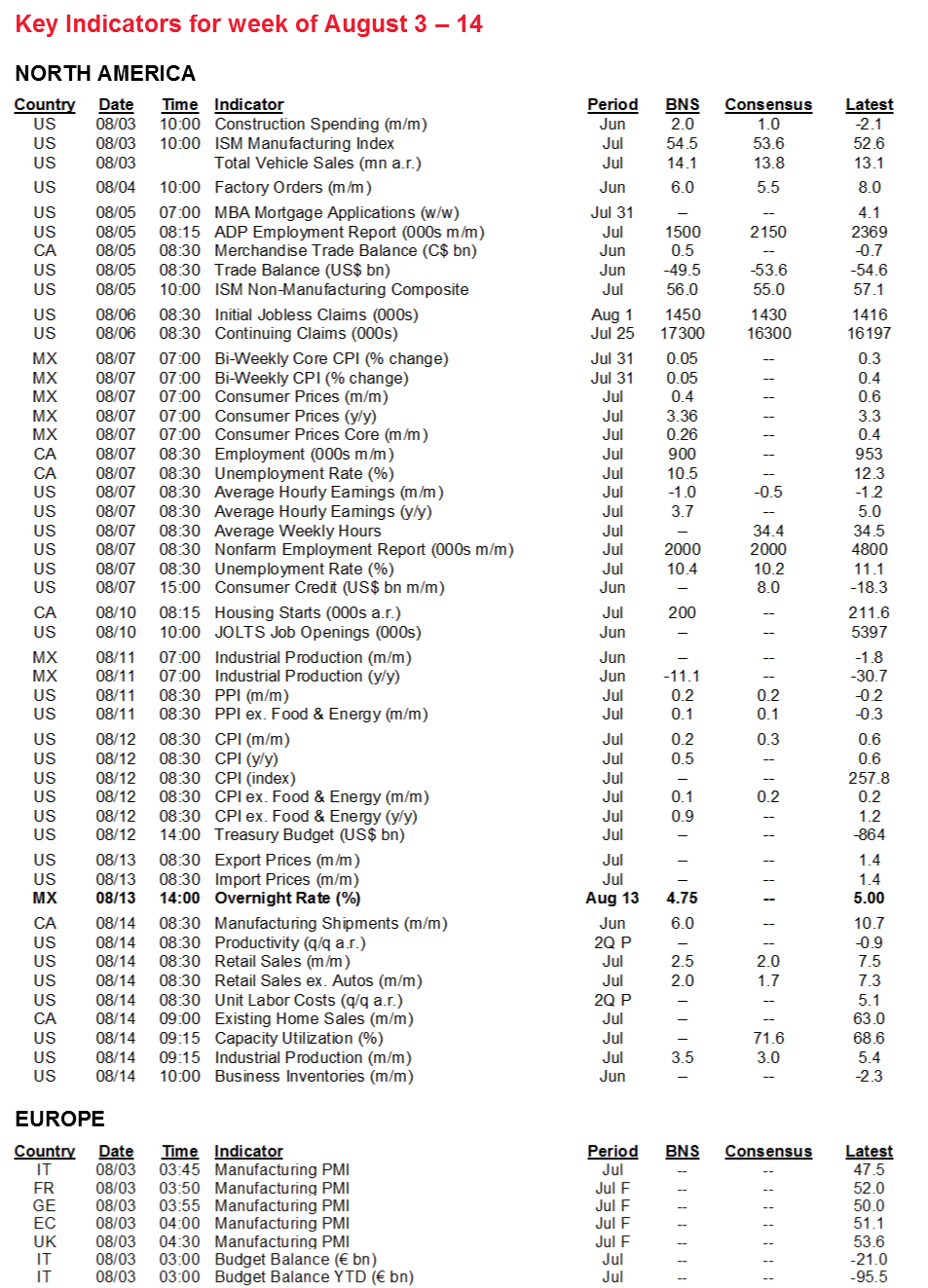
US releases will also include an expected gain in construction spending during June (Monday), another expected rise in auto sales during July (Monday), factory orders that should follow the 7.3% rise in durables higher (Tuesday) and an expected narrowing of the overall trade deficit (Wednesday) that may be mirrored in Canada (Wednesday).
European markets will digest a round of industrial and trade readings for the month of June. Industrial output Italy (Thursday) and then Germany, France and Spain are due on Friday as are trade figures from Germany, Italy and France on Friday. German factory orders are due on Thursday.
DISCLAIMER
This report has been prepared by Scotiabank Economics as a resource for the clients of Scotiabank. Opinions, estimates and projections contained herein are our own as of the date hereof and are subject to change without notice. The information and opinions contained herein have been compiled or arrived at from sources believed reliable but no representation or warranty, express or implied, is made as to their accuracy or completeness. Neither Scotiabank nor any of its officers, directors, partners, employees or affiliates accepts any liability whatsoever for any direct or consequential loss arising from any use of this report or its contents.
These reports are provided to you for informational purposes only. This report is not, and is not constructed as, an offer to sell or solicitation of any offer to buy any financial instrument, nor shall this report be construed as an opinion as to whether you should enter into any swap or trading strategy involving a swap or any other transaction. The information contained in this report is not intended to be, and does not constitute, a recommendation of a swap or trading strategy involving a swap within the meaning of U.S. Commodity Futures Trading Commission Regulation 23.434 and Appendix A thereto. This material is not intended to be individually tailored to your needs or characteristics and should not be viewed as a “call to action” or suggestion that you enter into a swap or trading strategy involving a swap or any other transaction. Scotiabank may engage in transactions in a manner inconsistent with the views discussed this report and may have positions, or be in the process of acquiring or disposing of positions, referred to in this report.
Scotiabank, its affiliates and any of their respective officers, directors and employees may from time to time take positions in currencies, act as managers, co-managers or underwriters of a public offering or act as principals or agents, deal in, own or act as market makers or advisors, brokers or commercial and/or investment bankers in relation to securities or related derivatives. As a result of these actions, Scotiabank may receive remuneration. All Scotiabank products and services are subject to the terms of applicable agreements and local regulations. Officers, directors and employees of Scotiabank and its affiliates may serve as directors of corporations.
Any securities discussed in this report may not be suitable for all investors. Scotiabank recommends that investors independently evaluate any issuer and security discussed in this report, and consult with any advisors they deem necessary prior to making any investment.
This report and all information, opinions and conclusions contained in it are protected by copyright. This information may not be reproduced without the prior express written consent of Scotiabank.
™ Trademark of The Bank of Nova Scotia. Used under license, where applicable.
Scotiabank, together with “Global Banking and Markets”, is a marketing name for the global corporate and investment banking and capital markets businesses of The Bank of Nova Scotia and certain of its affiliates in the countries where they operate, including, Scotiabanc Inc.; Citadel Hill Advisors L.L.C.; The Bank of Nova Scotia Trust Company of New York; Scotiabank Europe plc; Scotiabank (Ireland) Limited; Scotiabank Inverlat S.A., Institución de Banca Múltiple, Scotia Inverlat Casa de Bolsa S.A. de C.V., Scotia Inverlat Derivados S.A. de C.V. – all members of the Scotiabank group and authorized users of the Scotiabank mark. The Bank of Nova Scotia is incorporated in Canada with limited liability and is authorised and regulated by the Office of the Superintendent of Financial Institutions Canada. The Bank of Nova Scotia is authorised by the UK Prudential Regulation Authority and is subject to regulation by the UK Financial Conduct Authority and limited regulation by the UK Prudential Regulation Authority. Details about the extent of The Bank of Nova Scotia's regulation by the UK Prudential Regulation Authority are available from us on request. Scotiabank Europe plc is authorised by the UK Prudential Regulation Authority and regulated by the UK Financial Conduct Authority and the UK Prudential Regulation Authority.
Scotiabank Inverlat, S.A., Scotia Inverlat Casa de Bolsa, S.A. de C.V., and Scotia Derivados, S.A. de C.V., are each authorized and regulated by the Mexican financial authorities.
Not all products and services are offered in all jurisdictions. Services described are available in jurisdictions where permitted by law.