

HIGHLIGHTS
- Next week brings U.S., Brazilian, Colombian, and Chinese CPI, the BCRP’s rate decision, and a few other macro readings like Mexican and Colombian industrial production in what should generally be a quieter week around the globe.
- Economists are expecting that Brazilian inflation declined from 4.64% to around 4.4% in July, in line with IPCA-15 data. The BCB’s minutes may offer some insights into the next move for the central bank, whose real policy rate at ~10% remains highly restrictive.
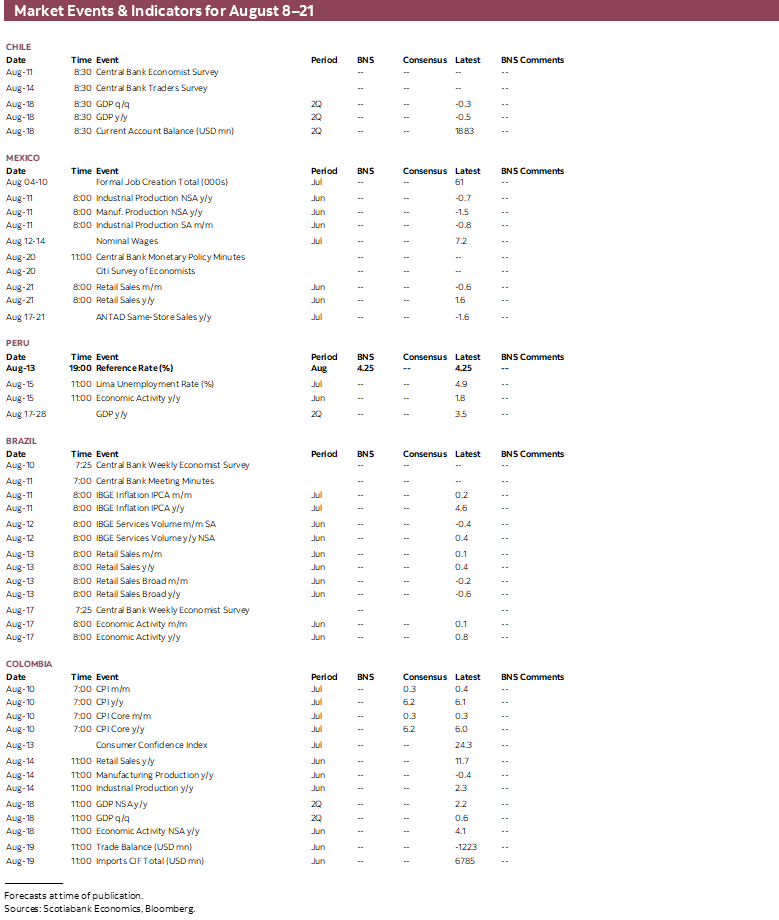
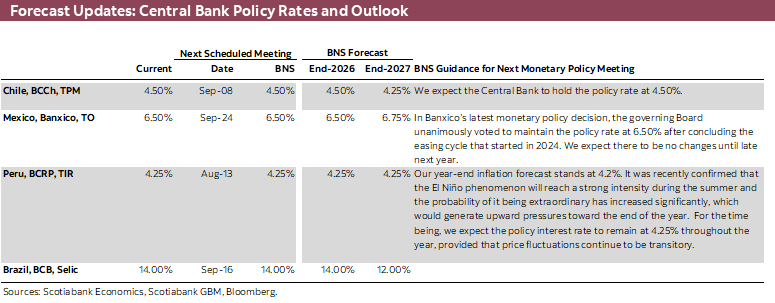
- The BCRP’s rate announcement on Thursday should not surprise anyone with a rate hold at 4.25% broadly expected, after expressing a view that the current inflationary shock and incoming pressures from El Niño are transitory, pointing to steady rates over the balance of the year.
- In today's report, the team in Mexico throws some cold water on the Q2 GDP beat, with data generally pointing to muted growth continuing rather than the second quarter rebound marking the start of a strengthening trend.
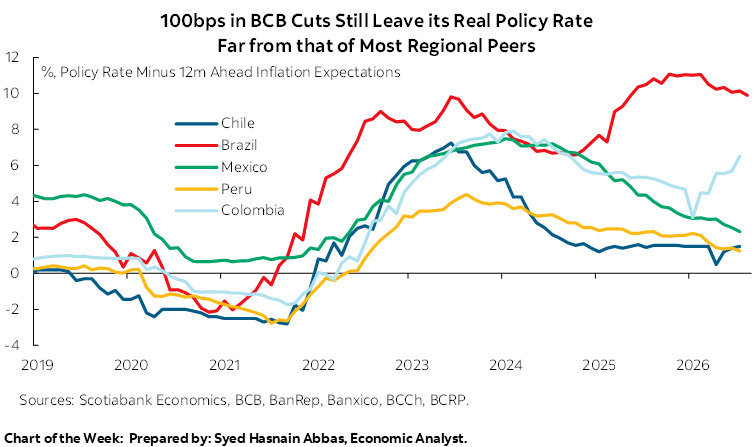
Chart of the Week
BCRP DECISION, BRAZIL CPI
Juan Manuel Herrera, Director
+52.55.2299.6675
juanmanuel.herrera@scotiabank.com
- Next week brings U.S., Brazilian, Colombian, and Chinese CPI, the BCRP’s rate decision, and a few other macro readings like Mexican and Colombian industrial production in what should generally be a quieter week around the globe.
- Economists are expecting that Brazilian inflation declined from 4.64% to around 4.4% in July, in line with IPCA-15 data. The BCB’s minutes may offer some insights into the next move for the central bank, whose real policy rate at ~10% remains highly restrictive.
- The BCRP’s rate announcement on Thursday should not surprise anyone with a rate hold at 4.25% broadly expected, after expressing a view that the current inflationary shock and incoming pressures from El Niño are transitory, pointing to steady rates over the balance of the year.
- In today's report, the team in Mexico throws some cold water on the Q2 GDP beat, with data generally pointing to muted growth continuing rather than the second quarter rebound marking the start of a strengthening trend.
It’s a stocktaking week for most of the globe over the coming days, as a busy run of economic data, monetary policy decisions, and company earnings shifts into a lower gear. That is not to say that markets will get to kick back, as next week brings U.S., Brazilian, Colombian, and Chinese CPI, the BCRP’s rate decision, and a few other macro readings like Mexican and Colombian industrial production, U.S. and Brazilian retail sales, and U.K. GDP. The usual Middle East headlines-driven volatility in energy prices likely awaits, with Brent prices heading into the weekend at ~$85/bbl, down about $15/bbl from the recent high a couple of weeks ago on hopes over a Hormuz transit agreement.
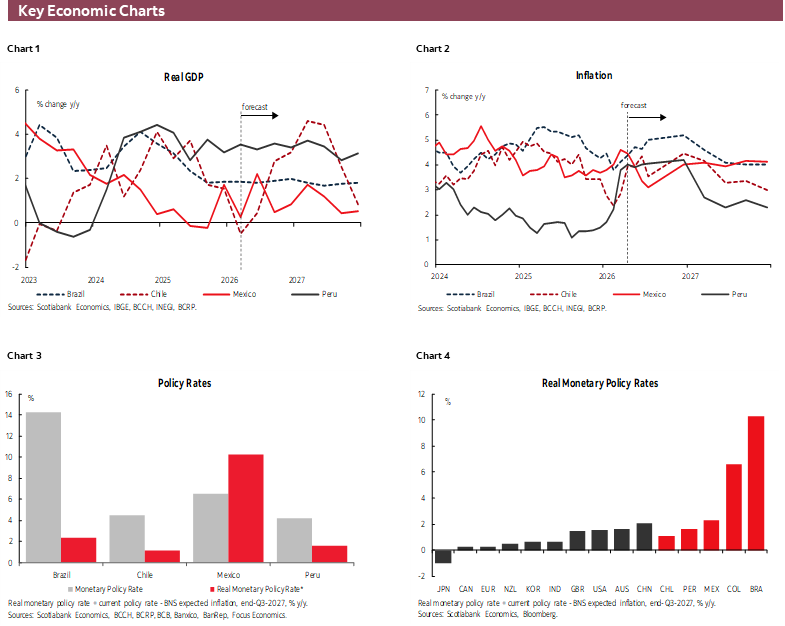
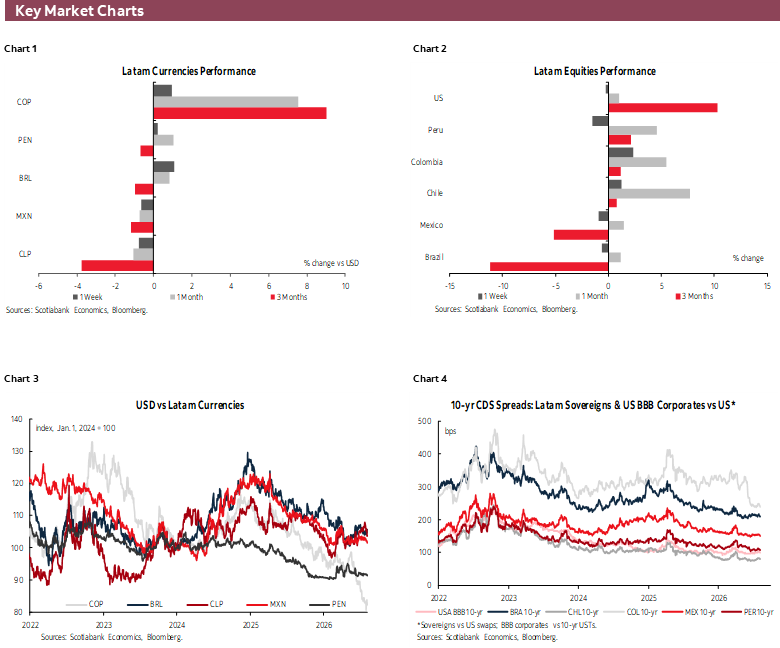
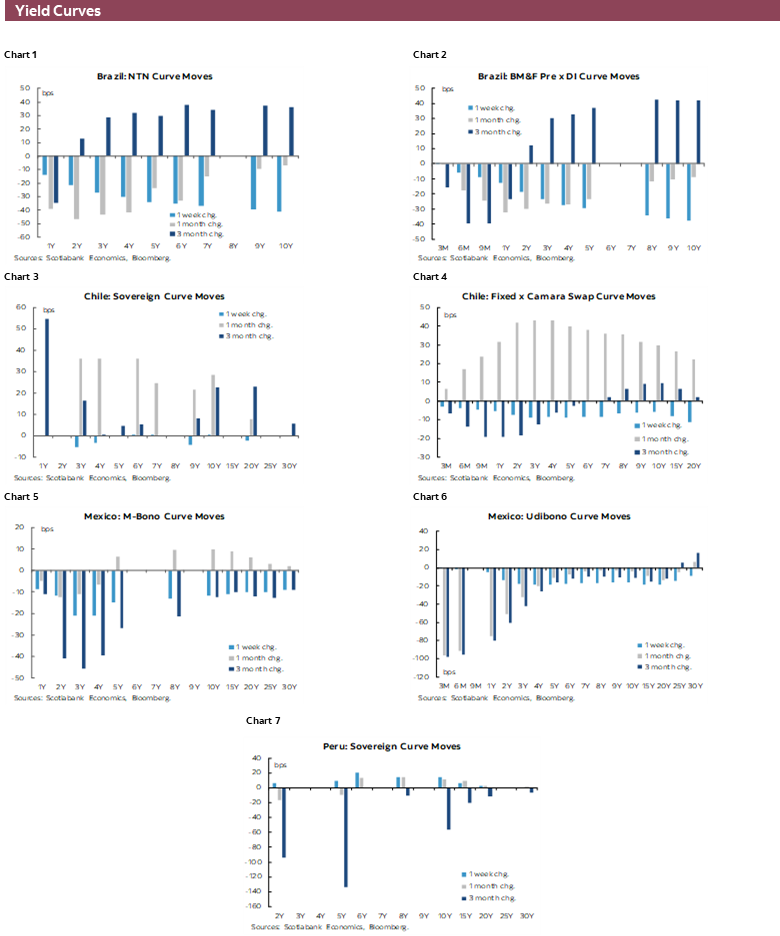
Brazil’s central bank publishes the minutes to its August 6th decision on Tuesday, with the statement announcing a 25bps rate cut to 14.00% broadly sticking to a no-guidance stance as economists and markets debate whether BCB has concluded its easing cycle. The statement merely notes that the BCB “will continue to monitor developments […] in order to keep monetary policy adequately restrictive” which leaves the door open to (marginal) additional cuts; markets are currently pricing in about an 80% chance of an additional quarter-point reduction by year-end. Still, one (or even two) 25bps cuts would only chip away at Brazil’s highly restrictive real policy rate, which at ~10% is 8–9ppts above that of Chile, Mexico, and Peru’s and 3.5ppts over Colombia’s.
While the BCB’s minutes may provide some insights into the bank’s next move, Friday’s July inflation—were it to surprise in either direction—could play a bigger role in shifting expectations. In the IPCA-15 release for July, headline inflation slowed from 4.8% to 4.5%, below a median forecast for a 4.7% print. Economists are expecting that the full month reading will show a similar decline from 4.64% to around 4.4%. In June, core inflation held at 4.7%, remaining in a ~4.5–4.7% band since November (outside of a brief dip in January). However, the trimmed mean measure slowed to 4.3%, its lowest level in a couple of years. It’s generally too soon to call for a clear cooling in Brazilian inflation, especially as expectations in the BCB’s economists survey have yet to turn the other direction—which is a key prerequisite for the bank to eye greater cuts than what traders and economists anticipate.
On the activity front, Brazil releases June services volume and retail sales data on Thursday and Friday, respectively. Both are expected to show an improvement in year-over-year growth after a muted May, which contributed to economic activity slowing to 0.8% y/y from 1.1% in April—where the industrial sector saw a more pronounced downshift for the month. In the year-to-May, Brazil’s economy grew by a modest 1.2% with limited employment growth (tight labour markets, however), fiscal supports fading, and restrictive rates keeping activity subdued. Looking ahead, the fast approaching October presidential election could further weigh on weakened business confidence, keeping a lid on hiring and investment. AtlasIntel and Datafolha polls for a would-be second-round election continue to show Lula ahead of Bolsonaro by about 5–6 ppts.
The BCRP’s rate announcement on Thursday should not surprise anyone with a rate hold at 4.25% broadly expected. Last weekend, July headline inflation at 4.1% y/y slightly overshot estimates (see our recap) but still only showed a 0.3% m/m rise that was below the 20-year average of 0.4% m/m for July. The BCRP has expressed a view that the current inflationary shock and incoming pressures from El Niño are merely transitory and would not require adjustments to its policy rate. On the flipside, the bank may not take too kindly to continued increases in inflation expectations, which at 3% at the 12-month horizon reached their highest since late-2023 in the most recent BCRP macroeconomic expectations survey (see here). Expectations for 2027 were nevertheless practically unchanged, at 2.53% among economists, sitting in that mid-2s zone since April.
Formal employment for July and industrial production for July are Mexico’s data highlights. As the team discusses in today’s report, the recent batch of Mexican macro readings has been mixed with fixed investment data surprising to the upside but private consumption figures showing a moderation in household demand as part of a broader trend. Overall, data suggest that the strong Q2 GDP reading of 2.2% y/y and 1.5% q/q should be taken with caution as it may have reflected one-off factors or recoveries from the weak Q1 rather than a clear pickup in activity.
COUNTRY UPDATES
Mexico—Consumption and Investment: Domestic Demand Continues to Show Signs of Fragility
Rodolfo Mitchell, Director of Economic and Sectoral Analysis
+52.55.3977.4556 (Mexico)
mitchell.cervera@scotiabank.com.mx
Miguel Saldaña, Economist
+52.55.5123.1718 (Mexico)
msaldanab@scotiabank.com.mx
Martha Cordova, Economic Research Specialist
+52.55.5435.4824 (Mexico)
martha.cordovamendez@scotiabank.com.mx
The indicators released this week could appear to offer a mixed reading of the Mexican economy. On the one hand, gross fixed investment surprised to the upside and showed a stronger-than-expected recovery in May. On the other side, private consumption continues to lose momentum and remains on a decelerating trend that has now extended for more than a year. Taken together, the figures suggest that, while the economy managed to post stronger-than-expected growth in the second quarter of 2026, there is still insufficient evidence to claim that a structural shift has occurred in the growth trajectory.
Gross fixed investment increased 1.1% year over year in May, well above the Bloomberg consensus, which anticipated a -0.5% decline. The result follows the 5.9% annual growth recorded in April, confirming a significant recovery from the weak performance observed over the previous 19 months. However, the underlying reading is less favourable than recent figures suggest. In monthly terms, investment fell 0.4% in May after the strong 4.1% advance recorded in April, indicating that part of the recovery may be associated with transitory factors, such as the FIFA World Cup, rather than the beginning of a new expansion cycle.
In addition, the composition of investment remains a source of concern. While public investment continues to show favourable momentum and posted annual growth close to 20%, private investment remained in negative territory, contracting -1.3% year over year. This divergence is particularly relevant because private investment accounts for most capital formation in Mexico and is a key driver of formal job creation and the expansion of productive capacity. In this sense, the recent aggregate rebound in investment appears to be supported mainly by public spending, a growth engine whose ability to sustain momentum looks limited given the fiscal consolidation process expected over the coming quarters.
On the consumption side, the story is different. The latest data confirms a gradual but persistent moderation in household demand. In May, private consumption advanced just 0.1% month over month, after growing 0.2% in April and 1.2% in March. In annual terms, using original figures, growth stood at 1.47%, a positive figure but clearly below the rates observed in previous months.
The loss of momentum is also evident when looking at the quarterly trend. During 2025, sequential consumption growth slowed from 1.94% quarter over quarter in the first quarter to 1.78% in the second, 1.41% in the third, and just 0.43% in the fourth. More importantly, during the first quarter of 2026, consumption contracted 0.37% quarter over quarter, the first decline observed in this indicator in the recent period. This trajectory confirms that the main driver of the Mexican economy has been gradually losing strength for several quarters.
The slowdown in consumption is especially significant because it is occurring in a context in which remittances continue to show notable resilience. In June, Mexico received USD 5.472 billion in remittances, above the USD 5.440 billion expected by consensus and equivalent to annual growth of 4.2%. The average value of transfers increased 3.9%, while the number of transactions rose only 0.3%, indicating that growth was driven mainly by larger amounts sent rather than by a higher number of migrant workers sending resources.
Nevertheless, the impact of remittances on consumption appears to have moderated. The cumulative appreciation of the USDMXN in recent months has reduced the purchasing power of these flows in local currency, limiting part of their impact on domestic demand. At the same time, the slowdown in private formal job creation and the moderation of growth in occupied population have reduced the impulse from the labour market. As a result, remittances have acted more as a cushion than as a catalyst for growth.
In this context, GDP growth of 2.2% year over year and 1.5% quarter over quarter recorded in the second quarter of 2026 should be interpreted with caution. Although the figure was stronger than expected and shows that the economy still has some capacity to expand in the short term, consumption and investment data suggest that much of this performance was associated with a one-off recovery after the weakness observed at the beginning of the year. Investment is only starting to recover lost ground and continues to depend largely on public spending, which appears quite limited, while consumption continues to show a clear loss of traction.
For this reason, we believe the Mexican economy will continue to face a very limited growth environment during the second half of the year. Although some analysts have revised up their growth forecasts for 2026, the available information suggests that domestic demand will continue to decelerate gradually. The persistent weakness in private investment, slower formal employment growth, and moderation in consumption suggest that the expansion observed in the second quarter is unlikely to be sustainable. As a result, we maintain our expectation that the economy will register growth close to zero in the third quarter of 2026, consistent with a stagnation scenario rather than a sustained recovery.
| LOCAL MARKET COVERAGE | ||
| CHILE | ||
| Website: | Click here to be redirected | |
| Subscribe: | anibal.alarcon@scotiabank.cl | |
| Coverage: | Spanish and English | |
| MEXICO | ||
| Website: | Click here to be redirected | |
| Subscribe: | estudeco@scotiacb.com.mx | |
| Coverage: | Spanish | |
| PERU | ||
| Website: | Click here to be redirected | |
| Subscribe: | siee@scotiabank.com.pe | |
| Coverage: | Spanish | |
DISCLAIMER
This report has been prepared by Scotiabank Economics as a resource for the clients of Scotiabank. Opinions, estimates and projections contained herein are our own as of the date hereof and are subject to change without notice. The information and opinions contained herein have been compiled or arrived at from sources believed reliable but no representation or warranty, express or implied, is made as to their accuracy or completeness. Neither Scotiabank nor any of its officers, directors, partners, employees or affiliates accepts any liability whatsoever for any direct or consequential loss arising from any use of this report or its contents.
These reports are provided to you for informational purposes only. This report is not, and is not constructed as, an offer to sell or solicitation of any offer to buy any financial instrument, nor shall this report be construed as an opinion as to whether you should enter into any swap or trading strategy involving a swap or any other transaction. The information contained in this report is not intended to be, and does not constitute, a recommendation of a swap or trading strategy involving a swap within the meaning of U.S. Commodity Futures Trading Commission Regulation 23.434 and Appendix A thereto. This material is not intended to be individually tailored to your needs or characteristics and should not be viewed as a “call to action” or suggestion that you enter into a swap or trading strategy involving a swap or any other transaction. Scotiabank may engage in transactions in a manner inconsistent with the views discussed this report and may have positions, or be in the process of acquiring or disposing of positions, referred to in this report.
Scotiabank, its affiliates and any of their respective officers, directors and employees may from time to time take positions in currencies, act as managers, co-managers or underwriters of a public offering or act as principals or agents, deal in, own or act as market makers or advisors, brokers or commercial and/or investment bankers in relation to securities or related derivatives. As a result of these actions, Scotiabank may receive remuneration. All Scotiabank products and services are subject to the terms of applicable agreements and local regulations. Officers, directors and employees of Scotiabank and its affiliates may serve as directors of corporations.
Any securities discussed in this report may not be suitable for all investors. Scotiabank recommends that investors independently evaluate any issuer and security discussed in this report, and consult with any advisors they deem necessary prior to making any investment.
This report and all information, opinions and conclusions contained in it are protected by copyright. This information may not be reproduced without the prior express written consent of Scotiabank.
™ Trademark of The Bank of Nova Scotia. Used under license, where applicable.
Scotiabank, together with “Global Banking and Markets”, is a marketing name for the global corporate and investment banking and capital markets businesses of The Bank of Nova Scotia and certain of its affiliates in the countries where they operate, including; Scotiabank Europe plc; Scotiabank (Ireland) Designated Activity Company; Scotiabank Inverlat S.A., Institución de Banca Múltiple, Grupo Financiero Scotiabank Inverlat, Scotia Inverlat Casa de Bolsa, S.A. de C.V., Grupo Financiero Scotiabank Inverlat, Scotia Inverlat Derivados S.A. de C.V. – all members of the Scotiabank group and authorized users of the Scotiabank mark. The Bank of Nova Scotia is incorporated in Canada with limited liability and is authorised and regulated by the Office of the Superintendent of Financial Institutions Canada. The Bank of Nova Scotia is authorized by the UK Prudential Regulation Authority and is subject to regulation by the UK Financial Conduct Authority and limited regulation by the UK Prudential Regulation Authority. Details about the extent of The Bank of Nova Scotia's regulation by the UK Prudential Regulation Authority are available from us on request. Scotiabank Europe plc is authorized by the UK Prudential Regulation Authority and regulated by the UK Financial Conduct Authority and the UK Prudential Regulation Authority.
Scotiabank Inverlat, S.A., Scotia Inverlat Casa de Bolsa, S.A. de C.V, Grupo Financiero Scotiabank Inverlat, and Scotia Inverlat Derivados, S.A. de C.V., are each authorized and regulated by the Mexican financial authorities.
Not all products and services are offered in all jurisdictions. Services described are available in jurisdictions where permitted by law.