

HIGHLIGHTS
- It’s all about GDP data next week in Latam, with Chile, Colombia, and Peru joining Mexico’s already-released Q2 GDP estimates while Brazil publishes June economic activity data to round out the quarter.
- News of trade talks between Mexico and the U.S. may also provide some clarity on the future of the USMCA or the state of tariffs, as the U.S. is currently charging a 10%+ effective duty rate on Mexican passenger vehicles and trucks.
- In today’s report, the team in Lima goes over their assessment of economic conditions in Peru. Growth is estimated to have slowed in Q2-26 to 2.6% from 3.5% y/y due to the impact of El Niño, all while domestic demand trends remain firm.
- Our economists in Mexico look at trends in consumer credit, with borrowing strength in recent quarters acting as an important tailwind for resilient household consumption, offsetting sluggish employment and wage growth.
Chart of the Week
REGIONAL GDP, MEXICO-U.S. TENSIONS
Juan Manuel Herrera, Director
+52.55.2299.6675
juanmanuel.herrera@scotiabank.com
- It’s all about GDP data next week in Latam, with Chile, Colombia, and Peru joining Mexico’s already-released Q2 GDP estimates while Brazil publishes June economic activity data to round out the quarter.
- News of trade talks between Mexico and the U.S. may also provide some clarity on the future of the USMCA or the state of tariffs, as the U.S. is currently charging a 10%+ effective duty rate on Mexican passenger vehicles and trucks.
- In today’s report, the team in Lima goes over their assessment of economic conditions in Peru. Growth is estimated to have slowed in Q2-26 to 2.6% from 3.5% y/y due to the impact of El Niño, all while domestic demand trends remain firm.
- Our economists in Mexico look at trends in consumer credit, with borrowing strength in recent quarters acting as an important tailwind for resilient household consumption, offsetting sluggish employment and wage growth.
It’s all about GDP data next week in Latam, with Chile, Colombia, and Peru joining Mexico’s already-released Q2 GDP estimates while Brazil publishes June economic activity data to round out the quarter. There is little else of major significance on the economic front in the region next week, while global markets will have PMIs and Canadian and U.K. CPI, alongside the minutes to the July FOMC meeting. U.S. 50% tariffs on about $20bn in imports from Canada are also set to kick in on August 19th unless the countries reach an agreement in the next few days.
News of trade talks between Mexico and the U.S. may also provide some clarity on the future of the USMCA or the current state of tariffs. Earlier this week, it was reported that Mexico is pushing for the U.S. to lower tariffs on the non-U.S. value of vehicle imports that is currently subject to a 25% duty rate—while U.S. shares face no duties. Mexico may reportedly be willing to concede a U.S.-specific content requirement for vehicles to qualify for USMCA preferential treatment, likely within the broader 40% labour value content requirement under current USMCA parameters though well short of the White House’s 50% U.S.-content demand.
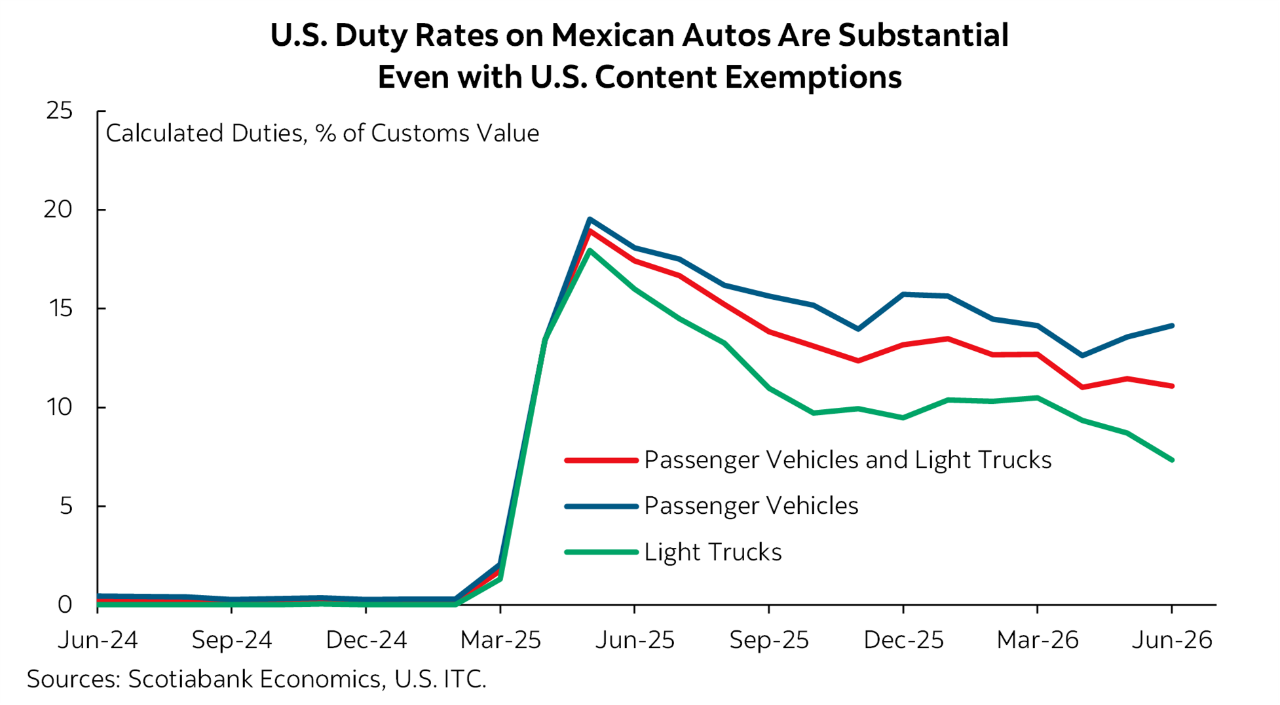
Across Harmonized System goods lines for passenger vehicles and light trucks (within HS 8703 and 8704), the U.S. levied duties totalling 11.1% of the customs value of these imports from Mexico in June (see chart below), compared to 0.2% in February 2025 prior to the beginning of the U.S.’s tariff waves, with the dollar value of these purchases falling by 9.5% y/y in H1-2026. Light passenger vehicles which tend to incorporate lower-cost foreign inputs were levied an aggregate duty rate of 14% in June, compared to 7.4% for light trucks. The former would, under ‘normal’ conditions, only face a 2.5% most-favoured nation U.S. duty rate so were less-incentivized to comply with USMCA content requirements, compared to light trucks subject to a 25% levy.
According to reports, Mexico is seeking to exempt the whole of North American value from 25% auto tariffs, but the U.S. may be concerned that Mexican content is not truly Mexican-made or its in-country value added is overstated. Earlier this week, the U.S. published a report titled “The Great Transhipment Scam,” where it singled out about 40 countries that facilitate or participate in the shipment of Chinese goods to the U.S. to sidestep tariffs, with Mexico (but also Canada and the E.U.) listed in the country category of “diversified scale leaders,” “where transshipment risk is embedded within broad legitimate trade flows.”
Relations between Mexico and the U.S. have also been tense in recent days amid the suspension of U.S. avocado imports from Michoacán due to a “threat to U.S. interests.” The Mexican government’s response with military deployments and extorsion-related arrests this week saw the U.S. lift the imports ban on Thursday, but the episode was a reminder of the U.S.’s displeasure with Mexican internal security matters. On Friday, former president AMLO’s son, Andrés, also claimed that the U.S. government had suspended his visa in a public letter to Trump.
In today’s report, our economists in Mexico look at trends in consumer credit that, while slowing from year-ago growth rates, expanded by over 10% y/y in the first half of 2026—+7.2% y/y adjusted for inflation. The strength in consumer credit growth in recent quarters has seemingly acted as an important tailwind for the resilience in household consumption, offsetting sluggish employment and wages growth. The more muted income backdrop of the spending picture and a greater reliance on credit stands as a downside risk for personal spending, with households likely to curb spending habits amid rising indebtedness—particularly without an improvement on the wages or hiring front.
Turning to next week’s data, Peru’s INEI publishes June economic activity over the weekend, followed by Q2 GDP data on Friday, although the BCRP front-runs the stats agency’s results with their own quarterly figures on Thursday—the data are similar, but with different enough that we take the BCRP’s readings over the INEI’s. In today’s report, the team in Lima goes over their assessment of economic conditions in Peru, with growth estimated to have slowed in Q2-26 to 2.6% from 3.5% y/y due to the impact of El Niño which weighed on fishing and agriculture. On the flipside, data for July are pointing to a continuation of the strong trend in domestic demand conditions that are a better reflection of economic momentum as headline growth data shifts around with the tides of one-off/transitory shocks.
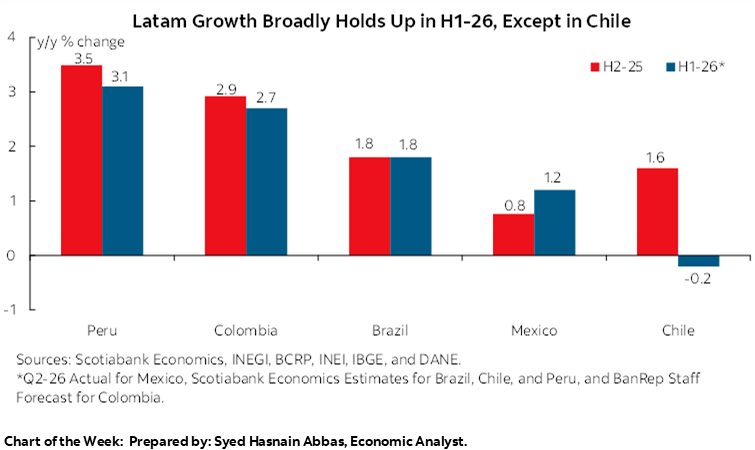
In contrast to Peru, Chile’s economy has clearly slowed so far in 2026 with temporary factors combining with a moderation in underlying demand. From an already muted GDP expansion of only 1.6% in H2-25, the country likely recorded a y/y GDP contraction in the first half of the current year due to Q1’s 0.5% y/y drop and a marginal 0.1% gain in Q2 based on monthly industry-level GDP data (compared to the BCCh’s 0.4% y/y projection). Such a performance would leave it at the bottom of the Latam majors in terms of average growth over the past four quarters.
On a marginally less negative note, Chile likely managed to avoid the recession label as the economy expanded by 0.3% q/q in Q2-26 in seasonally-adjusted monthly industry GDP figures, after the first quarter’s 0.3% decline. The difference between quarterly expenditure accounts and monthly industry accounts is generally no larger than 0.2ppts q/q, but the gap between these two has widened in the post-pandemic period, most notably for the second quarter of the year with industry-accounts overshooting expenditure-accounts growth. The bulk of the improvement for the quarter owes to a recovery in the mining sector, flipping from a 1.4% q/q decline to a 1.9% gain, while the manufacturing sector went from -0.7% to +0.5%, and the trade industry turned from -1.2% to flat. Meanwhile, services, which had been the whole support of economic activity in Q1-26 with a 0.1% rise also saw an improvement to 0.3%, all as per seasonally-adjusted monthly activity data.
Our economists believe that it will be tough for Chile to meet even a 1% expansion for the year as a whole, which means that the BCCh will very likely have to revise its GDP growth projection range from 1.75–2.75% down to likely 0.75–1.25% at its September Monetary Policy Report. The significantly weaker than expected performance of Chile’s economy in 2026 coupled with ongoing sluggishness in labour markets would at least warrant a discussion on a possible rate reduction, but external developments and second-round and indexation effect risks in inflation open the door to policy tightening. In the near-term, neither we nor markets see BCCh rate action in our baseline, but while we think the BCCh will loosen settings in early-2027, traders are eyeing the possibility of hikes from around Q1/Q2-27.
Finally, Brazil and Colombia publish June and Q2 GDP data on Monday and Tuesday, respectively. Brazilian economic activity grew by only 1.1% and 0.8% y/y in April and May, respectively, although the second quarter got a solid handoff from a 3.3% y/y expansion in March. Assuming no growth m/m in June would mean that Brazil’s economy activity index recorded a modest 1.2% y/y gain in Q2-26 in non-seasonally adjusted terms, down from 1.4% in Q1-26 (compared to 1.8% in quarterly GDP data). There’s also a bias towards a monthly contraction in output as industrial production showed a greater decline in June than expected. As for Colombia, the median economist polled by Bloomberg (among thirteen) is projecting a 3.3% y/y GDP rise in Q2, up from 2.2% in the first quarter and well above the median of 2.6% as of the latest BanRep economists survey. Retail sales and industrial/manufacturing production data published this morning surprised to the upside, and Colombian economic activity grew by a strong 4.1% y/y in May. Sadly, Colombia’s strong economic trajectory in recent months has been interrupted by this week’s strong earthquake, with the focus now turning to reconstruction and public support programmes.
COUNTRY UPDATES
Mexico—Credit Supports Consumption Amid Slower Labour Market Momentum
Rodolfo Mitchell, Director of Economic and Sectoral Analysis
+52.55.3977.4556 (Mexico)
mitchell.cervera@scotiabank.com.mx
Miguel Saldaña, Economist
+52.55.5123.1718 (Mexico)
msaldanab@scotiabank.com.mx
Martha Cordova, Economic Research Specialist
+52.55.5435.4824 (Mexico)
martha.cordovamendez@scotiabank.com.mx
In Mexico, recent economic activity has been characterized by persistent weakness in investment, which has been partially offset by a moderately favourable performance in domestic consumption. Meanwhile, external demand continues to show solid momentum, supported by the expansion of the U.S. economy, albeit with a different export composition than historical trends. Against this backdrop, private consumption posted real annual growth of 2.04% YTD during the first five months of the year, below the 3.25% average recorded between 2022 and 2025.
Consistent with this trend, commercial bank lending has benefited from the resilience of consumption appetite, even in a labour market environment characterized by moderate formal job creation. Total loan portfolios expanded by 6.0% YTD in nominal terms during the first half of the year, driven primarily by consumer lending, which recorded average nominal annual growth of 11.6% YTD. After adjusting for inflation, these figures translate into real growth rates of 1.9% for total lending and 7.2% for consumer credit.
Although consumer credit maintained a double-digit annual growth rate in June (11.3% y/y), it has been on a decelerating trend compared with the 18.7% observed in January 2025, in line with softer domestic demand. Within this segment, credit cards have followed a similar path, although with relatively stronger performance: annual growth increased from 11.1% in January to 11.8% in June. In real terms, June growth rates stood at 7.6% for consumer credit and 8.2% for credit card lending.
This performance would be particularly encouraging if it were accompanied by a similar increase in household income. However, this has not been the case. Formal employment creation continues to show signs of weakness; in July, jobs affiliated with the social security system grew by only 1.5% year-over-year, compared with the 2.6% average growth observed between 2022 and 2025.
The divergence between credit growth and the performance of labour markets suggests that part of private consumption has been financed through greater use of bank credit. As a result, the possibility of a sharper slowdown in consumption during the second half of the year becomes increasingly relevant, as households face a reduced capacity to continue expanding their indebtedness. Moreover, financing consumption in an environment of moderate employment growth may gradually erode household financial health. Indeed, the non-performing loan ratio for consumer credit reached 3.5% during the first half of the year, above the 3.2% average recorded between 2022 and 2025.
Overall, recent trends in credit and consumption suggest that a significant share of household spending has relied on increased use of bank financing rather than on sustained improvements in labour income. While this dynamic has helped support domestic demand amid weak investment, it has also increased financial pressure on households and reduced the scope for consumption to continue growing at the same pace. If employment growth continues to slow and credit quality indicators deteriorate further, private consumption is likely to lose momentum in the coming quarters, weakening one of the economy’s main sources of growth.
Peru—Solid Domestic Demand and Expectations Amid Contained Inflationary Pressures
Ricardo Avila, Senior Analyst
ricardo.avila@scotiabank.com.pe
Economic activity slowed in Q2-26 due to the effects of the El Niño phenomenon, which has been affecting sectors such as fishing and agriculture. Nevertheless, domestic demand remains robust and economic expectations continue to be favourable.
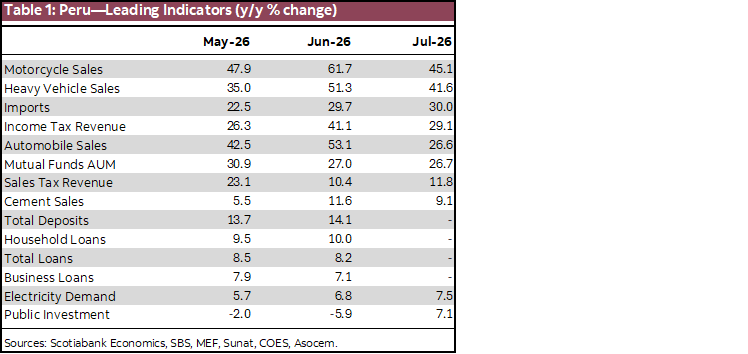
As of July, the leading indicators of domestic demand that we monitor (table 1), particularly those related to private investment and private consumption, continue to post strong growth. Regarding private investment, cement demand, heavy vehicle sales and electricity consumption have continued to accelerate. In terms of private consumption, mutual fund assets and light vehicle sales have continued to expand. Looking ahead, this momentum is expected to persist, meaning that economic growth will continue to be primarily driven by the sustained strength of domestic demand.
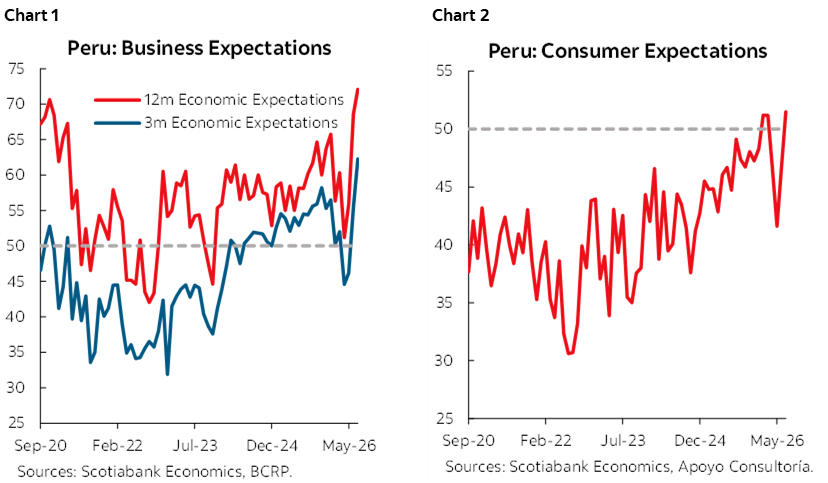
Economic expectations have also continued to improve significantly (chart 1). On the business side, according to surveys published by the Central Reserve Bank of Peru (BCRP), 12-month expectations have reached their highest level since February 2019, while 3-month expectations have climbed to their highest level since November 2017. Meanwhile, consumer confidence indicators (chart 2) based on the Indicca survey, compiled by Apoyo Consultoría, have followed a similar trend, moving into optimistic territory and reaching their highest level since January 2018. These developments are taking place in a context where the new administration is perceived as being supportive of private investment.
Regarding inflation, developments over the past three months (May, June, and July) have been broadly in line with the historical average observed over the last twenty years, excluding the pandemic period. Although annual inflation remains above the Central Bank’s target range (1%–3%), standing at 4.1%, this is largely explained by temporary shocks that occurred in March and April, including the disruption of natural gas supply in Cusco and the onset of the Middle East conflict.
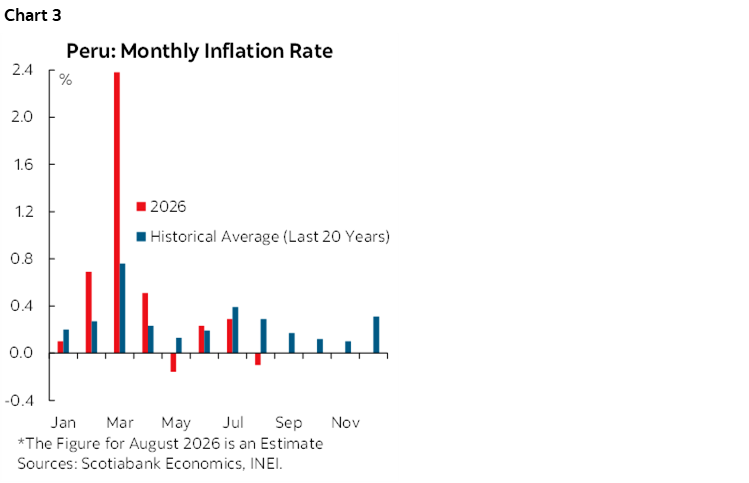
August inflation data will be released on September 1st. Based on our monitoring of key price indicators, the monthly inflation rate is likely to be close to 0% (chart 3), and could even be negative. As a result, monthly inflation would remain below the historical average of the last twenty years (0.24%). However, annual inflation could continue to face upward pressure due to a base effect, given that inflation in August 2025 was negative (-0.29%).
On the monetary policy front, the BCRP kept its policy rate unchanged in August, in line with our expectations. We believe there will be no changes to monetary policy during the remainder of 2026, based on the following considerations:
- Over the past three months, beginning in May, monthly inflation has shown no significant deviations from historical patterns, while August inflation is expected to come in below its long-term average.
- Core inflation excluding transportation stands at 1.7%, still below the midpoint of the target range (1%–3%).
- Recently, the government announced a temporary diesel subsidy of between 15% and 20% to address the fuel crisis, which should help ease price pressures across the economy.
Nevertheless, it remains important to monitor inflation expectations closely to ensure that they remain anchored within the BCRP’s target range. According to the latest reading for July, inflation expectations stand at 3.0%, corresponding to the upper bound of the target range.
| LOCAL MARKET COVERAGE | ||
| CHILE | ||
| Website: | Click here to be redirected | |
| Subscribe: | anibal.alarcon@scotiabank.cl | |
| Coverage: | Spanish and English | |
| MEXICO | ||
| Website: | Click here to be redirected | |
| Subscribe: | estudeco@scotiacb.com.mx | |
| Coverage: | Spanish | |
| PERU | ||
| Website: | Click here to be redirected | |
| Subscribe: | siee@scotiabank.com.pe | |
| Coverage: | Spanish | |
DISCLAIMER
This report has been prepared by Scotiabank Economics as a resource for the clients of Scotiabank. Opinions, estimates and projections contained herein are our own as of the date hereof and are subject to change without notice. The information and opinions contained herein have been compiled or arrived at from sources believed reliable but no representation or warranty, express or implied, is made as to their accuracy or completeness. Neither Scotiabank nor any of its officers, directors, partners, employees or affiliates accepts any liability whatsoever for any direct or consequential loss arising from any use of this report or its contents.
These reports are provided to you for informational purposes only. This report is not, and is not constructed as, an offer to sell or solicitation of any offer to buy any financial instrument, nor shall this report be construed as an opinion as to whether you should enter into any swap or trading strategy involving a swap or any other transaction. The information contained in this report is not intended to be, and does not constitute, a recommendation of a swap or trading strategy involving a swap within the meaning of U.S. Commodity Futures Trading Commission Regulation 23.434 and Appendix A thereto. This material is not intended to be individually tailored to your needs or characteristics and should not be viewed as a “call to action” or suggestion that you enter into a swap or trading strategy involving a swap or any other transaction. Scotiabank may engage in transactions in a manner inconsistent with the views discussed this report and may have positions, or be in the process of acquiring or disposing of positions, referred to in this report.
Scotiabank, its affiliates and any of their respective officers, directors and employees may from time to time take positions in currencies, act as managers, co-managers or underwriters of a public offering or act as principals or agents, deal in, own or act as market makers or advisors, brokers or commercial and/or investment bankers in relation to securities or related derivatives. As a result of these actions, Scotiabank may receive remuneration. All Scotiabank products and services are subject to the terms of applicable agreements and local regulations. Officers, directors and employees of Scotiabank and its affiliates may serve as directors of corporations.
Any securities discussed in this report may not be suitable for all investors. Scotiabank recommends that investors independently evaluate any issuer and security discussed in this report, and consult with any advisors they deem necessary prior to making any investment.
This report and all information, opinions and conclusions contained in it are protected by copyright. This information may not be reproduced without the prior express written consent of Scotiabank.
™ Trademark of The Bank of Nova Scotia. Used under license, where applicable.
Scotiabank, together with “Global Banking and Markets”, is a marketing name for the global corporate and investment banking and capital markets businesses of The Bank of Nova Scotia and certain of its affiliates in the countries where they operate, including; Scotiabank Europe plc; Scotiabank (Ireland) Designated Activity Company; Scotiabank Inverlat S.A., Institución de Banca Múltiple, Grupo Financiero Scotiabank Inverlat, Scotia Inverlat Casa de Bolsa, S.A. de C.V., Grupo Financiero Scotiabank Inverlat, Scotia Inverlat Derivados S.A. de C.V. – all members of the Scotiabank group and authorized users of the Scotiabank mark. The Bank of Nova Scotia is incorporated in Canada with limited liability and is authorised and regulated by the Office of the Superintendent of Financial Institutions Canada. The Bank of Nova Scotia is authorized by the UK Prudential Regulation Authority and is subject to regulation by the UK Financial Conduct Authority and limited regulation by the UK Prudential Regulation Authority. Details about the extent of The Bank of Nova Scotia's regulation by the UK Prudential Regulation Authority are available from us on request. Scotiabank Europe plc is authorized by the UK Prudential Regulation Authority and regulated by the UK Financial Conduct Authority and the UK Prudential Regulation Authority.
Scotiabank Inverlat, S.A., Scotia Inverlat Casa de Bolsa, S.A. de C.V, Grupo Financiero Scotiabank Inverlat, and Scotia Inverlat Derivados, S.A. de C.V., are each authorized and regulated by the Mexican financial authorities.
Not all products and services are offered in all jurisdictions. Services described are available in jurisdictions where permitted by law.