

A series of fiscal policy measures have been announced in recent days that will lead to higher public spending over the coming months. Last Wednesday, Congress approved PEN 8.2 billion (US$ 2.4 billion) in supplementary resources for the 2026 Public Budget, as requested by the Government. The additional funds will be allocated to completing ongoing public investment projects and strengthening the Government’s capacity to respond to potential emergencies associated with the El Niño phenomenon (ENSO). These supplementary resources, combined with the seasonal increase in public expenditure toward year-end, would cause the fiscal deficit to widen from 0.9% of GDP in September to around 1.8% of GDP by December 2026, broadly in line with the fiscal deficit target.
In addition, the Government announced the implementation of a countercyclical fiscal policy aimed at mitigating the impact of El Niño, higher oil prices, and rising international interest rates on Peru’s economic growth (chart 1). To this end, the fiscal deficit target will be raised from 1.4% to 2.4% of GDP (chart 2), allowing for an increase of approximately PEN 18 billion (US$ 5.2 billion) in the 2027 Public Budget. The additional resources will be allocated to completing stalled public investment projects, maintaining infrastructure, providing direct transfers to vulnerable households potentially affected by El Niño and, to a lesser extent, subsidizing fuel prices. The fiscal package seeks to prevent these supply-side shocks from causing a sharper economic slowdown and to support the Government’s 3.4% growth target for 2027. According to the newspaper Gestión, the Government is preparing sovereign bond issuance of approximately PEN 10 billion in international markets to finance part of the fiscal stimulus package.
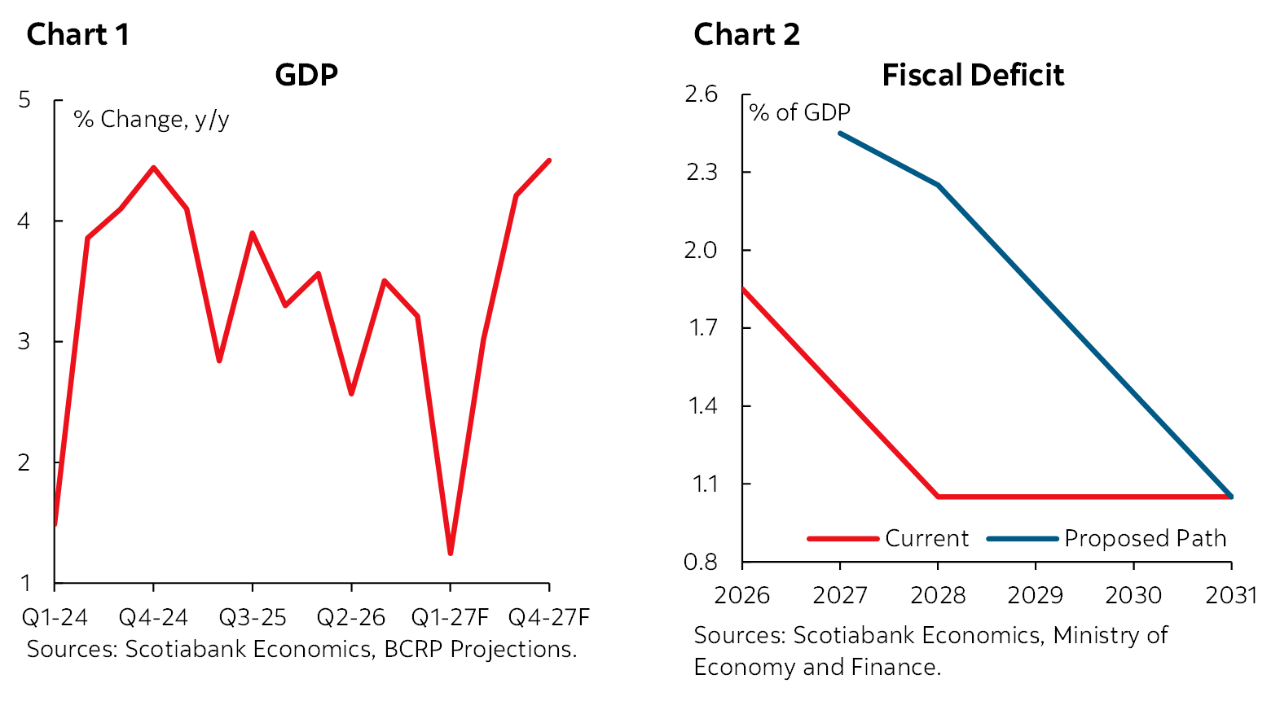
In our view, a countercyclical fiscal response is appropriate given the expected adverse effects of an “Extraordinary” El Niño event. According to our projections, GDP growth would slow markedly during the first half of 2027, potentially falling below 2%, as the adverse effects of El Niño are expected to be concentrated during this period, particularly in the Agriculture, Fisheries, Transportation, and Commerce sectors. During the 2017 and 2023 El Niño events, the negative impact on annual GDP growth was around 1 percentage point, broadly similar to the impact we anticipate across 2026 and 2027. Against this backdrop, the fiscal package could support a recovery in GDP growth toward the approximately 4% rate we project for the second half of 2027.
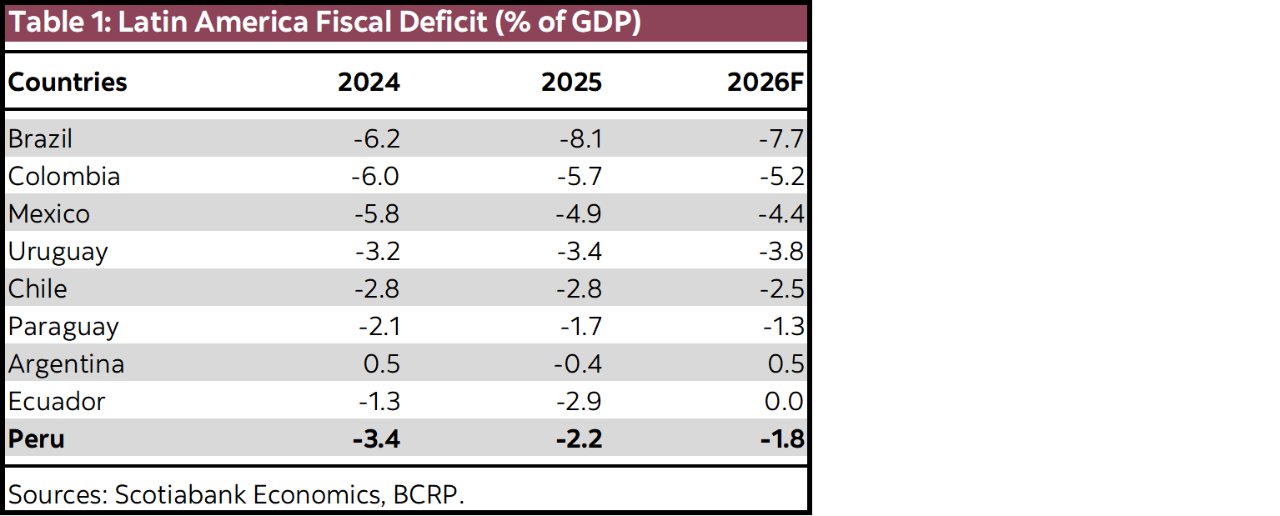
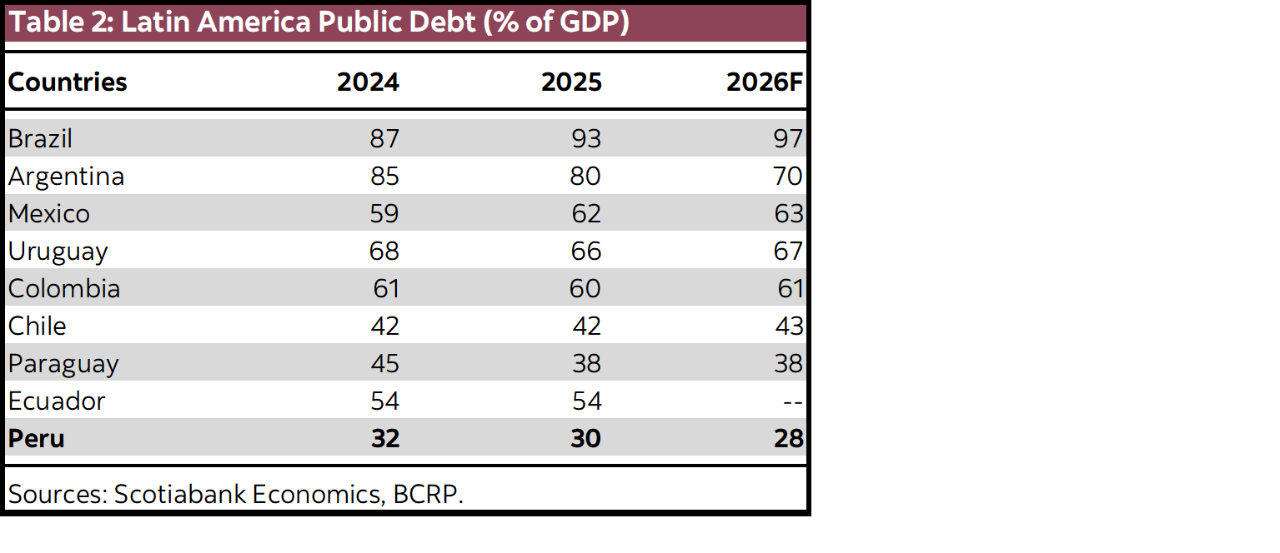
Peru also has sufficient fiscal space to implement a temporary countercyclical response, particularly compared with several other Latin American economies. As shown in tables 1 and 2, Peru’s fiscal deficit (1.8% of GDP) and public debt (27.8% of GDP) remain well below the averages for Latin American and emerging-market economies, providing room for a temporary and targeted fiscal response.
COUNTERCYCLICAL FISCAL POLICY
The Government’s proposed PEN 18.0 billion countercyclical fiscal package is concentrated in four main areas:
- PEN 13.0 billion for infrastructure projects. Of this amount, PEN 6.0 billion will be allocated to education infrastructure, while PEN 7.0 billion will be used to complete approximately 250 stalled public works that are more than 50% complete. For the latter, the Government is considering mechanisms such as the Obras por Impuestos (OxI, Works for Taxes) scheme.
- PEN 2.5 billion in direct transfers to vulnerable households, to be provided for up to five months, depending on needs. The transfers will target households affected by excessive rainfall along the northern coast, droughts in the southern highlands, and landslides in the central highlands.
- PEN 2 billion for the maintenance of public infrastructure. Spending will focus primarily on preventive and corrective maintenance of schools, healthcare facilities, police stations, and roads, with priority given to hiring local workers.
- PEN 500 million in fuel subsidies, specifically to maintain diesel subsidies for public passenger and freight transportation.
The Government also plans to approve measures aimed at providing liquidity to sectors affected by El Niño. These would include the postponement of advance tax obligations, the release of balances held in tax-withholding (detracciones) accounts, and government-guaranteed loans for micro and small enterprises (mypes, by its Spanish acronym) through Fondo Crecer, among other measures.
Finally, the Government is reportedly considering the application of the suspensión perfecta de labores, a temporary suspension of employment contracts, in sectors and regions most severely affected by El Niño. Under this mechanism, employees temporarily cease providing services and employers suspend wage payments, while the employment relationship itself remains in force. A similar measure was implemented during the pandemic.
SUPPLEMENTARY RESOURCES
The PEN 8.2 billion supplementary appropriation, equivalent to 3.2% of the original 2026 Public Budget, will finance priority interventions, ensure the continuity of public works, and strengthen the provision of essential public services. The resources will also support infrastructure development, public security, healthcare, education, the operational capacity of the Armed Forces, and pension payments.
The main expenditures to be financed through the supplementary appropriation include:
- PEN 1.0 billion to ensure the continuity of ongoing infrastructure projects, including Lima Metro Line 2, the Santa Rosa Expressway, the Chulucanas and San Francisco bridges, and railway concessions.
- PEN 762 million for the maintenance of 12,054 educational facilities.
- PEN 691 million for healthcare services and comprehensive interventions to address anemia.
- PEN 581 million for El Niño prevention and emergency-response measures aimed at reducing vulnerabilities and strengthening the Government’s response capacity.
- PEN 516 million for the purchase of school kits for more than 1.2 million students living in poverty.
- PEN 380 million for water and sanitation investments.
- PEN 247 million for the maintenance of small-scale irrigation infrastructure and other investments in the agricultural sector.
According to the Ministry of Economy and Finance (MEF), 53.8% of the supplementary resources will be financed through sovereign bond issuance, while the remaining 46.2% will come from higher tax revenues associated with elevated copper prices and stronger economic activity.
DISCLAIMER
This report has been prepared by Scotiabank Economics as a resource for the clients of Scotiabank. Opinions, estimates and projections contained herein are our own as of the date hereof and are subject to change without notice. The information and opinions contained herein have been compiled or arrived at from sources believed reliable but no representation or warranty, express or implied, is made as to their accuracy or completeness. Neither Scotiabank nor any of its officers, directors, partners, employees or affiliates accepts any liability whatsoever for any direct or consequential loss arising from any use of this report or its contents.
These reports are provided to you for informational purposes only. This report is not, and is not constructed as, an offer to sell or solicitation of any offer to buy any financial instrument, nor shall this report be construed as an opinion as to whether you should enter into any swap or trading strategy involving a swap or any other transaction. The information contained in this report is not intended to be, and does not constitute, a recommendation of a swap or trading strategy involving a swap within the meaning of U.S. Commodity Futures Trading Commission Regulation 23.434 and Appendix A thereto. This material is not intended to be individually tailored to your needs or characteristics and should not be viewed as a “call to action” or suggestion that you enter into a swap or trading strategy involving a swap or any other transaction. Scotiabank may engage in transactions in a manner inconsistent with the views discussed this report and may have positions, or be in the process of acquiring or disposing of positions, referred to in this report.
Scotiabank, its affiliates and any of their respective officers, directors and employees may from time to time take positions in currencies, act as managers, co-managers or underwriters of a public offering or act as principals or agents, deal in, own or act as market makers or advisors, brokers or commercial and/or investment bankers in relation to securities or related derivatives. As a result of these actions, Scotiabank may receive remuneration. All Scotiabank products and services are subject to the terms of applicable agreements and local regulations. Officers, directors and employees of Scotiabank and its affiliates may serve as directors of corporations.
Any securities discussed in this report may not be suitable for all investors. Scotiabank recommends that investors independently evaluate any issuer and security discussed in this report, and consult with any advisors they deem necessary prior to making any investment.
This report and all information, opinions and conclusions contained in it are protected by copyright. This information may not be reproduced without the prior express written consent of Scotiabank.
™ Trademark of The Bank of Nova Scotia. Used under license, where applicable.
Scotiabank, together with “Global Banking and Markets”, is a marketing name for the global corporate and investment banking and capital markets businesses of The Bank of Nova Scotia and certain of its affiliates in the countries where they operate, including; Scotiabank Europe plc; Scotiabank (Ireland) Designated Activity Company; Scotiabank Inverlat S.A., Institución de Banca Múltiple, Grupo Financiero Scotiabank Inverlat, Scotia Inverlat Casa de Bolsa, S.A. de C.V., Grupo Financiero Scotiabank Inverlat, Scotia Inverlat Derivados S.A. de C.V. – all members of the Scotiabank group and authorized users of the Scotiabank mark. The Bank of Nova Scotia is incorporated in Canada with limited liability and is authorised and regulated by the Office of the Superintendent of Financial Institutions Canada. The Bank of Nova Scotia is authorized by the UK Prudential Regulation Authority and is subject to regulation by the UK Financial Conduct Authority and limited regulation by the UK Prudential Regulation Authority. Details about the extent of The Bank of Nova Scotia's regulation by the UK Prudential Regulation Authority are available from us on request. Scotiabank Europe plc is authorized by the UK Prudential Regulation Authority and regulated by the UK Financial Conduct Authority and the UK Prudential Regulation Authority.
Scotiabank Inverlat, S.A., Scotia Inverlat Casa de Bolsa, S.A. de C.V, Grupo Financiero Scotiabank Inverlat, and Scotia Inverlat Derivados, S.A. de C.V., are each authorized and regulated by the Mexican financial authorities.
Not all products and services are offered in all jurisdictions. Services described are available in jurisdictions where permitted by law.