

- This month, Payments Canada announced the launch of Real-Time Rail (RTR), a decade-old project to modernize Canada’s payments system. While there is understandably a lot of excitement around this project’s launch, its impact on the payment system will be uneven and will take some time.
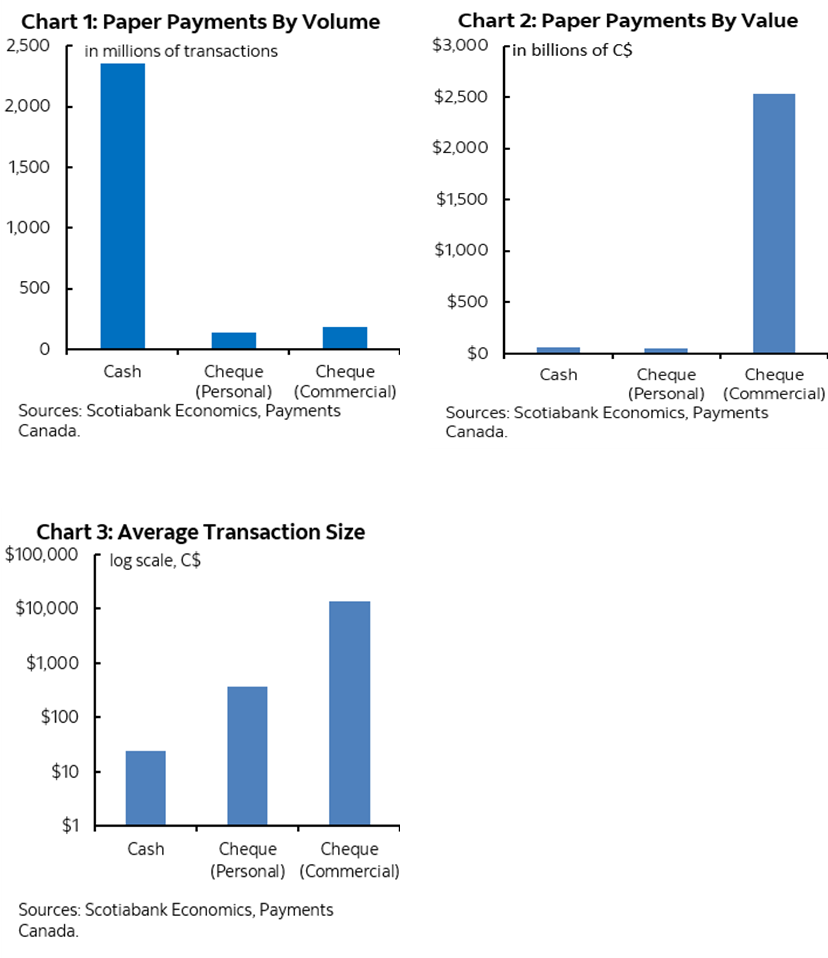
- Commercial cheques are ripe for disruption, as they remain the bastion of paper payments, corresponding to 96% of cash and cheque payment value. While cash has larger volumes (2.4B transactions in 2025 compared to 186M commercial cheques), the average transaction size of commercial cheques dwarfs cash payments.
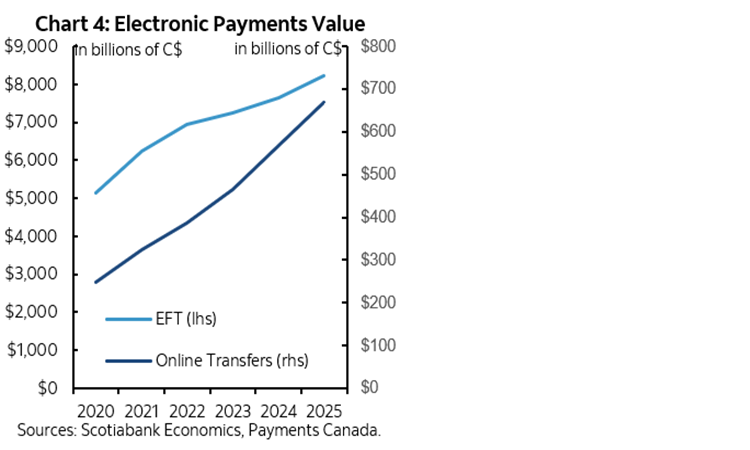
- Electronic payments like Interac E-Transfers experienced rapid adoption during the pandemic, real-time payments could improve them. Online transfers (ex: E-Transfers) grew from $249B in 2020 to $669B in 2025. Electronic Funds Transfer (EFT) use grew from $5.1T to $8.2T in that same time. This more than displaced declines in cash and cheques, representing a sharp transition to electronic payments.
- RTR volume will be low to start, but adoption should increase through 2027/2028. Payments Canada has staged roll-out of RTR through 2027, with only 8 participants in the initial cohort. As major financial institutions join in 2027, volumes should begin to increase.
- While RTR will help the payments backend, accounts payable and payroll departments will still need time to process outgoing payments. “Instant” payments should not be read to mean that all bills will be paid the instant that they are sent and that all employees will be paid the instant work is performed. The speed of these payments will depend on each business’ own ability to change their process.
To much fanfare, Payments Canada launched the RTR payments system on November 9th. This system launches with a lot of promise, namely the ability to conduct instantaneous payments between both businesses and consumers, 24/7.
RTR has been advertised to broadly improve the payments landscape, but its benefits will be uneven. Some systems like Interac E-Transfers, which are built on top of existing infrastructure, already offer the perception of relatively quick payment and are broadly popular among consumers. While RTR will likely speed up these existing payment methods, perhaps the biggest benefit will be for businesses.
BUSINESSES STILL USE A LOT OF CHEQUES
While paper payments (cash and cheques) have been on the decline, they have dedicated users, especially among businesses. While cash is used in a much larger number of transactions (chart 1), commercial cheques comprise the overwhelming majority of paper payment value (chart 2). Whereas the average transaction size for cash was about $24 in 2025, the average commercial cheque was for around $13,600 (chart 3).
Aside from instant settlement, cash has some qualities that are not replaced by systems using RTR, such as non-traceability and non-dependence on an intermediary. As other commentary has noted, cheques do not have the same value and represent a prime case for disruption. Cheques are slow, both in terms of transit time from payer-to-payee and in time to clear once cashed. They also rely on either dealing directly with a financial institution or using expensive cheque-cashing services.
While it’s unlikely that systems built on RTR will replace commercial cheque use entirely, this is an area with a high market value and a large degree of potential improvement.
ELECTRONIC PAYMENTS EXPERIENCED RAPID GROWTH AND MAY IMPROVE FURTHER
Since the pandemic, electronic payments have rapidly grown in use (chart 4).1 E-transfers (consumer and commercial) and electronic fund transfers (EFTs) dwarf the paper payments market in value. Given its benefits, it’s likely that RTR helps existing electronic systems to either increases or continues growth trends.
While these systems like Interac E-Transfers and EFTs are perceived by participants as relatively instantaneous, especially compared to cheques, there is still often delayed settlement. RTR could bring meaningful improvements to these existing systems. Payments Canada touts several areas where faster settlement could be beneficial.
Consumers are still advised by many services to pay multiple days in advance when using bank transfers and balances may not be posted to accounts for some time. Transfers between accounts at different financial institutions can also take time, especially if they are too large for an E-Transfer. For EFTs, after-hours and weekend transactions may not be processed until the next business day. RTR could improve on these issues.
THIS WILL TAKE (A LITTLE) MORE TIME
November was the first wave of onboarding, with 8 participants joining. Crucially, none of the Big-5 banks are part of this wave. In general, to use RTR, both parties’ financial institutions must be a member. This will limit volumes until large institutions join and network effects occur. The entry of new participants later in 2027 will likely be a necessary condition for transaction volumes to increase meaningfully.
While there is understandable excitement about use cases for RTR, its real ability to transform the payments system will be limited by business’ own abilities to adapt their processes. The prospect of instantaneous payment of wages is unlikely for many employees, as this requires both the logistical ability to process payroll in real-time but also the willingness of employers to move off the standard 2-week payroll schedule. Similarly, in business-to-business transactions, accounts payable departments will still need time to process invoices.
While the option of instant payments will help, structural changes by businesses will take longer than merely activating the system.
BOTTOM LINE
RTR has the potential to further the trend of electronic payments in Canada. In economic terms, there are some large estimated benefits from RTR. CD Howe studies quoted by Payments Canada estimate an upper-bound for cost savings of $14.5B over 10 years. Separately, they estimate a permanent gain of 0.08% of GDP, which is a decent nominal value, despite being a small percentage. Other potential benefits, from increased payments sovereignty to removing the annoyances of mailing and physically cashing cheques, are harder to quantify but certainly real.
An unknown is the entry of new participants and other payments innovations, especially on the consumer side. A large majority of online transfers between consumers occur through the Interac E-Transfer system and consumers make heavy use of credit cards for both online and in-person payments. The entry of new retail payments participants or enhancements of existing payments options using RTR could change this landscape. Whether this happens over time is to be seen.
1 Chart 4 mixes data from multiple years of the Payments Canada’s Payment Canadian Methods and Trends reports. There are changes in their methodology between some years and exact quantities may vary.
DISCLAIMER
This report has been prepared by Scotiabank Economics as a resource for the clients of Scotiabank. Opinions, estimates and projections contained herein are our own as of the date hereof and are subject to change without notice. The information and opinions contained herein have been compiled or arrived at from sources believed reliable but no representation or warranty, express or implied, is made as to their accuracy or completeness. Neither Scotiabank nor any of its officers, directors, partners, employees or affiliates accepts any liability whatsoever for any direct or consequential loss arising from any use of this report or its contents.
These reports are provided to you for informational purposes only. This report is not, and is not constructed as, an offer to sell or solicitation of any offer to buy any financial instrument, nor shall this report be construed as an opinion as to whether you should enter into any swap or trading strategy involving a swap or any other transaction. The information contained in this report is not intended to be, and does not constitute, a recommendation of a swap or trading strategy involving a swap within the meaning of U.S. Commodity Futures Trading Commission Regulation 23.434 and Appendix A thereto. This material is not intended to be individually tailored to your needs or characteristics and should not be viewed as a “call to action” or suggestion that you enter into a swap or trading strategy involving a swap or any other transaction. Scotiabank may engage in transactions in a manner inconsistent with the views discussed this report and may have positions, or be in the process of acquiring or disposing of positions, referred to in this report.
Scotiabank, its affiliates and any of their respective officers, directors and employees may from time to time take positions in currencies, act as managers, co-managers or underwriters of a public offering or act as principals or agents, deal in, own or act as market makers or advisors, brokers or commercial and/or investment bankers in relation to securities or related derivatives. As a result of these actions, Scotiabank may receive remuneration. All Scotiabank products and services are subject to the terms of applicable agreements and local regulations. Officers, directors and employees of Scotiabank and its affiliates may serve as directors of corporations.
Any securities discussed in this report may not be suitable for all investors. Scotiabank recommends that investors independently evaluate any issuer and security discussed in this report, and consult with any advisors they deem necessary prior to making any investment.
This report and all information, opinions and conclusions contained in it are protected by copyright. This information may not be reproduced without the prior express written consent of Scotiabank.
™ Trademark of The Bank of Nova Scotia. Used under license, where applicable.
Scotiabank, together with “Global Banking and Markets”, is a marketing name for the global corporate and investment banking and capital markets businesses of The Bank of Nova Scotia and certain of its affiliates in the countries where they operate, including; Scotiabank Europe plc; Scotiabank (Ireland) Designated Activity Company; Scotiabank Inverlat S.A., Institución de Banca Múltiple, Grupo Financiero Scotiabank Inverlat, Scotia Inverlat Casa de Bolsa, S.A. de C.V., Grupo Financiero Scotiabank Inverlat, Scotia Inverlat Derivados S.A. de C.V. – all members of the Scotiabank group and authorized users of the Scotiabank mark. The Bank of Nova Scotia is incorporated in Canada with limited liability and is authorised and regulated by the Office of the Superintendent of Financial Institutions Canada. The Bank of Nova Scotia is authorized by the UK Prudential Regulation Authority and is subject to regulation by the UK Financial Conduct Authority and limited regulation by the UK Prudential Regulation Authority. Details about the extent of The Bank of Nova Scotia's regulation by the UK Prudential Regulation Authority are available from us on request. Scotiabank Europe plc is authorized by the UK Prudential Regulation Authority and regulated by the UK Financial Conduct Authority and the UK Prudential Regulation Authority.
Scotiabank Inverlat, S.A., Scotia Inverlat Casa de Bolsa, S.A. de C.V, Grupo Financiero Scotiabank Inverlat, and Scotia Inverlat Derivados, S.A. de C.V., are each authorized and regulated by the Mexican financial authorities.
Not all products and services are offered in all jurisdictions. Services described are available in jurisdictions where permitted by law.