

- Canada shed about 5k jobs last month…
- …as more folks searching for work drove higher unemployment
- Youths are driving two-thirds of the losses in the past three months…
- …as the temps category of immigration is being curtailed…
- …which may lessen concerns about the health of the job market
- Yet wage growth has begun accelerating again
- Hours worked are tentatively reversing the prior gains
- BoC to remain laser-focused on the outlook for inflation
- Canadian jobs m/m 000s / UR %, Oct, SA:
- Actual: -4.7 / 6.7
- Scotia: 15 / 6.5
- Consensus: 15 / 6.5
- Prior: -68.3 / 6.5
Canada posted a mildly disappointing jobs report for October, shedding about 5k positions after two weak prior months.
The Canadian dollar slipped partly on the back of the report and given the strong US payroll gain. The impact on Canadian bond yields has been small with 2s richer by 1–2bps while nevertheless outperforming the rates sell off in the US. Markets scaled back December hike odds to just over one-in-three odds. I’ll explain why I think that’s a mistake.
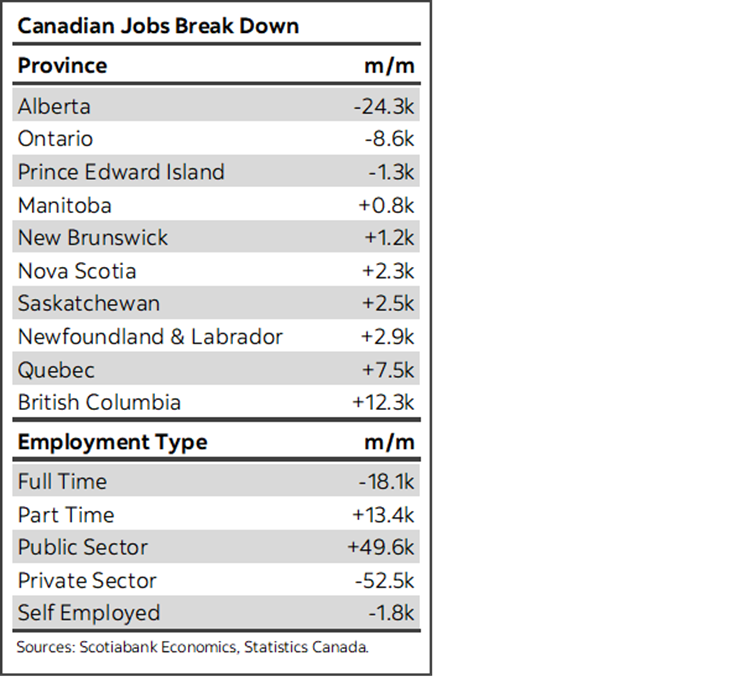
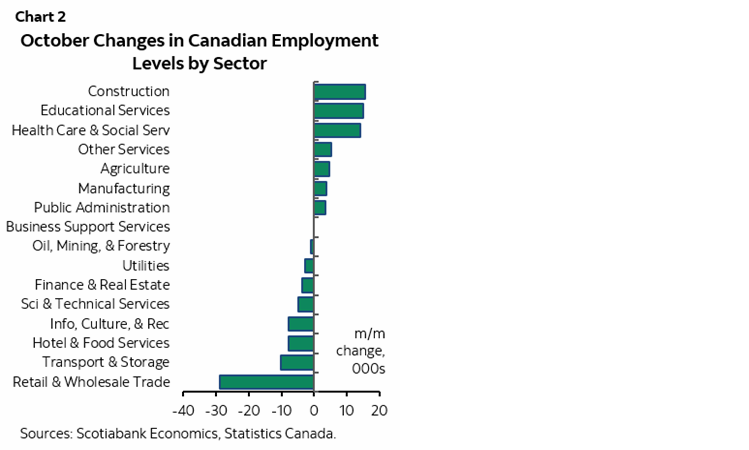
Chart 1 provides some highlights. Chart 2 breaks down the change in jobs by sector to show the three sectors that were up the most and the sectors that were down especially retail/wholesale. All of the latter category was driven by a 30k drop in wholesale sector employment which is probably where the trade bite came in. Think warehouse jobs.
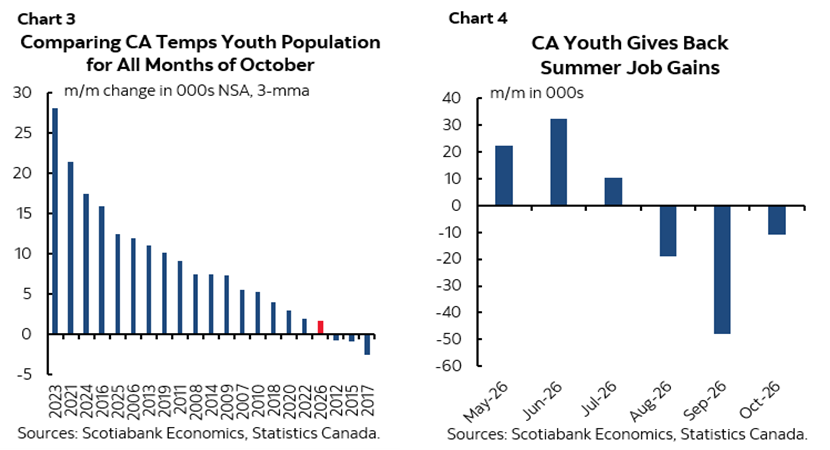
Youths drove the weakness with the 15–24 age category dropping 11k jobs for the third straight loss following -48k in September and -19k in August. The 15–24 youth category of employment has driven two-thirds of all job losses in Canada over the past three months.
There are four competing angles on the outsized role of youths in driving job losses of late. One is that they are driving most of the rise in the unemployment rate over recent months along with older 55+ workers.
Two is that youths are where the clamp down on the temps category of immigration is concentrated and note that the change in October’s temps youth population was among the weakest on record comparing like months of October over time (chart 3). Three is that this is somewhat of an unwind from one of the hottest youth summer employment markets in years over the May to July period and so it’s unclear that SA factors are compensating enough (chart 4). Fourth is that while rising youth unemployment is unfortunate, the impact on incomes and bills to pay is less of a shock than for other demographic groups.
Public sector payroll employees rebounded by about 50k. Yeah right. I believe that as much as I believe the 70k drop in the same category the prior month. Private sector payrolls fell 53k after gaining 24k the prior month. Self-employed positions were flat (-2k).
Full-time jobs fell 18k with part-time up 13k.
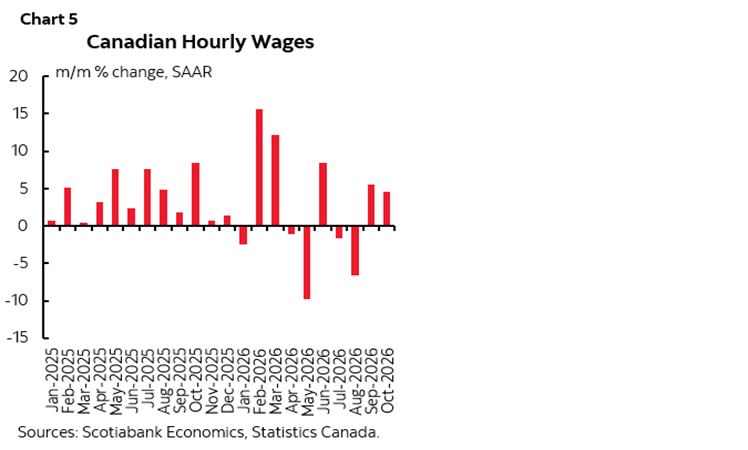
Wage growth has accelerated over the past two months with gains of 4.6% m/m SAAR in October and 5.5% in September (chart 5).
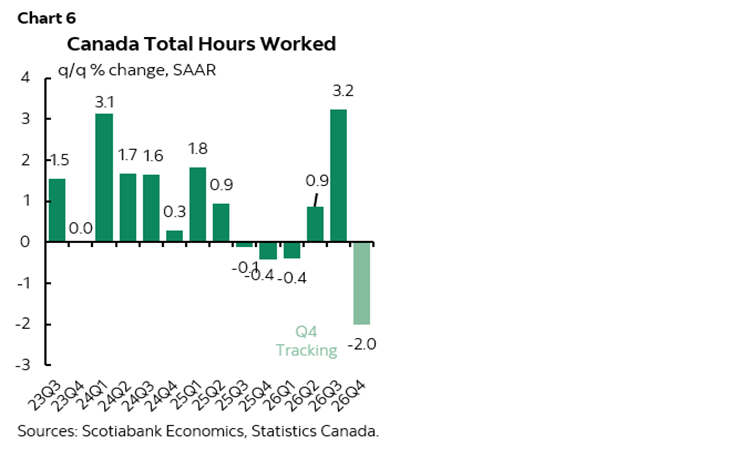
Hours worked were up in October (+0.3% m/m SA) which all else equal buoys October GDP. Hours are nevertheless tracking a sharp 2% q/q SAAR decline in Q4 which is unwinding the large increase in Q3 (chart 6). Tracking is obviously very tentative with just October data.
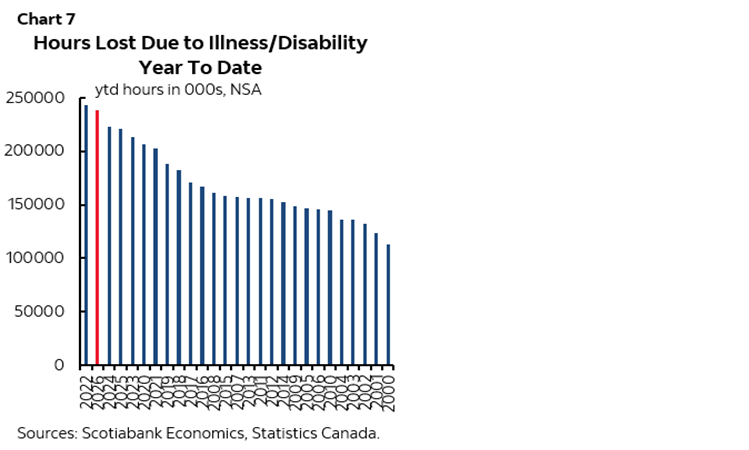
Sickness may be weighing on the results. This was the second highest month for lost hours worked due to sickness of any month of October in history. Year-to-date tracking is also abnormally high (chart 7).
WHAT ABOUT THE BANK OF CANADA?
Will the soft jobs trend and recent softness in monthly GDP derail the BoC’s hike path or suspend it into December? We have a month to figure that out as new information rolls in but here are some preliminary thoughts in addition to the comments above about being less worried about job losses that are two-thirds driven by youths and the temps reversal.
Recall that the BoC hiked despite arguing that growth would soften in Q4 to 1% and so we already know that some softening in the short-term activity data wasn't going to hold them back.
The BoC is entirely focused upon the inflation outlook and inflation risk.
Further, the path for oil is uncertain pending clarity around Iran, whether escalation, or de-escalation. I’m sceptical that war is over with nothing really having been accomplished to date, but we need to see.
Fiscal policy is additive to growth with the budget with a rising case for monetary policy to neutralize some of it.
If we do get a decent trade deal, whether a grand bargain or partial deal, then that could also be constructive. Let’s see if guidance from both sides pans out this time.
And the BoC is forward-looking and acting on 2027-28 expectations.
DISCLAIMER
This report has been prepared by Scotiabank Economics as a resource for the clients of Scotiabank. Opinions, estimates and projections contained herein are our own as of the date hereof and are subject to change without notice. The information and opinions contained herein have been compiled or arrived at from sources believed reliable but no representation or warranty, express or implied, is made as to their accuracy or completeness. Neither Scotiabank nor any of its officers, directors, partners, employees or affiliates accepts any liability whatsoever for any direct or consequential loss arising from any use of this report or its contents.
These reports are provided to you for informational purposes only. This report is not, and is not constructed as, an offer to sell or solicitation of any offer to buy any financial instrument, nor shall this report be construed as an opinion as to whether you should enter into any swap or trading strategy involving a swap or any other transaction. The information contained in this report is not intended to be, and does not constitute, a recommendation of a swap or trading strategy involving a swap within the meaning of U.S. Commodity Futures Trading Commission Regulation 23.434 and Appendix A thereto. This material is not intended to be individually tailored to your needs or characteristics and should not be viewed as a “call to action” or suggestion that you enter into a swap or trading strategy involving a swap or any other transaction. Scotiabank may engage in transactions in a manner inconsistent with the views discussed this report and may have positions, or be in the process of acquiring or disposing of positions, referred to in this report.
Scotiabank, its affiliates and any of their respective officers, directors and employees may from time to time take positions in currencies, act as managers, co-managers or underwriters of a public offering or act as principals or agents, deal in, own or act as market makers or advisors, brokers or commercial and/or investment bankers in relation to securities or related derivatives. As a result of these actions, Scotiabank may receive remuneration. All Scotiabank products and services are subject to the terms of applicable agreements and local regulations. Officers, directors and employees of Scotiabank and its affiliates may serve as directors of corporations.
Any securities discussed in this report may not be suitable for all investors. Scotiabank recommends that investors independently evaluate any issuer and security discussed in this report, and consult with any advisors they deem necessary prior to making any investment.
This report and all information, opinions and conclusions contained in it are protected by copyright. This information may not be reproduced without the prior express written consent of Scotiabank.
™ Trademark of The Bank of Nova Scotia. Used under license, where applicable.
Scotiabank, together with “Global Banking and Markets”, is a marketing name for the global corporate and investment banking and capital markets businesses of The Bank of Nova Scotia and certain of its affiliates in the countries where they operate, including; Scotiabank Europe plc; Scotiabank (Ireland) Designated Activity Company; Scotiabank Inverlat S.A., Institución de Banca Múltiple, Grupo Financiero Scotiabank Inverlat, Scotia Inverlat Casa de Bolsa, S.A. de C.V., Grupo Financiero Scotiabank Inverlat, Scotia Inverlat Derivados S.A. de C.V. – all members of the Scotiabank group and authorized users of the Scotiabank mark. The Bank of Nova Scotia is incorporated in Canada with limited liability and is authorised and regulated by the Office of the Superintendent of Financial Institutions Canada. The Bank of Nova Scotia is authorized by the UK Prudential Regulation Authority and is subject to regulation by the UK Financial Conduct Authority and limited regulation by the UK Prudential Regulation Authority. Details about the extent of The Bank of Nova Scotia's regulation by the UK Prudential Regulation Authority are available from us on request. Scotiabank Europe plc is authorized by the UK Prudential Regulation Authority and regulated by the UK Financial Conduct Authority and the UK Prudential Regulation Authority.
Scotiabank Inverlat, S.A., Scotia Inverlat Casa de Bolsa, S.A. de C.V, Grupo Financiero Scotiabank Inverlat, and Scotia Inverlat Derivados, S.A. de C.V., are each authorized and regulated by the Mexican financial authorities.
Not all products and services are offered in all jurisdictions. Services described are available in jurisdictions where permitted by law.