

- Nonfarm payrolls posted a solid gain in line with our above-consensus estimate
- Gains were driven by health, professional and AI-related categories
- Wage growth has been accelerating
- Hours worked support solid GDP growth
- Persistent under sampling will continue to feed high revision risk
- The FOMC is focused on inflation, but a solid job market adds to the hawkish case
- Nonfarm payrolls m/m 000s / UR %, October, SA:
- Actual: 165 / 4.1
- Scotia: 100 / 4.2
- Consensus: 70 / 4.2
- Prior: 60 / 4.2 (revised from 29 / 4.2)
- Two-month payroll revision: +84k
The US economy broadly met expectations for a solid report and my above-consensus estimate. 165k jobs were created with solid details including more upward revisions that will keep the heat on the Federal Reserve to hike in December pending further information like next week’s CPI and other developments. 19bps of a hike is now priced and this is driving higher short-term bond yields.
Two sectors drove much of the gain (chart 1). They were business services and education and health services but with the need to break that down finer.
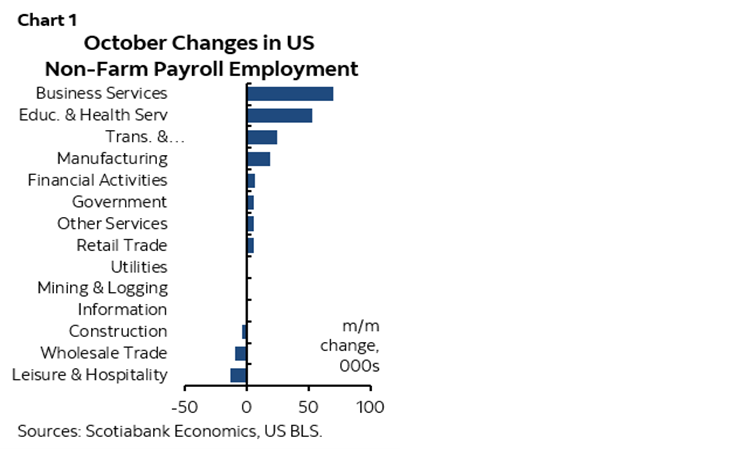
The health and social services sector added 55k jobs which is the fastest pace of hiring since April. 42,000 health care workers were hired including 16k at hospitals, 11k at home health care services and 5k at outpatient care centres.
In seasonally unadjusted terms this October saw elevated hiring of health professionals compared to prior years (charts 2, 3). The effect was tamped down by going relatively low on the health sector SA factor (chart 4).
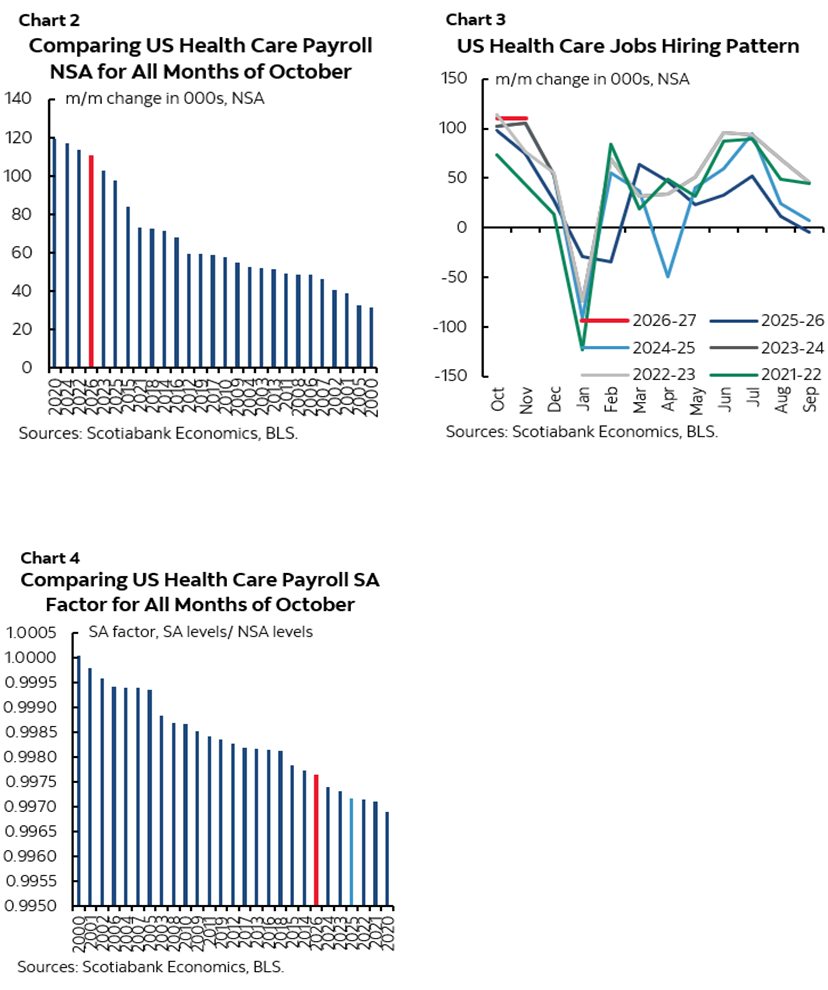
I would expect more elevated health sector hiring to come given the earlier than normal start to the respiratory virus season.
Where I was a bit surprised was in not seeing clear evidence of a weather effect given how unusually mild it was been across much of N.A. this Fall. Sectors like leisure and hospitality (-13k), retail (+6k), and construction (-3k) showed no real weather-effects. Perhaps that lies ahead with El Niño surging?
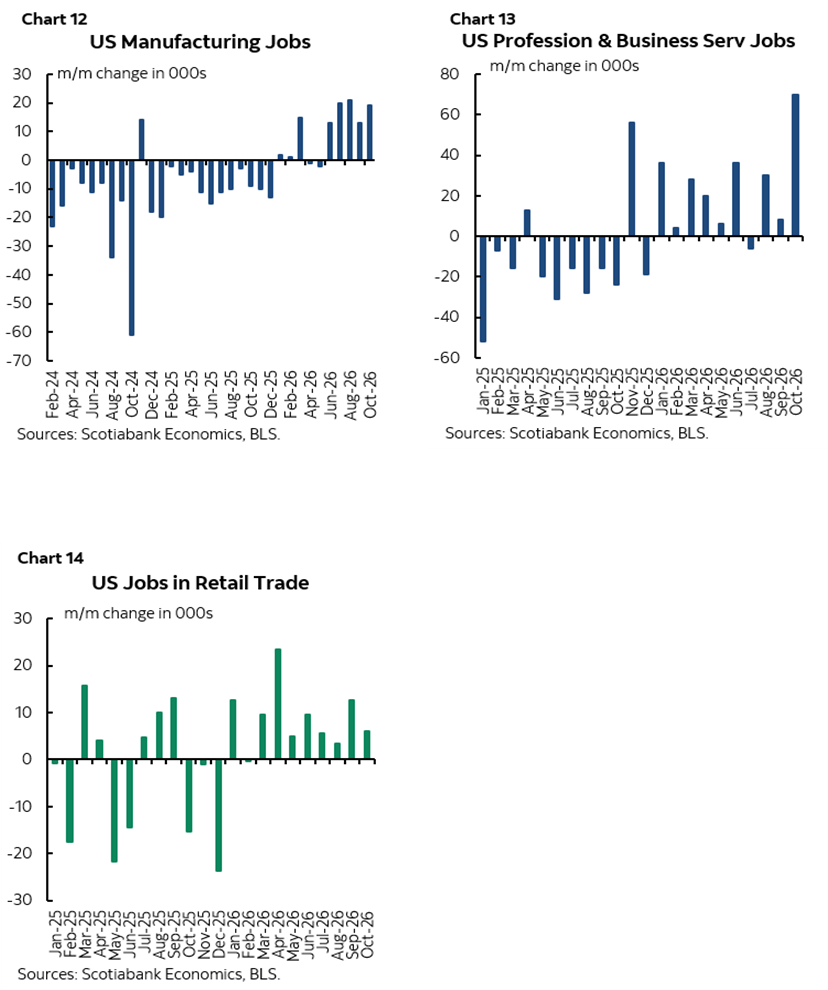
Professional and business services were up strongly at 70k and hence more than anticipated which explains much of the overshoot relative to my overall nonfarm estimate. The gain was driven by professional, scientific and technical services (33k), admin support and waste management (28k) and company management (9k).
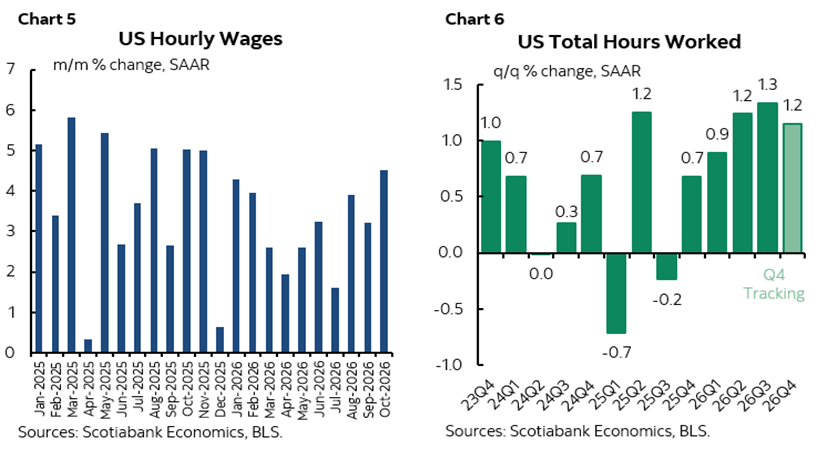
Wages are picking up with average hourly wages up 4.5% m/m SAAR in October after 3.2% in September (chart 5).
Hours worked posted a gain of 0.1% m/m in October and are tracking a 1.2% q/q SAAR expansion in Q4 which is similar to the prior 1.3% rise (chart 6).
The unemployment rate dipped a tick to 4.1% because the companion household survey registered a job gain of 463k that exceeded the expansion of the labour force at 421k.
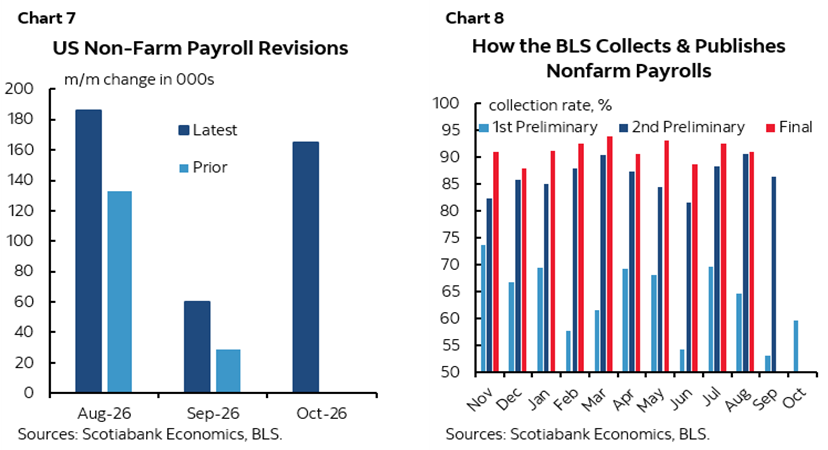
Revisions remain high with 84k extra jobs found in the prior two months (chart 7). Under sampling on first pass will drive further revisions the next time (chart 8).
Charts 9–10 show that the seasonally unadjusted gain was higher than usual and so was the SA factor.
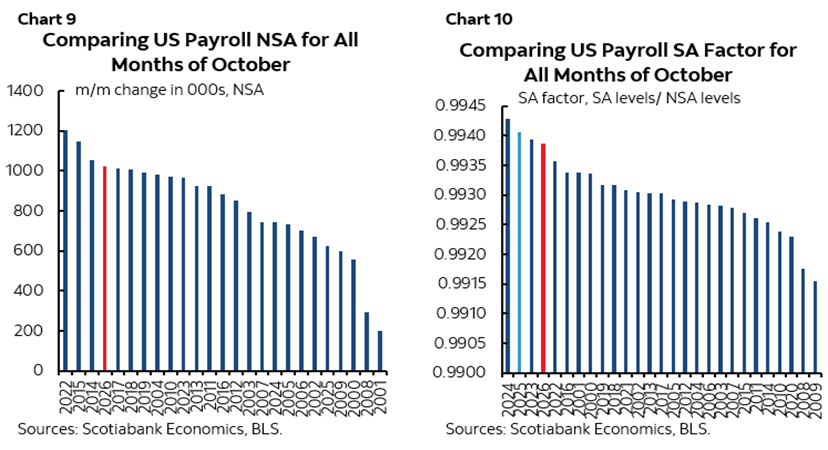
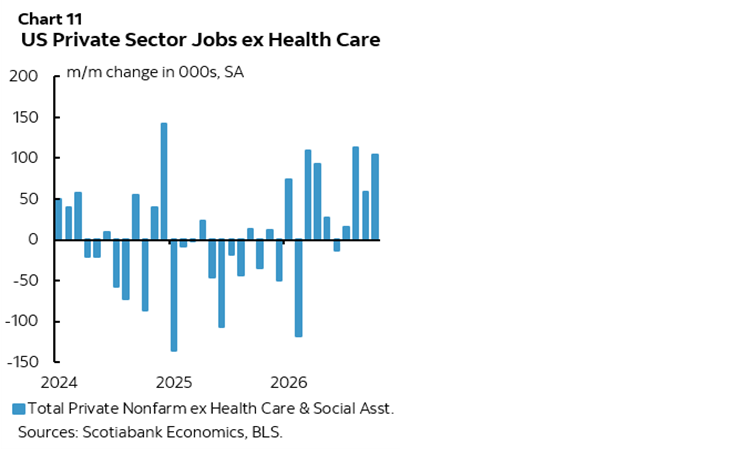
Chart 11 shows private sector jobs outside of health care are doing rather well.
Charts 12-14 break out some sectors.
DISCLAIMER
This report has been prepared by Scotiabank Economics as a resource for the clients of Scotiabank. Opinions, estimates and projections contained herein are our own as of the date hereof and are subject to change without notice. The information and opinions contained herein have been compiled or arrived at from sources believed reliable but no representation or warranty, express or implied, is made as to their accuracy or completeness. Neither Scotiabank nor any of its officers, directors, partners, employees or affiliates accepts any liability whatsoever for any direct or consequential loss arising from any use of this report or its contents.
These reports are provided to you for informational purposes only. This report is not, and is not constructed as, an offer to sell or solicitation of any offer to buy any financial instrument, nor shall this report be construed as an opinion as to whether you should enter into any swap or trading strategy involving a swap or any other transaction. The information contained in this report is not intended to be, and does not constitute, a recommendation of a swap or trading strategy involving a swap within the meaning of U.S. Commodity Futures Trading Commission Regulation 23.434 and Appendix A thereto. This material is not intended to be individually tailored to your needs or characteristics and should not be viewed as a “call to action” or suggestion that you enter into a swap or trading strategy involving a swap or any other transaction. Scotiabank may engage in transactions in a manner inconsistent with the views discussed this report and may have positions, or be in the process of acquiring or disposing of positions, referred to in this report.
Scotiabank, its affiliates and any of their respective officers, directors and employees may from time to time take positions in currencies, act as managers, co-managers or underwriters of a public offering or act as principals or agents, deal in, own or act as market makers or advisors, brokers or commercial and/or investment bankers in relation to securities or related derivatives. As a result of these actions, Scotiabank may receive remuneration. All Scotiabank products and services are subject to the terms of applicable agreements and local regulations. Officers, directors and employees of Scotiabank and its affiliates may serve as directors of corporations.
Any securities discussed in this report may not be suitable for all investors. Scotiabank recommends that investors independently evaluate any issuer and security discussed in this report, and consult with any advisors they deem necessary prior to making any investment.
This report and all information, opinions and conclusions contained in it are protected by copyright. This information may not be reproduced without the prior express written consent of Scotiabank.
™ Trademark of The Bank of Nova Scotia. Used under license, where applicable.
Scotiabank, together with “Global Banking and Markets”, is a marketing name for the global corporate and investment banking and capital markets businesses of The Bank of Nova Scotia and certain of its affiliates in the countries where they operate, including; Scotiabank Europe plc; Scotiabank (Ireland) Designated Activity Company; Scotiabank Inverlat S.A., Institución de Banca Múltiple, Grupo Financiero Scotiabank Inverlat, Scotia Inverlat Casa de Bolsa, S.A. de C.V., Grupo Financiero Scotiabank Inverlat, Scotia Inverlat Derivados S.A. de C.V. – all members of the Scotiabank group and authorized users of the Scotiabank mark. The Bank of Nova Scotia is incorporated in Canada with limited liability and is authorised and regulated by the Office of the Superintendent of Financial Institutions Canada. The Bank of Nova Scotia is authorized by the UK Prudential Regulation Authority and is subject to regulation by the UK Financial Conduct Authority and limited regulation by the UK Prudential Regulation Authority. Details about the extent of The Bank of Nova Scotia's regulation by the UK Prudential Regulation Authority are available from us on request. Scotiabank Europe plc is authorized by the UK Prudential Regulation Authority and regulated by the UK Financial Conduct Authority and the UK Prudential Regulation Authority.
Scotiabank Inverlat, S.A., Scotia Inverlat Casa de Bolsa, S.A. de C.V, Grupo Financiero Scotiabank Inverlat, and Scotia Inverlat Derivados, S.A. de C.V., are each authorized and regulated by the Mexican financial authorities.
Not all products and services are offered in all jurisdictions. Services described are available in jurisdictions where permitted by law.