

- The BoC hiked a quarter point as expected…
- …with generally hawkish guidance…
- …that supports our forecast for several more hikes to come
- It’s encouraging that the BoC is dithering less this time
The Bank of Canada did the right thing today. The statement is here, the MPR is here, the opening remarks to the press conference are here, and the press conference can be watched here or here.
They raised the overnight lending rate by 25bps to 2.5% as we had long forecast in leading all of consensus and markets. Scotiabank Economics had 2026H2 hikes in our forecasts since November of last year and delayed them to 2026Q4 in January and stuck with it since. This was no lagging shop while everyone else was either talking cuts or no hikes until 2027.
The bias was generally hawkish on the overall suite of communications and forecasts and drove higher market pricing for a follow up rate hike in December that we expect to be delivered. Market pricing for the December move is a 50–50 coin-toss between a hold and a hike. Nothing I heard today sounds like they would wish to pause.
Few like higher borrowing costs, but the BoC is not dithering as it did in the pandemic. Acting today with guidance that broadly points to more hikes ahead means there is a better chance at not having to swallow worse medicine against inflation later. Businesses and households need to understand this since the consequences to letting inflation get out of hand again would be devastating.
The priced path forward is broadly consistent with our 3.25% terminal rate by 2027H1 with more upside than downside risk to this forecast (ie: more, not fewer hikes). Canada’s rates curve is underperforming the US curve with a bear flattener move led by a 5bps rise in 2s on the day. The Canadian dollar is little changed on the day partly as the Federal Reserve’s decision awaits.
WHAT MADE IT HAWKISH
What made the communications hawkish was a combination of forecasts and the tone.
Key is that they are signalling uncertainty over when and how much by way of cost pressures get passed through, not whether that happens, and doing so by saying: "....and how quickly and fully higher costs will pass through to consumer prices."
Inflation and growth forecasts were revised up—especially a sharp increase in inflation.
There was also zero reference to the jobs report that doves hung their hats on. The very clear signal is that a) it's inflation that they're focused upon, b) they probably don't believe the September jobs report was worthy of being flagged just as much as I don’t.
STATEMENT COMPARISON
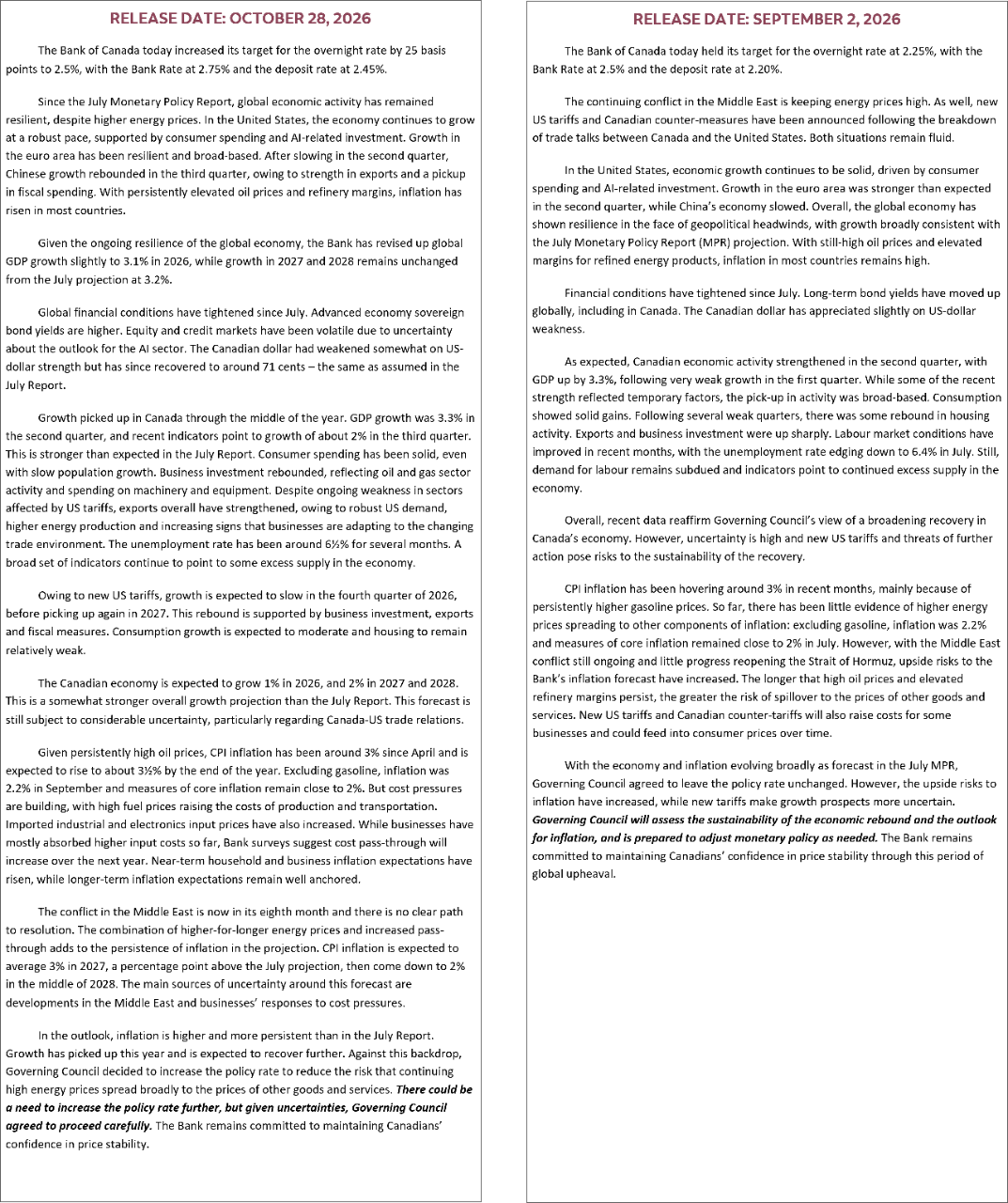
Key in the statement comparison at the back of this note is the concluding paragraph that guides more hikes are likely to come:
“"There could be a need to increase the policy rate further, but given uncertainties, Governing Council agreed to proceed carefully."
When asked during the press conference about this careful wording, Macklem said that policy is not on a pre-set path and there are many uncertainties.
That matched our expectations for what I’ve described as cagey, circumspect, careful and noncommittal guidance. Why? Because they don’t want markets running much further ahead of their plans, yet the broad communications set a more strikingly committed path to policy tightening.
A fuller statement comparison is always less useful when comparing MPR to non-MPR.
THE FORECASTS DID THE TALKING
The opening sentence to the MPR set the tone:
"Inflation in Canada is projected to remain above 3% through much of 2027, materially higher than previously forecast."
You knew where the rest was going after that deliberately chosen intro.
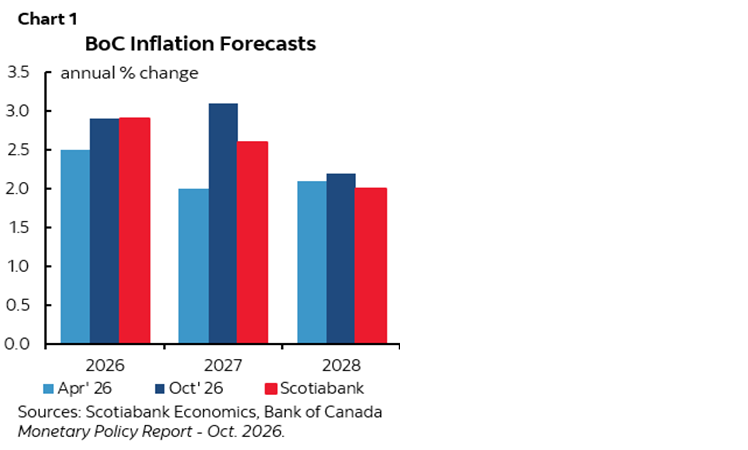
The inflation forecast was raised to 3.1% in 2027 from 2.0% previously and to 2.2% in 2028 from 2.1%. This is a sustained overshoot of their 2% inflation target.
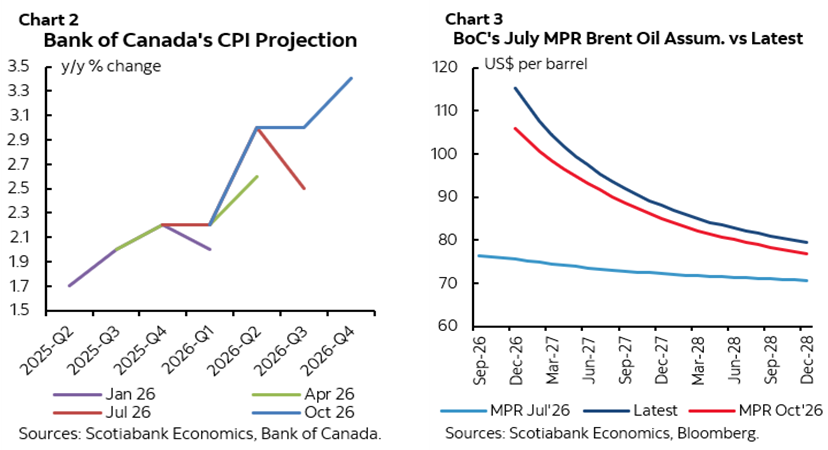
On a quarterly basis, the BoC now forecasts inflation to end 2026 at 3.4% y/y, end 2027 at 2.6% y/y and end 2028 at 2.1%. Chart 1 shows their forecast compared to ours.
Recall that the BoC’s projections will embed an unknown rate profile that presumably incorporates rate hikes. Despite these increases, they are still projecting inflation to overshoot their 2% target and are playing catch up (chart 2). That’s a signal they feel they may be behind in fighting inflation and that’s a rather hawkish signal. Chart 3 is part of the reason why as the oil futures curve has smashed through what they previously incorporated in their prior forecasts.
The BoC rolled out a new model called Prima which no longer forecasts core inflation. They made no effort to provide an alternative means of projecting core inflation. This is a knock against their new approach since there is no accountability in the forecast numbers for how they expect pass through of various inflationary pressures into core baskets.
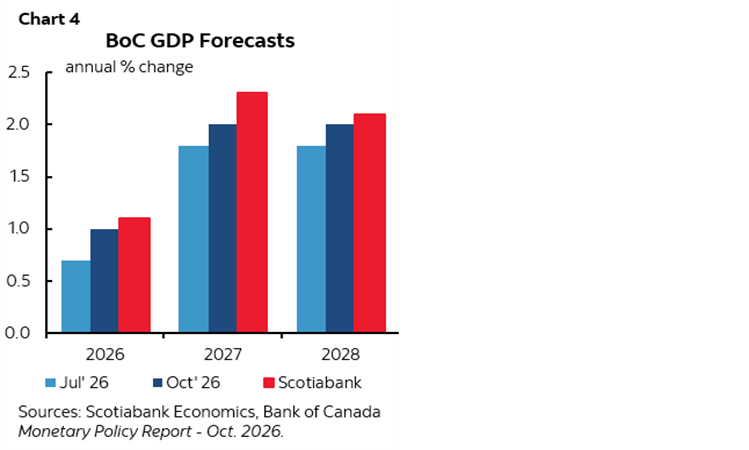
The growth forecast was raised to 2.0% y/y for real GDP from 1.8% previously for both 2027 and 2028 (chart 4).
They incorporated off-budget announcements, pending whatever fresh ones are due next week:
"The projection incorporates information from the latest provincial budgets, the federal Spring Economic Update 2026 and new federal fiscal measures tabled as at October 19, 2026. It includes the expected effects of the Productivity Mega Deduction and activities related to the Major Projects Office."
The BoC left its estimated ranges for forecast potential growth—the economy’s noninflationary speed limit—unchanged through the forecast horizon. They expect potential growth to be 1.5% in 2027 and 1.75% in 2028.
Since actual growth is forecast to be above potential growth, the BoC expects slack to close going forward. They estimate the output gap at between -0.25% to -1.25% in Q3 of this year.
PRESS CONFERENCE TRANSCRIPT
What follows is an attempt at providing a general idea of the Q&A part of the press conference after Governor Macklem finished reading his opening remarks.
I have a few comments on some of what follows. Regarding Q2, the answer could have been that the BoC’s job is to align supply and demand and so it doesn't matter if it's a positive demand shock or negative supply shock or both. It was the same thing in the pandemic.
Also note that the answer to Q1 sounded like Macklem felt the BoC was holding back on translating the government efforts to stimulate the economy. They’ll have another chance in the January MPR when those forecasts incorporate next week’s federal Budget.
On forward guidance questions, the reason the BoC is careful is because they learned a harsh lesson against pre-committing in the pandemic by promising to keep rates on hold for years.
On Q11, perhaps the answer should have been that acting now means getting an earlier handle on inflation and therefore hopefully hiking less than if we waited.
On Q13, note that some of the governments that are offering such fuel relief programs are paying a steep price in terms of fiscal deficits.
Q1. How much are federal measures expected to contribute to your growth forecast?
A1. One of the reasons growth is firmer is because of the big projects and mega deduction supports for investment plus high energy prices attracting more investment in the energy sector. I would say we've still been fairly conservative about how much we've increased investment. We've certainly been disappointed in the past.
Q2. What are you trying to accomplish with this rate hike? It won't impact global oil markets or AI so why raise interest rates to deal with this supply shock?
A2. We don't want second round effects. Energy prices have been hig for eight months and look like they're going to stay high and you can see the building cost pressures. Past behaviour shows businesses can absorb higher costs for a while but ultimately they pass them on. By raising the rate we're leaning against pass through and getting back to target more quickly.
Q3. If there is so much concern about inflation risk, why wasn't there a more full-throttled commitment to more rate hikes. Your opening statement says rates "could" move higher.
A3. Uncertainty is high. This is a forecast. It's not the only outcome. We're going to take it one meeting at a time. There is no predetermined path.
Q4. How much judgement did you apply to this decision? Was it a difficult decision? Were the data and everything else making this one a straight-forward call?
A4. You want to look at this through more than one lens. One is through our projections with higher for longer and more persistent inflation. The implication is pretty clear—there is less scope for monetary accommodation. But we are very conscious of the uncertainty around those forecasts, so the other lens is to look through it through a risk management lens. We don't want to increase the policy rate to harm growth if inflation is contained but we also don't want to maintain the policy rate if inflation is less well contained. The balance of risks became more titled toward the latter scenario with inflation being less well contained.
Q5. Do you think you would like to be at the midpoint of neutral as soon as possible?
A5. Neutral is a range, 2.25–3.25%. At 2.25 we're at the stimulative end of that range. We're not going to pre-judge the next decision, we're very mindful of the uncertainty, we're going to take decisions one at a time.
Q6. Are you expecting a slowing in the housing market?
A6. [Rogers now]: Uncertainty, sharper adjustments in Van/Tor are weighing on housing. Higher borrowing costs will weigh a bit on this.
Q7. If inflation is above 2% throughout the middle of 2028 are you signalling rate increases may be needed over the medium term to get on track?
A7. [Back to Macklem] I don't want to get too far ahead. We're going to take this one meeting at a time.
Q8. How did the discussions go? Were there conflicting opinions?
A8. [Rogers]: We debated a hold and a hike. We always do that. There was a very strong consensus and the shift in the risks to inflation drove that.
Q9. Will energy float all boats in the economy or is it just wishful thinking?
A9. Growth in the energy sector is contributing to growth but is not the only driver. The biggest contribution is household spending. Then you've got strength in exports partly driven by the energy sector but not only the energy sector. And business investment is contributing that is partly the energy sector but also the rest of the economy. The energy sector is by no means the only driver of growth.
Q10. Why is the BoC more optimistic about the growth outlook compared to the PBO's outlook?
A10. I can't comment on the PBO forecasts. A first reason is we're getting stronger growth in the middle of the year than expected. We do expect the fourth quarter to be weaker especially driven by tariff effects on small businesses. Looking beyond that we expect export growth, businesses are adapting to tariffs and managing them and finding ways to copy, and when exports go up, businesses invest more to add capacity. Businesses are telling us they're investing more in AI. There have been a number of fiscal measures like the mega deduction.
Q11. Can you explain to businesses how they can deal with higher interest rates when they're already dealing with tariffs?
A11. The best thing that we can do is get inflation down. We can prevent higher energy prices from spreading to other goods and services. By raising our policy rate today, it will help to lean against that pass through. It creates a more stable environment in the future. It's not going to feel good immediately but it's how you get inflation down and that will feel good.
Q12. Is today's hike a response to your delayed COVID reaction?
A12. There is no question we learned from the pandemic. Sicne COVID we've built a new economic model. They are helping us in our need to be more forward looking. Today is nevertheless different from COVID. Coming out of COVID the economy was in excess demand. We have less slack now than a year ago but there is still some slack. That will dampen the pass through. But the cost pressures have gone up, the economy is resilient, we think there will be less slack and inflation risks have increased which is why we increased the policy rate.
Q13. Why raise rates to address the impact of higher energy prices? Some countries in Asia and Europe are providing fuel and electricity subsidies and diversifying energy sources. How would that help?
A13. We're going to leave fiscal decisions to elected governments. The government does have a fuel tax relief program.
Q14. What would have to happen for a single hike to be enough? Is there any historical precedent?
A14. You shouldn't determine that this decision means all uncertainty has gone. We could get a resolution in the middle east but don't think that's imminent. We could get a resolution of trade uncertainty. We need to take our decisions one at a time.
DISCLAIMER
This report has been prepared by Scotiabank Economics as a resource for the clients of Scotiabank. Opinions, estimates and projections contained herein are our own as of the date hereof and are subject to change without notice. The information and opinions contained herein have been compiled or arrived at from sources believed reliable but no representation or warranty, express or implied, is made as to their accuracy or completeness. Neither Scotiabank nor any of its officers, directors, partners, employees or affiliates accepts any liability whatsoever for any direct or consequential loss arising from any use of this report or its contents.
These reports are provided to you for informational purposes only. This report is not, and is not constructed as, an offer to sell or solicitation of any offer to buy any financial instrument, nor shall this report be construed as an opinion as to whether you should enter into any swap or trading strategy involving a swap or any other transaction. The information contained in this report is not intended to be, and does not constitute, a recommendation of a swap or trading strategy involving a swap within the meaning of U.S. Commodity Futures Trading Commission Regulation 23.434 and Appendix A thereto. This material is not intended to be individually tailored to your needs or characteristics and should not be viewed as a “call to action” or suggestion that you enter into a swap or trading strategy involving a swap or any other transaction. Scotiabank may engage in transactions in a manner inconsistent with the views discussed this report and may have positions, or be in the process of acquiring or disposing of positions, referred to in this report.
Scotiabank, its affiliates and any of their respective officers, directors and employees may from time to time take positions in currencies, act as managers, co-managers or underwriters of a public offering or act as principals or agents, deal in, own or act as market makers or advisors, brokers or commercial and/or investment bankers in relation to securities or related derivatives. As a result of these actions, Scotiabank may receive remuneration. All Scotiabank products and services are subject to the terms of applicable agreements and local regulations. Officers, directors and employees of Scotiabank and its affiliates may serve as directors of corporations.
Any securities discussed in this report may not be suitable for all investors. Scotiabank recommends that investors independently evaluate any issuer and security discussed in this report, and consult with any advisors they deem necessary prior to making any investment.
This report and all information, opinions and conclusions contained in it are protected by copyright. This information may not be reproduced without the prior express written consent of Scotiabank.
™ Trademark of The Bank of Nova Scotia. Used under license, where applicable.
Scotiabank, together with “Global Banking and Markets”, is a marketing name for the global corporate and investment banking and capital markets businesses of The Bank of Nova Scotia and certain of its affiliates in the countries where they operate, including; Scotiabank Europe plc; Scotiabank (Ireland) Designated Activity Company; Scotiabank Inverlat S.A., Institución de Banca Múltiple, Grupo Financiero Scotiabank Inverlat, Scotia Inverlat Casa de Bolsa, S.A. de C.V., Grupo Financiero Scotiabank Inverlat, Scotia Inverlat Derivados S.A. de C.V. – all members of the Scotiabank group and authorized users of the Scotiabank mark. The Bank of Nova Scotia is incorporated in Canada with limited liability and is authorised and regulated by the Office of the Superintendent of Financial Institutions Canada. The Bank of Nova Scotia is authorized by the UK Prudential Regulation Authority and is subject to regulation by the UK Financial Conduct Authority and limited regulation by the UK Prudential Regulation Authority. Details about the extent of The Bank of Nova Scotia's regulation by the UK Prudential Regulation Authority are available from us on request. Scotiabank Europe plc is authorized by the UK Prudential Regulation Authority and regulated by the UK Financial Conduct Authority and the UK Prudential Regulation Authority.
Scotiabank Inverlat, S.A., Scotia Inverlat Casa de Bolsa, S.A. de C.V, Grupo Financiero Scotiabank Inverlat, and Scotia Inverlat Derivados, S.A. de C.V., are each authorized and regulated by the Mexican financial authorities.
Not all products and services are offered in all jurisdictions. Services described are available in jurisdictions where permitted by law.