

- Early CAD reaction is very muted, mostly about lower oil futures
- What happened?
- Canada was right to walk and retaliate...
- ...as the US was underhanded in overplaying its hand
- What next? Resist going to the darkest place
- The effects on our model-based macro projections are small—so far
- The mixed impact on the BoC
- Risks could develop in either direction
All things considered, markets are so far taking the break down of Canada-US trade talks in stride early into the Asian market open. The Canadian dollar has only depreciated by about a quarter of a cent to the USD and it’s hard to distinguish a material trade shock from the effects of initially lower oil futures prices that are also driving other petrocurrencies like NOK weaker. CAD would probably be the most likely barometer of market concerns and while the reaction into tomorrow will be closely watched, what we observe thus far is among the meekest reactions to trade headlines during Trump 2.0.
It’s clearly disappointing that all signs were pointing to a deal being consummated as late as well into Friday evening only to fall apart minutes before the midnight deadline when additional US tariffs kicked in. There are no winners in trade wars, only losers, including the United States and its consumers and businesses. We are closely monitoring next potential steps that will be critically important to inform the path forward from here.
What follows is a recap of developments, a caution against going to the darkest places on the path forward, and early model-based assessments of the macroeconomic impact.
A RECAP OF DEVELOPMENTS AND WHAT’S PENDING
This is a recap of developments that were shared in chat room coverage with staff and clients throughout the weekend.
- Canada withdrew its negotiating team on Friday night, so talks have ceased.
- The US 50% tariffs on $20 billion of imports sans CUSMA exemptions from Canada went into effect at midnight. This move raises the effective tariff rate on US goods imports to 11.5% and on goods and services to 9.6%.
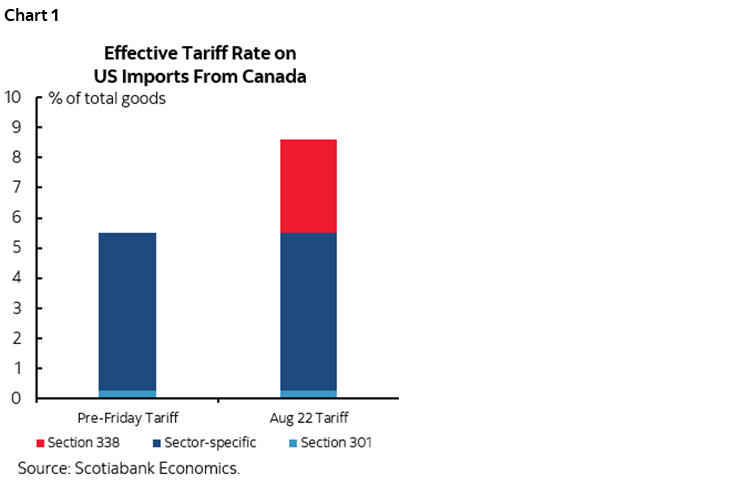
- These additional US tariffs raise the effective tariff rate on total Canadian exports of goods to 6.5%, on Canadian exports of goods to just the US to 8.6% (chart 1) and on total Canadian exports of goods and services to 4.6%. They remain the lowest imposed on any of America’s trading partners.
- PM Carney issued this statement very early Saturday morning.
- USTR Jamieson Greer issued this social media post.
- PM Carney explicitly stated “Canada will match those tariffs dollar for dollar to protect our workers and businesses.” He also noted that additional measures to support workers and businesses will be announced in the coming days. Expect announcements this week. We cannot calculate an updated effective tariff rate on imports into Canada until we see the details.
- Carney noted that announcements on the retaliatory tariffs will be made “in the coming days” and come into force on Tuesday September 8th. He noted that the retaliatory tariffs will be concentrated in sectors like steel, dairy, appliances, pulp and paper, electronics and sectors affected by 232 and 338 tariffs. He stated that the retaliatory tariffs will be designed to counter specific US measures to protect those sectors and to minimize the impact upon Canadians. The latter comment likely means products where there are substitutes available from elsewhere or they're not terribly vital.
- Carney said additional supports for Canadian businesses affected by the new US tariffs would be announced “in coming days.” He alluded to working with the Business Development Bank of Canada which I think may include loan programs, guarantees and other facilities.
- Carney issued a veiled threat when he stated that “Canada fuels America’s growth … I don’t think they want us to stop sending any of that energy." I think there is a negligible chance of self-imposed export bans or quotas across key commodities.
- Trump’s only public reaction thus far was in this social media post. It’s just a vacuous post and of course the counter is that Canadians are very happy with the benefits attached to who we are and what we stand for. And recall, nobody subsidizes agriculture more than the US—not even the Europeans with their Common Agricultural Policy. Yet you could take it as mildly positive that he showed restraint by his standards.
- Late Saturday morning, PM Carney delivered a televised speech that can be watched here and the text is here. I encourage you to watch it; there’s a definite export surplus of eloquence.
- Carney listed the three main issues that contributed to the collapse of trade talks:
- Autos: the level of tariffs, the treatment of Canadian content, and the scope of tariffs changed to add heavy and light trucks in addition to cars and was moving into a series of terms that would have made the production more uneconomic over time. If true, this is important because Ontario plants build the Chevy Silverado and GMC Sierra and Ford was to being building the F250 trucks at the Oakville plant late this year. There are conflicting accounts of exactly what happened, but expanding punitive tariffs to superduty trucks would very possibly have shuttered the plants overnight.
- Other trade deals: the US sought to restrict Canada's ability to pursue other trade deals and the US was pushing for Canada to apply tariffs against other countries as a way of achieving US trade goals on Canada’s back.
- Efforts to restrict protections of language, culture and sovereignty. He noted that this included suggestions about the discoverability online involving Canadian culture and French media, subsidies and support for our culture and the French language, and information provided on Canadian products (this is probably the dual language labelling).
- When asked if Canada made any last-minute offers that could have contributed to the breakdown, he said “no.”
- The USTR delivered a NY Times interview claiming offers to Canada that were either a) already known, b) still unacceptably punitive, c) failed to mention the issues the infringed upon Canada’s sovereignty, and d) neglected to address allegations of late game fast ones.
- Key quotes from PM Carney include "we cannot accept what they've offered and we will not give what they've asked," "In short, they asked too much, and they offered too little,” “last-minute changes in the U.S. proposed terms were unfair, uneconomic, and called into question the reliability of any deal” and "yes" we are now in a trade war with the United States.
- On Sunday afternoon, Canadian Ambassador to the US, Mark Wiseman, candidly explained the collapse of talks as a function of let’s just say underhanded moves by the US side: “As we drilled down, what we discovered was that what our understanding of what had been agreed to was quite different from what was showing up in the documents. When that kind of happens once or twice, it’s kind of understandably, but when it happens consistently, and every interpretation is the most negative interpretation” than it justified walking out.
- There is a lot of speculation that Commerce Secretary Lutnick’s late involvement in the negotiations scuttled the talks. When Carney was asked about this, he smirked and deflected, basically saying it was up to the administration to deal with its issues. Flavio Volpe—President of the Automotive Parts Manufacturers Association of Canada—reminded people that about six months ago, Lutnick jumped on a virtual call and said “Canada will not make cars.”
- Numerous other US politicians from both political parties railed against the Trump administration’s fight against Canada. The list includes Mike Pence, Susan Collins, Chuck Schumer, Richard Neal, Pat Murray, Governor Newsom, Governor Scott, etc.
HOLD OFF ON GOING TO THE DARKEST PLACE
In my opinion, if you know anything about Canada whatsoever, even just where to point to Canada on a map, then you'd understand that the US overstepped numerous red lines. The US had no right to be inserting language restricting French, flexibility in dealing with other nations, and other areas that all countries would view as germane to their national identity and sovereignty. They gave Canada no choice but to walk which questions why.
Does the US administration simply have no serious interest in a deal? Did the US strategically overplay its hand in a massive miscalculation? Perhaps Lutnick's involvement pushed it way too far and Trump will rein him in?
While another outcome would have obviously been preferred, resist the temptation to go to the darkest place.
One reason is that Canada deferred its retaliation by about two weeks. I'm sure that Canada has a list of retaliatory targets and measures ready right now given the warning since July’s US announcement that it would retaliate if needed and given its experience with such measures during Trump 1.0 and 2.0. The fact that Canada is delaying release of the list of retaliatory targets leaves open a possible window for people to come to their senses and strategically makes it difficult for the US to quickly retaliate to Canada’s retaliation which was to America’s retaliation.
It is in neither country’s interest to escalate and both countries have every incentive in the world to strike an agreement. For example, US midterms are fast approaching and the Trump administration will be perceived as entirely unable to get along with anyone including Canada (Canada!!) while raising costs for Americans. Further, you can guarantee that Canada’s counter-tariffs in addition to the existing retaliatory ones will strike deep into GOP territory and particularly hit sectors and individual firms in areas where the races are close. It’s a fallacy to argue that Canada has no leverage as that underestimates the breadth of the measures that can be drawn upon.
MACROECONOMIC IMPACT
There are two competing influences upon our forecast revisions after work we did this weekend including a shout-out to our modellers, Olivier, Patrick and Farah, who immediately set down to work on shock-control model exercises that impose analytical rigour over emotions and typical media gloom. One is that before the breakdown of talks, we were looking at forecast mark-ups for 2026–2027. Two is that incorporation of fresh US tariffs and expected Canadian retaliatory tariffs and fiscal and lending supports will subtract this effect and leave us roughly back to where we were in our prior forecast.
Charts 2–4 shows the results by comparing our old base case forecasts in July to a new updated base case pre-Friday and then the tariff and fiscal shock; they are not our completely updated forecasts versus a tentative attempt at showing shock-control outcomes. Before the breakdown in talks we were looking at upward revisions of 0.2% to 2026 and 2027 GDP growth compared to our prior forecast round in July and with the output gap closing next year. One reason is that oil and other commodity prices have been higher for longer which on net benefits Canada’s economy. Another is that we needed to raise our forecasts to acknowledge that growth and the job market have been outperforming our expectations. You might also argued that there is rapidly growing evidence of the AI surge in Canada with this piece being a good synopsis.
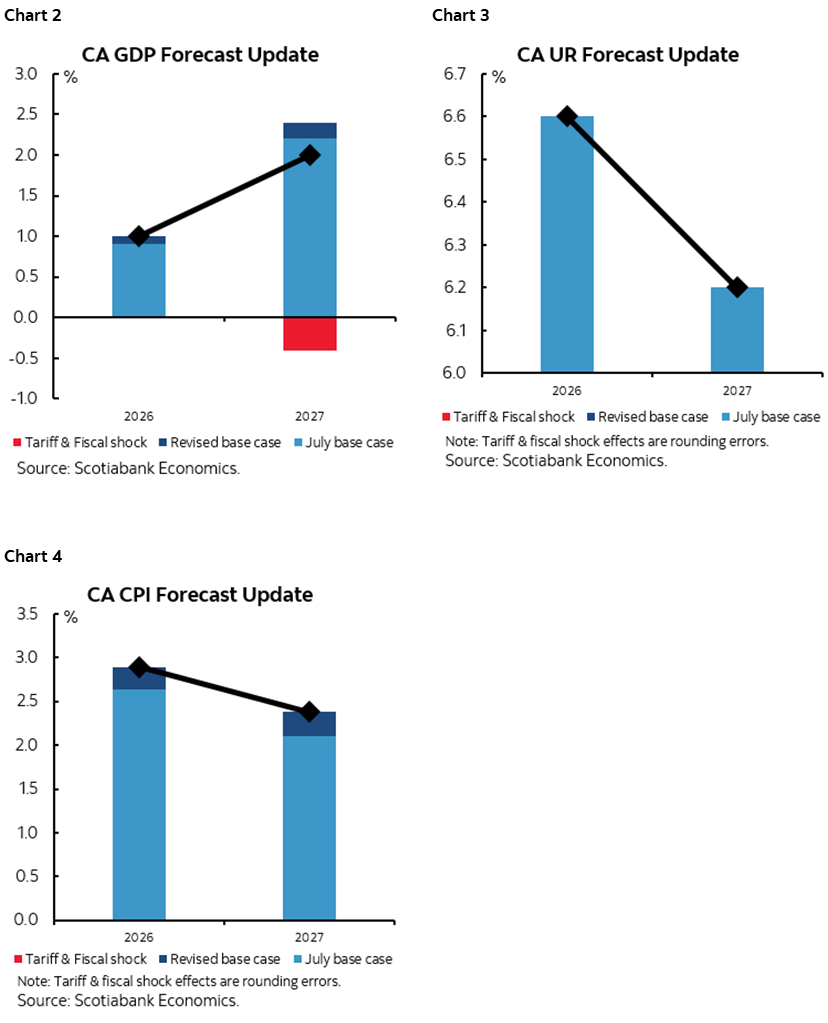
Upon incorporation of the effects of new US tariffs, Canada’s expected retaliation, expected fiscal supports funded at least in part by tariff revenues, and other financial supports, we would lean toward lowering growth to 2.0% in 2027. CAD and the rates curve apply some shock absorption. It is likely that fiscal and other supports will also be offered by provinces which we have not yet incorporated.
We do not estimate a material impact upon the national unemployment rate and only modest effects on CPI and core CPI over 2026–27.
The effects will likely be harsh on individual sectors subject to the additional US tariffs, but we judge that to be more of a micro shock than a large macroeconomic shock to the economy based on information to date.
What the BoC does is unclear and dependent upon retaliation— a point Governor Macklem repeatedly emphasized at earlier stages of the trade wars started by the US. There could be fewer and delayed hikes, but higher inflation would tie the BoC's hands including through retaliation's effects plus fiscal supports that need to be careful not to overdo it. Recall that the BoC cut about a year ago in part because retaliatory tariffs were lessened and so it may do the opposite upon reintroduction of retaliatory tariffs and supports. The US would also get renewed tariff pass through on goods in core PCE, thereby complicating the stance of the Federal Reserve.
These highly tentative views are accompanied by a massive caution. That caution is that what happens depends very critically upon next steps and so this isn't necessarily what we think will happen but only for purposes of spit balling a scenario. Developments could worsen. Developments could also improve as both sides were saying most of the work was completed before the last minute antics.
DISCLAIMER
This report has been prepared by Scotiabank Economics as a resource for the clients of Scotiabank. Opinions, estimates and projections contained herein are our own as of the date hereof and are subject to change without notice. The information and opinions contained herein have been compiled or arrived at from sources believed reliable but no representation or warranty, express or implied, is made as to their accuracy or completeness. Neither Scotiabank nor any of its officers, directors, partners, employees or affiliates accepts any liability whatsoever for any direct or consequential loss arising from any use of this report or its contents.
These reports are provided to you for informational purposes only. This report is not, and is not constructed as, an offer to sell or solicitation of any offer to buy any financial instrument, nor shall this report be construed as an opinion as to whether you should enter into any swap or trading strategy involving a swap or any other transaction. The information contained in this report is not intended to be, and does not constitute, a recommendation of a swap or trading strategy involving a swap within the meaning of U.S. Commodity Futures Trading Commission Regulation 23.434 and Appendix A thereto. This material is not intended to be individually tailored to your needs or characteristics and should not be viewed as a “call to action” or suggestion that you enter into a swap or trading strategy involving a swap or any other transaction. Scotiabank may engage in transactions in a manner inconsistent with the views discussed this report and may have positions, or be in the process of acquiring or disposing of positions, referred to in this report.
Scotiabank, its affiliates and any of their respective officers, directors and employees may from time to time take positions in currencies, act as managers, co-managers or underwriters of a public offering or act as principals or agents, deal in, own or act as market makers or advisors, brokers or commercial and/or investment bankers in relation to securities or related derivatives. As a result of these actions, Scotiabank may receive remuneration. All Scotiabank products and services are subject to the terms of applicable agreements and local regulations. Officers, directors and employees of Scotiabank and its affiliates may serve as directors of corporations.
Any securities discussed in this report may not be suitable for all investors. Scotiabank recommends that investors independently evaluate any issuer and security discussed in this report, and consult with any advisors they deem necessary prior to making any investment.
This report and all information, opinions and conclusions contained in it are protected by copyright. This information may not be reproduced without the prior express written consent of Scotiabank.
™ Trademark of The Bank of Nova Scotia. Used under license, where applicable.
Scotiabank, together with “Global Banking and Markets”, is a marketing name for the global corporate and investment banking and capital markets businesses of The Bank of Nova Scotia and certain of its affiliates in the countries where they operate, including; Scotiabank Europe plc; Scotiabank (Ireland) Designated Activity Company; Scotiabank Inverlat S.A., Institución de Banca Múltiple, Grupo Financiero Scotiabank Inverlat, Scotia Inverlat Casa de Bolsa, S.A. de C.V., Grupo Financiero Scotiabank Inverlat, Scotia Inverlat Derivados S.A. de C.V. – all members of the Scotiabank group and authorized users of the Scotiabank mark. The Bank of Nova Scotia is incorporated in Canada with limited liability and is authorised and regulated by the Office of the Superintendent of Financial Institutions Canada. The Bank of Nova Scotia is authorized by the UK Prudential Regulation Authority and is subject to regulation by the UK Financial Conduct Authority and limited regulation by the UK Prudential Regulation Authority. Details about the extent of The Bank of Nova Scotia's regulation by the UK Prudential Regulation Authority are available from us on request. Scotiabank Europe plc is authorized by the UK Prudential Regulation Authority and regulated by the UK Financial Conduct Authority and the UK Prudential Regulation Authority.
Scotiabank Inverlat, S.A., Scotia Inverlat Casa de Bolsa, S.A. de C.V, Grupo Financiero Scotiabank Inverlat, and Scotia Inverlat Derivados, S.A. de C.V., are each authorized and regulated by the Mexican financial authorities.
Not all products and services are offered in all jurisdictions. Services described are available in jurisdictions where permitted by law.