

- Chile: Monthly GDP falls 1.5% y/y in July—on the verge of a third consecutive seasonally adjusted contraction in Q3-26, a situation not seen since 2009
- Peru: Headline inflation reaccelerates, while core inflation eases slightly
CHILE: MONTHLY GDP FALLS 1.5% Y/Y IN JULY—ON THE VERGE OF A THIRD CONSECUTIVE SEASONALLY ADJUSTED CONTRACTION IN Q3-26, A SITUATION NOT SEEN SINCE 2009
Broad-based sectoral contraction, with utilities as the only exception. El Niño has already had a larger impact on activity than historical episodes, while the BCCh could deliver one of its largest growth forecast revisions between MPR.
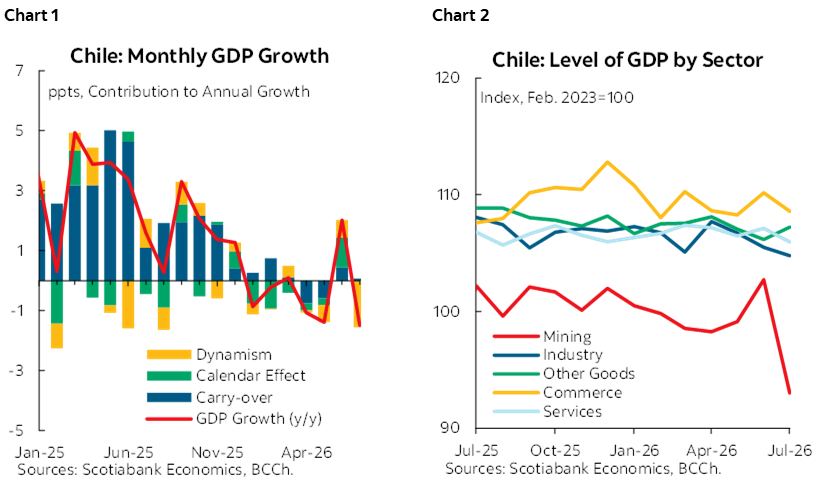
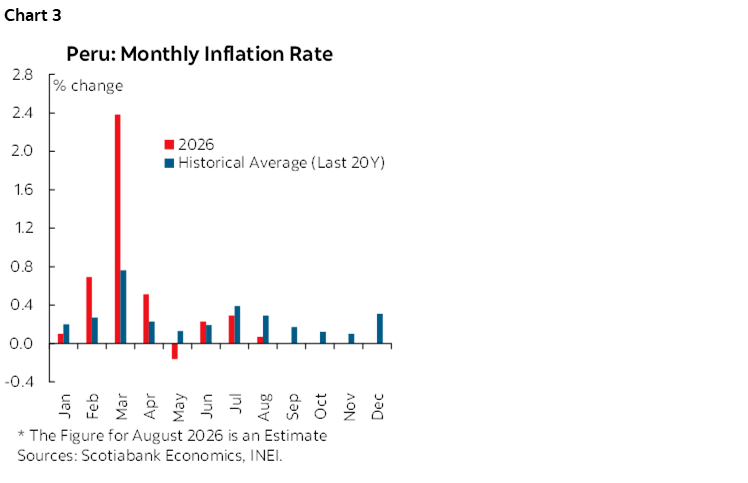
July GDP contracted 1.5% y/y, broadly in line with our expectations (-1.0%) and well below the Economic Expectations Survey forecast (+1.1% y/y). With no working-day differences and comparison bases that were not particularly demanding (chart 1), this print marks the largest y/y decline in more than three and a half years and was clearly affected by the impact of the El Niño phenomenon (chart 2), a factor we have repeatedly highlighted as crucial for both activity and inflation during 2026.
Nevertheless, it is important to note that weaker-than-expected private and public investment execution has also contributed to the economy's lack of momentum this year.
We are raising concerns regarding activity in August, which was also affected by the weather event as it moved into the country's north-central regions, generating additional disruptions in mining activity and several service sectors, including transportation, restaurants and hotels, and personal services, among others.
Should our August forecast materialize, it would become highly likely that the economy fails to emerge from the technical recession that has been underway since June, posting another seasonally adjusted contraction in the third quarter. September's performance will be critical in determining whether Q3-26 GDP posts another seasonally adjusted decline, while Q4-26 will be key in assessing the carry-over effect for GDP growth in 2027.
The risk of a third seasonally adjusted GDP contraction in Q3-26 is increasing, a situation not seen since the 2009 subprime crisis. If the economy expands by 1.5% y/y or less in August and September, implying average seasonally adjusted growth of 1.0% m/m or lower, our estimates suggest that, despite one additional working day, the economy would once again post a quarterly decline in seasonally adjusted terms during Q3-26. If confirmed, this would mark only the second episode since at least 1996 of such a prolonged recession, surpassed only by the 2009 subprime crisis.
We estimate that the Central Bank will revise its 2026 GDP growth forecast significantly lower in next week’s Monetary Policy Report (MPR), moving from the current 1.0%–1.75% range to between 0.25% and 0.75%. Such a downward revision would represent the largest adjustment between MPRs since December 2020, when the GDP growth outlook was lowered by 1 percentage point. At Scotiabank, we maintain our GDP growth forecast at 0.7%, as we anticipate a further decline in economic uncertainty following the completion of the Mega Reform, somewhat more favourable conditions in primary sectors such as fishing, transportation, and personal services, as well as a gradual improvement in consumer confidence. In addition, we expect a stronger pickup in residential investment as a result of the recent measures implemented by the government toward year-end.
—Aníbal Alarcón
PERU: HEADLINE INFLATION REACCELERATES, WHILE CORE INFLATION EASES SLIGHTLY
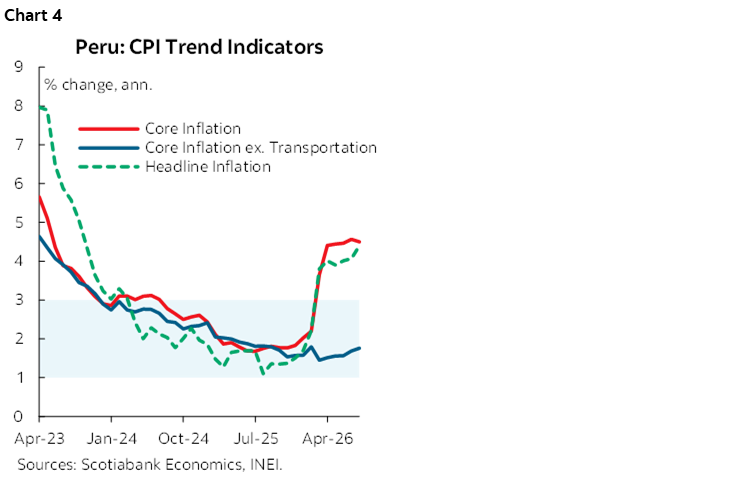
Headline inflation rose 0.07% month-on-month in August (chart 3), slightly above Bloomberg consensus expectations of a 0.04% increase. As a result, annual inflation increased from 4.1% in July to 4.4% in August, remaining above the Central Bank’s target range (1%–3%) for the sixth consecutive month.
This acceleration in annual inflation is largely explained by a base effect, as monthly inflation in August 2025 stood at -0.3%, compared with the historical average of 0.2% for that month over the past 20 years, excluding the pandemic period. In fact, recent monthly inflation dynamics do not point to significant inflationary pressures. Monthly inflation readings in May, June, and July were broadly in line with their historical averages, while the August figure came in slightly below its historical norm.
Regarding core inflation, prices increased by 0.02% month-on-month in August. Nevertheless, the annual rate edged down from 4.6% in July to 4.5% in August. This suggests that inflationary pressures in non-volatile components have moderated somewhat, although they remain elevated. However, it is important to note that the conventional core inflation measure includes the transportation category, which has been influenced by higher international oil prices.
Excluding transportation from the core inflation basket provides a cleaner measure of underlying inflationary pressures. Under this alternative metric, inflation stood at 1.8% y/y in August, within the target range and even below its midpoint (2%), indicating that underlying domestic inflationary pressures remain contained (chart 4).
At a more disaggregated level, the main contributors to the overall inflation outcome were:
- Housing, water, electricity, gas, and other fuels: Prices increased by 0.9%, primarily driven by higher electricity tariffs.
- Transportation: Prices rose 0.3%. Although interprovincial bus fares corrected following the seasonal increase observed in July during the Independence Day holiday period, upward pressure came from higher gasoline prices.
- Restaurants and hotels: Prices increased 0.3%, extending the uptrend observed since March.
- Food and non-alcoholic beverages: This category partially offset the overall inflation result, declining 0.7% due to lower prices for chicken and certain fruits.
Looking ahead, El Niño could generate additional inflationary pressures toward the end of 2026 and the beginning of 2027. Nevertheless, the likelihood of inflation returning to the target range by March 2027 remains high, supported by a favourable base effect.
—Ricardo Avila
DISCLAIMER
This report has been prepared by Scotiabank Economics as a resource for the clients of Scotiabank. Opinions, estimates and projections contained herein are our own as of the date hereof and are subject to change without notice. The information and opinions contained herein have been compiled or arrived at from sources believed reliable but no representation or warranty, express or implied, is made as to their accuracy or completeness. Neither Scotiabank nor any of its officers, directors, partners, employees or affiliates accepts any liability whatsoever for any direct or consequential loss arising from any use of this report or its contents.
These reports are provided to you for informational purposes only. This report is not, and is not constructed as, an offer to sell or solicitation of any offer to buy any financial instrument, nor shall this report be construed as an opinion as to whether you should enter into any swap or trading strategy involving a swap or any other transaction. The information contained in this report is not intended to be, and does not constitute, a recommendation of a swap or trading strategy involving a swap within the meaning of U.S. Commodity Futures Trading Commission Regulation 23.434 and Appendix A thereto. This material is not intended to be individually tailored to your needs or characteristics and should not be viewed as a “call to action” or suggestion that you enter into a swap or trading strategy involving a swap or any other transaction. Scotiabank may engage in transactions in a manner inconsistent with the views discussed this report and may have positions, or be in the process of acquiring or disposing of positions, referred to in this report.
Scotiabank, its affiliates and any of their respective officers, directors and employees may from time to time take positions in currencies, act as managers, co-managers or underwriters of a public offering or act as principals or agents, deal in, own or act as market makers or advisors, brokers or commercial and/or investment bankers in relation to securities or related derivatives. As a result of these actions, Scotiabank may receive remuneration. All Scotiabank products and services are subject to the terms of applicable agreements and local regulations. Officers, directors and employees of Scotiabank and its affiliates may serve as directors of corporations.
Any securities discussed in this report may not be suitable for all investors. Scotiabank recommends that investors independently evaluate any issuer and security discussed in this report, and consult with any advisors they deem necessary prior to making any investment.
This report and all information, opinions and conclusions contained in it are protected by copyright. This information may not be reproduced without the prior express written consent of Scotiabank.
™ Trademark of The Bank of Nova Scotia. Used under license, where applicable.
Scotiabank, together with “Global Banking and Markets”, is a marketing name for the global corporate and investment banking and capital markets businesses of The Bank of Nova Scotia and certain of its affiliates in the countries where they operate, including; Scotiabank Europe plc; Scotiabank (Ireland) Designated Activity Company; Scotiabank Inverlat S.A., Institución de Banca Múltiple, Grupo Financiero Scotiabank Inverlat, Scotia Inverlat Casa de Bolsa, S.A. de C.V., Grupo Financiero Scotiabank Inverlat, Scotia Inverlat Derivados S.A. de C.V. – all members of the Scotiabank group and authorized users of the Scotiabank mark. The Bank of Nova Scotia is incorporated in Canada with limited liability and is authorised and regulated by the Office of the Superintendent of Financial Institutions Canada. The Bank of Nova Scotia is authorized by the UK Prudential Regulation Authority and is subject to regulation by the UK Financial Conduct Authority and limited regulation by the UK Prudential Regulation Authority. Details about the extent of The Bank of Nova Scotia's regulation by the UK Prudential Regulation Authority are available from us on request. Scotiabank Europe plc is authorized by the UK Prudential Regulation Authority and regulated by the UK Financial Conduct Authority and the UK Prudential Regulation Authority.
Scotiabank Inverlat, S.A., Scotia Inverlat Casa de Bolsa, S.A. de C.V, Grupo Financiero Scotiabank Inverlat, and Scotia Inverlat Derivados, S.A. de C.V., are each authorized and regulated by the Mexican financial authorities.
Not all products and services are offered in all jurisdictions. Services described are available in jurisdictions where permitted by law.