

- Banxico unanimously kept the policy rate unchanged at 6.50%, noting that monetary policy remains restrictive to support the convergence of inflation to the target.
- Geopolitical uncertainty persists globally, mainly due to the conflict in the Middle East, amid softer global economic activity.
- The Mexican economy expanded in the second quarter of 2026, although growth is expected to moderate in the third quarter.
- Headline inflation rose to 3.42% y/y in the first half of September, remaining within the target’s variability interval; however, services inflation remains under pressure.
- The minutes highlight a willingness to decouple the domestic monetary policy stance from that of the Federal Reserve.
- Three members consider there is room for a rate cut at the next monetary policy meeting on November 5th, although the decision will remain data dependent.
- Looking ahead, Banxico is expected to remain on hold for the rest of the year, although room for an additional cut could emerge if inflation stays within the 3% ±1 range and the MXN trading conditions remain broadly orderly.
Banco de México published the minutes of its September 23rd meeting, at which the Governing Board unanimously decided to leave the policy rate unchanged at 6.50%. The minutes highlight a willingness to decouple the domestic monetary policy stance from that of the Federal Reserve, which remains more restrictive. On inflation, although the balance of risks is perceived to be skewed to the upside, the Governing Board expects prices to remain relatively stable in the absence of demand-side pressures. It also considers orderly exchange-rate movements to be consistent with the monetary policy stance. Looking ahead, three members believe conditions are in place to consider a downward adjustment at the next monetary policy decision on November 5th. Nevertheless, several members believe upcoming decisions should remain data-dependent, while maintaining commitment to price stability.
According to the minutes, the Governing Board emphasized that geopolitical uncertainty, mainly stemming from the conflict in the Middle East, persists in the global environment. Members noted that the global economy likely expanded at a slower pace in the third quarter of 2026 than in the previous quarter, reflecting more moderate growth in advanced economies. They highlighted stronger economic activity in the United States, partly driven by nonresidential investment and the technology sector. On inflation, they referred to the impact of geopolitical conflicts on the broad-based increase in commodity prices. Regarding monetary policy, they observed that some central banks in advanced and emerging economies raised their policy rates at their latest meetings, highlighting the Federal Reserve’s 25 basis point increase, which brought the target range to 3.75%–4.00%. They also noted a broad rise in advanced-economy government bond yield curves.
On the domestic front, some members highlighted that economic activity in Mexico rebounded in the second quarter, although slightly below the preliminary estimate. Meanwhile, some members noted that timely indicators for the third quarter suggest that growth could moderate relative to the previous quarter. They mentioned the recent momentum in investment and the support that this component and exports have provided to aggregate demand, in contrast with weak consumption. In this regard, they highlighted the dynamism of external demand and the recent strength of exports, particularly non-automotive exports. Some noted that year-end growth expectations had been revised upward, although slack conditions are expected to persist in the economy, together with signs of weakness in the labour market.
The Governing Board noted that headline inflation rose from 3.10% to 3.42% y/y between July and September due to an increase in non-core inflation, while remaining within the variability interval since May of this year. Members also noted that core inflation declined from 3.95% to 3.79% over the same period and continues to trend downward. This decline was supported by a reduction in merchandise inflation from 4.56% in January to 3.22% in September, with low prints in both food and nonfood merchandise. Services’ inflation remains sticky, edging down only marginally to 4.33%. Non-core inflation increased from 0.21% in the first half of July to 2.17% in the first half of September, although it remained below the levels recorded in April, reflecting low volatility in agricultural prices and low energy inflation owing to policies implemented by the federal government. Members also noted that the inflationary impact of the fiscal changes introduced at the beginning of the year has been in line with expectations and that year-end inflation expectations declined, while long-term expectations remained moderate, supported by the absence of demand pressures and the strength of the exchange rate. However, upside risks persist due to geopolitical conflicts—particularly through their impact on energy markets—as well as uncertainty stemming from trade policies.
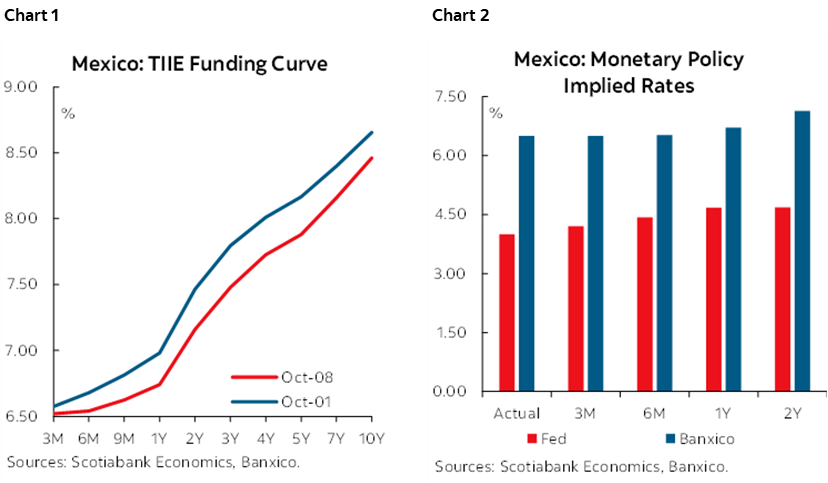
Regarding domestic financial markets, Board members agreed that performance has been relatively favourable despite external volatility. They also noted that the peso appreciated significantly for much of the period and traded with low volatility, although it recently came under pressure from broad-based U.S. dollar strength and shifting expectations for international interest rates. In fixed-income markets, they highlighted that government bond yields rose in line with global movements. Even so, Mexico continues to benefit from attractive interest-rate spreads relative to the United States, particularly at longer maturities, which has supported capital inflows. Risk premiums, meanwhile, remain low and consistent with orderly financial conditions.
On monetary policy, the comments by three Governing Board members regarding the possibility of an adjustment at the next meeting stand out. One member considered that the supply shocks the economy could face may be transitory in nature. Another highlighted the differences between the U.S. and Mexican economies, arguing that these could allow for a narrower interest-rate differential, together with other factors that may be altering the historical relationship between the spread and the USDMXN. This member also considered that the stance would remain relatively restrictive and that there could therefore be ground to assess a downward adjustment. Conversely, two members emphasized the importance of maintaining a cautious approach. One member considered that financial and monetary conditions have become tighter amid uncertainty. Another noted that the restrictive effect of the previously achieved monetary stance has diminished, while inflation has not fully subsided.
Looking ahead, based on members’ comments, we believe there is a possibility of a cut at the November meeting. However, this is not our base-case scenario for now, as we believe such an adjustment would depend on an October inflation reading with no upside surprises and an orderly exchange-rate behaviour. Following the release of the minutes, the peso depreciated by 21 cents, reaching levels as high as MXN 18.21 per U.S. dollar. Against this backdrop, we maintain our forecast for a terminal policy rate of 6.50% in 2026.
—Rodolfo Mitchell, Miguel Saldaña & Martha Cordova
DISCLAIMER
This report has been prepared by Scotiabank Economics as a resource for the clients of Scotiabank. Opinions, estimates and projections contained herein are our own as of the date hereof and are subject to change without notice. The information and opinions contained herein have been compiled or arrived at from sources believed reliable but no representation or warranty, express or implied, is made as to their accuracy or completeness. Neither Scotiabank nor any of its officers, directors, partners, employees or affiliates accepts any liability whatsoever for any direct or consequential loss arising from any use of this report or its contents.
These reports are provided to you for informational purposes only. This report is not, and is not constructed as, an offer to sell or solicitation of any offer to buy any financial instrument, nor shall this report be construed as an opinion as to whether you should enter into any swap or trading strategy involving a swap or any other transaction. The information contained in this report is not intended to be, and does not constitute, a recommendation of a swap or trading strategy involving a swap within the meaning of U.S. Commodity Futures Trading Commission Regulation 23.434 and Appendix A thereto. This material is not intended to be individually tailored to your needs or characteristics and should not be viewed as a “call to action” or suggestion that you enter into a swap or trading strategy involving a swap or any other transaction. Scotiabank may engage in transactions in a manner inconsistent with the views discussed this report and may have positions, or be in the process of acquiring or disposing of positions, referred to in this report.
Scotiabank, its affiliates and any of their respective officers, directors and employees may from time to time take positions in currencies, act as managers, co-managers or underwriters of a public offering or act as principals or agents, deal in, own or act as market makers or advisors, brokers or commercial and/or investment bankers in relation to securities or related derivatives. As a result of these actions, Scotiabank may receive remuneration. All Scotiabank products and services are subject to the terms of applicable agreements and local regulations. Officers, directors and employees of Scotiabank and its affiliates may serve as directors of corporations.
Any securities discussed in this report may not be suitable for all investors. Scotiabank recommends that investors independently evaluate any issuer and security discussed in this report, and consult with any advisors they deem necessary prior to making any investment.
This report and all information, opinions and conclusions contained in it are protected by copyright. This information may not be reproduced without the prior express written consent of Scotiabank.
™ Trademark of The Bank of Nova Scotia. Used under license, where applicable.
Scotiabank, together with “Global Banking and Markets”, is a marketing name for the global corporate and investment banking and capital markets businesses of The Bank of Nova Scotia and certain of its affiliates in the countries where they operate, including; Scotiabank Europe plc; Scotiabank (Ireland) Designated Activity Company; Scotiabank Inverlat S.A., Institución de Banca Múltiple, Grupo Financiero Scotiabank Inverlat, Scotia Inverlat Casa de Bolsa, S.A. de C.V., Grupo Financiero Scotiabank Inverlat, Scotia Inverlat Derivados S.A. de C.V. – all members of the Scotiabank group and authorized users of the Scotiabank mark. The Bank of Nova Scotia is incorporated in Canada with limited liability and is authorised and regulated by the Office of the Superintendent of Financial Institutions Canada. The Bank of Nova Scotia is authorized by the UK Prudential Regulation Authority and is subject to regulation by the UK Financial Conduct Authority and limited regulation by the UK Prudential Regulation Authority. Details about the extent of The Bank of Nova Scotia's regulation by the UK Prudential Regulation Authority are available from us on request. Scotiabank Europe plc is authorized by the UK Prudential Regulation Authority and regulated by the UK Financial Conduct Authority and the UK Prudential Regulation Authority.
Scotiabank Inverlat, S.A., Scotia Inverlat Casa de Bolsa, S.A. de C.V, Grupo Financiero Scotiabank Inverlat, and Scotia Inverlat Derivados, S.A. de C.V., are each authorized and regulated by the Mexican financial authorities.
Not all products and services are offered in all jurisdictions. Services described are available in jurisdictions where permitted by law.