

- Peru: BCRP surprises market consensus with a rate hold
- Chile: September CPI, up 0.4% m/m, keeps annual inflation at 4.1%
- Mexico: Inflation edges higher in September as non-core pressures rebound
PERU: BCRP SURPRISES MARKET CONSENSUS WITH A RATE HOLD
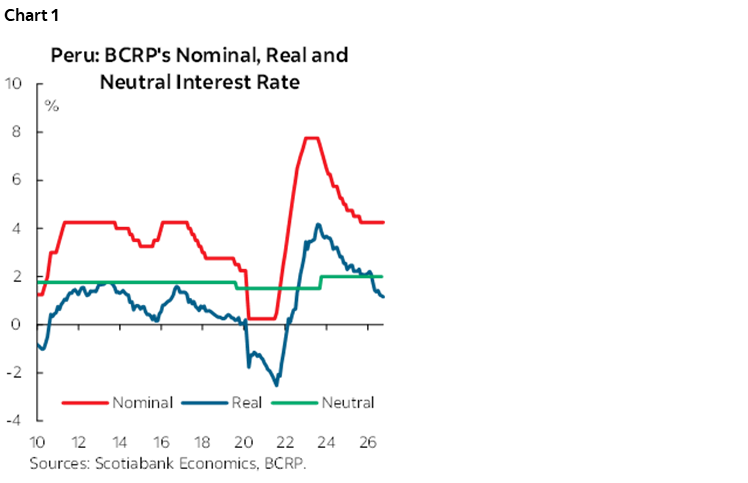
The Board of the Central Reserve Bank of Peru (BCRP) decided to keep its policy interest rate unchanged at 4.25% in October, marking 13 consecutive months without any adjustment (chart 1). This decision was in line with our expectations but differed from market consensus, according to the Bloomberg survey. Of the 13 analysts surveyed, nine expected a 25 basis point increase, while four analysts (including ourselves) anticipated no change in the policy rate.
There are no significant differences between October’s statement and September’s. However, the following points stood out:
- Inflation: Headline and core inflation in September were 0.12% and 0.07% m/m, respectively. On an annual basis, headline inflation increased from 4.4% to 4.5%, mainly due to higher energy prices, while core inflation remained unchanged at 4.5%. Meanwhile, y/y inflation excluding food, energy, and transportation remained below the midpoint of the target range, reaching 1.8% in September.
- Drivers of inflation deviation: The divergence of inflation from the target range continues to be driven primarily by higher fuel prices and their impact on transportation costs during March and April.
- Inflation expectations: Twelve-month inflation expectations remained at 3.1%, slightly above the target range. At the same time, the BCRP expects inflation to return to the target range over the forecast horizon (2026–2027).
- Upside inflation risks: The risk remains that El Niño and geopolitical tensions in the Middle East could generate more persistent effects on inflation.
- Economic expectations: Leading indicators for economic activity in September continue to point to solid performance. Results from the BCRP’s business survey were mixed: current conditions indicators showed a heterogeneous evolution relative to the previous month, while expectations indicators remained in optimistic territory, albeit with some moderation.
- International environment: Global risks remain elevated, as reflected in increased volatility in financial markets and oil prices.
- In summary, the statement is largely unchanged from the one released in September. The BCRP continues to emphasize arguments in favour of keeping the policy rate unchanged; however, the risk of more persistent inflationary pressures remains. Our baseline scenario is for the policy rate to remain at 4.25% by the end of 2026. However, if 12-month inflation expectations continue to rise, and if higher energy prices begin to spill over into other components of the consumer basket, something that has not been observed so far, the likelihood of a BCRP rate hike would increase.
—Ricardo Avila
CHILE: SEPTEMBER CPI, UP 0.4% M/M, KEEPS ANNUAL INFLATION AT 4.1%
- A print that reflects some “calm before the storm”
September CPI rose 0.4% m/m, below market expectations embedded in forwards, surveys, and our point forecast (0.5%). Meanwhile, core CPI excluding volatile items increased 0.3% m/m, in line with our forecast, suggesting that volatile components, particularly international air transportation and insurance, once again explained the gap relative to market projections, as was also the case in August.
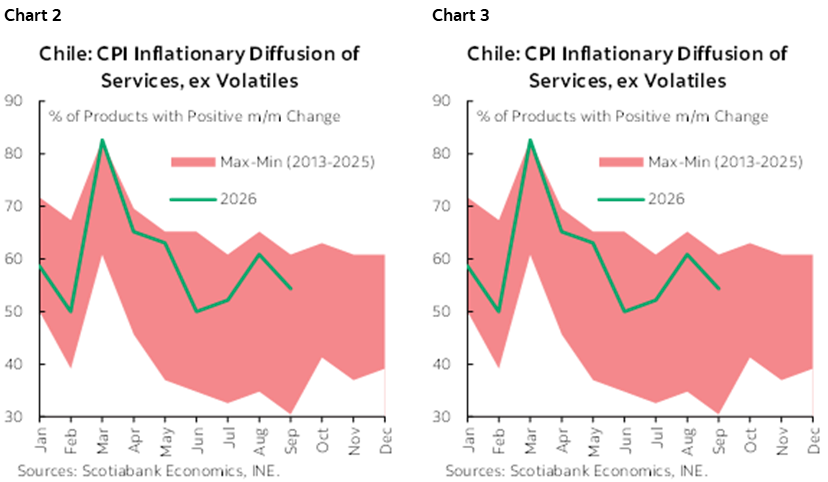
Inflation diffusion accelerated in September, driven by volatile items (charts 2 and 3). The share of products posting monthly price increases reached 58% of the basket, moving away from the historical median for a September reading. Within core inflation, services inflation diffusion moderated, while goods inflation diffusion rebounded, potentially reflecting the typical increase in this category ahead of a Cyber sales event. Although inflation diffusion among volatile items stood at the upper end of the historical range (63%), it was not accompanied by significant price increases in high-weight products within the CPI basket.
Insurance recorded a significant decline during the month. Indeed, the 7.7% m/m fall in insurance prices (contribution: -0.06pp) reflects lower claims frequency in the automobile segment, as well as stronger competition in the industry, which has also affected other general insurance products. We do not expect this behaviour to be repeated in coming months. Meanwhile, although international air transportation services reversed much of the increase observed in August (-18.7% m/m), we anticipate renewed increases in the months ahead, when airfares typically rise due to year-end holiday travel demand.
Our expectation is that inflation will end 2026 at 5.0%, implying inflation prints above those currently priced into forwards. Weak demand is unlikely to be sufficient to offset cost pressures stemming from labour market developments and the multilateral depreciation of the Chilean peso. Therefore, despite the mild downside surprise from volatile items in this CPI release, we expect upcoming inflation readings to reflect not only the impact of fuels but also additional price adjustments in non-volatile components. These would come on top of climate-related effects already affecting volatile items, which have begun to show price increases and, in the context of an El Niño event, would have further justification for rising during the final quarter of the year.
—Aníbal Alarcón
MEXICO: INFLATION EDGES HIGHER IN SEPTEMBER AS NON-CORE PRESSURES REBOUND
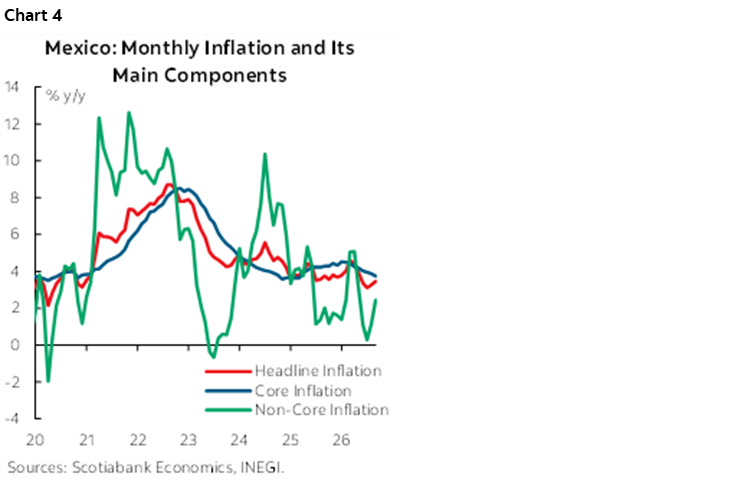
In September, headline inflation rose again, from 3.26% to 3.45%, slightly below the consensus forecast of 3.47%, and remained below 4% for a fifth consecutive month (chart 4). Core inflation declined from 3.88% to 3.75%, also below the 3.78% consensus estimate. Within the core component, merchandise inflation eased from 3.41% to 3.21%, while services inflation moderated slightly from 4.33% to 4.27%, with education at 5.84% and housing at 3.55%. Meanwhile, non-core inflation accelerated again, rising from 1.13% to 2.45%. Agricultural inflation stood at 0.79%, with fruit and vegetable prices up 8.78% and livestock products down 4.46%, while energy prices and government-authorized tariffs increased 3.81%. The products with the largest upward impact, ranked by contribution, included tomatoes, with a monthly increase of 30.25%; onions, 23.00%; domestic LP gas, 3.14%; owner-occupied housing, 0.22%; chicken, 1.78%; and primary education, 6.00%. In contrast, potato prices, professional services, bundled internet, telephone and pay-tv services, and avocados declined during the month. On a sequential monthly basis, headline inflation increased 0.42%, core inflation rose 0.20%, and non-core inflation rebounded by 1.20%.
—Rodolfo Mitchell, Miguel Saldaña & Martha Cordova
DISCLAIMER
This report has been prepared by Scotiabank Economics as a resource for the clients of Scotiabank. Opinions, estimates and projections contained herein are our own as of the date hereof and are subject to change without notice. The information and opinions contained herein have been compiled or arrived at from sources believed reliable but no representation or warranty, express or implied, is made as to their accuracy or completeness. Neither Scotiabank nor any of its officers, directors, partners, employees or affiliates accepts any liability whatsoever for any direct or consequential loss arising from any use of this report or its contents.
These reports are provided to you for informational purposes only. This report is not, and is not constructed as, an offer to sell or solicitation of any offer to buy any financial instrument, nor shall this report be construed as an opinion as to whether you should enter into any swap or trading strategy involving a swap or any other transaction. The information contained in this report is not intended to be, and does not constitute, a recommendation of a swap or trading strategy involving a swap within the meaning of U.S. Commodity Futures Trading Commission Regulation 23.434 and Appendix A thereto. This material is not intended to be individually tailored to your needs or characteristics and should not be viewed as a “call to action” or suggestion that you enter into a swap or trading strategy involving a swap or any other transaction. Scotiabank may engage in transactions in a manner inconsistent with the views discussed this report and may have positions, or be in the process of acquiring or disposing of positions, referred to in this report.
Scotiabank, its affiliates and any of their respective officers, directors and employees may from time to time take positions in currencies, act as managers, co-managers or underwriters of a public offering or act as principals or agents, deal in, own or act as market makers or advisors, brokers or commercial and/or investment bankers in relation to securities or related derivatives. As a result of these actions, Scotiabank may receive remuneration. All Scotiabank products and services are subject to the terms of applicable agreements and local regulations. Officers, directors and employees of Scotiabank and its affiliates may serve as directors of corporations.
Any securities discussed in this report may not be suitable for all investors. Scotiabank recommends that investors independently evaluate any issuer and security discussed in this report, and consult with any advisors they deem necessary prior to making any investment.
This report and all information, opinions and conclusions contained in it are protected by copyright. This information may not be reproduced without the prior express written consent of Scotiabank.
™ Trademark of The Bank of Nova Scotia. Used under license, where applicable.
Scotiabank, together with “Global Banking and Markets”, is a marketing name for the global corporate and investment banking and capital markets businesses of The Bank of Nova Scotia and certain of its affiliates in the countries where they operate, including; Scotiabank Europe plc; Scotiabank (Ireland) Designated Activity Company; Scotiabank Inverlat S.A., Institución de Banca Múltiple, Grupo Financiero Scotiabank Inverlat, Scotia Inverlat Casa de Bolsa, S.A. de C.V., Grupo Financiero Scotiabank Inverlat, Scotia Inverlat Derivados S.A. de C.V. – all members of the Scotiabank group and authorized users of the Scotiabank mark. The Bank of Nova Scotia is incorporated in Canada with limited liability and is authorised and regulated by the Office of the Superintendent of Financial Institutions Canada. The Bank of Nova Scotia is authorized by the UK Prudential Regulation Authority and is subject to regulation by the UK Financial Conduct Authority and limited regulation by the UK Prudential Regulation Authority. Details about the extent of The Bank of Nova Scotia's regulation by the UK Prudential Regulation Authority are available from us on request. Scotiabank Europe plc is authorized by the UK Prudential Regulation Authority and regulated by the UK Financial Conduct Authority and the UK Prudential Regulation Authority.
Scotiabank Inverlat, S.A., Scotia Inverlat Casa de Bolsa, S.A. de C.V, Grupo Financiero Scotiabank Inverlat, and Scotia Inverlat Derivados, S.A. de C.V., are each authorized and regulated by the Mexican financial authorities.
Not all products and services are offered in all jurisdictions. Services described are available in jurisdictions where permitted by law.