

- Mexico: October inflation surprises to the upside
- Headline inflation stood at 3.75% y/y, above consensus and still below 4%, although with increases across its components
- Core inflation accelerated to 3.80% after months of deceleration, with increases in both goods and services
- The non-core component rebounded, rising to 3.59% y/y, mainly due to sharp increases in fruits and vegetables and slight increases in energy prices
- Inflation expectations for year-end 2026 remain elevated, although below 4%
In October, headline inflation rebounded, rising from 3.45% to 3.75% (chart 1). Although it remains below 4% for the sixth consecutive month, it came in above the 3.65% anticipated by consensus. On a sequential monthly basis, it rose 0.65%, and it continues to be pressured by both the core component and by agricultural products within the non-core component (chart 2).
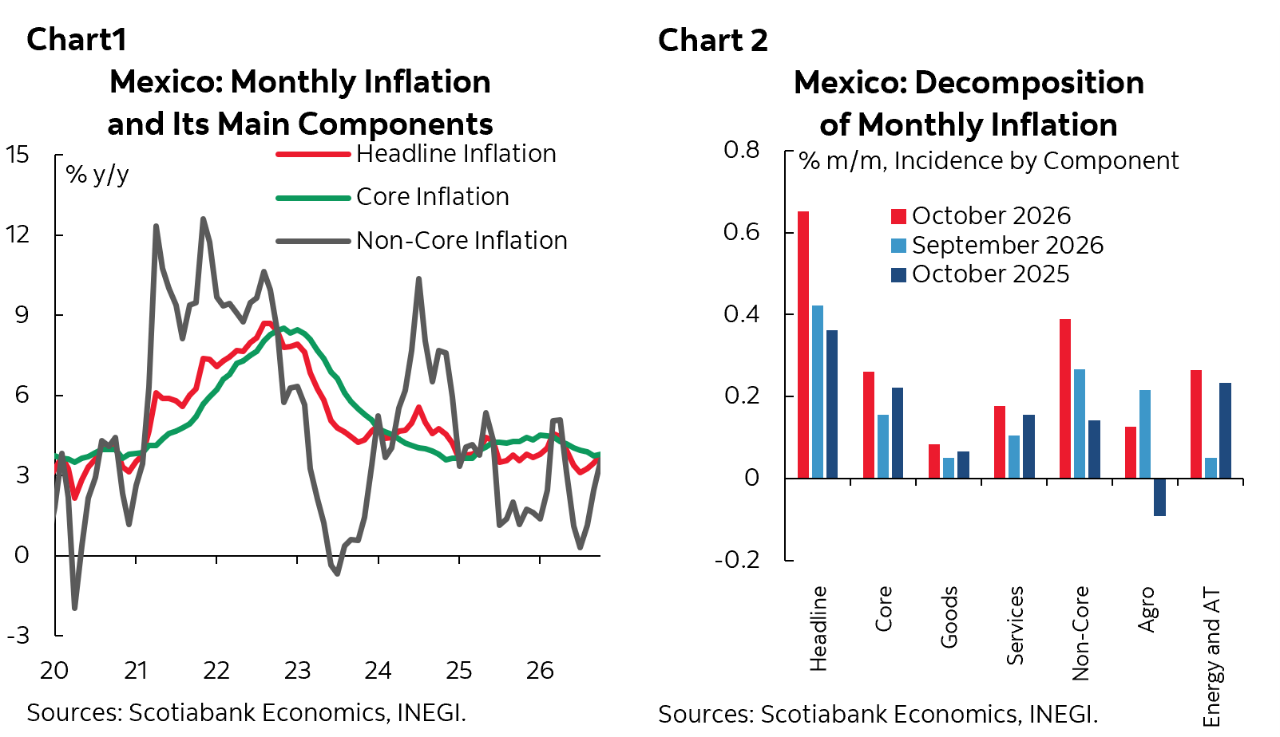
After an eleven-month deceleration process, core inflation increased again from 3.75% to 3.80%, also above the 3.78% consensus, with a sequential monthly surge of 0.34%. Within it, goods rose from 3.21% to 3.25%, driven by a rise in non-food goods, which stood at 2.15% from the previous 2.03%, while food goods edged down to 4.53% from the 4.57% recorded the previous month. Services increased again after five months of deceleration: they rose from 4.27% to 4.32% in October, driven by services other than housing and education, which moved from 4.73% to 4.87%, although education held at 5.84% and housing stood at 3.53% from the previous 3.55%.
For its part, non-core inflation rose again, going from 2.45% to 3.59% y/y, with a 1.75% m/m change, the largest monthly increase since April. The agricultural component stood at 2.99%, where fruit and vegetable subcomponents rebounded to 13.89%—its highest level in five months— offset by livestock products, which showed a negative annual change of -3.61%. Energy and government-approved tariffs stood at 4.06%—rising above 4% for the first time in 20 months—driven by an increase in energy prices from 1.48% to 2.27%—their highest level in fifteen months.
Among the products with the largest upward impact—ordered by greatest incidence—are electricity, with a monthly change of 18.51%, air transportation at 26.36%, tomatoes at 9.68%, domestic LP gas at 3.67%, and tomatillos at 35.58%; while internet, telephone and pay-TV packages, potatoes, and lemons continued to see falling prices this month.
Among the factors and products that moved prices this month, energy prices stand out, specifically electricity, which had a monthly change of 18.51% caused by the end of the summer subsidy. Beyond electricity, domestic LP gas rose 3.67% month over month, a pressure that had already been building since September. In services, air transportation stood out with a 26.36% increase, followed by professional services (9.88%), package tourism services (8.72%) and owner-occupied housing (0.26%). On the agricultural side, supply shocks in fruits and vegetables explained a large part of the non-core increase: tomatillos rose 35.58%, zucchini 23.22% and tomatoes 9.68%. Conversely, several items helped contain and prevented a larger rebound: internet, telephone and pay-tv packages (−2.48%), potatoes and other tubers (−6.29%), lemons (−16.53%), oranges (−8.90%) and automobiles (−0.47%). It is important to note that, while electricity and gas are seasonal or cost adjustments tend to reverse, the recovery of core inflation to 3.80% y/y—which broke nine months of deceleration—points to more persistent pressures, especially in services.
This data is released against a delicate monetary policy backdrop. Last Thursday, Banco de México’s Board of Governors cut the policy rate by 25 basis points to 6.25% in a split decision that surprised markets, as consensus had anticipated a pause. The majority justified the adjustment by noting that the disinflation process “has continued,” alongside the absence of demand-side pressures and limited exchange-rate pass-through. Moreover, three of the five Board members had indicated in the minutes of the September meeting that there was still room for additional “fine-tuning”. Regarding year-end 2026 headline inflation expectations, the Citi Survey placed them at 3.90% and the Banxico Survey at 3.88%, while Banxico revised its 4Q26 forecast to 3.7% from 3.5%, suggesting that inflationary pressures could persist through year-end. With the balance of risks skewed to the upside, particularly due to persistent services inflation, peso depreciation, and energy price volatility, the October inflation print and market expectations appear somewhat at odds with the outlook of some Board members. This divergence could strengthen the case for keeping monetary policy on hold rather than resuming the easing cycle, although the policy path will ultimately depend on the evolution of inflation and its underlying components over the coming months.
—Rodolfo Mitchell, Miguel Saldaña & Martha Cordova
DISCLAIMER
This report has been prepared by Scotiabank Economics as a resource for the clients of Scotiabank. Opinions, estimates and projections contained herein are our own as of the date hereof and are subject to change without notice. The information and opinions contained herein have been compiled or arrived at from sources believed reliable but no representation or warranty, express or implied, is made as to their accuracy or completeness. Neither Scotiabank nor any of its officers, directors, partners, employees or affiliates accepts any liability whatsoever for any direct or consequential loss arising from any use of this report or its contents.
These reports are provided to you for informational purposes only. This report is not, and is not constructed as, an offer to sell or solicitation of any offer to buy any financial instrument, nor shall this report be construed as an opinion as to whether you should enter into any swap or trading strategy involving a swap or any other transaction. The information contained in this report is not intended to be, and does not constitute, a recommendation of a swap or trading strategy involving a swap within the meaning of U.S. Commodity Futures Trading Commission Regulation 23.434 and Appendix A thereto. This material is not intended to be individually tailored to your needs or characteristics and should not be viewed as a “call to action” or suggestion that you enter into a swap or trading strategy involving a swap or any other transaction. Scotiabank may engage in transactions in a manner inconsistent with the views discussed this report and may have positions, or be in the process of acquiring or disposing of positions, referred to in this report.
Scotiabank, its affiliates and any of their respective officers, directors and employees may from time to time take positions in currencies, act as managers, co-managers or underwriters of a public offering or act as principals or agents, deal in, own or act as market makers or advisors, brokers or commercial and/or investment bankers in relation to securities or related derivatives. As a result of these actions, Scotiabank may receive remuneration. All Scotiabank products and services are subject to the terms of applicable agreements and local regulations. Officers, directors and employees of Scotiabank and its affiliates may serve as directors of corporations.
Any securities discussed in this report may not be suitable for all investors. Scotiabank recommends that investors independently evaluate any issuer and security discussed in this report, and consult with any advisors they deem necessary prior to making any investment.
This report and all information, opinions and conclusions contained in it are protected by copyright. This information may not be reproduced without the prior express written consent of Scotiabank.
™ Trademark of The Bank of Nova Scotia. Used under license, where applicable.
Scotiabank, together with “Global Banking and Markets”, is a marketing name for the global corporate and investment banking and capital markets businesses of The Bank of Nova Scotia and certain of its affiliates in the countries where they operate, including; Scotiabank Europe plc; Scotiabank (Ireland) Designated Activity Company; Scotiabank Inverlat S.A., Institución de Banca Múltiple, Grupo Financiero Scotiabank Inverlat, Scotia Inverlat Casa de Bolsa, S.A. de C.V., Grupo Financiero Scotiabank Inverlat, Scotia Inverlat Derivados S.A. de C.V. – all members of the Scotiabank group and authorized users of the Scotiabank mark. The Bank of Nova Scotia is incorporated in Canada with limited liability and is authorised and regulated by the Office of the Superintendent of Financial Institutions Canada. The Bank of Nova Scotia is authorized by the UK Prudential Regulation Authority and is subject to regulation by the UK Financial Conduct Authority and limited regulation by the UK Prudential Regulation Authority. Details about the extent of The Bank of Nova Scotia's regulation by the UK Prudential Regulation Authority are available from us on request. Scotiabank Europe plc is authorized by the UK Prudential Regulation Authority and regulated by the UK Financial Conduct Authority and the UK Prudential Regulation Authority.
Scotiabank Inverlat, S.A., Scotia Inverlat Casa de Bolsa, S.A. de C.V, Grupo Financiero Scotiabank Inverlat, and Scotia Inverlat Derivados, S.A. de C.V., are each authorized and regulated by the Mexican financial authorities.
Not all products and services are offered in all jurisdictions. Services described are available in jurisdictions where permitted by law.