

- Peru: New vehicle sales remain strong and exceed our expectations
New vehicle sales posted another year-over-year increase in July, reaching the highest level on record for the month (charts 1 and 2). Sales have now remained in positive territory since February 2025. The July result exceeded our expectations despite fewer effective sales days due to an additional public sector holiday, with heavy vehicles showing strength. Accordingly, year-to-date sales introduce upside risk to our full-year 2026 forecast.
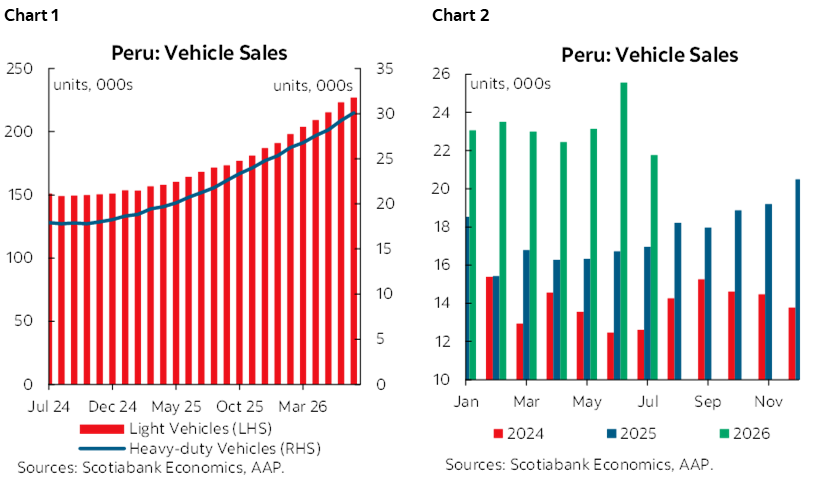
Cumulative sales reached 162,488 units through July, up nearly 39% year-over-year, according to the Asociación Automotriz del Perú (AAP). The main drivers were: i) continued formal employment growth—up 4.2% year-over-year in May, according to the Central Reserve Bank of Peru; ii) a 3.5% increase in private consumption in Q1-2026, supported by stronger consumer confidence through July; iii) a lower PEN/USD exchange rate, with the sol appreciating 7% year-over-year in H1-2026; iv) improved financing conditions following lower auto lending rates; and v) a broader supply of light vehicle models, particularly SUVs, together with sustained corporate fleet renewal.
By segment, heavy vehicles slightly outperformed the market. Sales reached 18,656 units through July, up nearly 40% year-over year, led by heavy duty trucks. Light vehicle sales increased by approximately 39% to 143,832 units. SUV sales rose 52%, supported by demand for higher-capacity vehicles and a broader model offer than in previous years.
For August, we expect sales of around 23,000 units, close to the January–July monthly average. Growth should moderate over the coming months due to a high comparison base: average year-over-year growth exceeded 30% between August and December 2025, versus 25% for full-year 2025. Downside risks remain. Geopolitical tensions in the Middle East could disrupt oil shipments through the Strait of Hormuz, constrain supply and increase price volatility. A stronger US dollar would raise vehicle prices in soles, while higher fuel and fertilizer costs could increase operating expenses and food inflation, weakening household purchasing power. The magnitude of the impact would depend on the duration and intensity of these shocks.
A higher probability of an El Niño event adds to these risks. A severe episode would weigh on light vehicle sales by raising food prices, reducing households’ real income and increasing caution toward durable goods purchases and new debt. For heavy vehicles, damage to roads, bridges and other infrastructure could disrupt logistics and delay fleet renewal. However, subsequent reconstruction could support demand for trucks and cargo vehicles. The net impact would depend on the event’s intensity and duration, as well as the speed of the public sector response.
We forecast new vehicle sales slightly above 260,000 units in 2026, which would set a new record. The forecast retains upside risk. Stronger consumer confidence should support private consumption, which we expect to grow by 3.5%—and light vehicle demand. A gradual improvement in business confidence should also support heavy vehicle sales, consistent with our 9.3% private investment growth forecast. Nonetheless, geopolitical tensions around the Strait of Hormuz and a higher probability of El Niño could constrain sales growth.
—Carlos Asmat
DISCLAIMER
This report has been prepared by Scotiabank Economics as a resource for the clients of Scotiabank. Opinions, estimates and projections contained herein are our own as of the date hereof and are subject to change without notice. The information and opinions contained herein have been compiled or arrived at from sources believed reliable but no representation or warranty, express or implied, is made as to their accuracy or completeness. Neither Scotiabank nor any of its officers, directors, partners, employees or affiliates accepts any liability whatsoever for any direct or consequential loss arising from any use of this report or its contents.
These reports are provided to you for informational purposes only. This report is not, and is not constructed as, an offer to sell or solicitation of any offer to buy any financial instrument, nor shall this report be construed as an opinion as to whether you should enter into any swap or trading strategy involving a swap or any other transaction. The information contained in this report is not intended to be, and does not constitute, a recommendation of a swap or trading strategy involving a swap within the meaning of U.S. Commodity Futures Trading Commission Regulation 23.434 and Appendix A thereto. This material is not intended to be individually tailored to your needs or characteristics and should not be viewed as a “call to action” or suggestion that you enter into a swap or trading strategy involving a swap or any other transaction. Scotiabank may engage in transactions in a manner inconsistent with the views discussed this report and may have positions, or be in the process of acquiring or disposing of positions, referred to in this report.
Scotiabank, its affiliates and any of their respective officers, directors and employees may from time to time take positions in currencies, act as managers, co-managers or underwriters of a public offering or act as principals or agents, deal in, own or act as market makers or advisors, brokers or commercial and/or investment bankers in relation to securities or related derivatives. As a result of these actions, Scotiabank may receive remuneration. All Scotiabank products and services are subject to the terms of applicable agreements and local regulations. Officers, directors and employees of Scotiabank and its affiliates may serve as directors of corporations.
Any securities discussed in this report may not be suitable for all investors. Scotiabank recommends that investors independently evaluate any issuer and security discussed in this report, and consult with any advisors they deem necessary prior to making any investment.
This report and all information, opinions and conclusions contained in it are protected by copyright. This information may not be reproduced without the prior express written consent of Scotiabank.
™ Trademark of The Bank of Nova Scotia. Used under license, where applicable.
Scotiabank, together with “Global Banking and Markets”, is a marketing name for the global corporate and investment banking and capital markets businesses of The Bank of Nova Scotia and certain of its affiliates in the countries where they operate, including; Scotiabank Europe plc; Scotiabank (Ireland) Designated Activity Company; Scotiabank Inverlat S.A., Institución de Banca Múltiple, Grupo Financiero Scotiabank Inverlat, Scotia Inverlat Casa de Bolsa, S.A. de C.V., Grupo Financiero Scotiabank Inverlat, Scotia Inverlat Derivados S.A. de C.V. – all members of the Scotiabank group and authorized users of the Scotiabank mark. The Bank of Nova Scotia is incorporated in Canada with limited liability and is authorised and regulated by the Office of the Superintendent of Financial Institutions Canada. The Bank of Nova Scotia is authorized by the UK Prudential Regulation Authority and is subject to regulation by the UK Financial Conduct Authority and limited regulation by the UK Prudential Regulation Authority. Details about the extent of The Bank of Nova Scotia's regulation by the UK Prudential Regulation Authority are available from us on request. Scotiabank Europe plc is authorized by the UK Prudential Regulation Authority and regulated by the UK Financial Conduct Authority and the UK Prudential Regulation Authority.
Scotiabank Inverlat, S.A., Scotia Inverlat Casa de Bolsa, S.A. de C.V, Grupo Financiero Scotiabank Inverlat, and Scotia Inverlat Derivados, S.A. de C.V., are each authorized and regulated by the Mexican financial authorities.
Not all products and services are offered in all jurisdictions. Services described are available in jurisdictions where permitted by law.