

- Peru: Housing market could reach record sales levels in 2026
We expect Peru’s housing market to expand at a double-digit pace in 2026, outperforming the broader construction sector, which is forecast to grow by around 9.4%. The outlook is underpinned by sustained momentum in mortgage loans, which are poised to reach an all-time high, supported by stronger new home sales in Lima and a recovery in government-backed social housing lending.
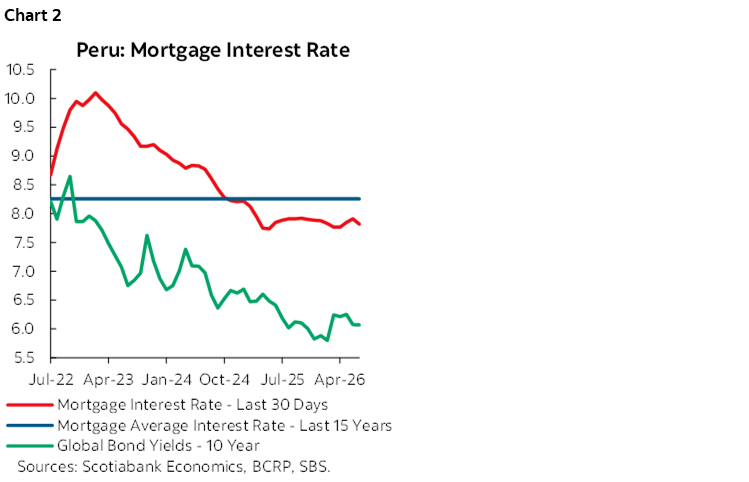
The sector’s momentum has been underpinned by a gradual decline in mortgage rates, which has lowered monthly payments and improved housing affordability. The easing in borrowing costs has tracked the decline in Peru’s 10-year local-currency sovereign bond yield, a key benchmark for long-term lending rates. Meanwhile, broadly stable construction material costs—up just 1.8% in H1-26—have encouraged new project launches. The Peruvian sol’s recent appreciation against the U.S. dollar has provided an additional tailwind by reducing the local-currency equivalent of home prices, as most residential properties are quoted in dollars. Improving formal employment and household incomes have also helped bolster homebuying demand.
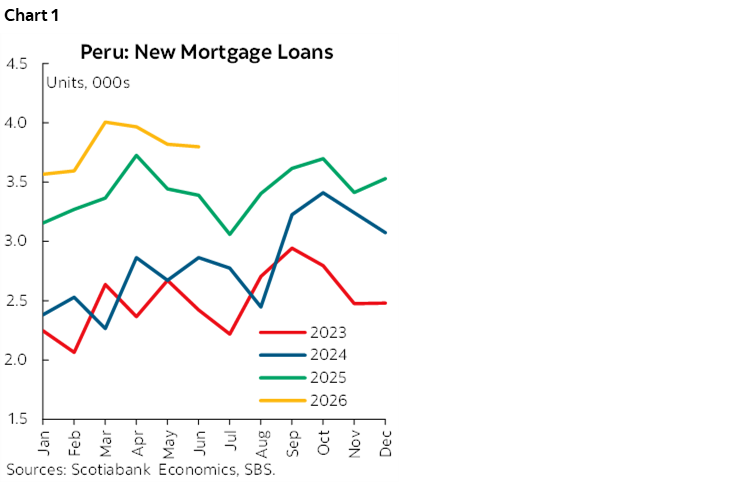
By segment, we forecast mortgage loans to rise by around 10% in 2026 to more than 45,000 loans, up from 41,057 in 2025. This would mark a third consecutive year of growth and surpass the previous record of 43,882 loans set in 2021.
The expansion would be driven by new home sales in Lima, which we expect to increase by around 15% y/y to more than 28,000 units, based on data from CODIP (Confederación de Desarrolladores Inmobiliarios del Perú). Government-backed housing lending is also poised for a modest recovery, with disbursements under the Nuevo Crédito Mivivienda program expected to edge above the 9,157 loans granted in 2025. Lending under the program fell 2% last year to its lowest annual level since 2020.
Performance during H1-26
New mortgage loans reached 22,743 loans in H1-26 (chart 1), up nearly 12% y/y, according to the SBS (Superintendencia de Banca y Seguros). The first half reading surpassed the previous half-year record of 21,987 loans set in 2H21. Monthly loans also climbed in March 2026 to their highest level since March 2021, excluding the temporary post-pandemic rebound recorded in July 2020.
Meanwhile, new home sales in Metropolitan Lima reached 15,477 units in 1H26, up 26% y/y, according to CODIP. The increase was underpinned by lower borrowing costs, with mortgage rates standing at around 7.8% at end-July, boosting housing affordability (chart 2). Additional tailwinds included broadly stable home prices—residential property prices rose just 1.1% y/y in Q1-26, according to the BCRP (Banco Central de Reserva)—the Peruvian sol’s appreciation against the U.S. dollar and improving labour-market conditions, particularly in the private sector.
The recovery in government-backed housing lending provided additional support to the sector. Combined disbursements under the Mivivienda and CRC programs reached 4,399 loans in H1-26, up 5% y/y. Following three consecutive annual declines, we expect social housing lending to return to growth in 2026, assuming broad economic policy continuity after the elections and no major regulatory changes affecting the housing market.
—Carlos Asmat
DISCLAIMER
This report has been prepared by Scotiabank Economics as a resource for the clients of Scotiabank. Opinions, estimates and projections contained herein are our own as of the date hereof and are subject to change without notice. The information and opinions contained herein have been compiled or arrived at from sources believed reliable but no representation or warranty, express or implied, is made as to their accuracy or completeness. Neither Scotiabank nor any of its officers, directors, partners, employees or affiliates accepts any liability whatsoever for any direct or consequential loss arising from any use of this report or its contents.
These reports are provided to you for informational purposes only. This report is not, and is not constructed as, an offer to sell or solicitation of any offer to buy any financial instrument, nor shall this report be construed as an opinion as to whether you should enter into any swap or trading strategy involving a swap or any other transaction. The information contained in this report is not intended to be, and does not constitute, a recommendation of a swap or trading strategy involving a swap within the meaning of U.S. Commodity Futures Trading Commission Regulation 23.434 and Appendix A thereto. This material is not intended to be individually tailored to your needs or characteristics and should not be viewed as a “call to action” or suggestion that you enter into a swap or trading strategy involving a swap or any other transaction. Scotiabank may engage in transactions in a manner inconsistent with the views discussed this report and may have positions, or be in the process of acquiring or disposing of positions, referred to in this report.
Scotiabank, its affiliates and any of their respective officers, directors and employees may from time to time take positions in currencies, act as managers, co-managers or underwriters of a public offering or act as principals or agents, deal in, own or act as market makers or advisors, brokers or commercial and/or investment bankers in relation to securities or related derivatives. As a result of these actions, Scotiabank may receive remuneration. All Scotiabank products and services are subject to the terms of applicable agreements and local regulations. Officers, directors and employees of Scotiabank and its affiliates may serve as directors of corporations.
Any securities discussed in this report may not be suitable for all investors. Scotiabank recommends that investors independently evaluate any issuer and security discussed in this report, and consult with any advisors they deem necessary prior to making any investment.
This report and all information, opinions and conclusions contained in it are protected by copyright. This information may not be reproduced without the prior express written consent of Scotiabank.
™ Trademark of The Bank of Nova Scotia. Used under license, where applicable.
Scotiabank, together with “Global Banking and Markets”, is a marketing name for the global corporate and investment banking and capital markets businesses of The Bank of Nova Scotia and certain of its affiliates in the countries where they operate, including; Scotiabank Europe plc; Scotiabank (Ireland) Designated Activity Company; Scotiabank Inverlat S.A., Institución de Banca Múltiple, Grupo Financiero Scotiabank Inverlat, Scotia Inverlat Casa de Bolsa, S.A. de C.V., Grupo Financiero Scotiabank Inverlat, Scotia Inverlat Derivados S.A. de C.V. – all members of the Scotiabank group and authorized users of the Scotiabank mark. The Bank of Nova Scotia is incorporated in Canada with limited liability and is authorised and regulated by the Office of the Superintendent of Financial Institutions Canada. The Bank of Nova Scotia is authorized by the UK Prudential Regulation Authority and is subject to regulation by the UK Financial Conduct Authority and limited regulation by the UK Prudential Regulation Authority. Details about the extent of The Bank of Nova Scotia's regulation by the UK Prudential Regulation Authority are available from us on request. Scotiabank Europe plc is authorized by the UK Prudential Regulation Authority and regulated by the UK Financial Conduct Authority and the UK Prudential Regulation Authority.
Scotiabank Inverlat, S.A., Scotia Inverlat Casa de Bolsa, S.A. de C.V, Grupo Financiero Scotiabank Inverlat, and Scotia Inverlat Derivados, S.A. de C.V., are each authorized and regulated by the Mexican financial authorities.
Not all products and services are offered in all jurisdictions. Services described are available in jurisdictions where permitted by law.