

- Peru: GDP growth moderated in Q2 2026 amid stronger-than-expected El Niño effects
Gross Domestic Product (GDP) grew by 2.6% in the second quarter of 2026, nearly one percentage point lower than the pace recorded in Q1-26 (chart 1), according to our estimates based on data published by the National Institute of Statistics and Informatics (INEI). The slower pace of expansion was mainly attributable to the impact of the El Niño event on primary sectors such as fishing and agriculture. As a result, GDP accumulated growth of 3.1% during the first half of 2026.
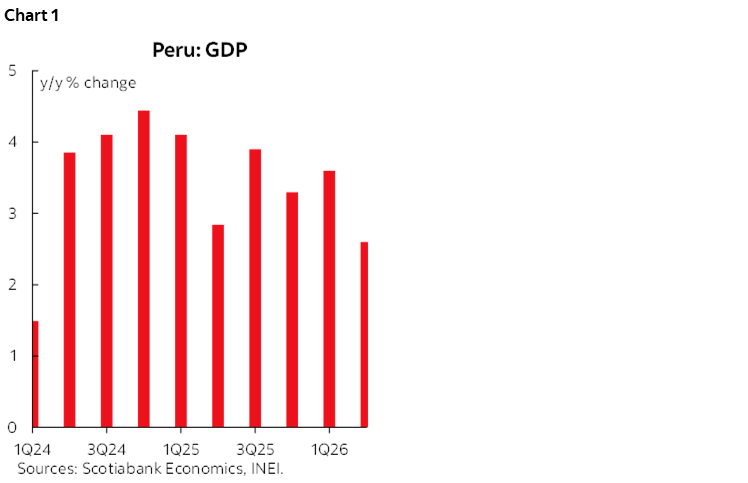
The impact of El Niño on economic activity has been greater than initially anticipated, largely because the magnitude of the climatic event has exceeded expectations formed several months earlier. According to the statement issued in late March by the Multisectoral Commission responsible for the National El Niño Phenomenon Study (ENFEN), the warm event was expected to reach a moderate intensity between May and July. However, by June it had already attained a strong intensity, and an extraordinary intensity became the most likely scenario from August onward.
This development is expected to continue affecting primary sectors during Q3-26, particularly agriculture and fisheries, although the latter has a lower contribution to overall GDP during this period. Consequently, while we maintain our forecast that non-primary sectors will expand by approximately 4.5%, our projection of 3.5% GDP growth for Q3-26 is subject to downside risks.
Performance in Q2-26
The fishing sector (-49.2%) was severely affected by the early suspension of the first anchovy fishing season in Peru’s north-central region. Between April and June, only 477 thousand metric tons were captured, compared with 2.23 million metric tons during the same period in 2025. Warm ocean temperatures associated with El Niño caused anchovy stocks to migrate southward or move to deeper waters, making them more difficult to catch. Reduced anchovy availability also affected fishmeal production, contributing to the decline in primary manufacturing output (-21.0%).
The agricultural sector (-2.0%) experienced a sharper contraction in June (table 1), reinforcing the negative trend observed throughout Q2 2026. Adverse weather conditions, including above-average rainfall along the coast and highlands and precipitation deficits in the Amazon region, negatively affected yields of crops destined for the domestic market, such as olives, onions, wheat, and corn, and, to a lesser extent, export-oriented crops including coffee, avocados, and cocoa.
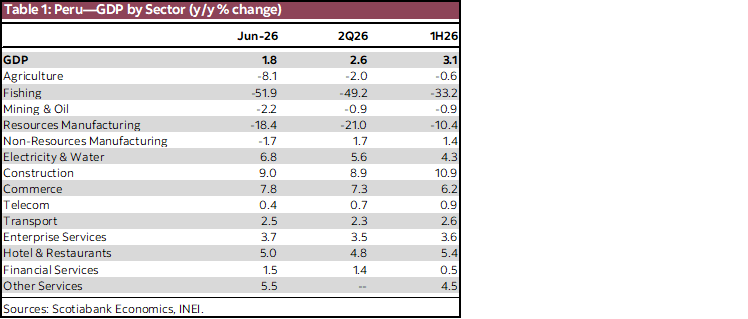
In contrast, non-primary sectors linked to domestic demand maintained a positive performance during Q2-26, expanding by approximately 5.0%. At a disaggregated level, construction (+8.9%) stood out, supported by higher domestic cement consumption driven by both self-construction activity and the formal real estate sector, as well as stronger public investment by regional and local governments. These factors were partially offset by lower investment by the national government.
Meanwhile, the commerce sector (+7.3%) continued to be supported by robust retail sales, particularly in supermarkets, department stores, and home improvement retailers, as well as new light vehicle sales, which have reached record levels.
Finally, the services sector (+3.3%) benefited from the strong performance of the hospitality and restaurant industry, especially due to increased demand for food consumed outside the home amid improving household incomes. Business services also expanded, reflecting stronger economic activity and greater demand for consulting, security, and advertising services.
—Pablo Nano
DISCLAIMER
This report has been prepared by Scotiabank Economics as a resource for the clients of Scotiabank. Opinions, estimates and projections contained herein are our own as of the date hereof and are subject to change without notice. The information and opinions contained herein have been compiled or arrived at from sources believed reliable but no representation or warranty, express or implied, is made as to their accuracy or completeness. Neither Scotiabank nor any of its officers, directors, partners, employees or affiliates accepts any liability whatsoever for any direct or consequential loss arising from any use of this report or its contents.
These reports are provided to you for informational purposes only. This report is not, and is not constructed as, an offer to sell or solicitation of any offer to buy any financial instrument, nor shall this report be construed as an opinion as to whether you should enter into any swap or trading strategy involving a swap or any other transaction. The information contained in this report is not intended to be, and does not constitute, a recommendation of a swap or trading strategy involving a swap within the meaning of U.S. Commodity Futures Trading Commission Regulation 23.434 and Appendix A thereto. This material is not intended to be individually tailored to your needs or characteristics and should not be viewed as a “call to action” or suggestion that you enter into a swap or trading strategy involving a swap or any other transaction. Scotiabank may engage in transactions in a manner inconsistent with the views discussed this report and may have positions, or be in the process of acquiring or disposing of positions, referred to in this report.
Scotiabank, its affiliates and any of their respective officers, directors and employees may from time to time take positions in currencies, act as managers, co-managers or underwriters of a public offering or act as principals or agents, deal in, own or act as market makers or advisors, brokers or commercial and/or investment bankers in relation to securities or related derivatives. As a result of these actions, Scotiabank may receive remuneration. All Scotiabank products and services are subject to the terms of applicable agreements and local regulations. Officers, directors and employees of Scotiabank and its affiliates may serve as directors of corporations.
Any securities discussed in this report may not be suitable for all investors. Scotiabank recommends that investors independently evaluate any issuer and security discussed in this report, and consult with any advisors they deem necessary prior to making any investment.
This report and all information, opinions and conclusions contained in it are protected by copyright. This information may not be reproduced without the prior express written consent of Scotiabank.
™ Trademark of The Bank of Nova Scotia. Used under license, where applicable.
Scotiabank, together with “Global Banking and Markets”, is a marketing name for the global corporate and investment banking and capital markets businesses of The Bank of Nova Scotia and certain of its affiliates in the countries where they operate, including; Scotiabank Europe plc; Scotiabank (Ireland) Designated Activity Company; Scotiabank Inverlat S.A., Institución de Banca Múltiple, Grupo Financiero Scotiabank Inverlat, Scotia Inverlat Casa de Bolsa, S.A. de C.V., Grupo Financiero Scotiabank Inverlat, Scotia Inverlat Derivados S.A. de C.V. – all members of the Scotiabank group and authorized users of the Scotiabank mark. The Bank of Nova Scotia is incorporated in Canada with limited liability and is authorised and regulated by the Office of the Superintendent of Financial Institutions Canada. The Bank of Nova Scotia is authorized by the UK Prudential Regulation Authority and is subject to regulation by the UK Financial Conduct Authority and limited regulation by the UK Prudential Regulation Authority. Details about the extent of The Bank of Nova Scotia's regulation by the UK Prudential Regulation Authority are available from us on request. Scotiabank Europe plc is authorized by the UK Prudential Regulation Authority and regulated by the UK Financial Conduct Authority and the UK Prudential Regulation Authority.
Scotiabank Inverlat, S.A., Scotia Inverlat Casa de Bolsa, S.A. de C.V, Grupo Financiero Scotiabank Inverlat, and Scotia Inverlat Derivados, S.A. de C.V., are each authorized and regulated by the Mexican financial authorities.
Not all products and services are offered in all jurisdictions. Services described are available in jurisdictions where permitted by law.