

- Chile: January GDP of 2.5% y/y (0.4% m/m) tees up higher 2025 growth estimates
- Colombia: In January, the unemployment rate improved showing a potential sectorial recomposition
CHILE: JANUARY GDP OF 2.5% Y/Y (0.4% M/M) LEAVES CARRY-OVER AT 1.7% BY 2025
- GDP growth 2025 on track for an upward correction. Strong wholesale/retail trade expansion with about 1/3 explained by non-residents.
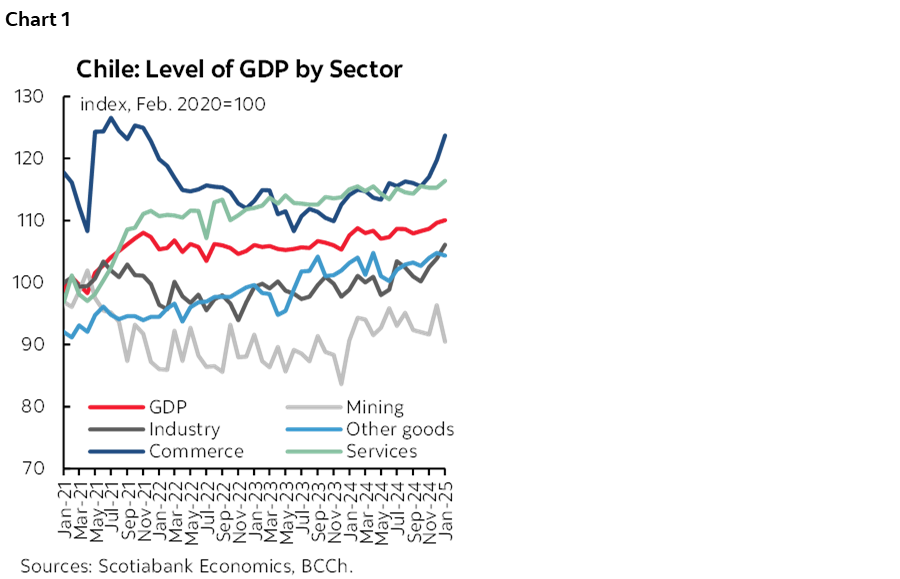
This morning, the central bank (BCCh) released January GDP growth, which came in at 2.5% y/y, slightly above Economist Survey expectations (2.3%), although in line with Bloomberg consensus and slightly above our forecast. Of note was the strong seasonally adjusted growth of non-mining GDP of 1.4% m/m. At the economic sector level (chart 1), the positive performance of commerce stood out thanks to the wholesale and retail sectors, as well as strong growth in manufacturing (food) and services, the latter driven by business and personal services. However, it should be noted that the leap year effect, together with the late-February blackout, would result in a year-on-year contraction of activity in February, which given its statistical and transitory nature does not change the macro diagnosis.
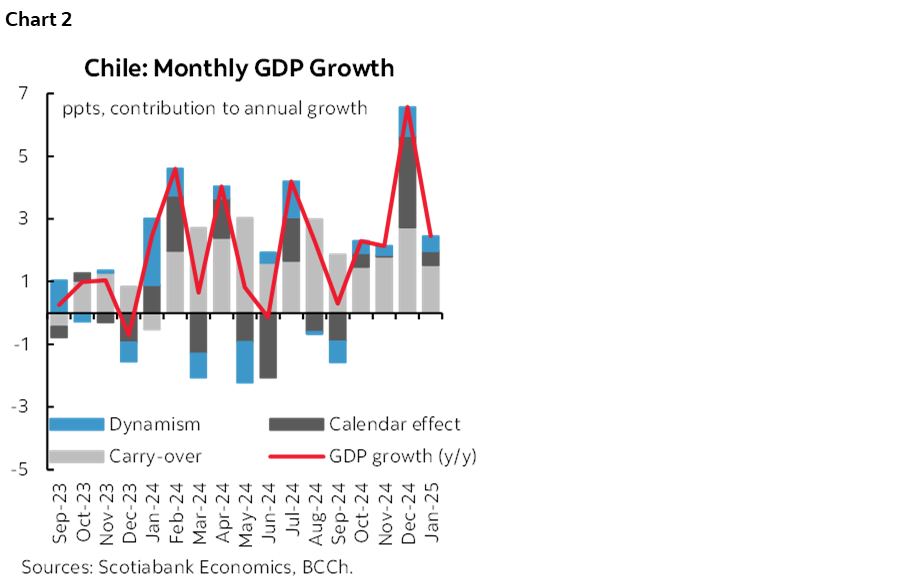
Without differences in working days, the seasonal factor had a marginally positive contribution (chart 2). Unlike what was observed in December and in previous months, the influence of the calendar effect was not a relevant factor in this GDP record. In fact, the annual growth of the seasonally adjusted total GDP series was 2.3% y/y, with no major differences with respect to the original series. However, the calendar effect would again become relevant in the GDP of February, a month that will be compared to a leap year, so its influence could be significant and downward on the year-on-year growth rate of that month.
Trade grew for the third consecutive month, accumulating an expansion of 7.1% in the last three months. In January, trade expanded 3.4% m/m, thanks to the positive contribution of wholesale trade and the good performance of retail trade. Both sectors, according to INE figures based on sales in the sector, have been favoured by the increase in sales of clothing and footwear. Meanwhile, sales of electronic products also stood out in retail trade. In both cases, the contribution of tourism would be relevant, especially due to the large number of Argentine tourists who visited the country this season. In fact, 518k Argentine tourists visited the country in January, who, according to figures from the Santiago Chamber of Commerce, mainly consumed electronic and clothing items.
From the monetary policy point of view, the acceleration in trade is relevant, anticipating a good expansion of private consumption this first quarter and, most likely, an upward correction in the expansion of consumption by 2025. Regarding the non-mining activity gap, the strong growth of 1.4% m/m driven by trade, industry and services would indicate that the activity gap is closed or very close to being closed. In this scenario, the BCCh has a somewhat easier task sustaining the neutral bias introduced at last January’s meeting. It is worth noting that around 1/3 of the trade expansion would be explained by non-residents (from Argentina) who have supported the purchase of durable goods ex-autos and some services.
We anticipate an upward correction in GDP 2025 growth projections by the central bank in the March IPoM. Indeed, a carry-over of 1.7% after this January GDP and despite a seasonally adjusted contraction in February caused mainly by the energy blackout, the better performance of consumption and the upward revision in investment would justify an upward adjustment in projected growth in the BCCh’s baseline scenario from the current 2.0% to a mid-point between 2.25% and 2.5%. At Scotiabank, we maintain and reaffirm our GDP expansion projection of 2.5% for the current year, which incorporates total investment growth of no less than 6%.
—Aníbal Alarcón
COLOMBIA: IN JANUARY, THE UNEMPLOYMENT RATE IMPROVED SHOWING A POTENTIAL SECTORIAL RECOMPOSITION
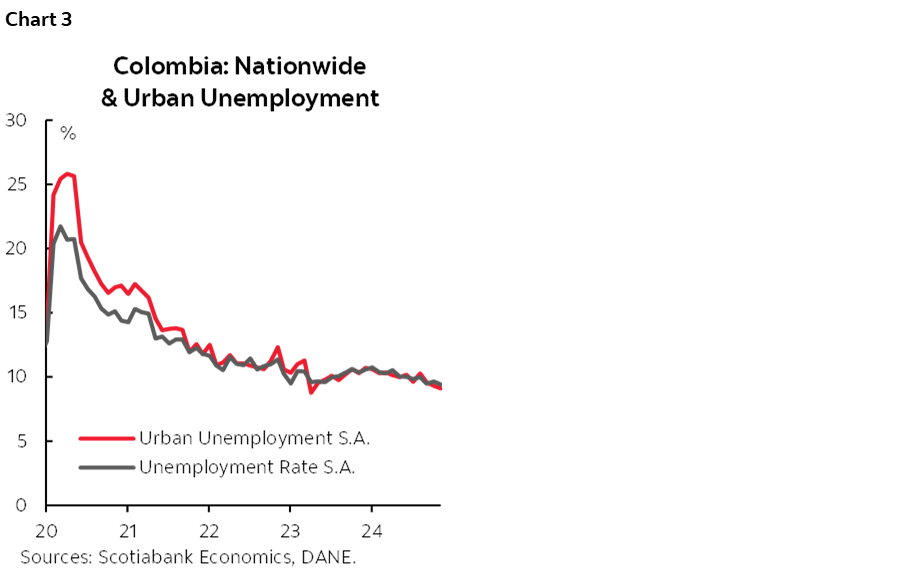
On February 28th, DANE published labour market data for January 2025. The national unemployment rate stood at 11.6%, decreasing by 1.0 ppts compared to 12.7% in January 2024, posting the lowest unemployment rate seen in a January since 2015. The urban unemployment rate decreased 1.3 ppts to 11.1% compared to 12.4% in January 2024. Seasonally adjusted, the national unemployment rate decreased to 9.4% from the previous month and remains below the 10.4% of one year ago, while the urban unemployment rate decreased by 0.2 ppts from December 2024 to 9.1% (chart 3).
Job creation in some sectors has slowed compared to one year ago, while in other sectors, employment is starting to reflect the ongoing recovery in economic activity. In January, 878 thousand jobs were created, with the most significant contribution coming from commerce, hotel, food services, public administration, and the real estate sector, contributing 70% of the total job creation in the period. The job recovery in commerce reflects a recovery of some job losses one year ago, but it also suggests a better economic growth perspective for 2025. Professional activities prolonged a negative trend exhibited since mid-2024 and were the main drag of the data (chart 4).

The three-month moving average of job creation accelerated. In the November 2024 to January 2025 quarter, job creation averaged 685 thousand, compared to 543 thousand in the November 2023 to January 2024 quarter, reflecting that job creation has accelerated in the second half of 2024 and at the beginning of 2025. However, we continue to believe that economic activity still needs a stronger boost to reach pre-pandemic levels, as high interest rates and the lack of investment continue to hinder greater dynamism, especially in activities such as industry and construction which represent 90% of the total investment in Colombia.
On a seasonally adjusted basis, the unemployment rate decreased compared to the previous month. The national unemployment rate decreased to 9.4% in January, the same as urban areas, which decreased from 9.3% in December to 9.1% in January. At this point, the number of people outside the labour market has decreased by more than 138 thousand people at the beginning of the year and was reflected in an increase in the labour participation rate from 63.3% in January 2024 to 64.1% in January 2025. For now, in our take labour participation will continue to recover after a drop of 0.2 ppts in 2024 that could be related to the historical inflow of remittances in 2024 (+17%), discouraging labour participation, especially in the female population.
All in all, previous results suggest that employment creation is gaining momentum, while sectorial composition is changing. The stunning sectors leading economic activity during most of 2024 are now losing steam, while some sectors that are starting to show stabilization signals in their production dynamic are now showing better job creation. For now, we expect an average unemployment rate that will increase from 10.2% in 2024 to 10.4% in 2025, due to a greater increase in participation levels compared to the acceleration in job creation. However, we don’t rule out that unemployment may even be below what we estimate, which depends on the degree of absorption of the new labour force by the economy.
Friday’s data reduces the pressure on the central bank to continue cutting the interest rate. However, we call attention to the fact that the low unemployment rate is hiding the effect of a still-low participation rate. Our current official projection is a rate cut of 25bps; however, international uncertainty, domestic noise around fiscal accounts, the rebound in inflation, and economic activity pointing to a gradual recovery are tilting our projection towards rate stability. It will be critical to monitor upcoming macro data, especially for inflation and inflation expectations, to firm up this view.
Key information on employment data:
- In December, +878 thousand jobs were created, with 12 of the 13 economic sectors recording positive changes. Job creation was concentrated in commerce (+242 thousand), hotel and food services (+207 thousand), public administration (+139 thousand) and real estate activities (+87 thousand). In general, the labour performance was better than expected where sectors such as utilities (+84 thousand), manufacturing industries (+32 thousand), and agriculture (+16 thousand) registered an employment expansion in contrast to the results of December 2024. In contrast, the decline in professional activities (-118 thousand) continue since mid-2024 and is due to the expiration of temporary employment contracts that had been executed in 2023.
- Informality increased in January. The informality rate increased slightly compared to the same period of the previous year, from 55.7% to 56.1%, indicating a weaker performance domestically. The quality of employment in urban areas has deteriorated, with the informality rate rising from 40.9% in January 2024 to 42.5% in January 2025. Despite the employment improvement, the new jobs have been focused on informal sectors such as self-employed which increase by +617 thousand in this period.
- Colombia’s labour market maintains a high gender gap. In January, the national unemployment rate for women was 15.8% and for men it was 8.6%. Thus, men absorbed +560 thousand new jobs, of which +478 thousand were in self-employed workers, +201 thousand in the private sector and +35 thousand in domestic activities, offset by the destruction of 159 thousand jobs in employers, public sector and day-labourer. The female population created +318 thousand jobs, of which +221 thousand are in the private sector, +139 thousand were in self-employed workers and +31 thousand in domestic activities, offset by the loss in employers, public sector and day-labourer (-72 thousand).
- For 2025, we expect a restructuring of the labour market with improvements in the labour participation rate. The balance will depend on the capacity of the labour market to absorb the new labour force that will be incorporated in 2025, highlighting the loss of momentum in public employment creation.
—Jackeline Piraján & Valentina Guio
DISCLAIMER
This report has been prepared by Scotiabank Economics as a resource for the clients of Scotiabank. Opinions, estimates and projections contained herein are our own as of the date hereof and are subject to change without notice. The information and opinions contained herein have been compiled or arrived at from sources believed reliable but no representation or warranty, express or implied, is made as to their accuracy or completeness. Neither Scotiabank nor any of its officers, directors, partners, employees or affiliates accepts any liability whatsoever for any direct or consequential loss arising from any use of this report or its contents.
These reports are provided to you for informational purposes only. This report is not, and is not constructed as, an offer to sell or solicitation of any offer to buy any financial instrument, nor shall this report be construed as an opinion as to whether you should enter into any swap or trading strategy involving a swap or any other transaction. The information contained in this report is not intended to be, and does not constitute, a recommendation of a swap or trading strategy involving a swap within the meaning of U.S. Commodity Futures Trading Commission Regulation 23.434 and Appendix A thereto. This material is not intended to be individually tailored to your needs or characteristics and should not be viewed as a “call to action” or suggestion that you enter into a swap or trading strategy involving a swap or any other transaction. Scotiabank may engage in transactions in a manner inconsistent with the views discussed this report and may have positions, or be in the process of acquiring or disposing of positions, referred to in this report.
Scotiabank, its affiliates and any of their respective officers, directors and employees may from time to time take positions in currencies, act as managers, co-managers or underwriters of a public offering or act as principals or agents, deal in, own or act as market makers or advisors, brokers or commercial and/or investment bankers in relation to securities or related derivatives. As a result of these actions, Scotiabank may receive remuneration. All Scotiabank products and services are subject to the terms of applicable agreements and local regulations. Officers, directors and employees of Scotiabank and its affiliates may serve as directors of corporations.
Any securities discussed in this report may not be suitable for all investors. Scotiabank recommends that investors independently evaluate any issuer and security discussed in this report, and consult with any advisors they deem necessary prior to making any investment.
This report and all information, opinions and conclusions contained in it are protected by copyright. This information may not be reproduced without the prior express written consent of Scotiabank.
™ Trademark of The Bank of Nova Scotia. Used under license, where applicable.
Scotiabank, together with “Global Banking and Markets”, is a marketing name for the global corporate and investment banking and capital markets businesses of The Bank of Nova Scotia and certain of its affiliates in the countries where they operate, including; Scotiabank Europe plc; Scotiabank (Ireland) Designated Activity Company; Scotiabank Inverlat S.A., Institución de Banca Múltiple, Grupo Financiero Scotiabank Inverlat, Scotia Inverlat Casa de Bolsa, S.A. de C.V., Grupo Financiero Scotiabank Inverlat, Scotia Inverlat Derivados S.A. de C.V. – all members of the Scotiabank group and authorized users of the Scotiabank mark. The Bank of Nova Scotia is incorporated in Canada with limited liability and is authorised and regulated by the Office of the Superintendent of Financial Institutions Canada. The Bank of Nova Scotia is authorized by the UK Prudential Regulation Authority and is subject to regulation by the UK Financial Conduct Authority and limited regulation by the UK Prudential Regulation Authority. Details about the extent of The Bank of Nova Scotia's regulation by the UK Prudential Regulation Authority are available from us on request. Scotiabank Europe plc is authorized by the UK Prudential Regulation Authority and regulated by the UK Financial Conduct Authority and the UK Prudential Regulation Authority.
Scotiabank Inverlat, S.A., Scotia Inverlat Casa de Bolsa, S.A. de C.V, Grupo Financiero Scotiabank Inverlat, and Scotia Inverlat Derivados, S.A. de C.V., are each authorized and regulated by the Mexican financial authorities.
Not all products and services are offered in all jurisdictions. Services described are available in jurisdictions where permitted by law.