

- Chile: Unemployment rate at 8.4% signals sharp deterioration in private salaried jobs
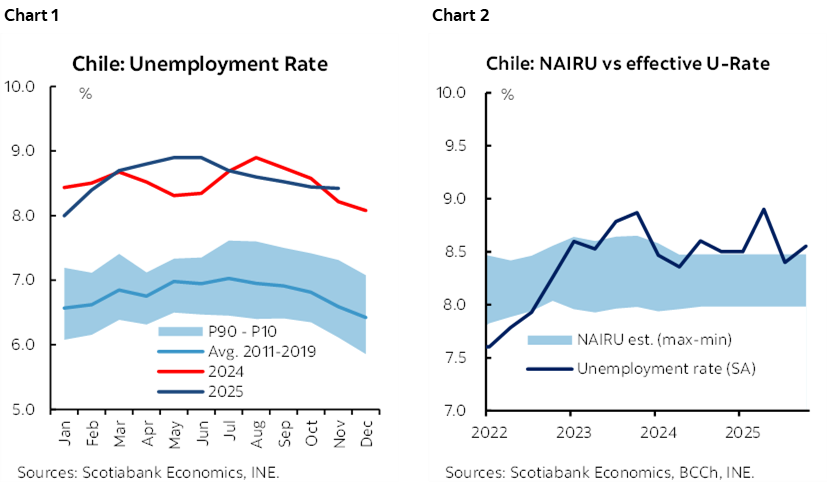
The unemployment rate stood at 8.4% in the quarter ending in November (chart 1), surprising negatively versus market expectations (consensus: 8.2%). This outcome reflected similar increases in employment (+15k) and labour force (+14k), both at the lower end of what is typical for November. Seasonally adjusted unemployment rose to 8.6% (chart 2), above the upper bound of the Central Bank’s estimated NAIRU range, partly due to widespread deterioration in private salaried employment. Job creation was concentrated in administrative and professional activities, partially offset by weakness in commerce.
Labour costs rising amid scarce job creation. In January, the economy will face another increase in the Minimum Monthly Wage (+1.9%), adding to successive hikes over the past two years. According to the Central Bank, these adjustments have negatively impacted formal employment by around 1.5% (roughly 100k jobs) during the same period. Additionally, the Pension Reform will introduce new benefits starting January, including guarantees for contribution years and life expectancy compensation, financed partly by the employer-side contribution hike implemented in August. The Ministry of Finance estimates this measure also weighed on formal employment. Higher costs will continue to pressure jobs in 2026 with another 1pp increase in employer contributions scheduled for August.
Labour market opens room for an early policy rate cut in January 2026. Seasonally adjusted unemployment unexpectedly climbed to 8.6%, above the reference unemployment rate (NAIRU), alongside zero net creation of private salaried jobs. For the Central Bank, with the policy rate currently within the neutral range (3.75–4.75%), this creates an opportunity to move directly to the midpoint. A cut ahead of the December IPoM’s rate corridor—which anticipates the next move in July—could materialize if December CPI prints sharply negative at both headline and core levels, combined with the latest labour data signaling disinflationary slack. Recent peso appreciation, if sustained, would further secure rapid inflation convergence and could even push inflation markedly below 3%.
—Aníbal Alarcón
DISCLAIMER
This report has been prepared by Scotiabank Economics as a resource for the clients of Scotiabank. Opinions, estimates and projections contained herein are our own as of the date hereof and are subject to change without notice. The information and opinions contained herein have been compiled or arrived at from sources believed reliable but no representation or warranty, express or implied, is made as to their accuracy or completeness. Neither Scotiabank nor any of its officers, directors, partners, employees or affiliates accepts any liability whatsoever for any direct or consequential loss arising from any use of this report or its contents.
These reports are provided to you for informational purposes only. This report is not, and is not constructed as, an offer to sell or solicitation of any offer to buy any financial instrument, nor shall this report be construed as an opinion as to whether you should enter into any swap or trading strategy involving a swap or any other transaction. The information contained in this report is not intended to be, and does not constitute, a recommendation of a swap or trading strategy involving a swap within the meaning of U.S. Commodity Futures Trading Commission Regulation 23.434 and Appendix A thereto. This material is not intended to be individually tailored to your needs or characteristics and should not be viewed as a “call to action” or suggestion that you enter into a swap or trading strategy involving a swap or any other transaction. Scotiabank may engage in transactions in a manner inconsistent with the views discussed this report and may have positions, or be in the process of acquiring or disposing of positions, referred to in this report.
Scotiabank, its affiliates and any of their respective officers, directors and employees may from time to time take positions in currencies, act as managers, co-managers or underwriters of a public offering or act as principals or agents, deal in, own or act as market makers or advisors, brokers or commercial and/or investment bankers in relation to securities or related derivatives. As a result of these actions, Scotiabank may receive remuneration. All Scotiabank products and services are subject to the terms of applicable agreements and local regulations. Officers, directors and employees of Scotiabank and its affiliates may serve as directors of corporations.
Any securities discussed in this report may not be suitable for all investors. Scotiabank recommends that investors independently evaluate any issuer and security discussed in this report, and consult with any advisors they deem necessary prior to making any investment.
This report and all information, opinions and conclusions contained in it are protected by copyright. This information may not be reproduced without the prior express written consent of Scotiabank.
™ Trademark of The Bank of Nova Scotia. Used under license, where applicable.
Scotiabank, together with “Global Banking and Markets”, is a marketing name for the global corporate and investment banking and capital markets businesses of The Bank of Nova Scotia and certain of its affiliates in the countries where they operate, including; Scotiabank Europe plc; Scotiabank (Ireland) Designated Activity Company; Scotiabank Inverlat S.A., Institución de Banca Múltiple, Grupo Financiero Scotiabank Inverlat, Scotia Inverlat Casa de Bolsa, S.A. de C.V., Grupo Financiero Scotiabank Inverlat, Scotia Inverlat Derivados S.A. de C.V. – all members of the Scotiabank group and authorized users of the Scotiabank mark. The Bank of Nova Scotia is incorporated in Canada with limited liability and is authorised and regulated by the Office of the Superintendent of Financial Institutions Canada. The Bank of Nova Scotia is authorized by the UK Prudential Regulation Authority and is subject to regulation by the UK Financial Conduct Authority and limited regulation by the UK Prudential Regulation Authority. Details about the extent of The Bank of Nova Scotia's regulation by the UK Prudential Regulation Authority are available from us on request. Scotiabank Europe plc is authorized by the UK Prudential Regulation Authority and regulated by the UK Financial Conduct Authority and the UK Prudential Regulation Authority.
Scotiabank Inverlat, S.A., Scotia Inverlat Casa de Bolsa, S.A. de C.V, Grupo Financiero Scotiabank Inverlat, and Scotia Inverlat Derivados, S.A. de C.V., are each authorized and regulated by the Mexican financial authorities.
Not all products and services are offered in all jurisdictions. Services described are available in jurisdictions where permitted by law.