

- Chile: Government issued debt for USD 3.75 bn in foreign currency—the second issuance this week; an additional USD 2.2 bn remains
- Mexico: Biweekly inflation surprises upwards again; upside risks for year-end estimate (5.73% y/y)
CHILE: GOVERNMENT ISSUED DEBT FOR USD 3.75 BN IN FOREIGN CURRENCY—THE SECOND ISSUANCE THIS WEEK; AN ADDITIONAL USD 2.2 BN REMAINS
Following Wednesday’s (July 21) debt issuance of 1.75 bn euros (USD 2.06 bn), Chile’s Ministry of Finance reported a further issuance of USD 3.75 bn on Thursday (July 22) of treasury bonds in international markets. Including the most recent issuance, Chile has now issued public debt for a total of USD 21.93 bn in 2021, of which USD 13.65 bn were bonds in foreign currency.
This week’s issuances are part of the updated financing plan for this year, which allows additional debt issuance for up to USD 8 bn in foreign currency, authorized by the Transitory & Emergency COVID-19 Fund. All in all, of the USD 8 bn mentioned above, there are approximately USD 2.2 bn remaining in debt issuances for this year, which is expected to be mostly in foreign currency denominated bonds.
—Anibal Alarcón
MEXICO: BIWEEKLY INFLATION SURPRISES UPWARDS AGAIN; UPSIDE RISKS FOR YEAR-END ESTIMATE (5.73% Y/Y)
Per data released on July 22 by Mexico’s statistical agency, the country’s consumer inflation increased 0.37% bi-weekly in the first half of July (chart 1), above our estimate of 0.27% m/m and that of the consensus estimate in the latest analysts’ survey of 0.26% m/m. Annually, headline inflation stood at 5.75% y/y, up from 5.74% y/y the previous fortnight. While the effects of energy prices that impacted heavily in the second quarter of the year have begun to fade, economic reactivation along with increases in agricultural and food commodity prices have added pressures over headline inflation.
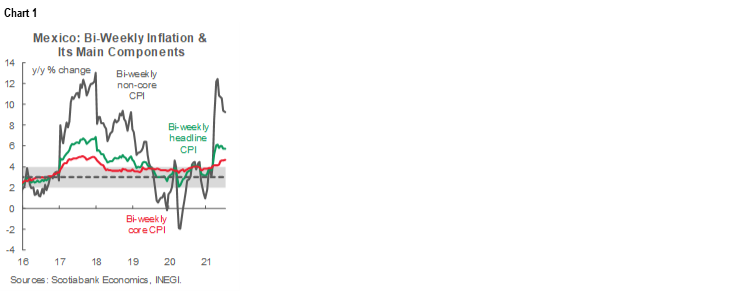
As we noted in our earlier coverage on Mexico’s policy rate decision-making, we think that these above-target inflation dynamics, combined with continued increases in inflation expectations are the main reasons for the central bank’s early tightening in June. Both of those factors deteriorated in the latest prints.
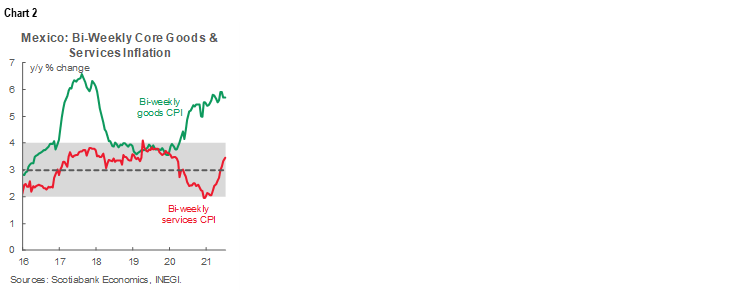
- Core prices increased 0.31% biweekly, lower than our projection of 0.44% but higher than consensus expectation of 0.22%. This growth was mainly driven by a 0.37% increase in merchandise prices, notably food products. Services prices rose 0.24%, largely due to higher prices of food and tourism services. At an annual rate, core inflation stood at 4.64% y/y, slightly higher than the 4.58% y/y rate registered in the previous fortnight (chart 2).
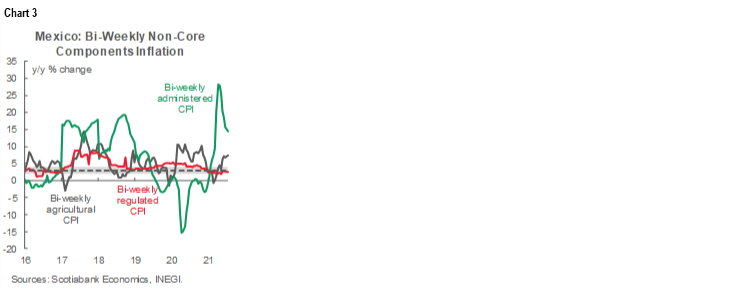
- Non-core inflation was 0.55% biweekly (up from a previous 0.18%). Energy prices accounted for most of the biweekly increase, with a 1.02% rise derived mainly from higher LP gas prices. Agricultural prices rose by 0.33% (from an earlier -0.21%) driven by onion, beef and zucchini prices. At an annual rate, non-core inflation stood at 9.24% y/y (chart 3), down from the 9.40% y/y rate registered the previous fortnight.
Our forecast for the coming months incorporates higher inflations in merchandise and services in a less constrained economy as the rollout of vaccination continues to advance. For the time being, we maintain our year-end estimate at 5.73% y/y, but we acknowledge that this forecast has potential upside risks. As for monetary policy, we are expecting a 25 bps rate hike by the Board on August 12 from 4.25% to 4.50%.
—Paulina Villanueva
DISCLAIMER
This report has been prepared by Scotiabank Economics as a resource for the clients of Scotiabank. Opinions, estimates and projections contained herein are our own as of the date hereof and are subject to change without notice. The information and opinions contained herein have been compiled or arrived at from sources believed reliable but no representation or warranty, express or implied, is made as to their accuracy or completeness. Neither Scotiabank nor any of its officers, directors, partners, employees or affiliates accepts any liability whatsoever for any direct or consequential loss arising from any use of this report or its contents.
These reports are provided to you for informational purposes only. This report is not, and is not constructed as, an offer to sell or solicitation of any offer to buy any financial instrument, nor shall this report be construed as an opinion as to whether you should enter into any swap or trading strategy involving a swap or any other transaction. The information contained in this report is not intended to be, and does not constitute, a recommendation of a swap or trading strategy involving a swap within the meaning of U.S. Commodity Futures Trading Commission Regulation 23.434 and Appendix A thereto. This material is not intended to be individually tailored to your needs or characteristics and should not be viewed as a “call to action” or suggestion that you enter into a swap or trading strategy involving a swap or any other transaction. Scotiabank may engage in transactions in a manner inconsistent with the views discussed this report and may have positions, or be in the process of acquiring or disposing of positions, referred to in this report.
Scotiabank, its affiliates and any of their respective officers, directors and employees may from time to time take positions in currencies, act as managers, co-managers or underwriters of a public offering or act as principals or agents, deal in, own or act as market makers or advisors, brokers or commercial and/or investment bankers in relation to securities or related derivatives. As a result of these actions, Scotiabank may receive remuneration. All Scotiabank products and services are subject to the terms of applicable agreements and local regulations. Officers, directors and employees of Scotiabank and its affiliates may serve as directors of corporations.
Any securities discussed in this report may not be suitable for all investors. Scotiabank recommends that investors independently evaluate any issuer and security discussed in this report, and consult with any advisors they deem necessary prior to making any investment.
This report and all information, opinions and conclusions contained in it are protected by copyright. This information may not be reproduced without the prior express written consent of Scotiabank.
™ Trademark of The Bank of Nova Scotia. Used under license, where applicable.
Scotiabank, together with “Global Banking and Markets”, is a marketing name for the global corporate and investment banking and capital markets businesses of The Bank of Nova Scotia and certain of its affiliates in the countries where they operate, including; Scotiabank Europe plc; Scotiabank (Ireland) Designated Activity Company; Scotiabank Inverlat S.A., Institución de Banca Múltiple, Grupo Financiero Scotiabank Inverlat, Scotia Inverlat Casa de Bolsa, S.A. de C.V., Grupo Financiero Scotiabank Inverlat, Scotia Inverlat Derivados S.A. de C.V. – all members of the Scotiabank group and authorized users of the Scotiabank mark. The Bank of Nova Scotia is incorporated in Canada with limited liability and is authorised and regulated by the Office of the Superintendent of Financial Institutions Canada. The Bank of Nova Scotia is authorized by the UK Prudential Regulation Authority and is subject to regulation by the UK Financial Conduct Authority and limited regulation by the UK Prudential Regulation Authority. Details about the extent of The Bank of Nova Scotia's regulation by the UK Prudential Regulation Authority are available from us on request. Scotiabank Europe plc is authorized by the UK Prudential Regulation Authority and regulated by the UK Financial Conduct Authority and the UK Prudential Regulation Authority.
Scotiabank Inverlat, S.A., Scotia Inverlat Casa de Bolsa, S.A. de C.V, Grupo Financiero Scotiabank Inverlat, and Scotia Inverlat Derivados, S.A. de C.V., are each authorized and regulated by the Mexican financial authorities.
Not all products and services are offered in all jurisdictions. Services described are available in jurisdictions where permitted by law.