

To truly thrive — at work and in life — we must take care of ourselves, our mental health, and each other.
That was the simple yet powerful message from Anthony McLean, author, screenwriter and storyteller, who delivered the keynote at Scotiabank’s recent World Mental Health Day event for employees.
"The world is already tough on you, don’t be tough on yourself,” he said.
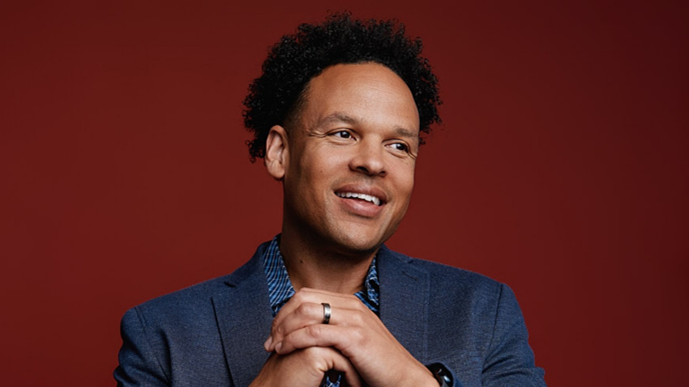
Author and storyteller Anthony McLean
Observed globally on Oct. 10, World Mental Health Day is dedicated to education, awareness and advocacy against the social stigma of mental health struggles. Scotiabankers gathered in Toronto to hear McLean share practical, science-backed insights on how organizations can foster mentally healthy workplaces.
The voice in your head matters
The theme of the event was ‘Supporting and striving together’, and McLean opened with a story about self-talk – the inner voice that shapes our mindset and resilience.
“If your friend called you upset, you wouldn’t tell them to ‘suck it up’ or ‘get over it’. You’d listen, you’d offer compassion. That’s how we should talk to ourselves,” he said.
Personal compassion alone is not enough however, according to McLean. The key lies in finding balance and knowing when to push forward and when to pause.
“Many of us are caring for aging parents, raising kids, and trying to keep up with demanding jobs,” he said. “Sometimes self-compassion looks like running a bath or serving cereal for dinner – and that’s okay.”
In her opening remarks, Jenny Poulos, Chief Human Resources Officer at Scotiabank, acknowledged how universal those challenges are.
“I know many of us wish we could wave a magic wand and eliminate all the difficulties, quiet the chaos,” she said. “This event reminds us how important it is to show up for one another, not just in the work we do, but in the way we care for each other.”
Know when to push and when to pause
McLean compared mental health maintenance to the rhythm of a racecar. It’s built for speed, but relies on pit stops.
“You can’t win a race without refueling,” he said. “The same goes for us. If we want to show up for others, our teams, our kids, our partners, we have to take care of ourselves first,” he said.
He also shared a personal metaphor: the check engine light. When he got his first car, he ignored that glowing orange light on the dashboard.
“You don’t want a $30 oxygen sensor to cost $1,800 in repairs because you waited too long to attend to it. Our minds and bodies are the same way,” he said. “If you start snapping at the people you love that's a check engine light. If you've got a pressure headache or you're hitting snooze over and over, check that engine light. Don't ignore it.”
Building your personal toolkit
McLean encouraged everyone to create a personal mental health toolkit with practical habits that help recharge and regulate well-being.
For McLean, that means mindfulness, movement, and science-backed self-care practices which may be as simple as walking a dog, journaling, or connecting with a trusted friend.
“Only one in three people say they have a close friend at work,” McLean said. “That’s a problem. When you have a friend at work who you can confide in, morale goes up and you’re more likely to stay at the company.”
McLean also offered small actionable steps that anyone can try:
Eat well – start small, like skipping sugar in your coffee.
Sleep well – try blackout curtains, a humidifier, and charge devices outside of the bedroom.
Move joyfully – Just 5,000 steps a day can reduce depression. At 10,000 steps, the risk of dementia drops by half.
Hydrate – your brain performs better when you’re fueled.
As an added tip, McLean recommends closing the door, putting on headphones and dancing to a nostalgic song.
“Dance to one song a day,” he said. “Music releases endorphins and serotonin. It’s science, it’s joy.”
Creating safe spaces at work
During the Q&A segment, McLean was asked about maintaining motivation and building psychological safety. His answer was simple.
“Build psychological safety as a leader. Ask ‘what have I missed’ instead of the usual ‘any questions?’” he said. “Work to build a culture where everyone feels seen, supported, and empowered to contribute.”
That philosophy aligns with Scotiabank’s approach to employee well-being through our ScotiaBond, the Bank’s culture ambition that includes the core Values and key Behaviours that guide employees and fosters a culture of inclusivity and support for one another.
As Poulos explained, connection and inclusion are at its core.
“We know that well-being is not a one-size-fits-all,” she said. “Our goal is to create a workplace where people feel safe to speak up, check in and access support, whether through our benefits, daily conversations or the relationships that we cultivate with our teams,” she said.
As the session closed, McLean left the audience with one final reminder: “Your body keeps the score. Your mind leaves clues. Pay attention to your check engine light,” he said. “Because when you take care of yourself, you’re not just better for you. You’re better for everyone around you.”
