

Even small acts of generosity can lead to big changes when people come together.
That’s the view of Sara Lomelin, the CEO and Founder of global initiative Philanthropy Together, whose mission is to democratize and diversify philanthropy through collective giving, where people pool resources to make a bigger impact.
“You don’t have to be a millionaire to change the world,” she said during a recent Scotiabank employee event in Toronto. “You just have to believe that your coin, your hour, your act of generosity, when added to others, can spark a movement.”
Lomelin was the keynote presenter at an event on Nov. 13 to kick off Scotiabank’s Employee Giving Campaign, an annual initiative that encourages employees to support charitable causes through donations and volunteering.
She cited the generous response to help those impacted by fires in California in 2017 as an example of the power of collective giving. She described how Sonoma, Calif. — once green and peaceful, and home to countless vineyards and farms — was suddenly glowing red as wildfires tore through the region. Hundreds of farm workers who had been putting food on the table of thousands of families were forced to evacuate, with many losing their homes and jobs overnight.
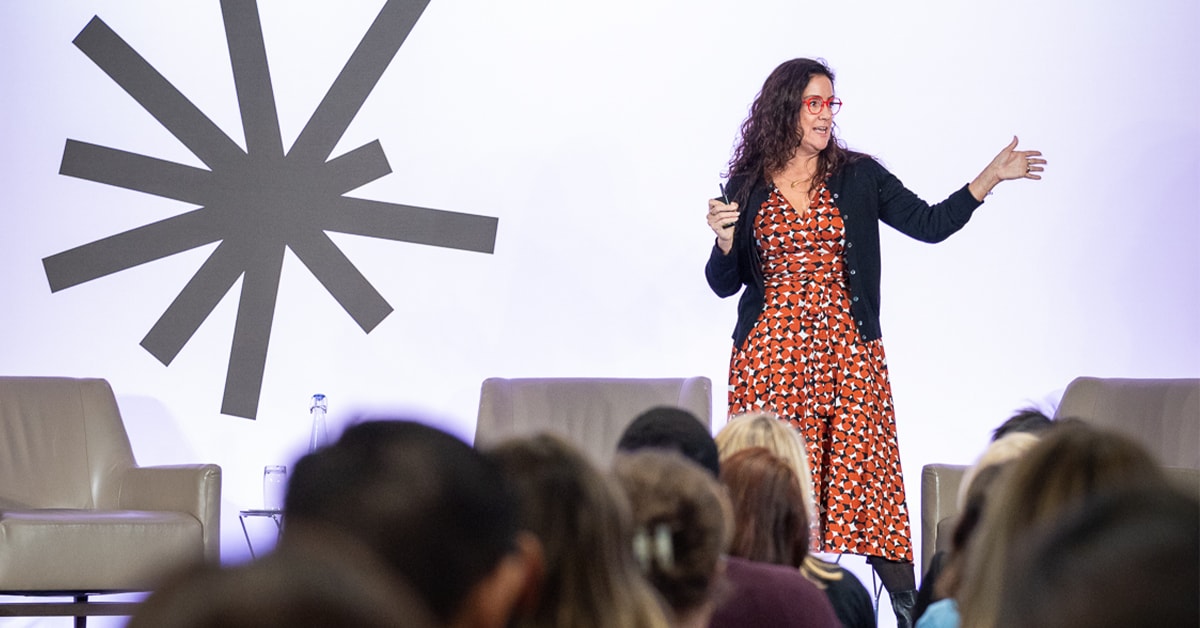
Philanthropy Together CEO Sara Lomelin speaking at a Scotiabank event in Toronto.
At the time, Lomelin was working at the Latino Community Foundation in San Francisco, California, and helped set up a small fund. She expected to collect a few thousand dollars to help families with rent, groceries and other essentials, but within days, donations flooded in from people far and wide. A 13-year-old violin player in New York held a recital to fundraise, and a yoga teacher in Los Angeles dedicated her weekly classes for the cause. A chef in San Francisco used her restaurant to fundraise. Next, companies supported the fund, and together, they ended up raising nearly $2 million.
“And that fund didn’t just build immediate relief, it built a table where local nonprofits sat around and planned for recovery, for advocacy for the next fire,” Lomelin said.
Giving circles
Now, one growing model of collective giving is giving circles, where groups of people with shared values pool their money, discuss their vision and decide where the funds should go as a group.
“In my own circle, we meet in my living room – teachers, tech leaders, lawyers, moms,” said Lomelin. “And it’s loud and it’s chaotic and it feels like home. And every year, thousands of dollars go out to an organization that is doing incredible work.”
For those looking to start a giving circle, Lomelin’s advice is to “start with who and not how much.”
“Lead with joy and belonging,” she said. “A giving circle is not a tax, it’s a team. Then you listen and discuss. You create a simple set of rules, and you make it transparent because transparency transforms dollars into trust.”
But a giving circle’s impact can go even further, amplifying those resources through means like corporate matching and promoting the cause to the public. According to Philanthropy Together’s research, for every dollar that is given by a collective giving group, another $1.25 is leveraged through channels like matching, volunteering and inspiring more people to donate.
The power of the many
In the philanthropic space, collective giving unlocks the power of groups to fundamentally change how people interact with their communities, and that shows up in the data:
84% become more civically engaged
77% increased belief that their voice matters on social issues
Collective giving is also bringing more people into philanthropy, which Lomelin says is needed as volunteering and giving have been declining since 2000 while ‘mega-gifts’ from ultra-wealthy donors have skyrocketed.
Lomelin said Scotiabankers are already familiar with the benefits of collective giving because of ScotiaRISE, the Bank’s 10-year, $500-million-dollar commitment and community investment initiative, as well as Spark, the Bank’s community engagement platform. Spark helps employees support causes that matter to them through corporate matching opportunities and the option to track volunteer hours and earn up to $1,000 per year to donate to charities of their choice.
Also speaking at the event, Paul Scurfield, Executive Vice President & Global Head, Capital Markets, encouraged employees to share their stories as well.
“When we share our stories, we inspire others to act. It helps us to see the many ways each of us can make a difference and reinforces that every contribution matters,” said Scurfield, who is an Executive Sponsor of the Employee Giving Campaign alongside Jacqui Allard, Scotiabank’s Group Head, Global Wealth Management.
As the Bank enters the 2025 Employee Giving Campaign and looks to surpass last year’s donation total of $17.1 million with a goal of $18 million, Lomelin reminded the audience that, like with giving circles, their generosity can have a meaningful ripple effect.
Years after wildfires ravaged Sonoma, Lomelin returned to find the hills were once again green and her mind went to the violinist, yoga teacher and chef who had chosen to help.
“They probably will never meet the farm workers they helped, but their generosity remains there in every rebuilt home, in every paycheck, in every kid that was able to stay at school,” she said. “And that’s the power of the many over one. That’s the power of collective giving.”
