

A Montreal developer is building what is expected to be North America’s largest sustainable industrial park — a 7-million-square-foot campus that has environmental stewardship and human well-being at its core.
The project, called 40NetZERO, starts out with the benefit of Quebec’s electricity supply, which comes almost entirely from emissions-free hydropower, so no fossil fuels are used in the main heating or cooling systems of the buildings. But the project’s sustainability plans go well beyond that.
“We looked at everything, every nut and bolt, to make the buildings more energy efficient, more resilient to the changing weather, and more durable,” said Peter Karambatsos, founding partner of Terrex Real Estate Services, one of two co-developers behind 40NetZERO, along with Loracon Construction.
Some of the sustainability features of the development include:
State-of-the-art building design and construction
Heat-pump based cooling, heating and ventilating systems designed to reduce energy consumption
Use of recycled concrete instead of asphalt in loading areas
Solar-powered exterior lighting
Abundant vegetation – nearly 28,000 trees, shrubs and plants – designed to support the local ecosystem, improve air quality and assist in rainwater management.
The first building in the project has already obtained ZCB (Zero Carbon Building) certification and is awaiting LEED (Leadership in Energy and Environmental Design) Core and Shell + Commercial Interiors certification. They will seek LEED Zero Carbon certification after one year of operation. All future buildings will be designed to achieve those same certifications. The entire site has also received pre-certification for SITES, which promotes sustainable landscape design and construction.
With all the buildings in the project designed to be 40-foot clear heights, capable of accommodating the needs of tenants of all kinds, there were plenty of challenges in keeping operating emissions at zero in a climate that ranges from arctic cold to oppressive heat.
“We wanted to build something that meets the current and future sustainability needs of our tenants, but also meets their immediate business needs, using the best available technology,” said Robert Soldera, owner of Loracon Construction, one of the partners in 40NetZERO.
Even something as seemingly mundane as the loading areas, a key part of any industrial park, are equipped with the latest technology designed for safety, efficiency, and energy savings. For example, while many people might not know what a dock leveler is – essentially the ramp that allows forklifts to access trucks from the building – it’s a key component of the operation. Older versions would allow cold air, odours, dust and vermin to enter a building. The vertical levelers used at 40NetZERO eliminate those problems.
“The door comes down and seals completely onto the framing, so there's zero heat loss when the door is closed. It's more expensive, but it’s highly energy efficient,” said Soldera.
“For the average person, this seems like ‘OK, whatever.’ But in terms of operations, it's phenomenal. And all these things add up.”
The campus also has electric vehicle (EV) charging stations, bicycle paths, and is close to public transit. And windows in the development are designed to help prevent birds from colliding with them.
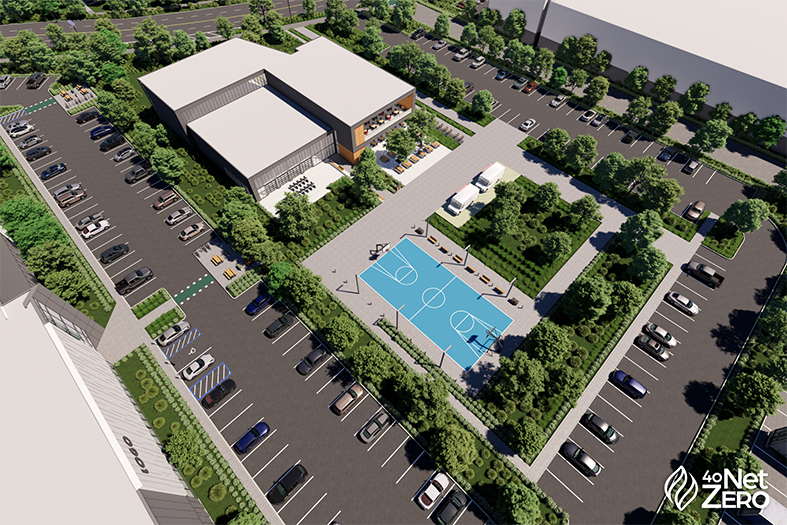
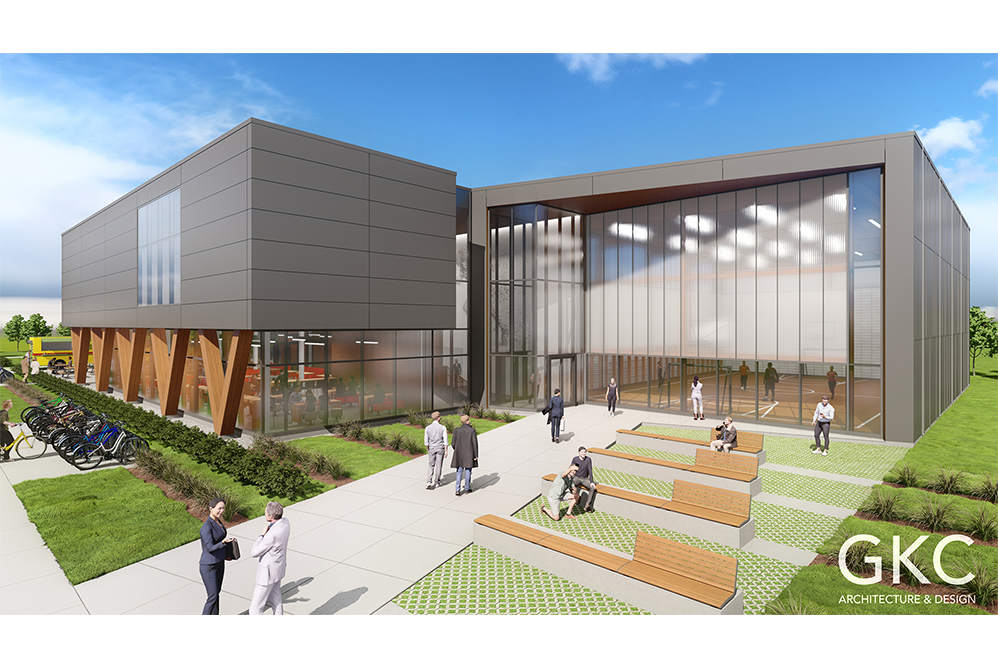
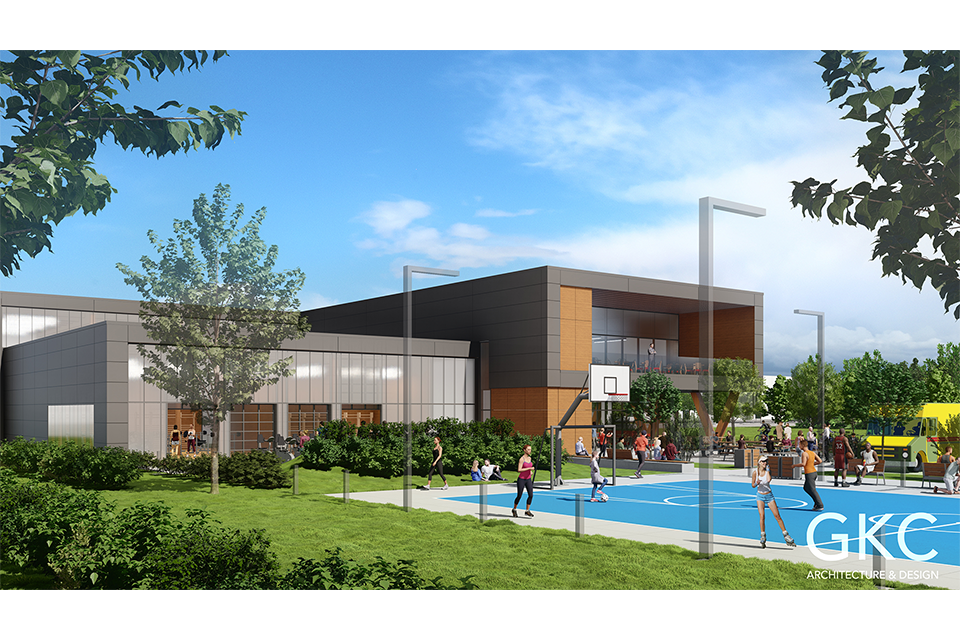
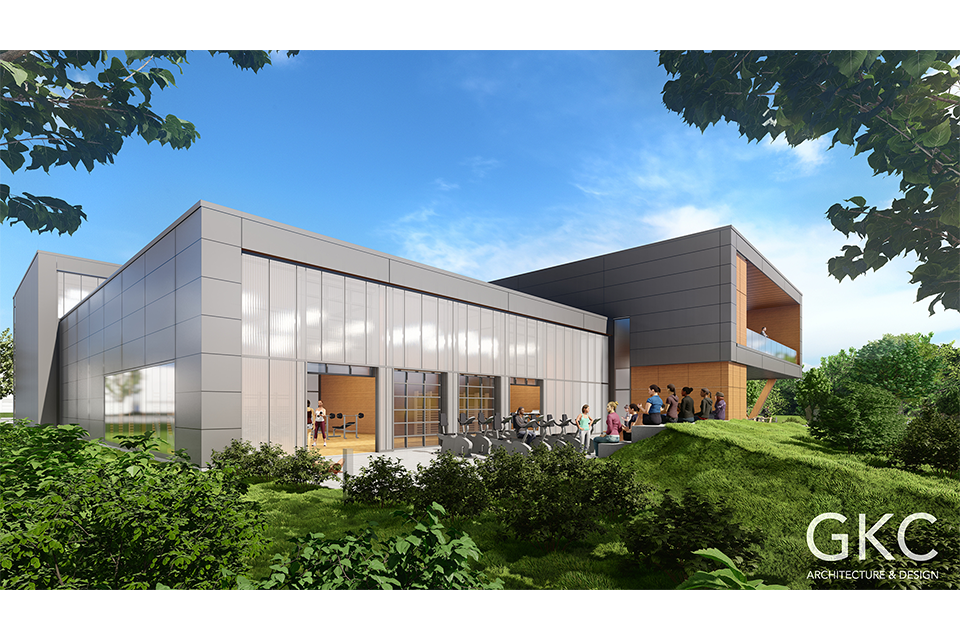
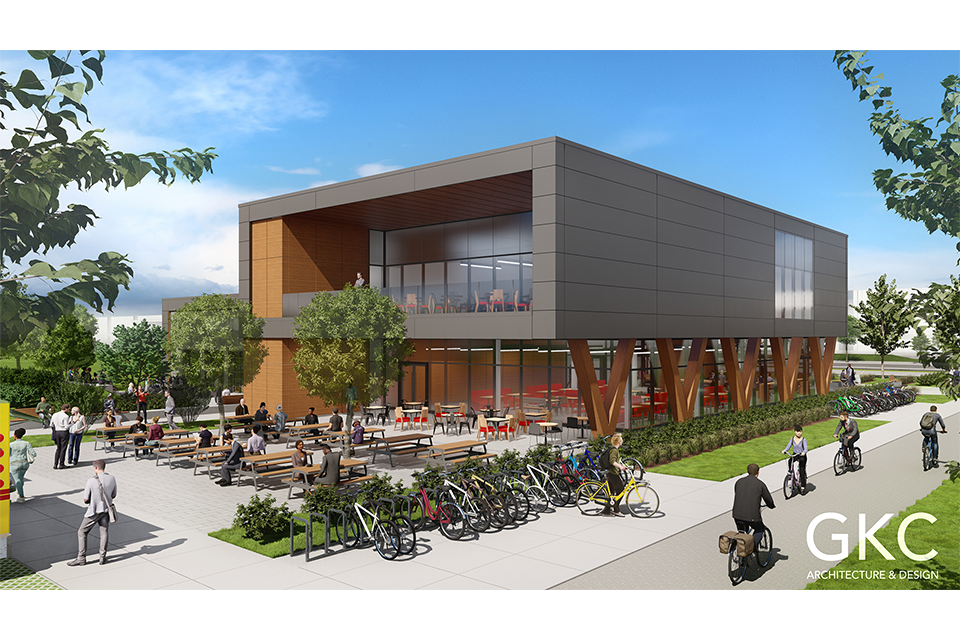
Renderings of the project's pavilion.
Built-in resilience to a changing climate
Karambatsos says that in addition to dramatically increasing energy efficiency, these features also make the buildings more resilient in the face of weather conditions that are changing in real time.
“Going forward, we're going to have extreme weather events, whether we like it or not,” he said. “Two years ago, we had what people called a 100-year rainfall in Montreal; a year after that we had another 100-year rainfall. These patterns are not 100 years anymore. They’re becoming normal life.
“So we designed our buildings for that reality.”
That includes roofs designed to withstand near-hurricane force winds, and water-management systems that move rainwater away from buildings, trucks and goods to nearby retention basins and filtering ponds.
The 40NetZERO campus will eventually encompass eight to 12 buildings offering up to 3 million square feet of leaseable space. The first building already has a tenant that occupies 400,000 square feet. The second is expected to launch later this year with delivery in 2026, and the rest to come in the next several years.
Benefits of building sustainably
The 40NetZERO project involves about $1 billion in investments from its initial phase in 2019 through completion. Scotiabank has been associated with the project since its inception, not just as a lender but in providing a partnership mentality and expertise on sustainability issues, said Vito Mangialardi, Vice President & Head Commercial Real Estate Banking for Eastern Canada at Scotiabank.
“There are a lot of benefits that can accrue to builders, owners, municipalities, tenants and end-users from building sustainably,” said Mangialardi. “From operational cost savings to tax rebates and other incentives, to helping tenants meet their own sustainability commitments and much more.
“Scotiabank has built the expertise necessary to be a trusted partner as our clients navigate the sometimes complicated process of building sustainably.
“That why we take a patient approach that builds trust and focuses on achieving our clients’ endgame.”
Amenities make campus more appealing
As important to the 40NetZERO team as sustainability was the human element — creating a workspace that would help attract and retain talent, a place employees would actually want to be.
The campus features a pavilion and public spaces that include outdoor recreation areas with a full-sized basketball court and other amenities; an indoor multi-sport area; catering facilities and space for rotating food trucks; and conference rooms.
“For decades basically you’d have a warehouse with maybe a picnic table out back for an employee to have lunch, and that was good enough,” Karambatsos said.
“Now there are forklift operators making 80-, 90-, 100,000 dollars a year, and they want more than that. So we wanted to create an environment that would give employees a reason to come to work beyond just their salary, something attractive at a very human level.
“We believe the tenants will see the value proposition in all that, and that even pricewise we're in line with the market, but they’re getting so much more.”
